Roleplaying Games


It was an election day (primaries) in New Mexico this week, so I figured I’d throw out a poll or two. The first is to satisfy my curiosity — what are people playing these days? Throw up a comment if your fave isn’t here, or you have a specific variant.


One of the things that I’ve always liked about the old James Bond RPG rules set, and to a lesser extent Cortex, is that the quality of the success translates into how well damage is rendered on an opponent. In the JB:007 game, the quality result is checked against the damage class of the weapon and there’s the damage done. In Cortex, the quality of the result gives you basic damage — 1/2 in stun and 1/2 in wound, but then there’s the additional roll of the weapon’s damage — this can give anything from a disappointing 1 up to the max of the die in wound.

It’s the one issue in Cortex’s combat mechanics that has always bugged me. Bang! I do 3S and 3W on my .45 pistol with a d6W and….oh. One. The second bit of random chance just seems to fly against the point of the basic damage based on quality. Granted, an extraordinary success lends the attacker certain benefits if the target doesn’t make their endurance test (or in the case of mooks, I just call it an incapacitate.)

I have two suggestions to improve the way combat is handled in Cortex:

1) Weapons and damage — In the case of damage, I suggest the player be allowed to  “take the average” — if a pistol has a d6W (and most do), the weapon normally does three. With an extraordinary success, it does the max for the die, in this example six. (Ex. Ted (d6 Agility+d4 Guns with a result of 10) shoots Steve (dodging with a d6 Agility and d6 Athletics with a disappointing 7 result.) He does 1 stun from basic damage, and 4 wound. Had he gotten an extraordinary (say, Steve only got a 3), it would have been 4 stun, 9 wound.

This should speed combat and reduce some of the chance of combat. I would still allow them to roll damage if they were feeling lucky, but it might be a good option for the GM running a big, complex fight to cut down on rolling and paperwork.

2) Always roll Endurance when taking a hit. Sometimes, you get hit and while it doesn’t do any real physical damage, it knocks the snot out of you. I like to have the players test against Endurance equal to an injury they sustain in combat. They took 2 stun, 2 wound? Beat a 4, otherwise be stunned for a number of rounds equal to how much to missed. On an extraordinary success, stick to the rules on pg. 94 of the Cortex core book — wounds start d2 Bleeding per turn of strenuous activity or 10 minutes otherwise; stun and you’re knocked out; basic damage, you’ve taken some kind of debilitating injury.

As always, feel free to completely ignore these suggestions.

Here’s a selection of the characters created for the A/B test of Serenity vs. Firefly RPGs. I think we’re going to start with the Serenity version first, since it’s the one we know, then hit Firefly.

Colonel Atticus Wynn

40 years old, he was born on Persephone to a good, somewhat well-off gentry family that supported Unification. He was a graduate student in politics and history with a promising future in local government when the war hit. He was an officer in the 901st Scout Brigade (Persephone) and rose to the rank of colonel by the end of the war. He was known for his lead from the front style and for speed and tenacity in his operations. By the war’s end, he had moved up to commanding the brigade. 

   While skilled in social niceties, which had helped his career, he was increasingly horrified by the treatment of the Independents by the general command, and made a few impolitic statements that dead-ended his career in the military, and have hampered him since the war. Most of this is due to the animosity of then-General Lao — now the minister of security for the Alliance.

   His family is led by Sir Trevor Wynn, and his family were one of the original investors in Persephone. While his father has not disowned him, he has had to scale back his expectations until the issues with Lao have been resolved.

Attributes:  Agility:d6, Strength:d8, Vitality:d8, Alertness:d8, Intelligence:d8, Willpower:d10; Life Points:20

Assets: Fightin’ Type: d6, Friends in High Places d4, Military Rank d4, Patient d4 (homebrew asset, adds to Discipline, Tactics), Tough as Nails d4

Complications: Branded d4, Credo d4 (loyalty to men, never leave a man behind), Deadly Enemy d4, Things Don’t go Smooth: d4

Skills: Animal Handling d4, Athletics d6, Covert d6 (Stealth d8), Discipline d6 (Leadership d8), Guns d6, Heavy Weapons d4, Influence d6, Knowledge d4, Perception d6, Planetary Vehicles d4, Survival d6, Unarmed Combat d6

…and the Firefly version…

AttributesMental: d8, Physical: d8, Social: d8

SkillsCraft d4, Drive d4, Fight (Dirty) d8, Fix d4, Fly d4, Focus d6, Influence (Leadership) d8, Knowledge (Politics) d8, Labor d4, Move d6, Notice d6, Operate d4, Perform d4, Shoot d8, Sneak d6, Survive d8, Throw d4, Treat d4, Trick d6

DistinctionsMercenary Leader d8 —  Gain 1PP when rolling d4 instead of d8. Lead from the Front: Spend 1PP to loan Influence die to his subordinate on any task.

Vet of the Unification War d8 —  Gain 1PP when rolling d4 instead of d8. War Stories: Can shift up an Asset or Complication if it is related to his service.

Smooth Talker d8 —  Gain 1PP when rolling d4 instead of d8.

Signature AssetsStealth Suit d8, Alliance G-36 w/ GL d8, Family Ties d6 —  (Spend 1PP to create a contact asset for a scene.)

Next up —

Michael Sands

Sands was conscripted straight out of school into the Unification War; his family was not wealthy enough to pay for a surrogate, like those rich people… He shipped out from DeSantis on Ariel as a rifleman in the 509th Infantry. After a particularly nasty battle with the Browncoats on Persephone, he was transferred to the 901st Scout Brigade under then Captain Wynn. The more fast and loose command structure got rid of much of the nonsense that made the military so unbearable, and by the end of the war, Sands couldn’t really think of anything else he wanted to do.

   Downsized out of the military as a sergeant with several commendations for valor and combat, he found he was having a hard time adjusting to life as a civilian. He got into security, then into the protection racket with some questionable folks in the blackout zone on the edge of Molina. He was nicked by the security service for assault and spend six months in the Charleston minimum security and labor prison facility.

Attributes:  Agility: d8 Strength: d10, Vitality: d10, Alertness: d8, Intelligence: d6, Willpower: d6; Life Points:18

AssetsFriends in Low Places d4, Intimidatin’ Manner d4, Steady Calm d4, Tough As Nails d4

Complications:  Criminal d4, Chip on His Shoulder d4, Loyal d4

Skills:  Athletics d6, Covert d6, Discipline d4, Guns d6 (Rifles d8), Heavy Weapons d6, Influence d4, Linguist d4, Melee Combat d6, Perception d4, Planetary Vehicles d4, Survival d6, Unarmed Combat d6 (Brawling d10)

…in Firefly 

Attributes:  Mental: d8, Physical: d10, Social: d6

Skills:  Craft d6, Drive d4, Fight d10, Fix d6, Fly d4, Focus d4, Influence d4, Knowledge d4, Labor (Lift/Carry) d6, Move d6, Notice (sight) d6, Operate d4, Perform d4, Shoot (rifle) d10, Sneak (Stealth) d6, Survive d6, Throw d6, Treat d4, Trick d6

Distinctions:  Friends in Low Places d8 (You come from dirt, you’re friends are dirt…) — Gain 1PP when rolling d4 instead of d8. 

Vet of the Unification War d8 (Alliance gave you skills, tell you not to use ‘em…) —  Gain 1PP when rolling d4 instead of d8. Fightin’ Type: Spend 1PP to double or step up fight or shoot.

Living in the Cracks d8 (You what you have to to get by…) — Gain 1PP when rolling d4 instead of d8. Fell Off a Truck: Step up/create a social complication for a d8 Asset.

Signature Assets:  Streetsweeper 12gd8 (Step up die for auto fire, but weapon is empty next turn.); One d6 asset to define.

…lastly,

Jun Li

A native of Jiangyin, she is the eldest daughter of two to a shop owner and his wife in Jiang Shan. She joined the Independents out of a sense of duty to keep her world free and was a gunboat navigator and pilot with the 12th Assault Fleet out of Silverhold. She was captured during the Battle of Red Sun and was interred at Camp Robison under horrible conditions. She suffered infection from the terrible sanitary conditions and had to have her legs amputated. She has a set of prosthetic legs of middling quality, but is still traumatized by the events. She is now a contract pilot for whoever will hire her.

AttributesAgility: d8, Strength: d4, Vitality: d6, Alertness: d10, Intelligence: d10, Willpower: d10; Life Points:16

Assets:  If It Moves, I Can Fly It d6  (Adds to Pilot & Planet. Vehicles. Can spend 1PP like it was 3PP.)

Complications:  Amputee d4, Prejudice, Alliance d4, Traumatic Flashbacks d4

Skills:  Athletics d4, Craft d6, Discipline d4, Influence d6, Mech Engineering d6, Perception d6, Pilot d6 (Blockade Runner d8, Navigation d10), Planetary Vehicles d6, Survival d6, Tech Engineering d6, Unarmed Combat d6 (Brawling d10)

…and in Firefly

Attributes:  Mental: d10, Physical: d6, Social: d8

Skills:  Craft d6, Drive (Cars) d10, Fight d4, Fix d10, Fly (Navigation) d10, Focus d4, Influence (Placate) d6, Knowledge d4, Labor d6, Move d4, Notice d6, Operate (Sensors)  d10, Perform d4, Shoot d4, Sneak d4, Survive d4, Throw d4, Treat d6, Trick d4

Distinctions:  If It Moves… d8  (Doesn’t matter what it is, if it moves, you can fly/drive it…) — Gain 1PP when rolling d4 instead of d8. Push the Envelope: Roll d4 to gain a Big Damn Hero d8 next round.

Prisoner of War d8 (I was in Camp Robison…) — Gain 1PP when rolling d4 instead of d8. Kept My Humanity: Spend 1PP to step up a die loaned for a task or when treating someone.

Amputee d8 (…that where I lost my legs…) — Gain 1PP when rolling d4 instead of d8.

Signature Assets:  Part of Me d8 (1PP steps down a complications on her vehicle.); Asset d6 to be defined

The distinctions on this last one were all customized to try and emulate the Serenity version…
I’ve got an e-copy of the Firefly RPG from Margaret Weiss Productions, and next week I’m planning to run a one-shot with the system. After that, we’re going to run the same adventure and characters in the old Serenity rules (with a slight modification — we’re using what I’ll call Cortex 1.1, using the Assets and Complications rules from Battlestar Galactica and Supernatural.)

However, I can give an initial report on the character creation for both systems, having put together six pre-gens for the one-shot.

1) Speed of character creation: I’ve been using Cortex 1.1 for six years of so for various games, so I’ve reached the point I can slap together a pretty nuanced character in about 10 minutes, tops. After getting used to how the writers laid out the character creation in the Firefly corebook, I was able to put together a reasonable version of the Cortex 1.1 characters in about the same time. It’d give the slight edge to the Cortex+ version here.

2) Closeness to concept: One of the reasons classic Cortex has become my favorite system is the ability to really craft a characters mechanics to match the concept. There’s six attributes — the physical: agility, strength, vitality; and the mental: alertness, intelligence, and willpower. Assets and complications give a die to the character or the GM, respectively, when they come into play. Usually, if I bring a complication into play, the player gets a plot point. Skills and their specializations are well-defined. These all are defined from d2 (weak!) to as high as 2d12 — but usually you will be between d4 and d12.

Firefly‘s Cortex+ has three attributes: physical, mental, and social and the characters get to assign a d6, d8, or d10 to the attributes. You can even them out to d8s across the boards, if you like. Assets and complications are replaced by the Fate-inspired Distinctions. You get three at d8, and  may add up to two triggers (ex., a Veteran of the Unification War distinction might allow you Fightin’ Type or War Stories with certain mechanical benefits.) All characters have the same skill list and at least a d4 in all of them. Each of the distinctions gives you a linked skill that you gain a die step.

For instance: Colonel Atticus Wynn is a veteran of the Alliance military who has fallen on hard times. He crossed the wrong politician or military figure during the war and has found himself unable to capitalize on his service. In the Serenity rules, he’s got the Branded, Deadly Enemy, and Things Don’t Go Smooth complications, with Fightin’ Type, Friends in High Places, Natural Leader, Military Rank, and Tough as Nails for assets. He’s well defined.

In the Cortex+ version, I had to really work to balance the distinctions in a way that emulated the complications and assets. I created one called Mercenary Leader based on Ship Captain. He has a Lead from the Front trigger that allows him to spend plot points on his subordinates. He’s a Veteran of the Unification War with the War Stories trigger allowing him to step up assets or complications from the war. He’s got Smooth Talker, as well, since he was build in Cortex 1.1 with good influence and social skills. The three distinctions left him with good Fight and Shoot skills, and lesser Influence, Knowledge, Move, and Survival skills that were improved with the nine points given to tweak the skills. He added two specializations and took two d8 Signature Assets — a stealth suit and an Alliance assault rifle.

The difference between the character builds was subtle in this character. I had to create distinctions or signature assets to get close to the classic Cortex build on a few characters, but overall I was able to get close to a match, mechanically, for the characters. A few of the character templates were close enough to tweak and make them work — there’s quite a few of these templates to use to get yourself into play quickly. However, there’s a lack of detail to the Cortex+ assets, it can be hard to get distinctions to model the detail of the asset/complications, and the specializations are a bit free-form. If the players want the character design to help them play the character, I lean slightly toward classic Cortex for the ability to tailor a character in detail.

So for speed of character creation, there’s almost no difference in how quick you can put together a character (unless you choose to tweak a template — then Firefly is the clear winner here.) As to creating a detailed character, classic Cortex does a better job, but not by much.

So, we finally had a chance to play another session of our pulp campaign I’ve titled Thrilling Action Stories! after a two week hiatus to visit family in various parts of the country.* We had started off the campaign with the McGuffin — a death jade that apparently belonged to the first sovereign emperor of China — which was used in a summoning to better effect than was expected. The host of the summoning was temporarily taken over by the spirit of the emperor, but this was interrupted by the arrival of a bunch of black-clad martial arts types that killed the possessed man and stole the jade.

Fights and car chases ensued, and the characters eventually did a bit of sleuthing that led them to a warehouse in Limehouse (the Chinese district at the time of the game, 1936.) With the aid of a rival gang, they were able last night to raid the warehouse. There was a quick bit of wushu vs. gun play action and the heroes discovered the major henchman of the piece — a captain of the Si-Fan Triad named “Terrible Blade.” After a bit of chop-socky, they pursued the villain into the damp, dank catacombs below the warehouse, where the villain released a trio of black-skinned, pale eyed “Creature from the Black Lagoon”-style monsters.

The heroes destroyed the monsters by using a convenient barrel of gasoline used for the hoopcycles from the aforementioned car chase and a few well-placed shots from a Mauser .30 to blow the critters (and, very nearly, themselves) to kingdom come. Another chase sequence led to the capture of the jade.

After a night in jail and the intervention of MI5 and the Colonial Office, the characters have been hired to return the jade to the Nationalist government in Nanking — more to get them out of London and put to bed any talk of amphibian monsters, possessed academics, and Chinese gang activity.

I’ve been pretty lucky to have adult — psychologically, if not physiologically — at my gaming table for the last thirty years or so (Am I really that old!?!), so this hasn’t been much of an issue for my games, but judging from some of the gaming boards and Facef#$% — I mean Facebook — discussions this is not the case for others.

That most cootie-rific of issues: romance!

I’ve covered a lot of the issues connected to romance at the game table in a few posts from the past —

1) This was a response to Dom Mappin’s piece on Gnome Stew in which I discuss the issue of romance between players. While the piece still has some good thought and advice, my opinion on it has matured to a 1) It’s none of your business what the players are doing together, and b) It’s none of your damned business what the players are doing together…but it can still screw up a group’s dynamics.

2) As to romance between characters: Just do it. Especially if you are looking for good motivations for characters, or for a more realistic world for the players to game in. Which naturally leads to sex and romance — where do you draw the line? G? PG? R? NC-17? That depends on the players and the nature of the game.

As with anything, romance in-game means you have to know your audience — who are the players and what do they want or abhor? As to romance between players? It’s going to happen, and it’s none of your damned business.

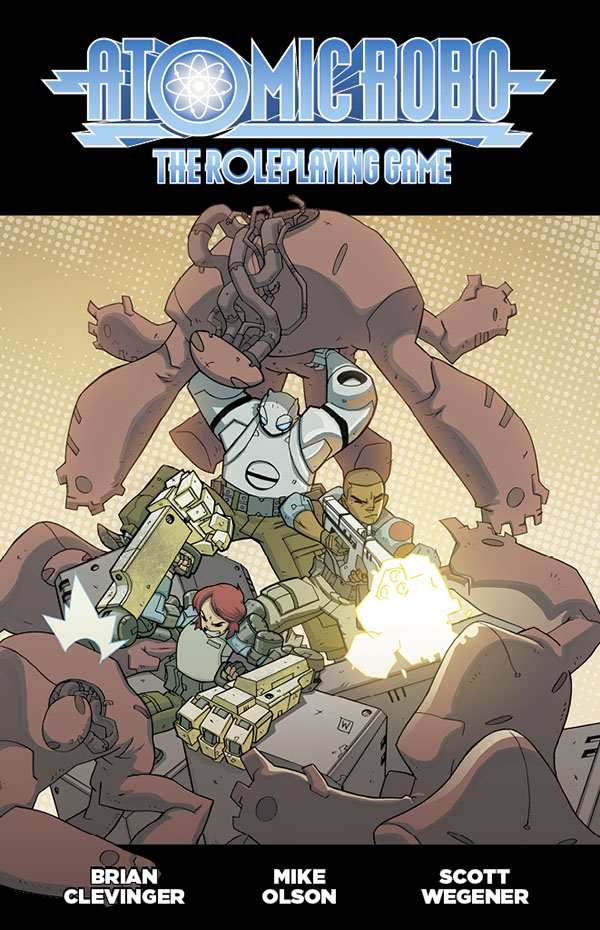
While I was part of the initial playtesting, I hadn’t read the finished product until I had a little time on planes while running around the country on ‘vacation’ (seeing family.) Evil Hat has the print version in the final works, but the pdf is available through their preorder or Drive Thru. Behold! The dramatic reveal!

Robo-Cover-600px

The system is Fate, tweaked a bit for the universe of Atomic Robo, but the basic mechanics are unchanged. Character creation is fast and “no-math” — the player choses the usual concept descriptor, a couple of their modes (ex. Action, Science, Intrigue) and their skills lump under those. Those odes with the same skills stack, so a character with, say, a vehicles skill in three modes would place it under the highest mode with the +4, then add two more for the synergy with the other modes. It’s easier than it is to describe.

You can have a character slapped together in minutes and be playing, and the rules allow for tweaking your character on the fly, and whenever you hit a particular milestone connected to the adventure or character.

The main additions to the rules are in the area of “brainstorming” science ideas, in which the players get to use their skills to try and figure out a science conundrum, then the one with the best quasi-applicable idea gets to define how the bad guy or mcGuffin for the adventure works (“The giant ants were obviously created by radiation!”) As for the rest of the mechanics, it’s Fate. It you aren’t familiar with the mechanics, you can find them for free on the interwebz. Have a look, if your puny mammaliam brains can conceive it!

On to the book itself — it’s very well laid out, easy to read, and captures the flavor of Atomic Robo and the related Real Science Adventures comics very well. Explanation blurbs with pics of characters from the series help you understand the mechanics, or just amuse you. They have Dr. Dinosaur — that alone was work the price of admission for me. Do not question it!

The book does an excellent job of laying out the timeline of Robo’s adventures, describing the various organizations in competition, and has rules for the kind of support the organizations can provide and how the characters’ adventures affect them.

So is it worth the $35? How can you even ask that? It’s got robots, and science!, and punching…and dinosaurs and stuff. The layout and utility of the e-book is better than most , but I’ve got one of the final pre-release copies and the hyperlinks to jump around the book weren’t enabled yet. I assume they will be in the current or future releases. The substance? The new rules help capture the flavor of the comics, and the book gives a pretty decent introduction into the world of Atomic Robo for those who are uninitiated, but this book has a pretty specific demographic — fans of the comics — so they could always crack open the original material, if need be. The rule book is very good about pointing you and the right series and issue of the comic that ties to the material in the background sections.

It’s a buy, especially if you’re a Tesladyne booster.

UPDATE: I received the physical book today from Evil Hat. The $35 gets you the book and a free e-book download. The look of the pdf is preserved in the softback book, which has a nice satin finish to it, and is slightly smaller than usual for a game book at what looks to be a 6.5″x10.25″ aspect. (I didn’t measure it, but should be close.) Still worth it.

Two weeks ago, I launched our new Hollow Earth Expedition campaign with an occult summoning gone terribly awry and straight into a fight with black-hooded wushu fighters that led to a high-speed chase through London on “hoopcycles”, as I described them. In reality, they are the Mono Wheel of Swiss inventor named Gerdes who built the contraption in 1935 (so period appropriate!)

HOOPCYCLES

Powered by a 980cc parallel twin motor from a motorcycle, the hoopscycle is a marvel of invention.  The vehicle has a single seat with a stearing wheel that operates a gyroscope, aiding in the maneuvering of the single wheeled craft.  It is incredible fast and maneuverable, and very very loud.

Size: 1   Def: 6   Str: 6   Speed: 110mph   Hand: +2   Crew: 1   Pass: 0   Cost: n/a

Here’s the real thing in action:

Ed. This contraption was originally featured in a post from 2010 during our Gorilla Ace! game.

Last week I finally got my new 1930s pulp game fired up. It’s been a few months coming, but the momentum in the Battlestar Galactica game was such that i wanted to push through to the “season finale” which allowed me to write a major character out as the player was leaving for San Francisco. I chose to use Hollow Earth Expedition again, although I was sorely tempted to use Cortex or the old James Bond: 007 RPG for the rules set.

One of the issues was trying to get the characters to mesh well. I’m the only person with a strong grasp of the period, so I did most of the heavy lifting on character creation for the players, weaving the history of the preceding years into the characters — two served in WWI together, the aristocrat character spent a lot of time in Africa with the “Happy Valley Set” — known for their promiscuous sex life, rampant drug use, and other scandals; and tying how the Great Depression affected them or their families. With the characters well established came the hard part…how to get them together?

There’s a few ways to do this — I like teasers that introduce the players to their characters in little vignettes that showcase their strengths, weaknesses, and basic schtick. (A classic one is the teaser in Raiders of the Lost Ark.) That seemed like it would suck up too much time in this instance, and several initial ideas fell flat. Another good way is to start in media res — where the story is already under way. Open with either an action sequence or some aspect of the story. The basic mission is either revealed during play, or the players were prepped for it before play. Most teasers start in media res, but usually don’t have a direct connection to the main story. I decided for the later, with the characters meeting at the Travellers’ Club in London after the “lead” — a tomb raider named Tom Steele — had already retrieved the item central to the plot.

This brings up the last point…what brings the group together? For a military or espionage setting, you can make that easy: they are assigned to a mission together. For a superhero game, maybe they’re part of the same team. What kind of mission would get an aristocratic occultist/pornographer, his two-fisted manservant, and an slick-dressing and talking American tomb raider who was tossed from Oxford together, then get them out to China? I tried a few different ideas, but they all fell flat. What I needed was what Alfred Hitchcock called ‘a McGuffin.”

What’s a McGuffin? This is the thing that brings everyone together for an adventure, and the characters can have different reasons for engaging with the object. The most famous is probably the Maltese Falcon. In the book and the 1941 film, the Maltese Falcon is supposed to be a gold falcon that has been painted black. All the characters get roped into the action because they want the falcon, or in the case of Sam Spade (Humphrey Bogart in the film), he’s a private dick hired for a case that starts playing all sides off each other. Rosebud, the sled from Citizen Kane, is another: “Rosebud” is the last word spoken by the lead character and a reporter tries to track down what it pertains to. The Death Star plans, the Lost Ark — these are McGuffins. They might be central to the action, a red herring, or something that is, ultimately, unimportant beyond being the impetus for the story (think the briefcase in the trunk in Repo Men, or the diamond from Titanic.)

While doing some reading, I came across an interesting bit of old Chinese culture — the “death jade”, usually a small carving of a cicada, which is supposed to take ones spirit to its final resting place (or close enough.) Some were alleged to be used to store the spirit until resurrection. I took this idea, fused it with another idea concerning the Huangdi, the First Sovereign Emperor, and his quest for the Elixir of Immortality. What if the Huangdi’s death jade held his spirit? What happens if it’s used in a summoning?

And there was the first night. Pull the characters together for a summoning at a common friend’s house in Hampstead Heath. The summoning, rather than being the usual excuse for drink and debauchery turns out to work, with the acquaintance being possessed by the spirit of the emperor. Before people can react to the glowing eyed possessed man, enter the competition — in this case a bunch of black outfitted wushu-fighting types. the resulting fight in the library of the country house was classic Hong Kong chop socky meets Indiana Jones. Of course the bad guys get the death jade, meaning the tomb raider (who has not gotten his full pay yet) has to go after it. The occultist wants it for the obvious power.

The fight led outside to a car chase with a bunch of the bad guys on “hoopcycles” — a one-wheeled “motorcycle” — through the streets of London, and down into the Underground. This long action set piece took most of the night and was a blast.

Who are the bad guys? I had a vague idea. Why do they want it? They can guess. This week, i get to fill out the particulars and get them started on their way to China.

A last minute cancellation put me in a rough place this week. I had a new pulp game all set to go and one of the “leads” — who was necessary for the beginning of the game texted out after we were due to start. At first, I thought, “Great! Board game night!” but the last board game night revealed that one of the players is not the sort with which you want to have any kind of game that involves competition. Plan C — fire up the Battlestar Galactica “new season” on the fly.

I didn’t have much to work with ready, so instead thought about what kind of impact losing two of the major characters would have on the NPCs and the players, and ran with that. In this episode…we talked about our feelings. I pieced together how the president — who had thought himself inured to loss after the Fall of the Colonies — is beginning to fall apart with the death of his son in law. Now, all he has is his son, and the fear of losing the man (the commander on Galactica) hasn’t paralysed him, but he no longer feels empowered. The commander lost his best friend, the other PC was a trusted colleague, and his burgeoning love affair with another officer has been interrupted by her reassignment to Pegasus. He’s alone. Another character had been the dead pilot/oracle’s lover — she’s crushed, and has had to take over his duties as a squadron leader. How can she command her friends, knowing she might have to send them to their deaths…and can she do it?

Another aspect of the night was the goings on aboard Pegasus. ADM Cain is a constant presence in the background, but was never encountered. Instead, the pilot now squadron leader found herself touring the flight deck of the flagship. She noted immediately that everyone was locked down tight — humorless or at least very restrained, with a strong undercurrent of fear or anxiety. She was approached by some of the crew who were curious about Galactica, including a couple of enlisted men who were interested in the “robot girl” they had in custody. It was creep, and made moreso by one of the female officers telling her to be careful where she went alone on the ship.

They heard about Cain’s “razor” speech — that they had to be a weapon, until they couldn’t fight anymore, or until they won. The idea that, being alone and having no real hope, the ship has been on a mission of vengeance is palpable. Now the trick is to bring Cain around to her new mission, that of guardian. (It’s a similar character arc that the one player’s commander had to go through early on.)

So there’s a prime example of how my slightly tongue-in-cheek post from a few days ago can be put into use.

« Previous PageNext Page »