Roleplaying Games


Runesligner, a regular poster on this here blog, had a wee contest to see who could do up the most interesting, setting appropriate characters for Hollow Earth Expedition. I tossed him two entries, simply because i couldn’t make up my mind which would be better — Trapp Sommers and a HEX homage of an NPC I created for the old Victoriana, Lord Mace — a debauched spy/orientalist with a penchant for the occult and pornography. Both won.

Head over to the excellent Casting Shadows site — he’s got some good stuff over there.

Ah, the mope…this is the player that just pulls the life out of the game. He might be the guy that sits in the corner, quietly waiting for the moment when they get to roll some dice, or they might be the guy that is actively involved in the game, but their attitude sucks — “My dice are fucking me!!!” “Man, this sucks! Why can’t we do X?”

I’ve had a couple of these over the years. One of the worst was the guy who min-maxed his character to alway be combat-inventors…they had zero social skills and would either not put in anything to the game or would make useless asides until it was their turn to roll some dice in combat. Every character was some version of this archetype.

Another was the guy with anxiety disorder who would get involved, but his personal discomfort was so palpable it made the other players uncomfortable. Few people enjoy being around someone obviously unhappy about being there. Similarly, another player was having some serious personal issues that provided him a palpable dark cloud of suck that followed him around. You could feel him moping, perfectly quiet, in another room.

The “my dice are fucking me!” guy was so scattered he couldn’t remember the basic mechanics of a game he’d been playing for two years. Worse, the above-mentioned moment was accompanied by him dropping to his knees in exasperation. It’s still one of the most memorable gaming moments for me in 30 years of playing. He was uncomfortable with the group, mostly due to some interpersonal dynamics going on.

The last example was a goth kid that spent the whole session in a light-hearted B-movie RPG playing the — you guessed it, gothy vampire kid with his killer ferret! Every action wasn’t just an attempt to hog attention, but to piss off the rest of the players. (We’ll probably see in him the next installment, as well…)

All these players have one thing in common — they are mopes. They tend to lurk in the room, obviously uninterested, uncomfortable, or otherwise miserable. There’s no real attempt to hide it, and their attitude can be infectious. Even when it is not, the fact people around them are having fun while they are not does not raise them up; they are more miserable than ever. So what do you do about the mope?

1) Find out what is bothering them, if it is something associated with the game, group, or another factor that the group and GM can address.

2) If it’s conflict with another member, perhaps it can be sorted out with a simple airing of differences on the side. The worst ones here, and guaranteed to eventually lead to the player dropping out, is if the conflict is between spouses or lovers. When a romantic relationship collapses between members, usually you lose both players. If there’s another player in the mix as well..? Oof!

3) If it has to do with the game, the setting, their character — these are easiest. Find out what will engage the player and try that. But there’s always the possibility that the player doesn’t want to play Mouse Guard. They joined to play Pathfinder, but everyone else after trying the former thought it would be fun to do that. Compromise. Rotate the games. Maybe split the group and have a second night (if feasible) and play one or the other.

4) Maybe it’s something that can’t really be addressed. The anxiety attack player had real issues that he was on meds for. He couldn’t eat around other people, so he never joined in the food. He wasn’t being rude — that he was there at all showed an interested. The personality just wasn’t especially convivial. Worse, he girlfriend was there…and was a spotlight hog, specifically, the wannabe actress type. They didn’t last too long. In this case, do what you can to accommodate the player. If there are special food needs, address them. If there’s a seating issue, try to cover that, as well. But you can only bend so far before you are inconveniencing the others in the group.

Ultimately, the goal should be to make people feel comfortable, and you should try to make that happen — but ultimately, this is a “needs of the many” situation, and if you cannot keep the mope from draining the life from the group, it might be necessary to ask them to leave. It’s never fun, and in a hobby that has a rarified population few want to lose a player of any kind, but sometimes it is necessary.

Can you think of ways that these respective examples (or others you could provide) might be addressed? Please share them in the comments.

This week’s Battlestar Galactica continued to move away from the TV show canon, while trying to actually one-up the style and flavor of the same. Looking for resources to mine, a recon raptor discovers a moon orbiting in the upper limits of a gas giant’s atmosphere — the word have been severely attenuated by the white dwarf it orbits when the star went nova millennia ago. The whole system is engulfed in the planetary nebula of the nova, awash with radiation — including the signature that affects Cylons — and debris. It’s far too dangerous to hide the fleet in, but the moon is somewhat protected from the nebular radiation by the strong, also dangerous, magnetic field of the gas giant.

They jump in to do a survey of the moon, battling strong atmospheric currents, the magnetic field of the gas giant and the powerful flux tube along the field line connecting the moon to its primary. They discover remnants of a settlement, badly eroded by micrometeorite, gas friction, and other elements…perhaps a mine? they estimate, based on the damage the place has been there for over 2000 years.

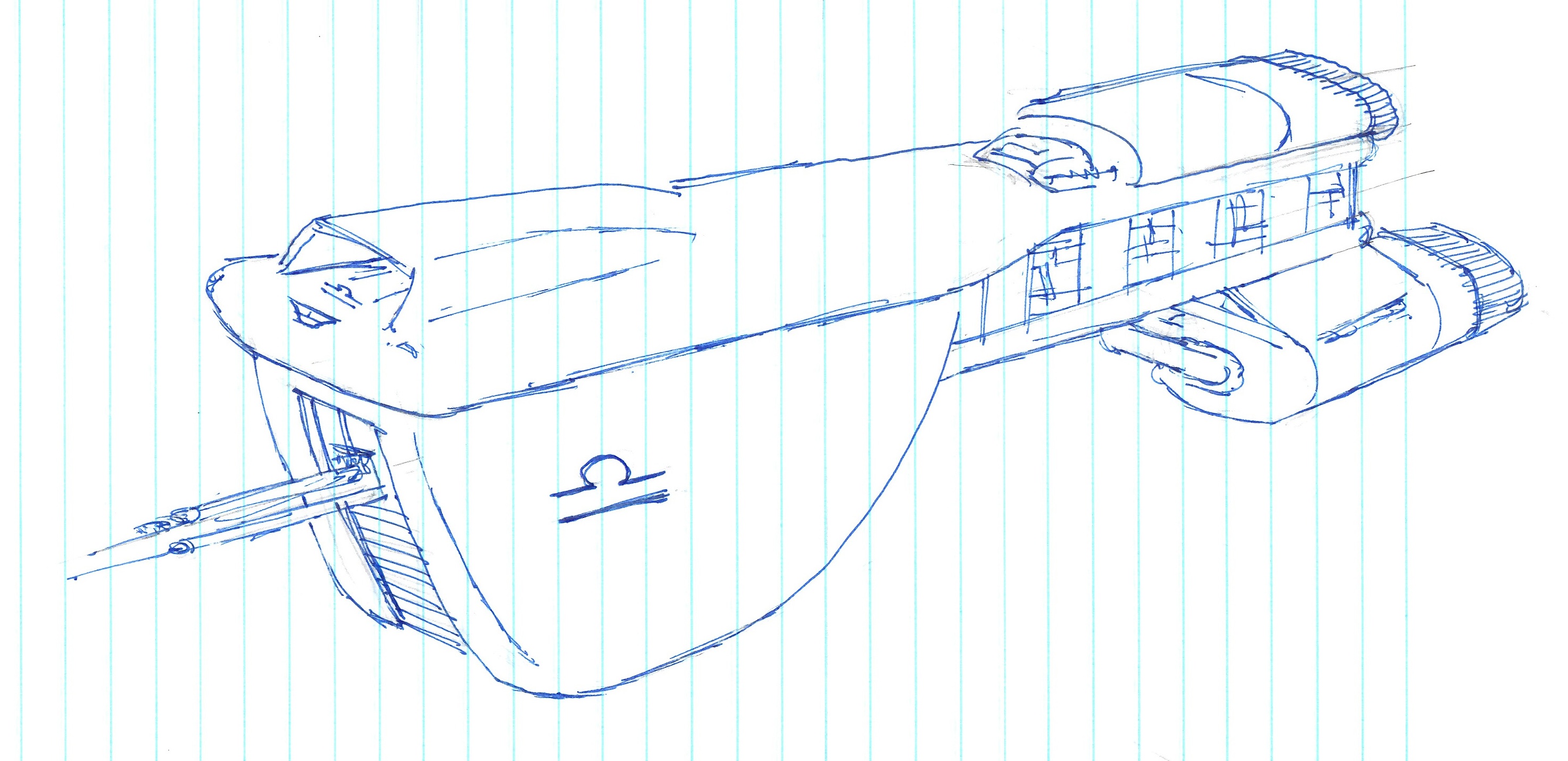
Despite the heavy DRADIS interference, they pick up on a massive object that seems to be trapped, circling the flux tube…it turns out to be an ancient, massive vessel that the pilot (the CAG, a PC) recognizes from a recurring dream I’ve been describing, as one of the galleons that brought humanity to the 12 Colonies!

A quick sketch i whipped up for the session...

A quick sketch I whipped up for the session…

The markings are those of Kobol-era Libra — the ancestors of the Librans, whose population we’d remarked on several times, has been historically much lower than the other Colonies. There was damage to the craft, indications of weapons impacts among the millennia of damage done floating in the atmosphere of the gas giant. They were making plans on how to board an investigate — having to take into account the heavy energy fields, the charges the recon raptor or shuttle’s hull would pick up, how to communicate through heavy communications interference, etc…

We ended there, but the hope is that the hulk will provide a key to the location of Kobol, and Colonial prehistory. The episode also shows how you can veer from the direct plot of an RPG setting based on an established property, and still keep — or enhance — the feel of the original material. In this case, the visions characters are having started as very ephemeral or confusing, but as events happen, they are making more and more sense.

One of the central tenets of Battlestar Galactica –both the 1978 and 2004 shows — was that the characters were trapped in events that were bigger than just their exodus. In the original show, the “ship of light” and its angelic beings were somehow interested in the plight of the Colonials; similarly, the Final Five were shown as being of light, draped similarly in white, and the “ship of lights” is riffed on in one of Starbuck’s paintings.

What I’ve been working toward is establishing that there may be some kind of cosmic force that is continually playing out this cycle of collapse, discovery, and rebirth over and over again, with differing protagonists and antagonists…but always toward some end that is unknowable. Kobol may be the home of godlike creatures that were overthrown by an angry, jealous “Blaze” (as per the cut scene in Kobol’s Last Gleaming), or maybe they themselves were just one set of oppressor-turned-oppressed in the Great Cycle.

I’ve kept the Scrolls of Pythia as a major plot point, but added the Aurelian Heresies — an apocrypha that might predate Kobol, itself — and which has strong influences from the Eleusian Mysteries of Greek myth — a cycle of decent into the underworld or some deadly event, self-discovery or rehabilitation, and the resurrection or rebirth of the character/civilization/etc. It ties tightly to Hades and his capture of Perephone, and I’ve dropped hints that “the Blaze” may have been Hades revolting against the Lords’ rule…but maybe not. Every point here has been to enhance the mystery and mysticism of the setting, but to temper it with some of the characters positing more sensible reasons — the Kobolians were some kind of alien race than made humans; the Kobolians were just exceptional humans; they were the Cylons of the Titans…

Don’t be shy when running a licensed setting to shred what you don’t like, pump up what you do, and go your own way. Your game is best thought as a reimagining, not a canon-inclusive sideshow. This gives the characters the chance to be the heroes, having real influence on their universe, instead of heroes playing in the shadow of the people in the property.

This player was a lot more common in the bad ol’ days of role playing, when the games were still mostly wargames with character rules bolted on. (It’s also one of the reasons why combat rules are usually a chapter long in modern games, but other skill rules fit in a page or two.) Knowing the rules gave you an edge over the dungeon master, with whom you had an adversarial relationship, rather than a cooperative one for telling a story — the DM spent his time coming up with ways to screw with you and your party; you tried to outsmart him. Knowing you got a +1 on a such-and-such test because of certain factors might make the difference between success and a TPK (total party kill, for those not playing D&D.)

The rules lawyer is still alive and well in gaming. Most of the ones I’ve run into are involved in the vampire LARPing scene, where the antagonistic relationship between characters and between the characters and the storyteller remain a central aspect of play. In modern tabletop games, the relationship between the game master/storyteller/dude who’s not a storyteller, but a facilitator for your gaming enjoyment (barf!) is more cooperative, and the rules usually reflect this by being much more minimalist or fluid. This isn’t the environment for a rules lawyering gamer to thrive…but there they are.

Often the rules lawyer now uses the rules to maximize his benefits at character creation, much like the min-maxer, but the rules lawyer focuses on mechanics that allow them to tweak the flow of play to their advantage. So they might take assets (or whatever they’re called in your favored system) like luck, where they can reroll a test, or something like Intuition in Cortex, where they can ask a question of the GM (usually a yes or no question) to skirt the plot.

In modern games where combat is more prevalent, the rules lawyer is much more effective. They know that a certain maneuver allows this benefit, they hang on the wording of a rule regarding social interaction, or how hacking “works”, and use that knowledge to browbeat the GM (or the group, if it’s a GM-less system) into ruling in their favor.

The rules lawyer was, in the past, much more of a nuisance than they tend to be now — but I admit I also don’t play stuff like D&D or Pathfinder where the benefit of lawyering might be more fruitful. In the early days of RPGs, the dungeon master was “god” in his world — and it was almost always a “he” — creating the setting, the adventure, managing the opposition to challenge the players. Rulebooks showed their wargaming past and were packed with minutiae on various tasks. It was hard to know it all well. Rules lawyers could leverage their knowledge of the rules to question the campaign’s architect. Now, it’s expected that the players will have some say in how the plot unfolds outside of succeeding or failing at a test. Plot/hero/story point mechanics allow them to “bribe” the GM to give them a certain result (and vice-versa), rules are less structured and important to the outcome of a scene (FATE can go so far as to go single test for combat with the player stating the preferred outcome), and gamemasters are more likely to working to help the players succeed than to kill their characters off. That makes rules lawyering much less necessary, or effective, than in early generation RPG mechanics.

So how to handle the rules lawyer? You can go with the time-honored “DM as campaign god” with your decisions as inviolate. Or you can set yourself up as a judge or referee, interpreting the rules to the situation — “I know it says the monster gets a -2 for the slippery surface it’s on, but the sheer size means that it doesn’t have to move around as much, so I’m not applying it…” Or you can give the rules lawyer a statute of limitations to argue their point and change the ruling and edit the story. You want to argue a rule that gives you that +1 you need to succeed in stopping the trap from springing? You’ve got a minute to find me the rule, or we move on with events. This gives the rules lawyer — who gets their enjoyment from that argumentation — time to have their fun, maybe have more of an effect on the play, but limits their ability to halt play over some point of procedure.


This is a variant of the “rules lawyer” we’ll get to in another post — the min-maxer is a particular problem in that the player really isn’t doing anything wrong, per se. They’re trying to tailor their character to their role, and this is admirable…but it can lead to narrative issues down the line.

One of the standard min-max techniques in Dungeons & Dragons is to pump a character up on their physical stats, but slight charisma, so that they are a survival monster, but something of a duffer in social environments. This is understandable when one considers that the stereotype of the gamer is a maladjusted type that can’t get a girlfriend. But that’s a stereotype…most of the gamers I’ve met are fully functioning human beings (but when the stereotype is in effect, whoo boy!) By slighting charisma, the players are doing a cost-benefit analysis, and erring on the side of being able to kick the crap out of the monsters and live…shmoozing at the tavern is not a priority.

This sort of cost-benefit design shows up in other settings, as well, and has the main side effect of making the character annoyingly good at some particular set of skills, often to the detriment of creating surprise, suspense, or a sense that failure is possible. A few examples:

One of my former group commonly would design their characters in our Victorian science game to be social and charisma masters. This made sense because 1) this was her fantasy, to be attractive, engaging, and sexy, and 2) it was the equivalent of maxing for social “combat” — the primary venue for a female character of the upper class in the setting. However, it meant that she would often run roughshod over NPCs of power and created connections that quickly put the character and her companions in a very rarified strata where they were essentially untouchable from a legal and political sense. To balance her out left other characters so outgunned that they were simply props in these social scenes. However, they would often flub rolls due to the higher difficulty this primary character created, and hence her friends would cause her trouble she would have to smooth over.

Another would be the detective who is uncannily good at sussing out the truth. The character was built with incredible analytical skills, intuition benefits that allowed them to make deductive leaps that made it very difficult — if they asked the right question — to disguise intent or guilt of NPCs they were investigating. This in itself isn’t too bad; you can find ways to adapt a good mystery by creating more layers of intrigue or guilt. However, he was also built with sixth sense skills, enhanced reflexes, all the sorts of things that make him the combat monster of the traditional sense. To challenge this character, I’ve had to either throw serious number of bad guys or very tough ones at him, or I have to come at the problem sideways such as giving him a problem he couldn’t dodge his way out of…and that’s the trick with a min-max character:

When you need to challenge them, one thing you can do is give them something outside their specialty to do. If you can split the party, give the bad ass with the low intelligence the riddle to solve. Give the thief a situation where they have to talk their way into a place to steal the object in question. (Shoulda put more than a 2 in charisma…shouldn’t ya, sport?)

Another is to play to their weaknesses. Most newer RPGs have some kind of weakness or trait system that either compels a response (usually for a reward) or or has a mechanic to adversely affect the character. So that tough guy is afraid of snakes, huh..? Shame to get to the McGuffin they need, he has to go through that room of dangerous asps. That thief is great in a building, working on locks and such, but never really got used to heights…and the way out, it’s through that 6th story window. Maybe that alcoholic pilot shouldn’t be drinking so much before an important dogfight.

The main thing I think a GM can do is to work with the players during character creation to decide exactly how far they want to push a certain trope. Sometimes, even in a campaign like a pulp game — where the characters are supposed to be over the top — you can go too far and have a character that “breaks” the game because they are just too much. (I actually designed a character like this for a player that seemed great on paper, but once in play just trashed the reality of the setting.)

This was an earlier piece that I’m including in this new group of essays on “problem kids” at the role playing game table:

We’ve all had some version this guy/gal in our groups. They get their moment in the spotlight during the session and just don’t seem to be able to let it go. Maybe they’re someone that every day is a “me day.” Maybe they don’t get to play often and just get overly-enthusiastic. Maybe they GM much of the time and are used to being the center of the group. (cough me cough) Maybe they’re the wannabe actor/tress for whom attention is the thing, more than the play. Maybe they just talk…a lot. (You can tell what spurred this post, can’t you?)

So how do you shut down the spotlight hog without hurting their feelings, being to obvious about it, or being a jerk? If you tend to be a hands-off GM, it’s going to be harder to move the action along than if you are a bit more active. For me, as a narative-type who likes to be involved more with the play than a simple “What do you do?” sort of GM, it’s a matter of engaging the player first, then shifting the focus of of them in a way that feels natural.

Example: The GIQ is doing a bit of expounding on the legal complexities of the adventure or mission the characters are on. It should be a simple bit of exposition, but the player (as well as the character) is a lawyer. And a bit long winded. Okay, knock off the “a bit”. He’s been on a roll for about five minutes, already, and has missed the queues from one of the other players — the equivalent of “Read you. Press on.” In the interest of advancing the plot and letting other characters get a bit of “scene time”, it’s time to step in as a GM.

At this point, I engage the player sort of like a director talking to an actor. Get into his mind space, or his emotional state with a few pointed questions. I’ve got his attention now. I shift the attention to the character he was talking about — how do you feel about this? What’s your perception of the information? Now the attention is on the other player and I can get the other players back in.

Now, I’ve found that 9 times out of 10, you’ve just fixed the problem. But sometimes GIQ is not going to want to relinquish the spotlight so easily. If you have successfully moved the attention — even for a moment — a simple upraised finger  (a “wait” finger) should do to keep that player sidelined long enough for the other players to get their say in for the scene, then return the spotlight to the player, or move on.

This is the gentle way to use social judo to take control of your game when necessary without coming off as a jerk.

Any other techniques out there?

There’s a great schtick in an awful (but funny) movie called Brainsmasher: A Love Story: the lead character’s mother seems to always be able to reach him by phone, wherever he is. Standing next to a pay phone? Mom calls. The villains are torturing him, and the lead bad’s cell phone rings… “It’s you mother!” “Gimme the phone. No, Ma, I don’t know when I’ll be home! Hang up on her.”

In a lot of RPGs, players often exit in a vacuum, much like character in movies — they are sprung fully-armed and armored from the Players’ Handbook, ready for action. No friends, no family, no real background. they develop in media res, and are a product of the numbers on a sheet and the adventures they work through. In a fantasy campaign, you can Conan the hell out of your background — the warrior/mage/rogue that has lost their family, or they simply don’t impact their lives — but in other sorts of games, building in family and friends for the characters at the start can really help flesh out a game.  

I’ve written a few times on how adding friends and family and playing a “season” before the Cylon attacks in our Battlestar Galactica campaign really helps the players experience their characters’ loss, but this isn’t the first time that family has been important in our campaigns. Often in espionage campaigns I’ve run the family is an important part of the character’s backstory. They’re the people you want to get back to (or escape the chaos of young child, as a former special forces guy I know admitted.) They don’t like when you’re out adventuring; they want you home. The issues of family and spies have been well done in True Lies  and more recently, TV’s Chuck

Family make decent motivators for adventuring, as well — family make great McGuffins: The terrorists have your daughter! The alien menace is advancing on the hiding spot in which you left your family! Your best friend discovered a hidden city in the Amazon! You son just knocked up his girlfriend and you’re way too young to be a grandfather! All of these can be seeds for an adventure.

But the best use of family is as, what they call in television, the “B plot.” Something is going on in your private life that needs your attention, and which distracts from the “A plot” (the adventure). Perhaps there’s an issue with your kid or wife that needs your attention — the wife was in a car accident and is injured and at the hospital — this murder investigation is just going to have to wait for a bit. Or you keep missing that parent-teacher meeting because you’ve been fighting creeping tentacled evil that is trying to break into this world…not exactly something you can tell them, but if you don’t get your ass over to the school right now, they’re going to think you are a negligent parent.

Beyond all that, even if you’ve just got the characters getting the occasional phone call or letter from their parents, having connections to the world around them outside of the plotlines gives a sense of reality to the world, no matter how fantastical it might be.

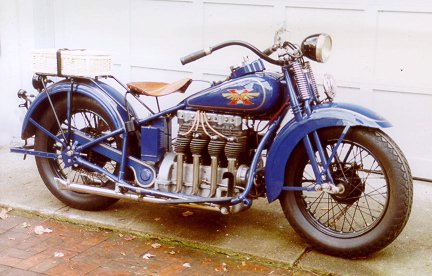
In 1929, Henderson Motorcycles released their “Streamline” bike — a powerful 1300cc four cylinder machine that allowed the bike to break the 100mph barrier. The KJ Streamline would become popular with police forces for its forgiving nature — as they could run from 8 to 100mph in top gear with no issues. The torque was impressive, allowing them to accelerate and decelerate swiftly. Not content with building one of the most powerful bikes of the time, Hnderson released a “Special” for $30 more with higher compression pistons and a larger carburetor that boosted the machine to 45hp and which hit 116mph on one run.

Henderson-1930

Henderson KJ Streamline Size: 1   Def: 6   Str: 6   Spd: 100   Han: +2   Crew: 1   Pass: 0   Cost: $450

Henderson KL Special: Size: 1   Def: 6   Str: 6   Spd: 110   Han: +2   Crew: 1   Pass: 0   Cost: $480

And the one that really caught the eye…

The 1934 Henderson KJ Streamline 

streamliner_1280

streamliner4_1024

This concept Streamline that came out of the impending Excelsior-Henderson merger could have been called the first scooter: it rode on 10″ wheels, had a fully-encased chassis, and a different seating position that was uncomfortable for the tall rider. The bike was heavy, a bit unwieldy in turns, and a pain in the ass to maintain:

1934 Henderson KJ Streamline: Size: 1   Def: 6   Str: 7   Spd: 80   Han: 0   Crew: 1   Pass: 0   Cost: $600

This one, however, has the most potential for pulpy goodness — of course a masked do-gooder could ride this with a boatload of style…yet no one would put together he’s on one of a handful of these things made. Cops in the 1930s just don’t put that sort of thing together. Or heavily modified, it would be the perfect platform for a “rocket cycle”…if only to do your best Brian Blessed “Flying blind on a rocket cycle!?!”

So, we’ve had a couple of good episodes running over the past few months in our Battlestar Galactica campaign that have centered on the emerging politics of the fleet. Unlike the show, where the government just sort of materialized as if by magic, or fleet has been hampered by the logistics of moving people and goods between, essentially, 78 islands in space. There’s a black market that has fired up almost immediately. There’s hoarding and other problems just trying to get a handle on what they have in the way of resources, how many people they have (still an estimate, but a pretty good one), and how to motivate people to work where needed.

The fleet immediately went on half rations for the civilians not working, 2/3rds rations for those working in essential areas (military, bioship, repair ships, etc.) and they’ve been trying to recruit people for the Fleet and marines. Of course, with no place to really do physical training and no time for basic training type stuff, the newbies are being thrown straight into OJT. Pilot trainees are learning their OCS manuals while at the same time trying to learn basic flight. Enlisted are right into occupational training. The marines are about the only people they have the time to train with weapons.

They are also putting together a Marshal Service to police the fleet for violent crimes — murder, assault, rape, human slaving (which they’ve already run across), hunt Cylon infiltrators, and hoarding (although there’s a question as to where property rights end…can they just take people’s things? What does that do for motivation?)

One of the B plots is finding resources to replenish the fleet. A raptor went missing this week’s game (Halloween night) and two of the characters had to go on a search & rescue to find them. The raptor had been investigating a system with two giant water worlds, and they quickly found the raptor on the ocean’s surface, riding a mat of algae, and afloat but sinking slowly and in the path of a massive hurricane. They had maybe two hours to effect a rescue. The ship was not answering, so they head down and find the bird has it’s side hatch open. Why? The crew are not answering and there appears no one is aboard. Why not?

One of the characters is winched down under the hovering raptor and boards to find the craft dead. A quick search turned up the seat covers, rubber gaskets, pages from the manuals, etc. …all gone. The character managed to work out these were all organic components and that’s when her pilot realized that the algae mat was moving — crawling onto the raptor. There were a few tense moments where the pilot investigating barely got out of the craft before monster ate her, and some of the slop was eating through her flight suit boot. (She managed to get it off in time.)

The players had been expecting a Cylon plot, or some kind of maintenance issue, so the introduction of their first confirmed multi-cellular life form — and a vicious one at that — made for a sharp turn from the show’s universe. But it also played well into how to introduce a bit of the haunting holiday into an established game.

I was reading over a couple of pieces on 11 Things to Help Your Players Be Better Roleplayers over on Gnome Stew, and the referenced 11 Ways to be a Better Roleplayer on LOOK, ROBOT and realized that several of their ideas were on display at this week’s game session.

The last few weeks have been a clusterf#$% regarding player attendance — between GenCon for one, another as a speaker at the Transformers convention over in England, and the third have to be away for work and other issues, we’ve been at least one player low all month. The past two weeks had me adapt to this by throwing together a murder mystery for our Battlestar Galactica game, set on one of the ships in the civilian fleet.

The two characters are members of the new Colonial Marshals Service, tasked with looking into violent crime, hoarding, and other immediate issues to fleet security. “Victimless” crime is ignored. However, in the aftermath of the Fall of the Colonies, there have been an understandable spate of suicides and suspicious deaths…they all have to be investigated. The veteran, Chaplain, is annoyed by this — he wants to focus on the Cylon menace, but I need the guy investigating crimes for this episode…right here, the player was doing what Grant highlighted in the second piece as points 3 and 4 — “Don’t Try to Stop Things” and “Take Control of Your Character”: The player didn’t pull the “my character wouldn’t do that” shtick — he followed the instructions of his boss, who told him he needed these cases closed and to get on it; the second character also had a case on the same ship — a missing 16 year old girl. The two decided to pool resources and investigate. The characters both bitched about their assignments — that was fully in character, and they were given the opportunity to harangue their boss…but they’re doing their jobs. In that, I was engaging in point 2 of Phil’s piece on Gnome Stew, Create Opportunities for the Players to Express Their Characters.

Points 3, 4 and 9 of the Gnome Stew article come into play here: One of the things I’ve always tried to do was act more as a director than a writer in games. The characters were given enough information to take action on their own. The players don’t lolligag — they immediately start looking into their respective cases. The whole time, I try to not just play the NPCs, but give possible queues that they might miss in the action, or might not have occurred to them while playing that tie into their character — getting inside the heads of the characters, as it were. Example: The new guy is a geek, an overweight former programmer than helped stop one of the prongs of the Cylon attack. He’s a coward, but he takes on the responsibility of being a cop seriously. As he realizes the parents of the missing girl are hiding something, and the younger brother is upset, I suggested that — this guy, the guy that no one would notice at college, that spent all his time playing a hero in RPGs and computer games, was suddenly the one guy that actually could make a difference and save this girl — he might find this both terrifying, but also an important moment for his self-esteem and personality. The player ran with it. They didn’t have to.

The veteran realizes that the suicide couldn’t possibly have happened as the report says — the safety protocols, etc. are too complex for a guy who was, in essence, the garbageman of the ship. He was murdered. The character is pissed, because now it’s not a check the box suicide investigation…he has to take it seriously. The two both run into a lot of stonewalling by crew and passengers and start to realize they are in real trouble…there’s something going on aboard the ship. They could, at this point, try to get backup or something, but they investigate further (Point 1: Do Something), checking the ship’s cargo manifests and the coming and goings of cargo ships and shuttles (the vessel is a major logistics hub for the fleet.) They also note the tattoos on the security men and crew of the ship — they realize it’s a Ha’la’tha (Tauron mafia) ship. They get the brother of the missing girl alone and find out she’s was sold to the HLT for extra food and clothing rations.

Point 3 for the GM: Keep things moving. Paraphrasing Raymond Chandler, the pulp mystery writer, when a scene bogs down, have guys with guns burst in. That’s what happened here. We’d been building up the suspense for a while and it was time to get things moving. The newbie’s questioning of the kid brings the gangsters after him. There’s a chase and hiding from the bad guys scene in a crew habitat that I described as being a lot like the living quarters in Outland. (I wanted the catwalks, the multiple tiers with points that would require jumping from level to the next. See the movie — it’s a great action set piece.) The vet has to come rescue him and they proceed to kick serious ass. Having done that, they find out they work for a HLT lieutenat operating out of the “box city” — an area of interconnected pressurized cargo containers (like those on a real cargo ship, but with pressure doors, etc.) The same place where the suicide-now-murder took place.

The encounter the bad guys, whom the vet taunts for their obvious lack of forethought on trying to kill them. “What do you think is going to happen? You’ll just wind up with more cops of the marines in here!” Of course, the gangsters are planning on scattering and changing their identities — easy enough with the terrible record keeping currently in the civilian fleet (it’s less than a month from the Holocaust.) It’s a Mexican (or in this case, Tauron, showdown…)

At this point I realize we’re getting close to quitting time for the night and seek to wrap the night before they get to the part where they rescue the girls. The question — do I go for the anticlimactic “Oh, you’re right, here’s the girls” ending, or step it up. I go Chandler — the area is suddenly sealed by other bad guys and the “big bad” (now just a minor functionary) tells them they’re all dead. The gangsters included. The trail will dead end here.

The area is getting vented and the characters had a series of misadventures trying to get to safety including attempting the classic air duct crawl…only to get stuck. Really stuck. Two botches in a roll stuck. At this point I invoke point 10 in Phil’s piece: Make Failure Interesting. The vet is stuck and goes seriously claustrophobic/ upset that after all the shit he’s been through with Cylons and other dangers, he’s going to die stuck in an air vent…and he doesn’t even know why! The players embraced failure, as grant suggested and ran with it. Eventually, they managed to get clear, but it gave a great half hour of entertainment.

One point grant had: Don’t try to stop things came into play here: the newbie is a coward, had been nearly killed, had to shoot a man, and he’s a wreck…his beloved top-end datapad was shot (saving his life) in the hab fight. He wants to get on the first ship off the craft, but the vet knows the HLT isn’t going to let them do that. They settle for hacking the comms system and firing off a report/call for backup from the CMS before they go after the big bad (see above.) The characters argue, they alter each other’s pans, but they don’t try to undo what the other player is doing. They built on it.

We ended for the night with the characters stuck on a gangster controlled ship, who were nearly killed by nameless baddies, but they know where the brothel/club that the HLT is running is on the ship and the newbie — cowardice pushed aside by pride and the chance to be a hero — is determined to save them.

The thing for players and GM to remember is that RPGs are a collaborative form of storytelling and play. The GM (at least in more traditional sorts of games) creates the outlines of the world and the players flesh it out with their actions. Sometimes it’s just offhand comments like the newbie stating the bad guys were trying to make their deaths look like accidents. Well, no, I was trying to come up with a quick ending that didn’t involve the characters getting killed by the ready to shoot villains…but it sounded good, so I ran with it. Take what the players are doing and mold it to work with what you intended — or it their idea’s better, purloin it [without telling them] and run with it. Ultimately, as long as everyone is having fun, you’re doing it right.
« Previous PageNext Page »