Roleplaying Games


One of the things I liked about Babylon 5 and the reimagined Battlestar Galactica was that the characters had to make big decisions based on bad information, little sleep, and through the prism of emotional strain of surviving the apocalypse. It’s something that was present in my last BSG campaign, but it is firmly up front and center in the current game.

The last few game sessions revolved around the death of Sergeant Hadrian, the master-a-t-arms, found murdered near the water tanks. It gave me a chance to do a police procedural in the environment of Galactica. The characters chase down forensics evidence — surveillance cameras near the scene, fingerprints and other evidence on the murder weapon, and the like — there were a few red herrings in the episode, and they were tripped up by sabotage of the tanks ala the episode Water. They have to solve the murder and sabotage at the same time. One of the suspects is the still-present Aaron Doral. In our campaign, he was a Ministry of Education flunkie responsible for the museum transition on Galactica and who is now the Scorpia delegate to the Quorum of Twelve. Eventually, it turns out Doral was set up by a Cylon agent whom they stop in a desperate fight outside of auxiliary damage control, where the bad guy was aiming to vent the ship and kill the crew.

The B story, however, seems to indicate where the meat of the campaign is going to be: BIG decisions. As the new government gets its legs, they are trying to decide what the government, laws, and life of the fleet is going to look like. One of the characters is the commander of Galactica and he is already showing signs of authoritarianism. He’s been floating the idea of a military dictatorship, something the vice president character seems to be somewhat supportive of. What kind of law and law enforcement are they going to have for the fleet? Concentrate on violent crimes only? What about crimes involving coercion or other kinds of “force”? They have two cops…do they form a bigger police force? What kind of authority should they have? What kind of surveillance and expectations of privacy should you have?

These kind of issues don’t turn up often in the average dungeon crawl or setting where the players are “street-level”, but they make for good fun for characters that have some level of power. What happens when your fighter becomes king of the realm..? Do you rule as a “good king”? Even if you do, what kinds of freedoms can you give your people? How does power affect your decision-making process — can you stay “good” or do you let the power go to your head?

What about the street runner that becomes a corporate exec in Shadowrun  or Cyberpunk — do you sell out? Do you work to fix the system from the inside? Do you convince yourself you’re doing one, while actually doing the other?


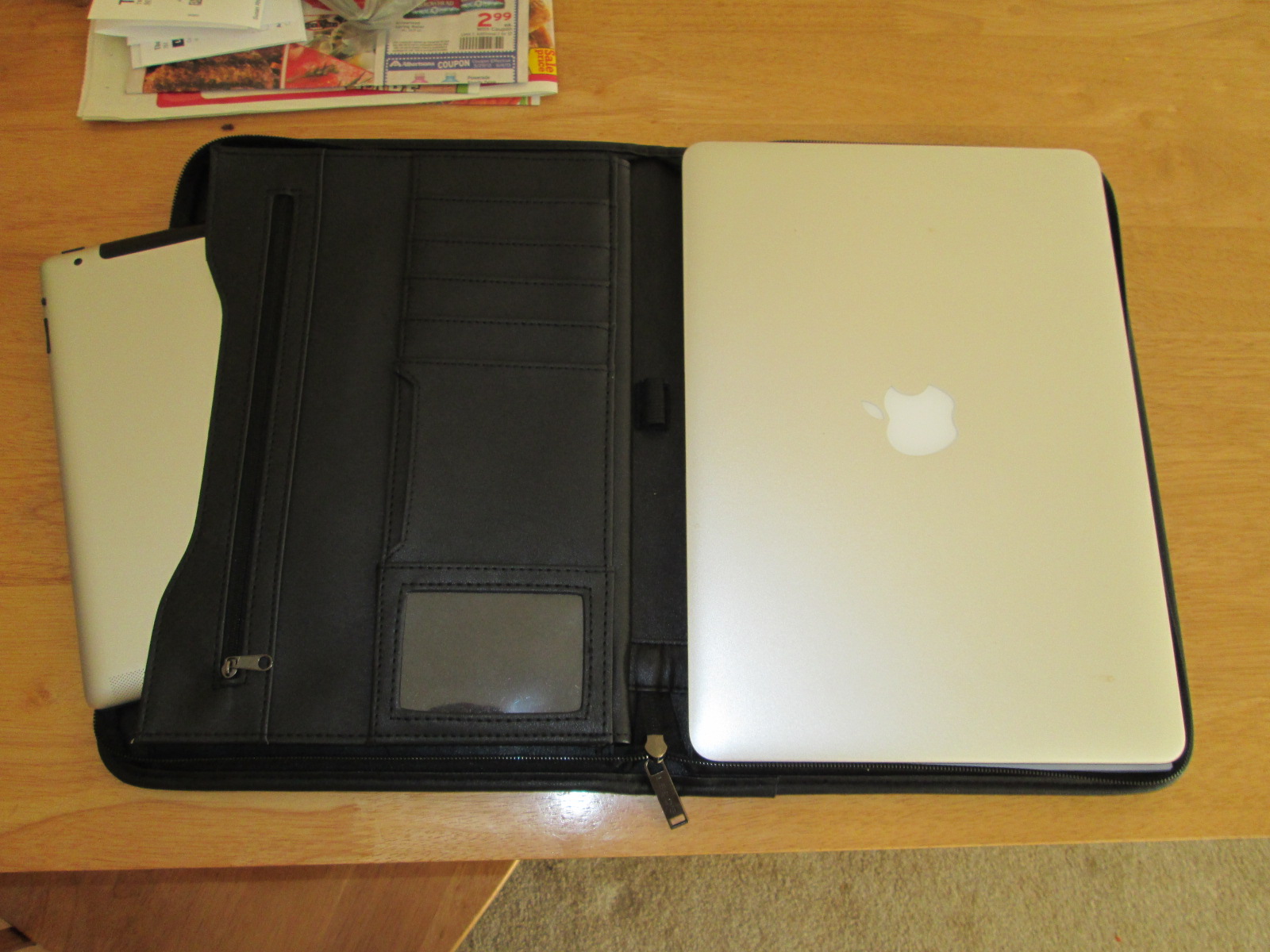
Here’s a leather folio that one of our players had made for everyone in the gaming group:

photo 4

It’s just large enough to hold both my Macbook Air 13″ and my iPad2, plus the notepad under the laptop, etc…

photo 3

Thanks, Nathan!


During our play session this week, we took the opportunity to finally try something we’ve wanted to do since we had most of the old gaming group fall away back in September. One of these gamers had scheduling issues — he works in Los Alamos on the days we usually have open to game. He lives in Santa Fe. We play in Albuquerque. If he were to leave for the game after work, he would have 93 miles during rush hour traffic to get here. It’s a two hour run at the best of times, and another 45 minutes to an hour to get home.

In other words, not doable.

We’d thought about trying to link this player and the one who GTT (Gone To Texas, for you non-history fans) to the group through the internet. During test runs in September, we’d found Facetime was the most stable platform, but couldn’t handle more than two callers; Skype could do multiple callers, if one of you popped for the ability, and was generally stable if not as much so as Facetime; and we tried Google Hangout, which could handle multiple callers and was mostly stable, but got increasingly twitchy over time.

Since we were only bringing one person in on the video call, and only one of us had Facetime, we went with Skype. The result was much better than I’d hoped for. We got the call-in about 1900 hours and game ran until 2230 hours. The call audio quality was good, although we’ve decided it would be a good idea to rig the iPad we were using into its bluetooth speakers next time. Video quality was patchy — good for the first hour or so, but it steadily degraded until the remote player had to kill his video feed for about 45 minutes. During a break, he called back in and the video was good again.

He has a few issues receiving video from us at first, but it cleared up after we hung up and recalled at the start of the session. He had a few problems tracking the crosstalk on the table at one point, but otherwise was able to feel part of the action and not terribly disconnected.

Here were the observations:

1) Positioning is very important. Depending on the webcam, laptop, or in this case, an iPad, you want to find a place where the camera can see the entire group and can adequately pick up the conversations.

Just as important is the GM’s position. I was seated to one side of the table — iPad at one end, players arrayed in front of me of to the opposite side of the iPad, and occasionally I would lose track of what the video caller or the player opposite of him was doing/saying. Better to position yourself so the players and teleconferenced person are in front of you; be at the head of the table, if using one, with the teleconferenced player at the other end of the room, so you can see everyone. this cuts down on the chance that you favor one side of the room or the other. I managed to avoid ignoring the video caller over the rest of the people in the room but I had to keep it in mind throughout the night.

2) Venue. Try to avoid big. empty rooms with lots of hard objects. This bounces the sound more, and the echo effect can make it difficult for the video caller. You want something big enough to allow the camera to pick up all the players, but small enough not to jigger with the audio.

3) Equipment: Screen size: we were running the conference on an iPad — an 11″ screen. It was good enough we could see the player just fine in the space we were working with. A bigger room, or more myopic players might like something larger. A good microphone and speaker are important when doing a conference call with a room full of players. I mentioned the bluetooth speaker to get past the reflected noise of the host’s kitchen and the generally crappy speaker of the iPad2 and later. If you have a TV and can connect the device running the video conference, the speakers and video should be more than enough to the purpose.

4) Coordination. As with tabletop gaming, coordination can be a real issue. This gets worse the more time zones you throw between the two sides of a call. This has prevented me from setting up a game with another gamer in Korea — 14 or 15 hours is a lot of time to work around; you’re in different days, much less times of day. Even a call home to Scotland is  six hours offset. Keep this in mind, even for something like a single timezone. An hour in the evening can mean starting too early for someone, or ending a touch to late for another.

Overall, our experience was very positive, with two of the players and myself expressing the wish to continue with Skyping the player in, and the others being positive about the experience in general, but not so enthusiastic. They’re also not part of the group from last year, so that’s probably a reason.

Video conferencing is a great way to retain players who have moved away or for some reason can’t make the haul to game. Depending on the number you need to conference in will decide what service you want, but if it’s just a single player Facetime (if they have a Mac) and Skype seem to be the most stable. Google Hangout is great for multiple players, but our last test showed it to be twitchy. They may have improved it since them, and it included a plug-in dice roller, so there you go. Just attend to the tips above, and you should be able to bring in long lost friends or busy players.

We’ve been trying to recruit a few more players for our group of late. One of the draws was an interest in several for the Marvel Heroic Roleplaying game (hereafter MHR) — which I like tremendously. So last night, we took a crack at playing this game again. We last played MHR around September, before the collapse of the gaming group as people moved away, and one of those “lost” players was joining us via Skype (there will be a post on that either tonight or tomorrow.)

The game involved PARAGON, a Captain Marvel-esque corporate tool who has weather control, flight, lightning bolts, and is physically superhuman; PARADOX, a probability manipulator and teleporter who is part of a government agency studying supers; PARALLEL, a Multiple Man-esque character who is — other than the ability to make copies of himself — normal and subject of PARADOX’s studies; and Special Agent Garcia — a telepath and mind controller, who the players later named “the Psychiatrist” to keep the unintentional P-naming convention that cropped up.

The characters and situation are introduced: one of Parallel’s dupes has gone rogue, launching a one man –well, multiples of one man — war on Jump gangs along the Eastern Seaboard. Jump is a drug that can temporarily create superpowers in people, is highly psychologically addictive, and does damage to the user’s mental faculties over time; good stuff is usually stolen from military stocks, but awful Jump analogues are popular with middle-class and well-to-do drug users. We introduced Garcia doing a scan on PARALLEL to make sure he wasn’t connected to the drug violence. The two were then sent to Liberty City, Delaware (our fake metropolis for the game) to link up with PARAGON. PARADOX, the probability guy, joins the team to observe PARALLEL in action because he thinks the multiplying power is quantum-related.

While looking into the targets the  dupe — who the police dub “Doppleganger” — might be targeting there was a big philosophical discussion on whether or not the dupes were “real people.” The police were horrified by the casualness of PARALLEL’s suggestion they either kill them, or he will reabsorb them (and their knowledge.) PARAGON is worried that the reabsorption process could damage PARALLEL’s mental state, if the dupes have been using Jump…and from past experiences, it’s entirely possible. In the process of explaining the mechanics of his power, PARALLEL spawns a dupe to have him “get coffee.” When the dup returns with coffee, he offers to help with the data analysis (giving him access to all the police data on the jump dealers in town), but he is not the same one (PARADOX uses his “Intuition” power to figure this out) and fails a pass & response test they’d put together to know PARALLEL from DOPPLEGANGER.

The fight ensued, with loads of dupes and action. There were a lot of 1s rolled and the doom pool grew quickly. There were a few things that cropped up quickly that needed to be addressed:

1) There’s an issue with scaling in the EFFECT rules. using the mechanics as they currently are, a normal person could conceivably hurt a Superman type if they had a big enough effect die (OM51 in the operations guide.) For instance, the One Man Mob power gives PARALLEL (or his dupes) a 3d8 to add to their dice pool and they get the same d10 Team affiliation die. The bad guys were thus able to use their d10 affiliation die to do stress to PARAGON, who has superhuman durability. Unlikely. Riffing off of the “Everyone Has Limits” rules at OM55, you could step back their effect to d8…still, this seemed unreasonable for the power level of Paragon. So a new house rule went into effect. If the power level is one level lower than the target durability, (say an Enhanced Strength of d8 vs. a character with a Superhuman Durability of d10) you step the die back one. If you are two or more levels below the target , you cannot inflict stress, but could inflict a complication on the character.

This should better reflect when a character like Daredevil goes up against Colossus. He’s not going to do anything to the man of steel unless he gets clever and targets his weaknesses. Much more likely, he will use his abilities to try and confuse, distract, or throw complications on Colossus.

2) There’s nothing to address a tie in effect dice. We had the dupes die on effect with one of the NPC cops. They didn’t fail, but they shouldn’t gain the full effect die in the opinion of the table…so we instituted another house rule: ties mean the attacker steps their effect back (in this case from a d8 to a d6.) If the attacker had gotten an extraordinary success (five over the reaction dice of the target), this wouldn’t have been an issue, since the that would have given them a step up to a d10 on the effect die.

3) Supporting NPCs — how should they be handled? We had a squad of six well-trained cops with the heroes. Rolling for each of them would have seriously tipped the focus from the heroes to the NPCs. I’ve decided to use them as a “mob” — in this case they would provide a 3d8 (well trained) support action to one of the heroes a round of play, and can use  area attack.

This also played into an issue with me not paying attention to the One Man Mob powerset for the bad guys. I had them rolling once against the heroes with area attack effects, but the players were targeting individuals. We were rolling the dupes as individuals (using PARALLEL’s sheet as the basis for their die pools.) Problem: the dupes, who are still normals, were having a decided advantage over much more powerful players characters. I forgot to have them target the One Man Mob power, as per OM55. They should have been able to knock back the powerset (effectively knocking out the dupes) for every d10 of effect.

Otherwise, the game went well, with the players getting the hang of the mechanics over the course of the night. the big issue for me (the Watcher) was opportunities — I couldn’t quickly find the rule on it (it’s stuck in a sidebar in OM21) — and was letting them buy dice I rolled a 1 on for an action, instead of letting them take a d10 stunt or d8 push die.  One of the players found the amount of things that could be accomplished by plot points confusing, and suggested a dumbed-down set of mechanics. I don’t think, reflecting on it, that’s particularly necessary. If the players want to ignore the things they can do, good enough, but they can have the options.

I found the the die mechanic — using d4 through d12 —  far superior to the classic FATE mechanics, to which Cortex Plus and MHR owe a lot. (I recently playtested a FATE-based game and found the +/- dice and number of modifiers truly annoying.) Equally, we found the stress/asset/complication mechanic borrowed from FATE to be occasionally overly complex, although it works well for creating quick modifiers without having to do the math. Just use the die if applicable. The other issue…if you’re not a dice pool rules fan, MHR is dice pool heavy. You can have as low as two dice, but up to a dozen dice, easily. This can get hard to manage for a player or Watcher.

That said, I find I still really like MHR for supers and other settings where you have sharply different power ranges (like, say, a Transhuman Space  or Eclipse Phase type setting.)

Looks like I’m on at least two new books in Cubicle 7’s Victoriana line. Under NDA right now, so that’s about all I can say is “Back in the RPG writing game.”

Here’s a few characters from our up and coming Liberty City campaign using the Marvel Heroic Roleplaying by Margaret Weis Productions that just got jerked out of print by Disney.

PARADOX (Dr. James Fravik)

Affiliations: Solo d8, Buddy d10, Team d6

Distinctions: It’s All Just Math, Just Lucky I Guess, What the @#$% Did I Do?

POWER SETS:

Probability Manipulator: Probability control d8, Intuition d8, Teleport d8; SFX, Can I Help?: Can loan his Probability Control Die to another player and shutdown the power until the other player has used the die. Can recover the die early with a plot point; SFX, Need a Lift?: +d6 and step up affect die one to inflict a complication on a target; SFX, Second Chance: Can reroll a Probability Manipulation test spending a plot point; SFX, Superpostion: 1 plot point to ignore physical stress; Limitation, Exhausted: Gain a plot point when power set is shutdown. Recover with an opportunity or in transition scene; Limitation, Fate Fights Back: On a 1 or 2, create an opportunity for the Watcher.

SPECIALTIES: Business Expert, Covert Expert, Science Master

MILESTONES:

I’ll Take My Chances: Gain 1XP when first using Probability Manipulation, 3XP when Watcher uses PM opportunity against the team, 10XP when power set leads to catastrophe or overwhelming success.

One Many, Many Worlds: Gain 1XP when he questions the reality of his situation, 3XP when he fails a power set test that causes stress to him or his team, 10XP when he has a cognitive break that requires him to leave the team or abandon the mission.


PARALLEL (Manny Byquist)

Affiliations: Solo d6, Buddy d8, Team d10

Distinctions: Many Copies, Many Problems; The Ultimate Backup, What Haven’t I Done?

POWER SET:

The Human Copier: One Man Mob (3xd8); SFX, Absorb Dupes: 1plot point to eliminate any dupe complication. If they resist step up emotional stress; step up any stress that the dupe has taken; SFX, Did I Do That?: In a transition scene can create a dupe-related resource; SFX, Plenty to Go Around: Acts like area effect; SFX, Take One For the Team: 1 plot point ignores physical stress on him or any team member; Limitation  Fly in the Ointment: Gains 1 plot point when a dupe-related complications is played, step up his emotional stress +1; Limitation, Mob Cohesion: his One Man Mob power can be targeted with area effect, and a d10 physical stress takes a die from One Man Mob power. Can be recovered with an opportunity or during transition scene.

SPECIALITIES: Covert Expert, Combat Expert, Crime Expert, Medical Expert, Psych Expert, Tech Expert

MILESTONES:

It’s Kinda My Fault: Gain 1XP when one of his dupes causes trouble for the character; 3XP when dupe is involved in a major criminal event as hero or villain; 10XP when he or his dupes defeats the team in a scenario.

Back Up…and Side and Front, As Well!: Gain 1XP when he or a dupe “Takes One For the Team”; 3XP when a scene is won primarily due to his dupes; 10XP when a team member dies protecting or being protected by a dupe.

Hey, Disney, suck it!

Reading a post from my Victoriana alum (and contributor over at Gnome Stew) Walt Ciechanowski on Facebook got me thinking about verisimilitude in modern games or writing today. Specifically, he was talking about Boost!, a citrus soda that is available only in a select area of southern New Jersey. I have a similar strange food from the Lehigh Valley in Pennsylvania, where I lived as a kid — Schaeffer’s Bologna, an “all-beef bologna, flavored only with salt and pepper”, an a touch of garlic has an edible skin and is great snack food.

For the longest time, you couldn’t get real New Mexican chile paste (red or green) or salsa outside of the state. The California stuff is too bland, Texas too sweet…during the ’90s, when I was away from Albuquerque, I would get cravings for NM-style chile and could only find something similar in Sierra Vista, Arizona when I was stations at Sierra Vista. It was also one of the first places I could find McEwan’s ales outside of Scotland — then it started popping up everywhere until Heineken bought the brewery and delisted it, leading to my singular desire to blow the Netherlands off the face of Europe.

So those of you reading, please chime in — what a particular, very popular but highly localized food or drink from your neighborhood or past. (Tell us what it is and where it’s limited to. Who knows, it might turn up in someone’s game!)

Tabletop gamers and LARPs have plenty of overlap in players, though I’ve found those who straddle the line prefer one type of gaming over the other. One of the elements of LARPing that rarely makes its way to the table is costuming. I’ve known player that have special dice for certain games, or some kind of fetish that gets them into character easier — one of our current players has dogtags from Quantum Mechanix for his Galactica pilot, (They’re lovely, by the way…) and a cowboy hat he wears for his Texan in the pulp campaign. Others have worn a Psi Corps badge in a Babylon 5 game, or brought Star Trek props to the table for a game. Hell, one of the players even dressed in BDSM gear for her character.

It’s fun. It helps the players fit in. But it can also make other players who haven’t quite made the leap from a social game of pretend at the table, to that more immersive style of play that LARPers and dress-up types bring with them. (Especially when you’ve got a girl wearing nothing-there leather bits…)

Personally, I could couldn’t care less. If the players are having fun, they can bring whatever prop or costume they want, so long as it’s not sharp or loaded, but it’s a good idea before people get too out there to make sure everyone’s comfortable with level of costuming being done.

Have your say.

We’ve had to sharply change gears on how we play the Battlestar Galactica campaign since the Fall of the Colonies. Up until the Cylon attack, it’s been mostly a Cold War spy/police procedural where one set of characters have been ferreting out the Cylon conspiracy, and another set have been dealing with the politics of the Colonies and how they are hampering the search. Now it’s a post-apocalyptic survival game.

First thing we’ve done is create groups of characters that have a certain sphere of influence. We can mix and match as works, but there are 1) political characters involved in the civilian fleet and the politics of running a small town on the run, 2) military to handle fighting Cylons and finding Earth, and 3) civilian characters whose fight crime, boredom, and dispair in the Fleet.

We’ve had two short episodes since the Fall. Our version of 33 only took about a day’s time, as the characters figured quickly that the Cylons were tracking the fleet and managed to locate the devices that were aiding the enemy. I had the white disk thingees we see in the miniseries (the one on the DRADIS console) play the role of trackers, tied into the DRADIS and navigation feeds, and powered by the ship’s power grid. Unplug them and they’re useless. There was an Olympic Carrier moment, but a shoot down is averted early on.

However, unlike the show, where the tiny government gets its act together fairly quickly, we’re addressing the chaos that 60,000+ people on about 92 ships (our Fleet is a bit bigger and has two battlestars and a few support ships surviving) that have had almost no time to mourn, come to grips with the enormity of what has just happened to them, and who are packed like sardines in some ships with terrible sanitary conditions, would face.

After the events of 33, the next adventure revolved around Vice President Jones — a player character — trying to get a decent census of the people in the fleet, and a sense of the conditions. Because the president and military are fixated on finding possible Cylon collaborators or agents in the fleet, they have stopped traffic between ships while the crews — tired, overworked, and grieving — try to figure out how many people they got and what their food/water/air situation is. There’s simply been no relief for people who are stunned by the Fall, and many can’t or won’t cope. When he arrives at the freighter Epheme, he finds the ship — which has pressurized container vessels packed with refugees — on the verge of mutiny. The people have been sealed inside the containers, because they have overloaded the ship’s water and waste systems. The ship has no water, and the sewage ship has yet to get to them. The place is an open sewer, and inside the containers, it’s worse. The characters have to avert a mutiny, convince the government to lift the no-fly order (and risk agents moving through the fleet), and then try to sort out how to move people.

The contrast between the lives of these people and the government types, sitting on Colonial One with only a small staff and press corps aboard, is marked, and made more obvious when the rump Quorum (only ten members chosen from the highest ranking officials from each Tribe they can find) votes to move from the small liner to Cloud 9 with its spacious staterooms, plentiful meeting spaces and convention halls, and amenities like dry cleaning service. Politicians, even in during the end of the world, still act like politicians.

It also gave us the chance to introduce a new PC, Quorum member from Aerilon who is a Cylon collaborator. His minder, a Cylon humanoid agent, got him from gang member and dock worker to community organizer, to politician in a few short years. He knows he was working for the enemy, but never expected them to actually attack. It should be an interesting tight-rope for the character to walk.

So what’s the point of all this? In your campaigns, it’s important to realize that — especially in fast moving, large events like battles, emergencies, etc. — the characters will never have full knowledge, or even accurate knowledge, of what’s going on around them. Think of the Boston Marathon bombings…even figuring out who the suspects were with mounds of photographic evidence took days, and over a week to start connecting them to those who aided them. In this game, after 3 days the Colonials still don’t have firm numbers on their survivors, don’t know how many lawyers to run courts, doctors to treat people, computer specialists, miners, and what have you they have in the fleet. To make these sorts of events real, you need to feed your players information. Then contradict it. Then do it again. Get them confused, worried, and make them act on imperfect knowledge. That’s how it really works, and when they screw up the consequences should lead to good drama and role play.

After our game group broke up late last year due to work schedules and folks moving away, we managed to pull together a bunch of new gamers and pressed on. Our Battlestar Galactica barely took a hit — a function of how complete a picture of where we were going for the “season” I had. I knew we were in the final stretch for the miniseries events, I knew I wanted a steadily quickening, higher stakes series of adventures where the characters were picking apart the Cylon conspiracy but would be too late to stop the war. Another campaign just stalled — the Liberty City Marvel Heroic game simply stopped, partly because one of the gamers that was the impetus behind playing it was no longer with us. But it was the Hollow Earth Expedition 1903s pulp game that surprised me. It had been one of the stronger games, with long arc stories that provided fast, fun, and…well, pulpy…game nights.

The new players and their characters were well thought out, and should have gelled, but for some reason it just wasn’t there. The characters didn’t fit together, the players weren’t feeling it, and the GM (me) was having trouble fitting the characters to a plot. The campaign was broke, and as a result has sat fallow for months, overshadowed by the BSG stuff. Sometimes, new blood breathes new life into the game, as with Galactica — it doesn’t need fixing, because the change just works — and sometimes you have to pop the hood. So, how do you fix a campaign?

First, talk it over. I’ve known HEX just wasn’t working, and it was only after the prospect of more new players I knew I had to make the decision on whether to scrap the campaign, tweak the characters, or play something else. After our play session on Tuesday, we took a half hour to chat on the situation (and another half hour with one of the long-time core players that’s survived the series of group collapses over the last three years.) Ask the players what they want to see, what they think is wrong, and how they think it can be fixed. I was surprised to find that one of the players agreed with me that his character — while an excellent character on his own — was a bit too over the top when paired with the others; the other found his character was a bit too subdued and realistic for the pulp setting.

That got me thinking to my own expectations as the GM. I’ve wanted to do a more over-the-top game, but my natural inclination as a historian makes me want to use my knowledge of the period to “make it cool” through use of the facts of the 1930s. Originally, the game dealt with Chinese cults, ancient warrior priests, mellified men that could heal injuries, sorcerers…but after China, was a much more realistic and subdued campaign chasing Illuminati treasures. No magic, no vast set pieces, but lots and lots of good action and cliffhangers. The attempt to weld the old characters to the new led to a kludged mess that even i was having trouble following, because I didn’t know, as GM, what I wanted to do. There was no stable core to the game.

Second, don’t be afraid to change the things not working. The HEW game was solid when it was over-the-top pulp. I had even tossed out the idea of resurrecting the Gorilla Ace! campaign, which was as comic book crazy as you could get. Another idea was to try something new — maybe a 1950s retro-future “space rangers” style game with an interplanetary setting for the Cold War. (This is a period that people seem to eschew for pulp or action games…at least, I rarely see it used.)

Third, collaborate: I asked the guys to drop me character ideas and three things they’d like to see for the various games I was proposing we play (including the pulp game) so that I could see what they wanted to play, and how they could be sewn together to make a cohesive group; and how I could use that group to create adventures around. Find the expectations for everyone — not just the GM, not just the players — and figure out how to bring them all together. Sometimes they’re too disparate to work and everyone either has to bend a bit, or you turn to something else, but usually, you can find some kind of common ground.

Once you’ve figured out the basic premise, pitch it to the group. Now let all the players (GM included) tweak it until everyone is happiest with it.  Then play.

« Previous PageNext Page »