Roleplaying Games


My Hollow Earth Expedition campaign has been zipping along nicely the last few months. Set in Shanghai in late 1936, the characters have come together to find a legendary mellified man. In preparation, I did a little research on the city, some people of importance — including some of the major players in the Kuomingtang based in nearby Nanking.

Central is the Qing Bang or Green Gang — supported by the Kuomintang, the Nationalist government of China, but is itself rent by internal divisions based on politics — some are outright communists, some lean left, some are firmly in the camp of General (and president of the KMT) Chang Kai Shek. The leader of the Qing Bang is Du Yuesheng, or “Big Eared” Du. He is mainly concerned with smuggling weapons, drugs (especially opium and heroin) into China. Profits are shared with the KMT. Big Eared Du’s point of contact in the KMT leadership is the intelligence chief, Dai Li.

The Green Gang is influential throughout Shanghai, but it’s grip is weakest in Hongkew, the northeast section of the city, where the Japanese intelligence service and the Japanese squad of the Shanghai Municipal Police is strongest. They operate pretty much unopposed in the “old” Chinese City, where the native SMP officers are sympathetic. It is, in 1936, the single most-dangerous city in the world.

The Green Gang has its hooks into many of the cabarets and “singsong” houses on the northern edge of the Old City and seeding the neighborhood between the Avenue Edward VII and Nanking Road to the north, and along the Foochow Road. Off of Ave. Edward VII is the infamous “Blood Alley” a place where bodies were regularly dumped. they also acted as Nationalist intelligence agents and assassins, frequently clashing with communists (mostly along the Avenue Admiral Joffre, and the Japanese.

The most raucous night is Thursday — the day the American troops get paid.

Some of the big cabarets: Ciro’s, Paramount, Majestic (owner, Mr. Wong) and it’s neighbor Little Club (very popular with the USMC.)  Caveau Montmartre is owned by a Corsican admiral who was chief-of-staff for Wu Peifu. The second string were the Palais Cabaret, ‘Frisco, Mumms, Crystal, George’s Bar, Monk’s Brass Rail, New Ritz.

Attempting to keep the peace is the Shanghai Municipal Police — 4756 men, 457 in Foreign Branch, 558 in Sikh Branch, 258 in Japanese. These officers live an existence that is close to ’70s TV cops show violent…shoot-outs, fist fights, riots, spies, and other dangers lurking around every corner.  They are often at odds with the Nationalist-run City of Shanghai government, and corruption in the force, particularly the native contingent, is endemic.  SMP is supposed to concentrate on the International Settlement.

Leading the force is Commissioner Frederick Wernham Gerrard (until 1938).  Already (in)famous is William E Fairbairn, the 55 year-old assistant commissioner of the Reserve Unit — a first-rate squad that is the model for later SWAT teams. He is the creation of defendu, a martial art that is one part karate, one part aikido, and one part dirty tricks. (He would later train British special forces in WWII and invent the Sykes-Fairbarin knife.) By this time, he had been in over 500 reported gun, knife, and fist fights. He’s still here, and most of the city knows you don’t go directly against him. His top sniper is Eric A Sykes (also designed the knife), who is a part-time member of the “Specials”, but his day job is as a manager at SJ David & Co. Last of the big names in the SMP is the huge and dangerous Dermot “Pat” O’Neil, who would later aid in training American OSS officers.

The ranks of the SMP in order of hierarchy from the bootom: Constable, Sergeant, Sub-Inspector, Inspector, Chief Inspector, Superintendent, Ass. Commissioner, Deputy Commissioner, and Commissioner.  The stations:  Central on Foochow Road, Kouza on Nanking Road, Bubbling Well Road Station, Gordon Road, Chungdu Road, Pootoo Road, Hongkew and West Hongkew, Yangtszepoo, Wayside, Arnold Road, Yulin Road, and Dixwell Road.

A few of the major figures in the Nationalist government: Chiang Kai-Shek, the “Generalisimo” is head of the KMT in the 1920s. He only speaks Chinese. Also very influential, especially with the American government, is Soong Mai-Ling, his third wife — a charming and intelligent woman who other members of the Cabinet attempt to exclude when they can. William Henry Donald is an Australian newspaperman who is sometime friend, sometime interpreter, and sometime agent for Chang and his wife. Other members of her family circle the leadership, like Kung Hsiang-Hsi — sometime finance minister and prime minister, who is married to Soong Ailing (Chiang’s sister in law.) Soong Ailing is the oldest Soong girl.  Greedy and corrupt, she used her husband’s position to get rich. Soong Qingling is the middle Soong girl who was married to Sun Yat-Sen, the original head of the Nationalists.

General Chen Cheng is Chang’s chosen successor, although he has compeition for the favors of the generalisimo from the “Christian General” Feng Yuxiang (who has good relations with the European diplomats in Shanghai) and General Fu Zuoyi, who is usually in the north fighting the communists.

Very active and militant is the influential Minister of War He Yingqin, who makes power grabs whenever he can, but usually gets slapped down. He wants to hit the rebels that kidnap Chang Kai Shek for a few months in December 1936, and who Lady Chang jockeys to stop from getting Chang killed in foolish retaliation.

Zhang Xueling (The Young Marshal) — Controlled Manchuria until 1931 when the Japanese took it. Has been working his way back into power & will kidnap Chiang at Xi’an in December 1936.

Hu Hanmin chairs the legislative Yuan in Nanking and is often looking for a way to ingratiate himself to the generalisimo…or whoever looks to be getting the upper hand.

Mao Zedong — Leader of the communists in Jiangxi.

Wang Jingwei — KMT politician and potential heir to Sun Yat-Sen.  Also a Japanese collaborator.

Zhang Jongjiang  (Curio Chang) — Shanghai businessman who buys curios.

A good place to look for more, including maps of the city is the website Tales of Old Shanghai.


After managing to find a pretty good hi-rez scan of the Quantum Mechanix map of the Twelve Colonies of Kobol, I decided to take another pass at my unofficial guide to the twelve worlds for the BSG role playing game. Some of the material is still specific to my campaign universe, but it’s as close to the material that’s out there as I could get.

The repair rules for vehicles and ships in the Serenity and Battlestar Galactica RPGs uses the same idea as healing wounds for a character — appropriate, in some ways, as vessels are treated as characters by the rules. However, not all vehicles are equal…a motorcycle might have 8 life points, as opposed to a car with 12 or 14…a 5W crash seriously impedes the operation of the bike; the car has some pretty nasty body work and maybe some mechanical repairs necessary, but it’ll still get you to Dubuque, if you need.

More important is the ratio of damage to structure, I think, and to more accurately reflect this, here’s my take on Repair:

io9.com is reporting that Quantum Mechanix — the boys and girls that gave us the superb Firefly maps and deckplans, etc. has just churned out a map of the 12 Colonies for the Battlestar Galactica fans.  It was put together with heavy input from Jane Espenson and the Caprica science advisor Kevin Grazer, so it’s as canon as it gets, folks!

I already preordered mine for $14.95.

There’s a short interview with Espenson, as well, at io9.com.

Looks like I might have to do a bit of work on my Colonies primer…

I stumbled across a review for Beat to Quarters, the companion volume of this game and liking the sound of it –I’m a sucker for Napoleonic sea stories, but strangely, have never done a game campaign in the setting — jumped over to DriveThruRPG.com to have a quick look.  Unlike a lot of the big players, the PDFs didn’t cost an arm and a leg; for $10 for the core book for each system I figured even if there were only a few things to scavenge out of them for other systems, it would be worth it.  I wound up buying the two books, and all the “free” miscellany for Duty & Honor and Beat to Quarters for a grand total of $20. (Here’s Omnihedron Games‘ page on DriveThruRPG.)

So was it worth it?  Oh, yeah.

Duty & Honor‘s designer Neil Gow gets a few simple things right with the system, the book, and the idea: keep it simple.  First, the look of the book.  As mentioned, I don’t have the print version, so I’ve no idea if it’s hardback or soft, but the prices on Omnihedron’s website seem to suggest the later. (They are — I’m guessing — running the hard copy on a print-on-demand basis, but the prices are still very reasonable: £12…about $18-20 US, plus shipping.) The covers are color, the rest of the book is greyscale and printer friendly (although they have an even more printer friendly version that comes with the DriveThruRPG purchase.)  The font is large, readable, and the layout is simple — a one column with a sidebar column for asides and rules clarifications.  There is a some simple black and white art in the book — mostly uniform examples and a few character portraits, and the page is watermarked with a battle scene that I know I’ve seen before and am blanking on as I write this.  Total length of the book 132 pages.

Not 300+, full color on glossy paper as is the standard now for the RPG industry (and half the reason you pay $50 a book now.)  132: simple declarative English with a minimum of chaff, but plenty of material to allow you to run the game.

The basics:  Duty & Honor uses a deck of cards and die poll sensibilities: for a test, the GM pulls a “Card of Fate” (no jokers). If the players are in a contested actions, a fight, wooing, whatever, the FM then pulls a hand of cards. Likewise, the players pull a hand based on their Measures (Guts, Discipline, Influence, Charm), possibly their Reputation, Skills, or a weapon. Match the suit, you get a success; match the card number of the CoF, you get a critical success; match the card (say it was a 3 of Diamond and that’s one of the cards in the players’ hand), it’s a complete success.  You count the number of success for who won.  Complete trumps criticals, criticals trump normal success.

Character creation is simple and fast:  hit on a concept, take a number of experiences (this can be “ten years as an accountant” or “spent a weekend running for my life in the Black Forest”) you’ve agreed on with the GM, do your military training (this is a Napoleonic war game, after all) and experiences.  Each give you points to put to your measures, skills, reputations, traits, etc.

Combat is generally rendered as a series of action sequences, not round-by-round combat.  A Skirmish can have one to three actions you need to take, and that’s it; a full-blown battle could run up to five tests for the characters.  The players and GM are expected to work together to narrate the events; this seems to be the new “in thing” for RPGs — the communal storytelling vibe is all over the new Cortex rules, and much of the indie games out there. The game suggests that players shouldn’t be the first ones to take a face full of grapeshot or injury…that’s what the mooks in your military outfit are for.  You’re the heroes, after all.

The combat sequences are interesting in that everyone’s actions effect the outcome of the other players. An officer or sergeant gives extra cards to a hand through their discipline measure to other players. The success of the ratings and sergeants gives cards to the commander for the next round of fighting. It’s a well thought out mechanic that mimics the interaction on the battlefield — the commander can motivate and direct the troops effectively, but if the troops don’t fight well, it’s all for nought; if the troops kick butt, even the worse plan might come to fruition.

Combat is interesting in that the characters have no combat skills, per se.  There’s Soldiering or Command, but for the day-to-day shoot/bash someone, it’s just the successes on the cards. That might seem counterintuitive, but in a mass combat, your Guts and Discipline are more use; extraordinary skill in combat can be taking in a Trait.  It sounds funky, but I suspect it would work fine.

Overall, I’d have to give the substance of the system and the background material a 4 out of 5; they could have given more setting material for the players in the corebook, but that would have upped the cost.  The look: 3 out of 5 — it’s clean, neat, and there’s not a lot of razzle-dazzle, but it gets the job done.

I’ll have a review for Beat to Quarters soon.

I’ve been playing or GMing for three decades and one thing you can count on: people are going to gab about stuff outside the game at the table.  I’ve seen some groups that are very serious about their play — the gong gets rung, some object gets set to show they’re in session; I’m surprised no one’s got a big “ON AIR” light hung on their wall (although, now that I think about it, that’s a pretty bloody cool idea…)  DNAPhil over at Gnome Stew has a short post on “Keeping the Focus” that might be handy for people that play like this:

“Jokes. Movie quotes. What happened in Fringe last week. Talk about the new supplement that is coming out. Dinner plans. Discussion about why the new WOW update is the reason to join/leave. These things swirl about the game table every session. When left unchecked they can break down the 4th wall of the game, cause players to miss key information, and grind a session to a halt. It is frustrating to the GM and to the players, even when both are guilty parties.”

It led me to think about the various campaigns I’ve played or run in, the atmosphere fostered in them, and the “problem” of table talk, so I will now opine.  ’cause it’s my blog.  I get to do that.

The play style mentioned above — this atmosphere of quasi-professional theater mixed with die rolling — frankly, doesn’t thrill me.  I find they take gaming far too seriously, whether it’s because this is their only “fun” outlet, or they see it as a chance to practice their “craft”, be it acting or storytelling.  Sure it can be fun, and for that sort of mindset, I’m sure it is…but not to me.

I blathered in another post early on in the history of this blog that my groups tend to be made up of people who do things together — in and out of game.  We see movies, we go to dinner, have parties, go shooting…we’re friends first, gaming buddies second.  Normally, the people that are in it to role play don’t last.  We’re simply not serious enough about the game, man!

We have table talk.  Every gaming group does, but it’s healthy.  Normally, we see each other once a week to game, and occasionally another day to two for other activities.  Like every group there’s that 30-45 minutes of chatting while stuffing our faces, before we get into the game.  For us, when the eating ends, play begins in earnest.  Sometimes there’s a bit of a stuttering start — something we were talking about intersects the set-up, or just is still bouncing around the mind, and it cuts into play.  That might bother some people, but for most of the groups I’ve been in, not so much.

The piece mentioned above brings up respect.  It’s one thing to go “…just like [insert whatever you were talking about]” when the GM starts the action; it’s another to keep talking one it’s obvious that the game is about to get started.  There’s a few things you can do, if this is bothering you. The don’ts first…don’t yell and scream or sulk or make a fuss.  You’ll look like a prat.  Rightly so.  I wouldn’t suggest taking your simulated dwarven battleax off the wall and burying it in the table, either.  It will look uber-cool until everyone freaks out.  Walking out of the room occasionally works, but you’ll still look like a petulant git.

The two things I’ve found that work — just sit patiently and wait for the chatter to die down.  Normally it works quickly if you just give everyone the “may I continue” look; if you’re a college kid, you’ve seen this look from time to time on your professor.  Another is start with the person closest to you and say quietly — “do we want to get going?” or something to that effect and have them pass it along.  It disrupts the talking and usually works well.

But, for me, the table talk is half the fun.   For me, gaming is a social occasion.  It does give me a chance to have a creative outlet outside of writing my dissertation, but it’s mostly a reason to get together with people I like, to do something I like.  It’s the same for them.  Yeah, there’s the occasional aside that goes on for a few minutes that has nothing to do with the Chinese mob helping the one player’s character find the mellified man in deepest Hubei in 1936.  So what?  If it’s important, interesting, or entertaining let it happen.  Hell, if it makes me laugh like I did last night, you might even get style points for it.  (I reached the coughing up a lung stage i was laughing so hard…)

Fun.  That’s what gaming, first and foremost, is about.  You want to do improvisational theater, join a theater group or LARP.  Knock yourself out. Some nights, it’s going to be obvious that no one is really there to game.  They’re there to hang out with their friends and talk about stuff. Those nights, close the screen and the books, shut down the computer, and enjoy.  Those moments are why you have to go to work in the morning; enjoy them.

I can see where some GMs feel that it’s disrespectful, or that no one appreciates the time they’ve put into the game setting and plot.  I’ve been gaming for 30 years and I like to play, but usually, I wind up running the game.  (There have been times I’d have said “saddled with” GMing, but I like it…so I shouldn’t bitch.)  Nobody really appreciates the amount of effort and time that go into planning a game, especially since I tend to run historical stuff that requires a certian level of research for verisimilitude.  My wife thought that I just knocked a few ideas together and didn’t understand why I would be annoyed when people would cancel out (that’s my bugaboo, but I don’t make a big deal out of it.)  Then she saw that I put a good 4-5 hours of time into a weekly game session, sometimes more.

A lot of GMs are pressed for time, but I don’t tend to be overly sympathetic to that.  I’ve run two games a week, different settings, for the last 5 years, and it could be as much as three or four a week for the five years before that.  I would be working part or full time, going to school full time, and I still cranked out a few adventures a week.  The worst was working full-time, school full-time, studying for comprehensive exams, AND still running two games.  But I did it, because I enjoy it, and it’s my main creative outlet, right now.  (I’ll probably be more likely to empathize once my daughter is born in April…)

So, yeah, players — the guy behind the screen put a bunch of time into the game.  Try to be respectful,but in the end, if you’re more interested in gabbing, gab away.  Sometimes you’ll still get some gaming done interstitially; sometimes you won’t.  Have fun.

Our Hollow Earth Expedition game featured a great moment where one of the characters, Shanghai Sally — an 11 year ld street urchin — saves another character’s bacon using a luggage carriage (one of the ones with the coat-hanging bar) laden with people’s baggage.  I think it’s the first time I’ve seen one of these used as a weapon.

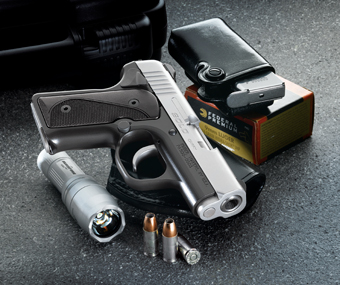
Coming soon is the Kimber Solo Carry 9mm, a lightweight handgun about the size of the Kel-Tec .380.  It’s about half an inch longer and wider in barrel and handle with a weight comparable to the loaded FN Fiveseven — easily a well-concealable sidearm that would be perfect for that undercover operative or officer.

They haven’t hit the stores yet, so the specs for James Bond: 007 RPG are speculative, but should be close.  The internals look to be a striker fired weapon like the Glock, but with the same barrel and recoil spring assembly as the 1911 (which Kimber excels at.)

PM: 0   S/R: 2   AMMO: 6   DC: E   CLOS: 0-2   LONG: 8-14   CON: -4   JAM: 92+   DR: +1   RL: 1   COST: $750

UPDATE! Having talked to several owners of the Solo here in New Mexico, it seems to be more than finicky on it’s ammunition. The JAM rating represents the Solo shooting 124grain and higher ammo. If using the mil-spec or junk 115 grain you’re likely to find (or lighter self-defense loads like the Pow-R-Ball, the jam is 85+. And that’s being kind.

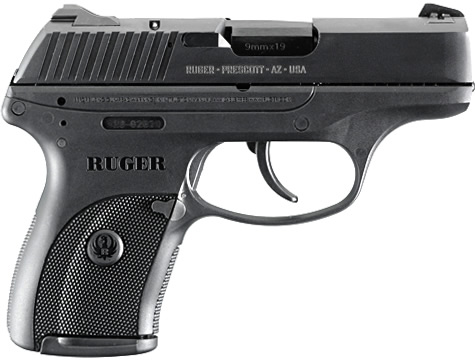
For the Kimber haters, there’s also the Ruger LC9 coming soon — a bit larger (an inch on the barrel and a half inch on the grip) than the Solo, but about the same weight.

PM: 0   S/R: 2   AMMO: 7   DC: E   CLOS: 0-2   LONG: 8-14   CON: -3   JAM: 98+   DR: +1   RL: 1   COST: $500

The core rules for Battlestar Galactica are pretty minimalist, designed to allow for quick action sequences that don’t detract from the drama or storytelling.  But BSG is inherently about conflict — the Colonials are fleeing Cylons, and are often fighting them.

Some players like a bit more “crunch” to their rules.  Especially when you have characters that are engineers, or deck crew — people who fix and maintain stuff.  They will want to know what systems got blown out, burned up, or shorted in the fight…and if you’re not the sort of GM to handle this on the fly, I’ve slapped together these rules to add a bit more to the spacecraft combat.

They’re crude and could use a bit of refining, so if you decide to use and improve them, let me know or kick me a copy of whatever you do to them.

Good hunting.

Here’s a character generation .pdf my group uses for making characters.

« Previous PageNext Page »