Looking over the weapons chapter in Secrets of the Surface World, I realized there were a few things in the weapons listed that didn’t feel quite right.  Granted, the Damage rating is a combination of power, but also accuracy…but there is still a great deal of error on the damage ratings of some of the guns vis-a-vis each other and archaic weapons.

I would suggest that the average flintlock pistol is far too highly rated.  The average muzzle energy of a flintlock is on part with a .380 revolver or automatic, and they are terribly inaccurate.  Instead of a 3W, a 2W is much more realistic.  I’m a bit torn on the 3W for .22 target pistols.   Yes, they’re accurate, but I find myself thinking the damage should be 2W with a better range (to better simulate the speed of the round) or a 3W with a shorter range to model the tendency of the lightweight round to be blown off target.

The most egregious error is the .357 magnum pistol and rifle listed:  5W?  Seriously?  The .357 magnum round is powerful and effective, but it’s certainly no moreso than a .30-06 round.  The 5W listed is ridiculously high — a 4W is reasonable in the rifle, but questionable in the S&W Model 27 or Registered Magnum.  The damage for the Webley MK VI and Fosbury is too high — the short-box cartridge fires a heavy bullet (266 gr to the .45ACP 230gr), but it is slower by several hundred feet a second than the .45acp.  Both should be 3W.  The Colt Single Action  .45 Long Colt  was the most powerful handgun round until the .357 magnum; it should be 4W.

Rifles are worse in SOTSW:  Nearly all are .30-06 or some comparable round like the .303.  Damage for all the 3W “game rifles” should be 4W, 5W for the more accurate rifles like the Webley #3062.  In military weapons like the Enfield #2, etc. with the .303, 7.5mm, etc.  — all comparable weapons — should be 4W.

“Friggin in the Riggin”

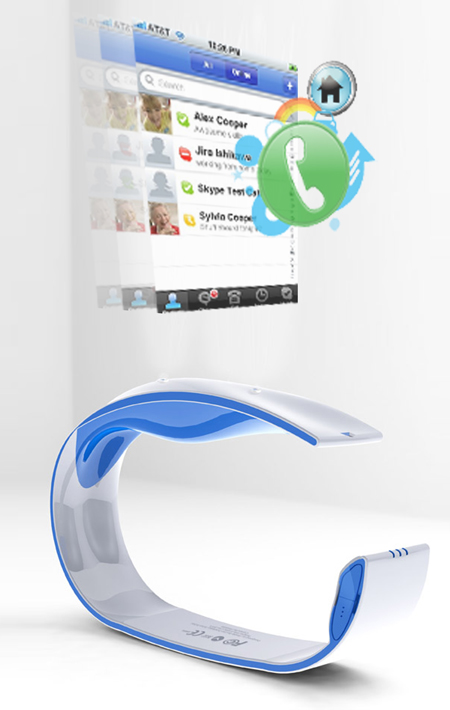
New for 2015:  the Holo 2.0 has a holographic display, powered by the movement of your arm.

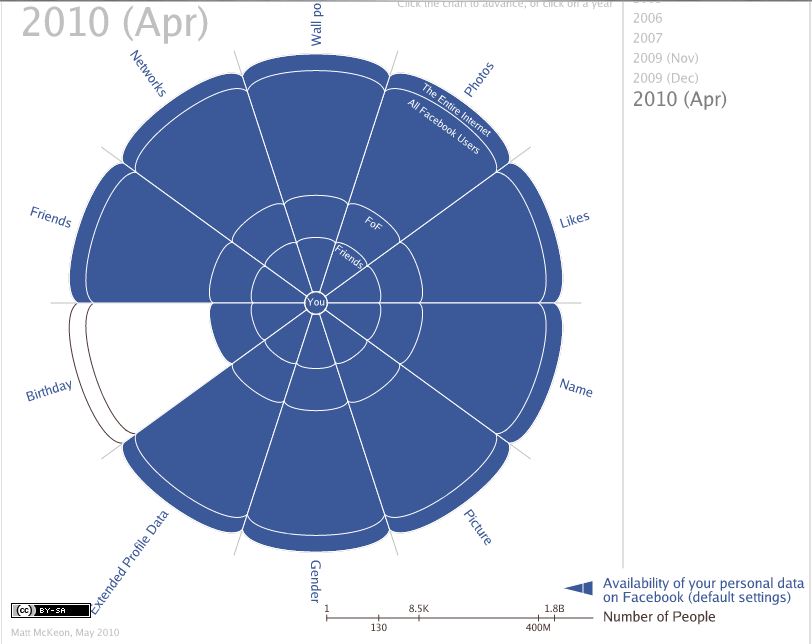
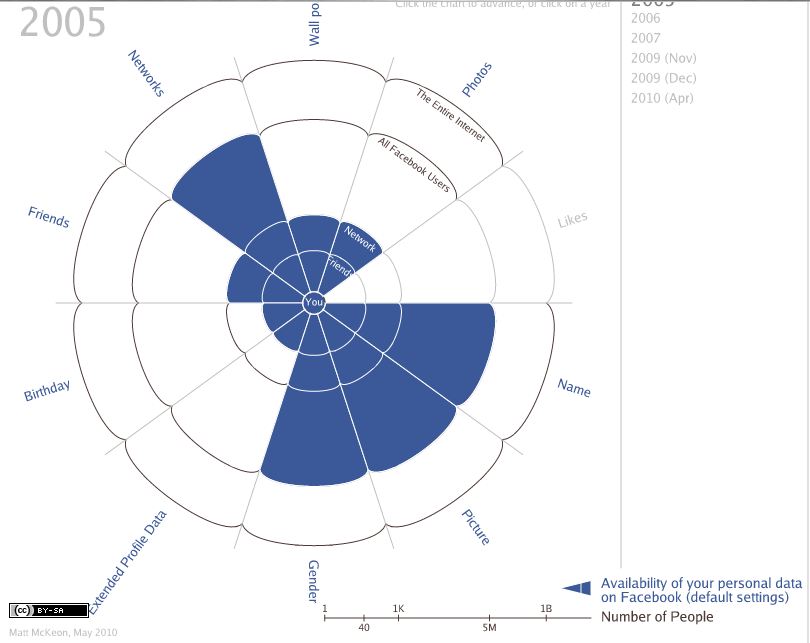
Wired has the story.  I understand that Facebook is an expensive proposition to run and maintain, and that the need to monetize its use was something that Zuckerberg could not avoid (welcome reality, open source folks!)  However, the sudden assault on privacy of the users of the service are creating a backlash.  Matt MacKeon of IBM has created an interactive chart showing the changes of the privacy policy and what information is exposed to friends, networks, and the internet.

Several of the people I have reconnected with on the service are bailing out, and I’m already thinking of bailing, as I did on MySpace.  This service might be the way to go.  Their project, Diaspora, is already funded and in the early stages of development.

Here’s a look at the changes from 2005…

…to today…

Here’s something for that James Bond: 007 campaign that’s taking place in the 1960s:  the Iso Grifo.  Built by the Iso Rivolta between 1961 and 1974, designed by Giotto Bizzarinni, who thought of it as an improved Ferrari 250GT (which he had also designed), with bodywork design by the Bertone coachworks.

The original Iso Grifo GL is a two door, two seat vehicle using a Chevrolet 327 V8 from the Corvette that was producing 400 hp, and after 1968 had a 427 V8 upgrade.  The vehicle was capable of 0-60mph in 6 seconds with a top speed of 170mph.  These cars were blazing fast and rare for their time, making them a great “style piece” for a character.

PM: +2   RED: 4   CRUS: 80   MAX: 170   RNG: 220   FCE: 2   STR: 6   COST: $7000 (1960s)

The 427 version…

And the AC/3 racing version…in action!

Most players of the Battlestar Galactica RPG are going to want to play viper pilots, but just as important — in fact possibly more important — is the Raptor. These vessels were used mostly for recon missions, and occasionally packed with missiles and rockets for some dramatic battle sequences in the show, but would the real use of these vehicles be?

The Raptor is the workhorse of the Colonial Fleet.  It acts as an SAR vehicle, recovering pilots that have successfully ejected from damaged craft; they are a small-group transport, moving sqaud-level troops into an area of operation; and they are an electronic warfare platform.  It is essentially a combination of Blackhawk helicopter and E-6 Prowler.

It is the role of ECM bird that is where the Raptor is highly important and overlooked.  Spacecraft in BSG are huge and ungainly — they don’t duck and weave to avoid missiles and gunfire.  They are also incredibly easy to hit with weapons — space is huge, but there’s also not a lot of stuff to hit on the way to the target.  This makes stopping incoming weaponry is of paramount importance.

Vipers are used to intercept and shoot down fighters and missiles in flight, and once ordinance is past this phalanx, the next line of defense is the ship’s point defense system.   In between these lines of defense is the raptor.  Acting in its ECM role, the raptor attempts to jam and confuse the missiles that are fired at their battlestar.  They can use this capability to confuse and limit the response of the raiders that are similarly attacking their viper squadrons.

During a combat turn, a raptor pilot or his ECO can attempt several actions:

They can attempt to jam incoming fire from an enemy unit.  The ECO or pilot rolls a ship ALE (usually a d12)+their Tech Engineering/ECM.  The result is the difficulty of the enemy to hit their target.  Example:  a Cylon basestar needs a 3 to hit the battlestar Pleiades.   Raptor pilot “Jumbo” attempts to jam incoming fire, rolling the raptor’s d12 Alertness and his d10 Tech Engineering/ECM.  He rolls an 11.  The basestar rolls its Alertness of d12 and a Heavy Weapons of d4 and rolls an 8…the missiles are jammed, missing the baattlestar or exploding in flight (confused as to their range to target.)

Although I don’t allow jamming of cannon fire, I do suppose that attempting to jam ranging DRADIS would be possible.

Second, a Raptor can try to jam the guidance or tracking systems of a raider.  The ECO or pilot does an opposed test against the raider’s Alertness +Perception.  If the ECO fails, the raider suffers no consequences.  If he succeeds, his success is added to the difficulty of the raider to fire on an enemy or avoid fire.

Example:  A particularly wily raider is harassing Pleiades‘ CAG, Professor.  He can’t shake the raider due to a series of really good rolls on the raider’s part.  His wingman, 3-Point, is trying to line the Cylon up, but it’s all over the place.  Jumbo decides to try and jam the raiders in the vicinity of his raptor, including this annoying toaster.  He rolls his d12+d10 (raptor Alertness+his Tech Engineering/ECM) vs. the raider’s d8+d4.  Jumbo rolls an 11, the raider an 8.  The raider now has a +3 to all difficulties on its tests (including adding to the dodging tests for Professor to avoid being hit, and 3-Point’s attack on the raider.)

A third option might be to deny the enemy use of communications — jamming their communications.  Doing this can seriously turn the tide in combat, by making it hard for the enemy to coordinate their actions.  The raptor crew can use their jamming test against the command and control elements of the bad guys.  this would make tactical rolls for the enemy more difficult.

Example:  Pleiades‘ commander has noticed that Cylons are running very tight operations, running their fighters in well-organized, coordinated attacks that their vipers are having trouble countering.  (Professor’s been rolling badly for his tactics test to gain initiative against the Cylons and it’s meant his squadrons are out of position and not intercepting Cylon raiders.)  He orders Jumbo and his ECO Drippy to find and jam Cylon communications.

Jumbo rolls a d12+his Tech Egnineering/Communications (a d6) to find the Cylon frequencies — he gets a lucky test of 18!  Having rolled onto the Cylons C3 signals, he has Drippy jam them vs. a Formidable (15) — Jumbo, being the player character, rolls for Drippy with his stats: a d12 for the raptor and a Tech Eng/ECM of d10 for a 17!  The Cylons now have a -2 to their Alertness+Tactics tests for the next round vs. Professor (rolling for the vipers) and Pleiades — and it’s just enough to allow Professor to use the confusion to get his people into position and splash some toasters.

There’s a downside to jamming, however, as any signals intelligence guy can tell you:  You have to broadcast loud and hard across the battlefield.  The makes you the brightest radiation signature in the area of operations…and that brings a lot of fire down on your position.  Jamming isn’t something you want to do for long, and you don’t want to sit still while you do it.

Locating the jamming element is EASY on an Alertness+Perception test.  Once spotted, the raptor crew can expect an anti-radiation missile (a missile which locks onto EM signatures) to come visiting in short order.  the pilot better be ready to dodge fire at any moment.  It also means that a raptor is unlikely to jam the communications across the battlezone consistently.  Leakage can effect friendlies, even if they’re not on the same frequencies, if they’re close enough.  (A botch and the friendly forces are being jammed.)

This gives the raptor player something more to do than wait for an SAR mission in combat, and makes them as important a part of the action as the gunnery officer or the viper pilot.
MANPADS are man-portable, surface-to-air anti-aircraft weapons.  In theBattlestar Galactica RPG, they give stats for the SMI92 “Flying Needle” — essentially the Stinger missile.  The weapon has a maximum range of roughly 15,000′  (about 3.5 miles), and damage of d8W, vehicle-scale.

Similar weapons like the Milan and the Starstrike use laser guidance, instead of optical sighting, and their rockets fly at about Mach 3.  The Starstrike uses a trio of “needles”, each made of tungsten and carrying roughly a 3 lb. warhead.  The Starstrike would have a vehicle-scale damage of d10W (and for Serenity a spacecraft scale of d0W.)

Once again, I’m doing a retcon campaign, so I’m going with the Abrams stype of phaser — two settings stun & burn a hole in you.

HOLD OUT/HAND PHASER

This is a small handheld phaser device with limited battery and power capabilities.  Civilian self-defense phasers are often similar, fitting in the palm of the hand.  The weapon is inaccurate more due to the awkward firing position than an inherent accuracy problem.  Most civilian weapons are stun only; dual setting weapons require the user to manually shift the phase tube (normally a sliding switch.)

Damage: stun/d6W     Power usage: 1 stun, 2 thermal     Battery: 20 charges     Range:  10m [close]

When set to stun, the victim must make an ENDURANCE test vs. Hard+success.  A botch means the victim is unconscious for 2d12 minutes, a failure for 1d6 minutes, and a success means they are at -2 die step to attributes for 1d6 combat rounds.

PHASER PISTOL (Starfleet Issue)

The starfleet pistol has a specialized phasetube that rotates from stun to thermal with the touch of a button.

Damage: stun/d6W     Power usage: 1 stun, 2 thermal     Battery: 40 charges     Range: 50m

DISRUPTOR (Klingon)

Damage: d8W     Magazine/battery: 20     Range: 50m

DISRUPTOR (Civilian)

Damage: stun/d6W   Power usage: 1 stun, 2 disrupt     Battery: 30 charges   Range: 50m

PHASER RIFLE (Starfleet)

This rifle version of the phaser is designed for combat, rather than self-defense.  It has three barrels that can be rotated from stun, to thermal, to a high thermal setting.  (Think a modern, streamlined version of the laser rifle from The Cage.)

Damage: stun/d6W/d10W     Power usage: 1 stun, 2 thermal, 4 high thermal     Battery:  80 charges     Range: 500m

Basically, from a mechanics point of view, shields in Star Trek work like armor — it soaks some of the incoming damage.  The shields degrade as more damage comes in, eventually failing.

Shields in Cortex Trek have two ratings:  wound and stun.  The Constitution-class starship for my retcon game (much closer to the original show ship) has a rating of 3W, 3S.  An attack from a Klingon D-7 might take a shot at Enterprise. The Klingons are firing at medium range, needing an average (7) to hit.  The gunner is an NPC so the GM rolls the ship’s ALE of d8 and a Heavy Weapons of d4: they get a 9.  Big E is hit with 2 basic damage, which is split into 1W, 1S.  Both are soaked by the shields.  They roll the damage on their disruptors: and roll a 2.  Another 2W hit the shields, but do not get through.  However, the shields lose a point of effectiveness.  This starts with Stun, then moves to Wound.

Here’s where the operations players can be of assistance.  While the tactical officer is shooting, the operations (navigator usually in TOS) tests to try and keep the shields fro losing effectiveness.  They roll their Tech/Shields as if doing a wound recovery test, in this case against a 5 (and average test.)  Say the character has an INT d8 and a Tech of d6.  [S]he rolls a 10.  The shield strength fluctuates, but remains 100%.   Had he rolled under a 7, the shield rating would be reduced to 3W, 2S.

If a shot breaches the shields, the ship tests for the reliability of the shields (VIT+WIL).  Say the next shot, the Klingons get really lucky:  they roll a 12.  That’s 12-7: 5 points of basic damage (2W, 3S), and roll a 6 on the damage.  8W, 3S total.  5W gets through and Enterprise takes a hell of a shot.  The shields are checked for their reliability by the engineering officer, command officer, or if neither of these positions is a player character, they GM.  (Engineering and command officers, however, can blow plot points on the test.)  The total hit of 11 requires a 19 to succeed.  They roll the VIT+WIL of the ship — a 5 in this case.  The shields are now at 3W, 2S.

Big E can take 18 points of damage.  She has 5 hit the hull.  That damage can effect the ship’s systems.  Do a series of reliability tests for the following attributes:  Agility+Willpower for the ships’s maneuvering thrusters vs. Average (for the 5W), Alertness+Willpower for the sensors, Intelligence+Willpower for the computers, VIT+WIL for systems like transporters, warp drive, weapons.  A failure lowers the die rating a step (a botch drops it to d0.)

Example:  Enterprise takes 5W.  AGL+WIL is a 7 — no damage to maneuverability,  VIT+WIL is a 4 — there’s a problem with life support and the Vitality is reduced to d8 until it can be repaired, and so on…  For systems, a VIT+WIL for engines that fails might mean the warp drive is offline, the same for transporters.  For weapons, it might mean a die step penalty for damage as a result of power loss, damaged emitters, etc.

This is where the engineers come in.  Mr. Scott, super-engineer, has an INT of d10, Mechanics/Repair of d10, and a Talented Engineer of d6.  He has a few things to attend to — he could try to repair the shields, the life support, or another system (one per combat turn.)  This is a bypass or jury rig, since a real repair takes time.  He rolls against the damage as a wound recovery (if the damage is STUN, it’s a straight test at Average.  This assumes it’s blown breakers, and the like.)  The system gains back a die step until the action sequence is over, or the system suffers another failure — in which case the jury rig fails and the original die step penalty is restored, along with the new damage.

An engineer can stage a second wind at anytime, recovering any stun damage and restoring a system of his choice.

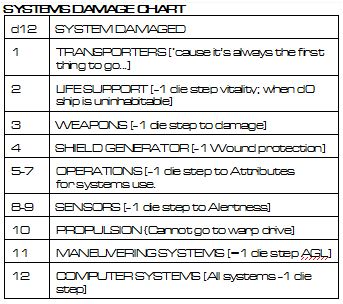
Alternately, the GM might want to randomly damage systems when the ship is hit. For that, here’s a quick random systems damage “chart”:

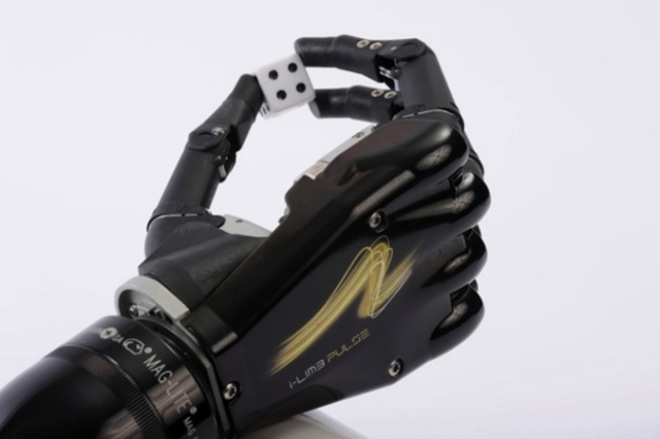
Wired has a piece on the new bionic hand from Touch Bionics, the i-Limb Pulse (OK…the iShit is getting out of hand…)  Thew new prosthetic is stronger (capable of lifting 200 lbs. if you can), it has greater sensitivity, allowing it to be used for fine motor work, and looks bloody cool.