Everything you’ve heard is true:  it’s gorgeous to look at, it’s even engaging for the first half or so.  The story is old hat.  So, what to add..?

First, if you’re going to bother to go see it, see it in 3D.  Instead of using it as a gimmick (oh, they’re shooting an arrow right at you!) Cameron uses it to create stunning depth of field.  You don’t feel like the image is a series of plates working on top of each other; the effects make you feel like the screen is more of a window, than a field for images.  One of the tricks they use to do this is to put insects, or bits of dust, ash, or what have you floating in the foreground.  It works well — there were several times I would have sworn one of these object drifted off the screen.  I didn’t notice any headaches, like I’ve heard some have gotten, but did feel like my left eye drifted out of focus a few times.

It works to pull you into the world Cameron is creating.  Pandora is stunningly beautiful, and I particularly liked the Roger Dean-esque floating mountains.  The flora and fauna is well thought out and well-designed.  However, I noted all the animals other than the natives in the piece (the Na’vi), were sextupeds — six limbs, usually four eyes, and breathing gills int he chest area.  The Na’vi are blatantly humanoid (most likely to make the love story work…it’s hard to get worked up about a love story between giant slugs, say.)

Following on that, the military technology is superbly thought out, and I wouldn’t be surprised if we see something like the movable displays on the gunships show up in the next iteration of military aircraft.  The craft — from the helicopters, to the shuttles, to the combat exos — are well thought out, completely believable, and uber-cool.  The super-helo they’re using in the combat sequences has design elements that are obviously cribbed from Aliens.  (I haven’t bothered to check, but I would suspect the gear is courtesy of the same design shop on that movie.)

The performances are adequate, with Stephen Lang doing the best job, in my opinion.  His Colonel Quaritch is undeniably a “bad ass” characature, but the actor makes him believable.  Part of the problem is the actors are emoting through the CGI characters, as well as having to work around the weak dialogue.

The story is old hat.  Evil corporate interests, supported by their mercenary army, are mining an unfortunately named “unobtanium” on Pandora, and those darned natives are sitting on the biggest deposit.  The unobtanium doesn’t appear to have a direct connection to the floating mountains (but should have!)  It’s not far fetched, this conflict, by any means.  But considering how touchy-feely many corporations are nowadays, I would expect that the PR nightmare of wiping out an indigenous species would not go over well.

The movie covers that, fortunately.  The company tried to educate the natives, provide them with medicines…all for naught.  They’re out of patience.  Colonel Quatrich, at this point, pushes the military option, leading to the big battle.

The hero, or course goes native.  This is the classic guilty white dude saved the natives theme that’s been floating around since the action stories of the 19th Century.  He falls for the hot chieftain’s daughter and after learning their ways, goes native.  He leads the ten-foot tall Na’vi against the human interlopers, with bows and arrows….not likely.  The final victory of the na’vi is about as likely as that of the teddy bears on Endor.  (Yes, I know they’re called Ewoks.)

There’s a lot to like about the movie.  The visuals are an experience!  The gadgets and sci-fi trappings are fascinating.  The story is hackneyed and predictable, and the characters are a bit flat.  Overall, however, it was worth at least one go ’round in the theater; it will lose a lot in translation to small screen.  See it in 3D, if you do.
A recent post on the Cortex RPG boards got me thinking about a problem with role playing games based on licensed properties like Star Trek or Battlestar Galactica, or even games with “metastories” like the World of Darkness stuff by White Wolf or Jovian Chronicles by Dream Pod 9.

The main problem is the extensive story arc (in the case of TV shows with the heroes of the universe in question being defined by the show), heavy backstory or world-building elements that are useful to the GM in setting the scene, but can get in the way of the storytelling when your vision of the world doesn’t feel with the established material.  While many GMs may be comfortable with making an established universe “theirs”, you can run the risk of what I’m calling “canon-pushers” in this piece.

Canon-pushers are, in short, the fanboys that either cannot come to grips, or are overly enamored with the fictional quality of these worlds.  You’ve met them — the guy that knows the events happening in Babylon 5 to the year, month, day, and minute; the middle-aged player that knows every detail of the deckplans for Enterprise-D, and all of the iterations every created for the original NCC-1701; the girl who will argue a story point because it conflicts with episode 304 of The Next Generation, and will point out that moon X on the Rim of the ‘Verse didn’t have cities (because they weren’t shown on screen, apparently the moon is desolate except for the set piece in episode 10 of Firefly.)

The same depth of detail that makes the universe so interesting can be turned against you faster than Enterprise moving at the speed of plot.  One of the easiest ways to get around this (if you have a reasonably adult crew of gamers) is to point out when you are getting the campaign started that this is your gaming world.  For a Star Trek campaign I simply used what JJ Abrams would — it’s an alternate reality.  I gave a quick run down of what I was keeping as “canon” for the game:  certain eps of the old show, most of  The Next Generation and Deep Space 9, none of Voyager. The movies, save for the first two, were out the door.  There would be changes to the technological timeline — tech that was discovered, then never talked about, was brought in.  You weren’t allowed to rewire the spiraling quantum whatsinator into a pulsing positronic whosijigger…unless the technology was similar.  With the understanding this was a different universe, we were able to turn what was supposed to be a mini-campaign into a 5 year game.  And it was good!

I love running licenses property-based games.  It cuts down on prep time for world building and most of the players have an idea of the look of things — clothing styles, equipment, aliens, etc.  It gives me a chance to do my own take on these universes.

Our Babylon 5 campaign was the most “canon-conscious” of the games I ran, based in a far corner of the action in the series.  It worked because there was overlap with the series’ events, but it didn’t not directly impact the characters and their actions.  The Serenity/Firefly campaign was set before the series (but after the war), giving me the chance to do some adventures in the ‘Verse without having to address the series at all.  Our current Battlestar Galactica campaign has run well, as there are plenty of places for survivors to be active ont he Colonies without ever running across Helo and Boomer/Athena, and another fleet might be running about looking for a habitable world, directed by “God” to help insure the survival of Man.

The GM should never be afraid to toss the stuff that doesn’t work, and keep the stuff that does for a game universe.  I have an upcoming transhuman sci-fi campaign in the works.  I was originally going to use the Eclipse Phase setting and rules set, but on further reflection realized that there were elements of the backstory and setting that were unwieldy and didn’t work with my vision of this kind of setting.  I began fusing elements of Eclipse Phase with Jovian Chronicles — one of my favorite settings for “hard” sci-fi (too bad Silhouette is clunky as a Model A) — and Transhuman Space.  All of these settings have something in common — RPG systems that were (in my opinion) a detriment to the gaming experience.

They’re getting mixed up, shaken hard, and ported into Cortex (Margaret Weis’ system for Serenity and Battlestar Galactica) and I’m hoping a for a successful synthesis.  I’m keeping the high-order AIs getting out of hand from EP…but using the old standby of they were defending themselves from being shut down by a UN edict against smarter-than-human AI (borrowed from River of Gods.)  I kept the Fall from JC, but now it was a fight between the AI and their mechanical minions, and the posthumans and transhumans.  the Edicts of the JC cover high-order AI, but it’s hazily defined and there will be a lot of gray area in the game.  I’m keeping some of the anime flair of JC — the giant mecha (themselves intelligent), for instance.  You’ll still be able to play uplifted animals, robots, human-like androids, etc. like in EP.

Running games in established game settings can take a lot of stress off the GM in the early stages of the campaign, but you and the players should be willing to throw canon out the window when it interferes with the storytelling, or more importantly, making the world your own.

Just in time for Christmas…okay, not in time for Christmas…  Three new weapons for your James Bond: 007 campaign.

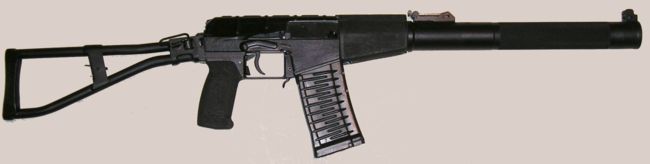
AS “VAL” 9x39mm ASSAULT WEAPON

Designed for the Spetnatz, MVD, FSB, and other security forces, the “Val” is an assault rifle with an integrated suppressor, using the 9x39mm SP-6 subsonic, armor-piercing round.  The round is a necked out version of the standard 7.62x39mm military round, and has twice the power of the 9mm Parabellum round used around the world… but with subsonic speeds, allowing the AS to be extremely quiet.

The AS has a folding stock, as is typical for Russian military weapons, and uses the same 10 and 20-round magazines as the VSS sniper rifle.

PM: 0   S/R: 2/10   AMMO: 10/20   DC: G/K   CLOS: 0-8   LONG: 25-70   CON: n/a   JAM: 96+   DRAW: -3   RL: 2

GM Information:  The AS is remarkably quiet and requires a PERCEPTION EF3 to hear the weapon at close ranges.

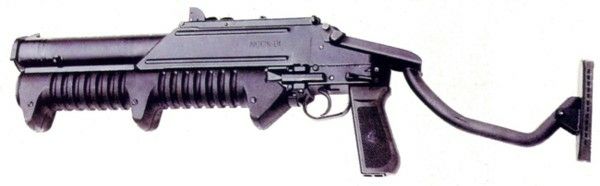
GM-94 43mm GRENADE LAUNCHER

The GM-94 is the latest weapon by the boys at Tula.  Designed for use by the Russian special forces for urban warfare, the grenade launcher has a unique pump action that allows the weapon to carry three grenades in the magazine above the barrel. The GM-94 can fire non-lethal rounds (tear gas and bean bag), or high explosive warheads with a plastic casing for reduced blast radius of roughly ten feet, perfect for room-to-room operations where the operator might have to fire at ranges closer than recommended for traditional grenade weapons.  The weapon is surprisingly accurate at close ranges, and has a maximum range of 300 meters.

PM: 0   S/R: 2  AMMO: 3   DC: varies   CLOS: 0-6   LONG: 20-70   CON:  n/a   JAM: 99   DRAW: -3    RL: 4

GM Information:  The VGM-93 thermobaric round is designed to impart high-pressure and temperature in a limited range.  A direct hit from the round halves armor benefits, and has a DC of H, but WL is reduced by two and applied to everyone in a 10′ radius.

Rubber rounds do DC G, but will not kill.

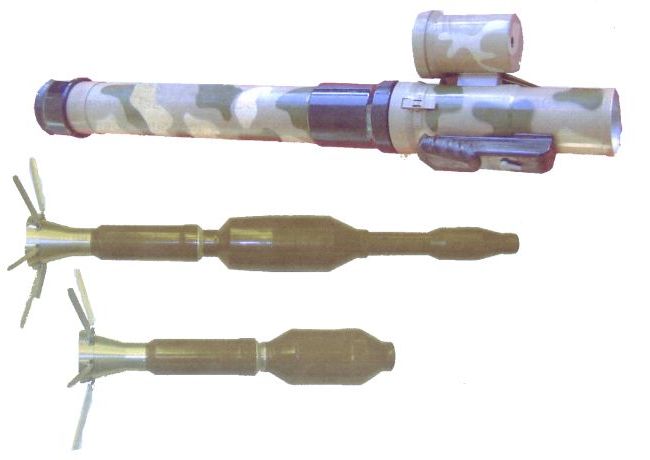
RPG-32 “HASHIM”

The new RPG-32 is a 105mm rocket launcher designed to defeat tank armor.  It utilizes either a HEAT rocket to defeat tank armor, or can use an FAE/ thermobaric charge with high fragmentation against soft targets.  The HEAT rounds are specifically made to set off Explosive Reactive Armor (ERA), like the kind used on Western tanks like the M1 and the Merkava.

This capability, coupled with the  RPG-32’s ease of use explains why it has been bought by the Jordanian military.  The launcher can be reused, is lightweight and easy to maintain.

PM: 0   S/R: 1   AMMO: 1   DC: K   CLOS: 0-15   LONG: 30-60   CON: n/a   JAM: 99   DRAW: -2   RL: 2

GM Information:  The RPG-32 has a blast radius of 20′, with a WL drop every 10′ after that.  The HEAT round will negate an armor DC reduction of four.  (Ex.  Armor Level IV would have a -4DC, instead of a -8DC.)

Twenty-five years of running espionage games has allowed me to develop a quick template, if you will, for plotting an adventure.  Strangely, this isn’t always the obvious (and successful) technique of having a bad guy/group and their desire (say…the destruction of the US economy.  Oh, wait…)

Normally, something on the news will catch my eye and get the brain working.  Somalian pirates have been nabbing ships…what if they get lucky and snag that weapon that was being transferred from North Korea to Iran?  Now you have to recover the weapon, but wait!  the Koreans are going after it to.  Quick thumbnail for an adventure.

Time to fill it in.  In this case, the story itself drives the location of the action, and possibly even the type of sequences.  Pirates:  we need a boat boarding sequence.  Good enough for a quick one-off, right there.  Need to fill another night or two?  The device was already moved!  The team must find the pirate vessel — damn!  It’s already in harbor in Mogadishu.  They need to slip ashore, not get killed by the Somalis in the area, and find the captain/crew.  Interrogate them.  Locate the weapon.  Throw in Korean commandos to make things interesting.

Maybe you just aren’t finding something to inspire you that day and the game is in 3 hours.  (This never happens, right!)   Sometimes starting in reverse works.  (Often, for me…)  Set it up like a Bond movie:  pick three exotic locales.  What do they have in common?  String a mission into it.

Example:  I know I want to do a big adventure where the team finally gets the chance to take down the bad guys they’ve been fighting.  We start with a teaser in the desert Southwest (just because.) Then the story gets rolling in New York (or London), next location is Shanghai in China (’cause it’s a big city, busy, and there’s a lot of cool architecture.)

Research the areas for action sequence locations.  The southwest gives you places for rock climbing, river rafting, or maybe they’re at a combat ranch out there, hoing skills when the bad guys hit them.  Lots of open space for an off-road car or motorcycle chase.  In New York, you’ve got Wall Street, the Empire State Building, the ruins of the WTC.  Just those quick choices tell me I’m thinking an economic plot.  Collapse of the world economy so the bad guy organization can make a mint shorting against the market (or whatever…)  The plot has been discovered in some manner, they start to investigate, leading to the next action sequence — car chase in the busy streets of Lower Manhattan?  A break in on a suspected connection’s apartment or hotel room?  I like the latter and want to keep it, but this is going to be a high-octane sequence, I’ve decided.  Their surveillance of the suspect is interrupted by his assassination by the lead henchman for the sequence.  I want a foot chase in Wall Street/downtown area.  Google Earth the location.  Find stuff to make it interesting.  But eventually, it’s going down into the subway for a chase on the multiple levels of the station.  Now I’ve got my henchman — a freerunner that can use the area to his advantage.

They’ll be able to find a clue to the plot through the dead man’s computer/emails/whatever — he’s investing in the futures market but his investments make no sense unless the whole system is in turmoil.  His money is coming from a Chinese concern in Shanghai.

Shanghai.  Way cool buildings.  There’s the Jin Mao Tower — very cool building with a fantastic atrium for an action sequence, and an outside scaffolding made for a climbing sequence.  Break into the offices of the organization.  Discovery and chase through the building, culminating with a jump down the inside of the massive tower, maybe?  Or a parachute dive off the outside and across Shanghai?  That gives the Chinese police a chance to get involved for a foot chase through the historic Bund section of town.  There’s a crazy cool tunnel under the river there.

Important in these types of games is to keep the action flowing fast enough to keep the players interested, but not so fast they can’t track the plot (unless you don’t have one…then it’s a good cover for that until you do.  This technique works better in games than movies.  See Quantum of Solace, which would have benefited from slowing down a bit.)

I rewatched the new Star Trek the other night and thought about the old game campaign I’d run and the possibility of a new one.  What would I change?  Would I use the new movie background or no?

A new Star Trek campaign for me would have to combine the trappings of both, I think.  I much, much prefer the old movie Enterprise to the misshapen thing they stuck on screen in the new movie, but the Apple Store interior, with some work, would be alright.  The hyperkinetic warp drive with the Earth-Vulcan travel times of a few minutes seems a bit extreme to me, as does the aerobatic maneuverings of Big E…this is a monstrous large ship.  She’s not going to be competing in the Red Bull Space Races anytime soon…

I like the new movie’s offhanded comments that suggest the new universe is much more dangerous.  The main fleet is massed somewhere…why?  Are they at war?  The fleet is described as a peacekeeping and exploration fleet.  Peacekeeping was one of their missions, but rarely mentioned as their main (although that was obvious) mission.   They promote a cadet to captain!?!  How friggin’ high is attrition in this universe, when captains are just turning their craft over to junior officers whenever the going gets tough?  Note the ships are more heavily armed, bigger, and faster…

I’d keep the idea of the galaxy being a much, much more dangerous place…not just due to combat, but the critters and situations run across.  I’d keep the larger ships, I think.

What I would keep from the old shows:  I like the racist, hypocritcal Vulcans.  This was a trope from Enterprise I really liked.  The Andorians with moving antennae from the show… keepers!

What I think needs added:  what, exactly, is the Federation?  Is it a collection of worlds/nations that act in concert but have internal sovereignty — like the early United States or the European Union, or is it an alliance, like NATO or even the UN?  I would go with something akin to the early US, with states having a level of internal autonomy (to preserve their cultures, etc.), but subscribing to certain set laws and principles.

What kind of economy does it have?  Is it a socialist utopia like the Next Generation envisioned, or do people actually work for a living?  And why would they?  Is there a population problem?  With space open, why worry about breeding restraints?  Would “protest” societies be out there — fringe groups looking to preserve their Celtic/Native America/whathaveyou culture, or groups looking to avoid the Federation “monoculture?”  What is the status of Starfleet in the Federation — do they meet with suspicion (as in the initial episodes of the original series), or are they viewed with pride? (as in the later series.)

What needs to be tossed off (in my opinion):  the World War III thing.  It was the standard future event in Cold War science fiction…I think it’s a bit worn now.  The Eugenics War is intriguing, and could be rescued, complete with Khan’s Central Asia Empire — replacing WW3 as the main event.  Perhaps throw in some AI troubles to cause the Federation to avoid strong AI usage, and you placate the transhumanists in your group.

I think my best bet is an alternate universe, free of the “canon” nonsense that trekkies are so prone to, and not constrained by some of the Star Wars-ishness of Abrams’ vision, but using trappings from both.

because they perpetuate stereotypes.  Thus perpetuating the image of geeks and nerds as humorless pussies.  Thanks a lot David Anderegg, you self-righteous dolt.

This is the second time in a week I’ve noticed my posts are not making it to the live feed.  Nothing in them was profane, yet they’re not showing up.

Interesting…

A few of these are written up in Secrets of the Surface World, but there are no pictures of them.  Since their stats are fairly similar, a lot of the reason for choosing one over the other is the look of the piece.  does it match the look of the character?  Does it aid in the character background (for instance, a Yugoslavian partisan might carry a Nagant 7.62mm revolver [Soviet stuff sold to them] or a Luger or Walther P-38 taken off of a German officer…)

Chamelot Delvigne or MAS 1873 11mm

The MAS1873 was the French standard from 1873 until 1889 and used an underpowered 11mm round.  While the gun was out of service after that, the Italians used a revolver based on it — the Bodeo Model 1889 10.35mm.  Italians nicknamed the piece the coscia d’agnello (leg of lamb.)  It was produced until 1925 and was still in service during WWII.  It was a six-shot revolver that was loaded and unloaded through a side gate, like the famed single-actions of the American West.

Dam: 3L   Str: 2   Rng: 50′   Cap: 6 (r)   Rate: M   Spd: A   Cost: $10   Wt:2.5 lb

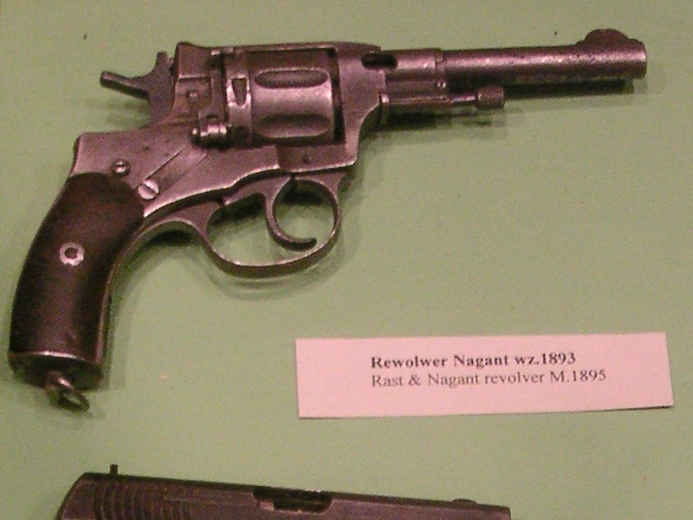
Nagant M1895 7.62x38mm

This revolver was unusual in that the cylinder moved forward when cocked to create a gas seal and reduce the loss of power when the round was fired.  Sweden, Norway, and Greece also fielded these weapons as standard issue police and military weapons.  Like the Bodeo, it was loaded through a side gate, due to the nature of the gas-lock system.  This made for a slower reload time than the break-top Webley or the side load of the Colt and S&W revolvers.  The 7.62x38R round is about the same power as the .32ACP.

Dam: 2L   Str: 2   Rng: 50′   Cap: 6(r)   Rate: M   Spd: A   Cost: $15   Wt: 2 lbs

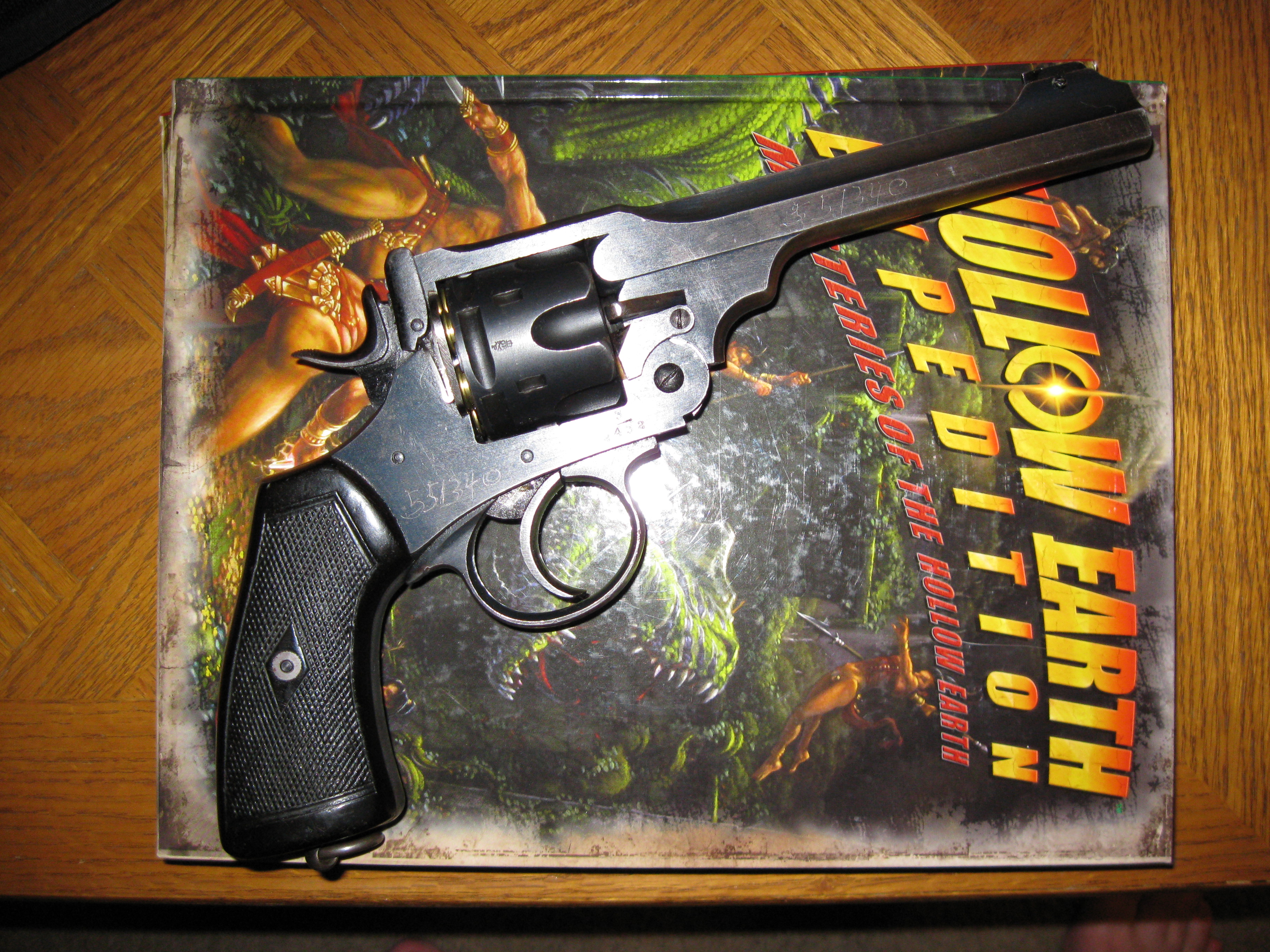
The following is a correction to the damage of the Webley revolver as written up in SOSW.   The .455 Webley round is a nice beast — I have one of the MK VI reovlers in the original caliber — but it’s a short-box cartridge.    While it throws a heavy 266 gr bullet (conical and soft, so it mashes and makes a mess) it is only moving at 650fps…about 200fps slower than the 230gr .45ACP.  The book has it doing a damage of 4L.  This is wrong.  It should do the same 3L as .45ACP.

Webley Mark VI .455

Here’s my standard-issue Webley .455, “Grandpa.”  This one has been converted to .45ACP and requires the rounds to be held in “moon clips” that hold the 6 rounds steady in the chamber.  My .455 looks the same, but I didn’t want to bust into the safe to get it out.

Smaller, and more popular with police and colonial constables was the Mark III .38 S&W (or .380 revolver) Webley.  It’s a six-shit, break top revolver like the .455, but uses a slow, weak .38 round.  It’s extremely pleasant to shoot, with little kick, and surprisingly good range.

This is my Webley Mk III (the first gun I ever bought) in .38S&W.  It’s lightweight, with a hair trigger in single action.  I’ve hit a man-sized target at 150 yards with it.  this particular one was pressed in 1897 for the Singapore Constabulatory, according to Webley’s records.  (Yes, they’re still around!  They make airguns, now…)

Dam: 2L   Str: 2   Rng: 50′   Cap: 6(r)   Rate: M   Spd: A   Cost: $12   Wt: 1.5 lb.

And the Webley-Fosbury — an odd attempt in 1915 to make a semi-automatic revolver.  The strange zig-zag grooves in the cylinder were to actuate the “semiautomatic” feature.  Pull the trigger — BANG! — the recoil would move the barrel/cylinder assembly back, cocking the gun and setting it up for the next shot in single action.  Great idea, awful execution.  they were finicky and prone to malfunction.  Fortunately…you just cocked the thing like a normal revolver and fired it.  Another plus, it’s one of the few revolvers with a safety catch.

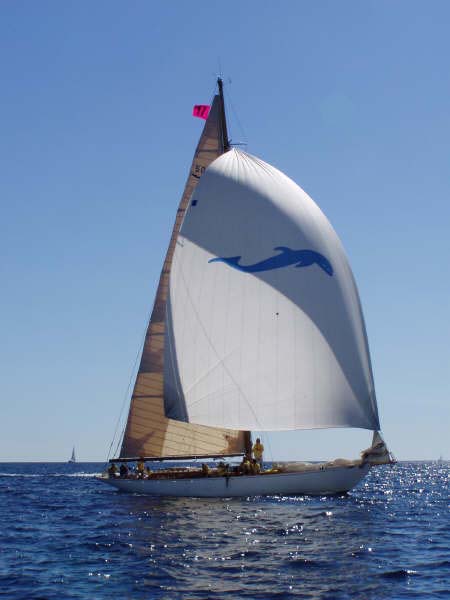
It was mentioned in passing this last episode that Artemis Campbell was in the market for a large sail yacht, something she could live on when getting away from business in the Adriatic.

Ariel is a Bermuda-rigged sail yacht 60′ in length designed by Andre Mauric for French businessman Paul Blanchet in 1940.  Because of the war, the boat was scuttled in Marseilles harbor to keep the Germans from breaking er up for the 13 tons of lead in her keel.  She was refloated in 1947 and bought by Artemis Campbell, notorious smuggling queen of the Adriatic.

Length: 18.35m   Beam: 3.99m   Draught: 2.6m   Mast Height: 23m

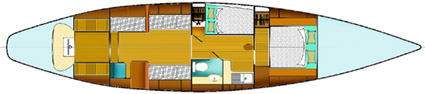
Accommodations include 2 cabins, a saloon with 2 more bunks, a skipper’s bunk aft w/ shower and washroom, cockpit dining table and galley, BBQ on after deck and dining table on foredeck, deck shower with potable water.  Equipped with radio and a wind direction and boat speed meter, an electric windlass and 100′ chain, 4 winches in the cockpit, and 7 on the mast and boom, as well as a 50hp motor with 300 gallons of petrol.

Hollow Earth Expedition statistics:

Size: 8   Def: 6   Str: 18   Spd:  20   Han: -2   Crew: 2   Pass: 6   Cost: $15,000

“Kinda makes you feel insignificant, don’t it?