Well…maybe not really. I just opened an “account” at the Whuffie Bank, no doubt inspired by the Cory Doctorow novels.
2 December, 2009
27 November, 2009
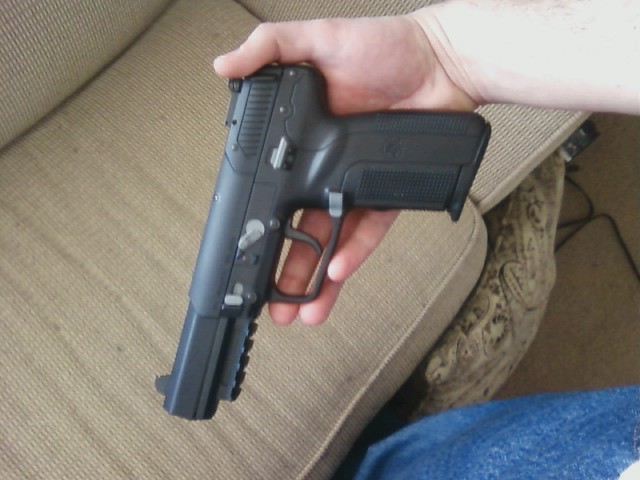
The FN FiveSeven handgun has received a lot of notoriety since it was released to the civilian market (10 years too late, thanks to the Clinton AWB) in 2005. Since then, it has gained a reputation that runs from “glorified .22” you’ll hear with the .45 aficionados (who view anything not starting with a .4 as too small to be an effective round) to the super-weapon that has such penetration it’ll shoot clear through to the core of the planet! of the anti-gun screeds. It’s called the mata policia in Mexico, and it was the weapon Major Hasan decided to shoot up a bunch of unarmed soldiers with at Fort Hood.
It’s been my carry gun since 2005. I would have been carrying it early, had it been available. I had a chance to fire the P90 during an open service shoot in the 1990s and was impressed with the submachinegun, but I never got a chance to fire the pistol until I bought one. After 10,000+ rounds through the gun, I’m still a fan of the platform and the round.
The pistol itself is a bit odd. The grip is long, but not thick and is best for people with longer fingers. I find the grip very comfortable and natural in it’s point of aim. The safety is ambidextrous and placed forward, above the trigger well. It seems odd until the first few times you snap it off quickly after drawing the weapon…it’s exactly where it should be; you only have to shift the firing finger, or use your off thumb to strike it off or on. The slide stop is back, where the right hand thumb can actuate it quickly. It is, however, in an awful position for the left-hander. I’ve learned when slapping the magazine in, to let my fingers on the right hand snag the release.
It is also incredibly light. With a full 20-round magazine, the weapon weighs about a pound and a quarter (half as much as the CZ-85 I also like to carry.) You can carry the thing all day without becoming fatigued, but it does feel a bit like a toy — a complaint of some of the reviewers out there. Frame and slide cover are plastic, and the metal bits are all alloys and aluminum. Despite the light weight, it’s very tough. It’s also an ugly bugger…
The 5.7x28mm round is, on paper, somewhat anemic. The SS197 rounds — V-Max 40 grain bullets — travel at a shade under 2000 fps, and hit about as hard as a .380 ACP round. The other civilian rounds from FN and their affiliates ( Federal and Fiocchi make rounds for the US market) is the SS192 and SS195 28-grain rounds. They are almost exactly the same, but the SS195s have lead free primers to make treehuggers happy (and make the ammunition only good for 3-5 years of storage.) Elite Ammunition loads their rounds in a variety of weights: from 28 and 40 grain rounds like the factory ammo, to a 55-grain and a smoking fast 32-grain (2400+ is advertised for the latter.) These specialty rounds will get your muzzle energies into the hot 9mm range.
The real benefit of the round is four fold: 1) you can cram a lot of firepower into a handgun, 2) the round has very low recoil impulse, making it easy to fire and control, 3) the round yaws on impact and according to a friend working for the Little Rock forensics department “is stunning in what it can do.” 4) the SS190 (restricted by law) rounds defeat Class 3 body armor. The civilian rounds are not armor piercing, but having fired a bunch at a friend’s expired Class 2 vest, we were surprised to find they blew through the thing the majority of the time. Two out of ten rounds got through his expired Class 3, but I suspect that was due to them hitting an area that was frequently folded and the fibers were weakened. I know of people who have had great success with nutria and other small to moderate sized vermin with the handgun at 25 yards.
Put the platform and the rounds together… The FN FiveSeven is highly accurate. The rounds move at about 1900-2200 fps, depending on which you are shooting, and give you a highly accurate gun out to about 50 yards. I dropped hits on a pumpkin, outdoors with a mild breeze, at 100 yards. (Out of the PS90 carbine, I hit a wine bottle at 300 yards with a light crosswind on the first shot.) At reasonable self-defense rounds of 10 yards or less, sub inch groups are entirely possible, and frequent with practice.
The extremely light weight of the FN, however, makes any twitch of the hand throw the aim a bit. Granted, this means you’re shooting a 2″ group, instead of a 1″ group, and the small diameter of the bullet means that it looks like you’re not so accurate…until you fire a 9mm or .45 at the same target and have a single round cover the two or three holes you thought were spread so far apart. I normal practice with a draw from the holster and a panic fire of three rounds to the chest area of a target at 15 yards with 2-3″ groups.
In the time I’ve had the firearm, I’ve had two failures to fire due to ammo issues, no jams, and only one mechanical issue: I wore out the magazine catch. FNH-USA replaced it for free…and I got a hat out of it. The magazine catch is, by the way, reversible for southpaws like me.
Despite the nay-sayers, I’ve never felt the FiveSeven inadequate as a self-defense round, it is fast and accurate, so you can drop two to three rounds in rapid succession with accuracy. Shot placement usually wins the day, and quite frankly…after the first round goes off, most people do not want to play.
As a carry gun, I feel I can recommend it, even with the high price of the handgun ($950-1200, depending on where you are in the country.) I carry it, and so do several friends of mine. I’ve never worried about it malfunctioning, like I did my Walther PPK. It’s a bit big for concealed carry, but we have open carry here in New Mexico. As a target pistol, it’s excellent fun, although the rounds are on the rich side at $20-22/box of 50.
27 November, 2009
Dropped into my local Triumph shop to pick up a new helmet and winter gloves, and was treated to a test ride of the new Ducati Streetfighter. The motorcycle is essentially the 1098, stripped for the city of farings and with a very aggressive headlight/instrument cluster that sits very low and gives the bike a nasty, scrappy look that reminds me of the MV Augusta Brutale…but meaner.

The saddle is hard, like most of the Ducati sportbikes, but there is supposedly a gel seat being made for the Streetfighter. That said, it was comfortable enough for a 20 minute jaunt through the twisties along the Manzano Mountains. Like all Ducatis, the gearing is long and the bike is deceptive in its power. You feel like you’re barely cracking the throttle, but the tach is reading 6000 at 55mph in second gear…but you’d swear you were only doing 30. Fortunately, there were no police on the stretch of street I was on when I first took the machine out.
Passing is effortless. Snap the throttle and hang on for your life. This bike is fast — slam the breath out of you fast. I got the Streetfighter up over 110 in forth gear in a second or two and was getting pushed backward in the saddle by the airflow over the bike. Maneuverability is unbelievably snappy and controllable, and reminds me of the Triumph Street Triple — the Ducati is super-light, and I could steer with a little pressure from my middle fingers. It’s like riding a cloud, and the Ducati does exactly what you want it to, no more, no less, and right away. The brakes are very strong and there’s not a lot of play or curve to them. And they stop the Streetfighter hard. Stopping distance is easily on par with my Speed Triples 110 feet for a 60-0 stop.
Sound on the stock pipes is a bit peculiar: the bike growls/purrs like a cougar, but the pitch is higher than I expected for a big bore sportbike. The bike is powerful, but has a definite feminine quality to it.
I highly recommend trying a ride for the sportbike enthusiasts out there. It’s a hell of a ride.
23 November, 2009
OK…time for something a bit different: a review of the CZ-85 Combat 9mm handgun. I bought one of these back in January because I have enjoyed the CZ variants I’ve owned or shot over the years — the Bren Ten 10mm handgun is one of the finest shooters I’ve ever had the joy to fire, and I’ve owned a few Tanfoglio Witness .45acp pistols — all tremendous values, as they usually cost a lot less than a comparable 1911. My current Witness regularly outshoots my friend’s boutique Kimber 1911A1, both in reliability and accuracy.
In the last eight months, I have put about 5000 rounds through the handgun, averaging 200 rounds or so an outing. There has never been a malfunction, and the only annoying issue is a tendency to throw Blazer aluminum brass onto my right shoulder when firing. (I fire pistols left handed.) It chews up all ammo I’ve thrown at it — Blazer, Wolf, Brown Bear (which it loves), and Prvi Partizan for practice ammo. At 10 yards, I can usually pull off 2″ groups with quick double taps. At 25 yards, my smallest group has been a hair over 2″ and largest 4″, unsupported. For slef-defense rounds, I’ve been running Pow-R-Ball 100 gr with a speed of 1450fps (according to the chronometer another shooter had set up this summer…this should give a 430ish foot-pound muzzle energy. Not bloody shabby!)
The handgun is well made, the finish in this case is the duo-tone — stainless steel frame and black polycoat slide. The finish has not degraded in the time I’ve had it, although the strange gray-colored barrel had polished itself to an odd dove gray color. I changed the grips from the plastic the weapon came with to CZ Custom’s cocobolo thin grips with half checkering. The gun looks quite fetching and the grip is very comfortable and points true coming out of the holster. The magazine holds 16 rounds. The CZ-85 Combat has ambi safety and slide release, but not an ambi or reversible magazine catch — the only alteration I think this gun needs to make it the perfect southpaw gun. Top it off with adjustable sights and phosporescent dots on the same (yes, you have to recharge them in the light.)

I like it enough that it goes on the belt once or twice a week, instead of the FN57 that I’ve been carrying for 4 years. Quality, reliability, and accuracy are tops, and the price for a no-frills all black -85 should be in the $550-650 range, depending on where in the nation you are.
I highly recommend it.
UPDATE, 28JAN2010: I removed the adjustable LPA night sights and traded them for Meprolight night sights — much brighter and they don’t need to be exposed to light for them to glow later. It’s Meprolight #ML17777, and the front sight needs to be drilled slightly so the roll pin can be put in to hold the sight.
Here’s a friend firing the CZ-85.
21 November, 2009
Review: AMC’s “The Prisoner” (Spoilers)
Posted by blackcampbell under Science FictionLeave a Comment
I’ve finally had the chance to view The Prisoner on my DVR last night. The six-hour miniseries was an update of the original 1960s television series by Patrick MacGoohan. The original was a product of its time: paranoid, overly dramatic (Pat…the microphone’s two feet above you, man!), and psychedelic, as you might expect for the time it was made. Canceled after 17 episodes, the series ended with a WTF episode that’s been analyzed by fans since.
The original series revolved around a spy quitting the service for reasons never disclosed. He is drugged and wakes up in a fairy-tale village in an unknown location and the rest of the series revolves around the attempts to find out why he resigned his job. It’s a spy series, mashed up with science-fiction.
AMC decided to take a crack at bringing The Prisoner into the modern day. The Welsh seaside resort of Portmeirion that had been the set piece for the original is replaced with a very stylish locale in the desert. This is the high point in the series — it is absolutely beautiful. The desert is shot lovingly, and the Village feels like a real place, not a set piece, as Portmeirion did. It should…in many ways, the Village is a character itself, much as Enterprise in Star Trek, or Babylon 5 was in the eponymous series.
The cast is solid: Ian MacKellen takes over the role of 2 — the manager/dictator of the Village. He is easily the strongest part of this new production. He brings menace, partly due to the character realizing that his methods are wrong, but necessary for the common good. The lead character, 6, is played by Jim Caviezel who is not bad in the role, but brings a much more bland flavor to the role. He just doesn’t feel important enough to warrant the amount of time 2 puts into breaking him. This is partly the fault of the writing — 6 in this is not a master spy, he’s an analyst with a skill for pattern recognition who realizes that his company is involved in some shady dealings.
The rest of the main players are Ruth Wilson, who is quite good and possibly, after 2, the most engaging character. Lenny James from Snatch and Jericho is a cab driver and friend of 6 in the series, and why no one has thought to make this guy a lead in something is beyond me.
The main storyline is not bad. The Village is more of a consensual hallucination of the people there. Their conscious minds are going about their business in the real world, but their quasi-conscious minds are trapped in the Village. The purpose of this is not the repository for spies and other persons of interest that it was in the original series; the Village is a sort of experimental therapy for “damaged people.” Good idea, poor execution.
The first night was, for me, interesting enough to keep me watching. the cinematography was pretty, and the differences between the original and the miniseries kept me involved enough to keep watching. The second episode almost undid all of that. The last half hour, particularly, was edited badly, with a lot of “classy” cuts back and forth to give the sequence a more “trippy” feeling. Instead, you find yourself wondering what the hell is going on. The final night moves quickly to wrap up the story, and some of the ideas present would have been great, had the writing and pacing been better. This was the main issue with The Prisoner — it’s slooooow. The pacing is not quite soporific, but unless you had a real interest in seeing a new take on the old show, it’s probably not worth your time.
Style: 4 out of 5, Substance: 2.5 out of 5.
19 November, 2009
Character Portrait: Admiral Helena Cain
Posted by blackcampbell under Roleplaying GamesLeave a Comment
To go alone with yesterday’s Pegasus posting, here’s my take on Admiral Cain. There are two versions, pre- and post-attack. Although some of the material in Razor helped to flesh out her background, I found the original Cain episodes of Season 2 to present not an insane woman, but one too sane. She is perfectly aware of their situation and is willing to do whatever has to be done to survive…even when she knows her actions are morally or ethically wrong.
Her step down from going through with the assassination of Adama after the attack on the Resurrection Ship, in my mind, was her first step toward regaining some of her moral compass. In many ways, I viewed her as what Adama could have become, had he not been shot by Boomer; he had been going down the road of expedience, and without his son or Roslin to give him a slap in the chops, from time to time, he could easily have gone Cain’s route.
Adama describes her as smart and well-connected in the extended version of Pegasus. That lead me to believe that she was more politically savvy than it would appear in the episode, and her crew’s loyalty is not that of a woman who was insane, or prone to irrational actions, but a steady, caring, but stern disciplinarian. Shaw’s arrival on Pegasus in Razor suggests a sharp, and somewhat cruel sense of humor.
Admiral Helena Cain, #866931

Tauronese female, age 49. Height: 5’9″ Weight: 140 lbs Hair: Brown Eyes: Brown
ATTRIBUTES: Agility: d6 Strength: d6 Vitality: d8 Alertness: d8 Intelligence: d10 Willpower: d10
Life Points: 20 Initiative: d6+d10 Endurance: d8+d10 Resistance: 2d8
ASSETS: Formidable Presence [d2], Lady Luck [d4], Political Pull[d6], So Say We All [d4]
COMPLICATIONS: Anger Issues [d2], Duty [d10]
SKILLS: Athletics: d6, Covert: d4, Discipline [Leadership]: d6 [d8], Guns: d4, Heavy Weapons: d2, Influence [Administration, Bureaucracy]: d6 [d8, d8], Knowledge: d4, Mechanical Engineering: d2, Perception [Tactics]: d6 [d8], Pilot: d6, Planetary Vehicles: d2, Survival: d4, Technical Engineering d6, Unarmed Combat: d4
At the time they meet Galactica:
ATTRIBUTES: Agility: d6 Strength: d6 Vitality: d8 Alertness: d8 Intelligence: d10 Willpower: d12
Life Points: 20 Initiative: d6+d10 Endurance: d8+d12 Resistance: 2d8
ASSETS: Cool Under Fire [d6], Formidable Presence [d4], Lady Luck [d4], So Say We All [d6]
COMPLICATIONS: Anger Issues [d4], Duty [d6], Out for Blood [d4], Sadistic [d4]
SKILLS: Athletics: d6, Covert: d4, Discipline [Leadership]: d6 [d10], Guns: d4, Heavy Weapons: d4, Influence [Administration, Bureaucracy]: d6 [d8, d8], Knowledge: d4, Mechanical Engineering: d2, Perception [Tactics]: d6 [d8], Pilot: d6, Planetary Vehicles: d2, Survival: d4, Technical Engineering d6, Unarmed Combat: d4
18 November, 2009
The last in this series, for now, is the Mercury-class battlestar. This is the newest, most powerful ship in the Colonial Fleet at the time of the Cylon attack. The onscreen example is Pegasus, and there is still a bit of speculation on her capabilities, but this is the best I could glean:
BATTLESTAR PEGASUS
SHIP DATA:
Class: Mercury Length: 5872′ Beam: 2187′ Draught: 1131′ Decks: 35 Scale: Spacecraft Crew: 1700 standard Passengers: up to 10,000 max
ATTRIBUTES:
Agility: d4 Strength: d12+d4 Vitality: d8 Alertness: d10 Intelligence: d10 Willpower: d10
Life Points: 28 Armor: 6W, 4S Initiative: d4+d10 Speed: 5 [SL/JC]
SKILLS: Heavy Weapons d6, Mechanical Engineering d4, Perception d6, Pilot d6
TRAITS: Construction Facilities (d4), Formidable Presence (d6), Tough (d4)
ARMAMENT: Heavy Skirmish Range Point Defense System (d12W Planetary-scale ), 34 Capital-Range Heavy Railguns (d12+d2W Spacecraft-scale), 24 Short Dradis-Range Heavy Missile Launchers (d12+d4W Spacecraft-Scale), 12 Short Dradis-Range Nuclear Missiles (d12+d8W Spacecraft-scale)
AUXILIARY VEHICLES: 200 (8 squadrons) Mk VII Vipers, 40 Raptors, 12 Marine Landing Shuttles, 6 standard shuttles, assorted work vehicles
 Schematics courtesy of Starship Schematics Database, Jim Stevenson’s encyclopedic site.
 The Black Campbell