Yes — there are spoilers. SCR

The second season of Daredevil dropped right when I was laid up with the flu and conjunctivitis, so lucky me — I was able to binge the series with a good reason. In some ways, the second season really improves on the first, and in others is a bit of a let down. Overall, I’d say the sophomore season doesn’t quite live up to the first for several reason that we’ll get into in a moment.

The season revolves around two main plotlines — the Punisher arc, in which an unstoppable killing-machine vigilante, Frank Castle, takes out scads of competing villains, is captured, and put on trial. The other is the surprise reemergence of Elektra Natchios, Matt Murdoch’s college-period girlfriend — who turns out to be a protege of Stick, part of the “war” he teased with a group called the Hand, and…well, she makes the Punisher look restrained and considerate.

First the best parts of the season — the focus and pacing is very tight. The characters are well developed and strongly written with the possible exception of Murdoch. Berenthal is fantastic in the role of Castle, with the nuance there, but dialed way down. He’s obnoxious, reactionary, and almost mad-dog violent, but he is also highly intelligent and there is still moments of humanity in him. Contrasting this, Yung is solidly convincing as the unhinged Elektra, and the weaknesses of the character are not hers, but the writing — she is simply unlikable. Beyond the snarky, violent exterior, there’s very little to be redeemed in her. Castle keeps giving you peeks of the decent man he was; there’s none of that in Elektra.

But the real standout, as with last season, is Elden Henson as Foggy Nelson. Where Murdoch becomes increasingly distracted by Elektra and the Hand, increasingly combative with Nelson over the latter genuine concern for Murdoch’s well-being, and less responsible by the episode, Nelson keeps their law firm afloat, shows up for work, battles a corrupt district attorney, and damned near wins a victory over their open-and-shut case until the Punisher purposefully torpedoes his own defense. He’s there for his friends, his clients, and he shows a faith in the system that — for all his protestations — Murdoch never does. More to the point, he’s smart, brave, and much more heroic than the rest of the characters for his firm convictions, his willingness to take the hits to his reputation and ego, and even some physical bravery.

He’s the real hero of Season 2. All the best bits of the season revolve around his legal machinations and pissing contests with the odious DA Reyes (you remember her from Jessica Jones.)

The main point of exploration is justice and the law, and the shades of vigilanteism. The Punisher is put up as an opposing view to Daredevil. Punisher isn’t looking for justice, so much as retribution for the death of his family by three gangs in a drug bust gone bad; Daredevil uses murder as his line — the point he won’t cross — and his vigilante nights are a response to the seeming weakness of the law. He’s filling in the holes where the system can’t tread. Murdoch slowly moves from viewing Castle as a villain toward seeing him as an extreme form of his own works, partly because Murdoch realizes that Daredevil’s tactics are less effective than ever, and partly because of the corrupting influence of Elektra. While occasionally battering the viewer with this dilemma, it doesn’t drag the show down.

Which leads to the weak points of the season. The Elektra plot line was set up in season one, with references to her in conversation, but mostly through Stick and his War, and the Black Sky (which becomes a very important point near the end of the season.) We find out that Elektra is one of his warriors, raised to the fight, and that Stick had pointed her at Matt in college to torpedo his career plans and lure him back. In some ways, this was probably the point where the Devil of Hell’s Kitchen really gets his start…I suspect, while it’s not explicitly rendered, that Elektra’s influence is what set him on his path. Yet, for all that set up, the pay-off is pretty weak.

Season 1 was a standout for the attempts to maintain verisimilitude in a superhero world. Daredevil’s foes were occasionally larger than life — Wilson Fisk, Nobu, Madam Gao…but they were believably portrayed. Season 2 suffers from a late 1980s problem in Marvel comics: f#$%ing ninjas. There is an army of these Hand ninjas running around — not dozens, but it seems hundreds of the bastards, and they are capable of “masking their heartbeats” but not their breathing…which super-hearing Daredevil doesn’t realize? Crying bullshit. Lazy writing to create more dangerous foes than they were. There’s a subplot about the Hand trying to find immortality, and about the Black Sky — apparently people of such sublime talent for violence as to be practically unstoppable. The secret ninja society trying to create the perfect weapon plot is slow burn until the last few episodes, then goes into high gear, and in doing so steps very quickly away from the sense of realism that the first season tried to create, and maintained well with the Punisher arc.

For all the Punisher is a caricature of the ’80s action hero — the superbly trained killing machine who can’t be stopped — he is vulnerable, emotionally and physically. He is a walking poster board for Fight Club through most of the season — battered and bruised to being almost unrecognizable. The explanation of how his gunshot wound to the head during the drug bust gone bad has caused him to live in a “heightened state of fight or flight; reliving the moment of his family’s death over and over” sounds plausible and makes him sympathetic. But he still can be put down. He still gets caught and jailed. He’s suprahuman, but not superhuman.

Another point where the season both succeeds well, but also makes the mistake of holding itself up for scrutiny to the first run, is the reintroduction of Wilson Fisk (who becomes Kingpin in the course of his appearance.) He is still pulling strings, still dangerous, even behind bars, and seeing him in action (including a fight scene where he easily batters the Punisher) serves to remind us of how grounded that story is in comparison to the half-assed ninja sorcery on the other side of the season.

Don’t get me wrong — Season 2 is highly enjoyable, and punches along at a great clip for the first two-thirds of the show, before the Elektra story moves to the forefront. It’s certainly worth a look, but in the end, it just didn’t quite tie it all together as well as they did the first try, mostly because they started to move too far from the tenor they set. I suspect, had the Elektra arc been saved for season three, with a bit more lead in to establish the “woo-woo” factor of the Hand, the arc would have been more effective.
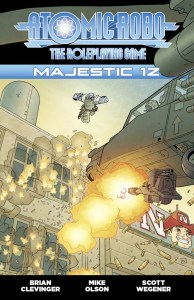
Admittedly, this is the “partially redacted” e-book version for the Kickstart backers, so some of this may change with the final version. With that out of the way — the boys at Evil Hat and Atomic Robo writer Brian Clevinger bring us the first sourcebook for the game: Majestic 12. The book revolves around the eponymous bad guy organization from the comic (and in particular their latest volume The Ring of Fire.

M12-Front-Cover-Mock-662x1024It’s a short splatboot, only 82 pages in .pdf. It begins with “The Secret History of Secret History” and outlines the creation and developmetn of Majestic 12. The second chapter briefly outlines the other secret organizations of the Roboverse — including Project Daedalus (which specializes in Helsingard tech), the Soviet’s Department Zero, China’s Most Perfect Science Division, and Big Science, Inc. This was a section I think could have been built out a bit, but more on that later.

Chapter 3 and 4 are the meat of the book. Three deals with new Weird Modes for characters, each for the six sections of the organization, and includes new skills like Teslology — the study of Tesla science and gear. Four focuses on some new rules — creating mission briefs, and requisitioning gear — which works like Inventions, except here you are getting gear not by building it, but by navigating bureaucracies. It’s a cool conceit and works well with the Atomic Robo rules.

There’s write ups of the various Majestic characters we’ve seen in the comic, as well as a few new ones. The final chapter is a series of adventure hooks.

It looks great, using mostly Scott Wegener’s art from the comics, but includes a comic vignette of the creation of Majestic with art by David Flora. some of the art, the indexing, and other things were incomplete (hence the funny redaction, which works very well with the flavor of the organization. I can’t wait to get the physical copy in a few months.

That said…I was very disappointed that they didn’t expand rules on Factions. In the core book, there’s very basic rules for Factions to cover Tesladyne, and how you can use the company to achieve your goals. In the core book, Factions only have a singular mode: Resources. Resources then have skills: Armory, Intel, R&D, and Transport. There is no write-up for Majestic. It would have been a simple text box to include it, so I’m hoping it’s in the offing, (and this may be the case, as Majestic’s Intel skill is mentioned in a few places) but I think adding similar stat blocks for the other organizations would be a good idea for those players and GMs that don’t want to write the stuff up themselves. With the new rules for Requisitioning, it might be an excellent chance to build out faction rules. (If you want some rules regarding organizations, you could also crib from Mindjammer by Sarah Newton…)

Style: writing and artwork (minus the Flora stuff) is solidly in the mode of the comics. I’d give it a 4 out of 5, for capturing the comic well. Substance: here’s where I have to ding them a bit. The lack of faction stat blocs is a big omission, but they might be part of the unfinished artwork. If so, I would expect to rate it higher than the 3 out of 5 I’m giving it, right now. Call it a solid 3.5/5.

So is it worth it? At $20 in physical form and you’re playing the game, yes. If you’re not a fan of the comics and game, then you probably weren’t looking to buy anyway.

Next up, the ubiquitous steam-powered aerial flyer, and the Aphid-class aerial gunboat of the Royal Navy on Mars:

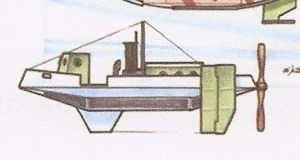
Aerial Steam Launch

SteamLaunchRightThese little craft are made by a few different purveyors in the colonized cities of Mars, and there are a few making these liftwood craft for Earth, as well. They are typically about the size of a water-bound steam launch.

SIZE: 4   DEF: 6   STR: 12   SPD: 20   HAN: 0   CREW: 2   PASS: 4   PRICE: £4,000

Aphid-class Aerial Gunboat

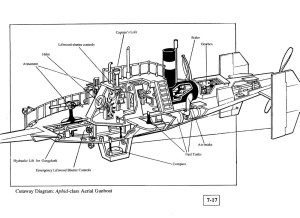
space-1889-lThe first of its kind, the Aphid class is the workhorse for the British Empire’s holdings in the Syrtis Major region. 65 feet in length, well armed for her size, and caable of speed up to 30mph, these small craft conduct aerial treasury activities throughout the colony.

SIZE: 8   DEF: 4   STR: 14   SPD: 30   HAN: -2   CREW: 15   PASS: n/a   PRICE: £23,000; WEAPONRY: 4′ short cannon (fore) — Dmg: 10L   Rng: 500′   Rate: 1/2   Spd: S   Size: 2; 2 1 lb. Hotchkiss Rotary Cannons (side mount) — Dmg: 8L   Rng: 500′   Rate: 1/2   Spd: S Size: 2; 2 Nordenfeldt machineguns (broadside) — Dmg: 5L   Rng: 250′   Cap: 40 (m) Tate: A   Spd: S

German Passenger Zeppelin

These lighter-than-aircraft are held aloft by hydrogen cells inside a rigid framework. The passengers reside in a car that is attached at the bottom of the hull.

SIZE: 16   DEF: 2   STR: 18   SPD: 50   HAN: -2   CREW: 15   PASS: 10   PRICE: £20,000

One thing Space:1889 fans might be interested in is actually using your aerial flyers and cloudships for the game. The basic rulebook covers just that — basics — but does not give the full statistics for even basic types of ships. So let’s rectify that, shall we?

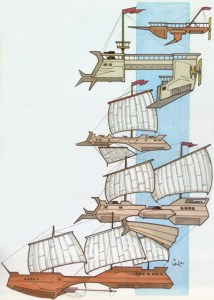
1889_06Most of the stats for Ubiquity are based on size, and you can find similar vessels to model the other stats on, save speed — the old Space:1889 or Cloudships rules use a speed rating that is roughy 2 cables for a turn, but I didn’t want to bother with a ton of math and findingout what a round was in the board game aspects of theold rules. I used the travel times in the core book where a steam flyer could go 300 miles in a day. Assuming they don’t stop, that gives us roughly a speed of 12-15mph. Most of the ships have a speed rating of 4-6. Assuming that estimate of 300 miles is at a leisurely pace I’m giving the ships a speed in Ubiquity of 5mph/speed point in the old game mechanics.

Martian Screw Galley, Small

The typical example of this type of ship is the Small Bird or Fleetfoot-class galley. Manned by up to a crew of 20, these small vessels are driven by a man-powered crank in the lower deck and are slow and not especially maneuverable.

Small Bird Screw Galley —  SIZE: 8   DEF: 4   STR: 14   SPD: 10   HAN: -2   CREW: ~20 PASS: n/a   PRICE: £13,000

Fleetfoot Screw Galley — SIZE: 8   DEF: 4   STR: 12   SPD: 10   HAN: -2   CREW: ~10

Typically, these ships have little or no armaments, save for sweeper guns (essentially big blunderbusses: DMG: 6L   RNG: 250′ RATE: 1/2   SPD: S   SIZE: 0

Martian Screw Galley, Large

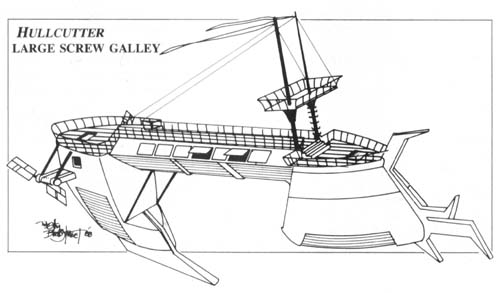
These mammoth screw vessels are typically between 90 and 130 feet in length, and have a draught of up to 50′, with crews of 60-100 personnel (about half of those yoked to the crankshaft.) Here we present a Hullcutter-class as the typical example:

Hullcutter

SIZE: 8   DEF: 4   STR: 20   SPD: 15   HAN: -2   CREW: ~60   PASS: n/a   PRICE: £50,000 WEAPONS: Rouge Gun (foreward) — Dmg: 8L   Rng: 250′ Rate: 1/2   Spd: S   Size: 1; Lob Gun (amidships) — Dmg: 10L   Rng: 250′   Rate: 1/2   Spd: S   Size: 2; 2 heavy guns (wing mounted) — Dmg: 8L   Rng: 250′   Rate: 1/2   Spd: S   Size: 2; Rod Gun (aft) — Dmg: 8L   Rng: 500′   Rate: 1/2   Spd: S   Size: 2

Martian War Kite, Small

The Bloodrunner is the smallest class of warkite likely to be encountered on Mars. At only 50′ in length, with a single deck, these are fragile, but agile, things.

SIZE: 4   DEF: 6   STR: 10   SPD: up to 25   HAN: 0   CREW: ~10   PASS: n/a   PRICE: £7000; WEAPONS: sometimes they will carry a pair of heavy guns fore and aft: Dmg: 8   Rng: 250′   Rate: 1/2   Spd: S   Size: 2

Larger and more typical is the Swiftwood-class light warkite:

SIZE: 8   DEF: 4   STR: 16   SPD: up to 25   HAN: -2   CREW: ~40   PASS: n/a   PRICE: £20,000; WEAPONRY: Rouge gun (fore) — Dmg: 8L   Rng: 250′ Rate: 1/2   Spd: S   Size: 1; 2 light guns (wing mounted) — Dmg: 6L   Rng: 250′   Rate: 1/2   Spd: S   Size: 1; 2 sweepers — DMG: 6L   RNG: 250′ RATE: 1/2   SPD: S   SIZE: 0; Grapnel gun — Dmg: 4L   Rng: 250′   Rate: 1/4   Spd: S   Size: 2

Martian War Kite, Large

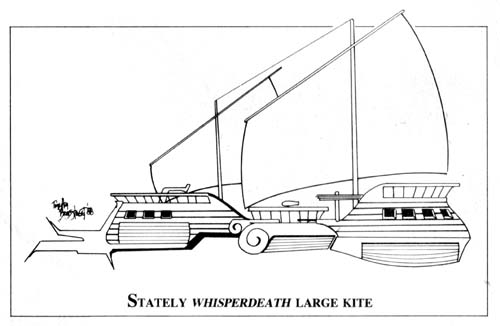
Here is the Whisperdeath-class warkite as an example. These ships are roughly the size of a 18th/19th century sailing frigate:

Whisperdeath

SIZE: 8   DEF: 2   STR: 26   SPD: up to 25   HAN: -2   CREW: ~40   PASS: n/a   PRICE: £60,000; WEAPONRY: Rod gun (fore) — Dmg: 8L   Rng: 500′   Rate: 1/2   Spd: S   Size: 2; 4 heavy guns (2 aft, 2 wing-mounted) — Dmg: 8L   Rng: 250′   Rate: 1/2   Spd: S   Size: 2; 1 Drogue Torpedo — Dam: 12L   Rng: up to 500′   Rate: 1/2   Spd: S   Size: 1; 2 Fire Racks — Dam: 6L*   Rng: 20’**   Rate: 1/2   Spd: S   Size: 2

* Drogue torpedoes are dropped on a line from the underside of a ship, and must be maneuvered into the path of another vessel. ** Fire racks drop incendiary liquid onto the deck of a ship below. Wind and other effects can carry this up to 100′ out from the rack. If hit, the fire will continue to do damgage at a die less/turn vs. the STR of the ship.

Martian Merchant Kite

These massive merchantmen are represented here by the Warm Winds class of kite.

SIZE: 16   DEF: 4   STR: 30   SPD: up to 30   HAN: -2   CREW: ~50   PASS: ~10   PRICE: £113,000

Typically, these ships are not armed, but very well could be, if one were to sacrifice the extensive cargo capabilities.

One of the few things that disappointed me about the Space: 1889 rules that came out recently was the lack of addressing Martian physiology in the rulebook. So here’s something more in line with what I expected for the new Ubiquity-powered game:

MARTIANS

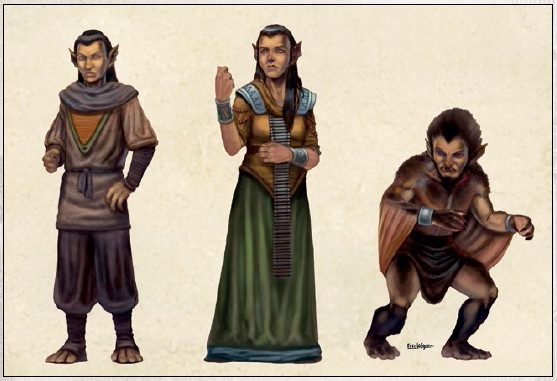
Hill, Canal, and High Martians -- as portrayed in Chronicle City's version

Hill, Canal, and High Martians — as portrayed in Chronicle City’s version

The denizens of Mars have three major racial types — the Hill Marian, found in the desolate wastes of the Red Planet; the Canal Martians, found almost exclusively in the urban and canal-fed areas of the world; and the High Martians — thought to either be the “Ur” Martian, or possibly a Hill Martians evolved to the particular environment of mountainous Mars.

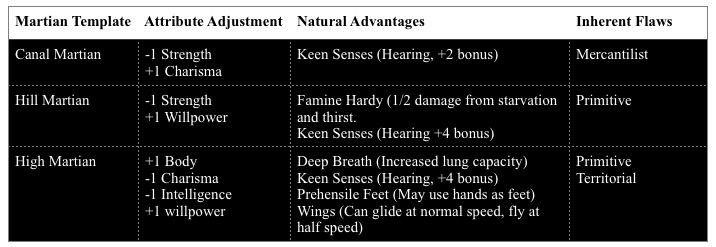
Using some of the Beastmen advantages from Mysteries of the Hollow Earth (pg. 14-25), I slapped together Martian character templates that were more in keeping with the original flavor of the game:

template

Venusians

Venusians aren’t set up as a player character in either any of the editions of Space: 1889, but I’m sure there are folks out there that might want to give them more to do in their campaign than be a poor man’s Sleestak. So here is a Template, vikked from Hollow Earth Expedition‘s Mysteries of the Hollow Earth to use to create a player character Venusian:

venusian

[This is a repost of an older one, but since I’m planning on statting out a bunch of the ships from Space: 1889, I thought it would be a nice kick-off. SCR]

Last week, we got all the players together for our next Hollow Earth Expedition adventure. We picked up with the group having arrived in London after their Africa adventure (see The White Apes of the Congo) — set up for a few days at the Ritz in Piccadilly, the characters set about trying to find out anything they could about the strange artifact from the city of the white apes, Mangala, at the British Library. Gustav Hassenfeldt, their big game hunter/guide, worked with Uncle Trevor doing research on others that encountered strange creatures like his “giant bat” at the Royal Geographical Society. His connections to the hunting world served him well and he is waiting for a vote to see him inducted as a friend of the RGS.

Lady “Zara” and Dr. Gould found a few references to the “Eye of Shambala” in the works of Sir Francis Younghusband during his expedition to Lhasa in 1904, as well as the memoirs of a German climber in 1920, the latter mentioned in the ramblings of Thule Society founder Rudolph von Sebbotendorf. This last claimed the Eye had been moved to protect it from the British in 1904; it was hidden in a cave under the northernmost chapel of the Potala Palace, and this was confirmed by the climber’s tale. Sebbotendorf has recenty escaped the Nazis, after having been jailed for claiming his Thule Society was the real power behind Hitler’s rise to power. The fuhrer, it seems, has not sense of humor…

Gus heard about a mountain climber and hunter named Munro Kinnie who claimed to have shot a “flying dinosaur” in Venezuela. He is currently in Montreux, Switzerland skiing and planning a run on the Eiger in spring. Sebbotendorf in also, supposedly, in the Lausanne area. They start working on trying to get funding for an expedition, andare contacted by Younghusand, who has invited them to dinner.

They learn from the old spy that he is the chair for the Himalaya Exploration Committee of the RGS, and after a long dinner, he offers to support their mission with a grant from the RGS of £100, matched by his own funds. With a loan of £200 from her ex-husband, they have enough to outfit and fly to Tibet, with a stop in Switzerland to talk to Kinnie. He has also arranged for Uncle Trevor’s grant to return to the Congo and find his apes, once more.

In Switzerland, the team is staying at the Beau-Rivage Palace in Lausanne. They go to Montreux and quickly find Kinnie at one of the ski lodges, getting drunk and taking a break from the slopes. Gus and Gould are able to convince him of their sincerity in asking about the dinosaur — he had found it on a tepui in Venezuela, and lost the catch due to the weak limbs of his bearers, who dropped the damned thing while they were scaling down the side of the mountain. The natives claim strange beasts have been sighted on the “Devil’s Mountain” — a tepui perpetually shrouded in mist. No pilot in the area is stupid enough to take on the mission to the top.

The party split, with Zara and Gould heading into town to drink and relax; Gus tries his hand at skiing, but not before being approached by a Dr. Albert Heiser — an archeologist and historian working at the University of Berlin, and a member of the Thule Society; and a George Werner, who if pressed, works for the Office of the Deputy Reichfuhrer. (Himmler, himself!?!) They offer to fund Gustav to find the Eye first for the Germans. They learned of their mission through some friends in the British Union of Fascists, and they also mention Sebottendorf (who they have learned escaped to Turkey), at one point. They believe the Eye is the product of the ancient Aryans — the Thule — and may hold the clue to the location of Ultima Thule, their ancient city (and Nordic knockoff of Atlantis.)

He politely refuses and Heiser is very understanding — he respects a man of integrity and loyalty. Werner, however, may not, as on his way down the slopes, Gus is attacked by a pair of thugs on skis, leading to a chase and fight with ski poles, and a jump off the side of a high cliff onto a sharp bank of snow. After returning to their chalet and informing them of what happened, the group rushes back to Lausanne to find their hotel suite ransacked and their Sikorsky S-36 sabotaged! They desperately get the plane fixed as the sun is going down and race off to Istanbul, to find Sebottendorf.

The chase for the Eye of Shambala is on!

I’ll admit, I was among the skeptical about the new Street Twin: How the hell could a larger displacement motor only make 54hp? Is the torque really going to be there across the band. Triumph shit the bed.

I was spectacularly wrong.

I got a chance to demo the Street Twin 900 this morning, and while I didn’t have it long enough to get an idea if the gas mileage estimates are true, or if the seat will be comfortable over long rides (I suspect it will be on par with the standard older Bonneville saddles), I have a really good idea of the handling and power. The torque comes on immediately and doesn’t let go until about the ton. Yes, I got it over 100mph and it still had plenty of power. It’s a squirty bike, blasting through traffic effortlessly.

I found I was cruising at 35mph in town in second gear. I didn’t go into fifth until I had gotten over 80mph. Passing a tree-filled truck on Old Route 66 outside of town, I popped the throttle in fourth gear and jumped from 75 to 85 in a blink. Similarly, passing traffic on the highway was easy. My guess — top end is between my 2010 Thruxton’s 122 and 130mph.

Handling — the bike is smaller than the old Bonneville, it’s lighter, the center of gravity is very low. It turns as easily as the Ducati Scrambler, is well mannered and stable, and the slipper clutch is effortless. I can’t stress how easy this bike is to ride, and ride hard.

If you don’t want to pay the $11k or more Triumph will be asking for the Bonnevilles and Thruxtons, you are not going to be disappointed with the “small” Street Twin — it’s brilliant!

2017 Jaguar F-Type

Jaguar_F-Type_V8_S_Cabriolet_–_Frontansicht,_12._Juli_2014,_Düsseldorf

Jaguar returns to the two-seater sports arena with the F-Type. The car is riding on a shortened XJ chassis, and can be had as a convertible or coupe, and uses an all-aluminum body and chassis. There are multiple engine configurations from the 3 liter supercharged V6 to the 5 liter supercharged V8, with the low end motor producing 340hp and a 0-60 of 5.1 second, and the biggest engine giving 567hp and a 0-60 of 4.7 second. Top speed is about 150 for the smaller V6, and 170 for the V8s. The vehicle features such amenities as 25 different driving profiles for the suspension, a low center of gravity, an automatically deploying spoiler wing, and gives the F-Type fantastic handling. The convertible top will open/close in 12 seconds, there are bi-xenon headlights, an active exhaust to beef up the engine note, and an interior of leather and brushed aluminum.

PM: +2   RED: 3   CRUS: 70   MAX: 150   FCE: 2   STR: 7   COST; $60,000-100,000

GM INFORMATION: The differences between the various models is small enough a single set of stats is applicable, save MAX: the V8 versions have 170.

[I can’t believ i didn’t get around to this one sooner… SCR]

The excellent folks at Mödiphius have gotten the license for the Conan roleplaying game. Now I’m not much on the sword-and-sorcery genre since I left my high school days behind, but for those of you that want some gritty fantasy goodness, jump on this bad boy! They’ve already blown past their $65k goal and at last look were at about $360k…enough they funded 11 other products off this.

I’ve had a look at the quickstart rules, and was impressed with how gorgeous even that 50 page taste of the game was. They’ve pulled top-notch artists for the project — Brom, Jusko, Tim Truman, Syrigos, among others. The system is 2d20 — a rules set that borrows a lot of good concepts, looks to play pretty simply. (Some of the writing makes it seem a bit more complex than I suspect it is.) An looks to capture the vicious, gritty side of fantasy, instead of the more friendly Dungeons & Dragons 5th edition. (Which I, surprisingly, liked!)

Speaking of — the 5th edition D&D is gorgeous. Truly a spectacular job from the production side of things, and Conan looks to be matching or surpassing that.

It’s not my cup of tea — I’m a bit more interested in the John Carter line —  but check it out, by Crom!


So, in addition to trying to boot up the new Hollow Earth Expedition game for the group, another genre I’m thinking of hitting is the cyberpunk, or at least near future sci-fi. Originally, I was thinking something along the lines of Greg Rucka’s excellent Lazarus comic — post collapse of the world economies and polities, and the rise of several large industrial fiefdoms around the world. The other influence vying for my attention is the police procedural cyberpunk of Ghost in the Shell (and specifically Stand Alone Complex animated series.)

After talking with the players, I’m slowly solidifying the game world around another project I’m working on. The police procedural angle has morphed into a news production team working for an internet news channel. Because I want that rainy noir quality to the setting, we were looking at Seattle, Denver, or Philadelphia as the city we’d use. I know the last the best, so right now, that’s the angle. Approximate time out, maybe 20 years in the future.

So how much cyber to put in this punk? The merging of man and machine is a lot less surgical than the works of Gibson and Sterling first posited. Instead of ubiquitous prosthetics, I’m thinking a lot of wearables, perhaps ones that can be worn to use of thought to access the internet, and which would act like the “cyberbrain” of GITS — by manipulating portions of the brain the “link” might allow you to see footage superimposed, or could record from your optic or audio nerve, etc. It gets you the same results, but with the added ability to have the damage the equipment, lose it, whatever… Prosthetics and prosthetic bodies would belong to the long line of military casualties from a never-ending War on Terror that has bled the developed world dry.

With many of the countries of the world “hollowed out”, there’s a lot of corporate sponsorship of government functions, a lot of graft and open corruption by government officials who still cling to the notion they are the only “legitimate” legal actors. Government types are constantly trying to wring cash from the people, and the divide between the rich and the rest has grown dramatically, mostly due to the government selling the legal system to the megacorps. There’s no true “poverty” like you see in Africa in the US, but there’s a lot of underemployment, lack of opportunity to create businesses and innovate because the big boys want no competition. The middle class has essentially been squeezed to the point they are no longer a factor. Without that steady stream of tax dollars, and with far too strong a technocratic oligarchy to steal from, the governments simply stopped being relevant, except for their ability to generate debt and use force. There’s a constant, uneasy tension between surveillance by the government and corporations, and souveillance by the people on these organizations. I’m picturing something between the kleptocracy of Russia, the bakshish culture of the Middle East, balanced by periodic Occupy/Tea Party/BlackLives political unrest and violence.

The goal was not to do the tired “evil corporations vs. the poor masses” schtick of cyberpunk. That was tired even in 1984. I didn’t want to do the Orwellian uber-powerful government, as well for the same reasons. What I wanted was something that looks like today, but twisted and turned up to 11.

I’m still trying to dial in on whether this is the way to go, but I think it could be off to an interesting start.