It’s just getting started, so there’s not a ton of the material that’s here just now, but I’m starting to port over the more popular stuff from this site to there. Come join us.

We’ve got the main page where everything new shows, but it’s also now broken into pages for games and geeky stuff, movies and entertainment (reviews and the like), firearms, and motor sports — this set up allows the fans of certain content and maybe not others to exclude those and get what you want.

I’ll begin with this: I’ve been playing — starting with one of the box sets of Dungeons & Dragons I got from Hess’ department store in…’77? ’78? maybe? Long enough that almost no one knew what D&D was. I know it took a long time to find someone who wanted to play. There was a distant cousin I wound up running the game for, and there was an older guy who was running D&D at the local library, but I remember he didn’t make it very exciting; it was very rules oriented.

Once I had an actually group of friends playing by 1980, we played a lot — and I was usually the guy running the show. That was partly because I didn’t have a lot of extracurricular activities, I could come up with a plot pretty, quick, and could usually improvise stuff on the fly. We cycled through a lot of games — all the TSR offerings, Universe and Traveler, then hit on James Bond: 007, which was my favorite system until about a decade ago. It’s still damned good.

In college, others would take over running games, but they usually would last a few episodes then hand it off to me because they were busy or just didn’t have the time. After college, I was down to a single player for a while before I moved to Philadelphia and picked up a new group. Again, me running. It was in Philly that I started being a lot more selective about who got invited to play. My roommate and I had the misfortune of meeting a 350-pound “ninja” who was so unrelentingly bad at peopling that we dropped him. He then stalked us for two months. I remember an incident where he was trying to call into the building, whilst me and my not-inconspicuous falt mate slipped into the atrium, got the inner door unlocked, and managed to slip up the stairs unnoticed by his well-honed ninja perceptive abilities.

There was an interregnum between Philadelphia and moving out to New Mexico where I was again down to one player before cobbling together a group over six months, pulling good gamers out of mediocre groups to form something special. In one of the groups, where I would meet my former wife, there was a goth Christian who wrote awful religious death metal music. He ran Call of Chthulu — and the experience was so Earth-shatteringly bad, I didn’t play CoC again.

The one GM that really sticks is this redheaded giant dude in Albuquerque, totally spectrum, who ran Dungeons & Dragons for his group of four. For about most of the session — which was a disaster — I started working on sussing out the players that were worth the effort, then peeled out the good gamers for our own group. This guy was stunningly misogynistic: after skimming through his 80 page bible on his game world, he gave us our characters, making sure the singular female got the cleric…who was mute. Seen, not heard. He rarely asked what she was doing, save when it was time to heal up the guys. Better yet, he made sure his wife was getting us drinks and food. He once played at our place and while stretching, he knocked the glass light cover off the kitchen ceiling. Shatter. Did he offer to clean up? Nope — he expected my then-wife to. Lovely fellow.

Even during the military, I was able to keep a game going with the wife and a rotating group of folks that came and went as we changed posts, and on returning to Albuquerque, I reconstituted parts of the old gaming group and added more. Divorce, remarriage, and a kid — there was always the gaming group, usually with me GMing.

I’ve manage to keep my gaming groups together for a good while. The original high school group gamed together, on and off, for almost eight years after we graduated and went out separate ways; we would get together once or twice a year at wherever was most convenient. The first Albuquerque group lasted — with a break for military service — twelve years. Several others followed, bouncing between two and six players, plus me. Recently, the current iteration of Nerd Night™, has been mostly the same people since 2017. In the last year, one of the other players took the role of GM for the first time. He’s been running us through Fallout, which several of the players know and have played the video game version, and there’s a promised Mythic Odysseys of Theroscampaign promised. It’s nice to play and not have the responsibility of the group on me but I did note — if I’m not available, the group doesn’t tend to get together elsewhere.

That brings me to the second topic of this piece: how does a group hold together for a decade or more? There’s a few reasons: 1) you have to be friends…not just for D&D. You have to get together for cookouts, or movie nights, or on the extreme end, blow a bunch of money to got to GenCon together. 2) There has to be the one guy that coordinates and keeps things moving. As forever GM, that typically has fallen to me, and still does — even when I’m not running. 3) Pick a day and time and commit. Yes, there will be kid’s plays, and illness, and trips, etc. but the group needs to meet regularly. Once a week is ideal, but at least every two. Longer than that and the momentum is lost. Chores, travel, other things will keep people away. If we have one player out, we typically have another player run the missing person’s character, or if the game allows for it, they are busy elsewhere. In our group of five, we’ll usually still play even with two down. We might do a board game night, movie night, or I find something I can run in a night. But you’ve got to keep it going.

This was originally posted at the new blackcampbell.substack.com. New stuff is hitting there. Come join us!

GenCon is one of those things that gamers all say they’re going to do at some point. It’s the nerd Mecca; going is the nerd haj — you’ve got to do it, sooner or later. It’s been one of those things on my radar since the ’90s, but I didn’t have travel to Indianapolis to play games and rent an expensive hotel room money in the ’90s. I’ve also always had the kind of jobs that don’t give you time to do it.

One of the players in my group makes the pilgrimage every year, and has since I’ve known him — 20 years! Man, I’m old! So we were discussing GenCon back in January when Matt (said haji) was getting ready for the ticket buying to open. The others all remarked that they needed to go at some point, where upon another player, our resident acupuncturist said, “why don’t we all go together?” Everyone agreed, save one. I was on the fence — time (it was close to when school was supposed to start), expense (yes, I could afford it…but still; it was a hit), and I’ve gotten more enochlophobic in the last decade or so (big crowds.) My wife was coming through the game room as I said, “I don’t know if I’ll be able to…” and stated, “You’re going.”

So I did.

The experience is weird. You buy your tickets through an online portal that opens at a select time. you buy your hotel rooms the same way, and if you don’t get an early time slot to order up your rooms, you find yourself housed in the ass end of nowhere. We got lucky and were in Hotel Indy, about a quarter mile (four blocks or so) from the Indianapolis Convention Center. You pick the events and games you want online and maybe you get them, maybe you don’t. i’m sure this is probably the most efficient way to do it, but it does mean you miss out on a lot. I mostly picked “mature” games, no kids — more because the idea of an old dude playing games with kids not his own was a bit creepy to me. I should have selected teens and mature to get more options.

We chose to come in a day early and leave on Monday. This cut the airline costs dramatically, and I popped for “comfort plus” on Delta so I had legroom and no one next to me for the flight out to Indianapolis. Two of the group flew first class. Must be nice.

Basically, gamers take over the downtown of Indianapolis for four days. There’s people in cosplay, but most of the people are wearing “the uniform” — usually some form of tee-shirt with game or franchise themed stuff on it. I had one idiot yell at me because he thought my Triumph shirt said “Trump”. I told him to read it again. (If you’re reading this…be better.) Traffic is awful and I really felt for the folks that had to get to work. At one point, I had to yell at some of the folks to let the traffic go, as we didn’t have the light. Social graces? — not on display at GenCon.

There’s a lot of walking. I average 6.2 miles a day according to my phone and the longest day was 10 miles. Blister time. Thursday is the start. You want to get in and get tickets and badges and everything, if you didn’t have them mailed to you. (I did. Good move.) The exhibit hall with the vendors opened at 1030 (although they were letting people in through one door a bit earlier.) There’s everyone there — although the Wizards folks were set up in nearby Lucas Oil Stadium. There was a lottery, I believe, to get one of the new Players’ Handbook and they were limited to 750 a day, I think it was.

I got a chance to meet the creators of Outgunned (and before that Broken Compass and Household) and speak a bit of Italian; the Lex Arcana folks were there as well. I finally met some of the people I’ve worked with in the gaming industry but have never physically met — which was nice. I spent too much money on dice, game books, a stuffed cat from the board game Boop! (which my daughter loves) — but much of the expense was food (and booze.)

I can heartily recommend Harry & Izzy’s, which is just a block from the convention center and has a nice Prohibition-era feel to it. the steaks are tremendous. It’s affiliated with St. Elmo’s next door, which is a stable for the GenCon crowd. Taxman was also good.

And that was the strange thing — dinners were the best part of the outing for me. I got a chance to reconnect with an old service buddy from Defense Language Institute who was running games for one of the D&D tables. I got to meet local gamers that were part of Haji Matt’s other groups. The socializing not connected to playing was more interesting for me.

Which brings me to the weirdest moment…I’ve always identified as a gamer, and a bit of a nerd. But that’s it: a bit of nerd. I always was the weird kid way back in school. Here, I felt very normal (witness the traffic incident above). It was strange to be “in the tribe” but not of it, if that makes any sense.

The games were good. We did one of the True Dungeon runs, which was fun and they put some work into it. I played in a Blade Runner game that was decent, and in an Alien game that was downright superb. The GM was on it, I connected well with the “buddy” and “rival” characters and players, and we managed to finish out a scenario that had TPK’d two other parties, and half of another. We lost one guy. Tactical acumen for the win. One game didn’t make because most folks head home on Sunday, so Sunday games often don’t make, so I chatted with other GMs for a while. I did a few drop-in games, as well.

Overall, was it worth it? It was damned expensive, but it was nice to see people I hadn’t in a while. Was it worth getting the newest stuff a few weeks early? Sure. did I have fun? Yes…but I’m not sure I would do it again. That said, when I told my daughter that last bit, she looked disappointed. So I guess, I might be doping GenCon again with my kiddo in tow.

Over the next few weeks, a lot of the content from this site will be migrating to the new site on Substack: The Black Campbell Review. There will be a lot of the same types of things we see here — a tighter focus on RPGs and other nerdiness, but there will also be a review site for things like firearms, motorcycles, ans other manliness once I’ve got my feet wet over there.

Eventually, this site will get decommissioned or turned into a storefront for Black Campbell Entertainment. I haven’t decided yet.

As for Black Campbell Entertainment — there’s a few new adventures being written right now that will hit DriveThruRPG in the next few months. We will also be branching out from our usual pulp action material that has been the core of our work toward other genres — sci-fi, horror, and maybe even a bit of 5e related stuff. We’ll be sticking to PDF for the new stuff, for now, as DriveThru has gotten finicky about the layout process for print and I have to retrain myself on some of the software to get around their nonsense.

A lot of this has been percolating since about 2021, when we pumped out two books in six months. We’re a small outfit and that combined with the COVID idiocy and a full time job burmed me out something fierce. It’s taken until a few weeks ago, when my school decided to go to what I derisively call “course in a can”. The school bought curriculum that is pre-packaged, often scripted, and where it’s been tried, demonstrably lackluster. No room for academic freedom, no room for reteaching or getting off schedule, no room for the students, who are to be “aggressively monitored” (as are the teachers). So I decided to walk away.

Now I have the big question: do I pivot to writing and creative work and leave teaching — something I’ve been doing at college and high school for almost 15 years; or do I go find another job in the classroom and hope things get better. The wife is of the opinion I should do the former. We’ll see.

For now, however, join me over at blackcampbell.substack.com

I’ve had several PPK and PP knockoffs across the decades, but I didn’t buy my first actual Walther PPK/S until about five years ago, when an Interarms period Walther showed up for a very reasonable price. It’s a great pistol, but I replaced it with one of the new Fort Smith-made PPKs in .380 a year later. With the release of the new Walther in 7.65mm (.32 acp), I jumped on the first one I saw when the guy that had been thinking about it didn’t just buy it. He walked away to look at something else; I bought it.

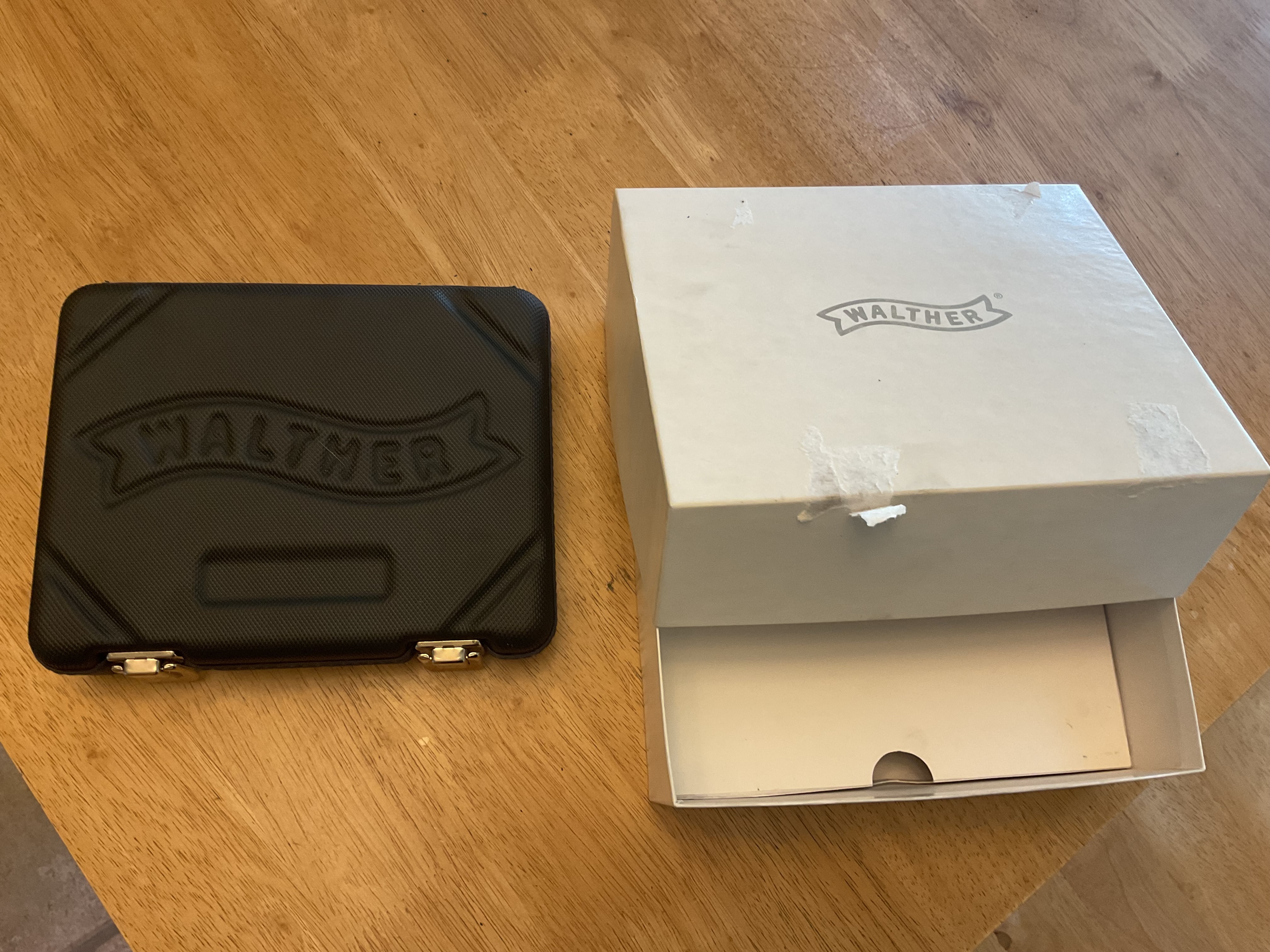
First off, Walther definitely took a hint from some of the latest packaging trends. The pistol comes in a very Apple-like simple white box with a gray Walther logo on it. Inside, there is a blue presentation case that is quite nice, with the pistol and extra magazine inside. Documentation, etc. is under the flap in the white box. Noticeably missing in the box is what you used to find — a spent cartridge and a target showing it had been test fired. I haven’t seen this in most manufacturers of late and I suspect a lot of them are kicking their products out the door without an actual test firing. That said — an A for presentation.

Both the .32 and .380 PPK are the same size, weight, and have the new extended tang/tail on the back of the frame. A lot of folks, especially those with bigger hands, love this. I do not. The pistol is beautifully formed, but the tail carried a sharp angle from side to the underside. I find a too high grip on the .380 and I come away with a triangular bruise in the webbing of my hand. Your mileage may vary. One complaint I’ve heard about the new tail is it presents a spur that could catch if you pocket carry. I haven’t experienced this issue in the years I’ve been carrying the PPK in my pocket. If you put your thumb on the hammer of the pistol while drawing, it clears a pocket with little issue.

The very low profile sights are minimal, to be kind, and this aids in concealment and in drawing from teh same. This is not a long-distance weapon. This is made for self-defense distances — under 15 yards. At contact to 5 yards, I can keep a two in the chest drawing and firing fast from low port, with a quick aim and follow up for a head shot. Rapid acquisition of the sights is doable and sub-2″ groups up to 10 yards are easy with little practice. For me, this has been the case with every version (including knock offs ) of the PP and PPK platform.

Back to build quality: The engraving in the “little” PPK is excellent — much deeper that you see on the .380 — to the point I can tell them apart just from that. (The .32 in the bottom pistol in the following images.) If fact, the only real way I could tell the difference otherwise is the slide is sprung much lighter on the .32, and is very easy to manipulate, whereas the .380 requires a bit of pull to cycle.

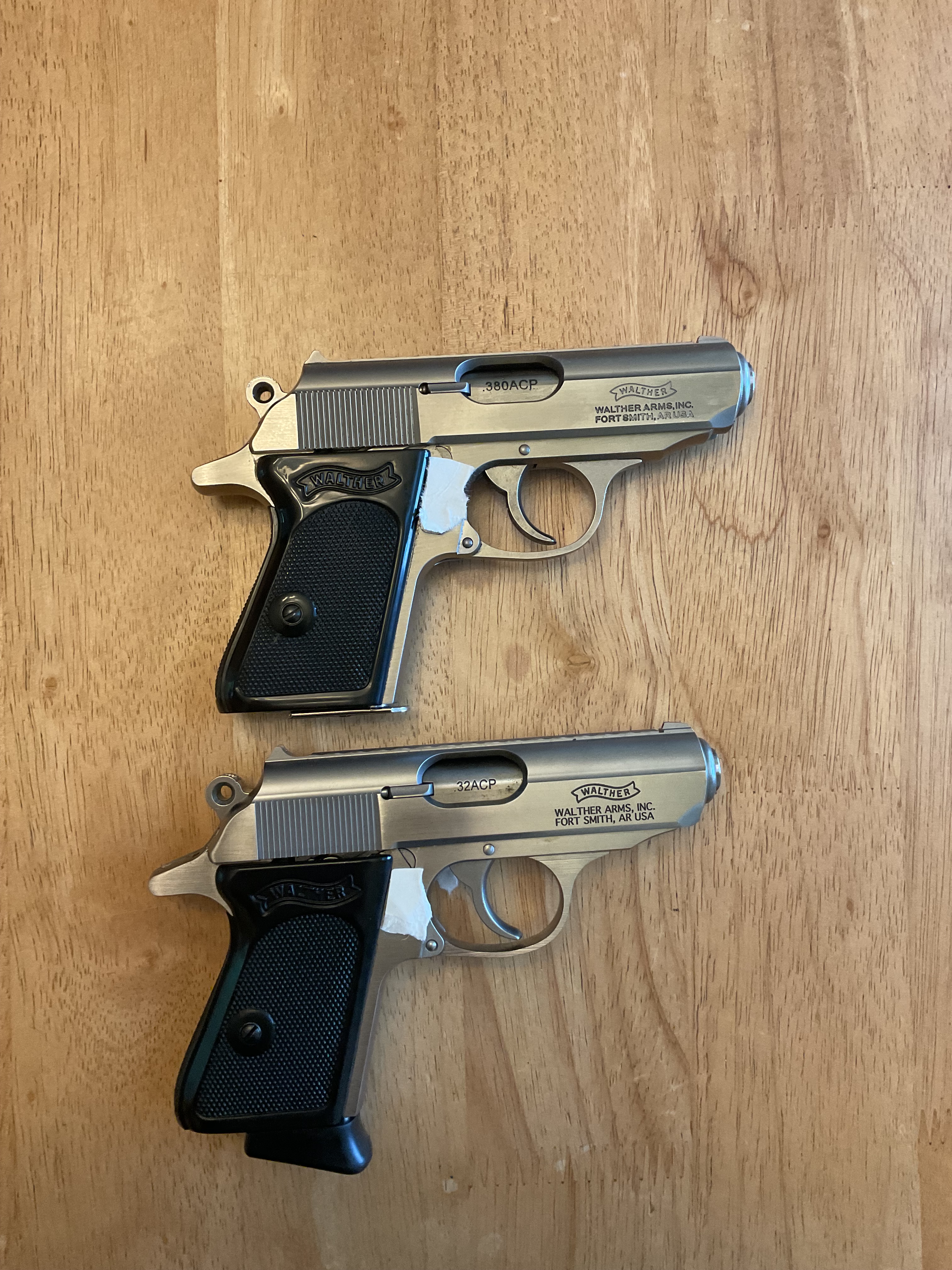
Trigger pull seems to be about the same between the two pistols, though I haven’t measured it — it should be about 10ish pounds on a long double action with a fast, crisp break; or a 4-5ish lbs. single-action. There’s a bit of takeup on the single action, but once you hit resistance, it’s going to break clean. The extractor spring seems a bit weak on the .32 — more on that later. Even the magazines will swap from one to the other, and yes — the .380 fit in the .32 mag. The only visible difference is an extra witness hole with a 7 to show the .32. The .32 mag in the .380 will lock in but will not lock the slide back. If still fed a round into the chamber when cycled. I’m not recommending you do this, but I was curious…

Take down and cleaning are the same, although my recoil spring on the .32 did not want to come off like the .380 does, and I didn’t want to use too much force. I just lubricated the barrel around it. Then it was off to the range to shoot both and torture test the little one.

For the .380 I used Freedom Ammunition’s 100 gr. remanufactured FMJs and Sellier & Bellot 90gr. FMJ. The .32 was fed only FMJs — 150 rounds of Magtech, 100 rnds. of PMC — both 71 gr. FMJ; Fort Scott 71 TUI., Aguila 71 gr. and Fiocchi 73 gr., then finished with 40 rounds of Underwood .32+P 55 gr. Xtreme Defender with the fluted copper bullets.

The .380 Walther has eaten everything I’ve thrown at it from 68gr. Lehigh and Underwood, to 100 gr. remanufactured stuff, and the only issue I’ve had is with S&B. There’s a real snap to the recoil impulse that is sharp enough that very occasionally, it will half drop or fully engage the decocker! It happened once with the Freedom 100 gr. on this trip but hasn’t happened before. Fortunately, everything else runs fine and the 90 and 68 gr. Underwood perform flawlessly, with hits into a coke can from 20 yards — no issues. I stay away from the S&B for my .380 PPK, although I’ve never had an issue with anything else.

The .32 — oh, the .32. The first box of Magtech was causing issues — solid primer strikes that dented the hell out of the primer, but requiring two or three trigger pulls to get them to ignite. I put this down to the ammunition. I was also having failures to eject. The empty would extract, but get caught above the incoming round about half the time. Then I figured it out: On the .380, the recoil with the new tang makes me teacup the pistol, with my thumb folded down. On the .32, I was riding with my offhand thumb forward…and pressing to the slide. I was slowing the action and causing the failure.

On the PMC, I started having stovepipes. I was 170 rounds in, so I stopped and cleaned the gun a bit. Problem solved for about 50 rounds, then recurred. However, when I switched to the Aguila and Fiocchi I had no such issues. They’re both slightly faster cartridges than the Magtech (which fired dirty!) and the PMC. The little PPK likes the hotter stuff. The Underwood +P 55 gr. Xtreme Defenders ran without an issue and printed solid 2″ groups at 10 yards free-standing. The Magtechs had the worst groupings, but partly that was my stop-and-start shooting while clearing jams. The stovepipes were super easy to clear: hook the casing with my finger and pull. The gun would go into battery and fire, no problem.

Now…I’ve used Fort Scott ammo before and it’s good stuff. Just not in the PPK. Every. .single. round… failed to feed, jamming up going into the barrel and requiring me to take the slide off to pry them out. The bullets are just too long for the breech. Avoid them for the .32 pistol! It does seem that the .32 is more finicky on ammo. It likes the hotter stuff and when it gets dirty, the chance of jamming — mostly stovepipes that can be quickly cleared — goes up. This is much the same for the .22 PPK/S my daughter has as a plinker; 40gr. only and the hotter the better, or you’ll get failures.

Would I carry this as a defense pistol? No, I’d stick with the .380 PPK or if I’ve got the opportunity to carry on my belt, my Alpha Foxtrot S15. If I want a deep concealment .32, the super-light and small Kel-Tec P32 is still king, for me. Would the PPK .32 be fine for a defense carry for someone who was recoil averse or had arthritis or some other condition bad enough that something heavier sprung might be hard to manipulate? Absolutely. When clean and well-fed, the gun is very reliable. Dirty and lighter range stuff is more prone to failure, although after I sorted my grip on the pistol, the incidence of failures to eject dropped from about 40% to about 2%, and that was usually after 50+ rounds of fouling from the cheaper stuff. It didn’t happen at all with Fiocchi, and only twice out of 100 rounds with Aguila (and that was with the gun filthy!)

So is it worth it? Depends, do you want a PPK in the original chambering like I did, and like fans have been railing on Walther for the last six decades to produce? Then, yes. Is it a good self-defense pistol? Provisionally — with good ammo and for people who are recoil averse. Is it a good range toy? With crappy ammo, and a lot of the .32 is meh quality, it’s a pain in the ass; with the hotter stuff, it’s good. Is it worth the near $1000? Meh… it’s easily the best-looking pistol ever designed. There’s something about it — the James Bond connection aside — that is just classy as hell, especially in the stainless steel. However, I keep feeling this pistol should be coming in about $700-ish max, but inflation has skewed pricing so badly the last four years I just can’t mentality keep up.

But was it worth it? I was not as impressed as I thought I would be after seeing it, and it’s a beauty. But I think the .380 runs better.

For a guy who was utterly disappointed by the playtesting of Modiphius’ John Carter of Mars RPG way back when, I’ve been playing a lot of 2d20 — a system I thought I’d never warm to. I’ll have a bit up on Star Trek Adventures — their 2d20 Star Trek game which I’ve been running now (on and off) for about a year with a surprising bit of success. In the wake of the second installment of Dune, which the wife loved, I thought I’d buy the RPG on the off chance I might run it for her and daughter. This review will encompass the core rules, The Great Game: House of the Landsraad, the Power and Pawns: The Emperor’s Court books, as well as the GM screen.

Dune is a much improved version of the 2d20 system (and if I’ve heard right, is used for their Chuthulu series of games), and from first glance at the quickstart, the version 2.0 of Star Trek Adventures. Really, I can’t impress on the reader how much improved the system is over the old one…but not just that, the things that made 2d20 so painful to engage with are improved: the writing is clear and concise, the indexing works — the stuff you look for in the index is where they say it is (unlike the execrable job that was done for STA), the color balance and use of typeface makes it readable where STA was an eyesore. (Fallout is equally well laid out and designed, written, and indexed.) This continues through the two supplements I quick picked up, as well, since while I saw the movies and read the Herbert novels way back last century — and boy, does that hurt to say — I’m not a real fan of the Dune setting after the first two books. However, while were on the usability and design of the materials, lets give a real round of accolades to the GM screen. There’s a way range of utility in GM screens — from the truly useless D&D screens and the practically unreadable screen for Aegean, to the serviceable like Hollow Earth Expedition and Star Trek Adventures screens (although in fairness, the ship combat cards that come with the latter are very useful), to the superb — Lex Arcana and Broken Compass/Outgunned screens where you can almost run the whole game off of the screens without referencing the core rules. Dune is in the last category: the screen features the combat sequence, the use of zones for different types of combat, difficulties, the use of momentum and determination, and the best of all , has the pg. the rules are located on in little bubbles on each chart so you know where to go if you do need a bit more. This wound up being useful on our first play test a few weeks ago.

The first 84 pages are dedicated to bringing you up to speed on the universe of Dune, a setting that is richly presented in the original novels and expanded n a bunch of books I haven’t read. There was a lot hinted at, and the size and scope of the Imperium is such that you could play in the setting without ever having to engage with any of the major players of the novels. Character creation is pretty straight forward and mostly moves linearly through chapters three and four. You create your house — be it a minor or major player, create a rival or rivals, then pick roles you will fill in the house from ruler or heir, to consort, to advisors and swordmasters and the like. You have two main sets of stats to run off of — there’s your Skills, like Battle or Move or Communicate; there’s Drives — motivations for the character to do something. Pick the most appropriate of the two and roll 2d20 (or more depending on other things) and get under the combined number for a success. you get two successes under the skill value, and if you have an applicable focus like “long blade” or “espionage” you get another. Beat the difficult of the task — a 1 if it’s a mundane task, or a 5 if it’s virtually impossible. Anything over the required amount generates momentum which can be used later to add up to 3d20, add aspects on a scene, gain a asset, etc. You have a drive statement that can, if you are playing to it, gain a determination (the really powerful game currency, which can erase an injury or give an auto 1 on a die….) The GM can invoke that statement, as well, to make you use that drive in a test (often to your disadvantage), and you can refuse but this gives the GM “threat” — momentum, but for the GM.

The use of two terms for momentum is a sticking point for me — it overly complicates the game currency, just as determination does.

Where Dune excels is losing the use of “challenge dice” — d6s that were specially marked for the respective games to give a character stress, or key a special aspect of the weapon, etc. They added more chance into play that could undo a particularly good test. (“Hey, I rolled six successes on a two success difficulty…but rolled two stress on my six dice of damage…”) That’s gone. You weapons, shields, vehicles, extra guys, whatever, are assets that add a die or more (up to 5d20 total) and extra success generate not just momentum, but do the damage. You have an asset of “sword 2” and rolled two successes over the necessary to hit? That’s 5 points to the other major NPCs “Battle” skill. Once you’ve got the skill to zero, you’ve won. You don’t have to kill the guy. You could injure, capture, whatever. Your choice; you won. For minor NPCs, you just drop them with whatever outcome you were looking for.

The use of zones gets a novel reworking. For duels, this involves trying to get through the guard of a character to the body. You can make this happen with a subtle attack, moving into the zone for your strike, or boldly — aggressively launching an attack to force the guard away and get to the person. For skirmishes, this works like 2d20 normally does, moving your character from one zone is an action, or you can boldly or subtly move and if successful, launch your attack after moving; you can also move the other person out of a zone — say, moving into a fight to push the attackers off an ally. This scales to large land battles, moving your forces from one objective to another and trying to push off the enemy, or launching an attack on them directly. Where it gets innovative is doing this for intrigue (social battles where you are trying to learn information or get close to a particular person) where you are trying to influence, gain information, or whatever from a person in a social setting. This recreates the medieval court intrigue that is central to the Imperium. It is also used for Espionage — similar theme, moving from one group or lead to another to get the information or contacts you need.

I liked this enough I ported it into the current side quest for the Star Trek Adventures game where the crew are trying to cut into the Orion Syndicate to find out who is dealing in Federation and Klingon war surplus after the war. (The game is set in the 1st season of Strange New Worlds.)

There’s a chapter on assets and how they work, another on the characters from the movies/books, and an adventure I haven’t used.

Layout, artwork, typefacing, paper and binding quality are all top notch, and this continues into the other material from the line I purchased. Power and Pawns digs into Imperial court life and gives a few more character options for the player. It also providess more insight into the other powers in the Imperium — the misterious Ix, who build machines that skirt right along the edge of the prohibition against “machines made in the image of Man’s mind”, the Tlelaxeu — the genetic engineers who are seriously creepy and played a major partin the play test I ran for the family; the Swordmasters of Ginaz, and CHOAM — the interstellar consortium of businesses that not-so-secretly run the whole show. I haven’t dug into this one quite as much, as we started with a minor house on a far-flung world. However, The Great Game is very useful, giving several chapters to expanding how the characters’ House works, how to run it, grow it, and interact with other Houses. There’s more on CHOAM, the Spacing Guild, and includes options for the players’ characters. Lastly, there’s a catalogue of the great houses of the empire.

Playtesting Dune over two nights, I ran an adventure where the characters stumbled onto smuggled Tlexlaxu artificial organs…but being smuggled off their world. The investigation took them through the spaceport to a smaller port town in their lands where a criminal gang was fronting the goods (not knowing what they were moving), to a small island and a distillery where a rogue Face Dancer — a Tlelaxu agent? — had set up a rogue lab using kidnapped girls to grow his organs. The distillery people, concerned for the safety of their families, and scared by the new “boss” and his ability to show up anywhere unannounced, had little idea what was going on, but knew it was bad. We ran the skirmish and dueling rule, as well as the espionage rules and they ran quickly and cleanly. The adventure was not hampered by the rules, and in a few places the use of assets and aspects on scenes (similar to how they work in Fate) lent flavor and options for the characters to use in their adventure.

So is it worth it? If you like the setting, absolutely. If you want a rules set you could cannibalize for another similar setting, probably yes. If you want rules that will port into 2d20 settings fairly easily, again, yes. The books are pretty, well written and laid out, and the setting is — when you really think about the genetic engineering end of things — potentially bonkers, as if seen in the later Herbert novels. I found The Great Game equally useful, and the GM screen is well worth it. As for the specialty dice? Not needed, and if you have any of the other 2d20 dice, they’ll work just fine.

Funnily, I saw the Kickstarter for the Blacksad roleplaying game before I’d ever known about the comic books. The comics are written by a Spanish duo — author Juan Díaz Canales and artist Juanjo Guarnido. The six or so graphic novels follow the adventures of a private detective named John Blacksad and is set in 1950s America…kind of. In the book, however, all the characters are anthropomorphic animals — this is more to help define their personality traits. The comics are well worth reading, although I’ve only been able to find a few of the volumes in English, hardcopy; you can get the Kindle versions, however.

The art in the comics, which is used liberally in the RPG corebook and the GM screen is stunningly good. The background art, from city street scenes to the clutter of Blacksad’s apartment/office is highly detailed. Cars, buildings, clothes — everything is perfect. It’s also not a kid’s series — these are classic noir stories with femme fatales, people getting killed, drug use, etc. and the roleplaying game leans into the noir storytelling with rules that allow you to use and lose conscience points as the drag of evil pulls you in. The rule book is available in Spanish and English, and the translation to English was superb.

The Kickstarter campaign, like most that started in the midst of COVID, ran long on getting the physical materials out, but the PDF has been in my iPad since last year. This past month, the boys of Nerd Night™️ finally got a chance to kick the tires on the system. Our experience was, surprisingly, very good. One of the players has a soft spot for the anthropomorphic animal thing, and I will admit I was into Albedo and Fusion back in the 1980s. The others were more reticent about that, but two of the players are hard-core noir fans, so they were in. The story revolved around a group of ex-army buddies who fought in Europe together and have come home to varying degrees of success — a motorcycle gang member who does petty crime (a coyote); another that does “odd jobs”, Equalizer style (mountain lion); another who was a demolitions guy and now works construction (Kodiak bear); and their former captain, a banker (owl). Their friend, a member of a rival biker gang that the coyote, is killed — shot under mysterious circumstances, and they are hired by his brother to find out what happened. Over the next few weeks of play, complete with well-timed cliffhangers, they found out he had been involved in buying H from the local Chinese gang, apparently in an attempt to bolster their gangs position for a proposed merger with the Pissed Off Bastards (creating, eventually, the Hells’ Angels). They figure out his girlfriend, a Chinese white tiger, might have set him up, but it also appears their buddy’s MC president might have done the deed. Gang fights, gun fights, motorcycle chases, and a showdown between the coyote, the tiger, and the other gang leader ended with both gang boys being shot by the tiger — who skips town.

The story gave us the chance to work a lot of the rules. There are four basic characteristics: Fortitude, Reflexes, Willpower, and Intelligence. You can have from 1-5 in the characteristics and this allows a number of “action dice” to be rolled equal to it. You then top off your “hand” of dice with “complementary dice” of a different color. (Black for action, white for complementary is the norm.) There are also “tension dice” (red) that can be added instead of the complementary when the character is doing something agains their principles or giving in to their worst impulses. The action dice have a success on a 4-6; complementary a success on a 6, but a failure that negates a success on a 1; and the tension die give a success on 4 and 5, two successes on a 6, and a failure that negates a success on a 1.

Characteristics also give you the number equal to the dice in Traits. A Kodiak bear, with a fortitude might have Big & Tough +2 and a Hits Hard +2 and a +1 to their protection against damage as Traits for that Characteristic. You get these for each characteristic. This allows even a klutz with a Reflexes 2 to have a +2 in Steady Hands or something similar so that even though they aren’t the fastest on their feet or quickest to respond to things, they’re good with their hands. The traits can be added to any one of the dice rolled in the dice pool. That includes flipping a failure (say adding the +2 Steady Hands to a failure on setting a bomb). It allows for more nuances characters. We found that the die mechanic and the characteristics/traits really made it feel like the characters got to act like they should — with failures mitigated where they should be, and successes being — if not assured — certainly not as reliant on sheer luck of the roll.

Milestones give two elements of the characters past — like Grew Up in the Wilderness or WWII Sapper — and two that tie to the character’s nature, like Easygoing or Defender. These traits are there to help the player direct their actions. There’s also the Complications — the weakness of the characters — and these can led the GM to push Conscience checks on some things. There are rules for resisting temptation and corruption by doing things that are morally damaging. We saw these in use for characters taking actions that were a bit outside of being the “good guy” — like shooting an attacker when they couldn’t see the character and were unable to defend themselves; or when the coyote character was duped by the white tiger girlfriend of his dead buddy.

The mechanic is simple — beat a number of successes needed for a task. An average task might be a two difficulty, negating the first two successes a character might roll. Anything more and you pulled it off. In combat, it works the same way. Most characters start with a 2 Defense, requiring three successes to really do damage. (It’s pretty easy to pull this off.) Get more than one success through, you multiply the damage by the number of successes. If you shoot a guy in a darkened alley who can’t see you, the dark and his lack of seeing the danger he’s in might cancel themselves out — he’s got a 2 Defense. The character blasts away with four successes…his Walther PPK .32 does 6 points times 2 [the number of successes that got through] = 12. The target’s in some trouble. There’s some derived combat scores like Endurance — typically about a 4. In the case above, the guy would have also suffered a serious injury (a concussion or a broken bone) from the attack being three times his endurance.

The rules only take up 50 pages of the 160 total run deal with running the genre well, NPC portraits based on the set piece for a scene — like a pool hall or the like. I would have liked a bit more fleshing out of the chase rules, but outside of that, the game is rules light and simple. It was fun to run and easy for the players to pick up how things worked.

So, is it worth the $40ish bucks? Overall, I’d say yes. We really enjoyed our trip back to 1948 San Francisco (where I set the adventure) and I could see us playing this regularly on our game rotation. You could conceivably just run a straight noir game with the ruleset and just ditch the anthropomorphic characters, if that’s not your bag (baby!) You can find Blacksad at Nosolorol’s website.

I bought one of the Tisas Service 1911s a few months back so I had a .45 I could use for our idiotic CCW setup here in New Mexico. Here, you qualify with the “largest caliber” you might carry in revolver and auto. I use my old 1917 issue Webley Mk VII for the revolver, but had to borrow a .45 auto to qualify every two years. The Tisas was ludicrously cheap, I had the cash, so boom — bought one. Other than feed issues that turned out to be a bad magazine, it ran flawlessly.

So imagine my delight when I found out Tisas was doing a commander-sized, bobtail 1911 in 10mm — God’s own caliber. I’ve been a 10mm fan through the drought of 10mm love in the ’90s after the FBI agents couldn’t shoot it, so they moved to .40S&W. I had an original Glock 20, but the grip angle on Glocks is (for me) awful. I’ve had the Tanfoglio — a pistol that was much maligned until people actually shot it, and now you can’t touch them for a reasonable price. I have a Kimber Camp Guard (which I carry on trips into the woods, etc.) and a Chiappa Rhino DS40 that went to Aria Ballistics to bore the cylinder out to 10mm. So a carry-sized 10mm? Yes, please.

I’d seen the 9mm version of the Yukon in the local gun store, and it was superb. The 10mm is also top-notch quality. It’s a Series 70, and the fit and finish are on par with early Kimber — when they were excellent. Solid lockup on the barrel, fully supported barrel. No MIM parts, save the safety levers. Oh, yes — ambi safety standard. Thank you, Tisas; you’ve outdone most 1911 manufacturers, already. It’s got a gray Cerakote forgerd carbon steel frame and black forged carbon steel slide. The grips are G10 “sunburst” texture in gray. The slide stop and safety levers are black and complement the gray frame. The trigger and hammer are skeletonized and there’s a good beavertail. 25lpi texturing front and back on the grip, and an Ed Brown style bobtail.

It comes with an excellent hard case, cleaning rod and brush, bushing wrench (that you don’t need — it’s a standard spring cap set up), and two magazines — again, beating most of the other manufacturers there.

So how’s it shoot? Wonderfully. It’s accurate and presents as a 1911 should: very well. The U-notch rear and fiber optic front sight work well and allow fast acquisition. The recoil…is stout. Compared side by side with my Camp Guard — a standard Government model size — the Camp Guard soaked up the hottest rounds (155 grain, 1650fps) and was mostly comfortable to shoot and quick to do follow up shots. The Yukon has more muzzle flip than most 10s do, and the recoil is not uncontrollable, but it does take some wrestling to keep it on target for follow up shots and was slower to do so. Still, Mozambique drills allowed two in the 9 ring and a center head out to 10 yards with reliability. I did note, however, the safety on the right side of the frame was cutting up my thumb prettily after 50 rounds.

We ran 250 rounds of various loads — 135 grain frangibles that were more the short & weak style, 180 grain Blazer, the 155 grain Texas feral pig killer ammo. No malfunctions other than a few failures to go fully into battery that were definitely the operator getting tired (and bleeding all over the size of the pistol from his thumb). Weak on the locking rings and the slide rails was about what you would expect for a trip out like this. There was some.

Accuracy was top-notch, function was nearly flawless — and the flaws I suspect were me — and the fit, finish, and quality of manufacturer are as good as anything Colt, Springfield, or Kimber are putting out. At $720 before tax and shipping, is it worth it? Unequivocally, yes.

I tried one of these a few months back at the shooting range and was seriously impressed. Considering I had recently stumbled across my (then) new favorite pistol, the Springfield Armory Prodigy in the 4.25″ barrel, it was no small feat. I knocked out a “first impressions” post that still holds true. So, yeah, I bought one. Right up front — is it worth it? Every penny.

The S15 is an officer’s size 1911 that uses the Glock 48X magazine…so it takes the Shield Arms 15-round 9mm magazines for the same. The magazine that came with the gun was flawless. The three I bought later required a few trips to the range before you could squeeze the fifteenth round in. That said, there were no failures to feed.

The pistol has a DLC (diamond-like coating) finish that is tough and stands up to abrasion extremely well. At about the 1500 round count, now, the pitol is showing some wear on the finish at the locking rings on the slide…but that’s it. The bull barrel is crowned and also finished in the same DLC (diamond-like carbon) coating the slide has. The finish is still very much intact. It’s glassy and very black, and looks good against the aluminum frame. It does love to hang onto fingerprints, however. I’ve been carrying it in a Galco Stow-N-Go IWB holster I had bought for the Springfield Prodigy, and at 28.5 oz. it’s a little heavier than the Colt Defender.

The pistol shoots incredibly well for me. My buddy that hits the range regularly with me is a Glock fanboi, so he has to work a bit on his aim due to the grip angle. I find it presents better than anything I’ve shot to date when drawn from the holster. The flat top of the slide is serrated to cut down on glare, but I find it also helps me shoot like a I used to years ago — no sights, point shooting where I simply use perspective to “run a road” from the flat top to the target. It’s fast and accurate (for me.) When taking time to use the sights — which are good, in the Novak style — this is one of the few pistols I used the trendy thumbs forward grip everyone seems to teach these days. One handed, two-handed, off-handed…the thing hits where I point with tight groups out to 15 yards with on issues. Beyond that, I’ve got to work a bit for sub-3″ groups. Old eyes.

The recoil is mild and the slide action is fast. Follow up shots are easy and smooth.

The grip is molded in aluminum with the grip panels part of the frame; there’s no changing grips, but it does allow the pistol to be incredibly thin at a hair over an inch wide. I’m finding it drops into the hand and presents like it’s part of me. Your mileage may vary. It’s got the usual higher end do-dads — beavertail, memory pad on the grip safety, skeletonized hammer and trigger. The trigger is excellent. It started off mid-line 1911 good but has smoothed out to a nice 4 lbs. with a hair of takeup before the wall and a crisp release. The reset is short and audible.

Now the negatives: It’s not cut for an optic. I don’t like them so this doesn’t bother me. It might you. Supposedly Alpha Foxtrot will be offering models cut for optics. It’s go no ambidextrous safety. As a lefty, this is annoying, although I find drawing and cocking the pistol is very easy while presenting. That said, even Tisas and Girsan are offering pretty everything but the bone-stock GI 1911s with ambi safeties. It’s a third or so of the market…economies of scale guys.

After 1500 rounds or so, there’s been one failure to go into battery. It never reoccured so I’m putting that down to operator error. No failures to eject, extract, feed, or otherwise function with absolute perfection. It is the single best handgun I’ve owned.

After seven months, 6000 miles, and a pretty cold commuting season this winter thanks to my car needing an engine rebuild, I’ve gotten to know the Guzzi pretty well. Here’s what I’ve learned:

Gas mileage is solidly good — on both the crappy “winter gas” and the less ethanol-challenged “summer gas”, I’ve been getting a reliable 54 mpg, regardless of style of riding. The motor and shaft drive work very well together to make it a quick machine — acceleration is very good for the displacement, power delivery is very smooth and linear, with a steady climb to redline. Speaking of — it’s not 6500rpm. It’s 7500rpm before the governor cut in on you. I’ve adjusted the shift light to a more appropriate 6000rpm. Top end still hasn’t been achieved, but she’s been up to 115mph in a highly aggressive pass and still was pulling. My guess is it will top out around 120-125mph.

The first oil change will alter the character dramatically. If the V7 is being a rough when you first get it, wait until that first oil change before you make any judgements; mine smoothed out dramatically and ran much better after the first 500 mile service. That said, the transmission is still pretty clonky compared to my old Triumph Thruxton or the Royal Enfield Interceptor (which is superlative), or even the BMW boxers, especially when you first fire it up. It usually takes a few blocks for the transmission to smooth out — most likely as the transmission oil gets circulated. I’ve also found occasionally it doesn’t want to drop into first when you first get ready to ride. Ease the clutch out just a hair and tap into first. No issues.

It’s cold-blooded. It really does like to limber up a bit before you take off. If you hop on and go at the start of the day, you’ll see the transmission material above.

It handles much better than you think. At parking lot speeds, it turns with grace. At high speeds, it tips in very well, but you need to scoot your ass or you’ll hit pegs. It doesn’t lose its footing in hard braking (but the nose does dip — progressive springs might be in order), and in high wind — and I mean 50 knot gusts with 30 sustained — it’s rock solid. (Side note — the new Royal Enfield Super Meteor is fantastic at handling wind.) Some of that is the excellent Dunlop AeroMax tires…which we don’t get in the States. It’s coming up on needed a rear at 6000 miles, and I’ll probably swap to the tire-of-choice for my 2010 Thruxton — the Shinko 712s. I suspect the bike is going to tip in much more aggressively.

There’s more out there to mod the look or performance than you think, but you have to hunt a bit. I’ve thrown a Dart flyscreen on it, as well as changed the execrable plastic injector covers to the nice black aluminum ones from the Stone Special, then dumped the stupid, massive plastic starter cover for a sleek black metal one from BAAK. For performance parts, GuzziTech is the place to look. Their forums are a treasure trove of information.

The midnight blue bike — sorry, “gray stripe” — attracted dust like crazy. I’m constantly wiping it down.

Service time is much better than other bikes I’ve had. The 6000 mile service was about a third less than I expected, thanks to things being much easier to access and lower labor costs.

Accessories that are branded? Not so much. They’ve got a tee-shirt design or two and an “adventure” style motorcycle jacket, but that’s really it.

Overall, after half a year, I’ve gone from not being sure I made a mistake trading the excellent little Interceptor 650 for the V7, to really loving this machine. It’s solidly made, easy to maintain, good on gas, and pretty damned zippy for a standard-styled 850 twin. It blows the tires off the old Thruxton.

If you’re looking for a classic-looking motorcycle that not everyone has, you’re willing to put up with not a lot of clothing accessories, this is a solid choice. I’d actually take one of these over a 900 Bonneville any day.