This is a subject that comes up frequently in RPG circles: Realism — how “real” should your games be? Ultimately, the issue is that you are not modeling reality, but are engaged in some form of storytelling. Dependent on the demands of genre, or the style of story told, your “reality” is likely to be different. Realism, however is the wrong word. A more appropriate one would be verisimilitude:

ver·i·si·mil·i·tude ˌverəsəˈmiliˌt(y)o͞od noun: the appearance of being true or real. “the detail gives the novel some verisimilitude.” Synonyms: realism, believability, plausibility, authenticity, credibility, lifelikeness “the verisimilitude of her performance is gripping”

Not only is it more accurate a description of what you are trying to explain, but it’s a damned cool-smart word.

Almost no movie, book, or game is going to be based in “reality.” There is some aspect of the fantastical — either you are in a world with elves, dwarves, and the like; or you are in a spy-fi world where you go out and hunt down bad guys (or are bad guys engaged in amazing acts of cool criminality) instead of sitting at a desk reading and translating a five foot high pile of SIGINT captures and hoping the TS-cleared coffee guys at the Starbucks in the lobby showed up today, while negotiating the hazards of the CIA Style Guide; or you are fighting killer robots in space, in airplane like fighters that have no business being plane-like in space; or you are fighting zombies/robots/ancient horrors….

See my point? Not reality. But you can use elements of reality to make it feel real. Steven King, for all his faults, is a great horror writer because most of his books start out normal. They really dig into the mundanity of every day life so that when things tip into the supernatural, or simply the dangerous (like getting stuck in a car with a rabid dog outside), the stakes feel heightened.

Why did the reimagined Battlestar Galactica work so well? Because it felt real. Clunky intercom phones, realistic military jargon, battered metal ships that broke down, guns not lasers. In the end, even the ability to do FTL jumps could be waved away, as there were issues with the time to “spin up” or distance limitations. The outlandish technology felt real because it seemed to have limits and they were consistent.

In multiple action movies, guys can shoot a propane tank –which, by the way, is probably built tougher than an actual battle “tank” — with a 9mm and BOOM! We don’t question it. You can shoot a car gas tank (again, kinda engineered to resist punctures) and BOOM! Pistols are magic. The heroes can fall ridiculous distances and with a pained grunt, limp away. We buy it. Grenades apparently explode in a neighborhood-sized ball of fire (they don’t; I know) and that fireball will travel linearly (just turn the corner!) and only as fast as you run/drive/fly. Is that real? Or even remotely realistic? No — but it is part of the tropes of that genre. It is the reality of that universe.

Is Tolkein “realistic”? Hell, no; but between the rich history, the different languages, the maps, the great characters, the feeling of real injury and danger, and the general consistency of how magic works, it feels real.

The key to verisimilitude is to, from the start, have a set of rules for the universe, or at the very least, an understanding of how it works. If technology works a certain way, don’t rewire the spiraling quantum whatsinator in your deflector dish this week to solve and issue, then forget all about it the next. If time travel requires living material, then your morphing death machine should still have to be inside a living creature to travel (and then it can be much more frighteningly revealed…) If your Cylons can’t breed, why? Is it “God” stopping them, or something to do with their bio-tech hybrid nature?

Example: Often when I run “spy-fi”, the game universe is based pretty tightly on how the nations, agencies, groups operate in reality. There’s politics to take into account, there’s technological limits to satellite imagery, cell phone captures, etc. You can’t get from Washington to Dubai in less than a day (but it’s still a nice smash cut for the sake of getting on with it.) You spend time doing some investigations, but often the analyst team has done the heavy lifting for you…otherwise, you are gaming sitting in an office going over reports and transcripts of phone calls. Guns aren’t magic, nor are explosives; you can only pack some many gadgets in a high-end car and if you keep breaking them, eventually they’re going to give you the Nissan subcompact rental with you have to pay for the insurance. This helps it feel real.

But you can still do things that are outside the norm of human ability — after all, you’re the heroes. And the villains are sometimes going to be larger than life — because that’s spy-fi. you can’t be hunting the same group of Islamic terrorists week to week; sometime you have to go for that evil environmental philanthropist looking to collapse the world economy to make another tens of billions on shorting currencies. (Not that governments would send you after these guys…they’re the politicians’ bread and butter.) This is what keeps it fun.

Depending on the genre and tone of the game, there will be a natural balance between the fantastic and verisimilitude. A ’30s pulp game could run the gambit from a Raiders of the Lost Ark setting where high action, very tough characters, and really high stakes (and the occasional supernatural) are going on but few generally know, to something a bit more outlandish like the plethora of masked crime-fighters from The Phantom and The Shadow to their more successful derivative, Batman. Pirates are loose in the world doing evil things, villains dress up like clowns, or guys have the power to “cloud men’s minds.” There is a natural step away from realism in these settings. You can embrace it, or you can try to amp up the “realism” but that only works if you show how unusual the hero and villain really are. (The Dark Knight does this to good effect in the first 2/3rds of the movie — Batman is established, but still odd, still an outsider; and the Joker…?)

Another great example of how verisimilitude can work is The Incredibles, a movie I borrowed a lot from for my short-lived Marvel Heroic RPG campaign. The heroes are pushed out of adventuring and crimefighting under the weight of a litigious society and ordinary folks’ envy and fear of them. I combined this with the desire of the state to box, catalogue, and control pretty much anything they can (read Seeing Like a State by James Scott) to make a game setting where heroes and villains exist, super-powered creatures have been around since the beginning of time, but with the population boom of the 20th Century, what was once a rare thing is still statistically rare, but common enough to be an ever-present threat. To use your powers, you needed licenses and insurance against damages. Many of our villains were folks that couldn’t get these permits and started operating outside the confines of the law. There was “the Crane” – a super-strong guy that worked construction illegally, but because it’s a federal crime, it’s a felony; there was the Hollywood heartthrob hero who liked little girls and lost it all. There were special teams of supers and well-trained normals with incredible gear to stop the bad guys. But it had certain rules to ground it in a reality where the normals were desperately trying to control creatures that were beyond that.

So how “real” do your game settings have to be? The answer is “it depends” — look at the conventions of the setting you are working with through the lens of the tone you want. There should be a natural balance that you will arrive at. Then be consistent with your rules.

Glen A Larson died at UCLA Medical Center of esophageal cancer this weekend. Without this producer, we wouldn’t have had the Star Wars knockoff that would be the inspiration for one of the best science fiction shows in TV history.

Since that reimagined show, and the RPG tied to it, is a (if not, the) major draw of visitors to this site, I thought it would be appropriate to mention him.

I was going to just do my usual quick review of the movie, but there’s so much going on tied to the success/failure, hype, and other aspects of this movie that have clearly skewed the other reviews of the film I want to address them first.

One of the bit bandied about the interwebz is about the “backlash” against Chris Nolan as a writer/director. His detractors view him as pompous — and certainly his statements about Interstellar have borne some of that out; his claims to have wanted to create something on par with 2001: A Space Odyssey seem to have infuriated that clique of sci-fi fans for whom the Kubrick opus cannot be matched. But that’s not the point. Is Interstellar  a better movie than 2001? No, it’s a different movie, and in some ways excels at storytelling in ways Kubrick often failed; in other ways, well it’s not that good.

Others claim Nolan’s films aren’t particularly clever, or complain about plot holes. Welcome to Hollywood — you’ve got two hours (well, three here) to do what you want or need to, and usually  that’s going to require some fudging figures. Complaints about The Dark Knight usually revolve about the weak last act with Harvey Dent, or the dense amount of social topics addressed rather offhandedly — like ubiquitous surveillance. Batman does it, there’s a bit of hand wringing, then it’s over; Winter Soldier kicked you in the face with the subject…but that was, in many ways, the main thrust of the movie. Inception is seen as overly convoluted to disguise its weaknesses. Fair enough. It was still fun. Insomnia was still great — anyone who can make Pacino act instead of yell for two hours is okay by me.

If there’s a sin Nolan commits as a filmmaker, its the same one we’re seeing with all writer/driectors, from Nolan, to Tarantino to Peter “Fuck, three movies to do what is essentially a novella” Jackson. Interstellar, like King Kong, or Inception, or Django Unchained would have been much more engaging if they were slightly shorter then Wagner’s Ring opera.

Then there’s the issue of hype and audience expectation. This is something I’ve noted, particularly from the know-it-all cinephiles in review circles — they can’t stand when the product doesn’t match the advertisement. It’s that Christmas toy that isn’t so cool once opened. We saw this a-plenty in recent sic-fi movies — particularly ones with the name Damon Lindelof in the writing credits somewhere. People were angst ridden that Ridley Scott’s Prometheus didn’t do deep meaningful questions about the state of reality and man’s existence. Yes, they tried to gussy the movie up with stunning visuals and a few hand waves at philosophy, but in the end — if you were paying attention — you were going to get a monster movie. Go in with that expectation, and it’s not that bad. (But certainly not up to the quality of the original Sphaits script.) Both of the JJ Abams Star Trek movies were awful if you expected a Star Trek movie; but if you realized they were set pieces for crazy fun action sequences with a bit of plot stringing them through — sort of a action porn movie — you probably didn’t feel like your childhood was raped out of you through your eyes.

At heart, though, the question should always, first be, did you have a good time?

So having heard about the overblown questions about the nature of reality, the importance of love as some kind of supernatural bond, and seeing the 2:45 runtime, i took my freebie Fandango ticket and went to see it on a Friday night.

…and I loved it.

It’s not without issues, but what film this year outside of Guardians of the Galaxy (yes, GotG is that fucking good) doesn’t have some issues. Here’s the first one: it’s too damned long. It’s been about 14 year since Lord of the Rings meant any successful writer/director stopped having to hire a damned editor. Chop some of the scenes back a bit – mostly the first 45 minutes on Earth and the black hole/time travel bits — it’s a fantastic movie. (Kinda like cutting the stargate sequence and trimming the intolerably long, dry talking bits from 2001 and concentrating on the events on Discovery would have improved that film.

It’s a bit schmaltzy. The Brand character (Hathaway) has a long diatrabe about the power of love and time and space, but she’s essentially trying to find anyway to convince Cooper — for whom she just destroyed his chance of seeing his kids before they were collecting Social Security — to take her to the planet her lover had surveyed. I didn’t see it as philosophizing; I saw a desperate woman trying to convince the kid she just screwed over to do things her way.

One of the critics’ complaints was the lack of a real emotional through line between Cooper (McConaghey) and his kids. I have a three year old that would fall apart if I left for another galaxy tomorrow; this apparently missing emotion queue kicked me in the balls so hard I started crying after the movie was over. Not during; after. For the whole walk home, I felt guilty about the possibility I might let my kid down in some hazily defined, not-going-to-space way. Bravo, Chris; screw you, critics.

The end is not as pathetically high-brow as 2001, and before your blather, yes, I read The Sentinel and yes, I understood what Kubrick was doing. It still sucked. This is the weakest point of the movie — the “in the black hole” act. It gets better after that.

The science is good enough for the average audience. Kind of like people bitching about satellite altitudes in Gravity, you’re missing the point if you’re busting out your Casio calculator watch and trying to work out the actual time dilation the planet should be experiencing. There’s no sound in space and Nolan uses the sudden silence of a decompression scene to scare you as easily as if he had done the big noise gotcha. The ship is well thought out and looks realistic enough. They worry about fuel, but not in the sort of numbers crunching way Apollo 13 did; that’s not the point of the movie. The “Earth is dying” trope is a bit worn out (sorry, environmentalists!) but it is a serviceable McGuffin for putting the characters in space.

The visuals are absolutely arresting. The sound design is great. Matt Damon plays a cowardly douchebag with abandon.

So past all the hype and hissy fits about Nolan, Interstellar was a solidly entertaining movie, with generally good performances, mind-boggling visuals, decent science, and a nice twist connected to time dilation at the end.

On my full-price, matinee, rent, borrow, avoid scale — it’s a full-price. I might have popped for IMAX, if I wasn’t a cheap bastard. But if it’s between Interstellar and Guardians of the Galaxy…Guardians, my son, Guardians.

Looks like Neill Blomkamp may have pulled it out of the fire for his next one. The Hollywood experience gave us the middling but pretty Elysium, with its overly preachy enviro and class-warfare messages. Here he goes after the artificial intelligence in a fearful human world theme, and it looks pretty good. It’s nice to see Hugh Jackman in something over that Wolverine garb, playing the heavy here.

I particularly like the Shirow-esque look of the robot.

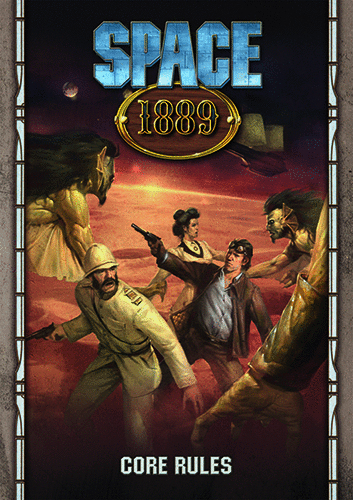
I remember the first time I saw the original GDW Space: 1889 in The Compleat Strategist near Rittenhouse Square– I was living in Philadelphia and the main games our group was playing were either superheroes (DC Heroes by Mayfair), or espionage games (using James Bond: 007) and cyberpunk Cyberpunk (by R. Talsorian.) The look of the game was intriguing enough, with the great David Dietrick art — one of the big boys in game cover art at the time — and a quick look through the interior was enough to get me hooked. There was a board game, Sky Galleon of Mars, that tied in and allowed you to make the jump from the RPG to a wargame and back, and there were about a dozen supplements and adventure books published before GDW died. I have the book I bought a quarter century ago sitting in front of me as I write this.

After a bit of stumbling to put together a game, I wound up running some form of Victorian science-fiction — usually in the Space: 1889 universe — from 1990 until 2004, when I started to drift toward ’30s pulp and Exile’s Hollow Earth Expedition. The game was one of the reasons I went into history, my specialty was Early Modern and Modern Europe until my doctorate (mostly due to the shoddy condition of the European section of the college) when I drifted into Modern US (which strangely coincided with my move to Hollow Earth Expedition.)

A few years ago, there was a Savage Worlds version of this, the original “steampunk” (gahd, how I hate that word!) game, and I have a PDF of that, as well, but never found SW made much sense, mechanically. Close to that time, it was announced that Clockwork in Germany was doing a version using Ubiquity — the rules set from Hollow Earth Expedition. In 2013, the Kickstarter for an English-language version was posted by Angus Abramson — who I worked for in the early days of Cubicle 7 on the Victoriana line — and his new Chronicle City house. I missed the Kickstart for this, having already blown dough on the Revelations of Mars book by Exile a month earlier (still not @#$%ing close to done…) Well, the PDF just dropped for sale yesterday with the print book not far behind, and I had a chance to do a quick read-through this afternoon.

space1889

The new book is very true to the original. There’s some difference in the verbiage and the arrangement of the book, but most of the setting is unchanged, with additional material for Germans on Venus that was most likely part of someone at Clockwork’s campaign prior to resurrecting the game. There is new artwork, some of which is an update of pieces in the original book, some of which is original. The quality is true to the original book, as well — mostly black and white pieces and the occasional color plate. The maps of Mars and Venus are updated and look better than the original, but when I looked at them side-by-side, they are “the same.” There is the alternate history from the original book — Edison’s flight in an airship with ether propeller to Mars, and the other alternate history moments. There’s a gazette for Earth, Mars, Venus, and Mercury. Here and there, you can see where the new publishers added bits and bobs to flesh out the worlds — new gadgets and gear, a few locations and “worlds in the ether”, etc.

Character generation is nearly the same as you would find in Hollow Earth Expedition, but there is a specific set of rules for older, more experienced characters that looks a lot like the character creation house rules we’ve been using for our HEX games. There are a few traits and flaws that are setting specific, the Status Resource is very slightly more fleshed out, but otherwise it’s the character generation from HEX. One of the things that I noticed was there were no real traits that differentiated the Martians from the human characters in the game. (Here’s my take on the setting species.) I would have expected something to take into account the acclimation to lower gravity and pressure, but Space: 1889 also has a much more friendly Mars than reality — heavier gravity and atmosphere than most alternate Mars settings. (Over a few campaigns, I started using a Mars with .5G, rather than the .9G of this game, and lower pressures, making mountain travel dangerous for Earthlings.)

Rules-wise, it’s Ubiquity: roll the number of dice (any even sided will do — even a coin) equal to your skill plus the connected attribute and beat the number of successes. It has the “take the average” than makes Hollow Earth Expedition work so well when fighting mooks and the like — the GM doesn’t have to do a lot of rolling and the action moves quickly; characters that just need a pass/fail result can take the average when they know it’s higher than the needed successes for the same reason — getting roll playing out of the way of role playing. If you know HEX, you can pick up and play this.

Style: The original game was pretty sharp for it’s time, with good color art and crappy line art for the rest; the new version is average RPG quality art for the black and white art, decent color. I’d go 3-3 1/2 out of 5. Substance: Unless you plan on really digging into political intrigue and the like, the book is good enough to launch into a campaign that night, and the rules are complete enough to handle mot situations. 4 out of 5. Is it worth the $56US for the print and pdf combo? If you are into this genre, yes; if you are an old Space:1889 fan that wants a better set of mechanics than the execrable ones from 1989, absolutely; if you’re just curious..? No.

Extra Review Goodness!

loa

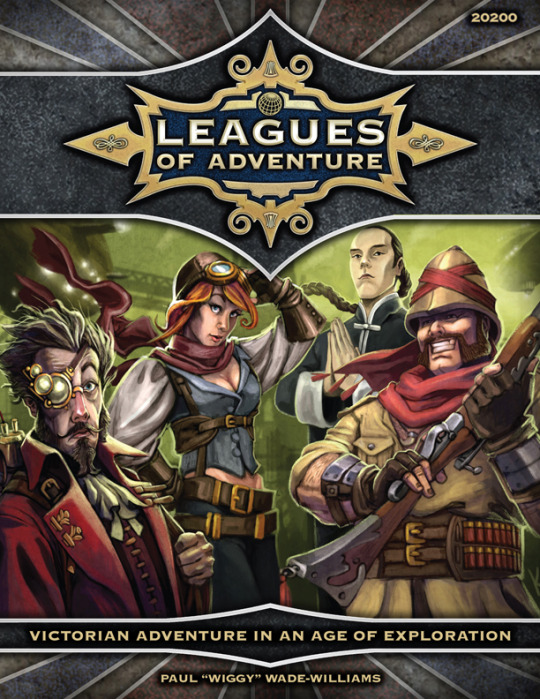
So, let me stack this up against the closest thing to its peer — Leagues of Adventure, also a Ubiquity-powered game set in a Victorian science-fiction alternate universe. This one is published by Triple Ace Games. Again — the mechanics, character creation, etc. is no different from Space: 1889 or Hollow Earth Expedition, but there are a few places where Leagues of Adventure excels: in the character creation section, there is a great bit on the Rank Resource, and how it ties to the various real and invented clubs of the period. Being a member of a club was almost essential for the well-heeled gentleman, and certainly for the aristocrat. Like Space: 1889, the Status Resources is pretty sketchily defined, but at least Space:1889 makes room for people below the rank of peer or wealthy middle class (bravo!) Also, Leagues provides rules for Inventions — something Space: 1889 (like the original) glosses over. Characters as inventors seem to be an afterthought in Space: 1889, but there’s a nice set of rules for it in Leagues and a goodly selection of weird steam- and clockwork-powered science!

Style: 4 out of 5 — the Art is superior RPG quality, full color, and the layout is nicely done. Substance: There’s a lot on the society and the basics of the Victorian period, and the rules are more comprehensive than Hollow Earth Expedition was… 4 out of 5. Is it worth the price of $30 US for the book? Absolutely. Is it worth the $18 for the PDF — no. Buy the book.

Now, here’s my suggestion: I would be surprised if Clockwork and Chronicle City didn’t do some kind of reprint or series of splatbooks for Space:1889, and TAG already has one book out and another with weird inventions on the way…if you’re a Space; 1889 or Victorian speculative fiction RPG fan — buy them both and mix and match the bits and bobs you need to build up your setting. (It’s what I’m doing.)

Give me control of a nation’s money and I care not who makes it’s laws.

-Mayer A.B. Rothschild.

That’s it! you’ve finished that epic (or not so) campaign. Months or years in the running, the players have enjoyed themselves so much that when it comes time for the next game to be played…they want more. Perhaps you felt like the game universe was moving in a direction that lent itself to something new and fresh and you all want more. Time for Game II: The Revenge of Game!

Like movies and spin-off TV show, there’s a lot to recommend about the sequel. There’s a built in interest for people who liked the last one. It’s a familiar universe or premise, and maybe a familiar character or two to help ease the audience into the next cast. They also have several problems that come along with them. So first:

WHY DO A SEQUEL?

Maybe there were things in the game universe that were left unanswered, or tantalizing bits on the side that people wanted to explore but there was no time? “What about that alien race we discovered? What were they up to?” “Remember that legend about the fall of Zarus? We should have adventured our way to that side of the map!” “What the hell was that cult up to — the one we were investigating before we all went made and were institutionalized?”

Maybe the players just aren’t ready to let that character go. “You know, Jack escaped the Wing Kong exchange, but was that it..? What if he ran into some other occult group in, say, New Orleans?” “The rebellion might be over, but i don’t think Wedge would just hang up his wings just yet.” “After fighting terrorists, I think my guy would go into business doing international security.”

WHY NOT DO A SEQUEL?

“How can the same thing happen to the same guy twice?” was one of the best lines from Die Hard 2 because it directly addressed the unlikely nature of someone called to be a hero then returning to regular life finding themselves playing the hero again. Bilbo Baggins had an adventure. Then he went home. Had he been fighting another dragon the next week, folks might have been a bit less intrigued by The Hobbit 2: Another F’ing Dragon. The main danger of the sequel is doing the same thing over again. It’s like the first one, but with bigger CGI ‘splosions!

HOW TO DO A SEQUEL

There are a few routes you can take in a sequel or spin-off game. Doing a new campaign requires a new focus. Maybe your sci-fi campaign was doing head-of-the-week exploration like a certain franchise we know; the next should be focused on something else — maybe long-term politics between the good guy organization and the prosthetic-headed alien we really liked the last time; or a static location where people come to you like Babylon 5, or some colony world that provides the opportunity for adventuring, while being connected to the rest of the parent universe.

Jump the action a couple of decades and include one or two of the old players as more mature, playing the mentor to the new characters. You could conceivably come back in a generation or two and see what the children of the players are doing. Did Bolbar the Barbarian’s kingdom really stand for 100 years as was prophesied, or did he spend himself into the poorhouse and wind up with his kingdom gobbled up by the larger Empire of Whatever?” Did your daughter wind up being a Jedi in the New Order? Did your grandkid follow the ol’ WWII hero (you) into the military or CIA to fight terrorists?

Another way to change the flavor of the game is to try a new set of mechanics in the same universe. Say you were playing 1930s pulp using Hollow Earth Expedition or Savage Worlds. The players love their characters, but they’ve been sold on your early Cold War game. You could rewrite the characters in their post-war form in James Bond: 007 or Spycraft and have them working for the new CIA with a Bondesque spy-fi vibe (itself just really a post war pulp style.) Hell, Atomic Robo has specific rules for playing a game with flashbacks, allowing you to tie new adventures to historical ones.

Aside — If you wanted to do flashbacks to adventures in the old campaign, you could do something old like use one system for the modern stuff, then return to the old game system for the flashbacks.

An example of a sequel campaign would be the Star Trek campaign I started in 2000. It was set just post-Dominion War and I carved up the Trek canon to make a more believable, consistent universe. the first game was mostly interested in post-war politics. We dealt with the Federation more — how a post-scarcity society with access to androids and sentient spacecraft (the big metaplot of the first campaign) might look. It got increasing transhuman as we battled Borg incursions and an ancient race of self-relicating machines. The sequel campaign was about a decade after that — sentient starships and androids were commonplace, as was storage of transporter patterns — essentially ridding the biological races of death. This campaign was deep space exploration focused, but the real adventure was dealing with how the new technology introduced in the first game was changing the lives of the characters. there were carry-over characters in secondary roles, minor characters that were now leads.

The campaign was good but hit one of the issues of a sequel campaign…it was just different enough that it no longer felt like Star Trek. There were the trappings, but as the characters got more used to the transhuman future-meets-Trek setting, it lost some of its luster.

YOU THINK SEQUELS ARE HARD? TRY A PREQUEL (PLEASE, DON’T!)

“Wow! I wonder what a show about the Federation before there was a Federation might be like!” “I wonder what the Galaxy was like before the Emperor took over.” “Hey, maybe Indiana Jones should do something with mystic stones before he “doesn’t believe in hocus-pocus”…”

Do I need to continue?


After three years of focusing on raising my little girl and doing side work as a college prof, my schedule is starting to loosen enough that I’ve turned my attention back to writing. This week, the research and plotting started on the “sequel” (but not really) to Perseus. I’m going to take on Hercules next. (I might go with the proper name, Heracles…)

To keep myself sane while going through the butt tons of mythology connected to the character, I also started research and work on a 1940s/50s spy novel. Also have a few ideas for an urban fantasy/horror book. (Not a big fan of the genre, but the idea’s there…)

So, if I stick to my usual speed of work, I should have at least one of them out in the next year.