Last week I finally got my new 1930s pulp game fired up. It’s been a few months coming, but the momentum in the Battlestar Galactica game was such that i wanted to push through to the “season finale” which allowed me to write a major character out as the player was leaving for San Francisco. I chose to use Hollow Earth Expedition again, although I was sorely tempted to use Cortex or the old James Bond: 007 RPG for the rules set.

One of the issues was trying to get the characters to mesh well. I’m the only person with a strong grasp of the period, so I did most of the heavy lifting on character creation for the players, weaving the history of the preceding years into the characters — two served in WWI together, the aristocrat character spent a lot of time in Africa with the “Happy Valley Set” — known for their promiscuous sex life, rampant drug use, and other scandals; and tying how the Great Depression affected them or their families. With the characters well established came the hard part…how to get them together?

There’s a few ways to do this — I like teasers that introduce the players to their characters in little vignettes that showcase their strengths, weaknesses, and basic schtick. (A classic one is the teaser in Raiders of the Lost Ark.) That seemed like it would suck up too much time in this instance, and several initial ideas fell flat. Another good way is to start in media res — where the story is already under way. Open with either an action sequence or some aspect of the story. The basic mission is either revealed during play, or the players were prepped for it before play. Most teasers start in media res, but usually don’t have a direct connection to the main story. I decided for the later, with the characters meeting at the Travellers’ Club in London after the “lead” — a tomb raider named Tom Steele — had already retrieved the item central to the plot.

This brings up the last point…what brings the group together? For a military or espionage setting, you can make that easy: they are assigned to a mission together. For a superhero game, maybe they’re part of the same team. What kind of mission would get an aristocratic occultist/pornographer, his two-fisted manservant, and an slick-dressing and talking American tomb raider who was tossed from Oxford together, then get them out to China? I tried a few different ideas, but they all fell flat. What I needed was what Alfred Hitchcock called ‘a McGuffin.”

What’s a McGuffin? This is the thing that brings everyone together for an adventure, and the characters can have different reasons for engaging with the object. The most famous is probably the Maltese Falcon. In the book and the 1941 film, the Maltese Falcon is supposed to be a gold falcon that has been painted black. All the characters get roped into the action because they want the falcon, or in the case of Sam Spade (Humphrey Bogart in the film), he’s a private dick hired for a case that starts playing all sides off each other. Rosebud, the sled from Citizen Kane, is another: “Rosebud” is the last word spoken by the lead character and a reporter tries to track down what it pertains to. The Death Star plans, the Lost Ark — these are McGuffins. They might be central to the action, a red herring, or something that is, ultimately, unimportant beyond being the impetus for the story (think the briefcase in the trunk in Repo Men, or the diamond from Titanic.)

While doing some reading, I came across an interesting bit of old Chinese culture — the “death jade”, usually a small carving of a cicada, which is supposed to take ones spirit to its final resting place (or close enough.) Some were alleged to be used to store the spirit until resurrection. I took this idea, fused it with another idea concerning the Huangdi, the First Sovereign Emperor, and his quest for the Elixir of Immortality. What if the Huangdi’s death jade held his spirit? What happens if it’s used in a summoning?

And there was the first night. Pull the characters together for a summoning at a common friend’s house in Hampstead Heath. The summoning, rather than being the usual excuse for drink and debauchery turns out to work, with the acquaintance being possessed by the spirit of the emperor. Before people can react to the glowing eyed possessed man, enter the competition — in this case a bunch of black outfitted wushu-fighting types. the resulting fight in the library of the country house was classic Hong Kong chop socky meets Indiana Jones. Of course the bad guys get the death jade, meaning the tomb raider (who has not gotten his full pay yet) has to go after it. The occultist wants it for the obvious power.

The fight led outside to a car chase with a bunch of the bad guys on “hoopcycles” — a one-wheeled “motorcycle” — through the streets of London, and down into the Underground. This long action set piece took most of the night and was a blast.

Who are the bad guys? I had a vague idea. Why do they want it? They can guess. This week, i get to fill out the particulars and get them started on their way to China.

I’ve had my 2010 Triumph Thruxton for almost two years, and one thing I’ve been contemplating was modifying the suspension. There’s a lot of threads on the various Triumph boards about the execrable quality of the stock shocks and tires, but to be honest I didn’t really mind the set up, other than it felt squidgy in hard turns and had a tendency to sharply nose dive under hard braking. I’ve had crappy suspension on just about every bike I’ve owned, so this wasn’t really much worse that the 2007 Speed Triple, or the 2010 Street Triple, the 2001 Sprint RS, or even the 2001 Buell Blast I had.

I started off with cosmetic modifications to get the bike where i wanted it visually, but eventually a few sphincter-puckering moments on the Sandia Crest road lead me to start tinkering with the suspension. I dialed the pre-load up and while that tightened the bike up decently, it still had a tendency to get overly-spirited in fast turns. I tried new tires.

The Metzler Lasertecs are nowhere as terrible as the boards have to say — they’re very predictable, hold well, and aren’t expensive, but the Avon AM26 Roadriders truly change the character of the bike. Instead of a polite, staid machine, the Thruxton tips much more aggressively into turns on the British rubber. They hold tight in turns, do well in wet weather, but I found they were awful on that grooves concrete some states use for the highways. The Avons had a tendency to set up a pretty frightening speed wobble on these sorts of roads it didn’t have on the tarmac. At the suggestion of a cafe builder acquaintance, I tried the Shinko 712s — half the price of the Avons ($115 at my local garage wrech’s store…Score for the Scottish guy!), they grip just as well and at 2000 miles on them in just two months, seem to be wearing much slower. They also seem more stable on the concrete roads and don’t feel the wind as much. As a bonus, they have an aggressive-looking tread pattern and are 10mms higher in aspect ratio, giving the bike a more lean and tough appearance.

What the Shinkos and Avons showed, however, was how substandard the suspension was in hard deceleration or turning. A few weeks ago in a fast group ride down the Crest the front end of Trixie tried to tuck in a 35mph, downhill, right hand switchback. So…time to address the suspension. I’ve had a ton of suggestions — from the overly-ambitious and expensive Ohlins shocks and springs/valving, to the more reasonable Gold Valve treatment up front and Icon, cheaper Ohlin rears, to progressive springs up front with Hagon rear shocks. I read through the various boards, looked at my style of riding, and the cost to benefit of blowing over a grand on suspension and decided…

Spending a grand on the suspension is idiotic.

The final decision was based on thrift, but also on the notion that I could improve the set-up if I didn’t like it. Progressive springs in the front for $89, Hagon 900 three point adjustable shocks in the rear for $199. So how did the el cheapo option pan out?

Great. The springs went in first, as British Customs didn’t have the shocks in stock and we had to reorder directly from Hagon. (Thanks, Christine!) They take your weight, the type of riding (street or sport — unless you’re riding track, ask for springs, if you like your testicles…), and the color of the spring and bodies (chrome or black for either.) The springs immediately tightened up the front end and the same section of road that had been so interesting the week before was a doddle at 40mph. The front end lost a bunch of the chatter it had at speed or in turns, and was a serious confidence booster. It also exposed how absolutely worthless the rear end was.

The Hagons went on in 20 minutes at the local shop and several rides through the Crest road and the less challenging South 14 at perfectly legal speeds (honest!) showed the bike to be a completely different animal — tight, responsive, if a bit stiff. I’m going to wait a few weeks and see if the rear softens a bit as the spring breaks in, otherwise I made have to dial it down a bit. I took my iPhone and fired up the clinometer and ran it over the tire to get an idea of the lean angles I’ve achieved. The next day i was watching GP Moto with a local bike club and got to see what the 48 degrees I’ve been regularly pulling looks like.

I need to slow the f#$% down.

If you want to spend more money and get a wee bit more performance out of your Thruxton, by all means, do so, but if you are looking to tighten the bike up for spirited street riding without breaking the bank, I think this is the set-up to go with.

And she even looks good…

2014-04-24 14.03.05 HDR

2014-04-24 14.03.15 HDRTrixie: 2010 Triumph Thruxton SE with EPCO exhaust, British Customs fender eliminator and turn indicators, Dime City Cycles fork gaiters, mirrors and levers, front fender painted locally, Hagon 900 shocks, Progressive springs, and Shinko 712 tires.

Here’s a look at my hometown from the Sandia Tramway:

A last minute cancellation put me in a rough place this week. I had a new pulp game all set to go and one of the “leads” — who was necessary for the beginning of the game texted out after we were due to start. At first, I thought, “Great! Board game night!” but the last board game night revealed that one of the players is not the sort with which you want to have any kind of game that involves competition. Plan C — fire up the Battlestar Galactica “new season” on the fly.

I didn’t have much to work with ready, so instead thought about what kind of impact losing two of the major characters would have on the NPCs and the players, and ran with that. In this episode…we talked about our feelings. I pieced together how the president — who had thought himself inured to loss after the Fall of the Colonies — is beginning to fall apart with the death of his son in law. Now, all he has is his son, and the fear of losing the man (the commander on Galactica) hasn’t paralysed him, but he no longer feels empowered. The commander lost his best friend, the other PC was a trusted colleague, and his burgeoning love affair with another officer has been interrupted by her reassignment to Pegasus. He’s alone. Another character had been the dead pilot/oracle’s lover — she’s crushed, and has had to take over his duties as a squadron leader. How can she command her friends, knowing she might have to send them to their deaths…and can she do it?

Another aspect of the night was the goings on aboard Pegasus. ADM Cain is a constant presence in the background, but was never encountered. Instead, the pilot now squadron leader found herself touring the flight deck of the flagship. She noted immediately that everyone was locked down tight — humorless or at least very restrained, with a strong undercurrent of fear or anxiety. She was approached by some of the crew who were curious about Galactica, including a couple of enlisted men who were interested in the “robot girl” they had in custody. It was creep, and made moreso by one of the female officers telling her to be careful where she went alone on the ship.

They heard about Cain’s “razor” speech — that they had to be a weapon, until they couldn’t fight anymore, or until they won. The idea that, being alone and having no real hope, the ship has been on a mission of vengeance is palpable. Now the trick is to bring Cain around to her new mission, that of guardian. (It’s a similar character arc that the one player’s commander had to go through early on.)

So there’s a prime example of how my slightly tongue-in-cheek post from a few days ago can be put into use.

So, I’ve been an early adopter of e-comic books, and loved the Comixology app. I’ve been buying all the Atomic Robo stuff through the app. Problem: they just got bought by Amazon, and all of a sudden they’re doing the out-of-app purchases. Remember, Amazon is sticking to the prickish idea that you don’t own the book you bought; you just “licensed” it — so I suspect this might be part of the issue I’m about to relate:

All my bloody books are goneI did their little two-step. I “restored my books, which only gave me three issues of the latest volume of one series, and one book from another. I keep trying. No joy. I download the new app — those aren’t even showing. That’s right, Stupid here dropped probably close to $100 on a series I no longer “own.”

That’s pretty bad. Worse is I know I’m not the only one. At the last check, the App Store was running almost unanimously 1 star rating for the new version, but hey! where are the hundreds of reviews? They’re not showing. Afraid to have your customers warn prospective customers what a sorry set of sticky fingered thieves you are?

Review: the app is gorgeous and worked beautifully. The downside: you’ll lose your stuff if you’re not careful (or in my case, even if you were.) Final word: don’t download, don’t buy from them, unless you want to shell out hundreds for nothing. Go to the local comic store and make them some money; Comixology wasn’t cheaper, anyway.

Redheads! Italy! Motorcycles!

I can watch this one over and over…

I finally getting around to responding to a reader’s question…

“Hey, Scott, why do you hate Fate so much?”

I don’t hate FATE, so much as I find some of the fast and loose aspects (See what I did there..?) can create a much higher level of complexity that is needed. I had the same issue with Marvel Heroic Roleplaying and Firefly from Margaret Weiss — which are essentially Fate with Cortex die schemes. The plehtora of assets, complications, etc. adding to dice pools can get a bit hard to manage. (Although it doesn’t reach the wheelbarrowful dumping of dice majesty of d6 Star Wars when a Stardestroyer opens up on you.) I also dislike the “damage” system of the rules. (I’m not a hit point guy, either.)

Speaking of dice: I hate the idea of the Fate dice, which is why the MWP stuff is a big more palatable for me. Similarly, I was okay with the positive/negative die mechanic of Chameleon Eclectic’s The Babylon Project, although I’ll admit it was also a crappy way of resolving chance. I’ve bought the Ubiquity Dice for Hollow Earth Expedition, but they aren’t needed; they simply make rolling dice pools (and Ubiquity does have a Shadowrun-esque love of dice pools) easier. You can play HEX with a bunch of coins, if you need to.

“But, Scott, you can do Fate die with a normal d6 — just assign positive, negative, and nought to the sides.” Well, there you go making sense. Away wi’ you!

The real issue isn’t Fate — they’re great pick-up game rules that can be tweaked any ol’ way you wish — it’s that I can’t seem to get a game that doesn’t have Fate trying to claw its way into the game mechanics. It’s like trying to escape OGL d20 junk in the early aughties.

“You like [enter game name]? you know you can get those rules in d20, right!?!” Scott: “Screw you, and get off my lawn!”

I’ve looked over a bunch of the new Fate and Fate-infected products that have been hitting the shelves over the next few months. There’s some really good stuff. I’ve been very complementary of Mindjammer — a game that really plays to the strengths of Fate — and Firefly — a Fate-ified Cortex product that makes good use of some of the Fate ideas, while retaining some of the flavor of old Cortex, but which, like the previous book, really shines for the writing, production values, and background material. I’m looking forward to Atomic Robo, but anticipate that’s going to get played using the MHR rules.

Addendum: This is also, apparently, the 1000th post for The Black Campbell!

Despite a dickish Twitter exchange with one of the creators, I am still a firm Atomic Robo fan and have Comixology on the iPad set to let me know every time a new comic drops. So i was very happy to hear an RPG of the comic was coming, and despite the rules being FATE, I signed the group up for playtesting. We didn’t get to do as much as I hoped, thanks to folks leaving New Mexico or finding gainful employment that prevented them from playing, but it looks like the game is finally here.

You can now preorder Atomic Robo through Evil Hat’s website. Clickenze here to do so.
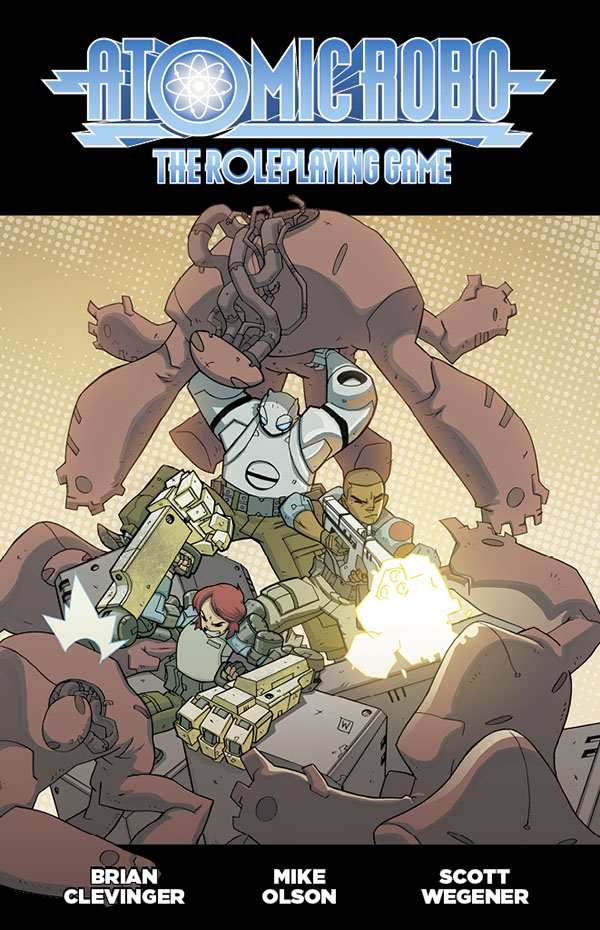
Robo-Cover-600px


I was having a look over the retro-clone Classified which repackages the old James Bond: 007 RPG very faithfully. It’s no secret I’ve been working on and off on a similar project for a few years — slowed and distracted by professional concerns and child care duties. As writing carried on two years ago, I realized that a redesign of a few of the rules were needed. That expanded into tearing the system apart and putting it back together. Here are a few of the points that I’ve been working from:

1) Less freakin’ math! Let’s face it — James Bond: 007 (hereafter JB:007) is a pretty simple setup for character creation…except for the math. No, it’s not GURPS or Champions, where you need to buy time on a supercomputer to build a character in less than a weekend, but the numbers are big enough for people to bone up if they’re working quickly and by hand. This has been rectified. Additionally, I’ve stripped off some of the extraneous stuff you had to buy.

2) Why the hell do Fields of Experience exist? Because no one wanted to buy those as skills in the initial design of JB:007. Fields of Experience have been given actual mechanical effects, and the same goes for Weaknesses. They help define your character, now.

3) Simplify and make consistent the rules. The different mechanics for gambling, seduction, torture, and other aspects of the game were cool in 1983. They’re a headache for GMs used to more streamlined games now. If you want to really capture the excitement of being at the green baize, have the players play baccarat, or whatever, against the GM or each other. Connected to that —

4) Lose the d6. Initiative is based on speed. If two characters have the same speed, roll a d10. Highest wins. There’s another initiative system in the works that might capture the action movie flavor better that I’m working on.

5) Speaking of — modern action movies have had a much different pacing since the 1980s, even Bond movies. Gone are the days of deliberative one shot from a .32 Walther kills a guy at 50 yards…Bond characters may not spray and pray the likes of Martin Riggs of John McClane, but they’ve a lot less ammo discipline in these days of high-capacity magazines. Combat rules are being tweaked to reflect this, and add in things like martial arts styles.

6) Hero points: Only on a 01? Nope. Hero point now look more like plot points/story points/style points of other game systems. You get them for playing to your weaknesses, for good roleplaying, for rolling QR1s, or making good suggestions for how failure might be interpreted.

7) A game’s corebook does not need to be 500 pages and full color to be good. I’m aiming to keep the book cheap, easy to read, and fast to get into playing. There will be a lot of background material on the modern espionage world, policing, etc., and the obligatory short adventure scenario. The goal is a book running about 200 pages.

The goal: Keep all the good stuff about JB:007, lose the bad, and bring these mechanics into the 21st Century.


Most game designers are very concerned with the notion of “balance” in the games they make. Systems that use a point-based creation mechanic for character creation often have levels of generation points that allow a player to customize their character, yet are all bought for the same “level” — being it novice or beginner, experienced/whatever, or expert/master, etc. In Dungeons & Dragons, characters used to start at 1st level and work their way up, but later iterations allowed for starting at higher levels…but you still had the same approximate range of abilities.

Until you hit the min/maxers and rules lawyers that can manipulate the system to build a character more effectively than other players. (I have a mathematician in the group right now who is an expert at this…)

The point to this notion of “balance” is “fairness”. Young players, players that use gaming to vicariously experience success or greatness, often don’t like the notion of having a player be weaker or stronger than others in a campaign. Everyone wants to be the hero, and balance is supposed to push the players toward a more ensemble model, where everyone is equally important to the game. It’s a nice ideal — and one that I subscribed to for a long time — but it’s not really achievable.

Problem, the first: All players are not created equal. Maybe your characters were all created for X number of points, but you have a rules lawyer that has made a character perfectly tailored to the sorts of adventures you will encounter, making them the “go to guy” all the time. It’s great for that player; they’re almost always now the center of attention. Even if, somehow, you managed to have characters that were all highly specialized and had their particular spotlight moments in a game session, some players are more passive, and others more active — one guy may spend all his time in his room inventing things, and only becomes a factor in play when the fight is on. Maybe a player is particularly clever at using a “weak” character to achieve greatness. Maybe one of them is just too funny to reign in and makes the game enjoyable. These players are going to capture most of the airtime.

Problem, the second: It’s not the way good storytelling works. In books, movies, and television — even with ensemble casts — there’s normally a lead or two that the stories focus on. For example, let’s take any of the Star Trek series from The Next Generation on…there’s an ensemble that sees the whole cast get some screen time, but normally, the focus is on one or two of the characters per episode, and often over the course of the series. Let’s look at The Lord of the Rings (books and movies) — Frodo is the main protagonist on the quest to destroy the Ring, with Sam as his sidekick, but arguably just as important. But Aragorn is the lead for the portions involving the return of the king and opposing the forces of Mordor. Frodo is in no way Aragorn’s equal (and arguably not up to that of Sam, either…) But he is the lead and the lead not need be the biggest bad ass of the bunch. Even Merri and Pippin are stuffed into the middle of great conflicts, and probably couldn’t resist a late-night mugging in any modern city. It’s not about being bad ass; the interesting part of characters is their weaknesses and how they overcome obstacles. Simply hacking your way through a problem like Schwarzenegger might have a certain appeal, but it’s not especially memorable after the first hundred kobolds, is it?

Problem, the third: Not everyone wants to be the bas ass. I have a player whose real interest is in the politics and social machinations in nearly every game we play. He often winds up being the politician, ship captain, leader because that’s the sort of thing he likes. Even when he had action star-type characters, he would often use other characters as proxies in fights. Some guys thrive on being the ass-kicker and trying to suss their way through a mystery is either boring or taxing…they like to sit and wait until it’s time to break the “in case of emergency” glass on their barbarian and let the carnage begin.

So what’s the point of attempting game balance, other than an attempt to preserve some sense of Harrison Bergeron-esque enforced equality? I’d submit none.

Here’s an idea — when in the planning stages of a campaign, there are a few things the GM and players can do to create engaging characters that are appropriate to the sorts of adventures in store for them. On the players’ side is arguably the harder job — letting go of the ego long enough to create characters that have a reason to be together, more than focusing solely on your cool concept.

Example 1: I had a player that had his high concept character — a Starfleet engineer who was super-talented, so that he didn’t have to play by the rules and regulations. Great idea, save for a few points: 1) everyone in friggin’ Starfleet is smart, educated, and competent, 2) the character’s purpose is to spotlight hog and create artificial conflict (specifically with the GM and the adventure itself, I suspect), 3) he’s got no logical reason to be there, other than to annoy everyone else at the table.

Example 2: In a short-lived Supernatural game, one of the players decided to play the overweight, stereotypical hacker/geek that ran a supernatural conspiracy website. He was the outsider of the group, but was useful (and played very amusingly) enough that he was essential in the investigation portions of the adventures, but was completely out of his element once they found the creature of the week. The spotlight then shifted to the other characters. They meshed, even with the built in conflict between the characters because they needed each other, and — after a few encounters — wanted to work together.

The first example was built to the same number of creation points as the other characters, but was specialized in away that, while it could have been highly useful, was mitigated by the assholish persona of the character. No one went to him for help. The players and characters hated the character in question.

The second example created highly memorable moments in the game that were fun enough that the other players gladly gave up their moment just to watch the hacker have his long-winded, hysterically-funny meltdowns. The characters might have hated the guys (and there was one in particular) but the players loved him. He fit. He was built for less points than the bad-ass exorcist priests that were the “leads” of the game.

A last example might bring this home: Most of the players in my last pulp game were built by the GM (me), based on character concepts the players had and I fleshed out to make work better. (This was more a function of my knowledge of the period and the manner of game I was planning.) They were all customized to play to the concept. The brick was a combat monster and utterly useless in other venues…yet was played with such joyful idiocy that he rapidly became our “Jack Burton” of the game — in the center of things, but clueless. The archeologist lead was built for more points and was talented in almost everything, but tended to use the first character to get the action bits done because a) it gave the other players stuff to do, and b) the player is risk aversive and uses the others as meat shields in almost every game.

It was the character of an 11 year old street urchin, however, that was the surprise. Built to be much less experienced, talented, and having a lot of the social and physical downsides to being a small Chinese girl in 1936 Shanghai, she was nevertheless highly effective outside of her niche of thief because of out-of-the-box thinking by the player as well as an obvious delight at playing a unique character. Everyone had their niche, got their airtime, but also frequently worked together in ways that were memorable and unexpected.

So…what’s your point?

Build to a character concept and their role in the game and to hell with stat and/or skill advancement (except where applicable to the story), and focus on how these characters interact.

For instance, our current Battlestar Galactica game saw characters generally built at “veteran” level — the median for stats and skills, then given assets and complications that made them unique. But the commander was built to a slightly higher level — somewhere between the veteran and seasoned veteran. It made sense for the commander to be more experienced and talented…his role of leader might put him in a position of power over the other characters, but also limits his ability to participate in some of the action. Unlike the captains of Star Trek, BSG captains (andreal military leaders) tend to have to stand powerlessly in their CIC while they listen to their subordinates succeed or fail based on their mission plan. One of the lead characters in the ensemble is a viper pilot. She’s great at flying and fighting in the cockpit. She’s also a gullible prat who acts before engaging brain. It’s appropriate to the character. She was built with less points than the commander, but her role is such she sees much more of the action. She’s just not in on the big decision-making…that’s not her role.

By building characters and playing them to the role and concept envisioned, you can craft a group that all work together and enjoy the story, even if one of the characters is more of a lead that others. I frequently see one of the players’ characters as the “lead”, with the others as the main supporting cast, and try to rotate that central role between the players per campaign. But if you play one game (looking at you Pathfinder folks!) for thirty years, rotate who is the lead in a particular adventure — maybe Bumbo the Barbarian was the lead in the last couple of sessions, seeking revenge on the man that killed his family and burned his childhood village, but for the next few, he’s helping his thief friend Sticky Fingers snatch a valuable McGuffin. He’s the sidekick for this one.

For players, this means giving up the spotlight and being the sidekick from time to time. For the GM, it means making sure everyone gets to be the hero every once in a while.