One of our players is moving to Texas, another has gotten a job that might impair his attendance…yes, we’re heading into a possible dry spell on gaming here in Albuquerque.

So we decided to pull a long session on Labor Day and finish out the “season” of our Battlestar Galactica campaign. We completed the last adventure we were playing and launched straight into (and finished!) the finale. The first hour saw the crew do a lot of scientific research and speculation on the findings at the archeological dig site under their deep-range observation post near the Armistice Line. The site appears to have been an ancient tylium mine, and they found human skeletons mixed with very tall human skeletons…and two intact corpses in spacesuits.

One corpse was send back to Picon for the intelligence corps to analyse, while the ship’s doctor and the dig’s archeologist did an autopsy on the other. They had only a few hours to do their work before exposure to the atmosphere caused decomposition of the corpse. What they found: DNA had 46 chromosomes but at least another 5000-10000 gene sequences over humans. It’s a different species, but one that most likely could breed with humans. The next move is to extract mitochondrial DNA and see if it matches that of the 12 “base” mitochondrial DNA sequences that make up the Twelve Tribes.

The height, very dense bones, and tightly packed musculature suggest a very strong and resilient creature. they also found what they think were dogtags in pockets of the suits — disks with the odd writing they’d found on signage and computer-like devices, but with a symbol of Athena on the reverse. Isotope dating put the corpse at about 3000 years old — so younger than the old city found on Sagittaron, but older than the founding of the Colonies.

Their speculation: these giants are Lords of Kobol. The discovery has both emboldened some religious types, and caused serious anome in the crew.

After a bit of episode clean-up, we moved onto the next mission — the recon of the Cadmus system, 3.2 light years on the other side of the Armistice Line. They have a clever plan to use a stealth viper (we’re calling them the Mk VI Cobra) to do a flyby of Cylon positions on a few moons of a gas giant in the system. Two other ships that are part of Operation UNDERTOW are Valkyrie (under CDR William Adama), and Mentor. As expected, things do not go as planned. For Valkyrie, it’s a version of the Bulldog episode from third season (I think it’s third…) Mentor pulls off her mission with no issues.

The players, on the other hand, have serious problems. The CAG is flying the mission and both he and the guy checkin his course goof their rolls. He nearly hit a moon of the nearby planet he’s using to slingshot assist his approach to the planet. He has a 10 hour ride in the cockpit to the gas giant and falls asleep and last minute realizes he’s drifted off course and has to risk a correction. He does his flyby and two ballistic drones capture images and ELINT of a new kind of basestar (the one from Razor the hybrid was on) and another on the surface of a moon acting as some kind of base of operations, as well as a massive tylium and metals mining operation. The Cylons are busy

Mr. Murphy is along for the ride, however, and while the raiders doing CAP over the posts don’t pick up his electronic signature or see him on DRADIS, they get eyes on him in front of the gas giant. He runs for it, pulls off a spectacular escape using the planet’s atmosphere, and flees, sending out a krypter to a nearby observation raptor. Good thing those new, strange looking fighters can’t jump, huh?

He runs straight into the radiers that were chasing him; they’ve jumped ahead of his course. The character’s Cobra gets shot to hell and he has to punch out. A heavy raider — they’ve not seen one before — comes for a pickup and he sees a new centurion inside. That’s when Aegis arrives to save his ass. The ship’s fighter squadron does a number on the Cylons, which are being jammed heavily by the ship to prevent their communicating with their basestar. One of the raiders jumps out.

The CAG is rescued and as another raptor is recovering the black box from his plane, the basestar arrives. A short and vicious battle ensues, but they escape.

The adventure ended with the heavy politics that has been central in the campaign. They find out that the mission was approved but no one expected it to be a success. A main point of the rules of engagement was a zero footprint mission — no contact with the Cylons. Both Adama and Pindarus (a PC and the task force commander) had some kind of contact. Adama wasted his pilot before Valkyrie was discovered. Aegis actually fought Cylons. It could start a war!

The admirals are ready to hang him out to dry, but an impassioned plea for the fleet to start getting ready, that the Cylons are mobilizing, manages to get him “promoted” to a bigger ship. It’s actually a penance tour to slow down his fast rise in the ranks…he’s been giving the soon to be decommissioned Galactica. The Cylon threat is used to coaxed the Quorum of 12 back into session — President Adar will classify the Sagittaron dig that has caused much political and religious strife, and the Sagittarons return to the quorum to allow for the defense budget to pass.

As you can see, I’m using the idea of the “all of this has happened before…” motif of the new show to do a new iteration of the story. Hints that were dropped suggest that last campaign (which was set during the RDM show as a second fleet game) happened in the past. Why have Adama as the commander of Galactica? This time, someone else is playing that role… It puts the characters in place to be instrumental in this next iteration of the Wheel of Time.
Here’s a new house rule for BSG:

Player characters can use Plot Points to aid a group, unit, or NPC under their command. The PC may either create a pool for use by those NPCs prior to the action sequence beginning (ex. CPT Muir decides to create a 4PP pool for his vipers during an upcoming battle) or, they must be able to communicate with the NPC to use plot point during an action sequence (ex. Muir has comms with a viper that is about to start a strafing run on a Cylon position. He can aid the roll of the NPC with his own plot points.)

Last night’s Battlestar Galactica RPG game was fantastic. It was one of those nights where all the plyaers were on it, all the characters got to not only do story-specific tasks but were able to have role playing/character development moments that were fun for all. As a GM, I was heartened by the fact that a half-assed plan and a vague idea of where the overall campaign is going combined with some inspired mental tap-dancing to create a spooky and intellectually engaging plot.

Having completed their murder mystery, it’s time for Aegis and her task force to set up for the Armistice Line to set up a forward operating base for their forays over the line into Cylon space. We opened with the master chief leading a bunch of the wrenches down to fix a problem with the magcats in the launch bay. There were comic moments where they are completely thwarted by a single, stubborn bolt holding the access panel closed. The new player/character got to experience the mundanities of service life — 0500 PT, communal showers in the general heads, breakfast on the fly as new NCO she gets the crap supervisor jobs. The CAG has to get the plan of action for their jump to the Polyxena system right.

The commander get s a gift from the chief engineer and master chief — a scanning electron microsope the engineer managed to appropriate from her last assignment at Scorpia Yards. Now they can identify Cylon tissue by the silica fiber optics and molecular machines’ signatures. Additionally, the master chief stole the material for a state-of-the-art holotank for their war room. Think Surface, but in 3-D. Of course, everyone’s first thought…we can get the 3D Pyramid games on this!

They jump to Polyxena, site of their first mission, wher they had been very cursory on their search before bugging out. the observation post is still abandoned, and the ancient tylium mine facility that had been discovered by the miners on the moon, and which the post had been conducting archeological research on, is still accessible.

While damage control teams get the observation post back online, a DC team under the ship’s CAG, Dr. Gio Mellor — an archeologist from the Sagitaron dig (search the site for the appropriate AAR), and the intelligence NCO head into the dig site. They get further than the crew did last time and discover several things in the dark, minute ammonium atmosphere of the old mine:

1) The doors to the mine were blown open by a shaped charge. 2) There is evidence of a fight. Shell casings from two different kinds of rifle — small caliber (.27 cal they later learn) and a mid-caliber (.335 cal.)…nothing they know of in use today. The dispersion of the shells suggest small caliber was used by the facility defenders. 3) Computers with keyboards in an unknown script. Some paper notes that have survive the ages, as well, with the same script. 4) All of the furniture, clothing, etc. is slightly larger than one would expect for humans, but is still recognizably human. 5) Coins with the symbol of Zeus on them… ( ♃ ) 5) They find musical instruments, personal items, and other humanizing trinkets in the labyrinthine living area. 6) The mine was extensive and equipment easily on par with current technology.

Lastly, they find a last stand with a line of armed remains protecting a group of unarmed remains. Most are skeletal, now, but a few were in space suits and are mostly intact. They look human.

The night ended with no answers, and they were shipping the bodies up to the ship for autopsy and analysis.

Monday we finished a short filler episode we started since the player of the ship commander was out at GenCon last week. The mission focused on a new PC, a Tauron marine staff sergeant who had been working as Colonial Fleet Special Investigations Division, Artemesia Largo.

She’s in the middle of getting introduced to her intelligence crew (she’s the intelligence NCOIC), and the other characters are going about their business. The ship’s command master chief, Ajax Giadis, comes across the chief engineer getting together a work gang to find a missing member of their team. Deckhand Reslou was posted to check and replace damaged life support sensors, requiring her to work behind the bulkheads in the tight, dark workspaces. It’s a lot of girders and the occasional catwalk, but it’s a hazardous place. A lot of the young kids don’t use their safety harnesses because it takes too long to clip on and off; people falling several levels is not unheard of.

The chief spots the FNG, Largo, and “hey-you”s her into aiding in the search. They find her body after half an hour of climbing around in the guts of the ship. (Of course, they find her; they’re in the credits!) She has been beaten sharply on the back of the head with a c-spanner, and fell several levels. She had then been dragged and deposited in an overhead air vent over a general storage locker. She is taken for forensics to the infirmary while the deck gang — the only people in the area — are held for questioning. The commander, in temporary NPC mode, assigns the CAG (a PC) to oversee the investigation, as he has uncanny instincts and they are in orbit around Picon with other ships and they aren’t running CAP.

The rest of the adventure is classic murder investigation. They don’t immediately interrogate  the 11 other members of the work gang. MAJ Muir, the CAG, is also ship’s chaplain and he chooses an unorthodox approach of doing “grief counseling” to get an initial read on the people. Only six have the right foot size for the boot marks in the oil and crud at the murder scene, only one transferred with the girl (she was only aboard for a week) from Scorpia’s Argenutm Bay Military Reservation. None are covered in blood (head wounds bleed copiously) and the perpetrator had obviously carried the murdered girl to her resting place. Two are Tauron and their tattoos suggest top her Ha’la’tha involvement, one is a massive “East German female weightlifter” type welder from Caprica, and the other is a bitchy Virgonian. Largo gets locked onto Deckhand Heraklea — a name taken by a lot of the Heraclitus regime after they were deposed following the Cylon War. Muir uses his Intuition to ask “is it Armov?” (the other Tauron.) The answer is yes…now they need proof.

The master chief heads up the search for the missing work jumpsuit that the murderer must have ditched in a relatively small distance from crime scene to their billets. They also turn over the victim and suspects’ lockers and foot lockers. In the victim’s footlocker, they find evidence that someone had taped a large amount of canaba inside for transit up to the ship. Drug smuggling — but was she a willing mule or no? They find the blood-soaked workvest in an access hatch behind one of the toilets in a general head not far from the scene, along with the c-spanner. The work clothes are Armov’s

With the evidence in hand, they go to arrest Armov — portrayed as a creepy, coiled spring sort of bad guy (think classic Russian mobster) — but he twigs they’re onto him, takes one of the other work gang hostage and tries to get to the launch bays, demanding a raptor. The characters give chase, bullets fly, and they manage to surround him. Largo puts a bullet through him, clearing the hostage, and Muir puts him down with a tight double tap.

Eventually, they find out from his Tauron buddy Heraklea that she was used unwittingly as a mule, but she discovered and flushed the canaba. Armov killed her for it.


Tonight’s episode was more of an interstitial episode, rather than a push episode (one that moves the main plot arc along.) In it, the character were conducting a shakedown operation to test the repairs to their vessel in a lead up to a few small combat exercises. Of course, they wind up getting dragged on mission to conduct a rescue of a salvage vessel being aggressed by an unknown pirate.

The salvage vessel has been hit hard, has its life support failing and fires aboard, requiring the ship to send a DC party. They do the necessary repairs, but not before the master chief leading the mission finds himself in the middle of a fire (something that terrifies him) that leads to a hull breech. After crapping himself, getting rescued by a raptor, he’s back into the repair fight.

The CAP, meanwhile, had raced to the hostile vessel — an older flatop like seen in the show — which jams DRADIS and other targeting with jiggers and sparrow; very unusual! Normally, they just run or jump away. Worse, they’re armed with light railguns and a point defense system. The fighters knock it around a bit, but the commander character finally has enough of the nonsense and pops a shot of anti-ship missiles. The flatop gets hammered for heavy damage, and surrender.

Turns out they stayed in the fight because the salvage vessel had very valuable cargo: 50 MTn MIRVs salvaged off of a derelict basestar from the first war.

One element (and a bit of freshadowing) I threw at them: the first rollout of the Command Naigation Program, which the XO describes as a beta, not real finished product. The CNP works alright, except it can’t talk to their Owleye sensor pallets (they have the rollbar version of Valkyrie)… they wind up finding a way to bypass the problem. Savvy players now know we’re getting close to the time of the miniseries.

Not a lot happened in our Battlestar Galactica game this week…or so it seemed. The “episode” was entitled “Mission Shift” and dealt primarily with the changing of several officers in the command staff and preparing for their next mission — planning and executing Operation Undertow, an attempt to collect intelligence on the Cylons in the wake of discovering they have cybernetically-augmented human agents (or possibly some new biomechanical Cylon?)

What they’ve learned: these agents are similar to humans in appearance and biology. Their DNA reads as normal. However, the blood contains molecular-sized machines, the purpose for which they haven’t ascertained. A fiber optic-like network was suffused in the brain and nervous system of the one agent, tying together into what they think was a central processing unit near the brainstem. There was some kind of heavily shielded superconductive liquid housed near the pineal gland — purpose unknown. The intelligence corps cannot decide if these are some kind of biomechanical Cylon, or humans augmented to be more pliant.

They have begged a scanning electron microscope to do the work needed to locate the nanobots, although a biopsy of the nervous tissue run through a spectroscope can also give a good indication of whether or not a person has been altered (or is a Cylon…) This information is still highly classified and the likelihood of a Colonies-wide test for Cylon agents is so politically toxic the fleet hasn’t even thought to suggest it.

Undertow’s current mission is to investigate systems with likely sources of tylium, radioactives, and other materials necessary for building Cylon and basestars. One of their vessels is the battlestar Valkyrie under William Adama (this is a version of the mission where Bulldog goes missing.)

I’m thinking about opening another front on the campaign, having the group play a second set of civilian or civilan and military counterintelligence characters investigating possible Cylon incursions on the Colonies.

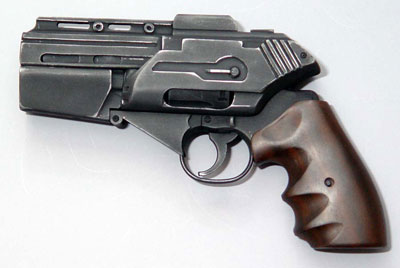
This is the pistol from the miniseries and season 1 of Battlestar Galactica. The producers wanted a futuristic-looking handgun, but one recognizable as a firearm not a laser. The “Colonial clamshell” as David Eick called it, was a Smith & Wesson 686 .357 magnum dressed up to look like some kind of autoloader, and had an underbarrel rocket/grenade launcher like on the FN57s they used later. (The reason for the switch was that the original pistol was barely functional and had to be broken down to be reloaded; the FN allowed for more realistic action, looked futuristic, and allowed them to burn up the huge 5.7x28mm blanks stores SciFi had from Stargate: SG1. So, going off of the basics, here’s my take on the CAL “Warrior” pistol:

CAL “WARRIOR” .36 magnum

At the beginning of the Cylon War it was obvious that the heavily armored centurions required more firepower than most traditional sidearms of the various colonies could provide. Most were almost underpowered for humans, much less killing machines — 5.7mm, 9mm, .45…  Various weapons were employed by the Colonial Fleet for the first half of the war but two pistols surfaced as the main sidearm for pilots — the Warrior by CAL of Caprica.

The Warrior is an electronic fired, magnetic-assisted .36 magnum which fires a 170 grain bullet at close to 1400fps by the time it leaves the barrel. The bullets are steel-cored with a hard tungsten tip that makes the round highly effective against hard armored target, and which would cause the bullet to break apart explosively in the target. A underbarrel single-shot 10mm rocket launcher was added quickly to provide a bit more punch when the .36 was ineffective — a system that translated to the new Picon 5-7, currently the main service pistol.

The Warriors were very powerful, but finicky weapons with a complicated loading gate system that allowed for six shots, which would then have to be unloaded through the same gate, one round at a time.

CAL “Warrior” .36 magnum   Type: Revolver   Damage: d10W (Special: 1/2 Armor ratings)  Ammo: 6   Range: 15 yards (Rocket launcher, 10mm minirocket   Type: breechload   Damage: d2d6W (1/2 armor ratings)   Ammo: 1   Range: 20 yards)


Colonial Military Equipment (Part 1): Spacecraft Equipment

The corebook covers the basics of Vipers and Raptors, and capital ships, but it was a first generation set of rules that never got cleaned up by Margaret Weis Publishing with the promised Colonial Military sourcebook. There’s a lot of wiggle room purposefully built in — this is not a combat simulation game; it’s a role playing game…but a bit of crunch might help with verisimilitude. So here goes…

In addition to the usual cannons and missiles that the light spacecraft of the Colonial Fleet employ, there are other important bits of gear that can save a pilot’s life:

Sparrows and Jiggers

“Sparrows” are the name of flare packages that both Vipers and Raptors employ for their protection. Designed to confuse and lure a missile away from their intended target, they use intense heat and visible light to combat an infrared or optical lock-on.

In game terms, a sparrow gives the pilot an opportunity (as an additional action to or replacement action for evasion) to roll a INTELLIGENCE+TECHNICAL ENGINEERING/ELECTRONIC WARFARE test. If they can beat the original gunnery roll of the enemy craft, the sparrow lures off the missile.

Jiggers are special chaff packages that shred themselves as they are launched, creating interference, and can be used to distract DRADIS-seeking missiles. In game terms, there’s very little difference between the two, but the GM could use IR vs. DRADIS missiles to give a bit more sense of realism.

Vipers typically carry two of each in the undercarriage of their vehicle, back near the engines. Raptors carry six of each.

Electronic Warfare

A new specialty for characters is Technical Engineering/Electronic Warfare. The characters use this to detect signals (SIGINT) and electronic emissions (ELINT.) The characters can do things with this skill like identify the EM or jump signature of a vessel, tell if the ship is under power or not, the temperature aboard, electronic activity that would allow anti-radiation missiles to lock on to the craft. They can also use it to identify open data ports and use the vessel’s communications to try and gain access to the vessel’s computer. (This requires a successful HARD Electronic Warfare test and a Hacking test vs. the INT+WIL of the ship, or the ALERTNESS+TECH ENGINEERING/COMMUNICATIONS or ELECTRONIC WARFARE of the target vessel’s communications or data control officer. Not all vessels have open ports, or they are only open during communications.)

The other use for Electronic Warfare is to jam communications, missile systems, etc. This is difficult, depending on the range to target, their shielding, and the frequencies covered.) In combat, jamming operations will often disturb friendly, as well as enemy communications unless the raptor’s ECO (or vessels EW specialists) can fix on the proper frequencies — a HARD  ALERTNESS+TECH ENGINEERING/COMMUNICATIONS or EW test. Once located, they can attempt to jam communications (thus rendering any benefits from a command and control element ineffective.)

Example: One Nite is the EW bird for a skirmish between Eagle Squadron and the Cylons. Her ECO, Drippy, has managed to isolate the Cylons’ communications (coded, of course and nearly impossible to break.) She takes over and attempts to jam Cylon communications and succeeds. Until they can re-establish communications, the Cylon squadron commander can no longer coordinate attacks, giving Eagle Squadron initiative each turn until the jamming stops or rendered ineffective.

There’s a problem with jamming — the jamming vessel is often completely blinded to incoming communications and can have their DRADIS array likewise jammed. They are also the brightest EM signature on the battlefield. While jamming, any unit targeting them gets a +2 shift to their PILOT or HEAVY WEAPON test to shoot the raptor.

This makes raptors a much more important part of the battlefield in a Batlestar Galactica game; they can easily turn the tide, as much as a Viper.

Decoys, Jammers, and other EW Weapons

During the rescue of the Colonials from New Caprica, we see the raptors use a new weapon they had not in other episodes — decoys. These are essentially missiles that are programmed to send out an signature that approximates another vessel. It hammers out an electromagnetic signal that creates a DRADIS “reflection” and associated signals to confuse the enemy. They are only truly effective in environments where DRADIS and other sensors are suffering from interference — as in a nebula, the heliopause of a planet, etc. They are programmed by the ECO using INTELLIGENCE+TECH ENGINEERING/ELECTRONIC WARFARE. The ruse is discovered if the enemy beats the result with an ALERTNESS+PERCEPTION or ELECTRONIC WARFARE test. Each turn, the enemy gains a +1 shift to their skill die.

Similar are jammers — missiles that are packed with high-powered transmitters that create havoc on the electronic battlefield, much like jamming operations for a ship. The missiles are fast moving and can be programmed to run a straight line or a shifting course. They will act on missiles, DRADIS, and communications within skirmish range and operate for up to an hour.

Lastly, there are EMP generators. These large pulse coils send out a massive burst of electromagnetic energy that is designed to stun or disable electronic-controlled enemies (i.e., Cylons.) They have a range of skirmish and will effect any Cylons aboard a ship, or within range. Most vessels are hardened against the effects, but it is very effect against the centurions (due to scaling.) They do planetcraft-scale d8W. The downside, since they are often mounted inside a vessel as a last-ditch defense against boarding elements, the effects are felt by the firing vessel, as well.

(Lee Adama used one of these arrays, slaving it to the FTL drive to make it appear that a nuclear weapon had detonated and destroyed Colonial One. The EMP generator would have done d12S damage slaved to the FTL with a range of capital. Using the FTL to boost the signal apparently caused stun damage to the crew of Colonial One, as well.)

Missile Guidance

As with the rules for sparrows and jiggers, missiles might be IR, optical/laser guided, DRADIS, or anti-radiation homing. In practical terms, in space, none of this is going to matter too much. There’s a lot of open space and not a lot to distract a missile. But as with the sparow/jiggers, the GM might want the pilots to specify their load-out for a mission. One way to do this is if there is a specific target — say, a transmitter tower of a Cylon outpost — might make using anti-radiation missiles more effective (a +1 or +2 shift to their PILOT or HEAVY WEAPON test to hit the place. Then it might matter that the Cylon raiders aren’t excellent radiation sources, their stealthy hulls providing a -1 shift to the same to hit them with the missiles.

The Big Guns

Capital ships’ weapons are pretty hazily defined in the BSG RPG. We know their range and their scale for sure, but what about the number of guns that can come to bear? Partly, this could accounted for by having the commanding officer do an AVERAGE INTELLIGENCE or ALERTNESS+PERCEPTION/TACTICS test and give the gunnery crews a +1 shift to their skill for every three over the result. This would represent the number of batteries that could be brought to bear on a target. Step the CO’s difficulty up a level for each target they are trying to engage.

How much damage to the guns do?

There’s Table 6.4 on page 133 of the rulebook. This applies to vehicle/planetcraft scale — light weapons would be wepaons designed for vehicle defense against personnel, medium would be standard armaments, and heavy would be something akin to the 130mm cannon that a modern-day AC130 carries.

For point defense, typical AA guns and 40mm autocannons would be “heavy” (d12W damage), with medium being slower-fire guns like .50 machineguns. Light would be the equivalent of a battery of squad assault weapons trained on a vessel…they can do damage, but it might take a while to drop a marine landing shuttle.

At the spacecraft scale, we are talking about massive AA guns that explode and do flak damage to larger craft. We haven’t seen this in the show; they use their railguns for that, but there’s no reason your campaign couldn’t have some sort of dedicated battery of cannon/railgun that serve the purpose.

Railgun damage is covered on page 134 of the rulebook in Table 6.5. What kinds of cannons would vessels have? Figure for small vessels — tenders, medical ships, and other transports, they have light railguns. They need the space for other equipment and cargo. this would be the typical “defense” gun a civilian vessel might have gotten a license for.

Medium railguns would be typical on gunstars and light battlestars like Valkyrie. Once again, there could be volume issues for the magazines causing them to favor the lighter weaponry, or perhaps if they were built during a time where the Cylons were not viewed as the main threat, heavy cannons are considered overkill against pirates and smugglers. they also might be cheaper…you have to figure a battlestar is an expensive piece of equipment, and the government would save money wherever they could.

Heavy railguns are the stuff of main line battlestars.

Missile payloads aren’t always going to be the biggest baddest available. You don’t use a MOAB for a surgical strike, for instance… Light missiles on a light craft would be the equivalent of a TOW pod — something to use against small, lightly armored vehicles when in air support mode. For light missiles, give the pilots a benefit that works to use them — they provide a larger area of effect, say, than a heavier missile, as a light missile pod shoots multiple warheads at the same time. Medium missiles, of course, are the typical combat warheads, and heavy would be large anti-structure weapons designed to destroy buildings and the like.

Spacecraft scale missiles start with light — these would be typical anti-ship missiles carried by fighters. They are small in size, but big in bang. (Think a Martel or Exocet.) Medium missiles would be cannon-fired missiles, essentially guided railgun payloads capable of tracking a target. Heavy missiles would have their own dedicated silos or have to be fired from dedicated railgun batteries. These could also represent low-yield nuclear missiles (below, say, 1 MTn.) In addition to anti-spacecraft duty, they would be used for ground bombardment. Extreme would be the equivalent of 1Mtn+ fuel-air bombs (unusable in space) and nuclear payloads.

Nuclear Bombs in Atmosphere

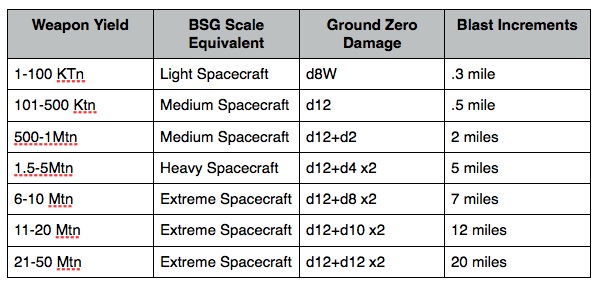
Nuclear bombs are not especially devastating in space. Spacecraft are shielded against radiation, there is no atmosphere to create pressure waves. But planetside, in an atmosphere — BAD.

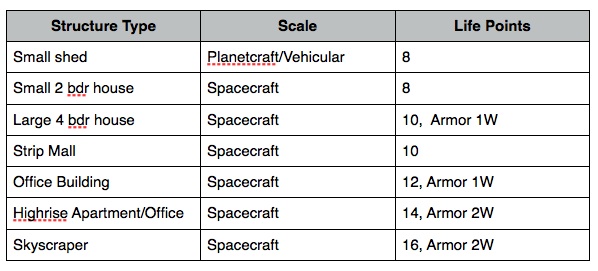
Here’s the damage caused by atomic/nuclear/thermobaric weapons. For each blast increment, half the damage (example: the Cylon use a 1 Mtn weapon on Caprica City. The damage rolled is 11. Every structure takes 11 points [usually enough to destroy most buildings] and vehicles 110, people dead if not in shelters… At 3 miles, the damage is 5 [round down] to structures — larger buildings will be severely damaged.)

 And because you need an idea of what you can destroy in game…

The latest episode of our Battlestar Galactica campaign is a follow-up to the last adventure. Previously, the characters had discovered that a worker at an archeological dig on Sagittaron that is causing massive political, religious, and academic upheaval — they’ve discovered an ancient city that appears to have been very modern and destroyed by a nuclear weapon 10,000 years before the Colonies were allegedly settled — is an astronomer that disappeared from a deep-range early warning observatory they found abandoned, possibly attacked by Cylons, at the beginning of the campaign.

Tracking the man down to Leonis, they arrested him because his travel companion — a beautiful, tall blonde woman — was involved in identity theft. Questioning him, they discover he has been brainwashed into believing his new life as an archeologist. When they finally break the programming, the man claimed the “they’ll know! They always know!” and that “they” were the Cylons. Moments later, he passes out from the stress. While doing an examination on the man, the back of his head blows out. They assume it was a kill switch or some kind of cybernetic implant.

They turn their attention to the companion, who had disappeared from Leonis, only to turn up on Caprica. A look into the mysterious “Vala Inviere”, they find out she works as a lawyer for the commander’s wife, who is the head of one of the more powerful political lobbyist groups in the Colonies. This would give the possible Cylon agent access to politicians, policy, and other important state information. They race to Caprica this episode to find her.

The evening starts with them linking up with the Colonial Security Service (essentially the FBI) to find and track her. The commander is hoping to follow her and find her associates. He has made certain his father, the president’s security advisor, is in the loop and this has put the character in the high-profile position of leading the investigation. However, the director of the CSS runs the operation up the chain of command to the Colonial Attorney General, a smart, connected, and highly ambitious politician looking to be the next Caprican Quorum member — a position that the sister of the commander (and wife of the other PC) is running for. The AG has been at loggerheads with the lobby group in question and sees the opportunity to link this powerhouse to Cylon sedition. She lobbies the president to take over the operation.

There was a lot of politicking this evening, and I used a modified version of the d20 Babylon 5 influence mechanics to represent the commander and his brother-in-law using all their connections to try and thwart the AG. (If you use the search function, you’ll find the post on this; I’m trying to punch out this post before the daughter wakes.) Their opponent, however, outmaneuvers them. Tomorrow, she takes over the mision and launches an arrest and seizure of the Inviere woman’s computers and other devices. The CSS is raiding her fancy home, while the AG leads the raid on the lobby firm. The commander and other PC get to ride along as observers — the AG is essentially rubbing their noses in her move to link their family to the Cylons.

The raid goes predictably bad, when the suspect turns out to be preternaturally fast and strong. She nearly breaks the commander’s neck in one surprise attack. There was a fast and furious fight and one of the CSS agents is injured. Another kills the suspect with a shot to the head, in the same general area where the last guy had the device implanted that killed him (but there’s no explosion…they didn’t catch that.)

The rest of the night was more politicking, trying to insulate the family from the AG, by dropping the blame for the operation on her. She, in turn, blames the tactical team and gets a bunch of them canned; she survives the incident (politically) but she is in a disadvantageous position with the president, right now. The characters, however, appear to have personal reasons for trying to shift the blame, and while the whole incident is being hushed up for national security concerns, the commander’s father has to step down as PSA. The lobby firm is safe, and the commander’s career is unaffected — in fact, the whole issue has been turned over to the military intelligence machine, which includes his command element. He’s not quite out of the loop, yet, but his political buffer (his dad) has been temporarily neutralized.

The episode has heightened the political intrigue and Cold War feel of the game, and has highlighted the dysfunctional nature of my Colonial government. (The legislature is essentially shut down due to a Sagittaron-led boycott in the Quorum over the archeological dig, which has brought work to a standstill.)

The characters are now angling to convince their bosses in BSG-20 (the Expeditionary Task Force) to allow them to lead a series of covert missions over the Armistice LIne to see what the Cylons are up to. It was an interesting move that’s giving me a series of adventure ideas for the next few games.

Overall, the players are enjoying the game, and I feel the campaign is really gaining legs with a very different feel from the last time I ran BSG — the level of paranoia is heightened, much like the early episodes of the show, because my Cylons appear to be using humans as agents. We don’t know anything about the Cylons themselves, other than they’re still out there. We don’t know the level of infiltration, what they’re up to, but with the agent placed in their immediate circle, it’s very personal to the characters…which should get them to act more impulsively and give them the opportunity to have serious consequences for their actions.

Second night of “episode 107” for our Battlestar Galactica campaign. The crew are tracking an archeologist from the University of Leonis that was at the Sagittaron dig that’s causing all the social and political strife in our game world after they found out he was a doppleganger of a missing astronomer rom a deep-range outpost that was attacked and unmanned from our “pilot” episode. they had looked through his apartment, found out he wasn’t in town from his phone and credit card records. They also ascertained he’s traveling/living with a woman who had spoofed the credit chit numbers of a rich guy here in Luminere.

They start pulling data together that morning and find the DNA and fingerprints of the guy are a match to the missing astronomer. He was snatched 5 months ago with the rest of the observation post, and has turned up a few weeks before the Sagittaron dig as an archeologist…it can’t be coincidence. The DNA from the woman’s hair matches nothing in the police databases, but they’ve managed to link the phone to a Caprican woman, Vala Inviere.

The main issue they’re up against in the episode is relativity. I’m using the Quantum Mechanix map for the Colonies, and the distance between Leonis and Caprica is roughly 110SU, or 15 light hours, away…we’re starting to find out that records between the colonies are incomplete and getting fast data requests from the other worlds can take days just due to latency. There are special courier ships that synch the interplanetary web servers from time to time, but that means that the cops are working with incomplete data, even though this is a high-tech universe. (it’s worse between the Helios Alpha/Beta and Helios Gamma/Delta colonies, where latency is upward of over a month.)

They take a fanblade VTOL to Hedon, a Monaco-esque town on Leonis to try and do surveillance on the couple. The town is one of the last vestiges of the deposed monarchy of the planet — the “Prince of Hedon” (once the title of the eldest son to the King of Leonis) owns the Hedon Grand Casino, which was formerly the vacation palace of the monarchy.  The place is spectacular — a combination of old and grand architecture and modern technology. The security is superb, and they have records fo the comings and goings of the guests.

Their initial target, the Corbett/Yanos man is in his room, but his companion left late last night (only a few hours after the incident with the security bot in Yanos’ apartment. She hasn’t returned, but she did have a suitcase with her. The characters are waiting on a courier raptor they had sent to Caprica to try and get more information on Yanos’ legend (he’s supposed to be Caprican) and the woman. Meanwhile, Yanos goes out to play triad at the casino. Commander Pindarus, the CO character, decides to play as well and chat the guy up. He seems genuine…not some grifter or enemy agent.

They get back intel from Caprica about this point on their cell phones: Mark Yanos died at 22 of alcohol poisoning during a binge at university; this guy took his identity. they knew he was a fake, but now they have the proof to arrest him for identity theft. The woman, Inviere, turns out to have an extensive background that is — like Yanos’ — doctored. She appeared out of whole cloth two years ago. She travels extensively throughout the colonies, and particularly those centers of government: Picon, Caprica, and Libran. And she works for the largest lobbying firm in the colonies, the Pindarus Group…the commander’s wife runs it!

The arrest and question Yanos over four hours, but they guy doesn’t break character. However, they notice his memories of his past seem very limited and his phrasing is exactly the same. It’s a script, but he doesn’t seem to know. Presenting him with all the DNA evidence and his past causes him to have a seizure and pass out. They get him to the hospital for a brain scan, but he wakes to tell them that they know! that he was broken, that he remembers his real past. He and the others were captured, tortured, programmed…by the Cylons! And they always know what is going on with their agents. He doesn’t know how.

The brainscan is dramatic when the back of his skull explodes. Some kind of kill switch? The scan only had started — they have no data on what happened. While the forensics folks get to work, the characters leave Hedon for the Cavoir CMC Reservation, get their intelligence people to work on trying to track this Inviere’s whereabouts and movements, then they procure a raptor for a trip to Caprica to try and find the woman and investigate the Pindarus Group connection.

The good: there’s a lot of fleshing out of the minutiae of the world — the latency issues for the interplanetary webs, etc. as well as creating new “sets” like Luminere and Hedon. We found out that you can make cell calls from Caprica to Gemenon. There was a nice cameo of Galactica patrolling the Gemenon-Caprica spacelanes. The mystery of the Cylon spies and the possibility of programmed human agents has created a very paranoid Cold War era feel. The links to the players through their friends and family has also given them ties to the world.

Also, we’ve fleshed out other aspects of this BSG universe: the technology levels have been better established. There’s cybernetics in the world — prosthetics and the like — so the implant idea wasn’t out of their realm of experience, but the implications of controlling a subject still chilling. We saw holographic screens in the expensive Hedon casino environment and I established that these are only used for big billboards most places because of the expense. (the characters were miffed their fancy battlestars don’t have them.) We saw normal (if sci-fi-ish) aircraft. We established that the Leonine aristocracy mostly fled to neighboring Virgon after they were struck from the planet’s civil list. Communications inside a star system (say between Virgon and Leonis is relatively normal — vid and text messages take a few minutes to an hour to get back and forth, but other colonies are nearly a day away, and others are completely out of communications range and require “packet boats” to move massive data from one set of colonies to the next. We also established a few campaign specific organizations: the Colonial Security Service (sort of the Colonial FBI), that there is a Colonial Marshal Service that almost exclusively hunts interplanetary fugitives, and that there is a Colonial Fleet Security Bureau (NCIS-like group.)

The bad: I was off script most of the night and had to tap dance a lot. It was also a big crosstalk night. One of the players hasn’t been here for a few weeks, so there was a lot of out of character/game chat about movies, TV, and the like. I don’t mind this, like some gamers — gaming is first and foremost a social thing for me — but it did slow the action for the first hour or so. We also had another player be quite late.

Overall, I like how the campaign is coming together . I was a bit iffy on it until the Sagittaron stuff, and I think this last storyline has really established the feel of our first “season” and the moving the action from one colony to the next is fleshing out the game universe and making the Colonies a real place. When the Cylons show up, it should feel like a real place they don’t want destroyed.

The filling out of the universe is essential in any campaign, but it can serve to help make a licensed universe more your own. Just the adding of the communications problems and law enforcement groups could lead to completely different styles of play, as well as creating verisimilitude. It also sets up a reason for the Command Navigation Program (which automatically syncs ships and bases so that they have the information and location of other units with less need for the courier raptors.) It also set up another reason the Cylons might be so successful in their attacks: communications is simply a nightmare between Caprcia/Picon command elements and Scorpia, Sagittaron, Libran, Arelon, and Canceron…