One of the featured toughs in our game this week drove a 1930 Mercedes Manheim 370 six-seater, four door saloon. Presented here is the beast, herself…

Built on the W10 platform, the Mannheim n 3689cc straight-six engine producing 75PS (73 bhp) of power through a three speed gearbox, with a top speed of 63mph!

1929-w10-typ-370-mannheim-2a

Size: 2   Def; 6   Str: 8   Spd: 60   Han: 0   Crew; 1   Pass: 5   Cost: $1000 (used), $6000 (new)


There’s plenty of secret societies in the Hollow Earth Expedition and Secrets of the Surface World books. We just introduced the Terra Arcanum and Thule Society into our current campaign, and we’ve used the Green Gang in Shanghai before, and of course, the Ahnenerbe… One of the groups our intrepid explorers has crossed paths with is a Jewish Relief Society in Istanbul that is working s an underground railroad to get Jews out of the Ukraine. So here we go…

The Bosphorus Hebrew Relief Agency

This “secret society” is hardly that — registered in 1925 with the Turkish government, the BHRA has been instrumental in aiding many Ukrainian Jews escape from the Soviet Union since the post-war pogroms began. More recently, they have been bringing in many of the German scientists and entertainers currently settled in Istanbul.

The head of the BHRA is Rabbi Chaim Riger, a charming, middle-aged man from Odessa, who fled his country in 1922. He is the public face of the legitimate organization aiding jews throughout the Soviet Union and Europe.

The BHRA, due to their work, is tied tightly to organized crime, and specifically the Rabinowitz Group — led by Cantor Werner Rabinowitz, late of Warsaw. His arrival in 1930 saw the disparate Jewish gangs in Istanbul pulled together to help fund the BHRA and other Jewish groups. While the cantor is not involved in day-to-day criminal enterprises, he is the undisputed “boss”, making sure a cut of the various illicit activities goes to the various aid groups. His brother, Pavel, is his right hand, and is known for his “object lessons” doled out to those that would operate outside the Rabinowitz Group’s direction.

Mostly, the group is involved in smuggling — people out of Europe and the USSR, guns, opium and hashish into Europe through Greece (Turkey is not a signatory to the International Opium Convention), as well as gambling and prostitution, and the protection thereof. They are known for delivering swift and violent retribution on Turkish and Greek gangs that cross them, and they have a tight relationship with Armenian gangs.

Sample character: Nathan Baum

Nathan is one of the Rabinowitz go-to toughs. Born in the Crimea in 1910, his teen years were shaped by the violence and hardships of the post-revolutionary Ukraine. He is a strange man, highly loyal and sympathetic, yet willing to commit grave acts of violence. He has been known to cry over people he has had to kill, and even paid for burials and the support of widows. He drives a 1930 Mercedes Manheim 370 saloon, and his favored weapon is the Luger P08 9mm. I described him as a sort of Daniel Craig-esque fellow.

Ally 2

Archetype: Criminal     Motivation: Survival   Style: 3   Health: 8

Body: 3   Dexterity: 2   Strength: 3   Charisma: 2   Intelligence: 2   Will: 4

Size: 0   Move: 5   Perception: 6   Initiative: 4   Defense: 5   Stun: 4

Skills: Athletics 2/5, Brawl 2/5, Bureaucracy 2/4, Con 2/4, Drive 2/4, Firearms 2/4, Intimidation 2/4, Linguistics 3/5, Melee 2/5, Stealth 2/4, Survival 2/4

Talents: Iron Jaw

Resources: Artifact 1: Mercedes 6-seater saloon, Rank 2: Rabinowitz Group (+2 social bonus and Artifact resource)

Flaws: Loyal, Vow

Weapon: Luger P08 — Dam: 3L   Attack Rating: 7L   Cap: 7   Rng: 50′   Rate: M/A   Spd: A(this is one of the few artilery select-fire versions that uses a wooden shoulder stock to activate automatic fire. If he knows he’s going into real trouble, he has a 32 round drum for the pistol.)

The characters left Switzerland after an altercation with men, possibly sent by the Gestapo, to stop them in their quest to find the Eye — a mystical or superscience device left behind by…they don’t really know who. (See here for the first episode, and here for the second..) After a tense night where Lady Zara fell asleep at the yoke of their plane, Dr. Guld as able to wake her just as the lane stalled out. A few tense minutes of plummeting to the ground later, they were able to limp into Istanbul and land.

While a local mechanic was trying to suss out the damage they’d done to the motors, the band got a hotel room and started looking for the whereabouts of Rudolf von Sebottendorf. Zara checked in with the British Embassy, Gustav with the Germany, and Gould touched base with the local Jewish relief group that was aiding Jews escaping the communists in the Soviet Union. They quickly learned the address for Sebottendorf, but found they’d picked up a Gestapo tail while in the Grand Bazaar.

Gustav, rather that eluding them, engaged the men in conversation (they wouldn’t admit they were following them, but he was able to keep them busy) while Gould and Zara (who had bought a money she named Rigoletto) secured a taxi with some difficulty. The driver of the vehicle that picked them knew they were being followed, as well, and quickly, expertly, lost the Germans. Nathan, it turned out, had been sent by Cantor Rabinowitz to aid them.

At Sebottendorf’s house, the old man who started the Thule Society, only to be cast out, was shocked to hear they had discovered another “Eye” in Africa, and that they had gotten it to work! He figured out Gould was the key — an actual descendent of the Thule! He brought out a scroll with runes similar to Linear A, hoping he could read it. (He could not.) But when he had him hold a spear with the runes, Gould could feel it wake.

That’s when four men burst in, armed to the teeth. They wanted the spear, but also to stop them from their mission. Gould knocked Sebottendorf down to save him, Gustav threw himself on top of Zara, but before Gould could hand over the spear to prevent violence, the ir masked attackers realized the runes were glowing — he was a child of Atlantis! Zara has secretly given her wee Astra .32 to Gustav, who took the opening and dropped two of the men. For two style points, Rigoletto suddenly became useful and jumped on another of the men; he is now a full-fledged “follower” for Zara and will get statted out. Gould let fly with a blast of electricity or something from the spear, dropped the last man.

With a shot in the ass for good measure from Zara, they questioned the two men still conscious — they were all carrying a pendent: a triangle with the All-Seeing Eye. They learned they were members of a secret organization bent on protecting dangerous bits of knowledge and ancient technology like the spear — and the children of Atlantis, like Gould — from forces that would misuse them. They are the Terra Arcanum!

Knocking at the door might be Gestapo, or reinforcements for the Terra Arcanum people, or the police, but they quick made their get-away down a secret staircase to the Istanbul catacombs with the aid of Sebottendorf (who kept the spear.) His last words were that the Eye — last he knew — was in a cave under the Northern Chapel of the Potala Palace. After retiring to their hotel with the aid of Nathan (who had been the man at the door, it turns out), they find out the plane still has a day left until fixed, and they get an invitation to see one of Zara’s old friends who is here in Istanbul.

Her husband is a member of the India Survey (also the Indian Army’s intelligence corps), and it turns out Terra Arcanum. They had no knowledge of Gould’s nature, but now that they do, they are eager to help them get to the Eye in Lhasa before the Germans do. A contact in Simla, a member of the Survey, who knows Lhasa…

The race continues!

Here’s a video of the Google Hangout session of Triple Ace Games’ Leagues of Gothic Horror using the Ubiquity system (the same used for Space:1889 and Hollow Earth Expedition.) Here the GM is Runeslinger, a regular commenter on these pages, and Andre Martinez, in addition to yours truly. I’ve been sick for several weeks, so my voice is a bit quiet in the video.

Here you’ll see examples of use of style points, how to “take the average”, which I do quite a bit.

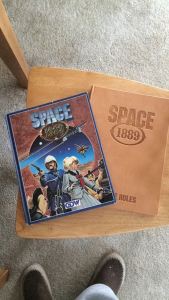
12670087_10153963273907082_3286283278008602244_nI’ve already done a review of the PDF version of the game, but I’ve finally laid hands on a physical copy of the game. This was a game that loomed large in my gaming through the 1990s, and informed some of the Victorian sci-fi camapigns of the early 2000s. I still have the original copy of the GDW game, bought at Compleat Strategist in Philadelphia in 1989. Now I have the new Ubiquity-powered game from Clockwork Publishing out of Germany to complement it.

First off, this is the “premium” faux leather covered version of the book. They go for about $100. Production quality on the book is good — the fake leather feels nice and the gold embossing is well done. The binding is solid, and includes a bookmark ribbon in bronze. Good glossy paper, with a readable font in two columns per page, with black & white, grayscale, and color art throughout the book. One point of contention is the sizing. Rather than a typical 8.5×11 or 11.25″ book, like many game lines, this one is 8.5×12″, so it sits higher in the bookcase. The different aspect ratio looks nice, but might be a pain if you don’t have spacious bookshelves.

The new edition is very true to the original setting, but expands a bit on the original material of the game, mostly in dealing with Venus and the German colonies there, but also adds a bit on Mars and Mercury. Setting takes up much of the page count at 121 pages. The game rules are Ubiquity — the same system that powers Hollow Earth Expedition, the ’30s pulp game that usurped Victorian sci-fi in my group’s play rotation. There’s not much new to the rules beyond those found in HEX, same for bits on gravity on different worlds, and comes in at 80ish pages with character creation. One point where the new rules dropped the ball was on the Martian and Venusian characters…there’s no racial templates to give them their own flavor, so I cobbled some together based on the rules from Mysteries of the Hollow Earth and Secrets of the Surface World sourcebooks from the Hollow Earth Expedition line. They are presented below.

Style: The original game was pretty sharp for it’s time, with good color art and crappy line art for the rest; the new version is average RPG quality art for the black and white art, decent color. I’d go 3-3 1/2 out of 5 for the normal edition of the game, but the faux leather brings this edition up to a 4 out of 5.

Substance: Unless you plan on really digging into political intrigue and the like, the book is good enough to launch into a campaign that night, and the rules are complete enough to handle most situations — 4 out of 5. Is it worth the $56US for the print and pdf combo? If you are into this genre, yes; if you are an old Space:1889 fan that wants a better set of mechanics than the execrable ones from 1989, absolutely; and this edition with the swanky cover might be worth the $100 for the fans of the old game.

Space: 1889 is now available through the shop at Mödiphius.

Here’s the templates for the main alien races of the setting:

MARTIANS

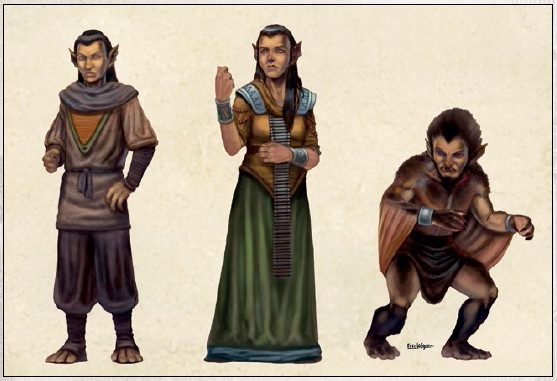
Hill, Canal, and High Martians -- as portrayed in Chronicle City's version

Hill, Canal, and High Martians — as portrayed in Chronicle City’s version

The denizens of Mars have three major racial types — the Hill Marian, found in the desolate wastes of the Red Planet; the Canal Martians, found almost exclusively in the urban and canal-fed areas of the world; and the High Martians — thought to either be the “Ur” Martian, or possibly a Hill Martians evolved to the particular environment of mountainous Mars.

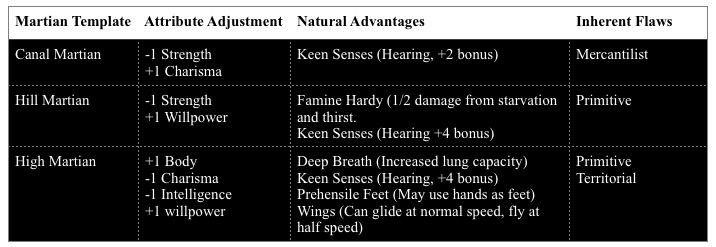
Using some of the Beastmen advantages from Mysteries of the Hollow Earth (pg. 14-25), I slapped together Martian character templates that were more in keeping with the original flavor of the game:

template

Venusians

Venusians aren’t set up as a player character in either any of the editions of Space: 1889, but I’m sure there are folks out there that might want to give them more to do in their campaign than be a poor man’s Sleestak. So here is a Template, vikked from Hollow Earth Expedition‘s Mysteries of the Hollow Earth to use to create a player character Venusian:

venusian


Runeslinger brought up an excellent question while chatting about my Reusing Stories post. He remarked that it was nice to see some Hollow Earth in my Hollow Earth Expedition game. Like me, he had avoided that obvious bit of faux science that — while a popular theme at the time — is utter rot.

In this case, I’ve got some ideas for why the hollow earth exists in our game that doesn’t cause the obvious issues dealing with gravity. Or common sense. But more on that at another time.

It got me wondering, however, ow many people that play Exlie Game’s Hollow Earth Expedition actually set adventures in the interior of the planet? While I suspect we’re unlikely to get many folks opining in the comments section, I’ll open this up to any reader — if you’ve run the game, did it include that setting; for those who haven’t played HEX, if you were going to run a ’30s pulp game would you consider using the hollow earth as a setting or McGuffin?

Day two of the #rpgaday2015 conversation, “Kickstarter Game You’re Most Pleased to Have Backed” was a easy. I’ve only backed three Kickstarts, so far — two from Modiphus — the Transhuman book for the Eclipse Phase game (mostly because they do such nice work) and Mindjammer, Sarah Newton’s immense sci-fi transhuman setting for FATE; and from Exile Games, Revelation of Mars (for Hollow Earth Expedition) a book I’ve been waiting for from when it was first teaser a good five years ago.

It’s a tough one — I’m much more excited about RoM than the other two, but was disappointed by the length of time it took for them to get it out the door. (I’ve got the eb0ok, but am still waiting on the physical products, at this time…) Modiphus, on the other hand, blasted Transhuman and Mindjammer out the door in quick order, seems to be shipping the push goal products at a good clip, and the company has been superb with their communication, so I think I’m going to have to go with Mindjammer on this one.

And honorable mention goes to a project I missed the Kickstart on, but did a pre-order as soon as possible, and that’s Chronicle City’s translation of Clockwerk’s German-language, Ubiquity-powered Space:1889. That setting thrilled me enough in 1989, when it came out that I’d run some version of it from 1990 to 2008-ish, when we started dabbling with Hollow Earth and Battlestar Galactica. It also inspired me to go into history (something I should berate the game producers for..terrible life choice!) and to study the Victorian period for my master’s work.

Almost two years after their successful Kickstarter, Exile Games has finally rolled out their PDF for Revelations of Mars — their planetary romance supplement for Hollow Earth Expedition. The e-book is stil in proofreading (it’s being done by the people that crowdfunded the book) and it should be up for general consumption soon. The physical book should be available at GenCon, or so Jeff Combos — the head developer at Exile — claims.

The book has a similar layout and look to the other Hollow Earth Expedition products — a nice full-color cover and map of the RoM Mars in the endpapers, and color character example pages, but grayscale drawings throughout the rest of the work. It’s got a nice clear font, and the slightly gray pages are easy to read on my iPad in low light conditions without causing eye fatigue. I suspect the physical book will be hardcover, but I could be wrong about this one, and will have solid production values. Most of the HEX line has been very high quality.

The book has an opening fiction to set the flavor of the game, and does its job well enough, then after a short introduction to give the reader an idea of the goal of the setting, they jump into character creation. There are specific motivations, skills, traits and flaws to fit the creatures on Mars, as well as a selection of examples using artwork from when this book was first supposed to be coming out (five years or so, if I remember correctly.)  There’s a new skill: armed combat, that has a big blurb about various styles of fencing, etc. One of the things this brought to mind is that Ubiquity — the system Hollow Earth Expedition uses — feels like an older generation game, something from the dice pool era of the 1990s. This is not a bad thing — I’ve not been overly complementary of the new hotness of very rules lite games and shared narrative responsibility. Ubiquity feels lighter than many rules sets, but compared to Fate Accelerated, is a bit beefy. Or maybe “crunchy” is a better term. There’s a chapter of new psychic powers to fit with some of the new Martian races.

The equipment chapter give the players a nice anachronistic flavor — melee weapons galore and “blasters” — quasi-energy weapons that shoot energized slugs — and other rayguns. The skyships of Mars use sails to get around, but mysterious ancient Martian tech to fly. The how isn’t really addressed, or how new lifter systems might be manufactured (or perhaps I glossed over that bit) — something that should have be addressed, if even to hand-wave it off. This is followed by a chapter on vehicle combat that expands on the material in Secrets of the Surface World, and primarily deals with skyships, as one might expect.

The next chapter deals with the natives of Mars, and the flavor of this chapter, together with the equipment and vehicle chapters, evokes the Barsoom of Edgar Rice Burroughs mixed heavily with the more glitzy (and underrated) John Carter movie. There are the Chitik, beatle-like bugmen; Dheva, the four armed green-skinned human-looking Martians; the Elosi, more traditional “gray aliens” that are tied to the Atlantians — the ancient race that one ruled the planet and who tie this setting to the Hollow Earth of the other sourcebooks; the Grodh, four armed apemen of Mars, Praelor, four-eyed purple “smart” Martians; and Sauren, dinomen of Mars; Vrii, giant crystal humanoids that guard and feed “the Great Machine” that is breaking down, but used to keep Mars alive; and lastly the red-skinned Zhul-ya, the “demi-god” children of the Atlantian “God-Kings” that are alleged to be “sleeping” after an Age of War.

After this is a guide to Mars, including several important cities, the Great Machine in Olympus Mons, and descriptions of the wastelands of the planet. Also, they talk about how to get to the Red Planet — by rocketship, abduction by the Elosi’s disk-shaped spacecraft, an astral projection machine that lets people transport their consciousness to Mars while their body slumbers (John Carter-like), or Atlantian portals. This is followed with Atlantian History on Mars and defines the various God-Kings and their differences. There’s a chapter of NPCs for the GM to use and a bestiary.

The book ends with a Revelations of Mars adventure campaign that I haven’t read through yet; I tend to ignore these as they tend to interfere with the vision of running the setting I tend to get while reading the material.

So is it worth it? Yes — it has a nice Burroughs-esque flavor while cutting its own path in creating a planetary romance setting for the Hollow Earth Expedition game world. Comparing it to Space: 1889 (especially the Ubiquity version recently released), it has some very strong points — much more alien creatures, for instance. The look of the book is up to Exile’s standards, but it’s also obvious they had to go with another set of artists for their interior work, where the other books were very consistent in their look. The writing is solid, the system mechanics well thought out, if a bit heavier than is popular these days.

I haven’t gotten pricing for the ebook or physical product at this time, but my Kickstarter contribution entitled me to a physical book, some dice, a Martian Princess figure, and a map of Mars for $75. So yeah, it’s worth it. I assume the book will run about $50 for the physical book.

It’s a buy.

One of the few things that disappointed me about the Space: 1889 rules that came out recently was the lack of addressing Martian physiology in the rulebook. So here’s something more in line with what I expected for the new Ubiquity-powered game:

MARTIANS

Hill, Canal, and High Martians -- as portrayed in Chronicle City's version

Hill, Canal, and High Martians — as portrayed in Chronicle City’s version

The denizens of Mars have three major racial types — the Hill Marian, found in the desolate wastes of the Red Planet; the Canal Martians, found almost exclusively in the urban and canal-fed areas of the world; and the High Martians — thought to either be the “Ur” Martian, or possibly a Hill Martians evolved to the particular environment of mountainous Mars.

Using some of the Beastmen advantages from Mysteries of the Hollow Earth (pg. 14-25), I slapped together Martian character templates that were more in keeping with the original flavor of the game:

template

Venusians

Venusians aren’t set up as a player character in either any of the editions of Space: 1889, but I’m sure there are folks out there that might want to give them more to do in their campaign than be a poor man’s Sleestak. So here is a Template, vikked from Hollow Earth Expedition‘s Mysteries of the Hollow Earth to use to create a player character Venusian:

venusian

Update: Looks like the boys at Clockwork, over in Germany — the originators of the Ubiquity Space: 1889 noted this piece and are interested in incorporating it into future productions. Might lead to some more work, which would be nice.

I remember the first time I saw the original GDW Space: 1889 in The Compleat Strategist near Rittenhouse Square– I was living in Philadelphia and the main games our group was playing were either superheroes (DC Heroes by Mayfair), or espionage games (using James Bond: 007) and cyberpunk Cyberpunk (by R. Talsorian.) The look of the game was intriguing enough, with the great David Dietrick art — one of the big boys in game cover art at the time — and a quick look through the interior was enough to get me hooked. There was a board game, Sky Galleon of Mars, that tied in and allowed you to make the jump from the RPG to a wargame and back, and there were about a dozen supplements and adventure books published before GDW died. I have the book I bought a quarter century ago sitting in front of me as I write this.

After a bit of stumbling to put together a game, I wound up running some form of Victorian science-fiction — usually in the Space: 1889 universe — from 1990 until 2004, when I started to drift toward ’30s pulp and Exile’s Hollow Earth Expedition. The game was one of the reasons I went into history, my specialty was Early Modern and Modern Europe until my doctorate (mostly due to the shoddy condition of the European section of the college) when I drifted into Modern US (which strangely coincided with my move to Hollow Earth Expedition.)

A few years ago, there was a Savage Worlds version of this, the original “steampunk” (gahd, how I hate that word!) game, and I have a PDF of that, as well, but never found SW made much sense, mechanically. Close to that time, it was announced that Clockwork in Germany was doing a version using Ubiquity — the rules set from Hollow Earth Expedition. In 2013, the Kickstarter for an English-language version was posted by Angus Abramson — who I worked for in the early days of Cubicle 7 on the Victoriana line — and his new Chronicle City house. I missed the Kickstart for this, having already blown dough on the Revelations of Mars book by Exile a month earlier (still not @#$%ing close to done…) Well, the PDF just dropped for sale yesterday with the print book not far behind, and I had a chance to do a quick read-through this afternoon.
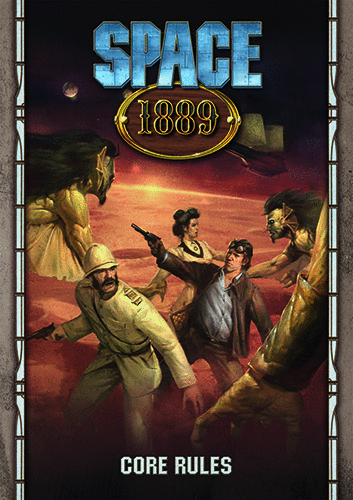
space1889

The new book is very true to the original. There’s some difference in the verbiage and the arrangement of the book, but most of the setting is unchanged, with additional material for Germans on Venus that was most likely part of someone at Clockwork’s campaign prior to resurrecting the game. There is new artwork, some of which is an update of pieces in the original book, some of which is original. The quality is true to the original book, as well — mostly black and white pieces and the occasional color plate. The maps of Mars and Venus are updated and look better than the original, but when I looked at them side-by-side, they are “the same.” There is the alternate history from the original book — Edison’s flight in an airship with ether propeller to Mars, and the other alternate history moments. There’s a gazette for Earth, Mars, Venus, and Mercury. Here and there, you can see where the new publishers added bits and bobs to flesh out the worlds — new gadgets and gear, a few locations and “worlds in the ether”, etc.

Character generation is nearly the same as you would find in Hollow Earth Expedition, but there is a specific set of rules for older, more experienced characters that looks a lot like the character creation house rules we’ve been using for our HEX games. There are a few traits and flaws that are setting specific, the Status Resource is very slightly more fleshed out, but otherwise it’s the character generation from HEX. One of the things that I noticed was there were no real traits that differentiated the Martians from the human characters in the game. (Here’s my take on the setting species.) I would have expected something to take into account the acclimation to lower gravity and pressure, but Space: 1889 also has a much more friendly Mars than reality — heavier gravity and atmosphere than most alternate Mars settings. (Over a few campaigns, I started using a Mars with .5G, rather than the .9G of this game, and lower pressures, making mountain travel dangerous for Earthlings.)

Rules-wise, it’s Ubiquity: roll the number of dice (any even sided will do — even a coin) equal to your skill plus the connected attribute and beat the number of successes. It has the “take the average” than makes Hollow Earth Expedition work so well when fighting mooks and the like — the GM doesn’t have to do a lot of rolling and the action moves quickly; characters that just need a pass/fail result can take the average when they know it’s higher than the needed successes for the same reason — getting roll playing out of the way of role playing. If you know HEX, you can pick up and play this.

Style: The original game was pretty sharp for it’s time, with good color art and crappy line art for the rest; the new version is average RPG quality art for the black and white art, decent color. I’d go 3-3 1/2 out of 5. Substance: Unless you plan on really digging into political intrigue and the like, the book is good enough to launch into a campaign that night, and the rules are complete enough to handle mot situations. 4 out of 5. Is it worth the $56US for the print and pdf combo? If you are into this genre, yes; if you are an old Space:1889 fan that wants a better set of mechanics than the execrable ones from 1989, absolutely; if you’re just curious..? No.

Extra Review Goodness!
loa

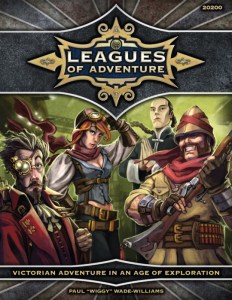
So, let me stack this up against the closest thing to its peer — Leagues of Adventure, also a Ubiquity-powered game set in a Victorian science-fiction alternate universe. This one is published by Triple Ace Games. Again — the mechanics, character creation, etc. is no different from Space: 1889 or Hollow Earth Expedition, but there are a few places where Leagues of Adventure excels: in the character creation section, there is a great bit on the Rank Resource, and how it ties to the various real and invented clubs of the period. Being a member of a club was almost essential for the well-heeled gentleman, and certainly for the aristocrat. Like Space: 1889, the Status Resources is pretty sketchily defined, but at least Space:1889 makes room for people below the rank of peer or wealthy middle class (bravo!) Also, Leagues provides rules for Inventions — something Space: 1889 (like the original) glosses over. Characters as inventors seem to be an afterthought in Space: 1889, but there’s a nice set of rules for it in Leagues and a goodly selection of weird steam- and clockwork-powered science!

Style: 4 out of 5 — the Art is superior RPG quality, full color, and the layout is nicely done. Substance: There’s a lot on the society and the basics of the Victorian period, and the rules are more comprehensive than Hollow Earth Expedition was… 4 out of 5. Is it worth the price of $30 US for the book? Absolutely. Is it worth the $18 for the PDF — no. Buy the book.

Now, here’s my suggestion: I would be surprised if Clockwork and Chronicle City didn’t do some kind of reprint or series of splatbooks for Space:1889, and TAG already has one book out and another with weird inventions on the way…if you’re a Space; 1889 or Victorian speculative fiction RPG fan — buy them both and mix and match the bits and bobs you need to build up your setting. (It’s what I’m doing.)