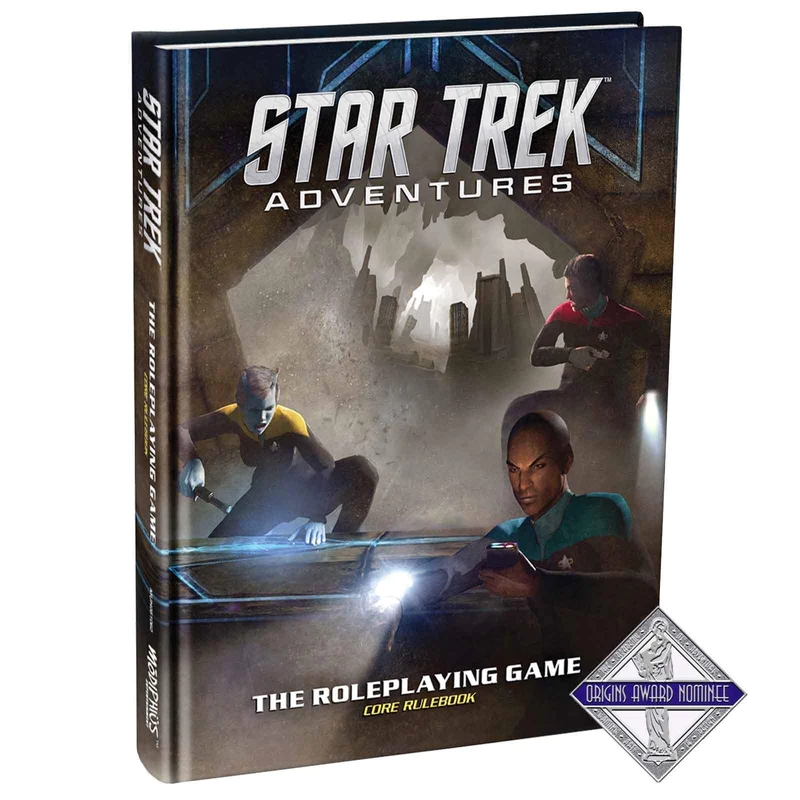
For a guy who was utterly disappointed by the playtesting of Modiphius’ John Carter of Mars RPG way back when, I’ve been playing a lot of 2d20 — a system I thought I’d never warm to. I’ll have a bit up on Star Trek Adventures — their 2d20 Star Trek game which I’ve been running now (on and off) for about a year with a surprising bit of success. In the wake of the second installment of Dune, which the wife loved, I thought I’d buy the RPG on the off chance I might run it for her and daughter. This review will encompass the core rules, The Great Game: House of the Landsraad, the Power and Pawns: The Emperor’s Court books, as well as the GM screen.
Dune is a much improved version of the 2d20 system (and if I’ve heard right, is used for their Chuthulu series of games), and from first glance at the quickstart, the version 2.0 of Star Trek Adventures. Really, I can’t impress on the reader how much improved the system is over the old one…but not just that, the things that made 2d20 so painful to engage with are improved: the writing is clear and concise, the indexing works — the stuff you look for in the index is where they say it is (unlike the execrable job that was done for STA), the color balance and use of typeface makes it readable where STA was an eyesore. (Fallout is equally well laid out and designed, written, and indexed.) This continues through the two supplements I quick picked up, as well, since while I saw the movies and read the Herbert novels way back last century — and boy, does that hurt to say — I’m not a real fan of the Dune setting after the first two books. However, while were on the usability and design of the materials, lets give a real round of accolades to the GM screen. There’s a way range of utility in GM screens — from the truly useless D&D screens and the practically unreadable screen for Aegean, to the serviceable like Hollow Earth Expedition and Star Trek Adventures screens (although in fairness, the ship combat cards that come with the latter are very useful), to the superb — Lex Arcana and Broken Compass/Outgunned screens where you can almost run the whole game off of the screens without referencing the core rules. Dune is in the last category: the screen features the combat sequence, the use of zones for different types of combat, difficulties, the use of momentum and determination, and the best of all , has the pg. the rules are located on in little bubbles on each chart so you know where to go if you do need a bit more. This wound up being useful on our first play test a few weeks ago.
The first 84 pages are dedicated to bringing you up to speed on the universe of Dune, a setting that is richly presented in the original novels and expanded n a bunch of books I haven’t read. There was a lot hinted at, and the size and scope of the Imperium is such that you could play in the setting without ever having to engage with any of the major players of the novels. Character creation is pretty straight forward and mostly moves linearly through chapters three and four. You create your house — be it a minor or major player, create a rival or rivals, then pick roles you will fill in the house from ruler or heir, to consort, to advisors and swordmasters and the like. You have two main sets of stats to run off of — there’s your Skills, like Battle or Move or Communicate; there’s Drives — motivations for the character to do something. Pick the most appropriate of the two and roll 2d20 (or more depending on other things) and get under the combined number for a success. you get two successes under the skill value, and if you have an applicable focus like “long blade” or “espionage” you get another. Beat the difficult of the task — a 1 if it’s a mundane task, or a 5 if it’s virtually impossible. Anything over the required amount generates momentum which can be used later to add up to 3d20, add aspects on a scene, gain a asset, etc. You have a drive statement that can, if you are playing to it, gain a determination (the really powerful game currency, which can erase an injury or give an auto 1 on a die….) The GM can invoke that statement, as well, to make you use that drive in a test (often to your disadvantage), and you can refuse but this gives the GM “threat” — momentum, but for the GM.
The use of two terms for momentum is a sticking point for me — it overly complicates the game currency, just as determination does.
Where Dune excels is losing the use of “challenge dice” — d6s that were specially marked for the respective games to give a character stress, or key a special aspect of the weapon, etc. They added more chance into play that could undo a particularly good test. (“Hey, I rolled six successes on a two success difficulty…but rolled two stress on my six dice of damage…”) That’s gone. You weapons, shields, vehicles, extra guys, whatever, are assets that add a die or more (up to 5d20 total) and extra success generate not just momentum, but do the damage. You have an asset of “sword 2” and rolled two successes over the necessary to hit? That’s 5 points to the other major NPCs “Battle” skill. Once you’ve got the skill to zero, you’ve won. You don’t have to kill the guy. You could injure, capture, whatever. Your choice; you won. For minor NPCs, you just drop them with whatever outcome you were looking for.
The use of zones gets a novel reworking. For duels, this involves trying to get through the guard of a character to the body. You can make this happen with a subtle attack, moving into the zone for your strike, or boldly — aggressively launching an attack to force the guard away and get to the person. For skirmishes, this works like 2d20 normally does, moving your character from one zone is an action, or you can boldly or subtly move and if successful, launch your attack after moving; you can also move the other person out of a zone — say, moving into a fight to push the attackers off an ally. This scales to large land battles, moving your forces from one objective to another and trying to push off the enemy, or launching an attack on them directly. Where it gets innovative is doing this for intrigue (social battles where you are trying to learn information or get close to a particular person) where you are trying to influence, gain information, or whatever from a person in a social setting. This recreates the medieval court intrigue that is central to the Imperium. It is also used for Espionage — similar theme, moving from one group or lead to another to get the information or contacts you need.
I liked this enough I ported it into the current side quest for the Star Trek Adventures game where the crew are trying to cut into the Orion Syndicate to find out who is dealing in Federation and Klingon war surplus after the war. (The game is set in the 1st season of Strange New Worlds.)
There’s a chapter on assets and how they work, another on the characters from the movies/books, and an adventure I haven’t used.
Layout, artwork, typefacing, paper and binding quality are all top notch, and this continues into the other material from the line I purchased. Power and Pawns digs into Imperial court life and gives a few more character options for the player. It also providess more insight into the other powers in the Imperium — the misterious Ix, who build machines that skirt right along the edge of the prohibition against “machines made in the image of Man’s mind”, the Tlelaxeu — the genetic engineers who are seriously creepy and played a major partin the play test I ran for the family; the Swordmasters of Ginaz, and CHOAM — the interstellar consortium of businesses that not-so-secretly run the whole show. I haven’t dug into this one quite as much, as we started with a minor house on a far-flung world. However, The Great Game is very useful, giving several chapters to expanding how the characters’ House works, how to run it, grow it, and interact with other Houses. There’s more on CHOAM, the Spacing Guild, and includes options for the players’ characters. Lastly, there’s a catalogue of the great houses of the empire.
Playtesting Dune over two nights, I ran an adventure where the characters stumbled onto smuggled Tlexlaxu artificial organs…but being smuggled off their world. The investigation took them through the spaceport to a smaller port town in their lands where a criminal gang was fronting the goods (not knowing what they were moving), to a small island and a distillery where a rogue Face Dancer — a Tlelaxu agent? — had set up a rogue lab using kidnapped girls to grow his organs. The distillery people, concerned for the safety of their families, and scared by the new “boss” and his ability to show up anywhere unannounced, had little idea what was going on, but knew it was bad. We ran the skirmish and dueling rule, as well as the espionage rules and they ran quickly and cleanly. The adventure was not hampered by the rules, and in a few places the use of assets and aspects on scenes (similar to how they work in Fate) lent flavor and options for the characters to use in their adventure.
So is it worth it? If you like the setting, absolutely. If you want a rules set you could cannibalize for another similar setting, probably yes. If you want rules that will port into 2d20 settings fairly easily, again, yes. The books are pretty, well written and laid out, and the setting is — when you really think about the genetic engineering end of things — potentially bonkers, as if seen in the later Herbert novels. I found The Great Game equally useful, and the GM screen is well worth it. As for the specialty dice? Not needed, and if you have any of the other 2d20 dice, they’ll work just fine.








 The Black Campbell