January 2012
Monthly Archive
13 January, 2012
This is a repost from the early days of the blog, when we had a much smaller readership. I’m looking for comments from the James Bond RPG fans regarding them, especially if you try them out. — Scott
I was reading through an article on Jerry Miculek today — he’s a shooter for Smith & Wesson in the USPDA competition. The guy is a freak of nature, capable of accurately putting 5 rounds downrange in .45 of a second! That got me thinking about my own effective rate of fire with a handgun, rifle, etc…even with my 10mm, I can drop with some accuracy rounds at a rate of 1.5/second. About a round a second with a 9mm or the 5.7mm.
The rate of fire in the James Bond: 007 RPG has always seemed a bit slow to me. Granted, that’s because the firefights in the old movies usually consisted of the actor taking aim and firing a round, maybe two, in a cautious and considered manner. But since the likes of Martin Riggs and John McClane came on the scene, the protagonists are a bit more quick n the trigger — in line with what real firefights are like. (Most police in shootings are surprised by how fast things happen.)
The Action Round for the game is described as 3-5 seconds. That two second wiggle room was designed to give the GM some leeway in what to allow the characters to do, but it is a bit long for a fist- or firefight. So I propose a hard target for the time period: 5 second, or 12 action rounds a minute. What can you do in five seconds?
Figure most people can achieve 2-3 short actions, like shoot something, change a magazine, and maybe do some kind of shuffling movement. The characters in the game are supposed to be trained, if not exceptional, in moments of action. So I propose they can do up to an action an action a second. (Just timing myself now, I was able, without moving, to dry fire three times on three different targets around the room with a handgun…in three seconds.)
Suggestion 1: the actions a person can take in the action round are equal to their SPEED, as in the rules. What an action entails: movement (from shuffling (to give the opponent attempting to hit a -1EF) to running, popping up from cover and getting back down [each an action!]), changing a magazine for a weapon (with the reload time now being the number of actions the move takes; so a tube-fed shotgun’s RL: 5 would take a character with a Speed of 2 just over 10 seconds…about right under ideal conditions), dropping an object or picking one up, taking a bead (to get the +3EF), engaging a target (so with a Speed of 2, you could engage two targets …but could not move or change mags), or do that many HTH actions (either attack or defense.)
Suggestion 2: The maximum number of targets a character can engage with a non-automatic firearm is equal to their Speed, and they may fire a number of rounds at each target equal to their Speed or the S/R of the weapon (whichever is lower.) If they shoot at a single target, the rounds that can use are equal to the Speedx2. If the character can fire 5 or more rounds at a target, resolve it like burst/autofire with one roll and add +2DC to the weapon (So a Beretta 92 in the hands of a character with a speed of 3 could go Martin Riggs for 6 rounds, with the gun DC rising from F to H.)
For burst or autofire weapons, the number of rounds is the maximum number of targets that could be hit by the burst or strafing attack, minus the QR of the test (so an MP5 with a S/R of 6 could hit up to six people, but with a QR of 4, at best the character hit two targets.) Instead of gaining negative modifiers to their Ease Factor for the number of people they are engaging (Spray Fire rules, p.50, main book), the character gains a -1EF for each 10′ wide area. Each extra 10′ arc also halves the maximum number of people you can hit. So if you have to spray an area 20′ across with an M4 carbine (S/R: 2 or 10), you would gain a -2EF and could only hit up to 5 people. Now you could mitigate this a bit by taking a number of your actions — say you have a Speed of 2 — two bursts of fire (really one long extended one) across the 20′ would be two 10′ arc attacks.
Suggestion 3: Using spray fire to do suppressive fire (keep an enemy’s head down): You’re not really trying to hit anything, and your Ease Factor to do this is EF5. You automatically use the maximum number of rounds you could use on a single target (for a handgun with S/R:2 and a Speed of 3, that would be 4 rounds, or an autofire weapon’s second rating [S/R: 2/6 for example].) For each action used, you gain a +1EF for the test. Additionally, the bad guys will keep their heads down for an extra round/extra success.
Example: If you have a Speed of 3 and a handgun with an S/R: 2, you fire 6 rounds for suppressive fire. The gun has a magazine with 15 rounds, so you decided to use all of your actions on suppressive fire, hoping to allow your teammate to move unseen to an advantageous position. The total rounds fired would be 15, with a +2EF to the test. The character gets a QR3 — the bad guys stay down not just this round, but the next.
Suggestion 4: Hand-to-hand combat is a bit more time consuming than pumping a trigger. You are, by necessity, moving — shuffling feet, swinging arms or kicking, grappling or otherwise engaged in multiple complex actions. The number of actions is equal to the character Speed. The character can use the actions for attack or defense (not in the original rules.) Attacks are handled as they are in the original rules, but if a character chooses to, they may rather than attack, instead defend from an attack, using their HTH Combat skill in an opposed test.
Example: Bill is in a fight with a couple of goons. He has initiative and chooses to punch Goon 1 in the face, trying for a knockout blow, but wants to use his second action as a defense, blocking an attack from Goon 2. He tests against Goon 1 (with a -2EF for the knockout blow) and succeeds. Goon1 is down and Goon 2 swings a lamp at Bill. Goon one hits him with a QR3 (Good) — Bill tests his HTH against the QR3 (that’s his Ease Factor) and succeeds. The attack fails.
Suggestion 5: New Speed Ratings. No one is so slow they’ll act once every 10 seconds (Speed 0 in the original game rules.) So here’s a more realistic Speed rating.
Speed is figured by adding DEXterity and PERception: 2-8 = Speed 1, 9-23 = Speed 2, 24-30 = Speed 3 ( An alternate idea is to expand the speed ratings: 2-6=Speed 1, 7-14=Speed 2, 15-22=Speed 3, 23-28=Speed 4, 29-30=Speed 5.) With this alternate suggestion, there’s the possibility of a character, really going super-badass. If a GM wanted to avoid this, they might be worth it to use Draw on a firearm or melee weapon to slow the number of attacks (so a submachinegun with a DR: -2 would mean no more than 3 targets with a Speed of 5.)
Comments and suggestions are welcome.
13 January, 2012
Posted by blackcampbell under
Motorcycles
[2] Comments
12 January, 2012
[Spoilers abound, so gamers in my campaign, don’t read this post!]
Of course the Cylons were never coming back…they’ve been gone, what, 40 years or more? We’re much more careful with our programming of the robots the government allows us to build, our networks are robust with excellent firewalls and virus-sieves. Why worry?
Here’s a few ideas for infiltration the Cylons might try in addition to the Command Navigation Program — I envision a society that is on the verge of making the exact same mistake they made a few decades back. Roslin, in the show, wants to network computers, Baltar is being interviewed about lifting a ban on artificial intelligence research, Pegasus had a lot of automation…it’s a modern world with ubiquitous computing, self-driving cars, expert system computers (but not sentient.) And much of that stuff is accessible via the various planetary datanets. You can see what I’m getting at (read Robopocalypse for a better idea of some things you can do to cause mayhem when the Cylons strike…)
The new combat Centurions (new show style) are just as they are in the core rulebook, but I added the trait Enhanced Perception d4 — my Cylons are going to have IR and enhanced hearing…just to make them that much more dangerous. They also gain a Perception skill of d4.
They won’t be the only machines on the battlefield:
Spyders
These are six-legged non-sentient surveillance robots designed to enter structures or hazardous areas and provide data to the centurions. (Think the spider bots from Minority Report.)
Agility d10 Strength d6 Vitality d6 Alertness d8 Intelligence d4 Willpower d4; Life Points 10, Armor 2W, Initiative d10+d8
Traits: Enhanced Locomotion d4 (can climb wals, etc.), Enhanced Perception (IR, UV, other sensors) d6
Skills: Athletics d6, Covert d6, Perception d4
Bugs — the Cylons employ various artificial insect-like critters to do surveillance. On their own, they are not particularly dangerous other than they are wirelessly connected to the centurion units running them, but in a swarm, their bites can do some damage.
Physical d2 Mental d4; Life Points 4, Armor 1W, Initiative d2+d4
Traits: Swarm (d2S damage per/10 bugs attacking)
Skills: Athletics d4, Perception d4
Motocenturion — out of an urban environment or if speed is needed, the bipedal design is impractical, hence the hybrid centurions created to operate off-road or in difficult environments. The following represent a motorcycle hybrid (think the Terminator motorcycle terminators.)
Agility d6 Strength d10 Vitality d10 Alertness d6 Intelligence d6 Willpower d8; Life Points 18, Armor 2W (no physcial stun), Initiative 2d6, Speed 150mph
Traits: Reconfigurable d8 (motocenturions are two-wheeled, but they can raise their torso section from the engine frame and use their arms); 7mm machineguns in arms (d8W, autofire, 250 rnds each.)
Skills: Athletics d6, Guns d6 (machine gun d8), Perception d4
There is a tracked version that has the same stats as the new centurions, and they can operate in wooded and hilly conditions better than the regular bulletheads, but they are badly designed for urban environments (stairs, etc.)
Phalanx — this is a tracked tank/APC hybrid that, like the heavy raider, is a Cylon itself. It can carry six centurions or two motocenturions, plus a ton of gear. It has a 105mm main gun and a 7mm machinegun for personnel suppression. It uses reactive armor making it one tough bugger. these often operate as command and control elements for centurion fire teams assigned to it. It is vehicle scale for damage purposes.
Agility d2 Strength d12 Vitality d12 Alertness d6 Intelligence d6 Willpower d10; Life Points 22, Armor 6W, 4S, Initiative d2+d6, Speed 80 mph
Traits: Enhanced Perception d4, 105mm cannon (d12W, 40 rnds), 7mmMG (d8W [personal scale], 500 rnds)
Skills: Athletics d4, Discipline d6, Heavy Weaponry d6, Perception d6
Next up, the humanoid Cylons…
11 January, 2012
With the reboot of my Battlestar Galactica campaign, I decided I wanted to break from the new show a bit and take a fresh look at the Cylons. There will still be the clankers from the First War and the bulletheads from the new, but I was thinking about the non military and other sorts of Cylons that might have been seen in the First Cylon War…
So…here’s a bunch of the old Basic Cybernetic Life Nodes (Cylons) — these were humanoid robotic lifeforms that served in various civilian functions:
Agility d6 Strength d12 Vitality d12 Alertness d6 Intelligence d6 Willpower d6; Life Points 18, Armor 2W, Initiative 2d6
Skills (Construction): Athletics d6, Craft d6, Mechanical Engineering d6, Technical Engineering d6; (Rescue) Athletics d6, Mechanical Engineering d4, Medical Expertise d6, Survival d4
Caretaker Cylons: these were either obviously mechanical robots or simluated humans (android/gynoid) designed to interact with people on a regular basis. The androids had realistic silicon skin, facial features and responses, but were still easily distinguishable from people.
Agility d6 Strength d8 Vitality d12 Alertness d6 Intelligence d6 Willpower d6; Life Points 18, Initiative 2d6
Traits: Duty d6, Uncanny (d2 added to social tests when attempting to pass as human)
Skills: Athletics d2, Craft d6, Knowledge d4, Performance d4, Planetary Vehicles d4, Survival d6 (First Aid d8); (Sex Robots [you know they had ’em…]) add Influence d2, Performance d6
Here’s the Model 0005 Centurion:
Agility: d6 Strength: d12 Vitality: d12 Alertness: d6 Intelligence: d6 Willpower: d6; Life Points: 18 Armor: 4W (no stun from physical attacks), Initiative: 2d6
Skills (Basic Centurion): Athletics d6, Covert d2, Discipline d6, Guns d6 (Rifle d8), Heavy Weaponry d6, Mechanical Engineering d4, Melee Combat d6, Perception d6, Technical Engineering d4, Unarmed Combat d6; (Pilot Centurion) add Planetary Vehicles d6, Pilot d6
Model 0006 Infiltration Cylon — These were improved version of sexbots, designed to be as close to realistic as possible. They still suffered from having synthetic skin and twitchy responses — they were still fairly easy to spot, but were good at infiltrating crowded areas where they did not have to do much interacting with people.
Agility d6 Strength d10 Vitality d10 Alertness d6 Intelligence d6 Willpower d6; Life Points 16, Initiative 2d6
Traits: Uncanny d2 (counts against them in social tests)
Skills: Athletics d6, Covert d4, Guns d6, Influence d4, Knowledge d4, Technical Engineering d6, Unarmed Combat d6
RUMORED: Near the end of the war, the Cylons were attempting to perfect the 0006 by encasing them in human skin. These versions were never seen and it was thought that the flesh casing would be difficult to maintain and would rot over time. These hybrids are considered urban legend.
Next up, the new toasters…
9 January, 2012
Just a quick apology to the readers if the quality of my prose has been a bit lacking of late. I’m slipping these posts in during my daughter’s naps, so I’m often trying to spin them out in the space of 15-45 minutes. Hopefully, the substance hasn’t slipped, but if it has, hopefully it’ll improve as her sleep schedule renormalizes.
9 January, 2012
Posted by blackcampbell under
Roleplaying Games
[3] Comments
If you’re playing modern espionage, science fiction of any stripe, or steampunk, there’s one thing you’re going to run into: computers. The old cyberpunk systems dealt with cyberrunning/diving/fighting/hacking/whatever as combat-style actions, which is perfect for recreating the William Gibson-style hacking of his early novels. A lot of the modern games gloss over the importance of computers, and when they don’t tend to cinematize hacking.
You’ve seen this: the hero needs information…now! and the team geek with bang away furiously on the keyboard, opening windows that look like nothing that actually exists on the market and make you wish Hollywood set designers did graphic interfaces for your machine. Bang! He’s got camera footage of the bad guy wandering around the target location, he’s got the files on the guy from whatever agency, whilst accessing satellites and getting shots of the bad guy doing bad guy things. A few keystrokes and he’s accessed the security systems of the building (or whatever,) and can do [enter incredibly unlikely action here.]
It’s crap, of course, but it looks great on screen. Probably the worst offenders were the Bourne movies and 24. You would think every single camera on the planet, every bank, every agency, every street light, etc. is online and ready to be snagged by a super-grade A hacker.
In reality, here’s what your guy is doing: he’s doing research first. He wants to know the system the target is running, the kind of security. Fortunately, a lot of that information is available just pinging the target. You need passwords? Well there’s the top 10 people use, there’s researching people who do password properly to figure out the code, and there’s the heavy, randomized password security of some businesses and government systems. What a hacker stealing information, money, whatever, is not trying to access a particular account; they’re trying to break down to the administrative functions so they can do what they want.
There’s a couple of ways they’ll do this: they’ll craft a virus, or they’ll utilize know issues with the operating systems of the machines they’re targeting. (Yes, this is a bit simplistic, but most of the players aren’t going to be hackers and only need a convincing description of what they’re doing.) Some of the simple virii are open-sourced, available on bulletin boards that the black hat community use; the hacker will take and modify these for their use. Others are higher quality and require the hacker to craft them him/herself or gain code from friends and contacts. Here you can either have some canned virus with a specific skill level to use against the target machine, or you can have the hacker alter it and use a skill test to represent the efficiency of the virus.
Mechanically, there’s no real difference for what they’re doing. You could have them test for their research, to hit the target with a few probes to figure out what kind of server, OS, internet browser and sometimes even the security they’re using. Any success or failure could benefit or hurt them for the actual intrusion test. The intrusion test would go against either a static difficulty (an automated anti-virus system like Norton or Symantec) based on the quality of security — most of the time, this should be a “hard” test; top end systems will be more difficult. If there is a sysadmin on the network paying attention, you could test this as an opposed test — a perception-style test vs. the hacker’s test to either hack or craft the virus to enter the system.
Once in, the hacker can pretty much cruise around the network doing whatever they need to, although some networks are firewalled in nodes. The problem here — if you have admin access, you can usually bow through these nodes using a remote access program to do repair. Planting programs would be a computer skill test, finding information and snagging it a perception/search/investigate test. Any changes made to the system (planting keystroke loggers, programs, etc) can alert a sysadmin, as it will require administrator approval. Each time the hacker does something on the system that isn’t a normal user action (opening files, send email, etc.) they might be noticed; give the sysadmin a chance to see their activity. If they are trying to open encrypted files on the system, they can also be found. Better is to simply download the file and crack the encryption on your own machine.
This gives you a more realistic way to handle hacking (if that’s your desire.)
As for what you can find — there’s a lot of stuff online now, including stuff that is truly, monumentally idiotic to have accessible online (like, say, defense department mainframes.) Somethings, like a nuclear reactor, might be able to be monitored online, but the control systems are usually firewalled off (at the very least; many are mechanically operated.) Yes, you could probably reprogram streetlights, access traffic cameras, but you’re not going to find street cameras and security cameras in the local mall on the same network. Each system requires a hacking attempt; each thing you’re working means your attention is split, and running multiple processes slows your machine, working against the intruder. (This is why a lot of hackers work in “farms” in China, or utilize zombies and ‘bot to handle the basic functions.
Even if you can access satellites, they don’t see every portion of the world at all times — satellites usually orbit the planet about once an hour, each orbit a few hundred miles from the longitude of the last pass. If the satellite isn’t over the target, it can be anywhere from 45 minutes to days between overflies. Retasking a satellite is a big f’ing deal — you have to get all manner of permissions, the satellite has to blow reaction material, and then is on a new orbital interval (possibly screwing another team’s intelligence.) It pretty much doesn’t happen.
Most people’s personal information is scattered throughout the internet. You’re not going to get some clean sheet with bank info, personal, data, family photos, nifty headshot, military record, etc. in one shot. You’ll have to cast about for a while. Information from before the 1990s is often not transfered to digital as of this time, so old records might need to be pulled by hand. Some of the information is going to be redacted; the scan of the material isn’t going to give you anything useable. This gives the GM the opportunity to gloss over certain things he doesn’t want the players to know, and hence keep some level of surprise.
In a sci-fi setting, this is less a problem. You can have centralized data files, and more integrated surveillance systems…whatever the GM desires.
Hopefully, this gives the GM some idea of how to design their adventures to create a more realistic hacking experience for the players.
9 January, 2012
Hasbro announced that they’ll be bringing out a 5th edition Dungeons & Dragons only a few years after releasing 4ed. I don’t really have skin in this particular game — I don’t play fantasy settings, so I haven’t played in a D&D game since 1993 or so. However, I am aware of the absolutely insane response to the release of 4th edition — friends apparently not talking to each other, game groups breaking up over whether to play 3rd or 4th edition. It’s the sort of thing that makes we gamers look the nutbags we are portrayed as in media.
You don’t like one system? Don’t play it. You have players who want to play one edition or the other, compromise.
I will admit I was unimpressed wtih 4th edition (and more specifically the Star Wars Saga Edition.) I found the mechanics looked to be trying to emulate the RPG video games, rather than emphasizing role playing. But that’s my opinion; you may feel otherwise, and please do. Here’s the kicker: I don’t like 3rd Edition either…in fact, I think d20 is a terrible set of mechanics in general and its the reason I don’t do D&D oriented material here at Black Campbell — I don’t play it, so I have no opinion one way or the other. Additionally, there’s plenty of sites dealing with fantasy-based settings, so I target old, dead systems and settings that aren’t as typical for RPG blogs.
6 January, 2012
Last night was our weekly game session, this time part 2 of the episode 3 of our Battlestar Galactica campaign. In this, the characters’ vessel Aegis arrives at Sagittaron with the mission to protect an archeological dig and the scientists there from fundamentalist terrorists who want the planetary government to arrest them for blasphemy and suppress their findings. (They have found the remains of a modern city that would have existed 8-10,000 years before Colonial settlement!)
The characters shuttle down a small marine detachment to provide protection, as well as the ship’s chaplain and commander — who will be negotiating with the local government to try and sort the matter out. One of the issues — Commander Pindarus’ father, a famed vet of the First Cylon War, helped suppress a serious general strike 20 years ago…his family name is not a benefit here. They are escorted to the Colonial military base outside of the capital to avoid possibly being shot down by insurgents. On the post, they find out Colonial servicemen are asked not to leave the post, and when they do to travel in groups for their protection. The commandant is adamant about respecting Sagittaron customs off-post; they are looking to avoid another attempted bombing on the place.
The meeting between the First Secretary of the Sagittaron Planetary Quorum and Sagittaron Security Minister went well, although the presence of the spiritual leader of the Sagittaron Freedom Movement (Tom Zarek’s “defunct” terrorist group) threw a wrench in the works. Pindarus essentially lies to them: they’ll suppress the findings and get the archeologists off planet when their funding runs out in two weeks, and hints that he’s willing to leave it all in local hands, so long as they don’t pop the trigger on the blasphemy charges…the meeting goes well.
Meanwhile, the military protection detail, in civilian clothes, talks their way past a couple of road blocks by local thugs to the dig and set up security, instructing the scientists on how to act, should they be attacked.
The next morning, Pindarus and his brother-in-law (the priest) head out to the dig site and their convoy is attacked in a rather expert way. They lost a few NPC marines that were guarding them, but all the characters got away with minimal injury. The fight sequence was tense until the lieutenant in charge of the dig site security and a couple of PC NCOs arrived to aid them. They have two prisoners they evaced to the ship (breaking a promise to the commandant of the military base not to fly outside of prescribed areas of operations.)
Pindarus is now going to use this to excuse military action to protect the dig and put pressure on the Sagittaron government — which is obviously looking for the easy way out of the issue — to help them shut down the splinter group that has been threatening the dig.
Next week, we’ll be seeing interrogation, politicking, and more trouble for the crew…
5 January, 2012
Posted by blackcampbell under
Board Games | Tags:
supremacy game |
Leave a Comment
This is another from the oldie but goodie category. Easily my favorite strategy game of the 1980s, Supremacy was a high-complexity board game in the style of Risk. The players chose a bloc that they controlled — Europe, America, South America, Russia, etc… The game includes an economic track that allows the player to buy and sell resources, or use them for their military. You can build armies, navies, and most powerful of all — nuclear weapons and weapons satellites. The player’s territories provide them with resources per turn, and playing the market can be very important in your ability to keep your fighting forces active and to keep yourself flush.
We often found that players would collude in market manipulation to profit from resource trading. Many would reflexively avoid using nuclear weapons, as 12 of the sinister black mushroom cloud figures on the board means everyone loses (MAD.)
Here’s the board:
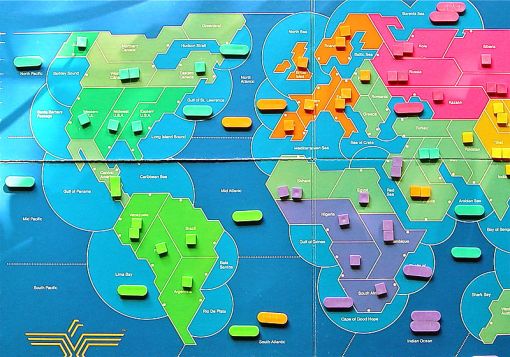
There were some good expansions that included submarines and “fortune” (natural disasters, etc. to help keep the market moving), and a few that were less useful (including massive maps and larger units for the wargamers who didn’t like dealing with child choking hazard-sized pieces.)
Some black mushroom goodness:
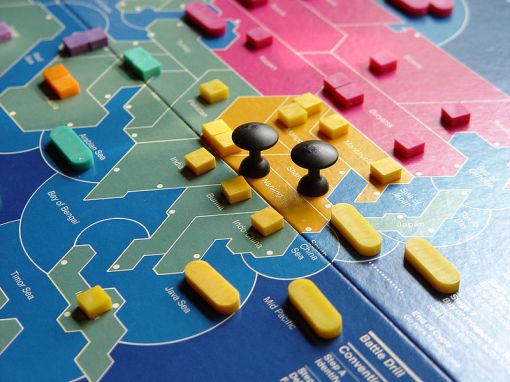
The goal is to either eliminate the opponent through conventional or strategic war, or bankrupt them through economic means. The average play time is between three and six hours, depending on the number of players. This is not a “hey, let’s just bust out a board game” sort of thing; this is a “let’s spend the day playing Supremacy” sort of thing.
To my knowledge, Supremacy Games is defunct and this is no longer produced. If you find it on eBay, or someplace, it’s a good addition to the pile if you are a board gamer. It’s stuck firmly between the light strategy game of Risk and the heavy sims of SPI and other wargames.
4 January, 2012
Posted by blackcampbell under
Movies | Tags:
alien |
Leave a Comment
« Previous Page — Next Page »

 The Black Campbell