Firearms


This post was prompted by an incident at the local gun store this morning. A couple came in, with the guy asking the dealer if they had any pistols for his girlfriend. He was looking for a subcompact Glock in .40 for her to carry. The girlfriend, through the entire exchange, says nothing. The dealer had none — they were sold out in the crazy hitting the nation. The dealer points out a few excellent carry pieces, including a Kahr .40. I pointed out the equally superb CZ-75 P-07 Compact (also in .40.) Nope — gotta be a Glock.

The warning bells were going off for me at this time. Not just because I was certain this carry piece wasn’t for his girlfriend, but for this tattooed douche. He most likely couldn’t buy one legally, and dragged the cow-eyed chick in to do a straw purchase. But even if that weren’t the case, it told me — and I had gone over this multiple times with male customers looking for guns for their wives/daughters/girlfriends/mothers while working at a small local gun store — they hadn’t thought a second past the classic “we can’t buy her too much gun” or the “it’s small, so she’ll be okay with it” thought processes of the Y chromosome.

Keep in mind several things: 1) Hand size. Most women have smaller hands than you, tough guy. The Glock is a fine pistol (but, I think, highly overrated compared to some of the competition) but it’s not the self-defense/combat panacea most of its fan base would have you think. It’s also got a brick for a handle with an unnatural grip angle for many people. A lot of women have thin hands with long, long fingers. Grips with the finger grooving isn’t as good for them. 2) Grip strength. This is especially important for the older woman. This can make choosing the right grip size, but also grip shape even more important to give positive control of the gun. It’s also the main factor to consider for trigger weight. 3) Overall comfort with a weapon or shooting. Don’t start them out with the damned .40 or a magnum cartridge until they’re used to shooting and are comfortable with the weapon. .40 — I find, it prone to a lot of muzzle flip that 9mm, .45, and even the bigger brother 10mm don’t. 4) What’s it for? Is it for the home, the car, to carry?

So here’s the best first guns for a woman:

1) 1911A1 (any size or caliber save 10mm)

IMG_0146

Really, Scott? The 1911? But .45’s too much gun for a chick. Wrong. The 1911 in Officer’s size (3″) is a perfect carry gun for the purse of backpack. It’s small, relatively light, and can be had in the three big self-defense calibers of 9mm, .40, or .45. My ex-wife had tiny hands with low grip strength; this was what she swore by — both in .45 and later 9mm. If you’re just going to have it for the house, the full size 1911 is accurate, powerful, with a low kick, and decent safety features (leave the hammer down and you’re good.) Most importantly, it’s a short reach to the trigger and even crappy 1911s run about 6 lbs on a short trigger pull, as compared to the heavy, long trigger pull of the double action only hammerless revolver a lot of guys buy for their ladies as a first gun.

What about jams, you say? Revolvers are better because they don’t malfunction! Girls aren’t strong enough to rack the slide! 1) Wrong. Revolvers malfunction. It’s happened to me. 2) Most modern autos function quite well thanks to modern ammunition and better workmanship. 3) That’s why you practice. Practice mean if you get a jam you know what to do. As to working the slide — practice.

The downside: Price on 1911s tends to be high with even cheap handguns starting in the $700s here in the Southwest.

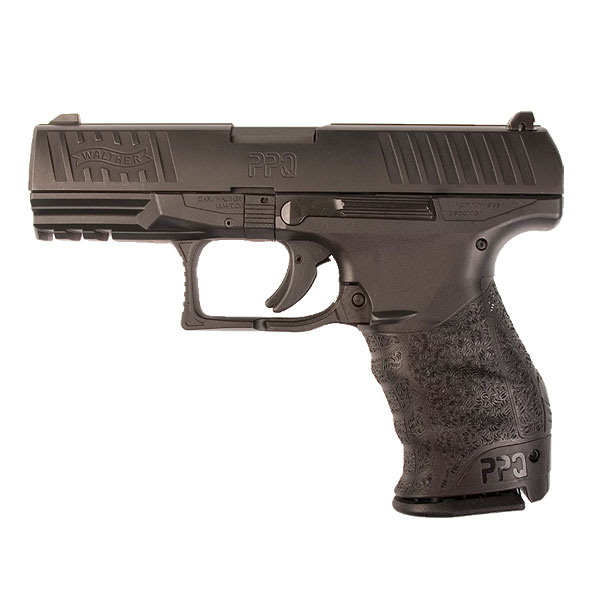
2) Walther PPQ

Walther-PPQ-2-660x516

The Walther PPQ shares similar positives to the 1911. The grip has interchangeable backstraps that allow you to size the weapon to the shooter. The trigger is light — about 5 lbs — and has a short reset. It’s light, concealable, and has 15 rounds in the 9mm. You can get it in .40. They function well and are fully-ambidextrous for lefties.

Downside: There’s no active safety that you can turn on or off. If the shooter is nervous about safety of the weapon, they might want to carry it without a round in the chamber, which runs into one of the perennial issues for “chicks are too weak to shoot autos” buyers; you need to practice running the slide. Period. I’d suggest getting a good retention holster, instead. Price-wise, I’ve found them for about the same price as the Glock, Smith & Wesson M&P, or similar polymer pistols.

Speaking of…

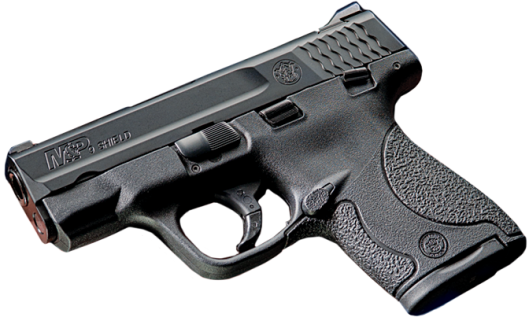
3) Smith & Wesson M&P Shield (or any M&P)
gun_in_hand

The M&P has all the same upsides as the PPQ, but the Shield is their new concealed carry version of this series. Like the PPQ, the backstraps can be interchanged for different sized hands (making them very popular with the female officers here in Albuquerque.) They have a safety. The larger versions of the M&P have more options for caliber — 9mm, .357 SIG, .40, and .45. Take down for cleaning is dead simple. And they’re relatively cheap — the full-size M&Ps start in the $500s. For the new shooter, especially if it’s for just for home defense, a full size M&P is probably a better choice, as the shooter has a better amount of grip surface to work with.

4) Smith & Wesson Model 36 (or similar)

150184_01_lg

The honorable mention, the S&W 36 — or any similarly hammered .38 special revolver — is an excellent choice for a beginner for several reasons: 1) Simplicity of use — point and click. 2) You can cock the hamer to lower the weight and distance of the trigger, which is important for the beginner, the person with small hands, or a weaker grip. 3) Ease of maintenance. 4) They fit well in a purse or a backpack, but they are a bit harder to conceal due to the size of the cylinder.

The downsides: 5 or 6 shots of a relatively anemic .38 special round (as compared to the other guns highlighted.) the range and accuracy of the short barrel work against the beginner shooter, as well, and they tend to be a bit jumpier in recoil than autos. Slow to reload, and can be difficult in high pressure situations. Lastly, they’re no longer cheaper than autos.
A friend of mine was divesting himself of some firearms this year, and one of the weapons was a Kimber Stainless Pro Carry II .45ACP. I took the pistol out for a run this week, and while I didn’t put a lot of rounds through it, I did enough to get a good feel for the pistol.

First off — aesthetics: The pistol is lovely. The stainless steel slide and the aluminum frame give it a two-tone silver look. The rubber grips look all right, but I think I’d like to swap to the black and brown grips they use on the Eclipse. It had come with the Hogue rubber finger grips for the front of the handle. Hated them, even though they probably contributed a bit to the excellent performance of the gun. The pistol is a commander-sized 1911, so it’s a 4″ barrel and a normal grip size. Here it is now…

IMG_0146Next, let’s discuss the carry factor. The size is nice — about on par with the Walther PPQ I like to carry. Weight-wise, I was very surprised. The Walther PPQ tips the scales with a full magazine of 115 grain 9mm at about 24-25 oz., the FN FiveSeven with twenty 27 grain about 25-26 oz., and the Pro Carry with eight 230 grain rounds is 32 oz. About half a pound heavier than the other two guns, but still well inside the comfortable to carry all day range. It also fits in the chest pocket my motorcycle jacket — the main requirement for a concealment gun — well enough to be drawn quickly. In short, it’s an excellent choice for carry based on weight to power.

Function: The accuracy of the gun is astounding. For as light as it is, the recoil is very manageable; certainly no worse than any other 1911 .45 I’ve fired. The sights are minimalist — no dots, just black front post between two black back posts…the way I like it. At 10 yards and a steady but not slow pace, I put eight in a 2.5″ group. Most probably never touched paper. At fifteen, which seems to be where I start to see degradation on accuracy for most pistol, I was still getting 3-3.5″ groups. I didn’t try a 25 yard test as I was out of ammo quickly. It’s a blast to shoot.

(Side note — the new eyes [I had LASIK done last week] probably helped with my accuracy. I’m about 20/10 now and could actually make out the 5.7mm hits a friend was making at 10 yards with little difficulty!)

As to the mechanical function – here we run into one of my complaints on Kimber. I doubt the previous owner(s) had put more than 200-400 rounds through the pistol, and the function was still a bit rough. The whole “you need to break it in” thing that shooters put up with is stupid. If you buy a guy and actually need it that night, what bloody good is it if the thing malfunctions because the manufacturer couldn’t do a bit of polishing and testing? I have never had to break in a Tanfoglio Witness (as much as folks love to malign them), nor my CZ, nor the FN, nor the Kel-Tec .32s I’ve owned. They worked.

The Kimber loved to jam up on the first round or two. I swapped mags — not the issue. Once running, it was fine after the first shot or two. the spring, to me, felt weak. The Pro Carry’s supposed to have a 22 lb. recoil spring, but it was about the same strength as my colleague’s Witness .45 (also on the range at the time) — a 16 lb. spring. I had my Witness with a Wolff 20 lb spring. this was not a 22 pound spring. I think this was the issue with the function, which admittedly eased toward the end of the session.

So I ordered up a 23 lb. Wolff spring for it.

Outside of the break-in or weak spring nonsense, the gun ran like a top. Enough so, it is replacing the Kel-Tec .32 I’ve carried in my motorcycle jacket for a decade. It’s not as light, true, but it doesn’t print and doesn’t seem to weigh the jacket down. I’m calling it Wee Jock.

The MSRP on the Kimber is just shy of $1100. It’s not worth that. Find a used one for about $700, it’s definitely worth it. Find it for less than that — jump on it.

UPDATE: My second outing with the Kimber saw no malfunctions, using crappy Blazer ammo. Shot a few rounds of Critical Duty .45, and wow! do you feel the +P with that frame.

I’ve yet to figure a name out for it, since I haven’t had a chance to shoot it, yet — but yesterday I got a smoking deal on a Benelli Nova Tactical 12 gauge shotgun. The plan is to add a +2 round extender to the magazine tube eventually. This model has the typical Benelli combat “ghost ring” sights — superb for fast target acquistion. The pump action is smooth, and I’ve yet to lubricate the thing. There is a magazine arrestor button on the pump to allow the chamber to be loaded without having a round leave the magazine. Total capacity right now: 6 rounds with one in the pipe? It can fire 2 3/4″ to 3.5″ shells. It’s very light, modern-looking, and shoulders very quickly.

I’d love one of their M4 Super 90 semiautos or the MR1 carbine in 5.56mm but we’re a bit tight on the budget at the moment. Still, a great buy from a great company.

I got a chance to shoot the new PPQ this morning. One of the other shooters on the range had one and wanted to try my CZ-85, so we swapped guns for a couple of boxes of ammo. Here’s my take:

First, the PPQ is a new and “improved” P99. When you crack it open, it looks the same as the older gun. The differences are mostly cosmetic, but they are also functional. The PPQ does not have a striker “ready” indicator sticking out the back of the gun. I kind of miss it, but it should help keep the weapon from getting outside material into the striker’s tunnel. On the outside, there’s grip serrations at the front of the slide, and the serrations are bigger and more pronounced than on the P99. This should make it easier to do press checks and run the slide with gloves. The slide release is larger and ambidextrous (Thank you! I’m a leftie!) Lastly, the grip is more like that of the H&K P30 — instead of a flat grip with finger indentations to aid in holding the gun, the PPQ has palm swells that feel good in the hand, but — in my experience with the old SIG-Sauers — can cause the pistol to shift when fired. Not so on the PPQ: there is a non-slip design to the plastic that holds the pistol in place well.

Here’s a quick look at the cosmetic differences:

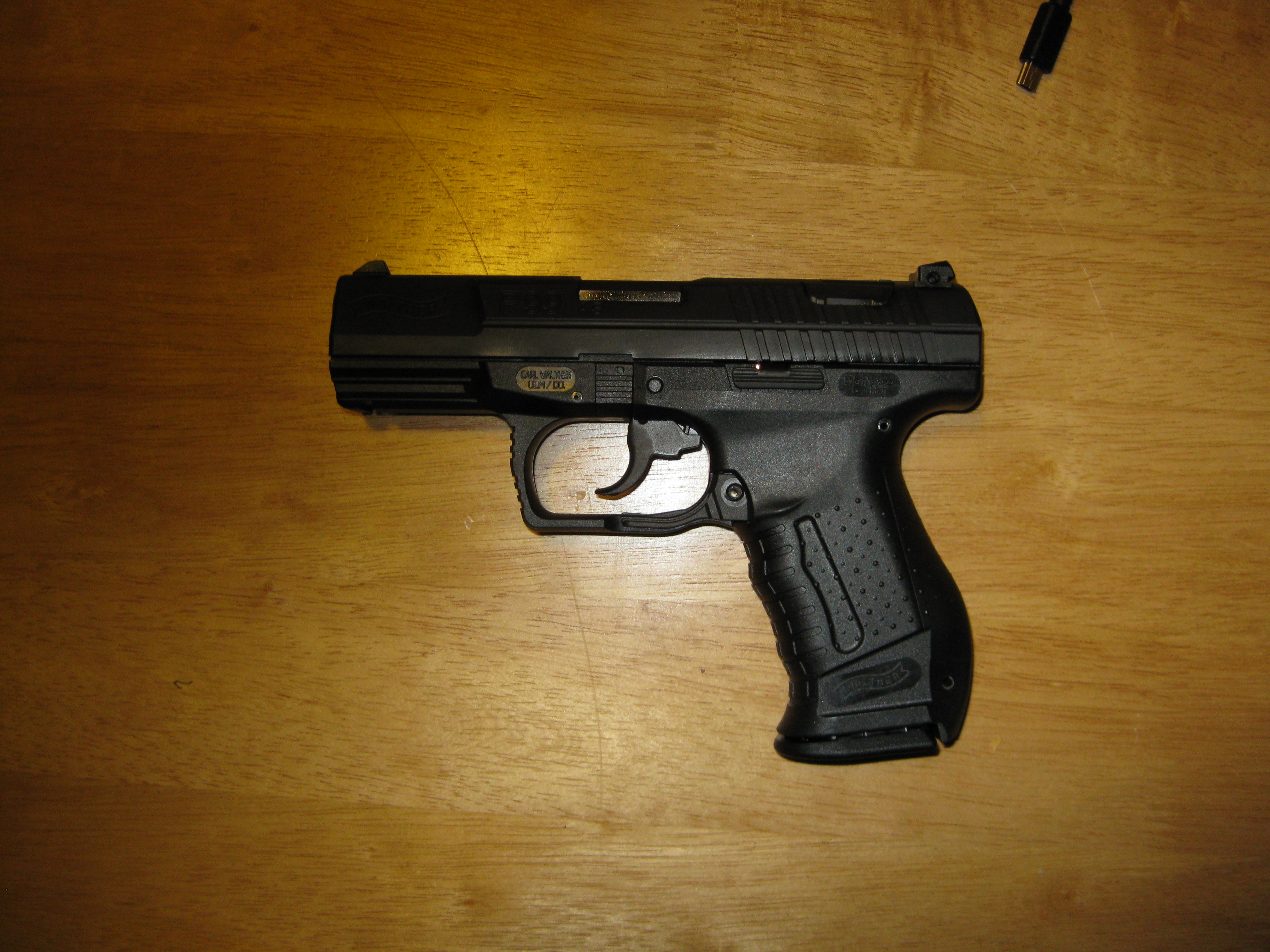
and the P99:

Now the range report: the new trigger, which looks and works like that of the Glock pistols, is phenomenal. The trigger pull feels about 3-4 pounds and the reset is very very small; small enough that I had two accidental second shots due to the recoil (which is mild.) The sights are like those of the P99, three dots…line ’em up. The light trigger pull made for a very accurate pistol — standing unsupported, I was able to place my first five shots at 25 yards in a four inch group. Two magazines of shooting at a steady string (a second or so apart) gave me a 30 round group that was no larger, and most of the shots fell in a 2-3 inch oval. At 25 yards, the sights were spot on: I was aiming at the shoulder line and the bullets hit in the shoulder neck region on the silhouette target.

Closer in, I shot like one would in a fight. Drawing and firing a double tap center mass without using the sights. All fell within the 9 ring. I would follow up immediately with an aimed shot to the head. Only three missed, and that was because the palm swells and my wedding ring were throwing me right. A slight adjustment to my grip and the shots flew true. There were zero malfunctions in 100 rounds, and the owner had put 500 through with the same results.

Overall, I think I still prefer the P99 grips, but the other modifications to the PPQ are a definite improvement.

I hit the range today to put in some much needed trigger time. One of the firearms that I took out was my Tanfoglio Witness 10mm. I’ve been shooting some excellent, but over-powered 165 grain ammunition that is deadly accurate and hugely powerful, but which is running the slide so fast I’m getting the occasional feed jam.

So I bought a couple boxes of the relatively cheap ($22ish at the range) HPR 180 grain 10mm, expecting the usual whimped out, glorified .40 S&W 10mm most of the big producers put out. I was wrong. This is full-power ammunition — I didn’t have a chronograph, but HPR is claiming 1250fps. I have no reason to doubt them, as it had the hearty snap of a real 10mm — after 100 rounds, it was nearly teeth-rattling.

Afterwards, the bore and the weapon were a bit dirty, but nowhere as much as I normally find after a couple of boxes put through the Witness (it’s an all steel gun — they tend to hang onto dirt.) The bore was a bit smoky, but no particulates of note, and most of the frame was clean.

I popped on their website — they’re a small and new outfit out of Payson, AZ. They cover the main autoloader self-defense calibers: .380, 9mm, .40, 10mm, and .45, as well as .223 for rifles. (Now if they’d only do 5.7x28mm!!!) In addition to the 180 grain TMJ 10mm, they do a full-power 180 grain XTP round that runs between $33-45 depending on where you look.

Definite thumbs up!

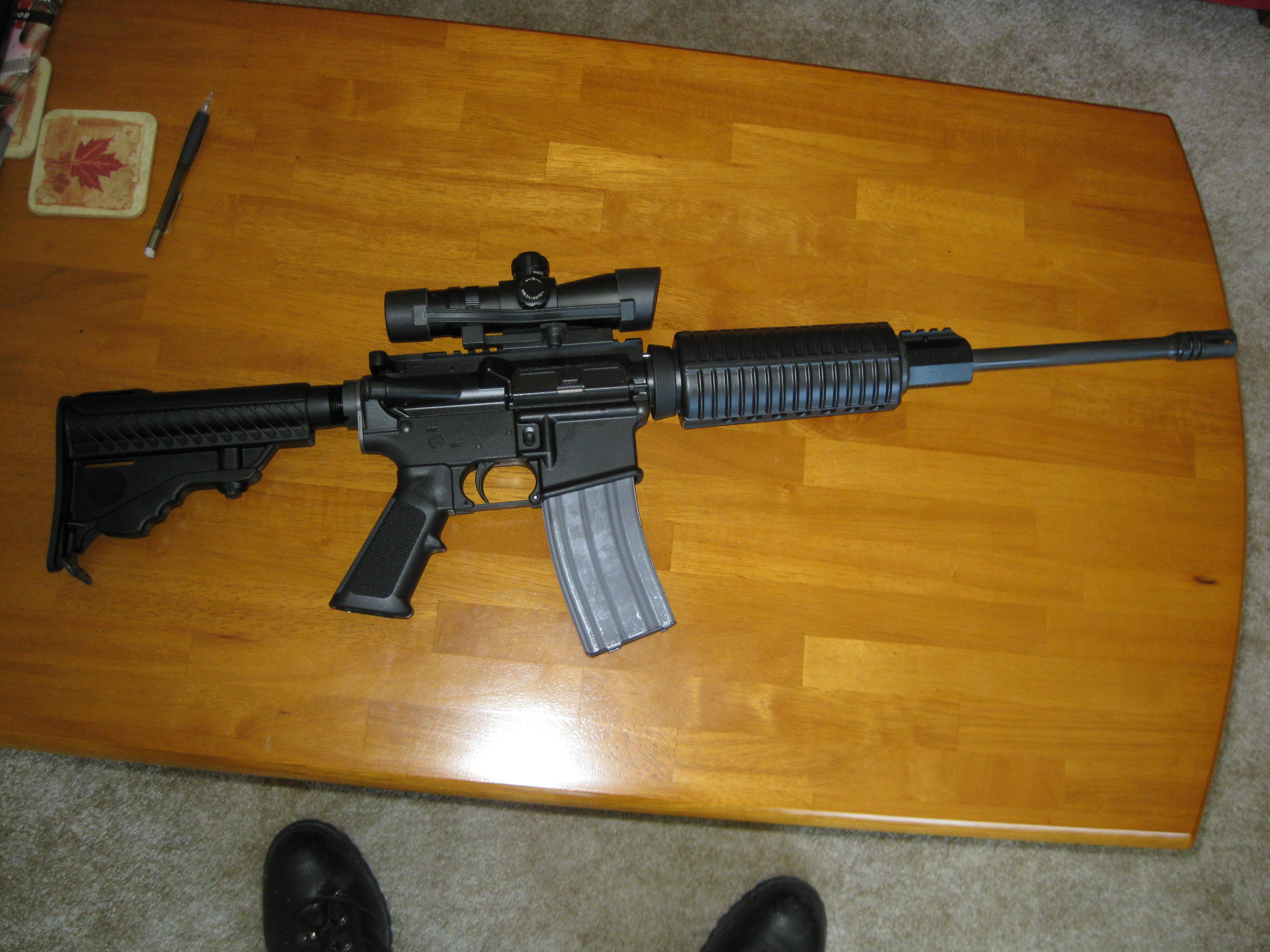
DPMS A-15 (M4A3-style) 5.56mm, 16″ barrel w/ 1-9 twist. Added a 1.5-4x scope with standard and illuminated reticle (red or green…)

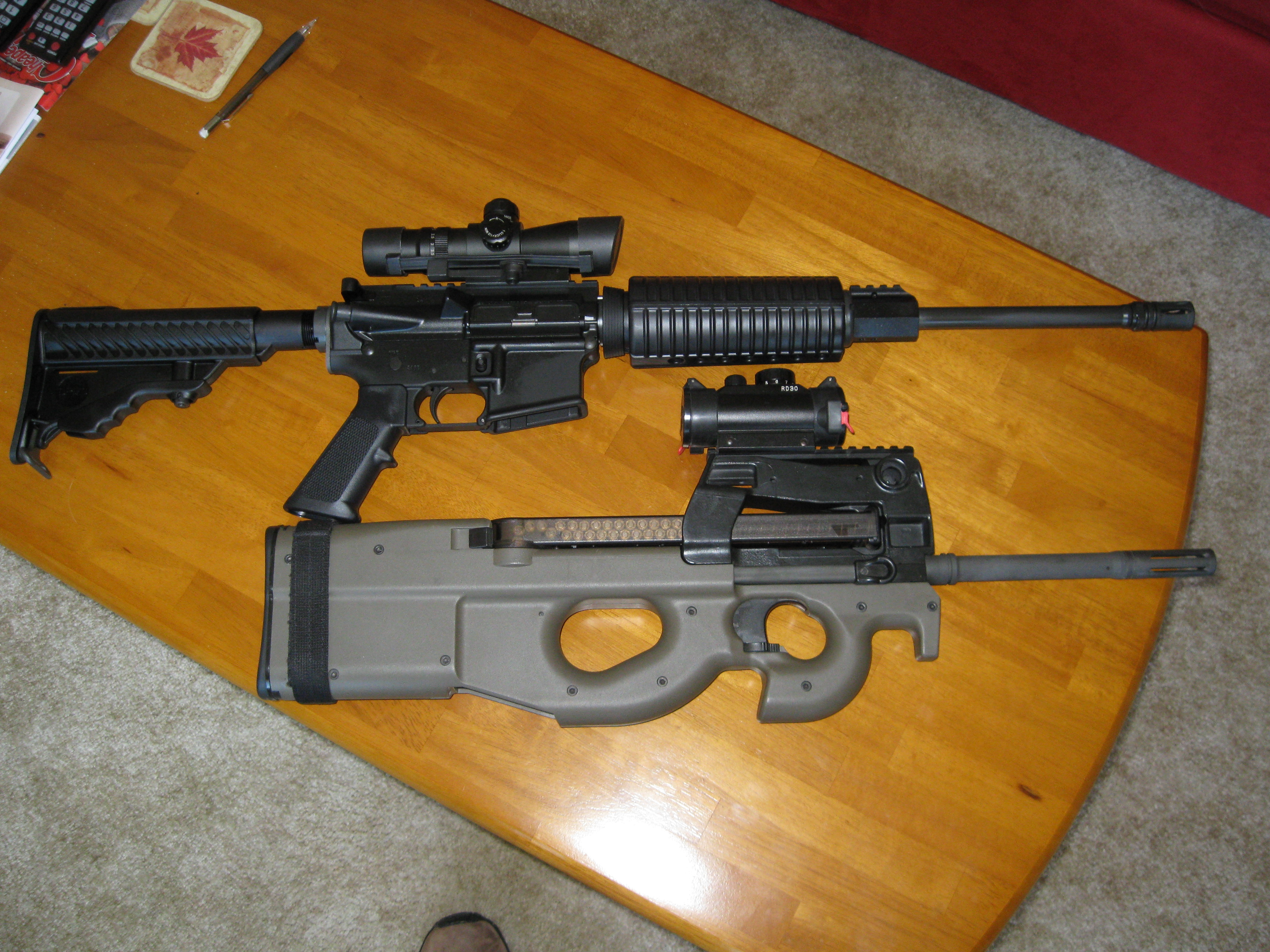
Here’s a size comparison of the PS90 and the A-15:

While the A-15’s got range and muzzle energy on the PS90, the FN’s much better for urban terrain and house-to-house operations for the compact size (the P90’s even better with a 10″ barrel.)

UPDATE: I got a chance to take the DPMS out for a run Saturday, scoping her in for 250 yrds. It only took 9 rounds to get her zeroed, although the old scope seems to have given up the elevation adjustment ghost. Out to 25 yards, I have to give it about a 3″ bump up, but it’s bang on at 100-200 yards. A new scope may be in the offing.

No issues in 100 rounds of shooting, the recoil is the usual M4 quantity — perfectly manageable. (I had a M4 gas piston gun that, while manageable, did hit harder…) And, as expected, only a few magazines and the thing is pretty dirty. Function and accuracy were top-notch. Worth the $25 I paid, would be worth the MSRP of $800-850 I’ve seen.

There’s another review of the FN FiveSeven on the site here, that covers the version of the pistol with the standard adjustable sights.  I had one of those guns for about six years and carried it daily.  I sold it to help cover expenses for my trip to Scotland last summer, having shot over 20,000 rounds through it with only a few malfunctions from a bad ammo lot early in it’s ownership, and two due to a failing magazine catch (I wore it out from use!)  The new owner, a friend of mine, is still shooting it regularly and without issue.

I was looking for the version with the C-More fixed sites — I prefer fixed over adjustable for a reason I can’t really qualify, but suspect it’s because the rear site groove tends to be more spacious in fixed sites, allowing for faster target acquisition.  For whatever reason, I shoot better with fixed, low-profile sites.  (I prefer the old, no-dot, barely-there ones on the 1911A1…so there!)

Delivery of my FiveSeven was yesterday, and I took her out to the range 250 rounds to break her in.  The new pistol has the fixed sites and they are much better for a pisto you intend to conceal — they are low-profile — especially the front site, which you could dig trenches with on the older model.  Mine is also, apparently, a limited-edition Davidsons-distributor only version with the controls — usually a dove gray against the matte black pistol — in black.

The all-black look looses the toy-like quality I’ve heard some people describe for the FiveSeven.  It’s still very light, has 20 rounds in the magazine (unless you live someplace crappy like California or New Jersey), has almost no recoil and is very accurate.

As you can see, the front sight is less blade-like, and low enough to lessen chances of catching on clothing while drawing.  Blackhawk makes the excellent Serpa holster for the FiveSeven; I usually got with the paddle Serpa so that I can get the holster on and off fast, without having to take off my belt.  The push-button retention allows for very fast release of the gun.

This is the site pattern of the new pistol:

The rear channel is wide ad allows fast taret acquisition.  I found the FiveSeven shoots about an inch low out to 7 yards, and about 3 inches low at 10-15 yards with the SS197 blue-tipped hunting rounds.  The SS195s should hit on target out to 7 yards, and drop an inch or so in the 10-15 yard range.

To be fair, I’ve shot an FN a lot over the last half decade, so my muscle memory for the handgun is pretty tight, but I found that I could more quickly bring the sites online with my target than I could with the old version of the FiveSeven.  My first round of the day, at 7 yards, snap-shooting was dead center of the bullseye over the heart of my silhouette target I was firing on.  A magazine of 20, fired without a rest and with deliberation gave me a 1.5″ group at 10 yards, with two flyers.  No malfunctions for the entire outing, and none were expected.  The reliability of the FiveSeven is equal to anything I’ve shot.

The gun run about $1200 in a store in the Southwest, and the prices vary by $200 depending on where you are.  I picked up the new in box FN for $930 on Gunbroker.  It’s worth every penny, and is an excellent self-defense gun — light (so you’ll take with you!), accurate and powerful enough to drop an assailant.  I don’t know that I’d use it for anything above varmint hunting, and it doesn’t take the place of my 10mm Tanfoglio as my “bike gun” (where you need to stop an inanimate object; something the 5.7x28mm round isn’t suitable for.)


After talking to a friend at the local gunstore, I did a bit of digging and found this picture of what could be the new Walther service pistol.  It’s obviously a refinement of the P99 — a grip that is cribbed from the Heckler & Koch P30 (but with out the replaceable side panels), an extended slide release lever (if it were ambidextrous, that would be excellent), and a retooled slide with forward serrations for press checks and the like.  The addition of the Glock-like trigger: awful — better to stay with the P99’s “anti-stress” trigger.  Takedown looks like it’s stayed the same as the P99.

Early reports are that it’s going to have the same ammo capacity as the P99s in 9mm and .40S&W.

Homebuilt…

Back in 1999, I bought one of the original Walther P99 9mm handguns.  I had a few different pistols, including the Heckler & Koch USP .45 Compact, and was tending to carry the latter at the time.  The P99 had one of the best grips on the market at the time — ergonomically designed to give the user an incredible hold on the weapon, three different backstraps to resize the weapon for the hand, and adjustable rear sights with different front sight heights to make the weapon customizable for the user.  These are all common on polymer guns now, but most forget how revolutionary this was in 1999.  It had the downside of being during the Clinton gun ban when you could only have 10 rounds, instead of 15…so it really didn’t offer much over the 8-shot USP.

It shot incredibly accurately, with mild recoil, but had a break in period that I found made me question the weapon’s reliability.  (After about 200 rounds, the P99 started running flawlessly.)  I know a lot of handgunners hear this “break it in” crap, but to me that means the factory didn’t bother to finish their product.  If I need the gun that night after I’ve bought it, “break in” just isn’t going to cut it, should it malfunction.  I didn’t have to break in my H&Ks, or my CZ-85 (flawless out of the box), nor my FN57.

I wound up needing money for a move from Austin to Albuquerque in 2000 and sold the weapon.  I regretted it almost immediately, and bought a P99 in .40S&W.  Unlike the 9mm, I found the .40 version functioned very well, but found the accuracy spotty past 10 yards.  I got rid of it and was on the look out for a 9mm P99 with the original trigger set up (now called “anti stress”).  At that ever turned up was the idiotic double action version.

Today, I found a P99AS in 9mm in near pristine shape but with enough rounds through it to be “broken in.”

So — the P99AS.  The benefit of the anti-stress trigger is that it is a stepped trigger:  with the striker cocked, the trigger has a step that allows the user to not accidentally pop a round off, and shortens the trigger pull.  A decocking button on the left side of the slide drops the striker for a long, heavy pull on the first shot, then drops to the AS trigger for the rest of the magazine.  The P99s now come with a 15-round magazine, making them an excellent, light, and super-accurate (to about 25 yards) self-defense weapon.  It is light enough I might occasionally take it on walks, instead of the CZ-85 (but the CZ configuration remains my favorite, to date.)

If you can find one of these gems used, a good price is between $450-600.  They’re one of the better handguns on the market — as good as the S&W built PPKs are bad.

« Previous PageNext Page »