Well, since Margaret Weis and Signal Fire aren’t going to be supporting Battlestar Galactica anymore (Smallville..? Really?) I figured I do up a Caprica-inspired retcon for the pages in the core book that deal with the colonies. Some of this is cribbed from the Battlestar wiki, some from the Serge Graystone Twitter account, some from the RPG core book, and some is spiced from my gaming group’s campaign and extrapolations I’ve made. Italics in parenthesis are my comments on why I decided to go with these points. The patron gods are cribbed from the link between the gods and the astrological signs, but I’m not sure it fits the god/colony model from the Tomb of Athena.
Feel free to modify as you need. After all…these are essentially house rules.
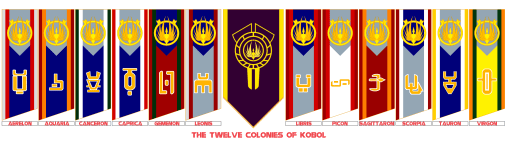
THE TWELVE COLONIES OF KOBOL
The Twelve Colonies of Kobol are twelve distinct worlds, located in a remote part of their home galaxy. About 2,000 years prior to the Fall of the Twelve Colonies, the last twelve tribes of Kobol left their planet over conflicts with their gods, as well as some sort of calamity.
The tribes settled on twelve worlds some distance away. The tribes’ namesakes and icons originally corresponded to the twelve signs of the ancient tribes, although these names drifted over time. The early Colonies lived (and fought) more as sovereign nations. Some (particularly Caprica) prospered, while others (such as Sagittaron and Aerilon) were often considered lessers. By the time of the First Cylon War, the population of the colonies was about 46 billion people. Forty years later, it is about 36 billion. (This is my attempt to reconcile the 20 billion and 50 billion numbers quoted at various times in the series. The original 12 billion was ludicrously low for 12 worlds, in my opinion.)
For peacetime labor forces as well as for wars between each other, humanity created the Cylons. When these early models rebelled, the Colonies unified their governments under the Articles of Colonization sometime before or during the Cylon War as a federal republic known as the Twelve Colonies of Kobol.
The twelve worlds orbit around three different stars, and there is a fourth star that orbits the cluster, as well. The stars are Cyrannus (the primary, G1V), Helios (G0V), Cimtar (K0V), and Sunna, the outlying M1IV. (The names of the stars are, of course, not canon, save Cyrannus. I used Cimtar, which does show up on paperwork in the Miniseries…)
Aerilon
Ancient Name: Aries
Patron God: Athena
Capital: Gaoth
Population: 1.01 billion
Aerilon is primarily an agricultural world. It is considered to be the “food basket” of the Twelve Colonies yet ranked among its poorest members. The planet shares an orbit around Cyrannus with the gas giant Ragnar, orbiting in one of its Lagrangian points. The world is cool to cold, wet, and verdant. The northern highlands of Eirlan are known for their hardy and formidable people. The major cities are Gaoth, Arelon City, Glenedon, and Neiran.
The primary exports of Aerilon are foodstuffs and livestock, but there is also a fine tradition of metalworking, jewelry-making, and other craftsmanship. There is a small high-tech sector, but much of that is imported from other worlds.
The mannerisms of Aerilon’s natives are considered rough and rude, at least by Caprican standards. The people of this world speak with distinctive accents (most of the northern English and Scottish accents are found on our Aerilon.) Proud, honorable, and honest, Aerilonians have a reputation for being trusting and loyal. While Athena is the patron goddess of the planet, Demeter and Hestia are also quite popular with the agrarian population. The tends to be religious, but separates their religious practices from the political system. Old Aerilonian – their ancient language – has all but died out, save in the northern sections of the planet.
Aquaria
Ancient Name: Aquarius
Also called Aquarion
Patron God: Hera
Capital: No official capital
Population: 250 million
Aquaria is widely known for its vast oceans, and shares an orbit with Ragnar, on the outer habitable zone of Cyrannus. It is a cold world, stormy and oceanic (84% of the surface is ocean.) Much of the land masses are volcanic in nature. The main cities of the world of Trivi, Hatch’s Bay, and Genovia. Aquaria developed techniques of building floating cities – settlements tethered to underground mountains — although they are difficult to maintain and most were abandoned.
The Aquarian “government” is comprised of representatives from the various city-states around the world. The central government is small, weak, and this has been used as an excuse for Colonial-level interventions in the Colony’s internal affairs since the signing of the Articles of Colonization. The city-states are the most influential element in an Aquarian’s life, and most of these either use representative or direct democracy.
Aquarian people are inured to hardship, and have a reputation for being cool-headed and thoughtful. While Hera is the patroness of this Tribe and the world, Poseidon is the most revered (or feared) god, with Hermes being the most popular.
Canceron
Ancient Name: Cancer
Patron God: Hermes
Capital: Hades
Population: 4.6 billion
Orbiting Cimtar and boasting a range of climates from tropical to sub-arctic, the planet is well known for its beaches. Hades is the capital city, but the largest metropolis is Argolis. Canceron is also home to some of the Colonies’ top-security prisons – most located in the massive Nubian desert. Canceron has a reputation for being a bit run down and impoverished, but that mostly due to the massive sprawl and run-down quality of Argolis.
Canceron citizens are often very poor, having spent much of the last few centuries under the rule of Virgon. While their world produces a large amount of raw materials – minerals including tylium, and food stuffs (primarily seafood and fruit) – the Canceron economy is still young and still tied to Virgon (to the advantage of that world.) The population is considered crafty and cheap.
Caprica
Ancient Name: Capricorn
Patron God: Hestia
Capital: Caprica City
Population: 6.5 billion
Caprica is a lush blue-green planet, covered by large oceans and continents. It is in a prime orbit around Cyrannus, and is gravitationally tied with Gemenon. The proximity of the two worlds makes for regular tectonic and tidal activity. Metropolitan areas on the planet include the capital, Caprica City, as well as Delphi – a major hub of culture and communications, Olympia, Thyrea, and Kolos.
Caprica is regarded (by Capricans; Virgonians would dispute this) as the center of Colonial civilization, even long before the First Cylon War. Graystone Industries was one of the Colonies most influential technology developers and had a hand in creating the very first Cylons. Some 60 years before the Fall, Caprica was also plagued by religious motivated terrorism from Gemenese monotheists.
After the war, the planet was once again “the” seat of politics, culture, art, science, and learning. It hosts the Colonial government apparatus, although major centers of power are also to be found on Virgon and Picon. It was also one of the wealthiest colonies.
Capricans tend to be more permissive, religiously, and secularism is most prevalent on this world. Many Capricans of religious bent will do pilgrimage offworld to Gemenon for training.
Gemenon
Ancient Name: Gemini
Patron God: Apollo
Capital: Oranu
Population: 2.5 billion
Gemenon is an arid and xeric red world that shares its orbit with Caprica. One of the poorer colonies, it is known for its religious fundamentalism, both poly- and monotheist. Gemenon’s second-largest city, Illumini, is built around a large Pantheon complex, composed of buildings intended to worship and celebrate every deity in the Sacred Scrolls. Another major city was Kryptos, home of the Kobol Colleges.
The Gemenese are known for their literal interpretations of the Sacred Scrolls, but also for a monotheistic religious movement from the deep deserts, and made infamous by a terrorist group known as “Soldiers of the One.” Very traditional, Gemenese value family above all else. Abortion is considered a sin both by the poly- and monotheists of Gemenon. The strong emphasis on family means many Gemenese homes are multigenerational – with children and grandchildren taking care of the elderly — and polygamy is permitted, but not common. Extended families tend to be close in a way that Capricans are not. Gemenese consider Capricans, at best, arrogant and decadent, dangerous and sinful at worst. There is enmity between the two worlds, as Capricans have held power – both financial and militarily – over Gemenon until the signing of the Articles of Colonization.
High technology is considered to be a bane to society – weakening the self-sufficiency of the individual, and acting as a disruptive force to the family and society. Old Gemenese, the original language of the colony is alive and well, and was used as a means of symbolic resistance when under the rule of Caprica.
Leonis
Ancient Name: Leo
Patron God: Zeus
Capital: Luminere
Population: 6.5 billion
Leonis orbits Helios and is geographically known for its vast open plains. Two major landmasses differentiate this beautiful colony, ideal for a variety of outdoor activities thanks to its predictable climate. Much of the population live in medium-sized towns of 100,000-500,000 people. Only a few metropolis and megalopolis dot the world, the largest being Deuteum. Luminere was, at one time, the largest and wealthiest city in the Colonies. The Colonial Marine Corps’ largest training facility is located near Deuteum.
Leonans are an overambitious and wealthy society that is increasingly isolationist and even xenophobic, making modern Leonan democracy and inter-colony relations deeply troubled. Much of this is due to the loss of their empire it had build around Helios – having conquered Libran, Scorpion, and Tauron — several hundred years ago. (Thanks to Terry for providing a bit more from Dave Eick’s blog!)
Leonis is a wealthy world, and rivals Aerilon for food production. The temperate climate is good for agriculture, and Leonis used this, as well as military prowess to expand their empire. Currently, their wines are considered without equal. Also they export a popular energy drink named “Leonis Red”, which was rumored to have amphetamines in it. Drugs being another major export of Leonis, this would not be surprising.
Libran
Ancient Name: Libra
Patron God: Hephaestus
Capital: None Official (Was Luminere on Leonis)
Population: 800 million
Libran is known for its courthouses and lawyers, and was the home of the Inter-Colonial Court (now the supreme judicial body for the united Colonies.) The largest city is Themis, home to the ICC.
Librans are known to be long-suffering, litigious, and financially conservative people. They were, until very recently, a colonized world with their government appointed from Leonis. While independent, Libran still looks to Leonis for military and agricultural aid, as their world – while rich in minerals and other material wealth, has a relatively small population and an orbit that makes its agricultural seasons short and the yields not plentiful. However, clever financial and legal minds have slowly turned Libran into the banking capital of the worlds around Helios. So powerful is the Libran banking establishment that they now are the single largest investors in the Leonis economy, effectively controlling the fate of that world.
While their patron god in Hephaestus, most Librans worship Zeus, Athena, and Themis – gods of justice.
Picon
Ancient Name: Pisces
Patron God: Poseidon
Capital: Queenstown
Population: 1.1 billion
Picon is a turquoise planet, mainly covered by water (80% oceans, rivaling Aquaria.) The world has an eccentric orbit around Cimtar that makes for long, mild summers, and short, but brutally cold winters. Most of the population lives in the temperate equatorial band, but some hardy souls live in the more rugged terrain of the lands south and north.
The capital city is Queenstown, a relatively small fishing village. After the Unification of the Twelve Colonies this world became the seat of the Colonial Fleet Headquarters, based in Pindarus (named for the famous admiral in charge of Colonial forces during the Cylon War.) Picon was also the home of Picon Laboratories, located in Pailyn, Muritolan.
Known as “Little Caprica”, Picon is one of the most beautiful worlds in the Twelve Colonies. The locations near Pindarus have a strikingly similar look to the Caprica City area and is frequently used by Piconian film crews as a double for Caprica City.
The world was colonized by Virgon, and the libertine culture of that world clashes frequently with the most straightlaced military types that settled here after the Articles were signed. Although home of the Colonial Fleet, it is one of the most anti-military worlds in the Colonies. Nearly all of the wealth of Picon is tied to the military establishment.
Sagittaron
Ancient Name: Sagittarius
Other Names: Sagittarion
Patron God: Artemis
Capital: Tawa
Population: 3.9 billion
Sagittaron was one of the poorest worlds of the Twelve Colonies, orbiting Cimtar. It was subject to massive exploitation by Virgon, and later by the Colonial government, leading to organized terrorist actions against the other colonies in the years after the Cylon War.
The Sagittarons were traditionalists who practiced a different form of the Kobol religion from the other Colonials. They distrust modern medicine and technology, and are generally unsupportive of the Colonial government and military. Sagittarons view the other colonies as rife with sin, decadence, and a lack of grace. They are viewed by most other Colonies as uncultured, violent thieves, sexually licentious…none of this is true, but the image still holds in some places. (I started to think of the Sagittarons as the equivalent of the Roma…)
The Sagittaron view of religion is different from the fundamentalist views of Gemenese. Sagittarons generally have more strict rules about food and grooming prohibitions, are stanch monogamists, and have a more spiritual view of the universe. Sagittaron is still a living language and most inhabitants will speak it to the detriment of outsiders. While honest with their own people, they are more than willing to bilk unsuspecting outsiders.
Scorpia
Ancient Name: Scorpio
Patron God: Ares
Capital: Celeste
Population: 3.2 billion
Scorpia is known for its lush jungles and hot temperatures. The world orbits Helios just at the inner edge of the habitable zone, sharing an orbit with Tauron. The moon that once circled Scorpia has broken up, since before colonization, and the world has a scorpion tail-like half-ring.
Scorpia was part of the Leonan Empire. Implacable and hard to tame, Scorpia and Tauron were thorns in Leonis side for centuries. Recently, Tauron rebelled and won its independence. Scorpia followed shortly after as Leonis found itself financially strapped from its empire building, and due to pressure from their other colony, Libran, which was already flexing its monetary muscles to free Scorpia and gain access to the markets and raw materials of the world.
While a popular and cheap tourist destination, with unparalleled biodiversity and spectacular vistas, Scorpia has a reputation as a dangerous, trashy place. The legal system here is highly corrupt, and much of the world works on the idea of bribery – known here as “paying respect.” Criminal organizations like the Tauronese Ha’la’tha abound, and much of the vaunted canaba and morpha trade of Leonis started with the Scorpians. In an attempt to improve the economy of the world, the Colonial government constructed the Scorpia Fleet Shipyards here (mostly with Libran capital and Scorpia and Leonan workers.)
Scorpians can be violent people, much like their Tauronese brethren. Scorpian is a sister language to Tauronese, and both are spoken on this world.
Tauron
Ancient Name: Taurus
Patron God: Aphrodite
Capital: Hypatia
Population: 6.7 billion
Tauron is a barren, arid planet that is was well-known for its agriculture. It shares it’s orbit with Scorpia, just as Caprica and Gemenon share theirs. Its capital is Hypatia, and the other major city was Tauron City.
Some 800 years before the Fall, Tauron was colonized, first by Virgon, and then Leonis. The people of Tauron liberated themselves, and ever since this world has been known for its troubled and violent history. Tauron was one of the poorer colonial worlds and the center of a civil war a decade or so prior to the Cylon War. A few years before the Cylon War, the crime syndicate Ha’la’tha had enormous influence over the planet, which even extended to other colonies, such as Caprica. The Ha’la’tha was particularly prevalent on Scorpia and Leonis.
After the War, Tauron was known to be a somewhat troublesome colony within the federal system of the Colonies, often disobeying directives decided by the colonies and pushing their luck with the admiralty. Yet this world was counted among the wealthier of the twelve worlds within a few decades after the conflict.
The people of Tauron are generally thought of as thugs and criminals before the war, with strange by-turns maudlin, by-turns violent personality. Family and friends are a very important element of Tauronese society, and like the Gemenese, many Taurons live in multigenerational arrangements. One trait of Taurons is the use of tattoos to chart their lives. Many get tattoos to mark important life events and relationships – the birth of a child, a marriage, a death. The darker side is the Tauronese habit of holding grudges: feuds between families, or family members, has led to centuries of bloodshed. Tauronese is the main language of the colony, although Scorpian is also spoken.
(Looking at the culture of Tauron — a strange mash-up of Russian and Mediterranean [especially the gangster elements] — makes me think that Admiral Cain’s violence toward her XO in Razor wasn’t so strange for her background… Think about Russian gangster culture, where a man can kill a good friend or family member — feel bad about it — but still do the act because “it was necessary.”)
Virgon
Ancient Name: Virgo
Patron God: Demeter
Capital: Boskirk
Population: 7.9 billion
Orbiting Cimtar in the “sweet spot”, Virgon is well-known for its forests, it’s spectacular architecture, and is considered to be one of the wealthier colonies. The climate ranges from arctic to tropical, and is remarkably stable. Like Caprica, Virgon is a modern world with high technology and a mainly secular – or privately religious – population.
A center for the arts, Virgon has a reputation for sexual promiscuity that is well-earned. The world is the only one of the twelve where polygamy is the norm – with group marriages often acting to spread the wealth for massive extended families. Art, literature, and cinema are key parts of the Virgonian economy, as is tourism. The world at one time was the most powerful colony, ruling over all of the worlds of Cimtar and Helios 1000-800 years ago. When Leonis rose to power 500 years ago, Virgon and Leonis were main rivals for power in the Helios Colonies, before Virgon was pushed back to its own star. Virgon and Caprica were allies during the struggle.
Now Virgon is known less for war, and more for libertine antics. While Demeter is the patron goddess, most would agree with the quip that Tauron and Virgon should trade their patroness.
COLONIAL RELIGION
Colonial religion is, by and large, polytheistic, and centered on a belief in the existence of supernatural beings known as the “Lords of Kobol.” These gods were not the creators of the universe, but were rather the children of the Titans, who did. These lords of Kobol are believed to have a historical significance, as well, having ruled over mankind (whom they created) on a world known as Kobol. The Twelve Colonies of Kobol represent those tribes that fled Kobol following a disastrous war with the gods.
The central texts of Colonial religious traditions are the Sacred Scrolls, which record much of the alleged history of humanity, including life on Kobol before the great exodus, and the legend of Earth. According to the texts, thirteen tribes of mankind lived in peace and harmony with the Lords of Kobol, until a single jealous god demanded to be held above all others. This led to a war between the gods and men, and a catastrophe known as “the Blaze” (which is sometimes coflated with the single god himself.) Mankind evacuated (with or without the aid of a few of the Lords of Kobol, depending on the interpretations) and eventually found a home in the star cluster the worlds now reside in.
Most notable among the Sacred Scrolls is the Book of Pythia, also referred to as the Pythian Prophecy. Written 3,600 years ago by the oracle Pythia, they are believed by some to foretell the destruction of the Twelve Colonies and their flight to a new home. This story is one of several that reveal the “Wheel of Time”, a cyclical pattern of history that is replicated time and again.
The Sacred Scrolls have been seen as an actual, ornate scroll, as well as a book. A shortened volume may be a specialized volume containing prayers and readings specific to a celebrant’s use during temple ceremonies, Services for the Dead, weddings, dedication ceremonies and the like. Many versions of the Scrolls are handwritten, but print and electronic versions are also popular. Gemenese and Sagittarons believe that the book should be copied by hand to preserve the spiritual aspects of the Scrolls.
Key phrases from the Sacred Scrolls:
• Life here began out there… (These are the first words in the scrolls.)
• Their enemies will divide them. Their colonies broken in the fiery chasm of space. Their shining days renounced by a multitude of dark sacrifices. Yet still they will remain always together.
• The gods lift those who lift each other.
• And the blaze pursued them, and the people of Kobol had a choice. To board the great ship, or take the high road through the rocky ridge.
• And unto the leader they gave a vision of serpents numbering two and ten, as a sign of things to come.
• And the lords anointed a leader to guide the Caravan of the Heavens to their new homeland.
• All this has happened before, and all of it will happen again.
(Big thanks to Steve “Munners” Munro for the Colonial banners! See more here.)



 The Black Campbell