Roleplaying Games


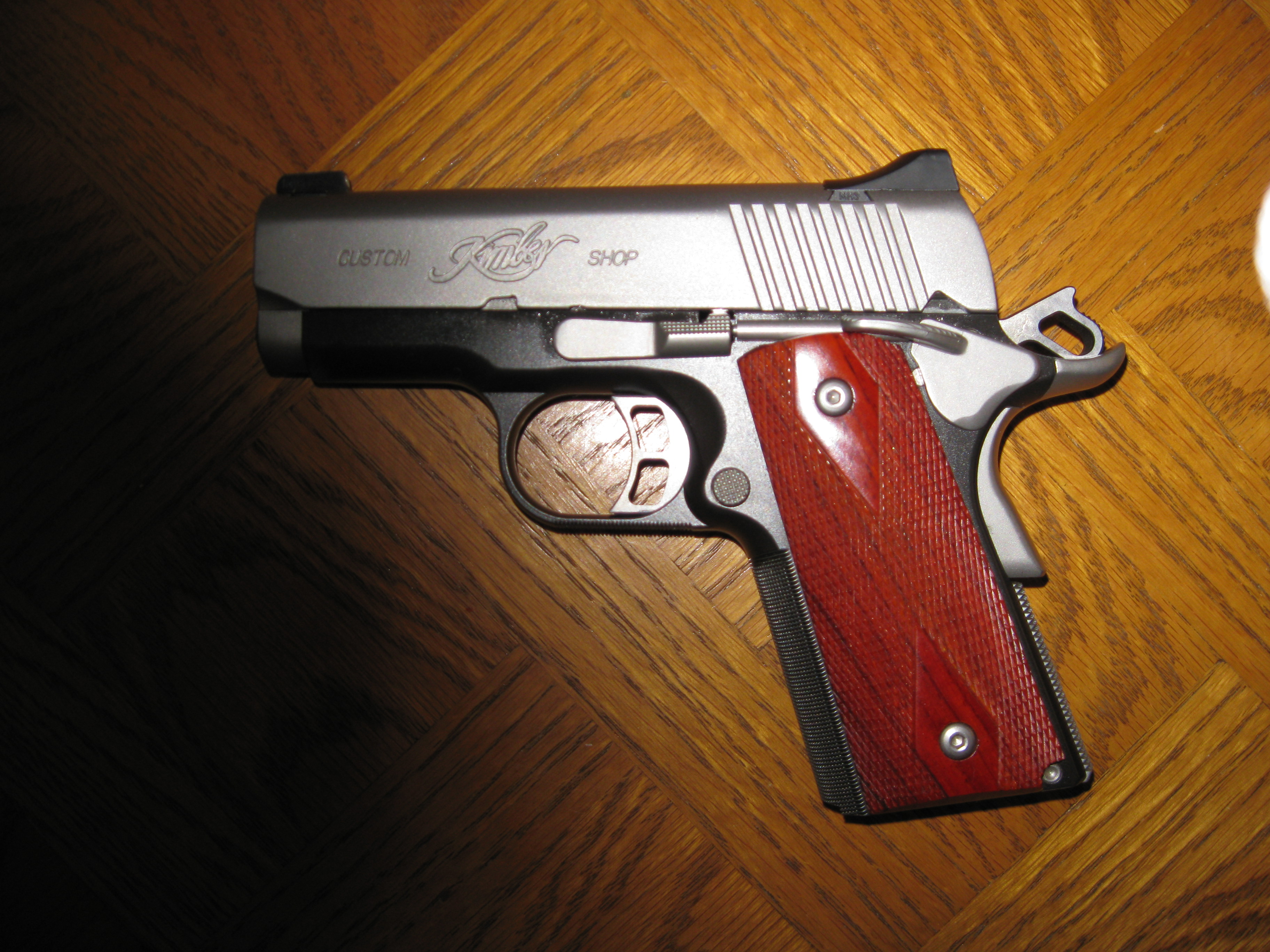
Since I had a chance to fire the new pistol today, I figured I might as well gin up some numbers for James Bond: 007.  Here’s the Kimber Ultra CDP II…

KIMBER CDP II ULTRA 9mm

PM: +1   S/R: 2   AMMO: 8   DC: F   CLOS: 0-3   LONG: 7-12   CON: -2   JAM: 98+   DR: +1   RL: 1

GAME INFORMATION:  The Ultra CDP II’s Meprolight night sights remove the ease factor penalty.  .40S&W and .45acp versions of the gun have much stouter recoil and lose the performance modifier, but have a Close range of 0-4 and Long of 8-14.

The Battlestar Galactica game naturally lends itself to mass-combat, if only due to the large number of fighters in any combat between capital vessels.  In our campaign, we’ve had three capital ships on either side, plus masses of fighters.  Instead of judging combat by caveat, some fights should have that element of danger that randomness gives…

To that end, I cobbled together a set of mass combat for BSG RPG:

1.  Whereas personal combat takes place in 6-second increments, mass combat takes place in at least 1 minute increments.  All capital ships are a single unit, with fighters represented by flight, squadron, or wing.

2.  At Capital range, all capital ships are an EASY target and cannot maneuver to avoid fire.  Point defense systems may conduct an opposed test against incoming fire to stop missile and kinetic weapons, as well as attack fighter craft that close to skirmish range.  At ranges before Capital, ships can also attempt to maneuver to make targeting more difficult by presenting a smaller target or better angle to slough off attacks.  This requires a HARD AGL+PILOT/CAPITAL SHIP.  A success allows the to add the ship’s AGL to the EASY difficulty, and at Long Dradis, the test acts as an opposed test to the enemy’s roll to hit.

3.  Another way to stop incoming missile fire is to jam the guidance systems of the weapon.  EW raptors can attempt to better the defense test of the capital ship with an INT+TECHNICAL ENGINEERING/ ELECTRONIC WARFARE.  The higher roll is the difficulty for the missile attack.

4.  Fighters and raptors act in groups to be ore effective.  Fighters are grouped into flights, squadrons, and wings – each is considered a single “capital level” unit in mass combat and do damage at the spacecraft-scale.

Flights consist of 1-11 fighters.    They can take twice the damage of the number of vessels in the flight.  Every two hits, lose a fighter (never a player character ship, though!)  Flights only do basic damage from a successful hit on a vessel.  Squadrons consist of 12-24 craft.  They gain d2W to a unit (be it a capital ship or a fighter unit.)  Wings consist of 2 or more squadrons (48+ fighters) and gain a d4W to any damage rendered.  Whenever a unit takes enough damage to drop below the minimum size, then lose their damage bonus.

5.  In fleet level combat, initiative is decided by an opposed INT+PERCEPTION/ TACTICS  of the commanders.  (For a fleet, this is the admiral; for a ship, the commander; for a fighter wing or what have you, the CAG.)  [We allow the CAG to roll separately of the admiral/commander, but the latter can do an indirect combined test with the CAG to gain initiative.]

6.  Combat takes place as with character level combat:  winners of initiative go first, then the force with the lower initiative.  On board the capital ships, the commander can aid any number of tests going on with an ALE+LEADERSHIP test.  Other characters can conduct tests they are assigned (a gunnery officer or executive officer might be handling the ship’s cannons or the point defense.)  Each test give a -1 step on the attribute.  (So a gunnery officer might be handling a gunnery salvo with a d8 Alertness and a d8 Heavy Weapons/Ship Cannons, then conduct point defense with a d6 Alertness and a d8 Heavy Weapons/Ship Cannons.)  This also counts for the leadership tests the commander might be rolling.  (Ordering a gunnery salvo, directing damage control, and aiding the CAG in conducting the fight — the last to tests would each lose a -1 shift to the attribute test.)  Engineers or deck crew can conduct damage control — fixing stun damage, or doing jury rigging on wounds.

Fighter units are commanded either by the player character leading a flight or squadron, and any non-PC led unit is commanded by the CAG.  The character rolls an opposed test vs. their opponents (usually an AGL+PILOT/VIPER) and vice-versa.

7.  Players in mass combat:  during the combat actions, you can “zoom in” on individual characters doing their thing — the fighter pilot in one tough dogfight, the engineer trying to stop the tylium lines from catching fire and blowing the ship sky-high, or the marines fighting Cylons boarding the ship.  Every ten rounds, zoom back out to handle the fleet-level stuff.

Granted, these aren’t well fleshed out, nor are they comprehensive, but they worked as a good framework for capital-ship level combat in the last few games we’ve had.

There is a debate going on in the Cortex System RPG boards over Strength as a dump stat for characters.  Agility is more important for scoring a hit on an opponent, Vitality more important for survivability.  Strength winds up often being the stat that gets short shrift.  One of the ideas to make strength more important in Cortex is to have it effect melee and hand-to-hand damage.

In the Cortex system, weapons damage is usually represented by the basic damage done by an attack with the weapons damage added (ex. Bill swings a knife at Jim.  Bill’s attack is and Agility of d6 and a skill in Melee Combat of d4 v. Jim’s Agility of d6 and Atheltics (he’s dodging) of d4.  Bill gets lucky and rolls a 9, while Jim rolls a 4…that’s 5 points basic damage, which is broken into 3 stun/2 wound.  He then rolls a d4W for the knife and gets a 2W — total:  4 wound, 3 stun…)

Here’s the rub:  Bill’s a friggin’ monster with a d10 Strength.  Shouldn’t the knife do more damage?  Certainly if it’s a cinematic-styled game, it should.  There are a few ideas floating around on the Cortex System RPG boards, suggesting an average between the knife damage and the strength of the character (in this case, it would be a d6 [rounding down].)  Another is to roll the strength and weapons damage and average that.  (Ex. On a d4W Bill rolls a 2, and for his strength a 7:  average of 11 is 6, rounding down.)

I am suggesting that the d10 Strength would be the damage roll for the weapon, but it would be Basic damage…thus the increased impact of the strength only amplifies, but does not replace, the weapon’s wound capabilities.  (Ex.  Bill had the 5 points basic for his initial impact split into 3S and 2W.   He rolls his strength-based damage of d10B and gets a 6.  That is split down the middle for 6 stun and 5 wound.  It’s a serious wound, but not immediately fatal to Jim with his 12 Life Points.)

As for hand-to-hand combat, I often allow the characters to choose Agility or Strength in HTH Combat.  While not entirely realistic in the ability to strike a blow, it captures the “big action hero” punch/kick styles for the movies.  Schwartzeneggar was never very fast in his punches, for instance, but on impact, they were impressive in their effects (on screen, at least.)

A long, long time ago in a city far, far away…oops:  wrong allusion!  Back when I was but a young lad in the 1980s (OK…not so young), FASA brought out their Star Trek roleplaying game.  The opportunity to play in a universe I liked spurred me to pick up the material and attempt to run a game.  It was a prime example of how a clunky system can interfere with play.

I didn’t bother with a Trek campaign until 1999, when I picked up Last Unicorn’s excellent RPG system.  There were a few things in LUG Trek that were annoying — having to buy different core books for each series, for instance.  LUG died a quick death, as many new independents in the RPG do, but many of the people found their way to Decipher to rebuild Star Trek as an RPG.

The system is stable and easy to learn and play.  It has root in both LUG Trek and d20, in that the system steals from both liberally, but the main mechanic is a 2d6 roll, with modifiers added from attributes, or from skill levels (also modified by attributes.)  It feels like d20, tweaked to actually give you a probability curve instead of the flat line of a single die.

The Player’s Guide has the character creation rules and basics of the system scattered about in the Skills chapter and the appendix.  you could conceivably play Star Trek with just the PG, but the Narrator’s Guide is pretty essential for more crunch and the rules on starships and combat between them.

One of the big complaints about the PG was the chapter layout.  After an introduction and a small chapter on the history of the series and movies, character creation rules were split into various chapters that required a bit of paging around to write up a character.  If I recall, the first few characters took an average 45 minutes to do up.  Within a few tries, I had the creation time down to 20 minutes.  I found the creation process fun:  there’s enough variation in the process that you can craft a personality with some precision.

1) Pick your species, 2) pick your profession (starship command officer, soldier, diplomat, what have you…)  This section feels cribbed from d20 — race and class, and should be familiar enough to d20 players to be immediately accessible.  While  I despise the race/class/level combination, it is palatable in this game due to the iconic nature of the characters.  Multi-classing (changing professions) is simple enough and the prerequisites aren’t too intrusive.

Next you pick attributes through either a point-based system, or roll ’em up.  I prefer the former.  Racial modifiers apply.  Move on to skill and trait packages based on your background and profession.  Professions give you abilities, much as in D&D 3rd edition that stack on each other, as well as traits to benefit the character.  Modify as you will with flaws.  Report for duty.  You can add “advancements” to create more experienced characters.  Once again, it feels d20-ish, but not enough for the d20 haters (of which I will admit I am one) to kvetch too much.  There are even “elite” professions that extend the list of abilities.

The Narrator’s Guide gives the GM more advanced rules, some corrections to weapons damages, etc.  It includes examples of starships, and rules for making your own (improved upon in Starships.)  There’s the usual chapters on the universe, how to run Trek effectively.  The system is a bit quirky on combat, most notably on damage.  Characters have different levels of damage that give them negative modifiers for each level of damage.  Each level they can take a certain number of damage (hit) points.  This makes hand-to-hand and melee combat a long, drawn out affair.  As with D&D, you’re characters can slug it out for a long time without real danger, at first, of getting really hurt.  Phasers are a whole ‘nother matter.  As with onscreen examples, a phaser set to kill is a really dangerous animal.  Most settings just kill you dead and leave a bit of ash.

I tried tweaking the combat rules to make HTH and melee combat a bit more dangerous and phasers less so…with little real success.  Starship combat is well executed, and gives the right feel.  Shields are terribly important, don’t necessarily stop damage from getting through in a fight, but do mitigate some of it.  Effects on systems are felt as the ship gets pasted.  It’s the best part of the system, for me — there’s crunch to the combat rules, but it’s not too restrictive and allows for role playing in the midst of combat; each player’s character can have something to do, be it fly the ship, fire the weapons, give orders, or jury rig repairs.

The books are gorgeous to look at.  They are hard cover with heavy-weight paper, full color and lots of screen captures from across the span of the franchise.  And there weren’t a wealth of typos.  This was one of the first RPG lines to go high-end on production values (following LUG before it) and high-price (one of the line’s downfalls, along with shoddy support from Decipher.)

The Player’s Guide is a necessity for using the Decipher system, and had it been bundled with the Narrator’s Guide, it would have been better at the release of the game.  Now, you can buy both books online used.  If you are going to buy Decipher Star Trek, make sure you get both books.  You can get by without Aliens and Starships, but I found those books an excellent buy, as well.  Creatures not so much.

Style: 5 out  of 5, Substance: 4 out of 5.  If you want to play Star Trek, you could do a lot worse than this system.  It’s still one of my favorites.


To go alone with yesterday’s Pegasus posting, here’s my take on Admiral Cain.  There are two versions, pre- and post-attack.  Although some of the material in Razor helped to flesh out her background, I found the original Cain episodes of Season 2 to present not an insane woman, but one too sane.  She is perfectly aware of their situation and is willing to do whatever has to be done to survive…even when she knows her actions are morally or ethically wrong.

Her step down from going through with the assassination of Adama after the attack on the Resurrection Ship, in my mind, was her first step toward regaining some of her moral compass.  In many ways, I viewed her as what Adama could have become, had he not been shot by Boomer; he had been going down the road of expedience, and without his son or Roslin to give him a slap in the chops, from time to time, he could easily have gone Cain’s route.

Adama describes her as smart and well-connected in the extended version of Pegasus.  That lead me to believe that she was more politically savvy than it would appear in the episode, and her crew’s loyalty is not that of a woman who was insane, or prone to irrational actions, but a steady, caring, but stern disciplinarian.  Shaw’s arrival on Pegasus in Razor suggests a sharp, and somewhat cruel sense of humor.

Admiral Helena Cain, #866931

200px-CainH

Tauronese female, age 49.  Height: 5’9″   Weight: 140 lbs   Hair: Brown   Eyes: Brown

ATTRIBUTES:  Agility: d6   Strength: d6   Vitality: d8   Alertness: d8   Intelligence: d10   Willpower: d10

Life Points: 20   Initiative: d6+d10   Endurance: d8+d10   Resistance: 2d8

ASSETS: Formidable Presence [d2], Lady Luck [d4], Political Pull[d6],  So Say We All [d4]

COMPLICATIONS:  Anger Issues [d2], Duty [d10]

SKILLS:  Athletics: d6, Covert: d4, Discipline [Leadership]: d6 [d8], Guns: d4, Heavy Weapons: d2, Influence [Administration, Bureaucracy]: d6 [d8, d8], Knowledge: d4, Mechanical Engineering: d2, Perception [Tactics]: d6 [d8], Pilot: d6, Planetary Vehicles: d2, Survival: d4, Technical Engineering d6, Unarmed Combat: d4

At the time they meet Galactica:

ATTRIBUTES:  Agility: d6   Strength: d6   Vitality: d8   Alertness: d8   Intelligence: d10   Willpower: d12

Life Points: 20   Initiative: d6+d10   Endurance: d8+d12   Resistance: 2d8

ASSETS:  Cool Under Fire [d6], Formidable Presence [d4], Lady Luck [d4], So Say We All [d6]

COMPLICATIONS:  Anger Issues [d4], Duty [d6], Out for Blood [d4], Sadistic [d4]

SKILLS:  Athletics: d6, Covert: d4, Discipline [Leadership]: d6 [d10], Guns: d4, Heavy Weapons: d4, Influence [Administration, Bureaucracy]: d6 [d8, d8], Knowledge: d4, Mechanical Engineering: d2, Perception [Tactics]: d6 [d8], Pilot: d6, Planetary Vehicles: d2, Survival: d4, Technical Engineering d6, Unarmed Combat: d4

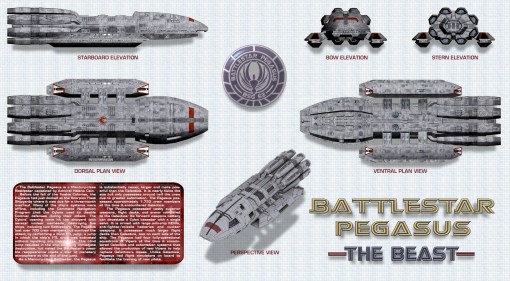
The last in this series, for now, is the Mercury-class battlestar.  This is the newest, most powerful ship in the Colonial Fleet at the time of the Cylon attack.  The onscreen example is Pegasus, and there is still a bit of speculation on her capabilities, but this is the best I could glean:

BATTLESTAR PEGASUS

SHIP DATA:
Class: Mercury     Length: 5872′     Beam: 2187′     Draught: 1131′     Decks: 35    Scale:  Spacecraft     Crew: 1700 standard    Passengers:  up to 10,000 max

ATTRIBUTES:

Agility: d4     Strength: d12+d4     Vitality: d8     Alertness: d10     Intelligence: d10     Willpower: d10

Life Points: 28     Armor: 6W, 4S     Initiative: d4+d10     Speed: 5 [SL/JC]

SKILLS:  Heavy Weapons d6, Mechanical Engineering d4, Perception d6, Pilot d6

TRAITS:    Construction Facilities (d4), Formidable Presence (d6), Tough (d4)

ARMAMENT:  Heavy Skirmish Range Point Defense System (d12W Planetary-scale ), 34 Capital-Range Heavy Railguns (d12+d2W Spacecraft-scale), 24 Short Dradis-Range Heavy Missile Launchers  (d12+d4W Spacecraft-Scale), 12 Short Dradis-Range Nuclear Missiles  (d12+d8W Spacecraft-scale)

AUXILIARY VEHICLES:  200 (8 squadrons) Mk VII Vipers, 40 Raptors, 12 Marine Landing Shuttles, 6 standard shuttles, assorted work vehicles

BG_Pegasus_schematic1Schematics courtesy of Starship Schematics Database, Jim Stevenson’s encyclopedic site.

Not all of the vessels of the Colonial Fleet are big bruising battlestars.  In fact, there are a number of smaller vessels that make up the 150+ vessels of the Big Blue Machine.  One of these important ships is the assaultstar.  Originally designed as a light, maneuverable vessel to screen the more valuable battlestars from damage, the assaultstars also proved themselves in more prosaic duties like smuggling interdiction, search-and-rescue, and marine reconnaissance and assault support.

Most battlestar groups have 2-3 assaultstars attached to them, coupled with 2-3 of the smaller gunstars, and a tender.  Assaultstars are also grouped in MRG (Marine Reconnaissance Groups) that are tasked with supplying marines to areas of operations including emergency response, disaster relief, and combat action.

The Vanguard class is an older model, the original models as old as thirty years in service, but they are nearly all still active as of the attacks. They carry up to a battalion of Colonial Marines for up to three months, which can be deployed using specialized Marine Landing Shuttles (uparmored standard shuttles.)  The MLS can carry 25 marines and either a tank or two APCs or CAWS, or 50 marines in a drop.

Here is an example:

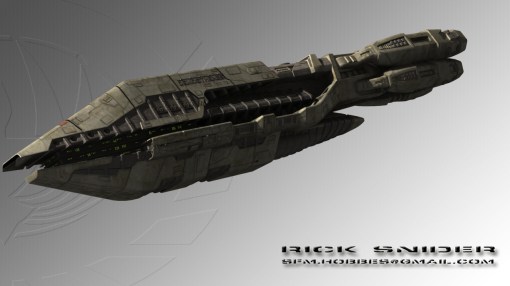
ASSAULTSTAR DEMOSTHENES

SHIP DATA:
Type:     Assaultstar/Escort     Class: Vanguard     Scale: Spacecraft     Registry: DD-72     Length: 1867′     Beam: 360′     Draught: 377′     Decks: 13     Crew: 270 standard, plus up to 500 marines

ATTRIBUTES:
Agility: d6     Strength: d8     Vitality: d6     Alertness: d8     Intelligence: d6     Willpower: d8

Life Points: 16     Armor: 4W, 4S     Initiative: d6+d8    Speed: 6 [SL/JC]

SKILLS:  Heavy Weapons d4, Mechanical Engineering d4, Perception d4, Pilot d4

TRAITS:
Lucky Ship [d4]

ARMAMENT:  Heavy Skirmish Range Point Defense System (d12W Planetary-scale ),  7 Short DRADIS-Range Medium Railguns (d10W Spacecraft-scale),  12 Short DRADIS-Range Medium Missile Systems  (d12W Spacecraft-Scale) *Can be fired from Railguns.

AUXILIARY VEHICLES:  10 Raptors, 6 Vipers, 10 Marine Landing Shuttles, can carry 10 tanks, 20 APC or CAWS, or a combination for landing with the MLS.

HISTORY:
Demosthenes is part of BSG-55 (Pleiades), but is often released to detached duty for search & rescue and smuggling interdiction missions.  “Old D” was constructed in 35AC, and is one of the older vessels in her class.  She has a reputation for being “lucky.”

vanguard85Demothenes is the design and property of Rick Snider.  You can find this and other examples of his work on scifi-meshes.com.

Here is another battlestar for your roleplaying game’s fleet (and the one we’re using in our campaign) — Pleiades, a Minerva-class battlestar.  She is an intermediate design, newer than Galactica and her sisters, and the iteration previous to the Mercury -class of Pegasus.  Many were still in service at the time of the attacks, including the class prototype, Athena.

She is the flagship for Battlestar Group 55 (BSG-55) and was usually deployed with a pair of Cygnus-class gunstars, two Vanguard-class assaultstars, and a Demeter-class tender.  Like Galactica, Pleiades must retract her landing pods for FTL jumps — her FTL sinks are spaced far and the displacement bubble generated is not large enough to handle the pods otherwise.

BATTLESTAR PLEIADES

SHIP DATA:
Class: Minerva     Length: 4777.7′     Beam: 1742′     Draught: 841.5′     Decks: 30     Scale: Spacecraft     Crew: 1500 standard, 10,000 max

ATTRIBUTES:
Agility: d4     Strength: d12+d4     Vitality: d6     Alertness: d8     Intelligence: d8     Willpower: d10

Life Points: 26     Armor: 6W, 4S     Initiative: d4+d8     Speed: 5 [SL/JC]

TRAITS: Formidable Presence (d4), Viper Construction Facilities (d4)

SKILLS:  Heavy Weapons d6, Mechanical Engineering d4, Perception d6, Pilot d4

ARMAMENT:  Heavy Skirmish Range Point Defense System  (d12W Planetary-scale ), 32 Capital-range Heavy Railguns (d12+d2W Spacecraft-scale), 22 Short Dradis-range Heavy Missile Systems (d12+d4W Spacecraft-Scale), 12 Long Dradis-Range Nuclear Missile Systems  (d12+d8W Spacecraft-scale)

AUXILIARY VEHICLES:  110 (4 squadrons and 10 spare) Mk VII Vipers, 25 Raptors, 10 Marine Landing Shuttles, 3 standard shuttles, assorted work vehicles

5views_textured_pleiadesOrthographics by tanj from scifi-meshes.com.  See more of his spectacular work there.

One of the things I noticed in the core book for the Battlestar Galactica RPG is that the Cylon ships seemed to have several of their statistics skewed.  I went through and corrected a few of the secondary numbers and fleshed out a few things, including giving the ships skills.  (At the time of the attack, I would assume the combat experience of the Cylon raiders, heavy raiders, and basestars to be sub-par, and this is borne out onscreen.  In our campaign, however, they are steadily gaining experience and getting better.)

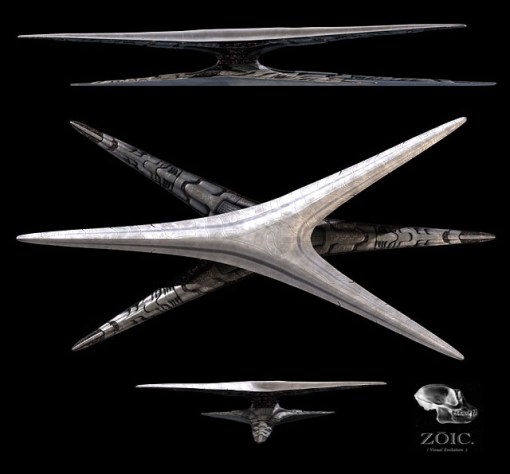
BASESTAR, MK II

This is the the basestar from the miniseries, through to when the ZOIC models were discontinued for the newer in-house effects team’s basestar (the Mk III, here.  We’re assuming the old double saucer from the Razor movie is a Mk I.)

There are, according to Battlestarwiki.org, 864 launching racks for either missiles or raiders (they are interchangeable in the early seasons.)  Later MkIII Basestars have missile launching turrets, and less of the the racks are used for fighters (434 total, if I counted correctly [and the above source agrees].)
basestar_cylon_mk2

DIMENSIONS:
Length: 4500′     Beam: 2250′     Draught: 625′     Decks: 31     Scale: Spacecraft

ATTRIBUTES:
Agility: d6     Strength: d12+d2     Vitality:  d10     Alertness: d12     Intelligence: d10     Willpower: d8

Life Points: 22     Armor: 4W, 5S     Initiative: d6+d12     Speed: 6 [JC/SL]

ASSETS:  Biomechanical [d8]: Can self-repair, Formidable Presence [d4]

COMPLICATIONS:   Memorable [d4]

SKILLS:     Heavy Weapons [d4], Mechanical Engineering [d6], Perception [d6], Pilot [d6]

ARMAMENTS:  Medium Skirmish Range Missile Systems  [d12, Vehicle-scale], Heavy Capital Range Missile systems  [d12+d4, Vehicle-scale],  Heavy Capital Range missile Systems  [d12+d4, Spacecraft-scale],  Nuclear Short-DRADIS range Missile Systems  [d12+d8, Spacecraft-scale]

AUXILIARY CRAFT:  up to 864 raiders, heavy raiders, and support craft.  I assume, for the Mk II, 300 raiders, 124 heavy raiders, and a few dozen support craft.  For the Mk III, I assume 434 raiders and heavy raiders combined.

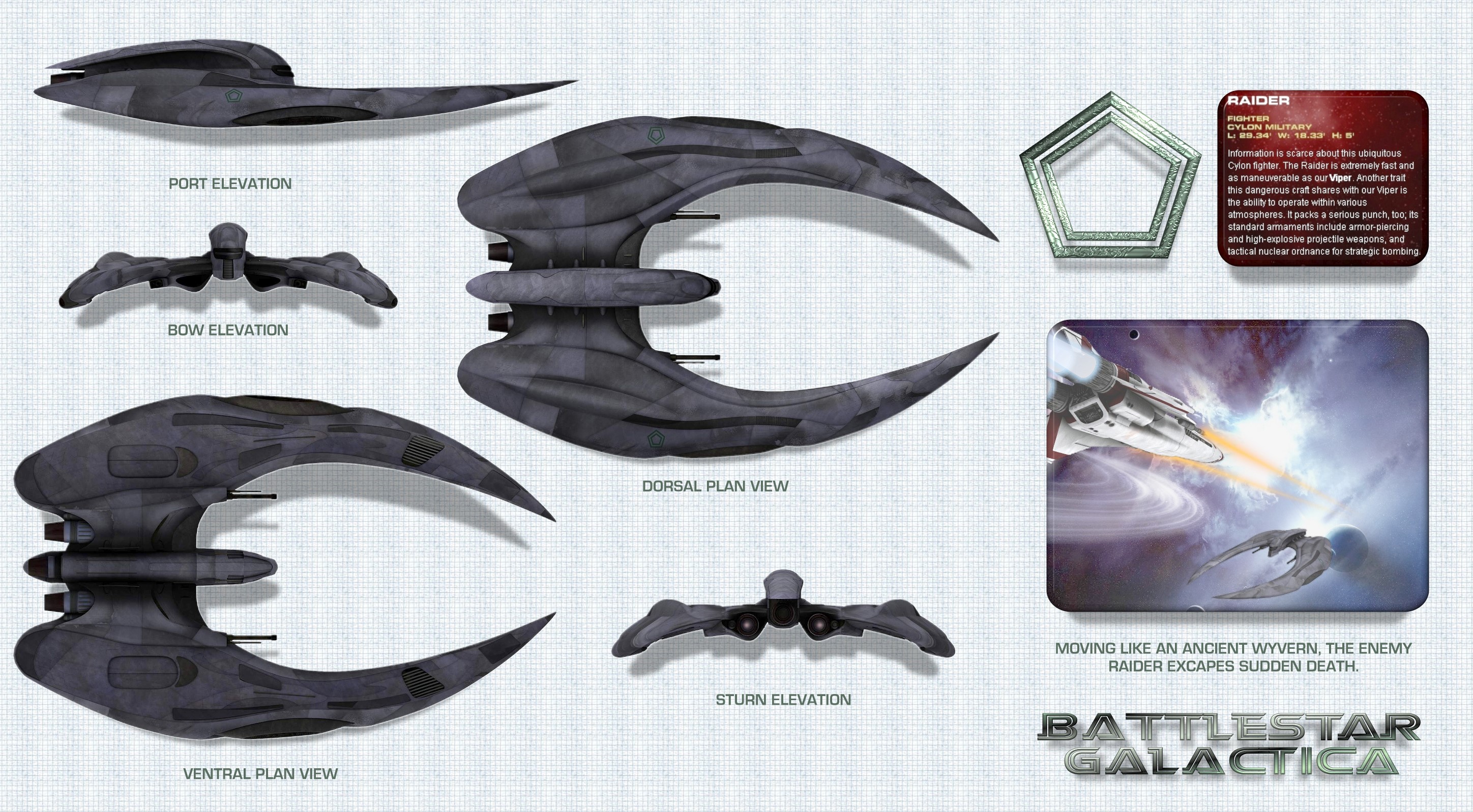
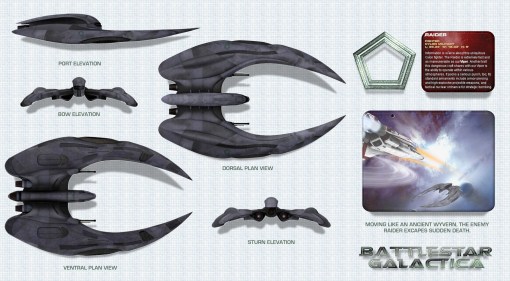
CYLON RAIDER

DIMENSIONS:
Length: 29.3′     Beam: 18′     Draught: 5′     Scale: Vehicle

ATTRIBUTES:

Agility: d12     Strength: d8   Vitality: d8     Alertness: d8     Intelligence: d6     Willpower: d6

Life Points: 14     Armor: 2W, 2S     Initiative: d12+d8     Speed: 9 [7 in Atmo] [JC/SL]

ASSETS:  Biomechanical [d8], Formidable Presence [d4], Stealthy [d4; adds to difficult to spot with the naked eye.]

SKILLS:  Perception [d4], Pilot [d4]

ARMAMENT:  2 30mm [Medium, Skirmish Range] Cannons  [d8, Vehicle-scale], 6 Medium Capital-Range missiles  [d12, Vehicle-scale] OR 2 Capital-Range Nuclear Missiles  [d12+d4, Spacecraft-scale.]

CYLON HEAVY RAIDER
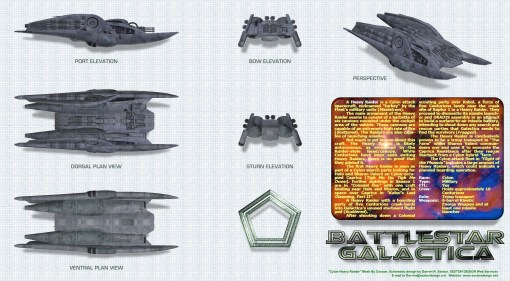
Schematics courtesy of Starship Schematics Database, Jim Stevenson’s encyclopedic site.

DIMENSIONS:
Length: 66′     Beam: 25.6′     Draught: 16′     Scale: Vehicle    Passengers: up to 12 Centurions

ATTRIBUTES:
Agility: d6     Strength: d10     Vitality: d10     Alertness: d6     Intelligence: d6     Willpower: d6

Life Points: 16     Armor: 4W, 4S     Initiative: d6+d6     Speed: 7 [5 in Atmo] [JC/SL]

TRAITS:  Biomechanical [d8]

SKILLS:  Perception [d4], Pilot [d4]

ARMAMENT:  2 Dual Medium 30mm autocannons  [d8, Vehicle-Scale, Capital Range], 12 Capital-Range, Medium Missiles  [d12, Vehicle scale]

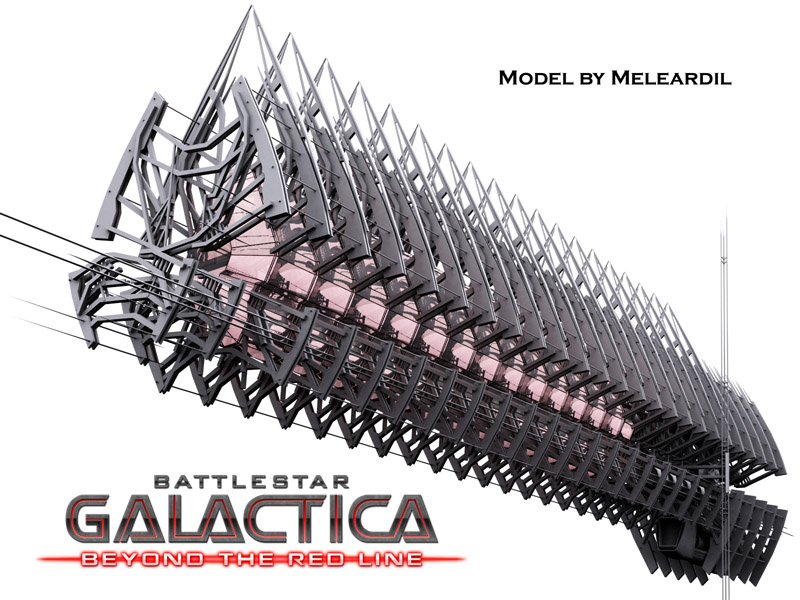
CYLON RESURRECTION SHIP
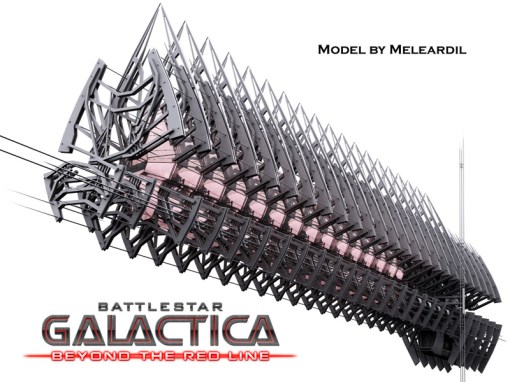
Model by Meleardil on scifi-meshes.com.

DIMENSIONS:
Length: 2010′     Beam: 465′     Draught: 784′     Scale: Spacecraft     Crew:  Unknown, assumed 1000s     Passengers:  Unknown, assumed 1000s

ATTRIBUTES:
Agility: d4     Strength: d10     Vitality: d8     Alertness: d8     Intelligence: d10     Willpower: d8

Life Points: 18     Armor: 1W, 4S     Initiative: d4+d8     Speed: 6 [JC/SL]

ASSETS:  Allure [d4], Biomechanical [d8]

COMPLICATIONS:  Memorable [d4]

SKILLS:  Mechanical Engineering [d4], Perception [d4], Pilot [d4]
It’s been a busy week for the Black Campbell, but I finally have a few moments to sit down and slap out a few posts.  The next few days will be Battlestar Galactica oriented with a series of new ships.  Since the Colonial Military sourcebook appears DOA, here’s my take, with visuals borrowed from various sources.  (Please pop over to scifi-meches.com for more of these artists’ fantastic work!)

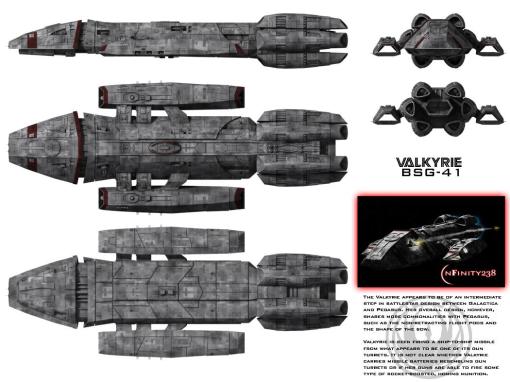
Here’s a sister ship to Battlestar Valkyrie

BATTLESTAR ARGO

SHIP DATA:
Type:     Battlestar, Light
Class:     Erynis [Furies]
Registry:    BSL-3
Group:    BSG-30 [Exploration]

DIMENSIONS:
Length: 3980′     Beam: 1514′     Draught: 634′     Decks: 17     Crew: 1500 [Air Group: 150]     Passengers:  up to 5000

ATTRIBUTES:

Agility: d6     Strength: d12     Vitality: d6     Alertness: d8     Intelligence: d8     Willpower:  d10

Life Points: 22     Initiative: d6+d8     Armor: 5W, 4S     Scale: Spacecraft     Speed: 5 [JC/SL]

ASSETS:     Loved [d4], Lucky Ship [d4],

COMPLICATIONS:     Past It’s Prime [d2], Slow Response (Argo can only launch 12 fighters/turn.) [d6]

SKILLS:     Heavy Weaponry [d6], Mechanical Engineering [d4], Perception [d6], Pilot [d4]

ARMAMENT:     Medium skirmish range point-defense system [d12W, Vehicle-Scale], 14 Capital range primary assault railguns [d12W, Spacecraft-scale] — Can fire Short DRADIS range missile systems [d12W, Spacecraft-scale], 6 Short DRADIS range nuclear missile systems [d12+d4, Spacecraft-scale]

AUXILIARY CRAFT:     68 Vipers  in 3 Squadrons w/ 8 reserve, 20 Raptors, 12 shuttles & assorted

HISTORY:     Argo is the thirds Erynis-class light battlestar off the line.  Constructed in 30AC (after Articles of Colonization) at the Scorpia Shipyards, these battlestars represented a new direction in Colonial military ship design.  For a time, the Colonial Defense Ministry was looking to curb costs of the Fleet, and these intermediate-sized battlestars were to take over much of the heavy lifting for the fleet, supported by the new assaultstars.  However, pressure from the Fleet brass led to the creation of the Mercury project – 12 super-battlestars to replace the aging Minerva, with the Erynis class as a dedicated support vessel.

Argo was scheduled for mothballing in 50AC, but was instead shifted to Battlestar Group-30 [BSG-30], the Exploration Fleet and assigned to protect scientific assets investigating the surrounding star systems for habitable planets, resources, and Cylon presence.  She was out of the system when the Cylons attacked, and neither she nor her Vipers have not be upgraded to the Command Navigation Program.

Valkyrie_OrthoThis orthographic of Valkyrie is the work of Infinity238.  Find more of his work on scifi-meshes.com

« Previous PageNext Page »