Roleplaying Games


The new Star Trek campaign has necessitated writing up some new ships and some new versions of old ships. It’s a bit difficult, as the new show has done a lot of handwaving about the capabilities of the new vessels. They are generally larger than TOS had vessels being, and they are much technologically advanced (because it’s not 1966 anymore), and I used some online sources as well as the excellent Eaglemoss models to slap these together. First: Federation ships…

CARDENAS CLASS EXPLORATION CRUISER
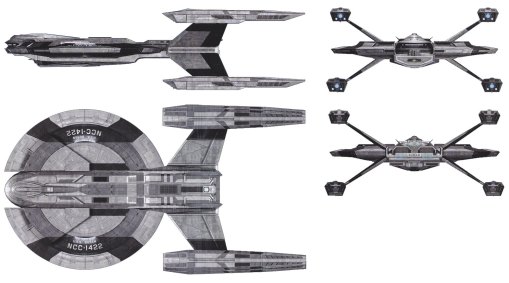
dis-cardenas-views2.jpg

I love the stripping some of the new ships have in the show, and our explanation is that the colors denote where the vessel was constructed. Red (as with the Shenzhou) is Utopia Planitia, turquoise (the original stripping color for the same, is Andor), there’s a green in our universe for Tellar, and a rust-color for Vulcan.

SIZE: 7     STRUCTURE: 45     CREW: 350     CARGO: 80     TRANSPORTERS: 3 personnel, 3 cargo     SHUTTLEBAY: 2 (7 shuttlecraft, 4 workbees)

LIFE SUPPORT: Class 2R (CC)     OPERATIONS: Class 2R (CC)     TRACTOR BEAM: 1 aft SENSORS: Class 3 (+3/+2/+1/0/0  D)     IMPULSE DRIVE: SBE (.5c/D)     WARP DRIVE: PB-16 (5/6/7  C)

ARMAMENT: 10 Type II Phaser arrays (4/4/4/0/0/ B); 4 Mk12 IF Photon Torpedo Launchers (4/4/4/4/4 B)

DEFENSE SYSTEMS: PFF-2a  Protection/Threshold: 13/3  Reliability: B

MANEUVERS: CMD +2   HELM +1   TAC: +2

CONSTITUTION CLASS LIGHT CRUISER
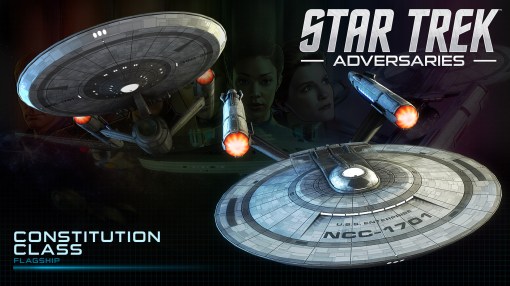
ConstitutionClassDSC_Detail.jpg

In DiscoveryEnterprise isn’t the biggest, baddest ship. She’s got “impressive specs” according to one of the characters, but she is now a light cruiser, a bit bigger than the old ship.

SIZE: 6     STRUCTURE: 35     CREW: 210     CARGO: 70     TRANSPORTERS: 3 personnel, 3 cargo     SHUTTLEBAY: 1 (7 shuttlecraft, 4 workbees)

LIFE SUPPORT: Class 3 (D)     OPERATIONS: Class 3 (D)     TRACTOR BEAM: 2 dorsal/aft  SENSORS: Class 3 (+3/+2/+1/0/0  D)     IMPULSE DRIVE: SBE (.5c/D)     WARP DRIVE: PB-32 Mod 3 (6/7/8  C)

ARMAMENT: 6 Type II Phaser arrays (4/3/3/0/0/ B); 4 Mk12 IF Photon Torpedo Launchers (4/4/4/4/4 B)

DEFENSE SYSTEMS: PFF-2a  Protection/Threshold: 13/3  Reliability: B

MANEUVERS: CMD +2   HELM +1   TAC: +1

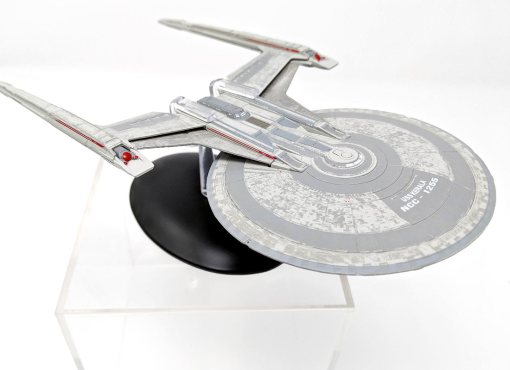
SHEPARD CLASS LIGHT BATTLECRUISER
header-kerala-review.jpg

This sleek ship was originally a design pass for Shenzhou but is larger and more modern. There are a few art pieces floating around out there of this class with the stripping seen on the Walker- and Cardenas-classes. I like to think those are older ships, and the grey paint schemes are ore modern. She’s listed as a “battlecruiser” in a few sources, so I went with that.

SIZE: 7     STRUCTURE: 35     CREW: 250     CARGO: 70     TRANSPORTERS: 3 personnel, 3 cargo     SHUTTLEBAY: 1 (7 shuttlecraft, 4 workbees)

LIFE SUPPORT: Class 2R (CC)     OPERATIONS: Class 2R (CC)     TRACTOR BEAM: 1 aft  SENSORS: Class 3 (+3/+2/+1/0/0  D)     IMPULSE DRIVE: SBE (.5c/D)     WARP DRIVE: PB-16 (5/6/7  C)

ARMAMENT:  8 Type II Phaser arrays & 6 PC-10a PD pulse cannons (4/4/4/4/4  B); 2 Mk12 IF Photon Torpedo Launchers (3/3/3/3/3  B)

DEFENSE SYSTEMS: PFF-2a  Protection/Threshold: 13/3  Reliability: B

MANEUVERS: CMD +0   HELM +2   TAC: +2

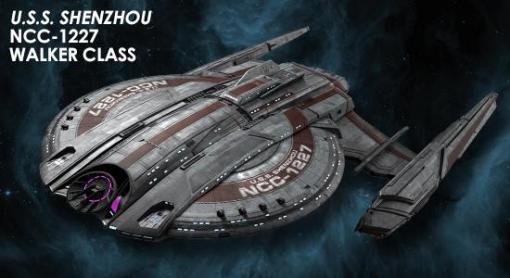
WALKER CLASS LIGHT EXPLORER
95643dcfcb8164892a701cd9bccc66d9.jpg

I love the look of thing — even with Eaves’ fascination for negative space making some of the design seem…anti-functional. I set our Trek game on a sister ship, Fearless.

SIZE: 7     STRUCTURE: 40     CREW: 160     CARGO: 90     TRANSPORTERS: 3 personnel, 3 cargo     SHUTTLEBAY: 1 aft (6 shuttlecraft, 4 workbees)

LIFE SUPPORT: Class 2 (C)     OPERATIONS: Class 2 (C)     TRACTOR BEAM: none SENSORS: Class 3 (+3/+2/+1/0/0  D)     IMPULSE DRIVE: SBE (.5c/D)     WARP DRIVE: PB-8 (4/5/6  C)

ARMAMENT:  8 PC-10a Pulse cannon batteries (4/4/4/0/0/ B); 2 Mk12 IF Photon Torpedo Launchers (3/3/3/3/3 B)

DEFENSE SYSTEMS: PFF-2a  Protection/Threshold: 13/3  Reliability: B

MANEUVERS: CMD +1   HELM -2   TAC: +1
So for Nerd Night™ the guys wanted to try something new. I’ve been wanting to to something more space opera-like and narrowed it down to two games: Battlestar Galactica (using Cortex), or Star Trek. The idea was to do a “pilot episode” and see if either took hold. I pitched Trek first, mostly because I enjoyed Season2 of Discovery so much I’ve actually rediscovered my love for the setting. I decided I wanted to use the new look and sensibilities of the series for the game pilot.

Now which system to use? We had been on the playtest for the John Carter version of 2d20 — the allegedly stripped down version of the game mechanics — and found it nearly unworkable, partly due to terrible writing making an overly complicated base mechanic impossible to grok. I thought of porting it into Cortex, then pulled the old Decipher Trek books off the shelf and had a look through. There’s a few things that are clunky with the game — especially damage in combat, but it was always a workman-like set of rules that I was mostly familiar with, although I’d forgotten quite a bit over the last decade or so since I ran it. Decipher it was.

The setting: It’s just the start of Season 2 of Discovery, and the Klingon War is over. The sudden win for the Federation, after what looked to be an inevitable loss, is still reeling both sides. How did they win? There’s a lot of obfuscation and politics surrounding it, and the command staff of the characters’ vessel is mired in “what really happened.” Their old captain, the famed Captain Robert Garth, hero of the Battle of Izar, has been removed from command for “mental breakdown”, but the crew isn’t buying it. He had been a major critic of the way the war was fought, and his ties to whatever manner they won the war have made him a liability to be pushed aside. His XO, Commander Fiona Kerr, has taken command, but Garth’s rivals in Starfleet Command have held up her promotion to captain citing her youth as a reason.

The characters: Stephen Archer, great-grandson of the admiral, is a hot shot pilot who was itching to get into the fight when the war ended. He’s just graduated the accelerated officer training program at the academy with his roommate and friend, Garav Idrani, a brash Andorian security officer. Right of the bat they find out there’s a lot more going on behind the scenes, as Idrani’s father — the general in charge of the Andorian Guard — invites them to a post-graduation party at the Andorian Embassy in Paris. There they meet their captain and her friend (and another PC) Doctor Sharas P’Trell, son of the Andorian Ambassador to the Federation and a chairman of the Defense Committee. He’s pulled strings to thwart Starfleet Command’s attempts to remove Kerr and any other crew who would not publicly disown Garth. P’Trell and she are tight, having been in direct combat with the Klingons, including the pyrrhic victory relieving Axanar. She’s saved his life and nearly died in the process; the ambassador has her back.

Aboard their ship, Fearless, an aging Walker-class (and one of three to survive the war), they meet the other two PCs, Lieutenant Olaf, a young Saurian operations specialist (Our conceit is that Saurians, like Linus, give themselves human names that other races can pronounce) and another loyalist to Kerr; and Lt. Kohal, the stereotypical hyper-competent Vulcan engineer who has become the ship’s troubleshooter.

The first adventure involved heading to Tau Ceti III to assist the population there with disaster relief, pending the arrival of large, better equipped ships. It’s been six months since the end of the war and 2/3rds of Starfleet is still in port under repairs or refit. They’re the first ship the fleet could afford to send. Along the way they suffer a horrific EPS conduit blowout that nearly kills two crewmen, the result of shoddy, rushed repairs at the Copernicus Yards. They encounter a ship hiding off the spacelanes. The captain is claiming issues with their drive and is evasive about what is going on. Kerr orders the characters to provide a “health and welfare” check of the vessel, and they discover the captain’s transporting Orion slaves to a meeting with a buyer. They promptly get into a fight, take the ship, and arrest the crew. They take the merchant ship with them to Tau Ceti, planning on releasing the women being trafficked and sending the crew to the appropriate officials.

Tau Ceti is a mess. The Klingon attacks here badly disrupted their infrastructure and the crew is hard pressed to address more than a few of the world’s needs. The leadership has felt abandoned and has been trading with the Orions and anyone else that can get them supplies. Starfleet’s arrival, while appreciated, is considered a bit late. The next few nights involved fixing maglev railways, power systems, air processing plants, and uncovering the mystery of a group of farmers who kicked the crap out of the Klingons that invaded a bunch of farming communities. It turns out they are the descendants of the Central Asian Khanate — the Asia-spanning empire of Khan Noonien Singh. There was some worry about what to do with them, but they’ve been staying out of the way of the world until the war. They find out that Section 31 (so far just called ‘the black badges”) cut some kind of deal with them in exchange for ignoring their parentage.

The last session ended with the crew having been replaced by a larger relief mission. They were celebrating in a famed whiskey bar in the world’s capital when their captain is beamed away suddenly — apparently taken by one of the Orion captains that have been supplying the world. It turns out that the high-ranking Klingon she killed was the favored son of House Mogh and there’s a bounty on her head. The crew is recalled hastily but it’s obvious that they are not going to have an easy time catching the much faster Orion freighter…

I didn’t expect the group to get into the game. I figured they’ve been interested enough to play, but it wouldn’t hook them like the Roman D&D campaign had. I was incorrect. Even though most of the players only have a passing knowledge of the shows, they clicked with their characters well, seemed to really respond to the more complicated universe I was throwing out, and bonded with their NPCs quickly. It’s one of the best starts to a game I’ve seen.

So now I’m writing up Decipher Trek versions of the new ships from Discovery. Because dead games are apparently my thing.

…and this time it’s more obscure. Or open. Different. Anyway!

66777285_2338299199824516_24914465333968896_n

The new(ish) game group has settled in nicely over the last two years. We started as a 5th ed D&D group — that was my sales pitch for two of the gamers — but they have tried out Hollow Earth ExpeditionTales from the Loop (which was very popular with the gnag, as most of them are of that particular late ’80s childhood.) I introduced them to a house rules version of cortex to run our end of Roman Britain campaign, swapping for the high fantasy of Dungeons & Dragons. I floated the idea of a new science fiction campaign; I’ve been getting the itch to do sci-fi, and particularly space opera again.

The ideas I threw out were a Star Trek campaign in the reboot (and let’s face it, it’s a reboot) Discovery universe (minus the awful spore drive McGuffin). I like the aesthetic of the ships and gear of the show, and the more gritty tone fits me well. And I would get to use the Eaglemoss starships for battles. (The Discoverse ships are gorgeous! and I’m warming up to the Warhammer 40k aesthetic of the Klingon designs from first season (which I initially didn’t like…) I’m thinking of either busting out the old Decipher Trek rules set, or porting it to classic Cortex, which remains a house fave for rules mechanics.

The second choice was to try and catch lightning in a bottle one more time with Battlestar Galactica. I miss the old campaign, loved the universe we had created, and think I could do a nice variation on the themes without repeating myself. And I would get to use the Eaglemoss models for combat scenes.

Something tells me with the current crop, Trek would fly better.

The James Bond: 007 Role Playing Game was written back in the early 1980s, and while it remains an excellent engine for espionage roleplaying, some of the mechanics are getting a bit like Roger Moore in A View to a Kill — a bit too long in the tooth.

One thing I’ve noted is that the firearms damage ratings, much like the structure points for electronic do-dads and performance modifiers for modern vehicles, do not take into account well the serious improvements in technology. I thought I would address the first in this post.

There’s one way to correct for this: hit the interwebz and find out what the ammunition the character is using has for muzzle energy. For instance, most modern 9mm is going to be running in the 330-360 ft/lbs. range. Using the Q Manual as a guide, you’ll see that most 9mm firearms of service weapon size (4″ to 5″ barrels) should be throwing lead with a DC of G. The Walther PPK in either .32 or .380 would have an E. Both 10mm and .40S&W run in the H range, etc… +P and other hot loads push this even further, but should lower the S/R by at least one due to recoil, and depending on the weapon, might increase the JAM rating, as the weapon takes a heavier beating than was intended.

For instance, running .32 +P through a Kel-Tec P32 is pretty inadvisable. It might do alright for the occasional firefight, but a steady diet with kill the weapon pretty fast. You might kick the JAM from a 98+ to a 97+ and add a GM Information tag that the weapons suffers a malfunction on 99 and 100, instead of just 100. Another good rule of thumb is that if the pistol has longer than a 3″ barrel, bump the DC up one. This holds pretty true for rifles, as well.

Now if game balance is your thing, you might find a close analogue to a weapon being used in the Q Manual or Black Campbell’s own Q2 Manual (and yeah, you’ll find it pirated on other sites…it’s my work) and riff on that. I’m planning a new gear manual in the future that addresses some of the changes the world has wrought on this venerable game system.

My new acquisition made me check the blog to see if I had covered this before, a lo! I had not. So without further ado…

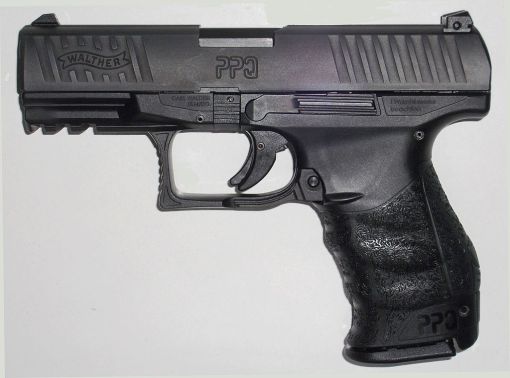
Walther PPQ 9mm

1024px-Walther_PPQ

Introduced in 2011 as a follow on to the P99, the new PolizeiPistole Quick Defence, or Police Pistol, Quick in English is a 9mm striker-fired semiautomatic pistol with a 15 round capacity. Unlike the P99, there is no “single action” mode, rather the pistol functions similarly to most striker fired pistols. The trigger safety is modeled on the Glock, with a small trigger lock that is depressed when the trigger is pulled, but which should not catch on clothing and cause an accidental discharge. This trigger is exceptional for a striker pistol — the weight is about four pounds, with an incredibly short reset that makes it is very fast to string follow up shots. The polymer frame is topped by a heavy slide which mitigates much of the felt recoil, and the grips have palm swells with slight finger grooving to improve handling. The backstrap is interchangeable with three different sizes to adjust for the shooter’s hand size. The magazine release was originally a German styled paddle on the trigger guard (now the M1 version), and a later M2 release swapped this for the American-style magazine release…because learning a very easy manual arms was too hard. Extended ambidextrous slide releases and large gripping grooves on the slide make this easy to use with gloves and along with the paddle-style magazine release make it easy to use with either hand.

The accuracy of the pistol, out of the box, is hard to beat, and the speed and ease of follow up fire makes this an excellent combat handgun. The grip shape and thin width of the weapon make it easy to conceal. Magazines with longer buttplates allow for a 17 round capacity.

PM: +1   S/R: 3   AMMO: 15   DC: F    CLOS: 0-3   LONG: 8-18   CON: +1   JAM: 99+   RL: 1   COST: $550

GM Information: With the extended magazines, the AMMO is 17 and CON: 0.

In .40S&W the PPQ stats are as follows:

PM: 0   S/R: 2   AMMO: 12   DC: G   CLOS: 0-3   LONG 8-19   CON: +1   JAM: 99+   RL: 1

Black Campbell comments: This is, hands-down, the single best handgun I’ve ever used in 30ish years of shooting. The trigger is on par with the 1911 for crispness and reset, the accuracy is top-notch out to about 30 yards. (Free standing, I did a sub 3″ group last week!) The ergonomics can’t be beat, and the size and shape of the pistol, being on par with the Glock 19, but more rounded and thinner hides well and comfortably in an IWB holster. I cannot recommend this Walther enough. If you don’t like the German-style magazine release on the trigger guard (and I’m a leftie, so it worked much better for me), there’s the M2 version that has the usual American-style “bullet button”.

Our “sequel” Hollow Earth Expedition campaign has been revolving around a new US intelligence/cryptoscience organization, the Office of Scientific Investigation. We had originally premiered this in our abortive Atomic Robo campaign, but the material was too good not to resurrect — especially after out initial HEX campaign ended with the Hollow Earth emerging from the middle of the planet (the “Ghost World” event) to become a second Earth.

So here’s a thumbnail of the group we’ve been using for our game:

Office of Scientific Intelligence

Formed in 1933 after the emergence of the Hollow Earth from the center of the world, the OSI is tasked with investigating “weird” science ideas, the remnant of races, creatures, and tech from the Hollow Earth and the ancients that had created that world. The OSI was formed by Congressional order and placed under the authority of the War Department. The director of this bureaucracy was obvious, Admiral Richard Byrd — the famed explorer and commander of the Los Angeles expedition into the interior world shortly before the emergence. The crest of OSI has the motto: Scientia est Victoria (Knowledge is Victory).

The OSI has been under congressional scrutiny from the beginning as it has been prohibitively expensive. The War Department, however, has protected certain programs as “essential to national security” and have pointed to the need for construction projects (using the PWA) and heavy industry ties as important to combatting the effects of the Great Depression. Equipment is usually borrowed from the US Navy and Marine Corps.

The headquarters of OSI are in an innocuous building in Arlington, Virginia, but the various “projects” are headquartered throughout the United States. these projects are each code named after smaller US cities.

Atlanta Project: The Atlanta Project is headquartered in Arlington and is composed mostly of field teams which investigate reports of superscience artifacts, strange creatures, and other “threats” around the world. These teams are led by an eclectic collection of scientists, adventurers, soldiers, and spies. Admiral Byrd takes a close interest in these teams and often tasks them himself.

Boston Project: Located in an underground facility on the grounds of the Goodyear Airship Factory in Huntingdon Beach, California and the nearby Muroc Army Air Field, this group is tasked with reverse engineering the flying saucer techology of the Atlanteans, as well as creating new and innovative aircraft for the military. They have close ties to the Hughes Corporation and Curtiss-Wright. The assistant director of Boston is Dr. Benjamin Leland.

Charlestown Project: Located in Baltimore, this group is tasked with pursuing the medical and biological research connected to the creatures and people of the Hollow Earth, as well as the Atlanean race and their human descendants.  The assistant director of Charlestown in Dr. Aaron Gould, a Spanish expatriate and a descendent of the Atlanteans.

Denver Project: Located in Brooklyn, this project is headed by Nikola Tesla and pursues research into high energy physics, electricity, and weapons research.

Easton Project: Tied to Boston Project is the rocketry program under the leadership of Robert Goddard. It is also based at Muroc Army Air Field in California.


banner

It’s been a very busy couple of months, but work on the sourcebook for 1930s pulp Istanbul continues. We’re about two-thirds of the way through writing, with layouts getting roughed out. Art orders for maps of the city and the Grand Bazaar are going out soon.

Right now, it’s a pretty vanilla tour guide to the city, but the pulpy bits are getting added soon including two adventure scenarios. The page count is anticipated to be about 80 — about the same size as our Queen of the Orient, and expect a similar price structure. There will be both a Fate and Ubiquity version and the planned release date should be August. Inshallah.

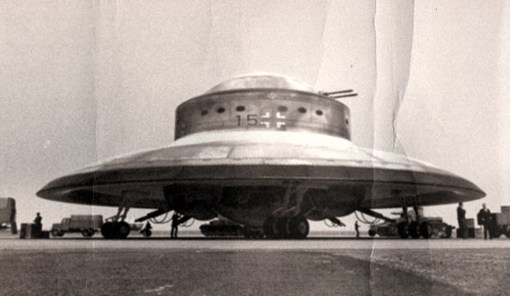
A little something from the ongoing Hollow Earth Exepdition game. The Ahnenerbe has had a bit of help reverse engineering a Vril flying saucer they captured in the Hollow Earth three years ago, and now it is harassing our party…

nazi_ufo_01Developed from a Vril flying saucer returned with the Deutschland mission, the Schwarze Sonne project reverse engineered the Vril technology using available technologies. The repulsor technology is a bit crude and is powered by a pair of Maybach V-12 engines. These flyer saucers are capable of carrying 12 men and have a minimal crew of two — a pilot and an engineer. The standard operating crew includes a second pilot, who also acts as a gunner, a radio and radar operator, and four gunners for the Solothurn turrets on the underside. It is armed with a turret topside carrying a pair of Spandau 7.92mm machine guns, and four turreted 20mm machine guns for ground assault.

SIZE: 8   DEF: 6   STR: 14   SPD: 200   CEIL: 20,000   RNG: 1000   HAN: 0   CREW: 8   PASS: 4 WEAPONRY:  dual Spandaus in turret — Dam: 5L   Rng: 250’   Cap: 250   Rate A   SPD: A; 4 Solothurn 20mm in turrets — Dam 6L   Rng: 500’   Cap: 100   Rate: A   SPD: A

The return of our Hollow Earth Expedition campaign included one of the players wanting to trade out his character, the French cat-burglar/actor for something new. He was leaning toward a character in the classy gentleman spy, John Steed vein but left it to me to build it.

Our adventure coming up was how there was a lost island, possibly a bit of the Hollow Earth that got “stuck” to the Surface World in the South China Sea. I figured we needed someone who was familiar with the lifeforms and might have a direct connection to the mission. Hence this character was born:

Aristotle Strange

Screen Shot 2019-03-20 at 20.45.07Ari Strange started his life as a philosopher and thinker in the ancient city of Molad, one of the apeman cities arrayed against the Emperor Mot. When the Interior World emerged in 1933, he was deposited in Hong Kong, where his ability to speak and reason earned him study by MI-13, the United Kingdom’s secret science intelligence agency. He was eventually recruited to aid the British with the leftover problems from the emergence of the “ghost world” and has become one of their most skilled, if least secret, agents in the East.

He is incredibly dapper, always well dressed in town, and he prefers a safari suit in the field. He rarely uses guns, preferring one of his custom-made gadget-laden umbrellas. His bowler hat is steel-lined so it can be used as a bludgeoning weapon or shield. He is frequently assigned to missions with two Special Branch officers who have been seconded to MI-13 — Sergeants Thicket and Tweed. Tweed acts as driver for the Bentley 6.5 litre “Green Train” car that MI-13 has issued to the large not-so-secret agent.

Archetype: Spy     Motivation: Knowledge     Nationality: British     Age: 40-45?

Place of Birth: Molad, the Interior World     Date of Birth: June or July, 1889

Ht: 5’11”     Wt: 370 lbs     Hair: Black     Eyes: Brown

ATTRIBUTES: Body: 3   Dexterity: 2   Strength: 4  Charisma: 2   Intelligence: 3   Willpower: 2

Secondary Attributes:  Size: 0   Move: 6   Perception: 5   Initiative: 5   Defense: 5   Stun: 3 Health: 5   Style 5

Resources & Talents: Animal Presence: Use Body for intimidation base, Natural Advantage: Climb (x2 move when climbing), Prehensile Feet, Rank 2: Special Officer, MI-13 (equiv. Lieutenant); Skill Mastery, Academics; Strong: +1 strength at creation

Flaws:  Code of Honor: 1 style pt. when he does the right thing; Curiosity: 1 style pt when it gets him into trouble, Obligation: MI-13, Weird Appearance: -2 social tests with new people.

Languages: Ophiri (native); Ancient Greek, Cantonese, English, Spanish

Skills: Academics 3/6, Athletics 2/ 6, Brawl 2/6, Bureaucracy 2/5, Firearms 1/3, Intimidation 2/5, Investigation 2/5, Larceny 1/3, Linguistics 3/6, Melee 1/5, Science (Biology) 1/4, Stealth 2/4, Survival 3/6

Weaponry: Sword Umbrella   DAM: 2L,  Attack Rating: 7L (Has a small whiskey flask in handle); Shotgun Umbrella (12 gauge): DAM: 4L, Attack Rating: 5L, Rng: 25’, Cap: 1, Rate: 1, Spd: S; Steel-Lined Bowler DAM: 1N, Attack Rating: 6N   Range (thrown): 20’ (Can be used as a shield for Armor 1)

Gadgets: Umbrella with gas spray: Range 10 (Test BODY 3 or fall unconscious for successes x minutes), Umbrella with camera (Can take up to 20 pictures (35mm cartridges), Smith Brothers wristwatch with compass, Belt with secret money pouch (5 gold sovereigns)

Note: I pulled the image off the interwebz at Traditional Games, but there was no citation for the artist who created it. No infringement is intended and as soon as I find a citation I’ll post it.

« Previous PageNext Page »