Roleplaying Games


There are a lot of good covers out there — especially some of the Scandinavian stuff that has hit Kickstarter and seems to always have been based on fantastic concept art. There are a lot of bad covers out there — just hit DriveThruRPG for a quick selection. And there are many more pedestrian ones that do the job — most of these are connected to licensed properties that use screen caps and some photo manipulation. Games like Firefly or Atomic Robo (the latter which I really like!) fit this last category.

The one that really capture what the game is about and look damned good has to go to Dungeons & Dragons 5th Edition. Don’t like the new edition? I’m cool with that. I’m not getting drawn into edition wars BS — especially as I had sworn off d20 in 1984. Certainly the loveliness (if somewhat had to read and hence use qualities of modern RPG graphic design) helped lure me into the game. I can tell you it was one of the tiefling pictures and the intriguing concept of that race that sold me on trying. I’ve yet to use one.

Honorable mention: Hollow Earth Expedition‘s covers always captured the campy pulp novels and comics that the game as emulating, and was much better art than the equally good for telegraphing the flavor of the game that was Spirit of the Century‘s cover. The cover got me to peruse the book, the interior art sold me.

After a week’s hiatus while I helped a friend move across country, the group got together for the next installment of our Dungeons & Dragons game. The had previously fought off some religious zealots who saw Carona, the satyress, as a ‘demonic creature” and the group as tainted by their association with her. They had discovered the plot was initiated by a local priest who admitted that the existence of Icio the Monk and his kind (aasimar, or “barukhim” (the blessed) in this campaign) were a direct threat to the Nicene sect of Christianity in the Western Empire, especially with the arrival of the new 4 year old emperor as his empress-regent mother, an Arian Christian.

Legate Quintus Marcellus Quadius, recently honored by the throne for his defense of Castra Stativa, was given a legion to go to Achaia in search of the River Styx and the “Shadow” — a mystical veil separating the world from the other planes of existence. A coalition of creatures — fallen angels and other monstrous things trapped on earth when the Shadow fell — are looking to invade Hades (the only plane that cannot be walled off) and release the denizens of Tartarus to invade heaven.

They marched to Aquileia, the northern-most port on the Mare Hadriatica and home to the family of Marcus Calvinus, their bard. Along the way, a few vignettes showed the growing influence the succubus Bayla was having on him. After their night together, she has been temptinghim with telepathic thoughts of sex and murder, and how he could be “a king in the new world.” Carrus the dwarf has been feeling the pressure of Carona’s pregnancy, while getting increasingly protective of her. Marcellus is feeling the weight of command — he was a discharged mercenary only a few months ago! — and Augustinian the cleric has been wrestling with the issues of morality and the strengths of monotheism in that respect, and what it means in a world where they’ve had demonstrable proof of gods other than Icio’s “one true god.”

On arrival in Aquileia, they found that Calvinus’ father, who had cast his “whore of an entertainer” son out of the city after he refused to marry the daughter of an influential Christian, was now the praetor urbanis (mayor) of the city, and his brother Lucius the head of the family’s lucrative shipping business. He’s is unquestionably the power in town, even lording it over the technically higher ranking corrector of the province. They are welcomed, and Calvinus finds out his father is impressed and proud of his black sheep of a son for his heroism and service to Rome. He also makes it very obvious that it’s time the boy, like the rest of the family, bite the bullet and convert to Christianity. It doesn’t matter, his father tells him, it he believes…it’s the appearance that matters.

Augustinian hit the local library and managed to finagle his way into seeing some of the “restricted” works (magical tomes) to find a way to help excise the succubus from Calvinus’ mind. He then started work on a crucifix the bard could wear that would give protection from evil. This would allow the character another charisma save to break the bond with the creature.

Marcellus worked with the local legate navalis (admiral) to secure the six triremes and command crews necessary to move the legion and their equipment. Their mules, however, would need to be abandoned, as this would require almost a week to get enough vessels together to move them all. As it is, two of the ships will have to be contracted for with the Calvinus family.

Icio met with the local archbishop, Valerianus, who is pushing him to speak out against Arianism and Homousian sects of Christianity (even though Icio is starting to realize they may be correct…) During the conversation, he learns that many of his ‘barukhim” brothers are siding with these now-heretical groups against the Nicene establishment in Rome. Returning to the legion’s camp from the meeting, he is accosted by a beggar that tells him the establishment won’t long need his services, and eventually they will cast him out as a liability. (Damn it, Satan, bugger off!)

That evening, a state function for the arrival of the Marcellus and Calvinus is had at the praetor’s residence. In the midst of their meal, the windows burst in as a pair of winged women, armored in black with red Greek inscriptions, incredibly tall and beautiful, invade the dinner to inform Marcellus and crew they will never reach the River Styx…alive! These creatures — furies, Augustinian thinks — have been trapped on Earth and have banded together with Satan to break down the Shadow. They are accompanied by a pair of hell hounds, and Bayla, Calvinus’ tormentor, who is offering him a chance to join them, rather than die with his friends.

Up until this point in the campaign, the characters have been munching through the bad guys with some ease. Even the Dark Man and the troll, Dufex, have only given them some challenge (but one that once they got their act together, they defeated with ease.) I figured I would ramp things up…apparently, too much. One of these Erinyes would most likely have provided them a real fight, but two plus the others was proving in a single round to be too much.

Poena (“Indignation”) blocked Marcellus’ action surged attack with ease, then cut him down to -4HP with a single blow, then seriously injured Augustinian. Invidia (“Malice”), the other fury, tore Icio (probably out biggest bad ass) up and nearly put him out of the fight — again with a single blow. The two hell hounds were badly injured and stunned by Calvinus’ use of shatter, and Carrus was unable to even land a blow.

Things were looking pretty dire for the crew when we knocked off for the night…

So one thing learned, while lower level characters are much more robust and powerful in 5th edition than the old AD&D I remember, they don’t really take off until 5th level. I over-gunned them, thinking that they would once again coordinate well enough to drop one of the Erinyes. Two was too much, and the addition of the extra baddies seems to ensure my first TPK in my 30+ years of gaming.

There is a possible out, a deus ex machina that is built into Icio’s character, and which the player was considering: asking for the aid of his angelic guardian. Could he call on Michael to help him?

I guess we’ll see.

That’s simple — there’s only been two games: Hollow Earth Expedition and Dungeons & Dragons 5th Edition.

The first game started in January 2016 as a filler for a week when the “lead character” for the Battlestar Galactica game was out on vacation. We played a “pilot” episode of HEX and it took off from there. The Galactica game ended very satisfactorily in April, and the adventures of our heroes in the Interior World zipped along until I hit a massive break point. Needing real time to figure out what the hell i was going to do, I pitched D&D5 to the group and a few others, as I had come into the books from a friend who didn’t like the system. (He’s an indie or nothing sort.)

I didn’t want to do standard high fantasy. I started thinking about a different character to D&D and hit on an earlier, less medieval setting. Then I realized I could do everything I wanted to do in a late Antiquity setting, using the monsters (humanoid ones, at least) as stnad-ins for racial differences, and this would allow me to keep deities that were known to the players from general Western culture. The choice of one of the players to have a Christian monk (and damn it, of course Late Antiquity Christianity was his focus in his history grad studies…) led me to start introducing Christian myth and characters into the world. Along the way, this has led to a tighter story, and a more nuanced view of the gods and angels, and has led to several in-character arguments about the nature of morality and the gods; and has also made Arian Christianity much more “correct” than the Nicene version of the late 300s. It’s flying along quite nicely and the players are really engaged, even the ones that were in it for the hack and slash are now interested in the metaphysics of the world, the NPCs around them, and the are enjoying the world.

Good question! It used to be you went to the local game store, but good luck with that in some places. I used to haunt some of the game-related boards and blogs, but I think most of it comes from other RPG writers or players posting on Facebook about a Kickstarter or upcoming product from a known group like Evil Hat or Cubicle 7.

Som Kickstarter-related posts have led me to that site, only to find something even more interesting to me. That’s how I found the excellent board game Xtronaut and the soon-to-be-released Constellations by the same gang. It’s how I heard about Cam Banks’ going solo from Margaret Weiss with a new iteration of Cortex Fate (I mean, Prime…) Most of the new stuff I’ve seen, however, is all from Mödiphiüs, which has gone license-happy (rarely a good sign.) They’ve got Conan, John Carter, and Star Trek, but their 2d20 system is lackluster. (Their Thunderbirds board game is excellent, by the way!) I was keeping up with Cubicle 7’s releases for a while because I was doing work for them, but I’m not a Whovian or Tolkein fanatic, so that doesn’t leave me much.

Because my interest in spending money of new game systems if they aren’t able to do a better job than Fate or Cortex (classic, not Plus) has waned of late, I’m finding I’m not actively seeking out new games. Even D&D 5th Edition, which inspired enough nostalgia for me to start running a campaign, only to realize that the stuff I didn’t like still remains (mostly related to hit points and healing, but the “everyone gets magic” schtick is annoying, as well.)

There have been a few good settings that have surfaces. Tales From the Loop looks interesting, but I’m not really looking to spend a bunch of dosh to see pretty paintings (and they are) turned into a game setting.

Man, I’m a cranky old bugger today!

Simple: I want an updated, improved version of the old James Bond: 007 RPG.

Barring that, I’m thinking I’d like to see a game set in a retro-50s sort of universe, ala Streets of Fire or Trouble in Mind with noir styling, biker gangs, elevated trains, great old cars, coupled with ’80s style urban decay and ennui. A place where tough, laconic guys go out and under protest do the right thing — save the girl, take down the mobster, face down the biker gang leader with frickin’ sledgehammers! (Serious…if you’ve never seen Streets of Fire, stop reading, rent it, and enjoy. No, it’s not good; but you rarely achieve cool like this with a bad movie…)

I think you’d almost have to have a series of soundtrack albums to go with it. Tough and grungy stuff, like Ry Cooder.

A second choice, and one that has inspired an up-coming Black Campbell splatbook for Fate and Ubiquity would be a Porco Rosso RPG. I discovered the movie a few months back, having had it in my wish list on Amazon for a year or two. My daughter loves it. My wife loves it. I love it.

I would love to see a game where the setting really pushed the love of a vehicle, and handles combat of the same well. Think of all the movie and TV vehicles that stick with us: Millennium Falcon, USS Enterprise, or “Mad” Max Rockitansky’s ’76 Ford Falcon (XB chasis, if I’m not mistaken) posing at the V8 Interceptor, Cutter’s Goose from Tales of the Gold Monkey, or John Wick’s Shelby 350GT. Certain vehicles just link to a character. They are as totemic as a cowboy or ancient soldier’s horse, maybe more so.


This question starts off the first day of 2017’s RPGaDay, and it was a hard one for me. Right now, I’m GMing a “published” RPG (and by that I’m running with “published currently” and not anything that was published): Dungeons & Dragons 5th Edition. The only other game(s) I would probably want to play at this time are both Ubiquity-powered: returning to our on-hiatus Hollow Earth Expedition game, or turning to the new Space: 1889.

That said, I did pick up an e-copy of Mödiphiüs’ Star Trek Adventures RPG. I was interested to see what they’d done, although I had a taste of 2d20 through the Conan beta testing and was seriously unimpressed. Having read through this iteration of Trek,  continue to be uninspired by the 2d20 rules set. The base die mechanic is fiddly: roll 2d20 (or more, if you use their equivalent of fate/plot/hero points) and get lower than a target number (usually your relevant stat) for a success, or if you get under your focus (skill) you get two giving you up to four possible successes on a normal roll. I just described this basic rule better than any of the 2d20 books — and much of the problem for the game is just that: describing what a player does in simple terms. There’s also momentum and threat — essentially the equivalent of fate points for the player or GM respectively. Simple…except naming these differently — momentum and threat — was a point of failure during our playtesting.

The product was gorgeous, well formatted and bookmarked for the PDF version, but suffered from some of the busy graphic design that favors look over transferring information (namely how to f’ing play) to the reader. It did make me think about running Trek again, but I suspect I would use the Firefly rules that MWP put out a few years ago. (A game that i don’t think models the ‘Verse well, but does a great job for something like Star Wars or Star Trek.)

Anyway — answer: Hollow Earth Expedition or Space: 1889.

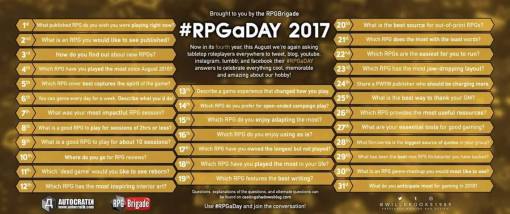
It’s that time of year: Autocratik‘s #RPGaDay celebrates the roleplaying game hobby starting on Tuesday, August 1 and ending on Thursday, August 31. We will, of course, be participating. Here are the questions for the month. Feel free to chime in as we post!

20424033_1418557494902904_852533811003771637_o

After a week off, our group picked up where we left off with our Dungeons & Dragons game. They had gotten to Mediolanum, the new capital of the Western Roman Empire, and had been lauded for their victory over the Quadi in a desperate siege in Germania. They had been feted by the Empress Regent, Justina, whose four year old son Valentinian II has just been made the augustus (senoir emperor) in the Western Empire. (They had been, until now, operating under the orders of the caesar (junior emperor), Valentinian’s 16 year old half brother, Gratian.)

While Marcellus was being personally “entertined” by the empress after a superb charisma test, the others took a drunk Carrus home to the villa they’d been loaned by the government. There, they found a gang of men waiting. They had already set on Carona for being a “demonic and unnatural creature” (she’s a satyr.) The fight jumped off with Icio the monk using his lesser restroation to heal Carrus of him massive drunk — not a pleasant experience! He then let fly with the ghostly angel wings the assimar can manifest and chastised the men to repent their sins and leave the place. It almost works.

Carrus, meanwhile, goes ’80s Schwarzenegger on the six guys that have been attacking Carona, leading to much mayhem and gruesome gore. Augustinian and Calvinus wind up battling a few of the men after the bard had put three of them to sleep. Icio finishes off all but a few who escape after they persist in their attacks.  In the end, the party questions the miscreants and finds out they were put up to this by a Father Thomas who found Carona’s presence with alleged heroes of the empire troubling, and made him question Icio’s faith, and to accuse Carrus (Carona’s lover) of bestiality. The father, apparently, arranged for the staff to be absent the house, as well.

They quickly cleaned up the mess, then retired outside of town to the farm Marcellus’ family owns. While there, he provided his brother with the rewards of his command in Germania — 5000 soldi: enough to buy up a few of the other farms around theirs! Carona was left in the care of the officer’s mother and brother, while the rest of the party returned to the city to confront Father Thomas after his noontime mass.

They learned that Thomas was most likely no the architect of the attack, but he refuses to implicate anyone else. However, during the questioning, Augustinian quickly realizes that Thomas’ string-puller was most likely the archbishop, Ambrose! Thomas lets slip that the aasimar (or “barukhim” [blessed ones] in our game) and their rivals, the tiefling (or “nephalhim” [cursed ones] ) are mistakes; mistakes that could imperil everything the Church is trying to build in Rome. This leads Augustinian to realize that the very nature of these creatures — the aasmiar are supposedly the “same blood” as Christ — are an anathema to concept of trinitarianism the Nicene version of Christianity has settled on a canon. If Jesus wasn’t just the son of god, but god itself, he should have no “brethren.” Icio and his kind lend credence to Arianism — which sees Jesus and the barukhim as literal “children of God.”

Through the course of play, the characters wound up discussing the nature of the Christian schism between Arians (represented by the Empress Regent, the anitpope, and her court) and the Nicene (represented by the Archbishop Ambrose and the Roman Church), but also things like the nature of morality — could you have a true concept of morality with multiple gods, which even Icio had to admit exist as they’ve met Pluto, already? If each god has their own versions of morality, can there be a universal good or evil? Icio countered that his God was the one, true god…his moral dictates, therefore were paramount…a singular version of good and evil. Augustinian admitted that he thought you could not have a true moral compass outside of morality. Calvinus — ever the reprobate — chimed in that morality was completely subjective, echoing the moral relativism of modern day.

Having moral quandaries has been a continuing motif in the game — from the notion of enslaving or executing their enemies (perfectly legal in Roman law), to choosing not to kill a troll because they realized that the creature was too dumb to understand the nature of his action, and now the questions Icio has about the Church: they chose to brand his friend (Carona) demonic, even though he knows she is 1) naturally good, and 2) shows ore mercy and charity than the Christians that came to murder her for their — his — religion.

Court intrigue has already figured into the game with the power plays around Gratian and Justina, but the internal conflicts of the Roman Church are also coming into play and intersecting. As the characters rise through the levels and become more influential in the game universe, these conflicts will impact them more, and in way you just can’t simply punch your way out of. And of course, their upcoming quest is taking them to Achaia (Greece) and the River Styx, where they could very well be facing off against Satan, or Pluto, or something worse…


Hedra is a new dice-rolling program for iOS created by the people that brought you Dicy, which has been reviewed previously here. The creator contacted us a few days ago about the review of Dicy — which remains my go-to dice roller for RPGs when I’m running off of my laptop — to htank us and let us know about Hedra.

I downloaded the app and played around with it for a few minutes and now it’s time for the review:  Hedra is a very lightweight, minimalist dice rolling program. No fancy backgrounds, and right now there’s no build-ins for modifiers to the dice. Pick what you want and roll it. There’s no limit to the number you can roll, save you can only roll 20 at a time. (I rolled 40d6, just to feel like I was playing old Star Wars for a moment…) There’s all the usual polyhedrons you’ll need d4 o d20, and d100. The background is an off-white, the dice are each a single color to easily differentiate them, and the program totals them for you. The only die that is hard to read the individual dice are the d4s.

IMG_0124

To roll multiple dice you can either tap like a lab rat looking for food, or swipe up and it will tell you how many it will roll when you let go.

I made the suggestion to the developer on the App Store to add Fate dice to the options. I think up-sizing the d4 is another good idea.

So is it worth it? It’s a buck. It’s a light serviceable dice roller. So, yes.

Our Dungeons & Dragons game has steadfastly steered clear of the classic fantasy game tropes and expectations, but has instead focused on an alternate-Late Antiquity setting with classical mythology and Biblical themes, but also is increasingly focused on the question of what “good and evil” is.

The characters are Roman citizens — a former legionnaire who is plucked from obscurity by the young and new emperor that he babysat while on campaign with his father (Marcellus); the cleric from Africa who is traveling the empire trying to find enlightenment (Augustinian); the bard from a good family that exiled him for his “trashy” occupation and refusal to marry an influential Christian girl in the court of Emperor Valens (Calvinus); an anchorite monk who is “barukhim” (a blessed one or aasmiar) and a trained “demon killer” who has been hiding from the world since his mentor was murdered by a nephalim (tiefling), and who has been called into the world by the archangel Michael to fight the armies of the Lie — Satan (Icio); and lastly, an Allemani dwarf (or “zwergi”) from the Alps who has a penchant for killing goblins (Carrus.) They are all “good” in alignment — some chaotic, some lawful.

But what exactly is good? One of the things we encountered early on in the campaign was that Roman law allowed for criminals that were caught — in this case a small village of Vandals (goblins) that had been terrorizing the surrounding countryside and which had taken some people as slaves — to be made slaves. By today’s standards, this is evil with a capital E. However, this was the law at the time, and not considered that much of a moral outrage. Hell, two-thirds of the Roman economy was worked by slaves.

In that case, the good/evil dichotomy wasn’t really that tough. The Vandals had taken Romans as slaves illegally. Rescuing these Roman citizens and enslaving the baddies might be problematic for a 21st Century player, but at the time, there was no question that this was the right thing.

In another instance, they had captured a few assassins that had been sent after them. They had attacked the party, which was by this time under imperial writ. Marcellus was a legate — an ambassador/general. Attacking him was a crime against the state. Executing the miscreants was under his purview. Again, for people raised on Enlightenment notions of due process, opposition to abuse of authority and cruelty, this was…evil. Again, lawful, but evil.

In our last night of play, the party was headed south to Mediolanum to meet the empress regent (Emperor Valentinian II is only four.) following a spectacular victory over a Quadi (hobgoblins as stand-ins for Goths) army, then head to Greece to try and find something called “the Shadow” — some kind of wall between the world and other planes of existence that Satan is looking to tear down. They had stopped in Cambodunum, a ruin of the old capital of the province Raetia and which is sparsely populated. They had found lodging in the distillery of one of the residents, only to be attacked that night by a troll that they had previously encountered, and who had tracked them because it was upset they were profiting from the story that Carrus had killed him.

In the process of fighting the troll, they accidentally blew up the distillery, and the explosion brought an avalanche down on the town. After rescuing their fellows, Carrus, Icio, and Marcellus, were aiding the townspeople in finding a few missing people and some of the livestock. Hearing a scream, they returned to the house of the distiller, which had been badly damaged in the avalanche.

Inside, Augustinian — who had been badly injured — had just wakened. Calvinus and Carona — a satyress they have been traveling with and whom Carrus has taken up with — were taking care of him when they were attacked — the front door kicked in by the troll they’d thought dead in the avalanche an hour prior. Carona panicked and played a frightening strain on her panpies, but before the troll could escape into the night, Augustinian threw a hold creature spell and trapped it. Encouraged by Augustinian to kill the creature, Carona went to cut its throat…but when confronted with a terrified, helpless creature, she couldn’t do it. It was unfair. Wrong.

Evil.

Augustinian shortly after lost his concentration and the troll escaped out to be met by the other characters, who had been returning. Surprised by the blubbering monster that was protesting, “she tried to murder me!” Icio was overcome with a moment of compassion and tried to talk the creature down. It wasn’t an option I’d even considered in the planning for the adventure, but with the monk’s moral compass, and his mission to try to turn evil to good, the player and I were in agreement it was definitely the way to go. He was able to get a good persuasion test and calm the troll a bit. The idea of even talking to it never occurred to the other players — but their characters, it turned out, was another matter.

After establishing that the main beef was the fraud they’d perpetrated by calling Carrus a “troll killer” (something the dwarf desperately wanted to “fix”) and that they couldn’t go around lying about him. The second was that they attacked him for defending his bridge (not quite how it happened, but he is obviously a bit dim.) Marcellus pointed out it was the Roman’s bridge, not his, and that is could be argued the troll stole it. Augustinian piled on about the complexities of property and ownership, and when it was right to attack someone. Perplexed, and well out of his intellectual depth, the troll eventually promised not to haunt bridges looking for victims if they wouldn’t lie about him, then stumped off into the night.

A game about killing monsters and stealing their treasure turned into one about avoiding conflict and attempting (at least on Icio’s part) to teach a troll the Ten Commandments. But more to the point, it was about playing their alignment — an element of the Dungeons & Dragons rules that always annoyed me. There’s always the question of moral relativism when trying to define good or evil, but in a game where those distinctions tie to rules that can affect how or if a spell works on a creature, how your character interacts with others, or how they behave in general, it’s important to figure out (in game terms) what they mean.

The encounter left Icio and Augustinian questioning the nature of morality, and if it could even truly exist in a poly- or pantheistic framework, where every god had an area of authority and subjective morality. Carrus was frustrated — he knew, in some way, they did the right thing, but it still felt wrong to let the creature go! Marcellus and Calvinus didn’t quite know what to think…

These quandaries bring up some interesting questions. If you serve an “evil” god, but your intent is to follow the precepts of that deity, are you doing evil or good? A real world example might by the thugee of India, who worship Kali, and who would waylay and murder travelers as a form of worship. Is that evil? The British overlords of India certainly thought so (as, I suspect, did the victims), but what did they think? Sati, where a wife was burned with her dead husband, was considered right and proper. Good. British authorities disagreed. Egyptian emperors were buried with their slaves and servants. Evil? Or was it, if these people went willingly because they were serving their emperor and gods?

A week later, the party finally arrived on the Via Claudia Augusta at Mediolanum, the capital of the Western Empire, where they were met by a legion of men dispatched to bring Marcellus to the empress regent. In the city, they were presented an ovation — a parade through the city to the palace, where the characters were presented accolades for the defense of Castra Stativa against the Quadi. Marcellus received the appellation “Quadius” for his victory and with Carrus were presented coronae and philerae (medals) for their actions (as well as finally paid for their three months of service…) The rest were given Crowns of the Preserver, a high award for those civilians who have saved a soldier’s life. Augustinian and Icio were also given the title pius felix.

Afterward, they retired to a villa that was set aside for them. There were already some issues with men wanting to buy Carona as a slave, but more worrying was Bishop Ambrose’s reaction to her — a demonic creature, and one that is supposedly fornicating with one of their number! That is bestiality, as best! Icio knows she is good, but the Church has decided that she is an unclean thing. Is he good for trying to defend her, or evil for being influenced by her?

Ambrose, nevertheless, impressed Augustinian with his rhetoric and intellect, and vice-versa (as was the case in the real world), leading our cleric to start dallying with Christianity.

That evening, a gala for the heroes (minus Carona who — it was suggested — should stay at home) led to Marcellus making one hell of an impression thanks to boosts from the cleric (eagle splendor) and band (bardic inspiration). Marcellus not only awe Empress Justina with his martial prowess and his story of the Shadow and Satan (she’s seeing it as an End of Days scenario), but he was able to charm the pants off her…literally. The empress is worried about the Nicene influence in Mediolanum; she and her family are Arian Christians and she is worried that Ambrose’s push to eliminate their sect may lead to instability. Since he is also friendly with Gratian, the junior emperor, she is hoping he can be a bridge between her and her stepson, for the good of the empire. Meanwhile, she has authorized a legion for him to take to Greece to meet this extraordinary threat (Satan.)

While Marcellus and Calvinus were getting familiar with their respective ladies in the palace, Icio and Augustinian escorted a very drunk Carrus home to walk in on a couple of masked men trying to kill Carona. That seemed like a good place to end for the night.

It was a good character night. Their beliefs and basic purposes were challenged — something that I think pushed character exploration and growth in ways that beating the crap out of monsters does not. Carrus was distinctly torn between his desire to kill the troll, or go along with the diplomatic solution that Icio and Augustinian pursued. Icio has been reeling from meeting Satan, and having that foe ask some very good questions about the nature of gods, angels, and his own people, the barukhim; he then followed it up by showing mercy (and having it work), and later finding himself in between his bishop and his friendship and experience with the satyr, Carona. Marcellus knows getting involved with the empress and her causes is dangerous…but he is also a creature of duty and order, and being part of an attempt to save the empire cuts straight through his better judgment. Calvinus is having trouble with the voice in his head — a telepathic link to the succubus that seduced him a few sessions back — that is trying to turn him slowly against his fellows.

The ethical and moral conundrums are making for a truly enjoyable game where the players are having to really figure out what their characters want, believe, and know. I’m pretty pleased to see that my instinct to move away from hack-and-slash and dungeon crawls was a good one.

« Previous PageNext Page »