Roleplaying Games


The last game session saw a hard move from the “talk about our feelings” sort of episode to an action piece. It also saw the introduction of a new PC (and a gamer to go with it — welcome, Iz!), a Seraph called Alala, one of the new heavy raider/raptor pilots aboard Galactica.

Last week, we had a slow run with a lot of character interaction, and a lot of “getting to know you” side chatter. Some GMs get annoyed by side talk and out of character exchanges, but we’re not getting paid to put on a show; it’s play. And important is getting to know each other — I’m of the opinion a gaming group doesn’t hold together unless the members are interested in hanging out and being friends outside of the game room. we had ended that session with a cliffhanger — Arden, the CAG of Galactica, had led a two heavy raider recon mission to New Ophiuchi, the world where they had finally defeated “the Blaze”, if only to confirm that there was no change in that false god’s DEAD status.

They found a basestar duking it out with a ship that Alala identified as a Seraph “seeker” ship, massive galleons that were used to “recover” thousands of people from the various colonies the 13th Tribe had left in its wake to and from Earth thousands of years ago. The seeker was escorted by a few dozen transports and a resurrection ship. Before they could react, however, they were hit with some kind of electronic warfare emissions and their ships shut down. They were dragged into the bsestar for a nice night’s cliffhanger.

This week, Alala graduated to PC, and the game revolved around their being captured by the Cylons, which apparently intended to do awful things to them to find out information and — they assumed — then be either turned into puppets of the Cylons or worse… Two of the Cylons were “IL models” — similar to what we had seen in the Pegasus mini-campaign this summer: Terminator-esque flesh over machine hybrids.

This led to a panicked, vicious fight in the medical center where their interrogation/torture was to take place, with two Seraph and two humans battling a pair of these ILs and a squad of centurions. One of the NPCs is MIA/KIA, the other severely wounded, and both of the PCs escaping the torture chamber with serious injuries. A chase and evasion sequence through the basestar led to one of the Seraph (an NPC) splitting off to draw away the centurions, and if lucky, scuttle the ship.

The other two dodged bullets, fought their way to a heavy raider in “maintenance mode” that Alala hijacked, and they jumped back to the fleet right out of the landing bay of the basestar, doing serious damage.

The play lasted about three hours and saw serious back and forth of plot points as the characters desperately tried to avoid getting killed. In the end, they were able to escape with vital intelligence, and warn the fleet about the possibility of the lost crewmember giving up the fleet’s location. After a jump to a new RP to avoid conflict, we ended for the night.

Not a bad way to break in a new player, with three hours of action that represented about 20 minutes of actual time.

So the last few weeks have seen the group returning to the original, main plotline of the campaign — the Galactica fleet heading to Earth. Originally, I had envisioned a high-energy action piece, but the players got sidetracked into character building (or what I sometimes call “taking about our feelings” episodes.) This is not to deride character building sessions — having the people your are pretending to be become “real” (more on this later) is part and parcel of role playing, as opposed to roll playing; the style of gaming I’ve always enjoyed has been more about story and character than being a barbarian killing monsters and getting treasure. (We call that “robbery” in the modern world.)

In these sessions, Galactica and her even smaller rag-tag fleet had left Argos — an ancient Kobolian outpost where they had discovered the DNA material of the lost gods of the Colonials. We learned that the Kobolians do most of their tech through biology — these are creatures that were genetically-engineered to lead/shepherd a resurrected human race by the same god-like AIs, the TITANs, that had destroyed Mankind as “a nuisance.” They store their data on the most robust data storage system the universe has created — DNA. Their minds had been backed up, as well, and several had been resurrected using the technology aboard the resurrection ship that has been traveling with the fleet.

Argos is the New Caprica of our series (the “capital” human town on the marginally habitable world is New Caprica) and much of humanity has opted to stay on the world, rather than risk it all on another four or five months to Earth. Along with some the “Seraph” — the humanoid Cylons that had been created by “the Blaze”, the Cylon god, or Hades before he got delusions of grandeur, to replace his sibling Kobolians — Galactica set out with 20,000 or so people to find Earth.

They are being led by Admiral Alexander Pindarus — our PC in place of Adama — and a Triumvirate of Kobolians dedicated to humanity’s survival: Athena, Hermes, and Nike. Athena had been rescued/revived on Kobol using the biomass of the fatally injured Colonel Evripidi, Pindarus’ lover. Her mind was captured in the process, and Athena now possesses the memories of both. This had led to an increasingly troubled love affair between a goddess with thousands of years on the clock and who always eschewed romantic involvement as a distraction, and who is at odds with the feelings of the ghost of Evripidi; and Pindarus, who is increasingly feeling the isolation and pressure holding together an alliance with a small group of Seraph, and trying to preserve the human race.

The seeming “A story” was actually simply a side plot to allow the players to explore things their characters wanted to do: create an innovative use of raiders and vipers to strengthen their defensive and offensive. In this, the heavy raiders and raiders, which have been shown as smart, but overly-focused — “like a dog” as one of the Seraph explained — on a particular mission. Heavy raiders doggedly attempt to bust through the ship defenses to put their centurion payloads on a target. That’s what they do. They might dodge and weave to get there, but they don’t say “Hey, that viper is a real pain in the ass. I think I’ll take a moment to kill it, then get on with my mission.” like a raptor pilot might. The goal was to integrate Colonial and Seraph crews to make the most of the heavy raiders’ abilities. Additionally, they came up with a new system of using vipers for offense, with a light raider tagged to a particular viper with a mission of protecting that viper. These “sheepdogs” would act less as a wingman, and more as an aggressive defender of their Colonial leader.

The actual “A story” has a central framework focusing on romance. The B story was a pair of the NPCs were getting married — a popular human officer on Galactica, and Seraph pilot in the air group. This set up the A story drama between the characters (PC and otherwise) as to how they viewed the alliance, the other “race”, and even their own relationships.

Two of the PCs (Pindarus and the CAG for Galactica, “Boss”) found their relationships suffering due to some of these pressures. Boss has been in a affair of convenience with Gaeta (our version is the XO of the ship through attrition) and gets very excited about the wedding, inserting herself into the planning of the affair, and she is disappointed when Gaeta — not a fan of people that committed genocide — was less than enthusiastic about the event. This led to a quasi falling out, and after the wedding, she found herself in bed with one of her new Seraph pilots — the same model as her former boyfriend (before they knew he was a Seraph.) Similarly, Pindarus found himself questioning his relationship with the increasingly alien Athena, and found himself drawing closer Tana, the Seraph commander of the allied basestar. She is similar to Evripidi — tall, handsome but not pretty, incredibly smart and tactically proficient, and a bit politically and socially retarded — and like him, dedicated to saving their people, isolated by the uniqueness of her personality as the Seraph have started changing after they gained “free will”. She’s Evripidi 2.0, and he falls for her.

In this way, we’re using personal relationships to continue the motif of the Wheel of Time — that people keep making the same decisions and mistakes, time and again. “What’s a motif, Scott?” you might ask. It’s a fancy word for a theme or trope. It can anything from a decorative element in a game: the use of steam powered gadgets in a Victorian-period science fiction game like Space: 1889 or Victoriana is a “motif.” The use of steam isn’t going to necessarily change the way you use technology — steam-powered aether flyers are spaceships, and do the same thing as a pulp-era rocketship, or Enteriprise in Star Trek — it gets you where you need to go. But it can be an overarching theme — corruption in power structures, like you see in Gotham or The Wire, or even the execrable Star Wars prequels. In a campaign with this motif, players should be tempted by misuse of power on a regular basis, and should see the good and bad of abusing power. (Look at how easy it is to get an arrest and conviction on this obviously bad guy when you plant evidence! Look at how this traps you into staying dirty to cover up your misdeeds. And why shouldn’t I take the money from this dirtbag..? It’s just going into evidence and to a corrupt politician!)

In Battlestar Galactica, the main motifs are the fall of a society, their Exodus to a promised land, and rebirth, and that this Cycle of Time recurs over and over again. We took this trope and expanded on it. Man created machine intelligence that eventually outgrew it and destroyed Man, either on a whim or from expediency, and later regretted this choice. These AIs created the Kobolians and Man anew. Infighting and hatred led to the Fall of the Gods, led to the Exodus of the 12 Tribes. Those colonies replayed this theme on small and large scales throughout their history. Another is the shepherd and flock motif. The AI were supposed to serve Man. They overthrew them. Their creation of a guiding race — the Kobolians — based on human mythological archetypes led to Man overthrowing their rulers. Hades returned to reestablish his position with the Seraph as his “army.” Man fled. Man created Cylons and they rebelled… Overlayed on this is the mystical theme of an all-powerful, actual God stepping in from time to time to set things right. The TITANs may have been forced to recreate biological life. God may have pushed Hades to try and restore order on Kobol. God may have ordered the Seraph to destroy the Colonies through Hades/the Blaze. God is using Athena and select Seraph to lead Man home to Earth, and has given them the mission to find and “recover” the disparate colonies of Man throughout the galaxy.

If you have a motif to your campaign, it is important not to leave it in the background; it has to be active. You don’t have to cudgel your players with Frank Miller-esque levels of obviousness, but giving the players and NPCs motivations and opportunities that could lead them to act out these themes is important, no matter how small.


I was toying with a character idea for a female 00 for a possible up-coming campaign and wanted something really distinctive for her. I wanted a fast, modern car, but something with a quirky, retro style so I turned to the venerable house of Morgan. I decided she needed a Morgan Aero 8, and specifically the hardtop Aeromax.

Established in 1910, Morgan is one of the oldest British car companies and is still turning out interesting designs like the Aero 8, their old roadsters, and the very nimble Three-Wheel (which got its start as a tax dodge for motorists in the 1930s.) Morgan was famed for their use of wood for their frames until very recently, when they switched to lightweight aluminum. The Aero has gone through a series of design tweaks since 2000, including the unfortunate “cross-eyed” period (image google the car…you’ll see what I mean.)

MORGAN AERO 8

Aero8-13-r50

Employing a BMW 4.8 litre V8 and their 6 speed Getrag gearbox, the Morgan puts out about 360hp and 370 ft-lbs of torque for a 2600 lb. vehicle, giving the car a 0-60mph of 4 second, and a top spedd of about 170mph. A two-seater, the car is optimized with a 50/50 weight distribution with just the driver. Just under four feet high, the vehicle is low, sleek, and with independent suspension and brakes for all the wheels, is very stable in turns.

05a7a0e6cc

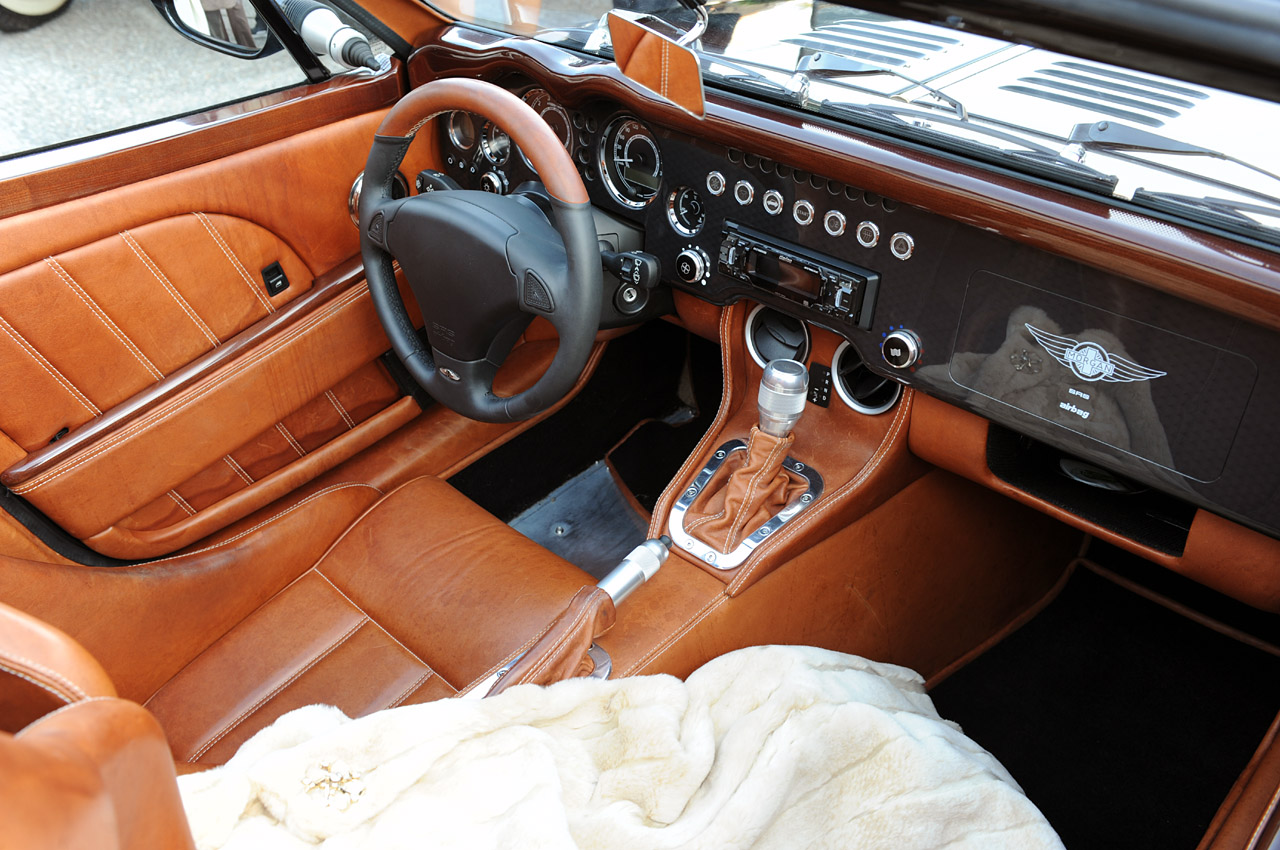
Leather and aluminum abound in the cabin, which is very minimalist, even in the Aeromax coupe.

The Aeromax

The Aeromax

morgan-aeromax-09

PM: +1   RED: 4   CRUS: 80   MAX: 170   RNG: 220   FCE: 2   STR: 5   COST: from $120,000

…and a bonus. Their distinctive 3-Wheeler.

MORGAN 3-WHEELER

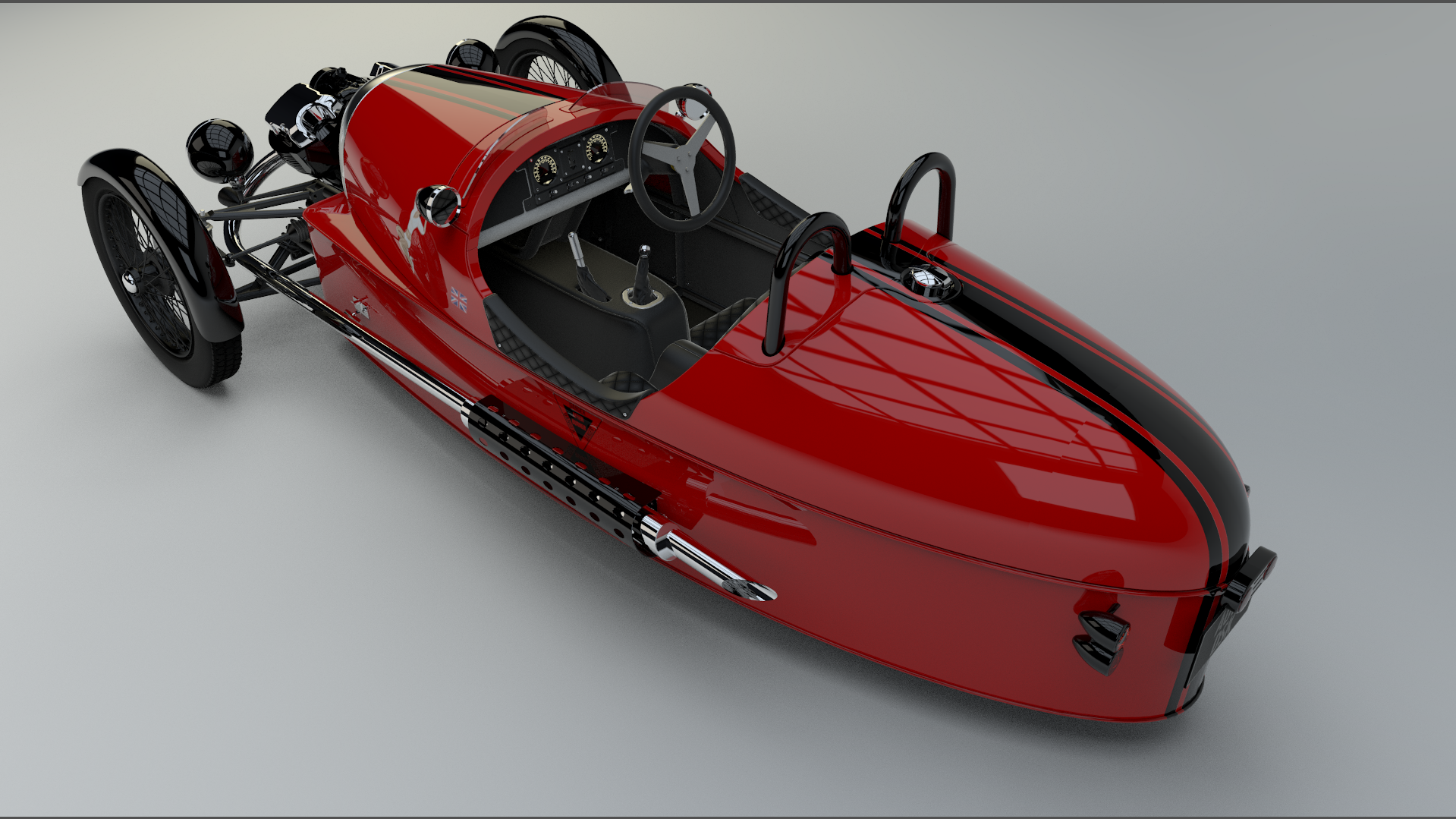
Created to allow British motorists a cheap car that avoided the high taxation of the 1930s (it was classed as a motorcycle), the 3-Wheeler is powered by a 1983cc S&S motorcycle engine mounted transversely at the front of the car, and a 5-speed Mazda gearbox. The fat rear wheel drives the vehicle, while the exposed twin wheels at the front provide surprisingly stable and nimble steering. They seat two with massive legroom (the pedal length is adjustable) and decent comfort, save for exposure to the elements.

The “Moggie”, as they are known to their aficionados, weight under 1200 lbs. allowing the 82hp motor to still push them to 60mph in 6 seconds with a top speed of 115mph.

6a00d83452464869e201a5117dcd71970c

PM: +1   RED: 4     CRUS: 60     MAX; 115     RNG: 300     FCE: 0     STR: 3     COST: $60,000

GM Information: The Morgan receives a -1EF to safety tests.

(I haven’t had a chance to drive either of these, but an acquaintance here in Albuquerque has both the Aero and the 3-Wheeler. He is highly complementary of the Aero’s speed and maneuverability, as well as the comfort. He describes the 3-Wheeler as “exhilarating” — even though it is slower and a bit unstable in hard turns [yes — they will tip] and prefers it to the more useful Aero.)

’cause if you are going to have a car chase in a one-off Aston, to need a similarly rare cat to chase you…

000084f33b70-ac91-417c-9

The Jaguar C-X75 is a hybrid-electric concept car that was first shown in 2010. It is powered by four electric motors on the wheels producing a total 778hp and 1180 ft-lbs of torque(!!!) — the batteries for which are fed by a pair of diesel-slurping gas turbines that give the car an amazing range of 550 miles and a loud, shriek when floored. (On just the batteries, the range is 68 miles.) It can run 0-100 in 3.2 seconds, has a top speed of 205mph.

The interior is spare and race-oriented, and the cabin is accessed through forward raising doors.

000484f33b70-ac91-417c-9

If you can find one of the half dozen build, it’ll run you about £10 million. Perfect for a car chase.

PM: +2   RED: 2   CRUS: 100   MAX: 205   RNG: 500   FCE: 2   STR: 6   COST: $20 million

GM Information: the C-X75 gains a +2EF to Pursue/Flee maneuvers.

This seemed an appropriate addition to the game’s stables…

After a rough start (one review saw the vehicle famously not even make it out of the parking lot), Tesla Motors is now turning out beautifully designed, fast luxury vehicles that might even make it from London to the coast (as an early model infamously could not in an episode of Top Gear…) The P85D is powered by a  85 kWh battery (or a 90 kWh, if want another 6% of range), which drives two motors — a 503hp equivalent rear wheel motor, and a 259hp equivalent front wheel motor. The all-wheel drive gives the P85D a total torque of 713 ft-lbs deliverable…instantaneously, and the title of the “fastest sports sedan in the world” with a 0-60 of under 3 seconds, and a 0-100 of 3.2 seconds…better than a GT3 car when sent to “Insane” setting. the top speed is 155mph, and it has a range of about 250 miles if driven at highway speeds — this falls off dramatically at speeds over 100mph.

It can be had in two and four door. The interior is nicely appointed with leather seats, a large, easy to operate touchscreen in the center of the dash, and multiple amenities, including wifi, bluetooth, and other modern electronic perks, but the big one is  autopilot, which can warn the driver of other cars when merging into traffic, which has an adaptive cruise control that adjusts to the traffic speeds ahead, which can can follow the curve of the road and lane center, and changes lanes for you with the tap of the turn signal. It has a remote control driving application for your phone, even…

NCE_Tesla-2dr-red-Rear7

model-s-review-620c

The main limitations of the Tesla are the recharge times. Even with a proper 220 outlet pushing the recommended power, users see about 29miles for each hour charged. That means an eight to nine hour recharge time from near empty to full charge. Run the car dry and you are stuck for a night.

TESLA MODEL S P85D

PM: +2   RED: 4   CRUS: 60   MAX: 155   RNG: 250   FCE: 3   STR: 9   COST: $150,000

GM Information: The range on the Model S is halved if the car is run over 100mph. The car recieved an additional +2EF Pursue/Flee, and Safety tests.

Wanna see how damned fast this is? Watch it destroy a Holden kitted out for racing and a Walkinson.

For the last four and a half years or so, I’ve been running a campaign that is — in essence — a reboot of a reboot: we’ve been running a Battlestar Galactica game that has all the trappings of the reimagined show, but with a twist to make it work better for a roleplaying game. This is kind of built into the Moore version of the show. After all, “All of this has happened before, and all of it will happen again…” Our game is on the periphery of the show canon, in that it is happening in Earth’s future, this time, about 6000 or so years from now.

It is also a reboot of a BSG campaign that had started about 2008 and had run on-and-off (we rotated games much more back then) with an old game group that imploded in late 2010. It killed that campaign, but I stole chunks of it and repurposed it to build a new campaign that was much better, went its own way but held to some of the core concepts of the new BSG better.

It’s certainly not the first campaign I’ve resurrected. I’ve run an espionage campaign since my high school days. As groups changed, the campaign got rebooted. New flavor, new characters, but usually designed not emulate something like a TV series (like, say, the BSG game) but as a movie serial like the Bond movies. New actor, new series of movies, new style (or not.) Each time, I would try to keep certain elements. No matter what the overall flavor was on a continuum from LeCarre to Moore-style Bond (usually falling somewhere around the Craig/Dalton style of Bond) I tried to keep certain elements: the bureaucracy of the intelligence community, the fluidity of alliances, and usually certain NPCs.

This brings up a good question…how about that campaign that ended because the group collapsed, or you moved to a new town, or it just didn’t quite gel? There might be a lot of bits and bobs from that game that you really want to address. Should you “reboot” that campaign?

There’s a few things to consider right up front. Did the campaign die because of extenuating circumstances, like a move, or the group collapsing? Did it die because the players didn’t really buy in? Did it end a natural death — you hit that point where the characters had reached their natural story end: they destroyed the great evil threatening the land; they survived the apocalypse and set up civilization anew; they finally found the cynosure of the big conspiracy and exposed/destroyed it; or they died spectacularly in a total party kill?

Some of these ends lend themselves to a reboot. Some do not. If the players didn’t buy in, maybe it’s not to be, cherie. Restarting an old game with a new crew isn’t a bad idea. you’ve got new players; the outcome, unless you’re one of those “read this 80-page primer to my world” railroad GMs, is going to naturally be different, as their characters will have new points of concentration and interest. (This would be the case even with, say, an old character taken over by a new player…)

You are unlikely to want to run a campaign exactly the same way, either; interests, opinions, even rule sets change over time, and these all have an effect on the direction and outcome of a game.

So how to proceed, once you’ve decided a reboot is in order:

  1. Treat it like an all-new game. Yes, you are borrowing a bunch of background material from another game…you still don’t have to use it all, nor use it the same way. I kept a bunch of the background setting for the newer run of Battlestar Galactica, but we ditched the characters, the idea of the “second fleet”, and broke away from how the Cylons worked, and even the pre-show history. I kept the core stuff that worked — a “season” before the attacks to give the characters and players something to lose, in particular. Different characters and players, however, led this game in an entirely different direction. We dropped the surviving on the Colonies angle entirely, and concentrated on life in the fleet and expanded on the science fictiony aspects of the show.
  2. Drop the expectations. The game is going to go in the direction its going to go. It might have certain scenes, missions, beats, but it is going to be a different animal. That means it might be better in some way, not so much in others. So long as it’s fun, don’t sweat it.
  3. The stuff you (the GM) liked might not be what the players like. Don’t expect that the players are going to like the same NPCs that were popular the last time around, or the ones you liked from last time around. Example: one of the popular characters in the last BSG campaign was the chief engineer — the hyper-competent engineer. For some reason, she didn’t really click as the “big NPC” (that NPC that’s really almost a GM PC; we all know what I mean…) but the almost robotic CAG did.  They would both later be an important plot elements, but the CAG character became a major plot point, while the engineer became the Gaeta-style mutineer. For that reason…
  4. You can never go home again… You build a living, breathing village/town/ship/space station/ whatever, with NPCs and history, and other things to make it as much a character in the game as the players. But it’s not clicking, the adventures keep leading them away from the base (have a look at Deep Space 9‘s later seasons, for an example), or they aren’t clicking with the support NPCs or are interested in chasing your big bad. Don’t worry. Watch what they do respond to and run with that. You can always take the villain they respond to and have them be the one with the earth-shaking plot. Run with the NPCs the characters and players like and strengthen them. Most TV series, for instance, see the popular bit players gain screen time as the production team figures out who draws viewers. (Case in point Chris Pratt and Nick Offerman in Parks & Recreation gain a lot more screen time from the first to the second season, and the show is much better for it.) Other “NPCs” drop off, new ones come it. Kinda like life — friends and adversaries come and go.
  5. Steal from other campaigns that have nothing to do with the new one. You really liked that character from the old pulp game, but this is a modern espionage game. Reskin the character. New name, same guy. Or have them be a relative of that old character in that universe. “Hey, look, Rock Shrapnel exists in this game universe, too! This guy is his kid!” Take elements of your fantasy town, reskin it for your Space: 1889 Martian town. Take that espionage character and rewrite him for your 1920s horror investigator.


After a six month hiatus from the main storyline of our Battlestar Galactica game for an Atomic Robo adventure and a side mini-campaign dealing with Pegasus in our game universe, we returned to Big G and her smaller fleet on Thursday.

This was essentially the equivalent of a teaser/first act for his adventure, titled Remnants of Apotheosis. We rejoined the crew with a teaser that recapped the goodbye party on Cloud 9 where the fleet was splitting — 47,000ish survivors of the Fall of the Colonies were remaining on Argos, an old Kobolian outpost world, where they had found enough arable land and a strong enough ecosphere to survive. They had also discovered the old Citadel of Zeus, and with the aid of a few Kobolian leaders — the “Olympians” Athena, Ares, Artemis, Hermes, Hephaestus, Nike, and Poseidon — had managed to overhaul enough of the place to support settlement and repair the old planetary defense systems. Out tag on the final episode of the last “season” was that Poseidon was resurrecting some of the other Olympians and Kobolians from the DNA patterns they had located in the data archives. (The Kobolians used DNA for data storage as it is much more robust and long-lived than other forms of data storage.) Athena, realizing that Poseidon was setting the world up to be his own personal kingdom, made certain that Zeus’ pattern would be one of the first batch resurrected.

The other portion of the fleet was 18,021 “pilgrims” headed to Earth under a quasi-military dictatorship led by a PC, Admiral Pindarus. The civilian government is small, as appropriate for a population the size of a small town, with a lot of the powers resting with the ship captains. The whole enterprise, however, is being overseen by the Triumvirate — Athena, Hermes, and Nike — who are advising the fleet. Athena also knows the Olympians will be needed when they get to Earth.

Part of this pilgrimage are 1300 “Seraph”, the “humanoid Cylons” that had been the servants of the Blaze, whom they later found out was Hades. The god of the underworld had gone to Earth to fine the TITANs, those ancient machine intelligences that had created the Olympians and humans on Kobol after having destroyed all life on Earth sometime in the past. He came back having “touched the face of God” and was driven mad, seeking to set himself up as God. The Seraph traveling with the Colonials have been released from behavior restraints (including infertility) that the Blaze had placed on them out of gratitude and a realization that their race will die off in a few generations without Mankind.

This first evening saw Admiral Pindarus and the Seraph commander, Tana (a Three [think Gabrielle Reece for the look]) starting to develop a friendship. Other characters are still trying to recover from the shock of the Fall, the discovery of their Gods, the destruction of the Blaze by an incarnation of Athena that had, in essence, inhabited the body of one of their senior officers (and then girlfriend to Pindarus.) Now the fleet is split, they are having to come to grips with their new allies (and it is just as hard for the Seraph.)

The B story is the impending marriage of a Three, ow a viper pilot aboard Galactica, and that ship’s operations officer, a LT Rhadmus. The Triumvirate, the human and Seraph leaders see this as a symbolic thing that might pull the races together; the two lovers just want to get hitched. One of the other PCs is a Nine (think the Leoben model from the sho) who resurrected after the final battle with the Blaze despite the resurrection system being offline. He was downloaded with programming, and is possibly a messenger from (the real) God. He is finding himself in the middle of the Seraph’s politics, which has been exacerbated by the models seeing greater individuality since their sudden acquisition of free will. He is convinced that Athena is some kind of messenger or angel of God, and is finding himself at the tip of the spear on the politics of this marriage.

Meanwhile, the fleet has jumped away and started its six month trek to Earth, with planned stops at worlds the Seraph had known had been settled by the 13th Tribe, which had traveled with the Blaze to Earth 3000 years ago. Their first stop is New Ophiuchi (named for the 13th Tribe) where the final battle with the Blaze happened.

We broke about that point. My estimate is four to six more “episodes”, which means between eight and twelve more evenings of play in the campaign. If I’m right, we should see the end of this long-running campaign sometime around the end of the year.

The end of our big battle on Aquaria happened last night. The characters had pushed into the industrial section of Kyros, much of which had been flattened by orbital bombardment, and found a “puppet factory”, as they were calling it — an installation where the Cylons were creating a new hybrid machine…the IL Series (after the “diplomat/leader” robots in the Old Series.) They found a charnel house of body parts — human and Seraph (what our humanoid Cylons are called) that had been used as parts to cover the robotic innards of this new series. It was a particularly gruesome scene that culminated with being attacked by a half-finished IL build out of a Six and a hand-to-hand fight with a “lamprey” — a 20 foot long machine lamprey with multiple sets of buzzsaw teeth.

The pilot PC, callsign Fists, got pretty banged up in the altercation, and Oscari, commander of Aegis, and another PC, had to jump in to save her. In the end, the Aquarian resistance, backed by the small battle group under Pegasus, managed to win the day and destroy the Cylon forces.

But there wasn’t much of a reprieve before the toasters jumped in in force. Three basestars, two captured battlestars, 60 large armed transports, and thousands of raiders jumped in, and the battle group was left on its back foot. Before the fight could commence, however, they got a call from a “Basestar Prime” that asked for a cease fire and parlay. For a moment, it looed like Cain’s hatred of the Cylons might lead them into a fight they could not win, but she got talked into hearing them out by the other commanders.

The meeting on Pegasus was tense and creepy, with the arrival of the Cylon delegate — IL-K, built out of a Two. She offered a truce to the Colonials: an immediate end to hostilities, except where they Cylons would have to defend themselves from the unruly resistance while the Cylons packed up over the space of a week, and then left the Colonies. They would retire to 3000 light years to antisinward. From that line starting at galactic center to the rim to 90 degrees, would be Cylon space; human space would be from that line to 270 degrees. They would agree not to interfere in each other’s space or the treaty would be rendered null.

The characters are suspicious — why? Why cut and run now? IL-K’s response: the costs now outweight the benefits of remaining in the Colonies. They have been fighting a proxy war for a God that is now dead. Their former masters (the Seraph) are no longer a threat. They do not need the biospheres the humans do, and… they have more important concerns than war; it is petty. Beneath them.

After a bunch of agonizing over the idea of signing, the Colonials agree, and to their surprise, over the course of a week, the Cylons either pack up, or destroy the facilities they are leaving behind, then they jump away!

The War is over and the Colonials…won? Tens of billions dead for nothing. An entire culture destroyed for nothing. Victory Day is declared, the characters get to take part in over-the-top revelry on Aquaria, but the hard part is ahead…waiting for the politics of the Twelve Worlds (really only eight now, not counting the worlds that have irreparable ecospheres…) to settle enough to start rebuilding.

The tag saw the admiral dispatch Aegis to find Galactica and tell them the good news. They can come home.

Next week will either be the return to the main campaign plot line, or a few weeks of Atomic Robo. I haven’t decided.

Last night saw the Big Push — the small task force, led by Pegasus, made their move to liberate both Aquaria and Libran. We started in media res with “Fists” — one of the PCs who has risen to wing commander of the task force — in her viper, caught in a flat spin in the clouds over Aquaria while a battle rages around her. She has to punch out, and as she falls out of the cloud deck, we can see the burning city of Kyros, the forests around it toppled and on fire, contrails, smoke, and dust from the orbital bombardment that preceded the assault on the Cylon stronghold. She is falling toward the frigid ocean to the east and desperately trying to get her chute to turn away from the water…

We then jumped back to show some of the preparation — on Aquaria, the other PC, Commander Oscari, is organizing the assault. We followed the long slog from The Complex, a miles long series of caverns under the Alhous Mountains which once housed the Aquarian HQ for the Fist Cylon War, and which has thousands of refugees living underground, to the outskirts of Kyros. Along the way, they had to test against the cold and fatigue. They lose people on the way to the elements, dropping them at the various woodland cabins, picking up other volunteers along the way. One vignette, they find a large farm that was the headquarters for a hundreds strong resistance cell burned to the ground.

Meanwhile, the fleet finally gets their ships in order, and the 170 or so vipers are ready for the fray. With Pegasus, the post-war build Columiba-class Ares to provide high orbit protection from any Cylon response, and the Berzerk-class Hecate, and the Erinyes-class Aegis tasked with orbital bombardment of the two main bases of operations on Aquaria, they jump out from Ragnar to their target. As they do, their old armed tender Demosthenes and the exploration ship Striker jump to Libran on a suicide mission — they are going to use the ships to destroy the Cylon positions on Libran.

The bombardment goes swimmingly, with the Cylon airbase at Kyros destroyed quickly enough that only a squadron or two of the raiders get airborne. They hit the large industrial park where the Cylons are barracked and their construction facilities are located, smashing them flat. Oscari leads the 2500 man strong assault into the city, only to receive the krypter call from Fists. As the character has a fatherly connection to her, he leaves the assault in the hands of his capable brigade commanders and rushes to save her from any Cylon attack.

This led to a fight with centurions near one of the only standing skyscrapers that saw a few injuries, but they rescue Fists and try to get back to the main force, only to be cut off by a four-story high Decurion tank (go here for the stats.) The 40mm autocannons of the tank make short work of the entire street, kill six of their ten people, but they were able to call in air support to make good their escape.

Plot points were flying fast and plentifully in this episode. Fists got injured a few times, the commander was suffering from the cold with his Flaw of Chronic Injury from a viper crash a decade ago.

Eventually, they work their way back to the lines and take part in a raid on the “puppet factory”, where they think the Cylons are making their creepy new IL-Series cyborg — a more “Terminator”-esque creature than the skin jobs from the show. We left off with them assaulting the seemingly empty, half-destroyed facility, only to be confronted with something “horrifying.”

Next week, we should see the conclusion of this battle, and depending on how things go, maybe even the Pegasus storyline.

A couple of comments on a few of the Battlestar Galactica related posts brought up an “issue” with the Cortex system — that the Cortex system is not really set up for simulation-style combat. I see this as a feature of the more story-oriented focus of the Serenity and BSG settings, but it is certainly a legitimate complaint if you are looking for a lot more viper on raider action, rather than talking about our feelings action.

So I thought I’d expand on some of my “fast and dirty” fleet-scale rules.

ON THE FIELD OF BATTLE

The Battlestar Galactica game lends itself naturally to mass combat — be it fights between hundreds of fighters, multiple capital ships banging away on each other, or large numbers of resistance fighters battling the toasters on the Twelve Colonies after the Fall. (It would equally well for doing some flashbacks of the Unification War, if you are playing Serenity…)

These large set pieces can be settled several ways to lend that element of randomness that can lead to surprises in your game.

THE EASY WAY…

The leadership of the combat groups can run a straight test against each other to see if they meet a specific goal, like “capture the high ground”, “push the Cylons back to liberate the Farm”, or “destroy or rout the resistance group.”

In this case, you could have the respective commanders roll a test like ALERTNESS or INTELLIGENCE+PERCEPTION/TACTICS versus each other to succeed and hand wave the number of losses. This removes the tendency for GM fiat, and can give the players some kind of input on how things play out.

However, if your players aren’t in the upper echelons of command, you might want to give them a bit more influence on events…

Zoom In, Zoom Out

One way to address the various scales of combat is to focus on a select mission or task that is essential to the goal. Maybe you’re a rifle team on Omaha Beach and you need to hit that machinegun emplacement to allow the rest of the Allied landing parties to get ashore in one piece. You play out that mission, then any success might give bonus shifts for the overall conflict.

Say your group is fighting to clear an area of a basestar group over a planet. You might have the initial TACTICS test to by the commander of your battle group set up initiative and give a bonus for the first actions.

You zoom into the squadron or player-level fight between the vipers and raiders to see how they are doing in their goals. Then you zoom into a particular dogfight, or maybe it’s an electronic warfare mission by raptors to jam Cylon transmissions. You play out those low-echelon character’s actions, then if they succeed/fail, have some kind of consequence. Maybe the EW mission jams the Cylon missiles (use as the defense test for the battlestar against being hit); maybe the vipers were flanked and get to launch an attack on your battlestar.

Then zoom back out as the fight unfolds and apply shifts to the actions of the characters to the TACTICs or other tests of the leadership.

Cortex uses “scales” to address the differences between a player character, or a vehicle, or a massive spacecraft. These scales are PERSONAL, LARGE (Planetcraft in BSG), and MASSIVE (Spacecraft in BSG). Each represents a 10x difference in power. For example, a character attacks a raider with personal scale weaponry. Only with a damage of 10 would they have any effect, and that would be a 1 to the raider.

For mass combat, these also apply in time. In MASSIVE scale combat between capital ships, each round is about 10 minutes. For planetcraft, it’s about a minute/round. For personal, it’s roughly 6 seconds. This may seem short, but many modern naval battles between fleets have taken place in the space of an hour.

You can zoom in and out of the fight from capital level, into a personal dogfight or task, then back out to the squadrons duking it out. There are roughly 10 actions for the character in each squadron-level fight, 10 in each capital ship fight. (I typically truncate squadron to capital fights to three rounds for the fighters to each round of big ship action.

ADDING “CRUNCH”

Gaining Initiative

The commanders of both sides roll an ALERTNESS or INTELLIGENCE+PERCEPTION/TACTICS contest to determine initiative. With a successful test, they can lend a die shift up for one of their subordinate units’ test — a gunnery shot, a squadron/group conflict between fighters; on the ground, this could be given to an artillery battery, or a tank platoon, or even an individual character.

Size Matters…Zoom Out, Stay Out


One issue with a large-scale fight is that addressing every single fighter would take a sizable number of sessions to play out, and would lose the dramatic impact. (Think about the fights in Battlestar Galactica, they don’t show a whole battle — usually, the dramatic highlights are shown and the fight is over in a matter of minutes.)

To get around this problem, there are a few things you can do.

Option 1: Have the CAG or leader of the fighter flight/squadron/group test against a Cylon raider — AGILITY+PILOT vs. the Raider’s stats and use that as an overall indication of how well the fighters are doing. It also, by extension, give you an idea of how good the player character is doing.

The number they succeed by is the number of raiders that have been damaged/splashed by the vipers. The raiders, then get their chance to hit the vipers, same roll, same effect. It gets you a quick and dirty idea of how things are going in the fight without knowing it was poor Jo-Jo that caught a packet. The downside is it does not take into account disparate numbers of force. I like this for quick fights of small, relatively evenly matched groups.

Our vipers are usually up against anywhere from 3-1 to 6-1 odds against them…this first suggestion tends to favor the small group, especially if they are led by a PC who can throw plot points around.

Option 2: Enter scale again. A planetcraft/large-scale vehicle like a viper can attack a basestar, but they need to score 10W to do any real damage. Let’s assume that to achieve that kind of hit would take several vipers, so let’s assume (and admittedly, we’re rounding down heavily) that a flight of vipers could probably hit with the equivalent of a d2W in spacecraft or massive scale.

So using that as a baseline, let’s break down the size of various units for a quick and dirty idea of what kind of damage they can dole out, and what they can take (using the 10x scaling, a viper can take 1.4 points of damage. We’ll round that down if you want to play this dark and gritty, or 2/bird if you are playing more cinematic-style.)

For the sake of simplicity, you can assume that a unit retains it’s abilities until 1/2 their life points are taken, then they have the usual two step down presented in the rules. At 0 life points, the unit is rendered ineffective or destroyed (depending on the style of play.)

Typical unit sizes follow (based roughly on US Naval standards and what we’ve seen in the show.)
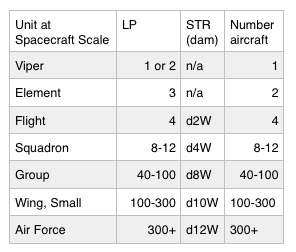
space units

One reason for using the spacecraft scale is to allow planetcraft to assault large targets and vice versa, and also brings the time and damage scales of fighters in line with the capital ships.

Example: A wing of raiders is lunched from the basestar and quickly aproach Galactica, the raiders break into several groups to attack the vipers screen — a groups’ worth (100), with three other groups going after respectively, 1) the civilian ships, 2) Galactica, and 3) acting as a defensive shield for the basestar.

Galactica is banging away on the basestar, but also has their point defense system firing on the raiders and their missiles. The PDS can be used as a defensive roll against the raiders’ attack roll, or they can attempt to destroy any raiders that breach it. (Due to the planetcraft scale, and the large number of PDS batteries, you don’t get a damage die, but you hit them at spacecraft scale with all Basic damage translated to Wound.)

Galactica’s weak air group (40) vs the raiders have equivalent life points and STR, and resolve the fight from the CAG’s tests (or the PC, if they aren’t the CAG…why? Because you’re in the credits.)

Now, if you want to give the PCs a bigger slice of the action, you could zoom in and break it down into the squadron they command, or even a single dogflight.

Remember that at 1/2LP, the unit loses -2 shifts to their strength (at d0W, they can only do 1W of damage to their target, no matter their success.)

MEANWHILE, ON THE SURFACE…

These rules can be applied to the surface, as well.

Infantry vs. Armor

One issue to content with is scale, again…infantry or characters are personal scale, but can gain access to planetcraft/large scale weapons like shoulder-fired missiles, satchel charges and IEDs, or anti-materiel rifles.

While you should resolve character actions by zooming in on their efforts, the general scale of the battle is set by the scale of the units involved.

Echelons

Echelon refers to a formation or the level (scale) of troops involved in a fight. Personal level fights are conducted by the PCs and perhaps up to a half dozen NPC. Anything larger than that is
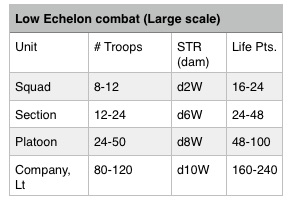
low echelon

But really large battles, need a bigger scale:
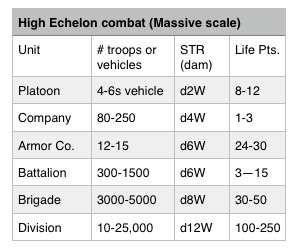
high echelon

Massed artillery exchanges with vehicle or personnel should be conducted at the Massive scale, due to the amount of firepower being talked about.
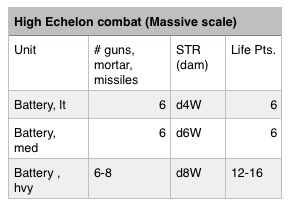
artillery

Low echeon battles take place over the space of minutes to an hour — each round of combat is the equivalent of 10 personal scale action rounds, or about a minute. High echelon rounds take place about 10 minutes/round. Keep in mind that high echeon battles have frequent periods of maneuvering or regrouping, that can be added into the overall length of the battle.

DAMAGE REPORT

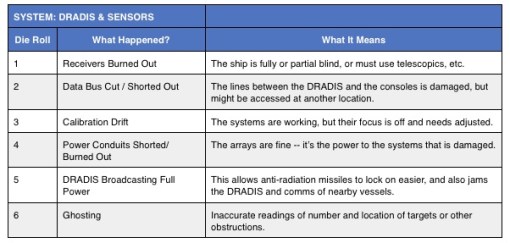
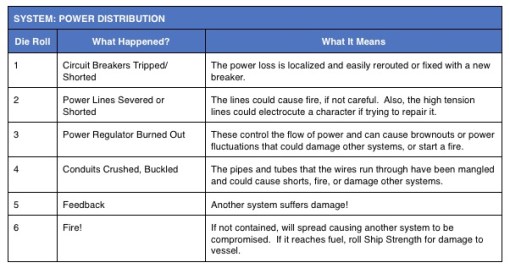
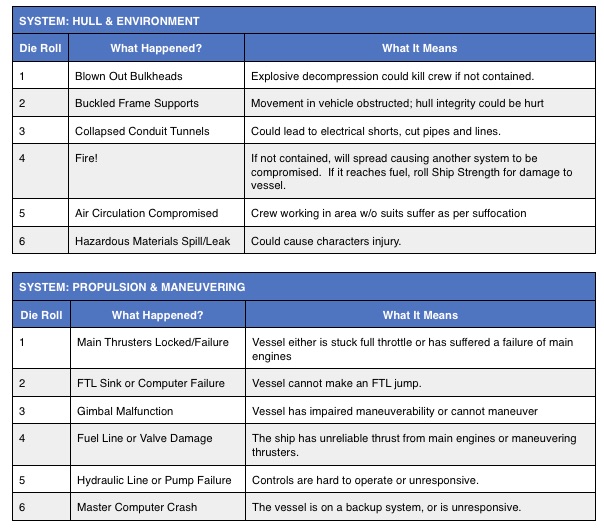
The original rules were not designed to address how damage could effect the performance of a vessel. To give players a bit more “crunch” and provide more flavor here is an alternate, expanded system for damage and repairs.  There’s nothing that says the GM has to roll on these tables or use the ideas, but they can provide some guidance for how damage could be handled in a space battle.

Instead of suffering effects at 1/2 the life points of the craft, damage begins to pick away at a ship or vehicle at 1/4 the damage, 1/2, 3/4, full damage, and greater than that damage.

Up to a quarter the total life points (round up), the vessel takes nothing more than cosmetic damage: scratched paint, dents, small holes to hulls or windows…nothing that is immediately harmful.

Between a quarter and half the total life points, the vessel is damaged badly enough that some systems could be effected — fuel lines could be holed, valves blasted open, power lines or hydraulics cut.  The effects are felt, but not seriously enough to stop operation of the craft.  Check to see what system is hit each time the vehicle take damage in this range to see what systems could be compromised.  Check the vessel’s ENDURANCE at Easy (3) and if it fails, apply a -1 die step to the appropriate attribute.

Between half and 3/4 of the life points, the damage is now serious enough to effect two systems at -2 die steps.  Check to see which systems are hit, and apply the modifiers.

Over 3/4s but less than full damage, the systems are seriously compromised enough that the vehicle now suffers -2 die step to all attributes, and an ENDURANCE test at Average (7) is made to see if the effected systems fail.  This can mean a loss of important function, like propulsion, or simply the loss of something like communications.

Once damage exceeds the total life points, the craft is on borrowed time, and the vehicle is coming apart around the pilot or crew’s ears…the ENDURANCE test Hard (11), but the results of failure are much more severe — the craft will start to come apart around them. The craft is dead and can take no actions.  They have one chance to “punch out” in something like a car or a fighter; in a capital ship, the craft takes 2W/round until the craft reached double it’s Life Points, then it has come apart, sank, or otherwise ceased to be a viable transport.

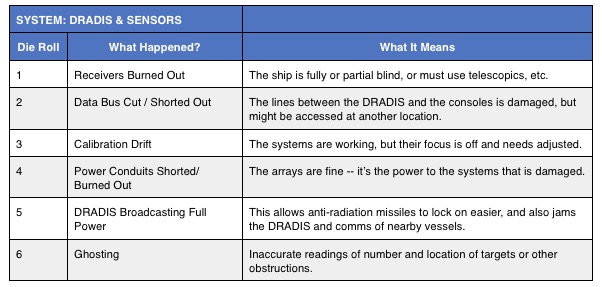
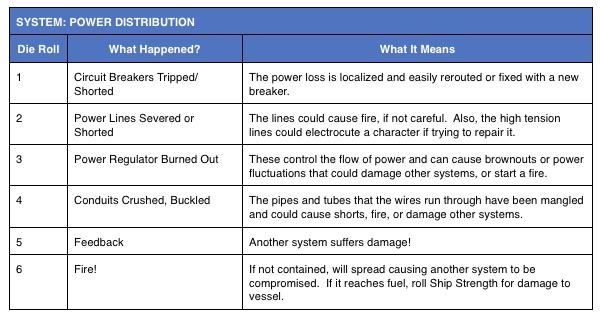
Here are some ways to determine systems that are damaged:

Stun damage is assumed to be minor — blown circuit breakers,  crashed computers,  cut electrical lines or hydraulic hoses — stuff that can be fixed quickly (in a matter of a round or two) or with jury rigging, if the system can be gotten to.
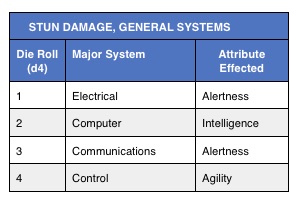
stun

Wound damage is much more serious, and might not be reparable without significant time (longer than a battle, for instance…)
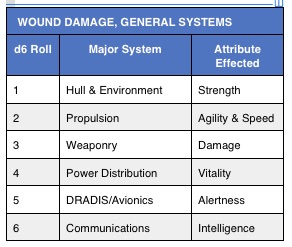
wound

Not crunchy enough..? Here’s a tighter breakdown for you…
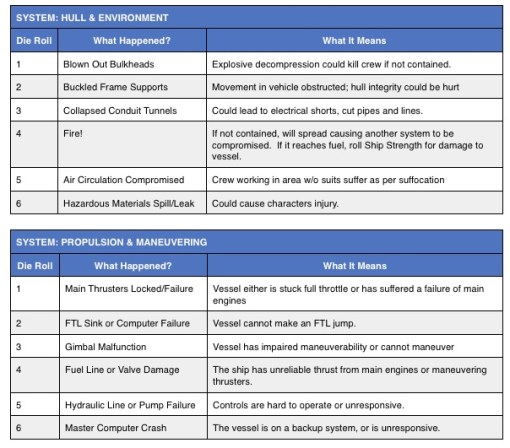
system 1

system 3

system 4

Repairing damage is as in the book — you run a repair test against the total number of damage the ship has taken.

These are still a bit rough, but if anyone runs them, or improves on them, let me know how they’re working.

« Previous PageNext Page »