Roleplaying Games


The United States Marine Corps is swapping out their M249 SAWs for the new M27 Infantry Automatic Rifle. It’s a gas piston driven 5.56mm NATO M4 similar to the FN SCAR and the H&K 416 (which this is based on.) Other than the piston drive  — which makes the weapon much easier to maintain and more resistant to heat, dirt, and other fouling — and full-auto rather than a 3-round burst function, it’s the same gun. The USMC is using both 30 round standard magazines and the 100 round Beta-C double drum.

PM: 0   S/R: 2/10   AMMO: 30/100   DC: I/L   CLOS: 0-15   MAX: 40-70   CON: n/a   JAM: 98+   DR: 3   RL: 2

GM Information: The M27 JAM is 99 for single fire.

Q Evaluation: The M27 represents the latest and best evolution of the M16/M4/AR15 platform, with a much more robust action (the gas piston similar to the AK-47) coupled with the accuracy of the 5.56mm round. There is some concern that this weapon represents a reduction in the firepower for a marine squad in comparison to having an M249 in the squad, but that is debatable.


Want to run Lovercraftian horror using the Cortex RPG system? Or any horror campaign for that matter?

COURAGE AND SANITY:
Central to the Chthulu games is SANITY…usually, if your character doesn’t get snuffed, they go mad. It’s not my cup of tea, personally; I rather like the possibility of success in a game, but CoC always felt like the point was to go mad in an inventive way.

So I propose the addition of another secondary attribute — you guessed it: Sanity! Like Life Points, Sanity measures your resistance to the horrific, tentacled menaces you might meet in a 1920s Spanish seaside town, or could be used for zombie post-apocalyptic games, or what have you. Sanity = Intelligence+Willpower.

COURAGE in the face of these horrors is tested using Willpower+Discipline/Morale vs. either a target number based on the nasty in question, the number of them, or the situation — I’m suck on a spaceship months from help and a acid-bleeding monster is killing my crew! I’d call that a Formidable difficulty, but your mileage may vary… Failure of a courage test results in Sanity damage…it is the equivalent of Stun in Life Points: past 1/2 damage to your Sanity and you’re so gripped with fear you lose the capacity for rational thought and receive a -2 die step to your attributes until you have time to heal (psychically.) Once below your Sanity rating, you have gone starkers and will require psychological treatment to hope to recover. Any damage after that has the chance of simply killing you out of fear: you roll your ENDURANCE vs. the damage: a success and you’re alive.

Recovering Sanity: Up to your Sanity in damage, you can conceivably recover on your own. You will roll a Sanity test once away from the monstrous occurrence causing you psychic pain vs. damage as with ordinary healing rules. Success and you start recovering a Sanity point per day (extraordinary success and it’s per hour.) If you surpass your Sanity, you can attempt to recover yourself, but the time frame is a month/point recovered. Psychological treatment can aid in the process.

The slippery slope: each time your Sanity dips below the full rating, you lose a point of Sanity. This can be mitigated by buying up your Intelligence or Willpower stat. Once your Sanity rating has been reduced below half it’s rating, you must take a Complication — a physical tick that afflicts you, a phobia, the Unstable complication…something to show you’re not quite right anymore. If reduced permanently to 0, you are irrevocably insane. At this point the character is unplayable.

CORRUPTION — Lovecraft was something of a Luddite, who saw scientific exploration as frightening and ultimately destructive. Knowledge of the occult is an analogy for science in Lovecraft’s Mythos: the more you know, the more corrupted by it you become.

A character that takes Knowledge/Occult is well kitted out to fight the evils from beyond this dimension…but the knowledge of that infests them with evil — they are not quite as sane, not quite as good as they once might have been. The die rating of the Knowledge can be applied to the difficulty of Courage or Resistance (to their foul lures) tests when facing the evils awaiting you.

Alternately, the GM could require that “real” occult knowledge be bought as a Trait (Uncommon Knowledge) with a Corruption complication that is equal to the knowledge and that corruption counts toward the difficulty of Courage or Resistance tests in the face of whatever they’re investigating.

Life on a battlestar is primarily one of routine. Training drills, physical exercise, work details — all are scheduled in such a way that the Colonial soldier has something to do most of his or her day. Here are a few things that one can expect:

WATCH SYSTEM

All colonial vessels run on a watch system — six four-hour blocks of time. Most vessels will run a 4 hour on/4 hour off/4 hour on/ 8 hour off watch for their divisions — usually three (first, second third; or blue, grey, and green [the colors of the service]; or some other color designator.) This means all divisions rotate through the business day and night throughout their service.

The 4 hours “off” in the middle of the day are ordinarily used for personal matters — including meals, and/or administrative duties or requirements (like urinalysis for drug use, report writing, classwork, physical fitness training, etc.) The two “on” watches the personnel are at their scheduled posts.

WATCH NOTICE

At each watch there is a “watch notice” or “action notice” posted to inform the crew of changes in duty roster, any pertinent information that they need to know like uniform of the day, new directives or regulations, and the like. They are posted throughout the ship and often read over the intercom at the beginning of watches or sometimes simply the changes are read.

Speaking of…

INTERCOM

This frakking thing never shuts up — morning, noon, night — there’s an announcement: do not radiate equipment because of EVA on the hull, vessels being recovered, vessels being launched, pass the word for the [insert name or title], action notice changes, reveille…the intercom alert tone is always going off on a battlestar.

PHYSICAL FITNESS TRAINING

Enlisted crew train together by division and by compartment (for instance, 3rd division portside maintenance crew, 1st division sickbay crew, etc.) They are ordinarily called together in the middle watch of their shift (the “off” shift) for their PT at which time their officer in charge or NCO in charge will take attendance (the “report”), then lead them in exercise. Officers like pilots, etc. often train together separate from the enlisted, or individually if their PT scores are high enough. “Remedial” PT or “fat boy” PT is usually every day, while normal PT is every other day.

Ordinarily, the compartment will find a place large enough for the massed personnel to conduct PT — the flight line, a causeway that sees little traffic, or a cargo hold. Sometimes they will break down to squads or teams so that they can find more usable space. There are weight rooms and gyms on the vessel, but usually these are snagged up on the schedule by the pilots and senior officers and enlisted.

Crew test two times a year to see if they meet the criteria set by Colonial Fleet HQ: a certain number of pushups, sit ups, pull ups, and a 2 mile run (usually conducted on the flight line or on the longest straight corridor or accessway available.) Scoring is by age groups, getting easier as the crewman gets older. CMC requirements are higher than the normal fleet, as are pilot standards. Males and females are required to achieve the same minimum, but scoring is easier for females in the upper body categories beyond that — a point of contention for most of the males in the fleet.

CHOW/MEALS

Meals are available 24 hours a day at the mess halls. There are several throughout the vessel, so that the crew do not have to travel too far from their work stations. Serving the food throughout the day allows for larger batches to be made and cuts down on spoilage and prep time. There are general mess halls for anyone in the crew, and officers’ messes for the officers. There is also a “chiefs mess” that is for the senior enlisted only. Invitation to the chiefs mess is considered a great honor for the officers.

Crew eat as they can.

FITREP (FITNESS REPORT)

This is the twice yearly review of the crewman’s performance. It’s damned lucky if they get done more than once every year. Crew are rated on their physical fitness, their work performance, any commendations/reprimands, and other aspects like doing outside training to improve their readiness.

Bad FITREPs can get a crewmember bounced from service at their reenlistment. Often they will be honorably discharged, but “other than honorable” is also possible. Dishonorable is reserved for serious attitudinal problems or criminal behavior. Even honorable discharges can be barred from reenlistment if they are deemed unable to adapt to service life.

FRATERNIZATION

It’s against the regulations, but everyone knows it happens. Crewmembers will flirt, make friends, and have sexual relations with each other. Among the enlisted, so long as there is no perception of impropriety or favoritism, command will look the other way. In the case of romantic relations, the two are usually reassigned to different divisions or work gangs.

Fraternization between the enlisted and the officer corps is a serious offense. It creates an atmosphere in which good order and respect for the officer tends to break down. (One can hardly expect obedience from the partner in last night’s debauch!) Officers are the ones that bear the brunt of this breach of protocol and can be court martialed for it. Enlisted rarely receive more than a reprimand, as the fault is expected to lie wit the officer who is in a position of power.

Relations between officers is handled much the same way as with enlisted. If it does not present a breakdown in the chain of command, it is grudgingly overlooked.

Realizing the realities of service on a battlestar, Colonial Fleet strongly suggests the use of contraceptives for servicemembers, but only requires it in time of war.

TRAINING

This is a constant in the service — from launch and recovery drills, to fire fighting drills, to combat and gunnery simulations — battlestars are usually engaged in some level of training. FTL training is a bit rarer — most battlestar groups tend to stay in a particular region of the colonies, but will do jump operations a few times a float.

“FLOATS”

Most battlestars will stage operations or maneuvers, called floats, two to three times a year. These floats require train-ups for the train-up for the training for the float. Once on maneuvers, a battlestar group is ordinarily on patrol or doing major combat exercises for two to three months, depending on the size of the exercise. There is TRAINEX (Training Exercise) AEGIS every six months, in which on of the battlestar groups will be pitted against Picon OPFOR (Opposition Force) — a group that is considered the best-of-the-best, as they train near constantly. OPFOR is often the full force, or a slice, of battlestar group Atlantia, and the exercise area or “box” changes every few years and the scenario is usually the training battlestar group vs. OPFOR as Cylons. For a few years prior to the Fall of the Colonies, OPFOR often played the role of separatist groups or pirates, rather than Cylons, showing the changing focus of the government and fleet in those days prior to the attack. No one really expects to win, and it’s the rare ship or group that does…but it can happen.

Between floats, the battlestar group will head into orbit to maintain guard of a Colony world, or put into spacedock for repairs and refit. Leave is only given when a vessel is not on maneuvers, and often not during the train-ups for maneuvers.

EXPECT THE STUPID

No matter how well-trained and run a vessel is, the crewmember can expect to run into stupidity. When reporting aboard a new vessel, the crewmember will be expected to learn the history of the vessel, learn its individual rituals, holidays, and other miscellany. There will never be a quartermaster around when you need bedding. The armorer is unlikely to be found during his “off” watch (the same goes for the mail room guy!) You have a boat full of young kids who often will get into the most obvious bits of trouble — setting up a still, smuggling contraband aboard, getting into relationships they shouldn’t, getting into fights over the same (or nothing), and doing mischief.

The same goes for your equipment — it’s the best the cheapest bidder could provide. 10 bit fuses go out and leave whole frames of the ship dark, or trip an O2 sensor and lock you in a room for no reason. Munition hosts fail with spectacular results, and that damned phone cradle won’t hold the phone for some damned reason, no mater how many times the maintenance crews fix it. Should there be security cameras everywhere? Sure, but there’s not enough money or they couldn’t get enough of the things, or somebody forgot to rig the units during the ship’s construction. Sometimes, things just aren’t the way they should be.

You can complain about it — in fact, that’s another constant: bitching and tall tales telling — but who would listen?

EVERYBODY’S GOT A STORY

Life in the service is routine and boring most days, so people gab to make their days interesting. Sometimes its BS stories that never actually happened, but have come to be accepted as “truth”. Sometimes its gossip. Often it’s complaining when the chief and the lieutenant can’t hear. Most of your day is spent doing mundane tasks and bleating off with your mates.
Just a disclaimer right off the bat: I was one of the writers on the first edition of Victoriana, and some of my stuff has survived into the second edition. Also, I’ll be writing for Cubicle 7’s version starting with a new equipment book. I’ll be reviewing the PDF version of the book:

Victoriana is marketed as a steampunk/fantasy setting, but it’s really more of a early industrial period fantasy setting. A lot of the early material had a “Shadowrun transposed into the Victorian period” feel to it — the use of the classic fantasy races, the lower orders versus the evil corporations(or in this case the imperial government…and corporations.) The science fiction/speculative fiction elements of the setting are downplayed in the core book in both the first and second editions, leaving it up to the GM and players how much technology they want in the game. The lack of “steampunk” (a term I hate, but it’s ubiquitous enough I’ll have to deal…) seems to be one of the major complaints about the universe, but I’m glad to say it’s being addressed in an upcoming sourcebook, Marvels of Science and Technology.

The second edition tossed the Fusion engine that the original had borrowed as it’s system and has moved to a dice pool mechanic. The basics: you roll the number of dice equal to the attribute and skill that is applicable. 1s and 6s count as a success. The GM rolls “black dice” with those successes counting against the successes of the player. (Example: Rory the navvie is trying to lift a chunk of stone. The GM decides the heavy rock is a difficult task. Rory rolls his 2 dice in Strength and 3 in Athletics and gets 3 successes. The GM rolls the 3 black dice for the difficulty and only gets one success — Rory has 2 successes, hiking the mass onto his shoulder.) Fate dice and points work to alter the results of your rolls.

Combat uses the same basic mechanic: Roll initiative and combat tasks as opposed tests — the player and their opponent rol their applicable attributes and skills and the one with the higher successes wins. Damage is rendered by the number of successes (weapons add dice for the test) against one’s health. Armor counts against the number of successes: hit someone for 4 points but they have armor of 2…? You did 2 to their Health.

Magic also works the same way, but cost the character “manna” — spiritual energy to use spells.

Character creation is relatively easy, although there’s a “rank” or level system that I found extraneous — but not onerously so. The character gains experience points for use to buy skills, assets, privileges, and talents; there is another set of points that are given to improve the characters’ “rank”. All players start as beginner characters, at level one and can rise to 20.

Overall, the look of the book is nice — grayscale watermarking and art of decent to good quality, along with some Dore prints from his London works. The cover is done up to look like embossed leather. For the style, I’d give it a solid 4 out of 5. For substance — the world’s history, politics, and the class system of England are well rendered, as is the magic system. There are some issues with the alternate history; some of the altered events aren’t explained, and when doing alternate history it is a good idea to have a reason for the alterations. Overall, substance is excellent — 4 out of 5. The system is solid, easy (although if skimming it comes across the opposite), and the background is crunchy, if lacking in the steam side of the equation.

If you like your Victorian settings more fantasy than science fiction, it’s a definite buy. If you’re a steam fan, you’ll be a bit disappointed (but not for long!)

There’s already a slapdash set of mass combat rules here on the Black Campbell site, but here’s another take to make the character’s respective actions more synergistic.

During a combat round, play is broken into initiative, the actions of the players/NPCs, then a final combat action by the respective commanders for morale.

Initiative is as in the core rules: the commanding officers roll their Alertness+Tactics in an opposed test (Cylons would use the basestar’s Alertness and Perception ratings if there’s no specific commander.) Winner goes first.

The commander then rolls an Alertness+Administration to see how well managed the ship or squadron is — the CO can pass off elements of this to other players. For instance, CDR Adama is overseeing the battle as a whole: his test, if successful, lends a skill dice step to his subordinates. He’s had COL Tigh take over damage control — he rolls the same ALE+Administration to give a dice step to the men under his command for making repairs (a fumble gives a -2 step to the DC teams as they are now uncoordinated.) CPT Adama is given command of the fighters and makes a ALE+Tactics test to aid the fighter pilots in their work.

The players now get to take their actions — Tyrol (or if there’s no PC, the ship Intelligence+Mech Engineering or Tech Engineering vs. damage suffered.) Starbuck takes the step Apollo gave for a successful tactics and slays a few toasters. The gunnery crews under another PC fire using his INT+Heavy Weapons skill with the step from CDR Adama.

Damage to the enemy ships is calculated. The fighter squadrons can be rolled as a unit, if you want — for simplicity sake, say the lead pilot can roll his AGL+Pilot v. the Cylon raider with a die step going to the attack or defense of the side with numerical superiority. Attacks by fighters on capital ships could be resolved with using the lead pilot’s skill v. the capital ship Agility or an EASY difficulty if in skirmish range, roll the damage of the vehicle with a step for each squadron attacking, then divide by 10 for the scale.

Next (or if the won the initiative, they went first) the Cylons do their worst, as per the rules.

Say all three PCs’ tests were successful: now the old man tests his WIL+Discipline to maintain the morale of the crew with a +3 die step (one for each success of the PCs). A failure will result in a -1 die step on the attribute of the NPCs and PCs on the next round of action. A success and the ship continues to fight well, an extraordinary success lends a +1 step to their skills for the next action round.

Do Cylons have morale? Depends on whether they have a resurrection ship in the area, doesn’t it?

It’s quick and very spitball, but it should work to allow the characters to have an effect on each other’s actions. It should also be applicable to ground forces with a bit of tweaking.

Looks like I’ll be writing for the Victoriana line again, starting with their upcoming Marvels of Science and Industry. I’ll be doing the vehicle and weapons chapters and some of the rules.

1) STEAL! All the best authors and artists have done it — they either call it an homage (think the Great Machine or the even the Shadows v. Vorlons metaplot of Babylon 5 [Forbidden Planet and Lensman respectively]) or a re-envisioning (everything friggin’ thing Shakespeare or John Scalzi wrote)…

You want a terrifying monster on your spacecraft light years from help? Alien…doesn’t have to be that particular alien, but you get the notion. Maybe you want that particular beastie in one of your campaigns…they’d drop into a Mythos campaign rather nicely, I think. Want a slightly run-down but noble contract pilot with a one eyed dog for your pulp campaign? Nothing says he has to be called Jake Cutter (but he is in my pulp China campaign…) You want to do a 1980s cop show with hot cars and clothes? You know where to steal from…just do it.

Steal ship designs from games you like. If I ever get around to my homebrew sci-fi setting, I’m using the ships from Jovian Chronicles. Steal guns — the pulse rifle from Aliens or the BFG Deckard has in Blade Runner jump to mind for your sci-fi or cyberpunk campaign; I stole the Tachikomas from Ghost in the Shell for my Serenity campaign (minus the cheery voices, but after thinking about the Fruity Oaty Bars commercials…) Steal characters and modify them; rename them if you like. I’ve used a variant of Sam Elliot’s character from the not-great but fun Shakedown in Bond games for 20 years; more recently I used his character from Avenger wholesale. (’cause Sam Elliot can rescue almost any scene, if not a movie…)

The real gold mine for stuff to steal — especially if you have a square like me in your group that doesn’t do computer or console gaming: video games! Dead Space, Mass Effect, L.A. Noire (man, this one’s almost enough to get me to buy an XBox360…), etc. These are great for set pieces, alien races, characters, ship, etc.

2) REUSE…or steal from yourself or other campaigns you’ve been in. I reuse plot lines all the time — some without modification, some with heavy alteration. I and other reuse characters. My ex-wife played a variant of her first character from an old Bond campaign in subsequent campaigns, in a Stargate campaign, in a superheroes campaign. Others have used the same general character tweaked and renamed — Jed Callahan is always the acrophobic, wise-talking inventor/ gunsmith/mechanic who likes guns way to much, and manages to get himself into trouble at every turn (and the rest of the players with him.) He started out as a Car Wars character, became a superhero character whose only power was he couldn’t die and healed very quickly…otherwise, normal. He was in an espionage campaign or two. He showed up in a sci-fi game.

3) [Insert name of series here] RE IMAGINED! They did it with Batman, James Bond, Battlestar Galactica  and you can do it, too. Have an old campaign that died on the vine with one group? Revitalize it with the new group. Or have a look at how you want to change the tone — the new espionage campaign I’m running, The Professionals, is similar to the last Bond campaign — a super-elite group that fights bad guys around the world. Last time, the characters were CIA, and were the honest and true guardians of America fighting bad political decisions and getting slapped around for it. They couldn’t operate legally in the US, but sometimes had to. It was more Sandbaggers than James Bond.

This time, the group is a test program — an interdepartmental task force that has sworn Secret Service agents and CIA special action team members on it, and is co-operated by the National Clandestine Service and Department of Homeland Security. Are they legal? Well, Eric Holder says so, but it remains to be seen…they have a short time to prove their worth to the law enforcement and intelligence communities, and to make the various directors look good. It’s one part The Shield, one part 24, and one part The Unit…they’re not always right, they’re rarely pretty, and the piss a lot of people off. But they get the job done (so far…)

I’m thinking about firing up a version of the Gorilla Ace! campaign that had so much potential before that gaming group blew up. Maybe it’ll fly, maybe it won’t — bu the idea was too good to let die & I need a filler pulp game for the time being, as my wife is out of rotation for the next few months due to baby and work scheduling.

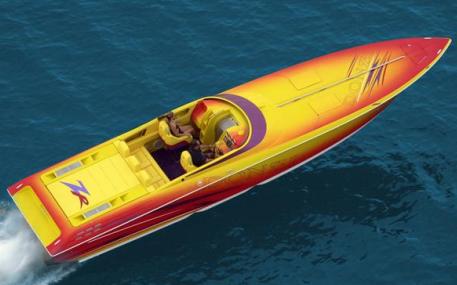
Starring in the next starting teaser for an upcoming mission is the Donzi 38 XR Competition powerboat:

Donzi’s 38 ZR Competition is a water-going sports-car: It’s fast, nimble and sleek. With five bucket seats and a couple of stowage lockers in the deck (think of it as a long hood), it’s a little more roomy but not much more than the average sports car. With its engines cranking out 5,300 rpm, the 38 ZR Competition reaches 112.5 mph; cruising is 83 mph. Time to plane with the tabs down is 5.8 seconds, and from a standing start the boat reaches 77 mph in 20 seconds.

PM: +1   RED: 3   CRUS: 80   MAX: 112   RNG: 350   FCE: 3   STR: 13   COST: $500,00 or more

GM Information: Gains a +1 to quick turn maneuvers.


(…and that title’s what happens when a 40-something Celtic guy tries to be hip.)

One of my players is getting ready to fire up a pulp campaign where I will actually get to play! (Whoo!) We had also discussed a superhero campaign where we could trade off GM responsibilities, similar to what I had done with a former gaming buddy in the late 1980s. That got us to discussing the merits of various RPG rules sets — a discussion that spread to the other gaming group.

It’s easy to forget how primitive RPGs were in the early days. They were an extension of war-games, and the heritage showed in things like Dungeons & Dragons, Gamma World, and other early settings. The rules were almost completely given up to combat simulation and movement, and roleplaying was really an afterthought.

Traveler, James Bond: 007, and other non-TSR systems tried to break this battle sim feel with more fleshed out character simulations — skills, weaknesses, etc. — and while there might be rules for seducing the femme fatale or car chases, in the end, the fists, blades, or guns came out.

The one thing that was central to these rules sets was the position of dungeon master or gamester…the DM/GM was the one that came up with the general world setting (or managed it, if it was a licensed setting), the players ran the characters and worked their way through scenarios of that person’s devising. Ultimately, the GM was the arbiter (although plenty thought of themselves as “god” at the table) of what happened, and tried to set up the adventures so that the players would be entertained, surprised, etc… It’s a position for a storyteller, but also someone who can juggle lots of tidbits of background material, flesh out NPCs on the fly, and otherwise manage a group of people.

In the 1990s there was a strong push to get away from combat as the raison d’être for characters to do things: romance was played up in the White Wolf line and in Victorian “steampunk” settings. Characters’ flaws, motivations, and allegiances became more important than their +2 sword of impressing girls. I, as a storyteller, loved this trend and it fit well with my notion of GMing — combat was not always the point. (In fact, for some settings, it’s to be avoided at all costs! Dead people attract attention…not good for thieves or spies, or pretty much anyone looking to avoid a trip to the local prison.)

Now it’s normal for the combat section of a game to be subsumed into the general task resolution rules (with some expansion for various combat specific mechanics.) Some systems have done away with damage — the new Cortex Plus for Smallville uses “stresses” from emotional to relational to physical. It’s a nifty idea and one that I’m intrigued by, other than the massive bit of book keeping it appears to make for the player to keep track of.

The other trend, and one that I’m not on board with the new hotness is the shift from a GM that acts as arbiter to a communal or troupe style of storytelling. Maybe it’s because I’m a control freak or I like to be the center of attention — this is all entirely possible. But having discussed it with my players, there seemed a consensus that the idea of everyone pitching in to create the environment and plotlines ala Primetime Adventures or Smallville was intriguing for the amount of input it gave the players, we all thought that it had a serious weakness — consistency and coherence.

Think of it this way: If every TV show, book, movie, etc. could have it’s universe tweaked to your liking, every plot could be crafted to what you wanted to see, every outcome was decided by the player should they succeed…there is going to be certain lack of coherence due to the “wouldn’t it be cool if?” factor. Even in the most interactive of media, computer RPGs, the player can alter the course of events but their decision tree is small and the outcomes they lead to smaller still — computer RPGs do exactly what critics of GMs who “railroad” complain of: they design the decision trees to provide a false sense of empowerment; ultimately, what you do will lead to one of a preset number of outcomes, unless your GM runs their games completely impromptu (and those that do, when they are good, are great!)

There is also a tendency to less cohesion in the plots, the story arc (if there’s one at all), and in the universe itself. Think of it this way: in the 1970s and 1980s, most TV shows were serial and their stories were contained in the events of the hour. Perhaps some characters might reoccur, some stories might resurface for another episode or two, but by and large, each episode was it’s own universe. The characters were general consistent, but might be completely miswritten to fit the story being presented (what I think of as the bad sort of railroading — the “it’s in the plot” railroading.) The shows that were consistent, where the characters remained true throughout, where the story arcs made sense, where the universe was consistent and coherent, relied on a smaller number of writers, more empowered producer or show runner input (think Babylon 5 or Hill Street Blues.)

Troupe style RPGs are Starsky & Hutch, or even Mork and Mindy; games where there’s no GM, rather than a new-agey facilitator, are more like Babylon 5. I’m a big fan of having a single central vision, altered and made the players’ own by their actions — nothing good comes of the GM that is playing to himself with the rest of the table as the audience.

So I guess that’s all I’ve got to say on that.


Discuss.

Here’s an idea that was suggested by a player a few months back near the end of our Battlestar Galactica campaign. He was suggesting that all the time he was giving to certain maneuvers (in this case, touch & gos to prepare for combat landings) for training his vipers should pay off with either a bonus to their skill die or a modification to the difficulty of a task.

Hard skills get easier for people — dirt bikers practice certain kinds of jumps over and over again ’til they get it right, but you still see them drop their motorcycles from time to time on the dead simplest maneuvers; freerunners do amazing stuff, and certain jumps or tricks they do so well they look effortless, but others they flub regularly; navy pilots practice landing and takeoffs on aircraft carriers over and over because they’re hard…yes, they get better overall, but some maneuvers have just been drilled into them; shooters on the firing range can drill sub 2″ groups with their pistol or rifle, but put them in a fluid, moving environment and they don’t do as well (and some people shoot action drills superbly, but can’t group standing still worth a crap.)

So how to reflect this? If your special ops team or spy does a lot of indoor range practice, they might gain a benefit when they have the time to take up the right stance, aim, and shoot. Your viper pilot might ace combat landings on their battlestar after months of practice while running from the Cylons or is particularly adept at a 180 roll or yaw that puts them flying backwards to fire at something in their six. Say your researcher is very good at combing through archives in a library, but they don’t do search engines too well… Maybe your archeologist/adventurer has practiced snagging objects and swinging over chasms with his whip multiple times, but snapping a cigarette out of someone’s mouth is a new trick…these characters might get a benefit for something they’ve repeatedly done in game, or that had been a stated part of their regimen of training. If it’s not something they practice, no benefit.

« Previous PageNext Page »