Hasbro announced that they’ll be bringing out a 5th edition Dungeons & Dragons only a few years after releasing 4ed. I don’t really have skin in this particular game — I don’t play fantasy settings, so I haven’t played in a D&D game since 1993 or so. However, I am aware of the absolutely insane response to the release of 4th edition — friends apparently not talking to each other, game groups breaking up over whether to play 3rd or 4th edition. It’s the sort of thing that makes we gamers look the nutbags we are portrayed as in media.

You don’t like one system? Don’t play it. You have players who want to play one edition or the other, compromise.

I will admit I was unimpressed wtih 4th edition (and more specifically the Star Wars Saga Edition.) I found the mechanics looked to be trying to emulate the RPG video games, rather than emphasizing role playing. But that’s my opinion; you may feel otherwise, and please do. Here’s the kicker: I don’t like 3rd Edition either…in fact, I think d20 is a terrible set of mechanics in general and its the reason I don’t do D&D oriented material here at Black Campbell — I don’t play it, so I have no opinion one way or the other. Additionally, there’s plenty of sites dealing with fantasy-based settings, so I target old, dead systems and settings that aren’t as typical for RPG blogs.


Last night was our weekly game session, this time part 2 of the episode 3 of our Battlestar Galactica campaign. In this, the characters’ vessel Aegis arrives at Sagittaron with the mission to protect an archeological dig and the scientists there from fundamentalist terrorists who want the planetary government to arrest them for blasphemy and suppress their findings. (They have found the remains of a modern city that would have existed 8-10,000 years before Colonial settlement!)

The characters shuttle down a small marine detachment to provide protection, as well as the ship’s chaplain and commander — who will be negotiating with the local government to try and sort the matter out. One of the issues — Commander Pindarus’ father, a famed vet of the First Cylon War, helped suppress a serious general strike 20 years ago…his family name is not a benefit here. They are escorted to the Colonial military base outside of the capital to avoid possibly being shot down by insurgents. On the post, they find out Colonial servicemen are asked not to leave the post, and when they do to travel in groups for their protection. The commandant is adamant about respecting Sagittaron customs off-post; they are looking to avoid another attempted bombing on the place.

The meeting between the First Secretary of the Sagittaron Planetary Quorum and Sagittaron Security Minister went well, although the presence of the spiritual leader of the  Sagittaron Freedom Movement (Tom Zarek’s “defunct” terrorist group) threw a wrench in the works. Pindarus essentially lies to them: they’ll suppress the findings and get the archeologists off planet when their funding runs out in two weeks, and hints that he’s willing to leave it all in local hands, so long as they don’t pop the trigger on the blasphemy charges…the meeting goes well.

Meanwhile, the military protection detail, in civilian clothes, talks their way past a couple of road blocks by local thugs to the dig and set up security, instructing the scientists on how to act, should they be attacked.

The next morning, Pindarus and his brother-in-law (the priest) head out to the dig site and their convoy is attacked in a rather expert way. They lost a few NPC marines that were guarding them, but all the characters got away with minimal injury. The fight sequence was tense until the lieutenant in charge of the dig site security and a couple of PC NCOs arrived to aid them. They have two prisoners they evaced to the ship (breaking a promise to the commandant of the military base not to fly outside of prescribed areas of operations.)

Pindarus is now going to use this to excuse military action to protect the dig and put pressure on the Sagittaron government — which is obviously looking for the easy way out of the issue — to help them shut down the splinter group that has been threatening the dig.

Next week, we’ll be seeing interrogation, politicking, and more trouble for the crew…

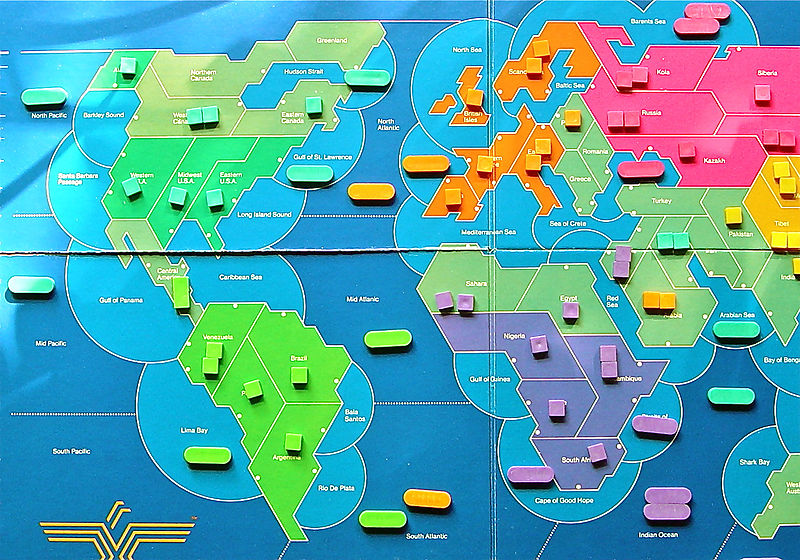
This is another from the oldie but goodie category. Easily my favorite strategy game of the 1980s, Supremacy was a high-complexity board game in the style of Risk. The players chose a bloc that they controlled — Europe, America, South America, Russia, etc… The game includes an economic track that allows the player to buy and sell resources, or use them for their military. You can build armies, navies, and most powerful of all — nuclear weapons and weapons satellites. The player’s territories provide them with resources per turn, and playing the market can be very important in your ability to keep your fighting forces active and to keep yourself flush.

We often found that players would collude in market manipulation to profit from resource trading. Many would reflexively avoid using nuclear weapons, as 12 of the sinister black mushroom cloud figures on the board means everyone loses (MAD.)

Here’s the board:

There were some good expansions that included submarines and “fortune” (natural disasters, etc. to help keep the market moving), and a few that were less useful (including massive maps and larger units for the wargamers who didn’t like dealing with child choking hazard-sized pieces.)

Some black mushroom goodness:

The goal is to either eliminate the opponent through conventional or strategic war, or bankrupt them through economic means. The average play time is between three and six hours, depending on the number of players. This is not a “hey, let’s just bust out a board game” sort of thing; this is a “let’s spend the day playing Supremacy” sort of thing.

To my knowledge, Supremacy Games is defunct and this is no longer produced. If you find it on eBay, or someplace, it’s a good addition to the pile if you are a board gamer. It’s stuck firmly between the light strategy game of Risk and the heavy sims of SPI and other wargames.

Maybe it’s staged, maybe it’s not…either way: pure awesome.

This month’s RPG Blog Carnival is being sponsored by Keith Davies and revolves around the idea in the title: Fantastic Locations.

Creating compelling locations for your games isn’t much different, in many ways from set location scouting for a movie: you want to find something that will grab the attention of the players and imbed the action into their minds. Even better is if the location pushes the action, as well.

At the “strategic level”, I like to start plotting an adventure by deciding where it will take place. For modern espionage, I like to follow the James Bond school of location scouting — pick a few major locations for the action to occur. For instance, in Die Another Day, the action sequences take place in North Korea, Cuba, London, and Iceland. For a Star Wars game, you might choose Coruscant, Tatoonie, and an asteroid field on the Rim. In periods where the transportation is slower, you might want to just fix on a certain general location: Tombstne, Arizona in a western, London and maybe it’s environs in a Victorian setting.

Once I’ve got the general place, for modern games I look for interesting buildings, scenic locales, something that will “look neat” and fit a predetermined action sequence or allow the place to set the action for me.

Cases in point: In a modern espionage campaign, say the heroes have to raid a high-rise office park — how do they get in? Do they rappel from the roof, climb the outside of the building? (There is a hotel in modern Shanghai I desperately wanted to use because it was a spectacular set piece for this sort of thing…some day…) For a sequence in my recent Hollow Earth Expedition campaign, I envisioned a multi-level restaurant with lots of staircases, intervening balconies, hanging lights, etc — perfect for the climb all over the damned set style of chop-socky fighting I wanted for the sequence. There were koi pnds to knock villains into, flaming kebab spikes to impale them on, lights to swing from level to level…everything was there to be used as cover or a weapon. (Think the big gong in Temple of Doom…why was it there if not to hide from Tommy gun fire? Or any Jackie Chan flick — the location is central to the stunts and fights going on.)

The description doesn’t have to be that extensive to set the atmosphere. You’re in an abandoned steel plant…it’s nearly dark and the catwalks and ladders between the levels throw shadows everywhere. Abandoned equipment lies dust covered and cobwebbed — shovels near the coal bins, tools here and there…. If there’s something you want the characters to notice, highlight it: …footprints in the dust lead you under the massive cauldrons that would drop molten metal. Chains rattle slightly from the rain that is coming through broken window panes in the roof, as you avoid a stand of metal poles that were used for whatever purpose (and maybe they notice one missing?)

Here’s a few examples from different eras of settings that have worked for me:

The working Victorian steel mill — nothing like molten slag, moving equipment, and the hazards of fire to get the players’ blood boiling. Dodge the kids and workers while chasing the villain over and around dangerous gear.

“Ridleyville” — when you need atmosphere at night, make the street slick from rain or recent rain and throw in a little neon to throw distracting shadows. A venting steam pipe or grate doesn’t hurt… You can even had Ridleyville inside a spacecraft (see Nostromo from Alien.) I’ve used this a lot for my 1930s Shanghai. The smell of crap from the nightstools doesn’t hurt, either.

A foggy hill in the woods, near a running stream (preferably winter time to throw breath, etc.) and the villans hidden in the mist. I’ve used this for my China campaign in Hollow Earth Expedition (fighting warrior monks) and in a Battlestar Galactica game where they could hear the toasters but not see them.

Craggy snow-bound mountains with loads of moguls and trees to have a ski/snowmobile chase through. And of course that big chunk of snow a few hundred feet up the slope is coming your way eventually…

The dimly lit pumping station wit lots of metal grate catwalks and steps to give you “spooky” lighting. This works for sci-fi, modern day, horror… I used this for a Supernatural game in which the heroes were hunting a werewolf. Fighting in tight spaces, with lots of metal guard rails to bang off of, water on the floor, the hum of the pumps to disguise movement, not to mention big spanners for weapons, fire extinguishers, etc…

Cliffs are always good. Cliffs are scary. Cliffs with waterfalls or snow, or loose earth are even better. A really good use of a cliff as a weapon? For Your Eyes Only. Kick that henchmans car that is holding on the edge by a tire or two into the ocean below. He was a bad guy, anyway.

Airplanes are great set pieces. They are a tactical nightmare when loaded with innocents. You have very little room to move, and there’s the danger of breeching the hull (which with a handgun or rifle really isn’t going to do much unless you clip a control line or bounce one into the engine. Some have big droppable gates at the back end so you can get tossed into thin air.

Boats are even better — most have a few decks and loads of stuff to destroy or use in a fight. Yachts are nicely lit but you’re still a bit cramped belowdecks. The engine rooms are a wealth of injury-inducing stuff. Cargo vessels are badly lit with tight companionways, big cargo holds full of stuff to climb on, fight around. Military vessels…well, you get the picture.

For things like car chases, the terrain can be very important. Try have a high speed chase on the crowded, very twisty roads int he Dolomites of northern Italy: hell, they couldn’t even transport an Aston-Martin Virage safely to the set of Quantum of Solace. When in doubt, drop a big Indiana Jones style cliff in…even when you’re driving along the flatest chunk on Egypt as in Raiders of the Lost Ark. If they’re having fun, the audience won’t care.

Cars in a chase can be your locale. Think the tanker from The Road Warrior — there’s a lot of action going on just on the rig itself. Or any western involving a stagecoach — runaway or otherwise.

When picking your settings, look for something to spice them up. You don’t need a monster or clever trap to make a cave complex dangerous (but it helps) — spelunkers can tell you they’re damned hazardous all on their own. The point is to have fun with it, and make sure the method of the character’s salvation is part and parcel of the danger they are in.

Back in 1986, Milton Bradley gave us their “Gamemaster Series” of “light” wargames. Unlike the high-complexity stuff you would have gotten from SPI or other wargame manufacturers, these were low-complexity rules that supported high-complexity strategy fun. Easily my favorite of these was Shogun, later renamed to Samurai Swords to avoid copyright issues with James Cavell’s novel and a game based on it (the most recent version was called Ikusa.) There’s a whole backstory of whuy the name changes, who owned the game when, etc…but we’re interested in the play:

The game consists of a large mapboard of Japan, broken down in to provinces which have corresponding cards to show ownership. Players split the cards evenly, populate their provinces with a spearman. They also get three armies (represented by a daimyo figure that corresponds to the army on another small army board. They also get a figure carrier fashioned to look like a fortification into which plugs a cardboard screen with all of the important rules on it. The plastic pieces include three daimyos, samurai (bowmen and swordsmen), and ashigaru (spearmen and riflemen.) Set up takes a bit of time, and does involve some strategy in the placement of units and armies.

Play is quick and easy. Each turn, you count the number of provinces and get a number of koku (money) to build fortifications (nifty fortress bases and castles), hire a ninja to assassinate your enemies, build your units. Order of play is decided by picking wee katana swords with a number of pips on them. The randomizers are d12s. Average play time is about 2-3 hours depending on the number of players and they quality of play.

The game is deceptively simple from a rules set standpoint: collect your money, build your units, etc., attack your enemies, repeat… The fights are ordered from the ranged weapons — bowmen and riflemen, to the daimyo, through the swordsmen and spearmen. Organizing your armies and standing guard in the provinces takes a lot of care and planning, and even the best plans can be laid low by chance. We’ve had some excellent games where it seemed one player was neigh invincible, only to have one single battle go awry and the player be taken out of the game early.

Quality of the Shogun and Samurai Sword sets is lovely — good cardstock, nice plastic figures, excellent artwork. I can’t say for Ikusa but I’m assuming it remained the same. If you find it on eBay or elsewhere, it’s a definite buy.

I’ve been watching this since the premiere and have enjoyed it throughout, but figured I would give it a bit of time before I commented on it. First of — the series involves the creation of the Union Pacific’s transcontinental railroad and the Credit Mobiliere scandal (although that has yet to become a major feature.) The history is solid, if dramatized, of course; the production values are high and improved by shooting the series in the Midwest of Canada to get the right look. Casting is solid and the acting is as well.

Central is an ex-Cnfederate out to find his wife’s rapist/killers from the Union army, Cullen Bohanan (Anson Mount looking very dirty and dishelved…perfect for the character),  who finds himself on the railroad hunting his quarry. He ends up as one of the rail foremans, which keeps him in the picture. The other lead is Thomas “Doc” Durant — the corrupt bugger that built the railroad and had been a smuggler during the Civil War, running cotton out of Mississippi (although he was a northerner.) He’s played well by Colm Meaney, who still can’t quite shed that Irish brogue. Durant is fighting to keep the money flowing from the Federal government and find a route through the Rockies (this is where the female lead, Irish actress Dominique McElligott comes in — her husand was his surveyor who is killed brutally in the first episode.) There’s a freed slave that become the counterpoint to Bohanan, Elam Ferguson (Common — doing an excellent job.) And there’s the agent provocateur, ‘The Swede” (played by Christopher Heyerdahl — familiar to any SciFi Channel viewer. [And no, I will not call it SyFy.]) who is the black hat for this first season. Tom Noonan, perrenial bad guy, played an alcoholic/wife beating priest who left his family to bring light to the Indians; I keep waiting for him to go crazified and evil, but it hasn’t happened yet.

The first episode had the usual “first episode blues” — a bit shaky and unsure of itself, but by the second episode, it was…on track? AMC has picked the series up for a second season, and we history buffs are better for it.

For the RPG readers, the series gives a good grounding for the sorts of adventures and conflicts one sees in the Reconstruction — good for the Western or Victorian/steampunk campaign.

I haven’t gotten a chance to see a lot of stuff in the theaters since Sofia was born, so I try to catch up when and where I can on DVD or Pay-per-view. Here’s a few of the ones seen recent(ish) and possible uses in a role playing setting:

Captain America — Probably one of the best movies of the year, despite a few hiccups at the end, this movie is perfect for stealing ideas for a pulp game, or a World War II-based game. The characters are very well written, the acting is solid to superb (Hugo Weaving), and the pacing is tremendous. The flavor of the movie fits with similar war comics of the time, from Airboy to the original Captain America stuff. It’s also a good look at how superheroes in historical settings can be done.

And along that note…X-Men: First Class — I had zero hopes for this one, and by the end it went on my to-buy list. The acting from Michael Fassbender and James MacAvoy (always good) is fantastic, and the rest of the cast does well, even Rose Byrne, who I find boring in almost everything I see her in. The movie is set during the Cuban Missile Crisis, which in this universe is being launched by the machinations of Sebastian Shaw, head of the Hellfire Club (played well by Kevin Bacon…) It’s a James Bond flick with superpowers and even better than Captain America, and excellent primer on how to do espionage in the 1960s, or superheroes in the 1960s. One of my friend’s fervent wish is for another “Magneto hunting Nazis in some exotic locale” film.

Strangely, it’s a better feel for the time than watching an old James Bond picture, which are fairly conservative (there’s the famed line about having to listen to the Beatles with earmuffs). First Class has mod fashions, a soundtrack that evokes the period well. It also does a superb job of pacing. There’s a lot going on, but the movie never bogs down in the exposition and character bits, never overloads you on action (like, say, Quantum of Solace.)

Burke and Hare — a little movie by John Landis about the infamous grave robbers turned murders in 1820s Edinburgh. The movie gives a good look at life in early 19th Century Scotland and you could use this in early-period steampunk games. The movie centers on the famed medical schools of the city competing to gain access to cadavers for anatomical training. Executions were dropping with the repeal of the Bloody Code and the heavy demand for graverobbing (a cadaver could bring upwards of £6!) made supply of bodies scarce, so the characters decide to create their own supply. Eventually, Burke — who’s name now applies to a form of murder, the asphyxiation while compressing the torso of a victim — is caught and hanged. His body, by the way, is on display in the Edinburgh’s Museum of Anatomy, if I recall…)

This one is played as a romantic comedy and it works mostly due to excellent performances by Andy Serkis and Simon Pegg. It’s definitely worth a look.

Rise of the Planet of the Apes — Another shocker…it’s really good. A medical chemist (James Franco) is desperate to save his father (John Lithgow, knocking it out of the park) from late-stage Alzheimers goes rouge when one of the chimps from a failed experiment shows mental improvement. He tests it on his father who improves, and actually exceeds his former self. Caesar, the chimp, is like a son to the men, but when the father’s dementia comes back, Caesar gets himself thrown in an animal sanctuary when he defends the old man from annoying neighbor (Stargate Atlantis‘ David Hewlett.) The company is working on a new version of the drug and Caesar escapes the abusive sanctuary, retrieves the drug, and “awakens” his mates so they can escape to the Redwoods north of San Francisco.

It might sound dumb, but it’s not played that way and works quite well. The kicker is why the apes are successful; sit through the credits for it. There’s a lot going on, but the pacing is so good that the movie feels much more complex and fuller than the 1:45ish run time.

The Unit — I finally got a chance to watch the entire series. If you want to see how to do modern espionage with a team, instead of the lone or pair of spies, here it is. The first two seasons are the best and hew closely to the sort of work the special forces do; the last two seasons drift too much into contrived conspiracy land…but it’s still fun. The show was loosely based on Eric Haney’s book on Delta Force, and the series was produced by Shawn Ryan of The Shield and famed playwright David Mamet. It’s worth it for a lot of reasons, not the least bit being Dennis Haysbert in the lead.

Fright Night (2011) — The remake’s better than the campy 70s/80s flick in that it’s got some fabulous performances by Colin Farrell and David Tennant. Same basic story — a creepy guy moves in next door (Farrell) and the lead character (Anton Yelchin) finds out he’s a vampire. Mayhem ensues. He enlists the aid of a Chris Angel-esque magician (Tennant) to help him. Farrell has a truly skin-crawling moment where he’s stuck at the stoop of the door to Yelchin’s house (he hasn’t been invited in) and is giving him truly sex offender-like advice about his girlfriend. You don’t know what’s worse — him being a vampire or him being the guy that would try for your underaged daughter or mom.

The flavor’s just about dead bang on for a Supernatural campaign or similar light humor/horror game.