Hot Air has a piece here on how the Apollo 11 astronauts are viewing the decision to cancel the Constellation program a bit differently.  Armstrong is deriding the president’s decision to close out the massively expensive program, while Aldrin is supporting the decision.  Like me, Aldrin thinks the future of space travel rests with the private sector.

Of course, considering the damage being done to the private sector by government policy for the last year, I think Aldrin might be a bit more optimistic about the prospects than is realistic.  (Although we’ll have a lovely spaceport a few hours south of here, if they finish it.)

NASA is a badly managed agency with serious aversion to physical and public relations risks.  They are underfunded for their visions, often because of their connections to the “bilk them dry” military contractor industry.  While they do good science with drones and robotic explorers, their manned mission future is doubtful.

The public sector is much more likely to do the job on the cheap, but they will need a reason to go to space:  profit.  The space tourism industry is a good addition to the massive telecommunications satellite business, but it probably won’t be enough to get us to the moon or Mars.  And I doubt it’ll be an American company that does it, at this rate.

…with a side of Angelina Jolie…

…and for the role playing gamers out there, the James Bond: 007 RPG stats (for the bike, not Jolie.)

Triumph’s Street Triple R

A smaller version of the famed and powerful Speed Triple, the Street Triple R has a 675cc triple engine producing 107hp and 51ft-lbs of torque; about 20hp / 20 lbs less than the 1050cc triple of the Speed Triple.  The weight, however, drops by 100 lbs…giving it a better torque and power/weight ratio than its larger brother.  It also makes the handling of the Street Triple sublime.

PM: +2   RED: 3   CRUS:  75   MAX: 150   RNG: 200   FORCE: 0   STRUC: 1   COST: $9400

GM Information:  The Street Triple R gains a +2 quick turn and double back maneuvers.

UPDATE:  I just bought the non-R version of this bike, but kitted out with carbon fibre exhaust that gives it a bit more kick, power-wise.  The standard Street Triple has a softer ride, but about the same stats.

I love steampunk.  I love what I’m seeing in the trailer.  Hell, I’ll even put up with subtitles…

I hate the new advancement system they unveiled in Battlestar Galactica and in the core Cortex book.  I much prefer the Serenity RPG way of advancement — for skills, you need the number of advancement points for the die you are going up to, and I don’t allow the players to horde points to jump levels (say they horde 10APs in the hopes to buy a d6 in something straight to a d10.)  For attributes, it’s the die you’re going to x4.

However, I also like using die ratings for the traits and complications, as was introduced in BSG.  So the conundrum, how to buy traits and complications up or down respectively?  In the Serenity RPG, it’s 20AP to buy down from a major to a minor; 10AP to clear a minor.  Assuming that a minor is equal to a complication of d4, that means 2AP per die step to buy up a trait or buy down a complication.  (ex.  You want to take Friends in Low Places from d4 to d6…12AP; if you want to take some angermanagement courses for that Chip on Your Shoulder of d4, 8AP gets you to d2.)

Recap:  Skills: AP=dice shifted to, 2APxtrait die going to/ 2APxcomplication level you are at to die shift down, 4APxdie going to for attributes.

I’ve been kicking around a few ideas for a sci-fi campaign for our Saturday group, and started working on a Star Trek campaign.  Trek represents a particular problem for the GM that wants to fiddle with Roddenberry’s universe due to the canon-thumpers in its fandom, but fortunately, I don’t have those in this group.  We’re going back to the original show period, and keeping elements from both the Original Series and the new Abrams movie, but this will be its own universe.

One thing that has to be fleshed out:  the United Federation of Planets… How does it work?  What are the politics?  Is it federal, confederacy, or a unified government?  Working from the Abrams movie and the first six or seven episodes of the show, I’ve chosen a very loose federal system:  most of the worlds and their colonies are ruled from their respective planetary governments, but overall security is handled by the UFP and Starfleet.  Poverty, hunger, energy allocation — that’s all been handled in a post-scarcity economy…on the home worlds.  The colonies are another story.

Most of the colonies are either outposts struggling to get the ecologies of their respective worlds wrestled into shape, or are refusniks — worlds where the settlers are moving to escape the new government, or to preserve their particular culture.  (Remember how often people weren’t happy to see Starfleet in TOS?) One of the players is particularly interested in exploring the identity issue of colonial worlds.

To make things worse, there’s a shortage of usable real estate out there in space; plenty of rocky, desolate worlds to land on, but not too many “Class M” planets.  This gives more reason for the respective great powers of the ST universe to need to squabble over those places that can support humanoid life.

Gone are the “head of the week” aliens.  Our imaginations have a bigger budget than Abrams had, so less head prosthetic and more weirdness.  Most of the TNG and later alien races are aced  — I’m keeping the big boys from the show and a few from the movie — but the gangster and Nazi planets..?  Gone.  So Klingons (with ridges), Romluans (without; they’re a nation of Vulcans that refused the precepts of Sarek), Andorians (Enterprise-style), Tellarites (same), Deltans (not Betazoids — which I might have as human/Deltan hybrids), and possibly Ferengi.  A central theme will be why there are so many humanoid races in this particular area of space, and why some are genetically compatible.

On the trappings side:  the new movie uniforms.  Keeping them.  The gear didn’t go far enough.  Our communicators will be, in essence, smartphones capable of most of the features (with access to a network) of TOS tricorders.  Tricorders will be full-blown sensor platforms and computers.  Phasers have two settings: stun and kill…and no you can’t dodge light.

For the ships — keeping the look of the show, but using some of the fantastic reimaginings that artists on scifi-meshs.com have been turning out.  The Constitution-class is the laters bad boy for the fleet, is roughly the size of the original ship, and the interiors will be closer to the original movies, but with some of the trappings of the new movie.

Right now, the characters’ vessel with be a slightly older frigate, USS Shenandoah.  The player character ideas are coming together:

A super-smart scientist type that comes from a human colony.  His only way off the rock was Starfleet, but his family and community see him as a sell-out (What?  This dirt farmer’s life isn’t good enough for you?)  He is top in his class, but surprised to find he actually has competition here at the academy.  He was raised with the idea that aliens weren’t any smarter/stronger/better than humans, and is finding that to be the case.

An Orion communications/cultural specialist who came to the Federation because she wasn’t quite sexy/dangerous enough to be enslaved (see Enterprise season 4.)

An Andorian security/tactical chief who has been posted on Andorian-only ships to date.  This is his first tour on a primarily human ship.

Loving this future Moscow.

Quantum state is observable...here are some of the implications.

Sure, you can find radio websites on the interwebs, but Antenna gives you a good interface allowing you to search the world for radio stations.

Kokoro — manufacturer of the Actroid — has revealed the Geminoid F, a surprisingly (and creepily?) realistic android.

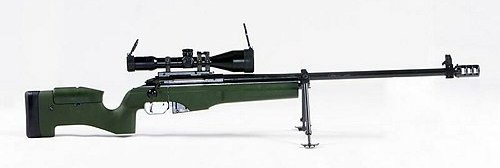
Here’s a quick look:

Used by several military forces around the world, the Sako TRG-42 is one of the most accurate sniper rifles on the market.  Designed specifically for that application, the rifle features a synthetic stock that comes in various colors — black, forest green, and desert tan, and can be had with a folding stock.  The standard stock has an adjustable cheek piece.  The weapons weighs between 5.5 and 6.5 pounds fully loaded.

The TRG-42 is a long action bolt (the TRG-22 is a short action), with the receive stabilized with three restraining screws.  The action is fed by a box magazine of five, seven, or ten rounds.  The two stage trigger is adjustable from two to five pounds, as well as adjusting the angle of the trigger itself; the safety is a silent-operation affair inside the trigger guard.  The barrel is 20″ and can be had with a muzzle brake to hide the muzzle flash, and is free-floating, with moly-chrome lining.  Rifling is 1/12, or 1/10 to stabilize longer, heavier bullets.

It has open sights, but is usually paired with a high-powered scope (range stats are for a scoped version.)  All together, the package offers less than a half-minute of angle out to 500 yards, and the effective range is closer to 1200 yards.

PM: +2   S/R: 1/2   AMMO: 5/7/10   DC: L   CLOS: 0-50   LONG: 300-600  CON: n/a   JAM: 99   DR: -3   RL: 2   COST: $7,000