Ever since the multi-touch, multi-user Surface tables were being shown about by Microsoft, the techno-geeky gamer in me has been lusting after my perfect gaming table.  Apparently, I’m not the only one...

For me, it’s the idea of having the ability to have multiple dice programs, character sheets, notepads for all the players right on the table top.  Need a map?  flick it out onto the surface for everyone to expand, mark-up, whatever…

It’s a dream I have.

Predator drone: $4.5 million…simple Windows shareware: $26…knowing when the Americans are gonna nuke your sandy butthole: priceless!

Iraqi-based terrorists were able to intercept video from the Predator drones on laptops, using data-leeching software and a small sat dish for a measly $26. You simply scan for the packet IDs and transponder codes, and HEY! Predator TV!  I wonder if any of the wunderkind out of Huachuca could, maybe, encrypt the data.

This is another example of how communications and computer technology is serious threat to the power of nations around the world (and also incredibly liberating to the individual.) I find myself torn on this one. While I really want us to eradicate the bad guys, I have to respect their ingenuity.

It also should give espionage gamers a good idea for the next time their GM throws a RPV at them.  You might not be able to hack the vehicle and take charge, but if it’s signaling the base unit, you should be able to tap the feed.  And maybe they’re not encrypted because there’s an issue at the base unit…how many people have turned off their router security because their laptop won’t link up with their home netowkr and they don’t have time to debug it?

Military missions are often time-sensitive.  Can’t get the drone up fast enough with the encryption on?  Have a team out there that needs cover?  Have a lieutenant that’s worried his FITREP is going to look like crap if you don’t get that bird aloft rightnowsoldier! ?

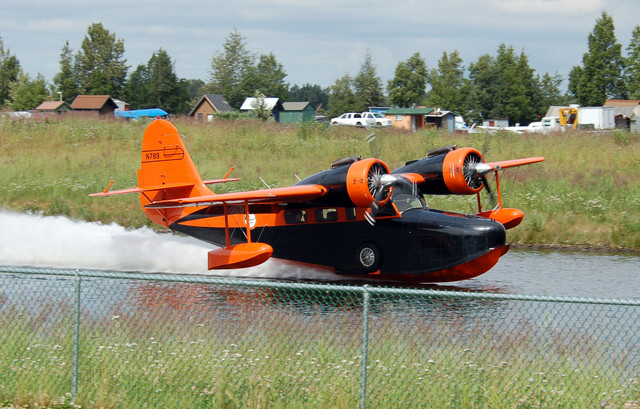
Keeping on the Tales of the Gold Monkey theme from the other day, here’s a new plane for those expeditions out there:  the 1937 Grumman G-21 Goose!

The Goose was designed to fit the needs of wealthy Long Islanders that needed transport to and from the Big Apple quickly.  The aircraft proved to be versatile and tough, and capable of heavy modifications.  It would serve as a military scout craft in World War II, and 60 of the 345 Geese made still ply the air today.

The Goose was a modern monoplane — the wings situated at the top of the fuselage, which was made of high-strength aluminum.  They were originally powered by twin 450hp, nine-cylinder Pratt & Whitney R-985 radial motors.  The hull was designed for water landings, and this seaplane had hand cranked landing gear.  Some of the craft had a hatch in the nose, which could remain open in flight for ventilation.  The aircraft’s shallow draught, seaplane configuation and landing gear, and later ice rigger modifications on the pontoons and undercarriage (on some) allowed the Goose to go just about anywhere.

1937 G-21 GRUMMAN GOOSE

Size:  4   Def: 4   Str: 8   Spd: 184mph   Rng: 1050mi   Ceiling: 21,000   Han: 0   Crew: 2   Pass: 8   Cost: $7000

A little update:  There is a company making the Goose anew, with improved motors, etc.

Yes, it was cheesey.  Yes, it was a Raiders knockoff.  I still loved it when I was a teen.

Tales of the Gold Monkey was a prime-time show on ABC in 1982 looking to cash in on Raiders (just as CBS had Bring ’em Back Alive), but  the flavor was closer to some of the 1930s adventure movies like Only Angels Have Wings, which the creator, Donald Bellisario, claims was more the inspiration.  (He had been trying to get the series made since the 1970s, predating the Lucas-Speilberg spectacle.)

The show took place in 1938 in the South Pacific and featured a young (and improbable) Stephen Collins as a rough around the edges contract pilot, Jake Cutter.  Other backup characters followed the Bellisario Magnum PI, Airwolf, JAG motif of hero, comedic sidekick (in this case his drunk mecnahic, Corky), and a bar owner/fixer (Bon chance Louie, played by Roddy McDowell.)  The love interest was a female American spy. And of course, there was Jake’s one-eyed dog, Jack — who was alleged to answer yes/no questions with a number of banks…that no one could remember which was which.

Central to the series was the building Japanese menace, led by a “dragon lady” type —  Japanese princess Koji (of course, not played by a Japanese actress, Marta DuBois [some might remember her as the alien posing as the Devil in Star Trek: The Next Generation].)

There were 21 episodes in all, and while I’m a bit worried that it won’t hold up to a mature screening (much like Heavy Metal), I would love to see a DVD release.

Yet another example of why I am rapidly losing patience for, and increasingly distrust, Federal law enforcement…

For James Bond: 007 — Helmet and armor jackets reduce Wound Level taken by the rider in a crash by one.  Full-racing suits lower injuries by 3 wound level.

My old Nolan N-01 helmet is six years old, and while it’s held up remarkably well, the thing is old and the padding starting to lose it’s thickness.  I ordered up an HJC Sy-Max II flip-face helmet from PJ Triumph Ducati here in Albuquerque and took possession today.

First impressions:  it’s a bit flimsier feeling than the original Sy-Max.  Granted, the plastics technology is improved int eh last eight years, but it’s incredibly light compared to my Nolan.  The helmet does have a better chin bar release system than the Nolan, which has two tabs to push on either side of  the chin bar; the Sy-Max has one in the center.  Easy to get to, easy to manipulate.  the helmet is comfortable, but there’s a space over the ears in the padding (probably for a bluetooth sound system) that will most likely give more wind noise that the Nolan.

Another plus:  the helmet has an integrated sunscreen.  There is a small lever on the top of the helmet that lowers a sun shade over the eyes.  It is far enough out it does not impact glasses — meaning I don’t need to swap from sunglasses to normal glasses when riding.  A single button releases the shade into the helmet.  It works well.

The ventilation seems pretty good, but I’ll find out more about that tomorrow morning when I ride to work, as I will with the road noise.  The color I chose was anthracite — metallic gray.  It looks good, seems well built, and other than the slightly chintzy feel due to the light weight (which I’m sure I will like when I’m wearing the thing for extended periods of time), it seems like a quality helmet.

Not bad for $200…

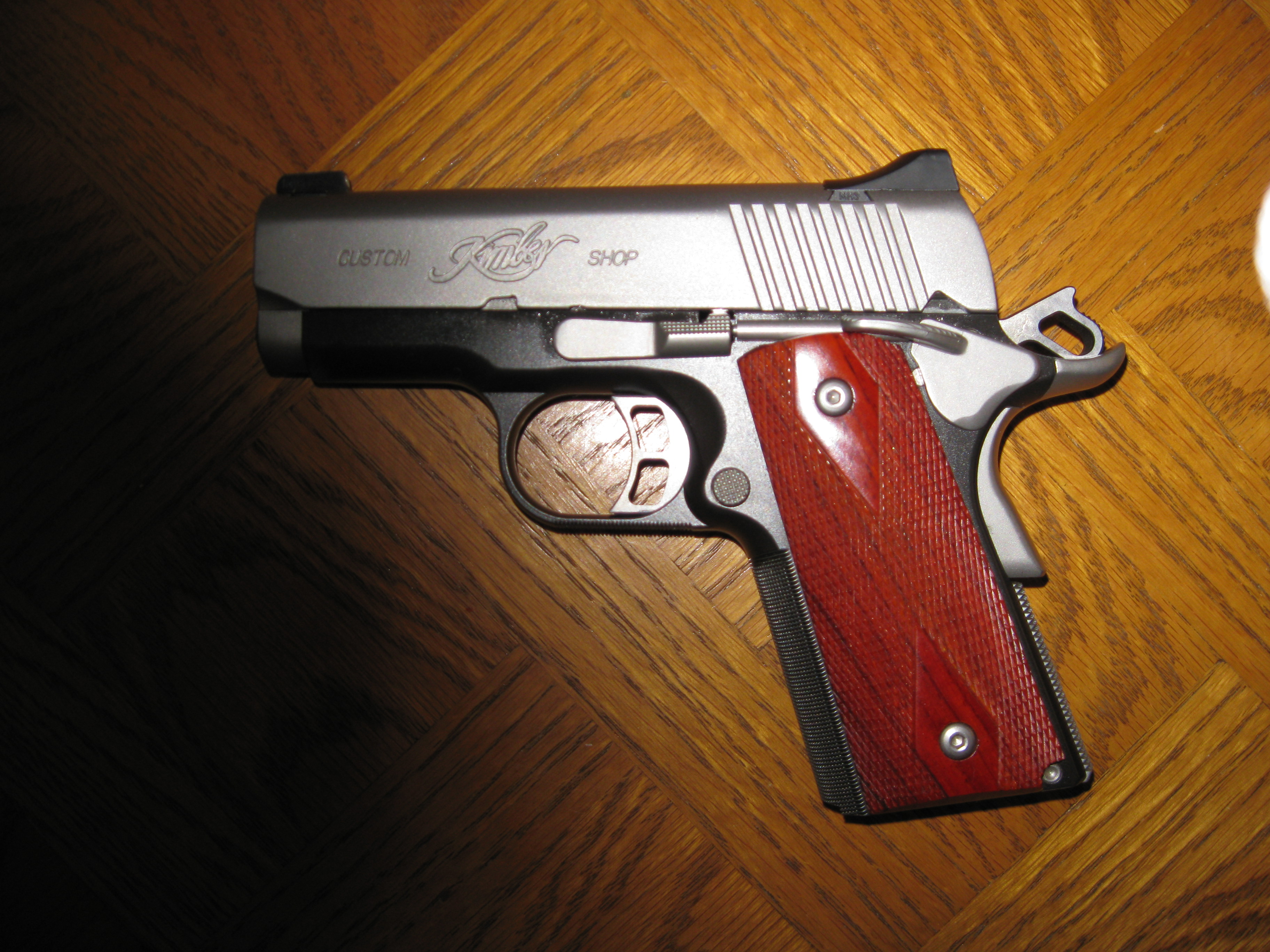
Since I had a chance to fire the new pistol today, I figured I might as well gin up some numbers for James Bond: 007.  Here’s the Kimber Ultra CDP II…

KIMBER CDP II ULTRA 9mm

PM: +1   S/R: 2   AMMO: 8   DC: F   CLOS: 0-3   LONG: 7-12   CON: -2   JAM: 98+   DR: +1   RL: 1

GAME INFORMATION:  The Ultra CDP II’s Meprolight night sights remove the ease factor penalty.  .40S&W and .45acp versions of the gun have much stouter recoil and lose the performance modifier, but have a Close range of 0-4 and Long of 8-14.

I found a Kimber CDP II Ultra in the local gun store, used, for under $1000.  I had looked earlier in the day at one in another store for $1300.  My wife likes the 1911 platform, and the 9mm round is still cheap and easy to get, so I figured getting her off of the .45acp round might be advantageous for the next 3-5 months, while the ammo supply catches up to demand.

Appearance:  Fit and finish are top notch, as one would expect from Kimber’s Custom Shop.  The CDP is an alloy frame in black, with a silver slide (the opposite of my CZ-85’s look) with cocobolo grips.  I find the grips a bit thick for the gun, but not uncomfortably so.  It’s a 3″ barrel, 8 round single stack magazine, with beavertail, skeletonized trigger and hammer.  (Guessing the trigger pull at about 3-4 pounds.)

Nice gun.  Looks great, light weight, and small enough to easily conceal.
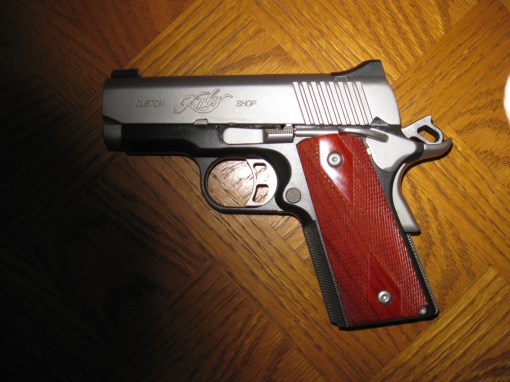
We took it out to the local indoor range and put 150 rounds through it, the first 100 were 230 gr Winchester FMJ, the last 50 Brown Bear 230 gr FMJ.  We did have double feed malfunctions on the magazine that came with the gun (there were small dents in the left side of the mag), but the extra Kimber mag bought had no troubles.  All of the malfunctions were the wife’s, I had none and suspect they were due to her limp-wristing the gun for the first 60 or so rounds.  She only had one or two more malfunctions on the original magazine after that.

The accuracy for me at 10 yards are about 2″ at a speedy pace of shooting.  Her accuracy was about Texas at 7 yards, but by the time she was done shooting, she was blasting 2-3″ groups at 10 yards.  One magazine fired at 15 yards by me gave up another 2.25″ group.  Accuracy is solid, recoil is surprisingly stout for a 9mm due to the light weight, but still much more controllable than her Rock Island Officer’s Model in .45acp.

After the range, cleaning is the usual Kimber headache where you have to capture the recoil spring with a little bit of paper clip or the wee tool for it (that Kimber makes you buy separately!)  Lock the slide open, capture the spring, drop the magazine and move slide forward to get the slide stop out.   Take off the slide and barrel.  Move the lug back to get the spring assembly out.  Remove the barrel.  Reverse once done cleaning.  Getting the friggin’ slide to get back onto the frame is fun and takes a bit of patiences…but it works.

Overall, the wife gives the gun top marks for looks (5 out of 5), a 3.5 of 5 for accuracy, a 3 out of 5 for reliability, and a 3 out of 5 for ease of cleaning.  I give it an excellent (5 out of 5) for the looks, 4 out of 5 for the accuracy and reliability, and 3 for ease of cleaning.  My marks were higher on the reliability and accuracy, as I had none of the troubles she did.

For this reason, I expect that a few more trips to the range will increase her ratings on the handling of the gun.  It’s a bit pricey for a 1911, in my opinion; a lot of the current crop are too expensive, especially when you can get the fantastic CZ or Tanfoglio for half the price.  But if you want a 1911 in 9mm, it’s this or Kimber’s Aegis, the Springfield Armory EMP, or the STI.
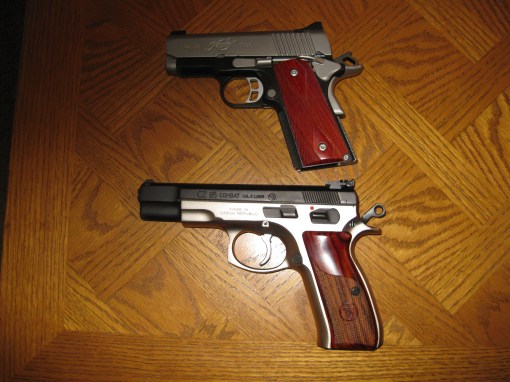
Here it is with the CZ-85…
Well, that was fun…

Had to replace the left rear turn signal on my 2006 Taurus.  Apparently, Ford has trouble with left rear turn signals…it’s the only thing that broke on my 1998 Mustang, and on other fords my other friends have owned.

Hey, Ford, let’s make it a bit more of a pain in the ass to change a simple bulb.  Step 1:  mangle the interior padding of the trunk to get to the screws for the light assembly.  Step 2:  struggle at awkward angle with the screws (don’t drop them under the trunk!)  Step 3:  realize at the last second there’s another screw under the plastic molding at the back of the trunk.  Try to bend plastic out of the way to undo this screw.  (See warning from step 2 and double it.)  Step 4:  pull light assempbly off the car.  Step 5: unscrew bulb assembly.  Step 6: pull bulb and replace with ice cold, unfeeling fingers.  (You should do this, if at all possible, in the cold and wind…)  Step 7:  try the turn signal to see if it works.

Success!  Now retrace your steps in reverse to put the thing back together.   Add curses as needed.