So, I went ahead and loaded the new macOS onto my MacBook Air. Installation was effortless and took about 45 minutes, start to finish. I was able to use the laptop for half of that while the file downloaded. Nothing was changed — my wallpaper, sounds, etc, were left as is; this felt more like an update than a “new” system (which it’s really not…)

The big new feature is Siri. I’ve been using it on and off, and it’s okay. For some things, it works well, like quickly finding a file that’s nested somewhere in a series of folders, or getting the weather…other things, it’s still a little, well, useless. Siri, however, was not the most useful change.

That’s tabs. Tabs in Pages, Keynote, Maps, etc. I usually have several Pages files open at the same time, and having them tabbed is useful. Next up, Universal Clipboard is potentially really useful. I sometimes find an article, or phrase, or picture on my phone and want to use it in a file. You can cut and paste between Apple products. You do need to be on the same network and have Bluetooth up and running. i played with it, and it’s pretty cool. If my iPad were new enough to run iOS10, it would be moreso.

Connected to that, the new iCloud services to store crap you don’t use that much off the laptop is a great idea if you have an Air with a small SSD…however, you only get 5GB from Apple for free. Come on, Cupertino — Google, Dropbox, they all are far more generous with their cloud services, and if you really want this to be a big thing, you might want to give people 20-50GB so that they can play with Continuity and iCloud. If they like it, they’ll use it and might want to start storing stuff online. (I think it’s a foolish thing, from a security standpoint, but there you go.)

Gatekeeper is more of a pain in the ass than it was before. Yes, I understand you don’t want idiots downloading malware onto their overly-expensive hardware…but I don’t want to jump through a load of hoops to get some app I’ve been using for years into action on my computer. (Fortunately, it hasn’t affected anything already loaded.)

The new Os is using IPv6 for networking, and it has been a smooth transition. Additionally, I noted the computer was finding my network drives automatically. I don’t have to go out and do it manually. This is one of the better features of the upgrade.

I don’t have an Apple Watch, so none of the auto-unlocking for me. Don’t really care. APFS — their new file system that’s in the offing and is tailored toward the particular needs of flash drives — is aboard this version, but not in use. Supposedly you can enable a partition using it, if you want to be so bold. Me? Don’t care, right now.

So is it worth it? For me, the automatic locating of my network drives, and the tabs make this a yes. If you use Siri, then, definitely. After all, it’s free…


All this thinking on the metaphysics of a Dungeons & Dragons world has been feeling nostalgic. I’m deeply missing my Battlestar Galactica campaign.

It’s the first time I’ve ever missed playing not just a game, but a specific campaign.

I was looking at the various pantheons in the Dungeon Master’s Guide, and while they don’t expand on the personalities, etc. I’m leaning toward using either the Dawn War and Forgotten Realms pantheons (as competing religious traditions in different areas), as well as the nonhuman deities from the Players’ Handbook.

Are these gods “real”? Maybe — as gods by ancient standards weren’t omniscient or omnipotent, but powerful enough to impact the world in grand ways. I’m leaning toward a Hindu-like division of devi and asura. They’re both “gods”, but one is divine and other malign. This works well with the traditional fantasy tropes of good and evil, but also fits the alignment conceit of the rules. Rather than a necessary behavioral guideline, it’s more a tie to which side of the grand fight you’re on. Demigods and demons are the foot soldiers of their mythic creatures.

I do know I want to lose the connection to Earthly pantheons and notions of divinity. There’s too much baggage with that, and I’m doing Hindu and classical riffs for our Hollow Earth Expedition game, and Battlestar Galactica was completely infused with Greek myth (which I love.)

Connected to that are the “planes” and the idea that they house these creatures. The dozens of planes aren’t needed. Astral and etherial are more as a function of their connection to spell-users. The Shadowfell and Feywild are much more useful — strange worlds just a half twist off of our own. (I’m seeing the Upside Down from Stranger Things for the Shadowfell, and a MAxfield Parish-like realm for the Feywild.) Then you need the positive and negative energies, or planes. It’s not Hell or Heaven, but rather Life and Death. But are they really dualistic? That could be part of the mystery for the wizards or magic users — what’s the real nature of the universe?

So…much to my surprise and chagrin, I’m considering running a Dungeons & Dragons campaign, using 5th edition. Before any of the veterans of the editions wars gets started: shut up. I haven’t played D&D since one session in 1993-ish, and before that 1984.

That last high school campaign ended with the characters taking on the “ultimate evil” of our campaign and winning. What the hell do you do after that? Our answer was more James Bond: 007 and Car Wars. I haven’t returned to fantasy since; in fact, I’ve actively avoided it.

The guy managing the local Meetup group for RPGs saw a sudden jump in interest after one of the members started running D&D 5e on their Meetup night. He’s a bit butthurt, since he had envisioned the group as a place where folks would get together and try loads of different (read, indie) games. Membership is high, but participation is low — Albuquerque is one of those places where you find a group and stick with it, mostly due to the commute time if you live on the Westside — but with the D&D game, suddenly people were coming out of the woodwork. Two tables of D&D are running and there is a waiting list. Apparently, people prefer D&D to Dogs in the Vineyard, and Night’s Dark Agents, and Apocalypse World, and all those artsy-fartsy games.

He asked me to run a game, and since he gave me his set for free, I feel a bit obligated. I made the mistake of mentioning his conundrum (people don’t want to try a different game every damned week; they want something to sink their teeth into…) and got four people say “You run it, I’ll play…” So without even trying, I’ve got a viable group. What the what!?! One of those is a regular in my other group (and an important part of the fledgling Black Campbell Entertainment), and his response was “I’d be interested to see what yu’d do with it…)

Well, now, so am I. I busted out the books and looked through the rules — it’s almost exactly the old AD&D I remember, but with some improvements. I’m intrigued by the tiefling, which weren’t around when I played. Thinking on it, I started laying out some rules for myself to avoid a lot of the “traps” of fantasy games…

First, start small. A county or province or whatever…I don’t need the whole world mapped out and an 80-page primer on the world to get started. (Yeah…the guy from 1993 wanted us to familiarize ourselves wth his world bible before playing…he also gave my ex-wife a female cleric character that was mute.)

Second, game balance — fuck that. If someone wants to play a starting character and another a more experienced one, I think I’m going to let them. Players don’t necessarily advance at the same rate in a game, as it is. Let them play what they want. That said — keep the levels manageable. Level 4 and down to start.

Third, no random tavern meeting BS. They should all have some sort of connection, or sets of connections that meet up. They need a reason to adventure beyond killing monsters and getting treasure.

And on that — monsters, magic, treasure…these things should be rare or at least uncommon, to my mind. Dropping in on the monster of the week isn’t exciting or shocking. After a while, it’s just another day on the job. Keep the magic use to a minimum and make it something surprising, even if it’s a PC using it. Make them get the bits for the spell, make them have to have time to enchant. Monsters should make sense — why is this thing here? Where did it come from? What’s the impact on the surroundings?

Connected to that: You don’t need to use the whole Monster Manual. pick things that make sense for the story and the campaign arc. I’m thinking of cutting out the old stand-bys like orcs and kobolds in favor of focusing on the main PC races as bad guys.

Alignments. Hate ’em. Always did. It might not be a bad place to base your character’s actions on. I was thinking of the notion of a tiefling that wants to be good…but in the end, that’s not their nature, and no matter how hard they fight it, sometimes, mature is going to trump nurture… But that brings up the necessary questions of what is good and bad in this game? What god/s and their antitheses exist (or don’t but we think they do..?)

You don’t need to have the universe jump, fully formed from your head, but anything that might be connected to the players’ motivations and back stories should be, at least half-assedly, laid down.

But, as always, I could be full of shit.

db11-012

The latest GT coupe from Aston Martin replaces the venerable and highly successful DB9. Powered by a 5.2 litre twin-turbo V12, the car produces a blistering 600 horsepower and 518 ft-lbs of torque. This is guided to the wheels by a rear-mounted ZF 8 speed automatic transmission that improves fuel mileage and performance over the traditional manual transmission. The DB11 can hit 60mph from a stop in 3.9 seconds and has a top speed of 200mph. (A more sedate 4l V8 is planned…)

15-aston-martin-db11-geneva-11

The interior of the Aston continues the 2+2 layout, with the rear seats being more of a suggestion than something to be used. The infotainment system has a 12″ screen for sat navigation and to utilize the proprietary Aston Martin sound system. And, of course, hand-stitched leather and other natural materials for the upholstery.

PM: +2   RED: 2   CRUS: 110   MAX: 200   RNG: 260   FCE: 2   STR: 6   COST: $290,000

GM Information: The DB11 receives a -1EF to Force maneuvers and safety rolls associated with the same, however, otherwise it receives a +1EF to safety tests.

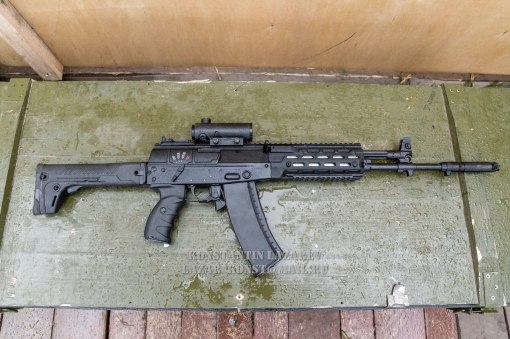
The Kalashnikov Concern has been busy these past few years, and just a few days ago, the Russian Defense Ministry announced that they would begin issuing the AK-12 as their new service rifle. So what better time than to have a look at the new Russian stuff that is certain to find its way into the hands of your bad guys in your James Bond: 007 RPG campaigns…

AK-12

ak12_4

The AK-12 is the culmination of modifications made to the AK platform. This rifle is a follow-on to the AK-74, and uses the same 5.45x39mm ammunition and will accept any of the magazines made for the earlier 5.45mm platforms. Improvements include a new, not-shitty safety lever — a sharp departure from the barely-workable lever of original rifles. Instead, the safety lever is a four-point lever that allows the weapon to be safe, single fire, burst fire, or fully automatic. Another improvement is a telescoping and foldable stock; folding iron sights and a  Piccatinny rails for optics, and another for the addition of a GP-34 grenade launcher. The bayonet lug remains and the muzzle brake is improved. 60-round quad magazines and a 95-round drum are in the works.

PM: 0   S/R: 2/10   AMMO: 30   DC: H/K   CLOS: 0-18   LONG: 50-90   CON: n/a    JAM: 98+   DR: -3   RL: 2   COST: $2000 (approx.)

Q EVALUATION: It’s a damned good rifle. The new safety switch is the best improvement of the lot, but the modifications to the gas block and tube have made this a much more reliable gun than the old AK-74. 007

AK-15

1473444639

A larger version, the AK-15, is in development and is the heavy version of the rifle, a follow-up to the AK-47 in 7.62x39mm. It has many of the same features of the AK-12.

PM: +1   S/R: 2/10   AMMO: 30   DC: I/L   CLOS: 0-20   LONG 50-90   CON: n/a   JAM: 98+   DR: -3   RL: 2

Q EVALUATION: One of our foreign liaison officers got the chance to fire the prototype for the AK-15 and was inpressed, stating that the weapon fixed many of the issues the old AK series had — from takedown, to the safety catch, to reliability with different ammunition. Cpt. Michael Roberts

Lebedev PL-15 9mm

1473834661

This pistol is produced by the Kalashnikov Concern and was designed by Dmitry Lebedev, and was created as a pistol for police and military use, as well as the ability to transition into “professional shooting.” As a result, it uses the 9x19mm “Luger” round, rather than the old Makarov 9mm, has a 15 shot magazine, a polymer frame with under PIccatinny style rail, and uses a striker fire action, and the reliable short recoil Browning-style locked breech. Unlike many manufacturers, all controls are ambidextrous, and a grip angle and low bore axis similar to the CZ-75.

PM: +1   S/R: 3   AMMO: 15   DC: F   CLOS: 0-6   LONG: 12-18   CON: +1   JAM: 99   DR: 0   RL: 2   COST: $900

Q Evaluation: Kalashnikov has really outdone themselves with this sidearm. It combines lessons learned by other pistol manufacturers into a solidly reliable, easy to use platform, that rivals its competitors. 003 compared it favorably to his beloved CZ-85 Combat. High praise, indeed! Q

John Fredericks was making some interesting comments on game continuity over at Gnome Stew, and it spurred a few responses from me, including on one the efficacy and issues of “troupe-style play” As to continuity, however, I have to say: I’m for it.

There are several levels of continuity he addresses, but I think we can ignore a few of the bullet points he uses, and frame this in terms of televisions or novel series. Additionally, however, I want to add the notion of “canon” — that the continuity is also tied to the internal logic and rules of the genre or setting.

Strong Continuity

The game university has an internal logic and history that affects, and is affected by, the actions of the characters. Things that happen are important and can/will be used against you in a future game.

Modern television series tend to follow this model these days, sometimes to abstraction. The characters’ action don’t just impact the universe around them, but drive the personal relationships between the characters. Friendships can be broken, alliances shift, goals change. There is usually some kind of central goal, villain, or motif to be served. There’s a “story arc” that can be a season long (Dr. Who, for instance), or series long (Battlestar Galactica.)

This requires a lot of mental lifting by the GM and the players. Note-taking and record keeping can be a full-time job. In this sort of continuity, I think it’s important to have NPCs changing along with the PCs. Their stats should evolve, if it’s a system with aspects or traits or weaknesses, these should change over time, just as with the players’ characters.

This has been the sort of game I’ve run for quite some time, and I agree with Fredericks that this is the sort of universe most players are interested in — something long-term than allows them to explore a character and feel that they have achieved something.

Ret-continuity

You see this in a lot of modern TV, as well, in shows that were meant to have some kind of central theme or mystery that the writers and executive producers — well — didn’t really have a clue what it was going to be. Shows like X-Files, or Lost are prime examples of this: there’s a conspiracy or mystery, and the characters are working toward figuring it out, but since the writers don’t really know what the hell they’re doing from one season to the net, they have to scramble to put a coherent arc together through seemingly (or obviously) contradictory elements.

I had to do  bit of this with my Battlestar Galactica campaign, which had a few points where I veered in different directions. I had a fairly solid idea of the campaign endpoint, so I was able to tap some of the elements into place, and fortunately (unlike TV) you can go back and rewatch a session to see if all the “facts” are the same as they were three years earlier. You can often get around this bad hand-waving, counting on the players’ faulty memories, or creating some kind of “your perception of the incident was not completely accurate” type out (see Rashamon…different people see an event differently.)

Honestly — this is probably the closest you’ll get to the “strong continuity”.

Loose Continuity

Like ’70s and ’80s TV, the characters tend to be static, or change in personality as the story suits. It’s episodic and each episode is unlikely to be linked; it’s almost like each episode is a reboot of the last episode. Set The A Team, or Starsky & Hutch, or TJ Hooker. Hell, see the original Star Trek…there’s no “canon”, no real continuity beyond the characters and the general flavor of the show. Maybe a character was too good to die in your pilot session, and like Hill Street Blues (which was an early “strong continuity” show) you bring those guys back and just ignore they were shot to death in a stairwell. Certain things that happen might matter — that love interest might be lost to the character, then show up conveniently to cause trouble; the big bad guy might return, or one of his kids; something that happened in “season 1” might suddenly become important for a storyline in “season 4″…but doesn’t really change anything outside of that episode or two.

Yeah, character C disappeared for two sessions of our dungeon crawl (including a bit fight), but he was just off having a pee. Or was there but for some reason never did anything. Doesn’t matter, he didn’t get XPs.

NPCs don’t change. They are there for comedic or supportive effect, or local color. Hell, they might not even have a name. Taking notes on what happened is optional (but the loot is not!) You might be able to ret-con a story arc into the game near the end for a satisfying denouement — all these things were actually under the control of the nameless bartender you guys all liked!

No Continuity

This might be the schtick of the game itself. No matter what you do, you reset to the state of the universe prior to the adventure. Your dungeon crawl? No effect on anything but your character level and stuff. That crime you solved? Hell, maybe the same bad guy is still around; he has a great lawyer. You died? When did that happen?

A campaign like this could be played for laughs, like Paranoia, or it could be — cunningly — the actual metaplot of your campaign. Maybe, all your disconnected adventures were happening while you were in suspended animation on a long space voyage, or holodeck adventures, or some kind of prison you are trapped in.

Canon — or “That Wasn’t in the Show!”

As to “canon” — that word every GM should fear when you are running a licensed universe like Star Trek or Dr. Who — setting ground rules is essential the higher up this scale of continuity you go. When I ran Star Trek, I had a trekkie in the group (it was why I wound up running it.) I was not. So to cover my ass on continuity, we agreed that game continuity trumped the show. Certain things weren’t going to happen. Voyager, for one..

When I ran The Babylon Project in the late ’90s, however, I parked the campaign on the edge of the show’s events so that we could play our own game, but dip our toe into the Babylon 5 continuity as we needed. It worked very well. We ignored certain things from Stargate SG-1 when I ran a short game and kept the good stuff.

Ignore it when it suits the game, don’t when it enhances the game. Your game is a reboot. Go easy on the lens flare.


I was reading an article on another site that was talking about continuity (more on that in another post) and how tight continuity campaigns could be derailed by scheduling issues. As readers of the blog have seen, my group has been beset by scheduling issues this year, and I’ve been something of a whiny bitch about it.

It got me thinking suddenly — we had similar issues with the long-running Battlestar Galactica campaign, lost players and gained them…why wasn’t this as much of a perceived issue before? Then it hit me: for the Hollow Earth Expedition game, the players only have one character.

To be able to explore other areas of the Galactica universe, all the players had two to three characters, each in their own circle of the rag-tag fleet. (In the abortive campaign prior to that, each had a fleet and a survivor on Caprica character…for the same reason.) One of the benefits of this “troupe-style play”, is that if a character isn’t present, they could easily be handwaved away as “on administrative duties”, or “somewhere on leave in the  fleet”, or I could concentrate on characters and situations that didn’t require all of the players to be present. I had an out.

File under “Duh!”

So how do you use this style of play, and what are the up and downsides? Let’s start with the downsides:

First, it shifts the focus away from one single character the player has. In the Battlestar Galactica campaign, for instance, one of the players was playing the Vice President of the Colonies. While this allowed the player to have high-level influence in the policies of the fleet his other characters did not, he wasn’t a combat guy. He didn’t investigate crimes or fly vipers. That mean he got a lot less time and focus as the other characters — a cop and a viper pilot — and wasn’t of as much interest to the player or the GM. But he was a great trapdoor to play when the other players weren’t present.

A codicil to that — the players may also take an interest in a different character than you anticipated, and push the plot or focus of the campaign in a different direction than the GM expected. This can be frustrating for the GM. If he ignores the B-string character, this can be frustrating for the player.

Secondly, if the various characters eventually have to interact, it can be problematic (or funny) to watch a player trying to effectively roleplay a scene between two of his personas. It can work, trust me, if you have a good player, and it can be a blast, even for the players on the sidelines for the scene; it can also be awkward as hell. We even had one player’s characters have to fight each other.

Third, you still have to explain away why the B characters aren’t wandering the dungeon with you. This is probably not as much an issue in a game that doesn’t have the players in a fixed location or vocation with each other, but if you’re on a dungeon crawl, or traveling as a tight group, B might suddenly be of use.

So now the upsides:

The GM and players can branch out and explore the world around them. An example: if the group were playing the Avengers in a superhero game and someone was Spiderman, you could focus on his crime-fighting in NYC, if there were key players missing that week. Or instead of world-shaking efforts, a few of the team might decide to aid another player in a side quest — finding a friend’s murderer, or looking for a shawarma restaurant.

Secondly, the players can switch it up from time to time and play something different to bust the group out of a rut. Maybe you’ve gotten a bit tired with your 12th level paladin, and playing that 4th level rogue sounds like fun that week… Maybe you can switch up genres a bit: maybe instead of playing a cargo ship crew running around the ‘Verse avoiding the Alliance, you are focused on helping a B-story character clear a neighborhood of a gang that has moved in on a neighborhood by the docks. It lets you get the characters out of their comfort zones — crap, my bad-ass fighter needs to schmooze with the upper crust as a date or escort for the team’s wizard at a Magician’s Guild meeting. Maybe the paladin suddenly has to engage in protecting a thief, engaged in a questionable side heist for a good cause (he hopes!)

Third, you can manage no shows much easier by swapping the stories you pursue with side quests.

But, as always, I could be full of crap…

So, I settled on a flag or standard for Atlantis for our Hollow Earth Expedition campaign. I wanted something that would “speak to the Nazis” when they eventually show up, but blended well with the Vedic beats we’ve been using for the “gods” — the devi and asura — that once ruled the Inner World (and may have created it as some kind of prison…)

atlantean-swastika

The city will have a similar radial canals to curving ones, with four great towers in the center.

The emperor’s standard, of course, is the same thing, but in gold.

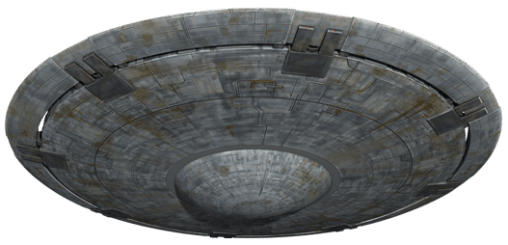
One of the big bads, Captain Thoth, has been chasing the characters around with a fleet of flying saucers. Most of them are smaller vessels, like Aruna or Agni , but the head of Atlantis’ secret police is toddling around in a super-szied version, Durga.

War Saucer Durga

At 60 feet in diameter and with eight dual heat ray batteries at the rim (above and below!) of the machine, Durga is an imposing craft. (The landing gear of the vessel retract into spaces proximate of the cannons.) As with most of the Atlantean craft, she bear the swastika of life and change, but the upper dome is also painted in the eight-pointed starburst of General Inanna’s flag.

pirate_saucer_mothership

The outer third of the saucer is primarily drive and weapons spaces, and the internal layout has a central command desk with four radial crew spaces that then curve to the right, mirroring their flag.

atlantean-swastika

The flag of Atlantis

The vessel can carry approximately two platoons of troops and their gear in tight quarters. In local memory, no one has heard of one of these machines being destroyed.

SIZE: 8   DEF: 4   STRC: 24   SPD: 350   HAN: +2   CREW: 10   PASS: 24; 16 Dual Heat Ray Batteries —   Damage: 10L   Rng: 500’   Cap: n/a   Rate: Beam**   Spd: A

**Beam weapons fire like autofire weapons. Use the same rules.

147bb81e5b980bd7063ae05bf8516b8a

Command flag of Gen. Inanna

Battle Flyer Shiva

shiva

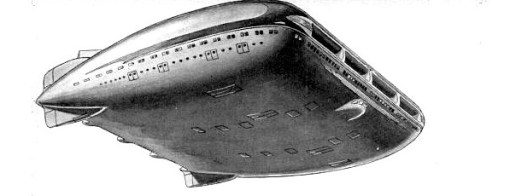
But it is the aerial warship Shiva that is most terrifying in the Atlantean arsenal. At a wondrous 900′ from stem to stern, almost 600 across the beam, and with seven decks — including a launch and recover deck amidships for light saucers — Shiva is the only one of her kind left flying. A dozen repulsion units keep her in the air, and she carries a massive broadside of heat ray batteries. She can — if she sacrifices some of her lift — pack up to 500 troops into the vessel or a dozen smaller saucers. It is rumored the Emperor has a stateroom aboard her from which he can look down on his domains.

Shiva usually patrols the skies above Atlantis, and is commanded by General Inanna, if the emperor does not take personal control.

SIZE: 16   DEF: 2   STRC: 36   SPD: 200   HAN: 0   CREW: 50   PASS: up to 500; 20 Dual Heat Ray Batteries (2 fore and aft, 16/broadside) —   Damage: 10L   Rng: 500’   Cap: n/a   Rate: Beam**   Spd: A; Bomb bays — Damage: 12L (area), Cap: 24 Rate: A   Spd: S