I discussed this particular game in another post, but that was aimed more at the idea of reusing old game ideas. Still, for those readers who frequent the site, there will be a lot of reused verbiage.

We had brought on a new player, one of the core group was away on vacation, so I thought I’d try them out on Hollow Earth Expedition. It had been four years since the death of the marvelously over-the-top Shanghai Campaign. We’d made a few abortive attempts to get a new campaign going, but the characters and the players just weren’t connecting. So, using the bones of a one-shot I ran for a Meetup RPG group, I put together a “backdoor pilot” using the same basic plot — the characters were looking for an academic that was lost in Equatorial Guinea, and claims to have found the mythic white apes of the Congo. Evil corporate interests with the backing of the local peninsulares are looking to stop word of the apes from getting out because…what does it really matter? They’re the bad guys. Little hints, in this case in the form of one character’s fascination with American pulp novels, allowed me to do a bit of foreshadowing. The lost city and white apes sounded a lot like Opar of the Tarzan books (which the character is reading during the downtimes — Tarzan and the Ant-Men — according to the player) and the Lovecraft short story Facts Concerning the Late Arthur Jermyn and His Family.

Here the missing fellow is Lord Trevor Ansom — Oxford Classics lecturer who runs about the world looking for mythic stuff. He’s a WWI vet, a bit addled thanks to serious PTSD, but just because he’s a bit weird doesn’t mean he’s not often right… The plot hinged on someone that would have the emotional connection to want to rescue him, and I wanted the new player to be the “lead” for the game. Her character: Margaret Ansom-Bose, recent divorcee and one-time companion of her uncle, who took her in after the death of her father in the War, and her mother from Spanish Influenza. She’s a “modern woman” who came of age as a flapper and an aviatrix in the ’20s, but after the Crash got married to an American oil tycoon to keep the family afloat. She’s a Beryl Markham sort of “damn it all, let’s have some fun!” sort.

The player leapt on this, but due to a series of crappy rolls over the course of two nights, this super competent woman kept coming up the damsel in distress for the other character to aid. Instead of decrying the situation, she’s added it to the flavor of Bose — she’s hyper-capable and useful until she needs to be a plot device. (I would point out, this makes her exactly the sort of heroine that was standard for 1930s/40s pulp.)

The next character was the problem one. The player in question just didn’t quite seem to jive with the pulp setting the two times we tried it. He had a big game hunter from Texas the first time around that just didn’t drop in well and the player didn’t connect with him. The second time he played a British occultist aristocrat…he liked the character but the notion didn’t sit well with me. I’ve found that unless magic or mind powers are common or ubiquitous, having a player with them sharply removes the feeling of danger and mystery from having powers loose in the game…it’s something bad guys have. The heroes have to overcome that. Look at almost every good horror/suspense piece — the good guys are usually outmatched and have to find some weakness that allows success. They don’t just hire a bigger sorcerer to take out the baddie.

The piece I was stealing from is set in Africa — big game territory. I took his original character of Gustav Hassenfeldt, and went to work with the editor’s scalpel. Background shifted from Texan of German descent to German who grew up in German East Africa until the British authorities tossed the family out in 1922. Didn’t connect with his dysfunctional homeland (and their actual family home is now in France and confiscated.) His parents moved to Texas to give me American adventure hooks, but he returned to hunting and being an  adventure guide for hire. There was my in to get the characters together. But the big reworking was to make him less arrogant and superb at his job (which he undeniably is — we’re talking Quigley Down Under levels of long shot goodness), less brash and impulsive, and made him a meticulous planner. Sensible and honest; a good man. This culminated nicely in a scene where he had the chance to take out a bunch of Spaniards at range and protect folks toward the end of night two, but quipped “This feels like murder…” This led to a non-violent solution to the scene — set up by the team’s combat bad-ass. It’s a great overturning of tropes. (He was also the guy referencing Tarzan.)

The first night started with getting the characters together through a mutual friend in Tangier. The necessary action scene to establish villains, get the characters to show their expertise and develop a connection, and set the stakes followed: goons hired by the Equatorial Lumber Company to get back the letter from Ansom, the map to his find, and (exposed) film wound up with a punch up and shootout on the harbor wall. Hassenfeldt character established himself as a guy that tried to talk his way out of big troubles, but is willing to throw a punch to be a gentleman and protect his employer (Bose.)

They travel by Bose’s old Sikorsky S-36 (stats are about the same as the S-38, here) over various points to Fernando Po, where they link up with the crew of Sylvia — the boat from the one shot, but now relegated to NPC status — who had been hired by the aforementioned contact in Tangier to get them upriver. The location they are going to will be inaccessible by airplane.

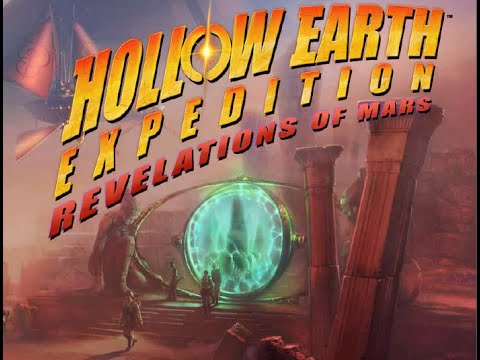
Here I was now back in the framework of the original one shot: a nighttime run past Spanish patrol boats, upriver until they are trapped by the Spanish in a tight section of the Benito River, rescue from the Spanish by the “lost” Professor Ansom and a platoon of gorillas led by a few white apes — gigantic, intelligent creatures that Ansom has befriended. They return to the city of the apes, called Mangani by the locals, and it is a place of strangeness: the color is all wrong, everything ooks like it is viewed through a funhouse mirror — geometry is peculiar, and the architecture looks almost Minoan. Ansom thinks it is an Atlantean outpost…and the piece de resistance is the temple, complete with a strange metal eye altar or icon (with the iris being an open space big enough for a few people to go through) — see the cover of Revelations of Mars for what I’m talking about.
hqdefault

They try to figure out some of the mysteries of the place, but the cameras don’t work — everything must be drawn and annotated. The apes can communicate, and Hassenfeldt helps Ansom train the apes to use the rifles they’ve taken from the Spanish. When Spaniards from the company show up, including a highly educated Jewish doctor named David Gould, they manage to defuse the situation. While showing the Spaniards the importance of the place and why they should cease their attempts to destroy the apes, they discover the doctor — when in proximity to the Eye — causes it to light up with a strange blue energy field. (Yeah — it’s a Stargate. Steal, people, steal!) The Eye firing up spooks the apes, who run away. While investigating, Hassenfeldt trips through the gate, and knocks Bose with him.

On the other side, it almost looks like they are in the Yucatan. The ground curves away for some distance…a massive valley? and they spot some kind of huge creature circling them in the air. A single shot from Hassenfeldt’s .375 magnum brings the creature down: it’s a pterodactyl! Realizing how alone and possibly endangered they are, Bose convinces him to go back through to the ape city and the gate shuts down.

That was where we left, with two possible PCs for the vacationing player — Ansom or the Jewish doctor with Atlantean blood that allows the gate to work. The player in question preferred the Gould character when asked. So this week, when that player away again, I had us return to Equatorial Guinea and Mangani, right at the point we’d left off: they’d come back through the Eye to find the apes had decamped, fleeing the city…but that was not all: landscape around the city seemed discolored and twisty, and the buildings of the city itself seemed to be moving. Whenever they looked away, things had changed.

Lord Trevor went to scout and see if other apes were around. Bose looked at the inscriptions on the walls for more information. But quickly it was obvious that something dangerous was occurring — the very geometry of the buildings was wrong! They looked for an found Lord Trevor in another of the larger buildings, a minaret-like spire. Inside, a red glowing, crystal (never good) was in his hand and when he addressed them, he told them they hadn’t much time.

“I’ve been sleeping a long time… I never expected one of my own to find me. (This to Gould.) It is time I return, before those that cast me out realize I have awaken.” When they try to find out what is possessing Trevor, he remarks “I can only wear this face for a short time. I’ve had so many, over the years, but this karn is old and will not handle the strain for long.” When asked what his real face was, he doesn’t even remember. Those that once worshipped him called him the Faceless One. “The city is returning home. We must not wait.” He took them to the temple and the Eye, where he casts the crystal through to some place of red sands and pink sky. “You must go. The city will disappear soon…” and with that he releases Trevor. The heroes hot foot it out of the city just as it folds and twists and pops out of existence.

The few Spaniards who had escaped when the apes ran, having seen the whole thing, take the characters into custody and question them at the local logging compound. In the end, no one really knows what to make of the situation — the Spanish saw the city disappear, the apes flee into the jungle. While they have issue with Trevor’s actions, and they suspect that the character may or may not have been involved in violence against their people, how the hell are they going to spin any of this? And the characters can’t really make too much of the Spanish actions, white apes, or a missing city. No one will believe it!

Released, the characters flee back down the river and eventually get to Fernando Po, where Bose’s S-36 is moored and fly home to England. On the way, the group decides they aren’t letting this go — they hit the British Library to quietly start looking for references to the Eye in literature and history; Trevor and Gustav talk to the Royal Geographical Society about the apes and to try and find anyone who claims to have encountered a creature like the one Gus shot.

In the end, they had a few leads — an eccentric mountain climber and hunter named Kinnie, preparing for his attempt of the Eiger in Switzerland had claimed to have shot a “dinosaur” in Venezuela; the others found references to the Eye in the Potala Palace of the Dalai Lama in the autobiography of Francis Younghusband (now the chairman for the Himalaya Exploration Committee of the RGS), and another reference in the crazy works of Thule Society founder Rudolf von Sebottendorf (recently arrested in Germany, but escaped, and allegedly in Switzerland, as well…)

So with one quick toss off adventure, I now have two lines of attack for a campaign — the Tibetan mystical one, or the Venezuelan jungles.

It’s a sharp break from the long running space opera of the last half decade, but I’m hoping this time it’ll catch fire with the players.


25 years later…

We open on Argos, the marginally inhabitable world (our New Caprica, if you will) which has become a thriving colony, thanks to the Kobolians and their technology. While the humans and Seraph have their own planetary government, everyone knows it’s the Olympian Council,  led by Zeus, who is in charge.

Visiting the Forge of Hephaestus, we reintroduce Nike, now the Goddess of War after Athena’s disappearance. She is inspecting the massive galleons — half warship, half ark — being constructed to protect the world by the Smith God’s multitude of mechanical assistants. Among his other toys, is a strange craft that she was not able to get a read on, but was a ship designed to reintroduce plant and animal material on Kobol — a world that had apparently been reconstructed by one of the TITAN’s leftover  hekatonchires — the great utility fogs that can repurpose entire worlds.

This led to a diplomatic party scene, where Argos was culminating its 25th anniversary since settlement. Among the guests were diplomats from the Cyrannus Colonies (the 12 Colonies of Man), Earth, and the Pleiades Colonies. Hermes was introduced, just back from his mission to the latter, where he found a culture older than Kobol, the source of the “Aurelian Heresies” — thousands of years ld prophesies that pre-dated Kobol and were frequently referenced throughout the game — and currently more advanced than the Kobolians. Other guests included the twin children of Athena and Admiral Pindarus — Athena and Alexander III, young, handsome, and smart half-Kobolians on a mission to the various worlds of Man.

We got a taste of the politics of Argos — the in-roads the monotheism of the Seraph was making, the shaky “alliance” between Argos and Earth, and the internal beefs of the “gods.” Zeus asks Nike and Hermes to represent them at Earth’s 25th anniversary of the founding of the Earth Alliance.

Six months later, we picked up on a rescue mission in the California Republic, one of the four great polities of Earth, where an earthquake has destroyed much of the City of Angels. Alala — the Seraph pilot introduced a few months back with the addition of a new player is now commander of the new basestar, Galactica, and is commanding the efforts. She is warned by one of the pilots on CAP, the daughter of Hermes and one of the major NPCs that had been a bit player throughout the game, of a tsunami coming, and is rescued by said pilot in a daring move.

When they return to Galactica, a more modern, welcoming basestar, with a much more advanced look, we reintroduce Admiral Armenta — a character that started as a pilot in old Galactica, just before the Fall, and who had wored her way up through the campaign to wing commander. She is 50, now, and older, more tired, and a bit less idealistic. After some character bits with her old friend Alala, and her operations officer, the daughter of Pindarus and Tana, his Seraph wife, she makes ready for the 25th anniversary celebrations of the Alliance. The ship bearing Hermes and Nike arrives from Argos about this time.

After some politicking in the Temple of Athena, in which we meet the older version of Pindarus, now 68 and the Princep (first citizen) of the Alliance, and his wife Tana — now ruler of the Athenian Republic (the city-state where most of the people who survived the Exodus live). There were a few bits of diplomacy, but in the end, the second night of the finale saw a day where the old characters getting together for an old fashioned picnic.

We learned about the fates of these long-running characters. Pindarus’ time as defense secretary putting together the Earth Defense Force, his marriage to Tana and its near collapse after an infidelity five years ago. His widespread cancers from a decade ago, cured by a bone marrow transfusion from Tana. He is now the first prince elected by planetary vote, he wrote a massive history of the Cycle of Time, and now potters about cooking and painting.

Zoe Armenta (formerly Arden, call sign Billboard, then Boss) became a lifer — commanding the fighter wings of Earth, then a basestar, before getting knocked up by her yeoman and taking command of the Sparta Military Reservation, training the EDF soldiers. She has recently taken over the new Galactica. She is married, mostly a settling for the most stable choice sort of match after two decades of short flings and throwing herself into building the EDF.

Hermes has been the chief diplomat for the Kobolians on Argos, but is more interested in furthering Athena’s dream of the worlds of Man (in all its iterations) united. Various NPCs that had been in the game for years were referenced or seen, and in the end, the last night had that same bittersweet quality that the Babylon 5 finale had. These are our heroes — old, tired, at the end of their working lives…but still standing. Still family.

Cut to 500 yeas later, Capricorn Colony in the Pleiades Colonies of Man. Starbuck (a Dirk Benedict-esque one) and Apollo are gambling at “Casino Planet” (this was some fan service for Jim, one of the gamers, who has been lobbying for a casino planet visit since he joined the group) on the Elysium Station over the colony. They are suddenly recalled to their battlestar, Galactica, when a massive fleet, led by the ousted Leader Baltar, strikes without warning. The vessels attacking are “Olympian”, and their mechanical Myrmidon troopers invade the station. After fighting them off in the hangar bay, they take their very futuristic vipers and race back to Galactica, where the ship is preparing for battle.

Apollo meets his father, Commander Adama, who informs him that Fleet Admiral Pindarus is reporting half the fleet has already been destroyed, their worlds nuked. There are refugee ships everywhere, and Galactica has been ordered not to join the main battle, but instead take the civilians out of the combat zone to the only safe harbor they know, the only world that could stand up to the Olympians…Earth.

Thus ended 4 years, 10 months  of one of the best and longest games I’ve ever run. The pay-off — seeing ones characters having come through their epic journey, succeed at rebuilding their lives — seemed to resonate well with the players. The coda 500 years later lend more power to the Cycle of Time, and suggested that the story wasn’t truly over.

Was this episode really needed? After all, they’d gotten to Earth and found a new home. End of story…but after investing so much in their characters, letting them see them aged, well-lived, and a new generation of heroes coming into their own (the children of the characters), gave a sense of continuity and closure. As finishing a campaign — especially one of this length — is relatively rare for a gaming group post high school or college, having that glimpse of what became of your characters is important for the players.

One way to go about this is for the GM to have a plan of what the world looks like five, ten, or a quarter century out. Another is to let the players each have a moment where they tell you what happened to their characters. Either works well. In this case, I asked what the characters wanted to do, long term. I had them roll their attempts at diplomacy or whatever, then I grafted on elements of the overall story arc to show how sometimes this or that didn’t quite work out.


CYRE PRECISION SIX12 12 gauge Shotgun

The SIX12 was developed as a breaching aid for the M16/AR-15 platforms, as well as a stand-alone product. Taking the place of a rail-mounted grenade launcher, the SIX12 is, in essence, a 12 gauge revolver.

on m16

When attached to a rifle’s under-rail, the SIX12’s stats are:

PM: 0   S/R: 2   AMMO: 6   DC: G   CLOS: 0-6   LONG: 15-30   CON: n/a   JAM: 99+   DRAW: -3   RL: 3   COST: $1500

In the stand-along configuration, the SIX12 comes in a standard 16″ and short-barrel configuration:

standalone

PM: 0   S/R: 2   AMMO: 6   DC: H   CLOS: 0-9   LONG: 20-40   CON: n/a   JAM: 99+   DRAW: -2   RL: 3   COST: $1800

GM INFORMATION: In the short barrel version (7″ barrel):

PM: 0   S/R; 2   AMMO: 6   DC: G   CLOS: 0-6   LONG: 15-30   CON: +4   JAM: 99+   DRAW: -2   RL: 3   COST: $2500

GM INFORMATION: The SIX12 can also be had with a SilencerCo Salvo suppressed barrel. This gives a -2EF for Perception tests to hear the weapon fire.

w silencer

You can find a video of the product at https://vimeo.com/118953590

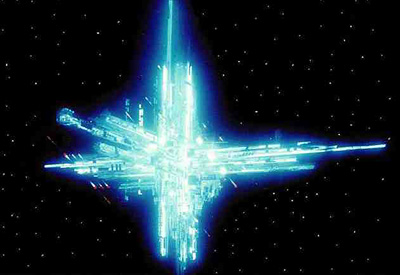
Last night saw the rag-tag fleet finally get to Earth. Last session, we had ended on the fleet suddenly finding itself face-to-face with a “Ship of Lights” — a TITAN, the ancient machine intelligences that, allegedly, made the Lords of Kobol.

bsg-sol-001

The characters found themselves overwhelmed by light and sound, and then we broke for the night…

This week, we opened on Admiral Pindarus and the Lords of Kobol traveling with the fleet confronting Prometheus, one of the two TITANs that have remained at Earth to protect it (the other being Atlas.) We learned, obliquely, that the TITANs have mostly gone away — “they have become that which went before, and which — if you don’t muck it up — you may one day become.” The planet has been under their protection since Hades showed up with a fleet of arks loaded with the Ophiuchans — the 13th Tribe of Kobol that traveled with him to Earth to “find answers” after his war on Zeus to control Kobol. (He lost.)

Hades was welcomed back by his progenitor, Prometheus, who had been behind the creation of Athena, as well. They were based on the most approachable Gods the TITANs could find to lead humanity after the TITANs had to reconstruct them. Like so many machine intelligences, they destroyed their creators — in this case through neglect, then by “accident”…the casual indifference and sense of entitlement made Nike almost lose her s#!t and she began mouthing off. Worse than Prometheus’ attitude was his indifference to her scorn; she (and the others) simply didn’t figure into his future, anymore. He was a mirror for the same sense of entitlement and power that the Kobolians had shown toward their human charges.

Hades was shown knowledge and power beyond his ability to comprehend and resist. A hoarder by nature, who could never let a mind-state go, once he had it; who was perpetually looking for “more” to know, have, or be, he had to become that thing the TITANs had discovered — “God”, the universal power, whatever — and he killed and stole Epimetheus’ body and became “the Blaze”, returning to wreak vengeance on his family and give the people of Kobol a real god. When things didn’t work as planned, Hades commited one of the few real sins against the universe: he traveled back in time to “fix” his mistakes. Over and over again, he retread the same section of space time until is was worn threadbare. That was when “God” decided to step in and put his finger on the scales.

Earth — which was recreated by the TITANs’ hekatochires utility fogs as Kobol — is supposed to be the home of it all, yet there were archeological finds on Sagittaron that predate some of this history. It had been 3000 years since Hades went to Earth, 2000 since the Fall of Kobol. Earth history was supposedly 10,000ish years leading up to the TITANs…but the finds early in the campaign had the Colonies destroyed 7,000, 10,000 years ago! And there’s the question of the “Colonies of Man” out by the Pleiades cluster…these predate Kobol, as well (and tied into our original, abortive “second fleet” campaign. They would have settled these colonies.)

Could it be even the TITANs don’t know the full story? Or aren’t telling?

Prometheus had informed the humans of Earth that the fleet was coming, and they were waiting for them, offered to take the Lords with him, but Athena informed him she “was already there.” The characters woke to their ships coming back on line, in orbit around Earth six days later, although the internal clocks of the Seraph showed no time had passed.

Contacting Earth proved easier than expected. While the moon had once been the repository of Mnemosyne (the moon had been turned into a giant computer for “Memory”), that TITAN was gone, but her knowledge base “Selene” was online and pumping translation programs to the fleet to let them decode the data, television, etc. A “princep” or first citizen had been appointed by Atlas shortly before the last TITANs decamped for eternity, and negotiations to have the pilgrims to Earth land began.

The people of Earth still remembered the Lords of Kobol, and worshipped them as agents of God (angles, if you will), so their appearance with Pindarus at the confab between the fleet leadership and the major powers of Earth eased their way. Earth is populated, but only by about 4 million people. These decedents of the 13th Tribe topped out after two millennia due to their access to advanced science through Selene, and the use of robotic farming and other high-tech, low-impact living. They haven’t ventured into space — there’s no point; they have all the food, resources, and space they could wish for. Their affluent, comfortable lifestyle has led to a post-scarcity paradise where the people are happy but unmotivated. Spoiled.

There’s plenty of room for the hungry pilgrims. The big issue: without their protectors, the Earthers must look to build some kind of defense, and the only folks with operating spacecraft are the Colonials. They quickly bang out a confederacy of the four major powers and several bigger city-states, but this new group — settled in Athens, the “city of Athena” — are already one of the bigger political units. To smooth the way, Pindarus makes sure the princep and quorum that will be the central (and mostly powerless) government will be in the hands of the locals, but he is the commander of the fleet (all three warships.)

Once the treaty is signed, Pindarus and Athena go for a walk to her temple on the acropolis, a perfect recreation of her temple on Kobol. There she gives him a few more suggestions for how to proceed, then suddenly, she’s just gone. Her wish was for Hermes and Nike to return to Argos and try to steer Zeus and their people away from ruling the humans there, toward an advisor position, with Nike replacing Athena as the Goddess of War.

We ended the night with the arrival of the battlestar Aegis, Pindarus’ old command before Galactica, now commanded by Oscari — one of the commanders that returned to the Colonies with Admiral Cain. Intense distrust over the fleet’s alliance with the Seraph is dispelled when Pindarus sells Oscari on the idea of a grand confederacy of human worlds — Argos, Earth, New Ophiuchi, and the Colonies — working together to stop the sorts of massive, solar system-levels of destruction they’ve witnessed on their travels.

We ended the night there, with the fleet having found safe harbor, some answers, and more questions… Have they managed to break the Cycle of Time?

One last episode remains for the campaign. We will be jumping 25 years into the future for the coda to this campaign.

Overall — a satisfying conclusion to the main story, I think.

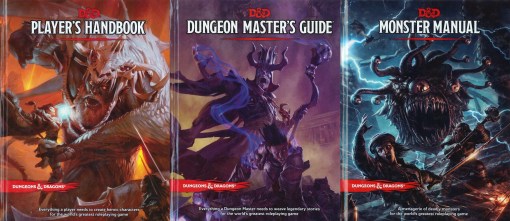
DNDtriumvirate

It’s the grandaddy of the roleplaying game industry, and for many — if not most gamers — the standard to which all other games are measured. It’s important enough in the gaming community that we’ve had vicious “edition wars” throughout the 1990s and 2000s. For many of us, and nearly all of us, if you’ve been playing since the 1970s or 1980s, it was your first exposure to RPGS (it was for me, rapidly followed by Traveler.) I missed out on all the edition war idiocy, as I walked away from d20 with the end of my high school D&D campaign.

The new edition of Dungeons & Dragons went through heavy playtesting with loads of input from players around the world as a response to the harsh (maybe overly so) reaction to 4th Edition, which tried to win the “kids” back to the tabletop by emulating computer RPGs — a bit of recursive irony, as computer RPGs (really, all versions of role playing games) owed its existence to the original D&D.

So what did all this hard work spawn? Answer: a modern version of AD&D with a few vestigial trappings of 3rd Edition — the most popular engine for RPGs at the beginning of the century, thanks to the Open Game License. For a while there, everything was f#$%ing d20 (and now it’s Fate.) The most popular version of D&D (if we’re being honest — that’s what it is) is Pathfinder, which uses a modified 3rd ed. rules set.

The system scrapped skills for the old school Abilities checks. Want to see if you did a balancing act on the thin wooden plank over a dangerous chasm, and do some complicated bit of lockpicking? Roll a d20 and add your dexterity bonus. Want to cast a spell or figure out a riddle? Intelligence. Just like AD&D. There’s class and race features and the usual Hit Point, Armor Class, and save thrown mods — just like in AD&D. I blew threw the Player’s Handbook in record time, because it was so familiar, even after 30 years, I barely needed to read it. There’s some new player character races (at least for me, but these have been around in various incarnations for decades), and some variations on the usual classes, but it’s all boilerplate Dungeons & Dragons. Spells work pretty much the same. There’s an equipment guide. Essentially, everything you need to play is in this book.

On to the Dungeon Master’s Guide: this book is not needed if you aren’t running the game, but it give the DM a massive tool kit for how to run a game. From worldbuilding elements like gods, planes of existence, to the minutiae of building a town or dungeon for exploration or adventuring, the book is a grand example of doing one thing really well — creating a world, adventures, picking treasures and monsters, and other aspects of the world or the encounters for a D&D campaign.

The third important book for the D&D gamer is the Monster Manual. I was pleased to see all the old standbys: the gelatinous cube, the bugbear, dragons of every color, orcs, monsters borrowed from all across the mythologies of the planet. There’s something for everyone, and every level of game. Looking for a total party kill? They gotcha covered.

The big difference between these products and those from back when I played D&D — the books are bloody gorgeous! Well bound, each coming in at about 330 pages, and filled with glossy paper with full color art of top-notch quality (no talented amateurs and somebody’s pal doing art here…) The fonts are clear and large enough for me to read without issue. The charts are well laid out and clear in purpose. The layout of the material proceeds logically; it’s unlikely you will get lost looking for a rule here. The table of contents and indexing are good, as well. The three books are an example of superior workmanship.

So — on substance, it’s a 5 out of 5. Everything you need to play is here. If you are not running a game, or are an experienced DM, the DM’s Guide is probably not especially useful. Style — again, 5 out of 5: layout, fonts, artwork are all top-shelf. I was very pleasantly surprised by the quality, and that it made me somewhat interested in what I might do with a D&D campaign…something I hadn’t considered since 1984.

Is it worth it? Well, I got them for the price of a pint and a desert because a friend didn’t think he’d play 5th ed. again. At Amazon prices (about $30/book), it’s a definite YES, and at the normal $50-70 a book I’ve seen in stores, if you want to play D&D, a qualified yes. If you don’t know if you’re going to play, or don’t think you need the books because someone else in your group has them — go the Amazon route.

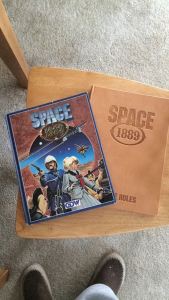
12670087_10153963273907082_3286283278008602244_nI’ve already done a review of the PDF version of the game, but I’ve finally laid hands on a physical copy of the game. This was a game that loomed large in my gaming through the 1990s, and informed some of the Victorian sci-fi camapigns of the early 2000s. I still have the original copy of the GDW game, bought at Compleat Strategist in Philadelphia in 1989. Now I have the new Ubiquity-powered game from Clockwork Publishing out of Germany to complement it.

First off, this is the “premium” faux leather covered version of the book. They go for about $100. Production quality on the book is good — the fake leather feels nice and the gold embossing is well done. The binding is solid, and includes a bookmark ribbon in bronze. Good glossy paper, with a readable font in two columns per page, with black & white, grayscale, and color art throughout the book. One point of contention is the sizing. Rather than a typical 8.5×11 or 11.25″ book, like many game lines, this one is 8.5×12″, so it sits higher in the bookcase. The different aspect ratio looks nice, but might be a pain if you don’t have spacious bookshelves.

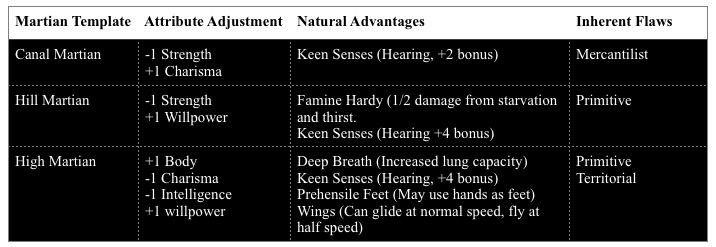
The new edition is very true to the original setting, but expands a bit on the original material of the game, mostly in dealing with Venus and the German colonies there, but also adds a bit on Mars and Mercury. Setting takes up much of the page count at 121 pages. The game rules are Ubiquity — the same system that powers Hollow Earth Expedition, the ’30s pulp game that usurped Victorian sci-fi in my group’s play rotation. There’s not much new to the rules beyond those found in HEX, same for bits on gravity on different worlds, and comes in at 80ish pages with character creation. One point where the new rules dropped the ball was on the Martian and Venusian characters…there’s no racial templates to give them their own flavor, so I cobbled some together based on the rules from Mysteries of the Hollow Earth and Secrets of the Surface World sourcebooks from the Hollow Earth Expedition line. They are presented below.

Style: The original game was pretty sharp for it’s time, with good color art and crappy line art for the rest; the new version is average RPG quality art for the black and white art, decent color. I’d go 3-3 1/2 out of 5 for the normal edition of the game, but the faux leather brings this edition up to a 4 out of 5.

Substance: Unless you plan on really digging into political intrigue and the like, the book is good enough to launch into a campaign that night, and the rules are complete enough to handle most situations — 4 out of 5. Is it worth the $56US for the print and pdf combo? If you are into this genre, yes; if you are an old Space:1889 fan that wants a better set of mechanics than the execrable ones from 1989, absolutely; and this edition with the swanky cover might be worth the $100 for the fans of the old game.

Space: 1889 is now available through the shop at Mödiphius.

Here’s the templates for the main alien races of the setting:

MARTIANS

Hill, Canal, and High Martians -- as portrayed in Chronicle City's version

Hill, Canal, and High Martians — as portrayed in Chronicle City’s version

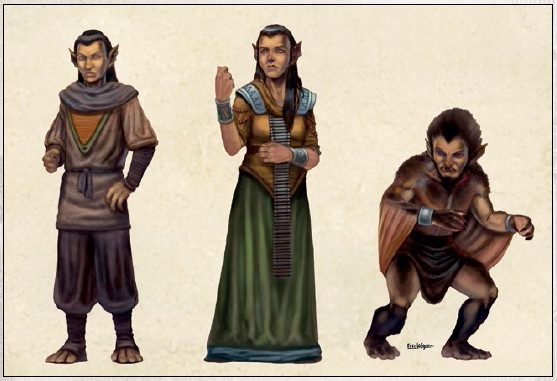
The denizens of Mars have three major racial types — the Hill Marian, found in the desolate wastes of the Red Planet; the Canal Martians, found almost exclusively in the urban and canal-fed areas of the world; and the High Martians — thought to either be the “Ur” Martian, or possibly a Hill Martians evolved to the particular environment of mountainous Mars.

Using some of the Beastmen advantages from Mysteries of the Hollow Earth (pg. 14-25), I slapped together Martian character templates that were more in keeping with the original flavor of the game:

template

Venusians

Venusians aren’t set up as a player character in either any of the editions of Space: 1889, but I’m sure there are folks out there that might want to give them more to do in their campaign than be a poor man’s Sleestak. So here is a Template, vikked from Hollow Earth Expedition‘s Mysteries of the Hollow Earth to use to create a player character Venusian:

venusian


Some game reviews coming soon:

Space:1889 by Clockwork Publishing — the physical book, this time.

Dungeons & Dragons, 5th ed. That’s right, Mr. I-Don’t-Play-Fantasy has the new game (mostly because I have a gig writing some adventure modules for it.)

Atomic Robo: Majestic 12 Sourcebook — the Evil Hat Kickstarter funded, and I’ve had a shufty at the pre-release book. As soon as it’s in my filthy furry paws, I’m reviewing it.

I had dinner last night with a gaming buddy I occasionally play with here in Albuquerque last night. We got talking about the various stuff we’ve been playing, what we’ve wanted to play, and I mentioned that the Battlestar Galactica game that’s dominated my group’s sessions for years was coming to an end. He pointed out I’ve been attempting to wrap this for a few years, and he’s right…but I just couldn’t bring myself to do it.

This past week, the rag-tag fleet reached Earth, 4 years and 9 months after the campaign first got restarted with a crappy pilot session about people going missing from a mining outpost on the Armistice Line. (I found the date on my computer’s calendar: 27 April 2011 — just ten days after my daughter was born…) There’s still a few episodes left, mind you, but the main conceit of the game — reaching Earth and (hopefully) safe harbor is the subject of next week’s session. Other than a few more loose ends to tie up, the game is over. My friend, at this point, bet me $20 I don’t finish by March. How could I resist?

But now I have a hard date for the finish of the game: February 25, 2016.

For five years, this campaign has dominated my life. Discussing it with one of the players during the ride home the other night, we were talking about the game. It is the longest continuous campaign I’ve ever run; it was the longest campaign he’s ever played in. During the course of the game, it moved from a Cold War conspiracy-style setting, to a military and post-apocalyptic setting, to an increasingly science-fiction setting mixed with Greek mythology, to a political thriller, and then hard into transhumanist science fiction. There have been players that have come and gone, but we two had been playing from the start, and three main players since the Fall of the Colonies, about three and a half years…the characters are rich, well-developed; the setting feels lived in, realistic — despite the increasing science fiction aspects; it’s been, I feel safe to say, epic.

There were a few really big risks I took. Early on, I threw out canon from the reimagined show, but kept the good stuff from the setting. The Adamas were not the focus; the player characters took the place Apollo and Starbuck and the commander.  A bigger risk was going with “the Blaze” elements that got cut from Kobol’s Last Gleaming (a mistake, in my opinion); the “angry god” that destroyed the harmony of God and Man became the main antagonist, and the humanoid Cylons became “Seraph” — his “messengers” and replacements for the Lords of Kobol, Hades’ “family” whom he missed. I brought in Athena to replace a popular NPC and though I’d really screwed the pooch doing it. After a few sessions, it was obviously better. And in the end, I think I may have run my best game in the 37(!!!) years I’ve been playing RPGs.

Better than the excellent Babylon 5 game that was the first time I tried to do a coherent, planned out story arc. Better than the surprisingly good and long-lived Star Trek game at the start of the aughties, after I moved back to Albuquerque. Better than the very good espionage and Victorian sci-fi games from the ’90s, or the uproariously fun Shanghai campaign for Hollow Earth Expedition that faded away after this gam started.e..and like a good TV series, I want to see how it ends, but I don’t want it to stop.

Now the question — the same one I’ve been trying to work my way through for about six months, once I realized how close we were to the end — is “what next?” Or maybe more appropriately, “How do I top this?” and I suspect that’s my big mistake when thinking about the next games. I didn’t set out to top myself with Galactica, I just wanted to do the best game I could for people.

I sent out an email to the group, looking to see what they wanted to play or run. The newest player likes to GM, I was hoping to coax her into the center seat, but we’ll see. The big favorite seems to be a cyberpunkish sci-fi game, Atomic Robo, and I’m thinking I’d like to take a crack at either Space:1889 or Hollow Earth Expedition‘s Revelations of Mars settings, but I think that’s it for space opera for a while.

It’s been a while since the last AAR for the Battlestar Galactica game. We had the usual holiday nonsense, some winter wonderment (snow) that buggered up attendance, and a change of venue due to my daughter’s new school schedule, and the last few sessions were “talk about our feelings” episodes mixed with the setting is being fleshed out, and ti was being chewed on by the players and their characters. It was interesting, but not enough to require their own posts. Without further ado…

Since the fight at New Ophiuchi, the fleet had been looking hard for the Seeker ship — the massive Kobolian ark they’d seen being attacked by the Cylons. Eventually, they find the ship, but not before we had one of the characters biff their navigation test for the jump into the star system they were looking in. Their heavy raider comes in too close to a ring system around a gas giant and they get hit with a chunk of ice and rock that kills the raider, rips open the hull killing one of the PCs — our equivalent of the Leoben model — from exposure to space, and leaves the two pilots desperately trying to fix the ship while running low on O2. Eventually, right as they are near suffocation, the Seeker ship’s scouts find them.

After convincing the Seraph leadership of their non-beligerance, they suggest a meeting between the Seeker ship and the fleet. This leads to a long series of meetings where the admiral and the Seraph leadership councils try to hammer out an alliance between all involved. They learn the Seeker ship has a bunch of transports — mostly running empty from feeding the almost 13,000 humans and roughly 17,000 Seraph in Seeker 13 and Resurrection 5. (10,000 of the Seraph are still “on ice”.)

One night dealt almost exclusively with the admiral finally admitting his love for Tana — the Seraph model Three commanding Unity (the former Basestar 19.) He’s managed to impregnate her, and they marry in the hopes this will draw their peoples together.

As all of this is happening, the fleet is moving steadily toward Earth, stopping periodically as they run across ancient battlefields — ships that have been dead 300, 500, even 5000 years. The two worlds the Seraph had known were settlements of the 13th Tribe, and which had been locked into the “Gene/Tech War” 500 years ago — blasted and dead. The very old ruins of ships show another major conflagration that almost predates the Lord of Kobol and their rule…how long has the Cycle been going on, and what are they going to find as they get to Earth? These mysteries are intriguing and encouraging some, but many in the fleet are rapidly losing faith in Lady Athena and the other Kobolians…what are they leading them into?

Finally, they find themselves a light year from Earth, scanning the sky for any sign of life. They find ELINT from Earth and its moon, from Mars, and from Jupiter. Someone is home. Admiral Pindarus orders the final jump of the fleet — Jump 75, serendipitously — and they arrive near Pluto and Charon, and their moons. A search of the system shows a beautiful, Caprica-like, world with a moon that is unusually symmetrical in its gravity field, a featureless orb with a high albedo, which is pumping out signals and is very hot. That’s not the most unusual thing — Mars is swarming with some kind of activity — a utility fog large enough to engulf a planet. This, the Lords of Kobol tell them, is a hekatonchires, a planet “repurposer” In orbit around Earth and in the flux tube between Io and Jupiter, there is a Ship of Lights, like the one Hades/the Blaze traveled in! These are the TITANs’ bodies.

Before they can do much else, suddenly there is a TITAN amongst the fleet! The ship systems die, there is a loud growling noise that drowns out all other sounds, and bright, white light which oversaturated everything to white.

Next week…answers?

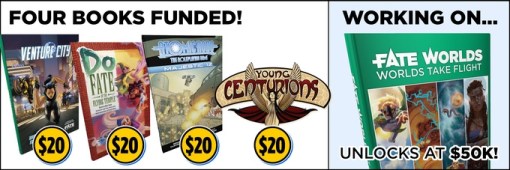
Evil Hat — the makers of many Fate titles — has a Kickstarter campaign going to help finance their next run of product. For each $20 bid you get one of their print books of your choice.

b327486c361dcfa3cefe8a773cd5d33b_original

At least the Majestic 12 book for Atomic Robo has been funded…now if we can just get a few thousand more, they’ll been releasing the Atomic Robo version of the system to their open license.