The repair rules for vehicles and ships in the Serenity and Battlestar Galactica RPGs uses the same idea as healing wounds for a character — appropriate, in some ways, as vessels are treated as characters by the rules. However, not all vehicles are equal…a motorcycle might have 8 life points, as opposed to a car with 12 or 14…a 5W crash seriously impedes the operation of the bike; the car has some pretty nasty body work and maybe some mechanical repairs necessary, but it’ll still get you to Dubuque, if you need.

More important is the ratio of damage to structure, I think, and to more accurately reflect this, here’s my take on Repair:

io9.com is reporting that Quantum Mechanix — the boys and girls that gave us the superb Firefly maps and deckplans, etc. has just churned out a map of the 12 Colonies for the Battlestar Galactica fans.  It was put together with heavy input from Jane Espenson and the Caprica science advisor Kevin Grazer, so it’s as canon as it gets, folks!

I already preordered mine for $14.95.

There’s a short interview with Espenson, as well, at io9.com.

Looks like I might have to do a bit of work on my Colonies primer…

The core rules for Battlestar Galactica are pretty minimalist, designed to allow for quick action sequences that don’t detract from the drama or storytelling.  But BSG is inherently about conflict — the Colonials are fleeing Cylons, and are often fighting them.

Some players like a bit more “crunch” to their rules.  Especially when you have characters that are engineers, or deck crew — people who fix and maintain stuff.  They will want to know what systems got blown out, burned up, or shorted in the fight…and if you’re not the sort of GM to handle this on the fly, I’ve slapped together these rules to add a bit more to the spacecraft combat.

They’re crude and could use a bit of refining, so if you decide to use and improve them, let me know or kick me a copy of whatever you do to them.

Good hunting.

These are the old basestars and raiders, as portrayed in Razor.  There’s a paucity of information on the vessels, so I had to do a lot of guesswork for the stats.  The assumptions:  the basestar is originally a warship from one of the colonies’ forces, as were the raiders.  The size would suggest these were the truly heavy guns of the War-time period.  These vessels most likely use similar weaponry to the Colonials, and much of it might be retrofitted onto a battlestar, if the need should arise (like, say, the whole of the Colonies being wiped out.)  I assume that the control mechanisms of the basestar are most likely usable by humans, and the raiders almost certainly.  That doesn’t mean that they might not have been retrofitted with some of the biomechanical equipment from the Mk II Basestar at some point.

MKI BASESTAR

DIMENSIONS:  Diameter: 2500′   Draught: 625′   Decks: 30  Crew: 5000 Cylons (about 1000 tasked for raider duty)

ATTRIBUTES:  Agility d4, Strength d12+d4, Vitality d8, Alertness d10, Intelligence d10, Willpower d10

SECONDARY ATTRIBUTES:  Life Points 24, Initiative d4+d10, Armor 5W, 5S, Speed 4 [SL/JC]

SKILLS:  Heavy Weapons [d4], Mechanical Engineering [d4], Perception [d6], Pilot [d4]

TRAITS:  Formidable Presence [d4]; Memorable [d4], Seen Better Days [d4] (Only in a campaign set around the Fall)

ARMAMENT: Heavy Skirmish Range Point Defense System [d12W Vehicle-scale], 80 Medium Capital Range Missile Systems [d12, Spacecraft-scale], 16 Heavy Capital-Range Railguns [d12+d4 Spacecraft-Scale], Nuclear Long-DRADIS range Missile Systems [d12+d8, Spacecraft-scale]

AUXILIARY CRAFT:  320 Raiders, 50 Heavy Raiders, various smaller craft

EARLY PERIOD RAIDER

DIMENSIONS (Estimated): Length: 28′   Beam: 18′   Draught: 10′   Scale: Vehicle   Crew: 3

ATTRIBUTES: Agility d6, Strength d8, Vitality d8   Alertness: d8   Intelligence: d6   Willpower: d6

SECONDARY ATRRIBUTES: Life Points 16,   Armor: 1W, 2S, Initiative d6+d8   Speed: 7 [SL]

TRAITS:Formidable Presence [d4]; Memorable [d4]

SKILLS:Heavy Weapons [d4], Mechanical engineering [d4], Perception [d6], Pilot [d4]

ARMAMENTS: 2 30mm MEC-A4 Cannons [d8W Skirmish-range, Vehicle-scale], 4 Thunderbolt Missiles [d12 Capital-range, Vehicle-scale] or 2 Trident Antiship missiles [d6 Capital-range, Spacecraft-scale]

At the end of our game “season”, the crews of Pleiades group had found the Home of the Gods, Kobol.  They arrived a little over two months after Galactica had blown through on their way to Earth, and the only sign of their passing (initially) was a debris field around the planet.  After besting a Cylon basestar there to guard the planet, we ended with the ships in orbit and preparing to go to the surface to look for clues to Galactica‘s course, the nature of the gods, etc.

With the return of one of our players from Scotland, we’re about to fire the campaign back up.  So now I have to turn my attention to Kobol, and what exactly there is to find there.  Unlike the TV show, Kobol is not simply a stepping stone to Earth.  Our characters will find that they have another path, that they are not following the Scrolls of Pythia, but rather the Scrolls of Sybil (even more hazily defined than the Pythian myths in the show!  Gotta leave wiggle room!)

So Kobol is a place not just of exposition for their course, it is a place that holds its own secrets and meanings, and reasons for being there for our crew.

So — Kobol was an advanced planet.  They had the ability to launch massive spacecraft to go colonize the 12 worlds.  It was at least as advanced as the Colonies were, themselves.  That means advanced construction materials and techniques.  So unlike the Kobol of the screen — there are more than a few damaged Doric columns to identify the place; there are ruins galore across the face of the planet.

The City of the Gods — Olympus — is mostly destroyed, partly due to war (the Blaze), and partly due to 2000 years of natural erosion and damage.  While concrete and other porous building materials are susceptible to damage from the elements, there are a number of ancient ruins — untended for centuries — here on Earth that have survived, often damaged or worse.  The best locations for material to stand the test of time are dry and relatively stable climates where the change of temperatures and a minimum moisture do not tear up the structures (the Pyramids, the Parthenon, Petra), while places far north are much more likely to have been destroyed by a combination of weathering and dramatic changes in climate.

Olympus is built on a marshy patch of ground in a wet, cool climate (it’s almost like it was shot in British Columbia!) and most of the place has eroded away to nothing…but depending on the materials used, there could be elements of buildings left standing:  girders (if made of a material that resists corrosion), hard stone walls, even evidence of roads, which might have been used by animals in the intervening millennium.  Evidence of technology is possible, as well — ceramics and some plastics are extremely resistant to the elements and flora.

For my Kobol, there will be at least 13 major cities — each being the home to a patron Lord of Kobol, each with its own unique elements to represent the lord of the city.  Thousands of other cities, and even more towns had dotted Kobol, in my take on the world, but much of that has being reduced to nothing by time.  Of the 13 cities, only a few are anything near explorable, and those are all, conveniently in desert or semi-arid climates.  (I’m still working on this; consider this a thought exercise, if you will…)

Olympus, City of the Gods:  this was the “capital” of Kobol, and the meeting place of the Lords.  Destroyed by war and time, there is little to see here (unless you count mystic visions.)

Heraion:  Near to Olympus, Heraion was centered in one of the breadbaskets of the world, in a richly forested valley (although from the air, the old patterns from agriculture and land division is seen as a strange patchwork design in the growth.)  The city is mostly destroyed, like Olympus.

Corinth:  A seaside city, this was once a center of commerce.  The place has been half destroyed by an earthquake and flood, but parts of the town still stand in the waters of a sheltered bay.

Aresium:  A desert town on a large river near a ocean bay, it is one of the better preserved ones.  Damage to the outlying buildings facing the desert are blackened and scorched, and have mostly collapsed.  Toward the river and bay, the town is surprisingly intact — roofs collapsed, but many of the walls stand, there are statures to the god of war, and there are the remnants of vehicles in the roads.  The harbor has collapsed, but the remains of a lighthouse are visible under water, along with an entire neighborhood of buildings.  Over a slight mountain range, there is evidence of a massive explosion — a nuclear weapon or meteor strike.

Etna/Vulcanium:  On a large volcanic island not far from Aresium are the remains of another town.  The metal superstructures of buildings are twisted and eroded by the sea air, but the walls, roads, and the substructures of the buildings are remarkably intact.  From the air, it is obviously an industrial center — and a large one (think Yokohama).  At least part of the town shoud have been buried in an old lava flow (because it’s great theater!)  On a nearby spit of land, there is evidence of more towns, mines, places to supply Etna with it’s raw materials.  It would be an excellent place to find an underground factory of immense proportions with a number of fantastical devices — like golden female robots.  This would be the Forge of Hephaestus.

Athenaeum:  This could be a city, mostly destroyed, with a recoverable data (with extreme difficulty) in an archive or library.

The point would be to show the Lords of Kobol really did exist, and throw some (incomplete) light onto their divinity (or not if you’re following the new show).  It could give insight into the “all of this has happened before…” motif, and allow the characters to find ancient technology that might not be usable, but might be copyable.

Or you could have the whole place wiped clean by the wrath of god (just make sure to use that Denholm Elliot accent, “wroth” when you say it.)

Battlestar Galactica and Caprica allow us a few hints for the time reference system over the course of a few episodes.  The units of measurement are about the same as today:  60 seconds to a minute, 60 minutes to an hour, 24 hours to the day.  There’s 7 days in the week and 52 weeks in a year, giving us a 365 day year. (This is pulled from Baltar’s monologue/whine-fest about the number of DNA tests he has to do in the first season.)  There are months mentioned, but never how many.

Days are named as they are in English — Sunday, Monday, and Wednesday are mentioned, so it would be safe, if you want to be a canon-thumper to use the days of the week as is.

Month names are gleaned mostly from set dressing — paperwork, newspapers, etc. Generally, they use the name of months with an “-ius” added to them.  Ianuarius, Februarius, Martius, Aprilus, Maius, Junius, Julius, Sextilis, Septembrius, Octobrius, Novembrius, Decembrius.  (Bolded names are seen in set dressing, others are taken from The Caprican website.)

The years seem to be based on the arrival of Galleon at the Twelve Colonies — 2000 years before the Exodus.  This is based on dating in Caprica which is frequently shown as xx:xx:xx (year, month day.)  There are other systems in the BSG series, but they appear to be, like stardates, a complete and total mess.  I would suggest using the YR01 (Year 1) system from Caprica, rather than trying to make sense of Galactica‘s dating.

To make it a bit more exotic, yet familiar enough to be grasped by the players you could use the Greek weekday names: (Monday to Sunday): Selenes, Areos, Hermiou, Dios, Aphrodytes, Kronou, Heliou.

Most players of the Battlestar Galactica RPG are going to want to play viper pilots, but just as important — in fact possibly more important — is the Raptor. These vessels were used mostly for recon missions, and occasionally packed with missiles and rockets for some dramatic battle sequences in the show, but would the real use of these vehicles be?

The Raptor is the workhorse of the Colonial Fleet.  It acts as an SAR vehicle, recovering pilots that have successfully ejected from damaged craft; they are a small-group transport, moving sqaud-level troops into an area of operation; and they are an electronic warfare platform.  It is essentially a combination of Blackhawk helicopter and E-6 Prowler.

It is the role of ECM bird that is where the Raptor is highly important and overlooked.  Spacecraft in BSG are huge and ungainly — they don’t duck and weave to avoid missiles and gunfire.  They are also incredibly easy to hit with weapons — space is huge, but there’s also not a lot of stuff to hit on the way to the target.  This makes stopping incoming weaponry is of paramount importance.

Vipers are used to intercept and shoot down fighters and missiles in flight, and once ordinance is past this phalanx, the next line of defense is the ship’s point defense system.   In between these lines of defense is the raptor.  Acting in its ECM role, the raptor attempts to jam and confuse the missiles that are fired at their battlestar.  They can use this capability to confuse and limit the response of the raiders that are similarly attacking their viper squadrons.

During a combat turn, a raptor pilot or his ECO can attempt several actions:

They can attempt to jam incoming fire from an enemy unit.  The ECO or pilot rolls a ship ALE (usually a d12)+their Tech Engineering/ECM.  The result is the difficulty of the enemy to hit their target.  Example:  a Cylon basestar needs a 3 to hit the battlestar Pleiades.   Raptor pilot “Jumbo” attempts to jam incoming fire, rolling the raptor’s d12 Alertness and his d10 Tech Engineering/ECM.  He rolls an 11.  The basestar rolls its Alertness of d12 and a Heavy Weapons of d4 and rolls an 8…the missiles are jammed, missing the baattlestar or exploding in flight (confused as to their range to target.)

Although I don’t allow jamming of cannon fire, I do suppose that attempting to jam ranging DRADIS would be possible.

Second, a Raptor can try to jam the guidance or tracking systems of a raider.  The ECO or pilot does an opposed test against the raider’s Alertness +Perception.  If the ECO fails, the raider suffers no consequences.  If he succeeds, his success is added to the difficulty of the raider to fire on an enemy or avoid fire.

Example:  A particularly wily raider is harassing Pleiades‘ CAG, Professor.  He can’t shake the raider due to a series of really good rolls on the raider’s part.  His wingman, 3-Point, is trying to line the Cylon up, but it’s all over the place.  Jumbo decides to try and jam the raiders in the vicinity of his raptor, including this annoying toaster.  He rolls his d12+d10 (raptor Alertness+his Tech Engineering/ECM) vs. the raider’s d8+d4.  Jumbo rolls an 11, the raider an 8.  The raider now has a +3 to all difficulties on its tests (including adding to the dodging tests for Professor to avoid being hit, and 3-Point’s attack on the raider.)

A third option might be to deny the enemy use of communications — jamming their communications.  Doing this can seriously turn the tide in combat, by making it hard for the enemy to coordinate their actions.  The raptor crew can use their jamming test against the command and control elements of the bad guys.  this would make tactical rolls for the enemy more difficult.

Example:  Pleiades‘ commander has noticed that Cylons are running very tight operations, running their fighters in well-organized, coordinated attacks that their vipers are having trouble countering.  (Professor’s been rolling badly for his tactics test to gain initiative against the Cylons and it’s meant his squadrons are out of position and not intercepting Cylon raiders.)  He orders Jumbo and his ECO Drippy to find and jam Cylon communications.

Jumbo rolls a d12+his Tech Egnineering/Communications (a d6) to find the Cylon frequencies — he gets a lucky test of 18!  Having rolled onto the Cylons C3 signals, he has Drippy jam them vs. a Formidable (15) — Jumbo, being the player character, rolls for Drippy with his stats: a d12 for the raptor and a Tech Eng/ECM of d10 for a 17!  The Cylons now have a -2 to their Alertness+Tactics tests for the next round vs. Professor (rolling for the vipers) and Pleiades — and it’s just enough to allow Professor to use the confusion to get his people into position and splash some toasters.

There’s a downside to jamming, however, as any signals intelligence guy can tell you:  You have to broadcast loud and hard across the battlefield.  The makes you the brightest radiation signature in the area of operations…and that brings a lot of fire down on your position.  Jamming isn’t something you want to do for long, and you don’t want to sit still while you do it.

Locating the jamming element is EASY on an Alertness+Perception test.  Once spotted, the raptor crew can expect an anti-radiation missile (a missile which locks onto EM signatures) to come visiting in short order.  the pilot better be ready to dodge fire at any moment.  It also means that a raptor is unlikely to jam the communications across the battlezone consistently.  Leakage can effect friendlies, even if they’re not on the same frequencies, if they’re close enough.  (A botch and the friendly forces are being jammed.)

This gives the raptor player something more to do than wait for an SAR mission in combat, and makes them as important a part of the action as the gunnery officer or the viper pilot.

MANPADS are man-portable, surface-to-air anti-aircraft weapons.  In theBattlestar Galactica RPG, they give stats for the SMI92 “Flying Needle” — essentially the Stinger missile.  The weapon has a maximum range of roughly 15,000′  (about 3.5 miles), and damage of d8W, vehicle-scale.

Similar weapons like the Milan and the Starstrike use laser guidance, instead of optical sighting, and their rockets fly at about Mach 3.  The Starstrike uses a trio of “needles”, each made of tungsten and carrying roughly a 3 lb. warhead.  The Starstrike would have a vehicle-scale damage of d10W (and for Serenity a spacecraft scale of d0W.)

Ever since I started running the Serenity RPG, I’ve been using the following rule for actions in action turn/combat round/whatever you want to call it.

Each extra action above the first comes with a -1 die step to the attribute. Say you have a d8 Agility. If you changed a magazine on a gun, then want pop off a shot in that turn, you can.  But the shot is a d6+skill.  Say you double tapped, the second shot?  d4+skill.  While doing that you were snagging your rucksack and wanted to get up.  Roll either an Agility or Strength and Athletics (if you had a Strength of d8, you would roll a d4+Athletics, as opposed to a d2+Athletics for an Agility.)

The limitation:  once one of your attributes is at d0 — you can do nothing, including take any kind of passive defense or passive perception tests (you tunnel vision on your tasks.)  We find it works out to roughly 3-5 actions a person could take in 6 seconds, each increasingly harder.  I’ve found that most players will leave themselves a d2 or d4 for wiggle room, should they need to defend against attack or notice something important.

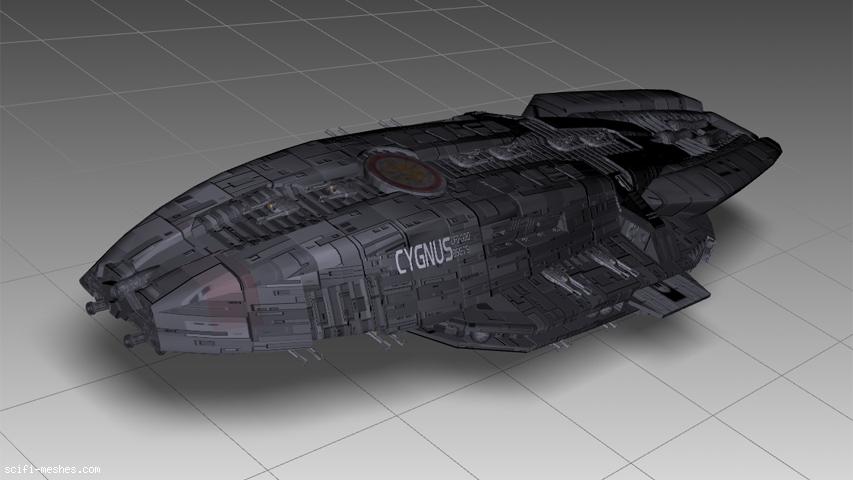
One of the readers had a question about a Cygnus-class gunstar mentioned in the Minerva-class post.  I had hesitated to put up my specs on it, since I couldn’t remember who had done the model of the ship I based the stats on.  Thankfully, Limerickcot on the Cortex Role Playing Game forum did a write of Cygnus and credited the artist (backstept.)

His version and mine are fairly similar, looks like…

Gunstar Cygnus

Cygnus is a small escort designed to work in conjunction with a battlestar group.  The main role of hte gunstar is force protection — in this case, to protect the lead battlestar by setting up an extended perimeter.  The gunstar is well-armed, but not designed for protracted fights.  The through-beam landing strip is meant only for standard ferrying and victual activities; she carries no fighters.  (Limerickcot’s version is a pre-Cylon War vessel and would have been colony-specific — an idea that I rather like…)

CLASS: Cygnus        TYPE: Assaultstar        SCALE: Spacecraft
LENGTH: 1153′        BEAM: 83.3′    DRAUGHT: 144′
DECKS: 11    CREW: 270 standard, 400 max

AGL: d6   STR: d8   VIT: d8   ALE: d6   INT: d8   WIL: d8
INIT: 2d6   LIFE: 16  SPEED: 6 [SL/JC]   ARMOR: 3 wound, 3 stun

SKILLS:
Heavy Weapons d4, Mechanical Engineering d4, Perception d6, Pilot d4

TRAITS:
Mass-Produced, Past It’s Prime

ARMAMENT:
Medium Skirmish Range Point Defense System: d8W Planetary-scale
22 Capital-range Medium Railguns:  d10W Spacecraft-scale
4 Short Dradis-range Medium Missile Systems:  d12W Spacecraft-Scale

AUXILIARY VEHICLES:
6 raptors, 2 shuttles

(You can find backstept’s work at Sci-Fi Meshes.com.)