I’ve got an e-copy of the Firefly RPG from Margaret Weiss Productions, and next week I’m planning to run a one-shot with the system. After that, we’re going to run the same adventure and characters in the old Serenity rules (with a slight modification — we’re using what I’ll call Cortex 1.1, using the Assets and Complications rules from Battlestar Galactica and Supernatural.)
However, I can give an initial report on the character creation for both systems, having put together six pre-gens for the one-shot.
1) Speed of character creation: I’ve been using Cortex 1.1 for six years of so for various games, so I’ve reached the point I can slap together a pretty nuanced character in about 10 minutes, tops. After getting used to how the writers laid out the character creation in the Firefly corebook, I was able to put together a reasonable version of the Cortex 1.1 characters in about the same time. It’d give the slight edge to the Cortex+ version here.
2) Closeness to concept: One of the reasons classic Cortex has become my favorite system is the ability to really craft a characters mechanics to match the concept. There’s six attributes — the physical: agility, strength, vitality; and the mental: alertness, intelligence, and willpower. Assets and complications give a die to the character or the GM, respectively, when they come into play. Usually, if I bring a complication into play, the player gets a plot point. Skills and their specializations are well-defined. These all are defined from d2 (weak!) to as high as 2d12 — but usually you will be between d4 and d12.
Firefly‘s Cortex+ has three attributes: physical, mental, and social and the characters get to assign a d6, d8, or d10 to the attributes. You can even them out to d8s across the boards, if you like. Assets and complications are replaced by the Fate-inspired Distinctions. You get three at d8, and may add up to two triggers (ex., a Veteran of the Unification War distinction might allow you Fightin’ Type or War Stories with certain mechanical benefits.) All characters have the same skill list and at least a d4 in all of them. Each of the distinctions gives you a linked skill that you gain a die step.
For instance: Colonel Atticus Wynn is a veteran of the Alliance military who has fallen on hard times. He crossed the wrong politician or military figure during the war and has found himself unable to capitalize on his service. In the Serenity rules, he’s got the Branded, Deadly Enemy, and Things Don’t Go Smooth complications, with Fightin’ Type, Friends in High Places, Natural Leader, Military Rank, and Tough as Nails for assets. He’s well defined.
In the Cortex+ version, I had to really work to balance the distinctions in a way that emulated the complications and assets. I created one called Mercenary Leader based on Ship Captain. He has a Lead from the Front trigger that allows him to spend plot points on his subordinates. He’s a Veteran of the Unification War with the War Stories trigger allowing him to step up assets or complications from the war. He’s got Smooth Talker, as well, since he was build in Cortex 1.1 with good influence and social skills. The three distinctions left him with good Fight and Shoot skills, and lesser Influence, Knowledge, Move, and Survival skills that were improved with the nine points given to tweak the skills. He added two specializations and took two d8 Signature Assets — a stealth suit and an Alliance assault rifle.
The difference between the character builds was subtle in this character. I had to create distinctions or signature assets to get close to the classic Cortex build on a few characters, but overall I was able to get close to a match, mechanically, for the characters. A few of the character templates were close enough to tweak and make them work — there’s quite a few of these templates to use to get yourself into play quickly. However, there’s a lack of detail to the Cortex+ assets, it can be hard to get distinctions to model the detail of the asset/complications, and the specializations are a bit free-form. If the players want the character design to help them play the character, I lean slightly toward classic Cortex for the ability to tailor a character in detail.
So for speed of character creation, there’s almost no difference in how quick you can put together a character (unless you choose to tweak a template — then Firefly is the clear winner here.) As to creating a detailed character, classic Cortex does a better job, but not by much.
So, we finally had a chance to play another session of our pulp campaign I’ve titled Thrilling Action Stories! after a two week hiatus to visit family in various parts of the country.* We had started off the campaign with the McGuffin — a death jade that apparently belonged to the first sovereign emperor of China — which was used in a summoning to better effect than was expected. The host of the summoning was temporarily taken over by the spirit of the emperor, but this was interrupted by the arrival of a bunch of black-clad martial arts types that killed the possessed man and stole the jade.
Fights and car chases ensued, and the characters eventually did a bit of sleuthing that led them to a warehouse in Limehouse (the Chinese district at the time of the game, 1936.) With the aid of a rival gang, they were able last night to raid the warehouse. There was a quick bit of wushu vs. gun play action and the heroes discovered the major henchman of the piece — a captain of the Si-Fan Triad named “Terrible Blade.” After a bit of chop-socky, they pursued the villain into the damp, dank catacombs below the warehouse, where the villain released a trio of black-skinned, pale eyed “Creature from the Black Lagoon”-style monsters.
The heroes destroyed the monsters by using a convenient barrel of gasoline used for the hoopcycles from the aforementioned car chase and a few well-placed shots from a Mauser .30 to blow the critters (and, very nearly, themselves) to kingdom come. Another chase sequence led to the capture of the jade.
After a night in jail and the intervention of MI5 and the Colonial Office, the characters have been hired to return the jade to the Nationalist government in Nanking — more to get them out of London and put to bed any talk of amphibian monsters, possessed academics, and Chinese gang activity.
Here’s an excellent 12 minute film by Ferand Peek about a combat mission gone bad. It’s most interesting for the focus on the face of the soldier throughout the piece.
I’ve been pretty lucky to have adult — psychologically, if not physiologically — at my gaming table for the last thirty years or so (Am I really that old!?!), so this hasn’t been much of an issue for my games, but judging from some of the gaming boards and Facef#$% — I mean Facebook — discussions this is not the case for others.
That most cootie-rific of issues: romance!
I’ve covered a lot of the issues connected to romance at the game table in a few posts from the past —
1) This was a response to Dom Mappin’s piece on Gnome Stew in which I discuss the issue of romance between players. While the piece still has some good thought and advice, my opinion on it has matured to a 1) It’s none of your business what the players are doing together, and b) It’s none of your damned business what the players are doing together…but it can still screw up a group’s dynamics.
2) As to romance between characters: Just do it. Especially if you are looking for good motivations for characters, or for a more realistic world for the players to game in. Which naturally leads to sex and romance — where do you draw the line? G? PG? R? NC-17? That depends on the players and the nature of the game.
As with anything, romance in-game means you have to know your audience — who are the players and what do they want or abhor? As to romance between players? It’s going to happen, and it’s none of your damned business.
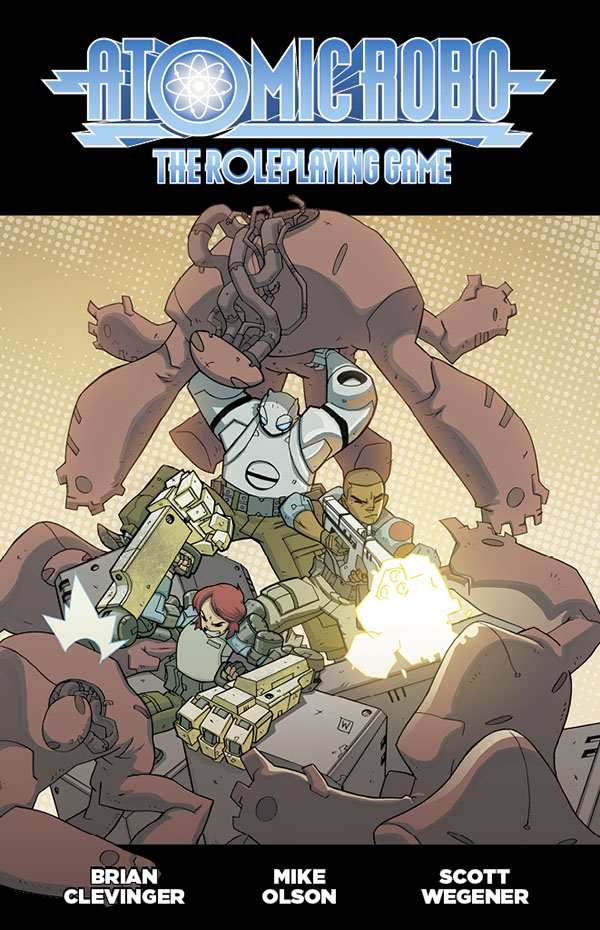
While I was part of the initial playtesting, I hadn’t read the finished product until I had a little time on planes while running around the country on ‘vacation’ (seeing family.) Evil Hat has the print version in the final works, but the pdf is available through their preorder or Drive Thru. Behold! The dramatic reveal!
The system is Fate, tweaked a bit for the universe of Atomic Robo, but the basic mechanics are unchanged. Character creation is fast and “no-math” — the player choses the usual concept descriptor, a couple of their modes (ex. Action, Science, Intrigue) and their skills lump under those. Those odes with the same skills stack, so a character with, say, a vehicles skill in three modes would place it under the highest mode with the +4, then add two more for the synergy with the other modes. It’s easier than it is to describe.
You can have a character slapped together in minutes and be playing, and the rules allow for tweaking your character on the fly, and whenever you hit a particular milestone connected to the adventure or character.
The main additions to the rules are in the area of “brainstorming” science ideas, in which the players get to use their skills to try and figure out a science conundrum, then the one with the best quasi-applicable idea gets to define how the bad guy or mcGuffin for the adventure works (“The giant ants were obviously created by radiation!”) As for the rest of the mechanics, it’s Fate. It you aren’t familiar with the mechanics, you can find them for free on the interwebz. Have a look, if your puny mammaliam brains can conceive it!
On to the book itself — it’s very well laid out, easy to read, and captures the flavor of Atomic Robo and the related Real Science Adventures comics very well. Explanation blurbs with pics of characters from the series help you understand the mechanics, or just amuse you. They have Dr. Dinosaur — that alone was work the price of admission for me. Do not question it!
The book does an excellent job of laying out the timeline of Robo’s adventures, describing the various organizations in competition, and has rules for the kind of support the organizations can provide and how the characters’ adventures affect them.
So is it worth the $35? How can you even ask that? It’s got robots, and science!, and punching…and dinosaurs and stuff. The layout and utility of the e-book is better than most , but I’ve got one of the final pre-release copies and the hyperlinks to jump around the book weren’t enabled yet. I assume they will be in the current or future releases. The substance? The new rules help capture the flavor of the comics, and the book gives a pretty decent introduction into the world of Atomic Robo for those who are uninitiated, but this book has a pretty specific demographic — fans of the comics — so they could always crack open the original material, if need be. The rule book is very good about pointing you and the right series and issue of the comic that ties to the material in the background sections.
It’s a buy, especially if you’re a Tesladyne booster.
UPDATE: I received the physical book today from Evil Hat. The $35 gets you the book and a free e-book download. The look of the pdf is preserved in the softback book, which has a nice satin finish to it, and is slightly smaller than usual for a game book at what looks to be a 6.5″x10.25″ aspect. (I didn’t measure it, but should be close.) Still worth it.
Looks like Matthew Vaugn, who brought us the excellent spy/superhero thriller X-Men: First Class, has delivered another comic-inspired movie. This time it’s the Mark Millar/Dave Gibbons Kingsman: The Secret Service…
Two weeks ago, I launched our new Hollow Earth Expedition campaign with an occult summoning gone terribly awry and straight into a fight with black-hooded wushu fighters that led to a high-speed chase through London on “hoopcycles”, as I described them. In reality, they are the Mono Wheel of Swiss inventor named Gerdes who built the contraption in 1935 (so period appropriate!)
HOOPCYCLES
Powered by a 980cc parallel twin motor from a motorcycle, the hoopscycle is a marvel of invention. The vehicle has a single seat with a stearing wheel that operates a gyroscope, aiding in the maneuvering of the single wheeled craft. It is incredible fast and maneuverable, and very very loud.
Here’s the Dutch Euro-dance-crap band ADAM’s video for their song Go to Go. Here’s the ladies attempt to sing their song while using a vibrator. Its not the first time this schtick has been done. There was a series called Hysterical Literature of porn stars reading while doing the same thing.
Lage Manufacturing builds custom accessories for submachine guns, and here they make the dreams of millions of geeks come true with a function replica of the Colonial Marine’s M4A1 Pulse Rifle called the MAX-41A:
Submachinegun component is a NFA registered SWD M-11/9 with an Anthony Smith style Suomi upper receiver. Magazine used is a Suomi “Coffin” magazine that holds 50 rounds of 9mm. No modifications or alteration of the M-11/9 lower receiver is required. Shotgun component is a NFA registered Remington 870 short barreled shotgun. BATFE letter was obtained confirming this is a legal configuration, prior to manufacturing.
The original Pulse Rifle was built off of a Thompson .45 submachinegun and SPAS-12 shotgun. In the film it was a 10mm caseless rifle with a 100 round magazine, and with a 30mm 4-shot grenade launcher. Considering there is the FRAG12 round out there, you could get darned close to the actual weapon…

 The Black Campbell