Our series of adventures concerning the Pegasus task force continued last night. After a hard fight at the main Cylon staging base, we picked up a few weeks later. The ships are repaired, and are close to arriving at the Colonies. There was some character stuff for this episode involving a B story in which the ship’s command chief “lost” his coffee mug he’d been working on for years of his service. (Most of the navy guys I know would only do a cursory cleaning of the mug, claiming the brown staining on the mug aided the flavor. One guy, at DLI, lost his mind when a young airman, hoping to earn points with him, cleaned his mug spotless…this is where I first heard the term “fuck knuckle”.) The mug had been a last present from his father, who had retired from the same ship the chief was first stationed on, and who passed away shortly after from cancer.
(We’ve established that most people who serve in the fleet for a few tours come down with some form of cancer in the future. It’s one of the realities of living in a high radiation environment.)
Eventually, the MARDET commander/master at arms find out that a few of the CIC crew that were ridden hard by the chief stole the mug and took it to the mess hall to be power washed. She stops this, returns the mug, then quietly lets the chief know who did it, so he can exact his revenge.
While this is going on, a recon mission to one of the Cylon supply depots returns to reveal that they found two basestars — one new design, and one of the basestars from the first war — destroyed and in close proximity to each other. There’s enough heat from the ships to suggest they were slugging it out only a few days ago, and weak wireless transmission show there are surviving skin jobs of centurions on the respective vessels. Cain gives Hecate the go-ahead to investigate.
They find a dense debris field of dead raiders, heavy raiders, bodies of humanoid Cylons, and centurions of old and new design, all drifting together over the small world with the supply base. They board the newer basestar, hoping to gather intelligence, and after a long search, they find supplies — food, medicine, munitions…and survivors. They come across a Twelve (in our campaign, a large Oliver Platt-sort), and an Eleven (these are our Boomers) protecting a half dozen humans, including a pair of little girls. The humans, surprisingly, protect these two from injury, and after a tense standoff in which the children protect the Twelve — whom they call “Victor”, they are able to secure the skin jobs.
Victor helps them locate the other survivors, and after a short fight with a fire team of centurions, they rescue three more humanoids Cylons, and four humans that had been rescued by a Four (the “Simon” from the show.) After salvaging what they could, the team had to abandon the basestar ahead of a group of surviving centurions, and destroy the ships.
The basic story they had managed to put together was that the modern basestar, allied with Seraph (the humanoid Cylons serving “the Blaze”) had come here to raid the supply base and return home to Kobol, and that the older basestar showed up. A point-blank fight ensued and both ships were killed in the fight.
They returned to the fleet with their prisoners and supplies and we ended the night with the inevitable “what to do with the skin jobs” conversation with Admiral Cain, and interrogations, in the offing. and what to do about the humans, who appear to have traumatic bonding (one of the players coined the term “Delphi Syndrome”)?
Here’s the bad guy group for our upcoming Atomic Robo game.
DIE SPINNE(THE SPIDER):
The Spider is a group connected to ODESSA or, “Organisation der Ehemaligen SS–Angehörigen” (Organization of Former SS Members) that has helped hundreds of SS members escape Germany in the hopes of setting up the infrastruture aroudn the world to bring about “The Fourth Reich.”
Mission Statement: The Dream Lives On!
Mode: Fair (+2) Resources: Intel, Transport +3; Armory, R&D +2
Pressures: Hunted Worldwide, Working in the Shadows
I’ve been busily putting together a new series of adventures for the group. This volume will start in World War II and end in 1959, and involves tracking Colonel Skorzeny, Vanadis Valkyrie, and one of their labs of evil in northern Greece, then following their trail through ODESSA in South America…
COMMANDO: This is essentially a reworking of the soldier weird mode and would have similar stunts. It’s an 11 point package.
Skills: Athletics, Combat, Notice, Physique, Stealth, Vehicles, Will; no improvements.
PARTISAN: Again, a reworking of the soldier package, it’s an 11 pointer.
Skills: Athletics, combat, Contacts, Notice, Stealth, Tactics, Vehicles; no improvements. Use Soldier or Action-like stunts.
…and from an earlier weird mode:
WHEELMAN: The wheelman is an expert with a vehicle (usually car, truck, boat…) and is often hired to get people in and out of a mission safely. The thought here is to emulate the bootlegger turned racer or getaway driver.
Sample Stunts: Duck in That Alley!: For a Fate Point, use Vehicle instead of Stealth to hide from a pursuer; Just a Good Ol’ Boy: +2 with Vehicle skill to create an advantage when attempting a fancy stunt; Peddle to the Metal: +1 to vehicle test when overcoming in a chase; Rev’ It: Use Vehicle instead of Provoke when in a vehicle; She’ll Hold Together: The vehicle driven has an Armor: 2.
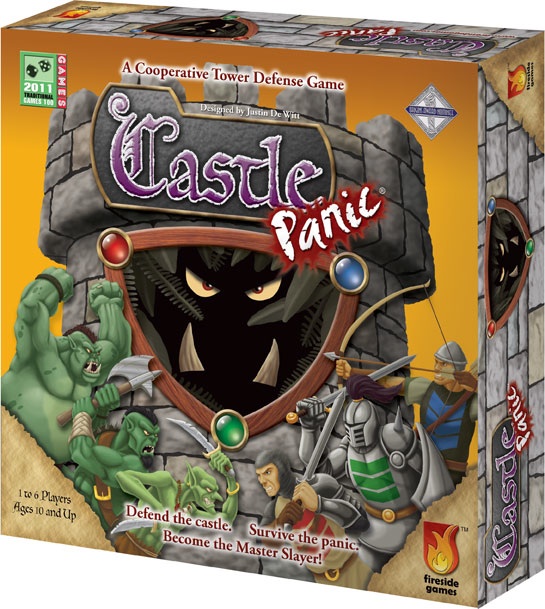
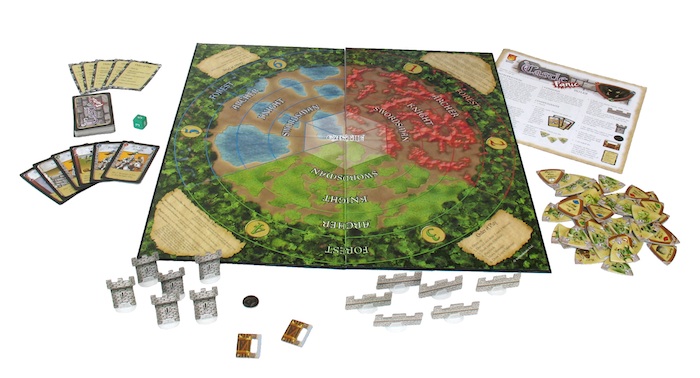
Another game that came in from Noble Knight yesterday was Castle Panic by Fireside Games. It’s a cooperative game where players try to defend their castle from rampaging monsters. You have a six-walled tower, with six protective walls, and six zones to defend. You draw five cards, which allow you to hit the monsters at different ranges — archer, knight, swordsman, or castle (where you need a barbarian to take out the monsters before they knock the whole she-bang down and you lose.
It’s a deceptively simple game. The cards give you zones you can defend at the respective distances, and you can trade between players to try and strategize to stop the creatures. The actual doing is a lot harder. The few times I’ve played it, it takes between 45 minutes and an hour and a half. It’s great fun, there are a few expansions available, and at $30 is a steal. Definite buy.
I decided the fam has been playing enough board games i needed to get a few that weren’t quite as complex as, say, Supremacy or Firefly even. We’ve got a four year old that’s pretty bright for her age, and was really engaged by Munchkin, so I looked for games with easier base games in subjects she might like.
She loves cars and motorcycles, and racing, so enter Formula D — a later edition of the French Formula Dé board game by Asmodee. It’s supposedly for 10 and older, but we found the simple rules were easy enough for Sofia to grasp, and she quickly started to understand the ideas behind “slow in, fast out” and how to shift appropriately.
The game has two boards for the race — Monaco and a street race we haven’t tried yet. Wee toy cars are placed on the board, and each player gets a marker box with a shifter from 1-6th gear. Each gear has a corresponding die that is rolled for your speed per round: a d2 for first, d6 with 2-4 for second, d8 for third, d12 for fourth, d20 for fifth, and d30 for sixth. Your car can take a certain number of wear points. Downshift to hard, brake to hard, overshoot a turn too hard and you lose these. Take a turn far too fast, you wreck and are done. It requires some canny reading of the distances to start working the shifter to your advantage.
The advanced game breaks the wear across tires, engine, etc. and there look to be characters you can play. There’s even weather rules. When the kiddo is old enough, I suspect we can start tacking on the harder stuff.
Would it be more “realistic” to play each other on a gaming console? Sure, but there’s a certain fun to sitting at the kitchen table, throwing different types of dice and chatting while playing a game. It’s tactile, it’s teaching her (subtly) probabilities and how to judge distances, etc.
I found a copy with no troubles at Noble Knight for $35. There’s four different expansion packs, each with two new and different tracks at $30. It’s a great example of how simple rules can still lead to complex strategizing. If you see a copy, and you’re into board games and racing games, it’s a buy.
After concluding our first volume in our Atomic Robo game, we shifted fire back to Battlestar Galactica, where we began the first of a series of adventures chronicling what happened when Pegasus split from the fleet (In our campaign, that is….)
The characters are CDR Philip Oscari, the CO of Hecate, a Berzerk-class escort or “light battlestar”. He’s seems a quiet and thoughtful man, but underneath the tight control he has, he’s still the former enlisted marine that went into the service to avoid jail time. The other is CPT Danica “Fists” Tanner, a Gina Carano-esuqe former professional fighter than joined the Colonial Fleet to fly vipers, and who is also the commander of their marine detachment.
It started with a nice intro scene recapping the happenings at that time — the Kobol mission had just concluded, and with the destruction of that world and the ongoing Cylon Civil War, the leadership decided there was a good chance Pegasus could shake up the bad guys and keep them off of the fleet while it continued the Exodus to Earth. We had a nice cameo of some of our main campaign characters, and the challenge was to try and recreate their attitudes and emotions from that time. After some politicking and the threat of having to “terminate the command” of the commander PC from the main game, Pegasus gathered the materiel necessary to head back toward the Colonies to distract and harry the Cylon menace.
Using the intelligence from skin jobs captured by Galactica, they were able to stage an attack on a major Cylon staging post a few light years away from Kobol. The battle proved to be extremely difficult and the players’ ship, Hecate — a Berzerk-class escort — as well as Pegasus, took a hell of a drubbing, but managed to win out against a major base with tylium mine and a new centurion production facility.
They found that all the skin jobs had been murdered and stacked like cordwood outside the base in the minimal carbon dioxide atmosphere. They also raided the Cylon computer system using software Baltar designed to read and translate the data to Colonial formats. To their surprise, the Cylons are a lot weaker than they seem. Between the vessels that are chasing the fleet and the civil war, a lot of Cylon materiel is considered destroyed. They confirm that there are only six basestars running patrol in the Colonies, along with two battlestars they’ve cut out of mothballs.
They realize there’s a very real chance of pushing the Cylons out of the Colonies, if they can win the space game. The ground game, however, will be the real challenge. There are plenty of Cylons on some of the worlds — corps and army-level numbers, but other worlds have no more than a battalion or two holding them due to low population density. The other intelligence they’ve gleaned (remember, this is only a few months after the Fall of the Colonies):
Aerilon was mostly spared the nukes, as the humanoid Cylons (or Seraph, as they call themselves) needed the farmland; there’s heavy resistance movements around the world. There looks to be alliances between some of the survivors and the remaining humanoid Cylons. [20,000 centurions, mostly near the cities not fully destroyed]
Aquaria wasn’t really worth nukes — they used centurions. There’s a healthy and highly successful resistance in the snow and mountains of the world. Most of the floating cities were sunk. [down to 1000, mostly in the two major cities.]
Canceron was hit hard due to the large population, but they are still having trouble subduing the world — suddenly those survivalists don’t look so quaint or stupid. There’s heavy environmental damage, but it’s still habitable. The Cylons have large-scale industrial projects to pump out more centurions — they will be near completion by the time the characters get home. [50,000 centurions]
Caprica got hit the worst, after Picon. There are still survivors, but the world is mostly dead. The Cylons have large-scale industrial projects to pump out more centurions — they will be near completion by the time they get home. [10, 000 centurions, mostly in areas around Caprica City and Delphi.]
Gemenon — the world was borderline inhabitable, anyway; the nukes have killed it. [1000 centurions]
Leonis is much like Canceron — it got hit hard, but the world is big and had absorbed more radiation damage than the Colonials expected it could. The big cities are gone, for the most part, and there is heavy Cylon presence. Resistance movements planetwide, and there are rumors the Leonine Navy (their Coast Guard) is actively fighting the toasters The Last Ship-style. (This would make for an interesting B- story paralleling the rag-tag fleet in a campaign, I think…) The Cylons have large-scale industrial projects to pump out more centurions — they will be near completion by the time they get home. [50,000 centurions]
Libran wasn’t worth more than a few nukes. The world is proving very difficult to tame due to rough terrain and heavy jungle. A small but effective resistance has been winnowing down the centurion numbers…not bad for a bunch of hedonists and beach bums, eh? Setting up industrial bas to produce more centurions. [down to 2000 centurions]
Picon — Destroyed between the nukes and the reentry of Picon HQ. [5000 — mostly doing materiel collection]
Sagittaron — The cities are gone and there was almost no resistance to the Cylons. There are a lot of survivors hiding around the world, and the centurions are converting the industrial base to their needs. [10,000 centurions, mostly doing industrial work]
Scorpia — destroyed between the nukes and the shipyards falling out of the sky. [5000 centurions — mostly doing materiel collection]
Tauron — Destroyed between the nukes and the shipyard falling out of the sky thanks to Pegasus. [see Scorpia]
VIrgon — See Leonis.
Cyrannus Shipyards — the ‘boneyard’ saw Cylon action and the last information they have was that the centurions had equipped a bunch of the mothballed ships for combat to bolster their basestar numbers. There’s mostly transports and raiders in the area, and a company’s worth of centurions automating the hulks they’re cutting out.
The better news — there are at least three other Colonial vessels harassing the Cylons — 2 Erynis-class light battlestars positively identified as Aegis and Valkyrie, and one Berzerk-class battlestar, Enyo. They might be able to find these ships on their way to the Colonies.
I know people have been pushing for Idris Elba to be the next Bond, mostly out of a reflexive need to be “inclusive.” He’s a great actor in his own right, and I think he’d be good in the part. (I kinda liked the idea of Colin Salmon that was floated around after Brosnan’s departure…) Now The Telegraph is telling us the bookies in Britain are cutting the odds sharply for Damian Lewis — the superb actor from Band of Brothers, the highly underappreciated Life, and the way overrated Homeland. Apparently, Barbara Broccoli is a big fan, and since she’s the Grand Panjandrum of the Bond film franchise…
I have to say — I really want to see him get the part, although I think James McAvoy could pull it off famously, and Michael Fassbender’s got the look.
If there’s one trope that always works well in fiction, whether it’s on the screen or on the page, it’s having your heroes double crossed by one of their erstwhile allies. Particularly in espionage settings, but also in the realm of pulp — be it private eyes duped by their comely clients or archeologists who choose the wrong friends — or even in superhero comics, finding out that guy or gal you’ve been depending on has been selling you out to the enemy always works for great drama, and great drama makes enjoyable stories.
Working in that double cross with background NPCs is easy enough, but what if the traitor is a player character? There’s a few ways to make this work, but they all need player buy-in, if you’re to make it work without honking off the character’s player.
The player knows from the jump, the group does not: Here the GM can work with the player early on to set up the parameters of what the turncoat is doing, how much they want to reveal to the players, etc. You could have a general idea — my character is a SHIELD agent working for HYDRA undercover; my character is a Cylon in the fleet, working to erode the stability of the Colonial fleet; my MI6 operative is secretly a member of SPECTRE/the Russians/enter bad guy group…
With this option, the people who need to know, know, and they can try to work together to make life difficult for the others in the group. The player is the accomplice of the GM in making things move. They can conspire out of game, or by notes/texts in game — did he just report the team to the bad guys, ensuring their capture?, and the point of this approach is to keep the others in the dark. You might give them the occasional hint — Agent Smith sure seems to disappear a lot at night. That hot blonde chick in the berth next to me was seen talking with someone in the corridor right before that bomb went off and disabled the FTL! the key here is to make it innocuous — something that should be easily explainable. You might give them the occasional perception check to see something out of place. Or you could just wait until the cinematically appropriate time, and drop the world on them, complete with the traitor helping out. “Suddenly, HYDRA soldiers swarm the room, before anyone can act, Typhoon strikes!”
For players — this can be a real blast to do. You get to influence the story in a way that is not obvious to all. You are, in essence, acting as a deputy GM — your actions and ideas can turn the storyline in a way that might advantage you over the other players…try not to take a competitive stance as the player, even if your character feels that way. You are working with the GM to make this a better experience for all.
The GM wants to make a character a turncoat at some point appropriate in the campaign: I had this happen in my ongoing Battlestar Galactica game, and it went well. The key was that I chose the character that made sense for this — he was the equivalent of an FBI agent, a conspiracy nut that believed aliens, or something, was infiltrating Colonial society. The more he and the others dug up Cylon conspiracies, the faster they seemed to cover it up. In the end, I used a background bit that had been established early on — the character had been in a car accident and was “modified” by the Cylons to broadcast his experiences, and occasionally fugued out for his handlers to make him do things without his knowledge. The player loved it and it was a great reveal and made for great drama.
Another time, I tried this without player knowledge, and they were less than enthusiastic about the idea. I let it drop. Similarly, a PC whose player moved away I turned into a traitor at an appropriate moment. It worked so well because the character had seemed to earnest and steadfast. They never saw it coming. The player, while agreeing it was a great plot twist, was not overly happy with it being his former character.
Players form attachments to characters, and these are an expression of the player’s agency in the game world (and sometimes, it’s the only damned control they have over things in their real life, too…) — get the player’s buy-in before you turn their alter ego into something despicable. Trust me on this one.
Players — if your GM comes to you with this idea, here’s a few things to consider before turning them down or buying in: 1) Does it seem like a logical twist? In other words, have your character’s actions or beliefs hinted that they might be susceptible to the influence of the bad guys? And can you see how they might have gotten your cooperation? 2) Do you think this could give the game more or less dramatic appeal? Will this be something you could play up for a while, or do you think the others will just magic missile your ass to your game world’s version of Hell? 3) Might it be appropriate for the character’s story to end that way? 4) Do you want to keep playing the character, or were you getting bored? Maybe this might give the character a new lease on life. Maybe it’s a good way to end the character and move to something more interesting. Maybe you are moving away and your character is a bit too integral to just conveniently disappear…
The whole group knows: This only works when you have players adult or good enough to not use their meta-knowledge to try an improve their character’s actions in the game. Here, you might allow the player to openly show how he’s screwing the others over, or still use the secret note route…but people know he’s built to be a double agent. You might use codas and little cut scenes to let the players know that Agent Smith is dropping a dime on them to the enemy. The point is — they know and don’t do anything beyond what their character might know because they enjoy watching the story unfold, even if it disadvantages them, because they know that adversity is part of the fun of having an adventure.
I say this works best with players who are “adult”, and that can be a loaded word but it is truth — some folks (see above) put a lot of emotional investment into their characters, are competitive, or want to feel in control…these sorts of personalities do not work and play well with this sort of approach to conspiracies. You’d be better off with the first choice, here. However, as gaming has moved away from the antagonistic relationship between GM and players, and the more narrative/storytelling idea of role playing has become more popular, I’ve found people are usually willing to separate their knowledge from the character’s.
Players — the advice here is simple: help the story and the fun along. Yes, it’s great to win all the time, but it’s often more interesting when things go pear shaped. You get to do heroic stuff.
Example: I had one player in my Hollow Earth Expedition China campaign that was not the brightest fellow. He was trusting, a sucker for women, and a jump first, try to fly next, think once he hit the ground type. The player knew that something he was about to do was going to get the character munched, possibly killed…but it made sense that he would leap before he looked, so he did it anyway. He frequently had to take a moment to “do what Jack would do”, rather than what he knew was the smart thing.
Be that player — make the character and the game sing, even if it means things don’t go so smooth. GMs — in game systems with plot/hero/fate points, this kind of play can be aided by — well — bribing the player (or “compelling” them in Fate). Give ’em points for going along with the script. You all win.
(Aside: Way back in the ’90s, I used to keep a couple of 3×5″ cards that had a few words written on them just to have a nice shorthand for players that were about to let their natural desire to shred everything, including the plot. One had HINT on one side, CLUE on the other for when they missed the obvious. The other said IT’S IN THE SCRIPT, which I used for one particular player…)
I always found the Reavers of the Firefly universe intriguing until the movie ruined it. Oh, look, space zombies… Or maybe “space Crazies” would be more appropriate. I understand the movie was an attempt to wrap as many plotlines from the far-too-early-axed television series, but making the Reavers simple a science experiment gone bad was…lazy.
Worse, it too away the agency of a group that had been built up to be a terrifying, almost existential, terror for space travelers in the ‘Verse, the equivalent of trolls under the bridge.
One of the things that made them so interesting was shown in the episode Bushwhacked. Here, the reavers had killed the crew of a transport, yet left one of the crew alive…why? The man is suffering from traumatic bonding, and starts to see himself as one of those that had tortured and killed his crew. But what if it were more than that..? What if, periodically, they leave people alive to see if they will come find them? What if they recruit..?
What if this was a culture, instead of simply space zombies?
These are people who can pilot ships, navigate, operate tactically, who lay traps…not the behavior of animalistic nutballs. Instead of drug-addled space crazies, what if you have a culture of people that have taken body modification, anarchic tendencies, and counterculture ghettoization to a point where they simple don’t quite fit as “human” anymore? We are talking about a period, post war, where there would be a lot of disaffected and damaged folks looking for…something. What about those kids that want to rebel, or are damaged from their childhood — the sort that fled to the likes of Charles Manson and every other low-rent messiah? They don’t just torture their victims; they do it to themselves! They recruit from their victims, like the character in Bushwhacked, but they also have people out there collecting the vulnerable, the young and stupid, the disaffected war veterans, or the power-mad that cannot succeed in the political systems in place.
They prey on ships, but where do they get that flight data to intercept? Space is big; you’d miss your prey without intelligence. What if some of these folks look and act “normal” (’til they ask you, Hannibal Lector-like, to dinner) and work jobs that allow them to find prey or to recruit. you could be friends with one and never know that the erudite fellow you have drinks with after work would torture, rape, and eat you, were you on a spaceship in the black.
Maybe, like other subcultures, it is fragmented and tribal — they fight each other, as much as “the man.” What if you got that one charismatic leader that pulled the disparate crews together?
This version of the reavers could be more than a campfire ghost story, but a much more dangerous and driven group that doesn’t just seek to terrorize for terror’s sake, but might look to eat its prey — in this case civilization — from the inside, as well as out.


 The Black Campbell