Roleplaying Games


Ever since I started running the Serenity RPG, I’ve been using the following rule for actions in action turn/combat round/whatever you want to call it.

Each extra action above the first comes with a -1 die step to the attribute. Say you have a d8 Agility. If you changed a magazine on a gun, then want pop off a shot in that turn, you can.  But the shot is a d6+skill.  Say you double tapped, the second shot?  d4+skill.  While doing that you were snagging your rucksack and wanted to get up.  Roll either an Agility or Strength and Athletics (if you had a Strength of d8, you would roll a d4+Athletics, as opposed to a d2+Athletics for an Agility.)

The limitation:  once one of your attributes is at d0 — you can do nothing, including take any kind of passive defense or passive perception tests (you tunnel vision on your tasks.)  We find it works out to roughly 3-5 actions a person could take in 6 seconds, each increasingly harder.  I’ve found that most players will leave themselves a d2 or d4 for wiggle room, should they need to defend against attack or notice something important.

I was reading through an article on Jerry Miculek today — he’s a shooter for Smith & Wesson in the USPDA competition.  The guy is a freak of nature, capable of accurately putting 5 rounds downrange in .45 of a second!  That got me thinking about my own effective rate of fire with a handgun, rifle, etc…even with my 10mm, I can drop with some accuracy rounds at a rate of 1.5/second.  Twice that with a 9mm or the 5.7mm.

The rate of fire in the James Bond: 007 RPG has always seemed a bit slow to me.  Granted, that’s because the firefights in the old movies usually consisted of the actor taking aim and firing a round, maybe two, in a cautious and considered manner.  But since the likes of Martin Riggs and John McClane came on the scene, the protagonists are a bit more quick n the trigger — in line with what real firefights are like.  (Most police in shootings are surprised by how fast things happen.)

The Action Round for the game is described as 3-5 seconds.  That two second wiggle room was designed to give the GM some leeway in what to allow the characters to do, but it is a bit long for a fist- or firefight.  So I propose a harder target for the time period: 5 second, or 12 action rounds a minute.  What can you do in five seconds?

Figure most people can achieve 2-3 short actions, like shoot something, change a magazine, and maybe do some kind of shuffling movement.  The characters in the game are supposed to be trained, if not exceptional, in moments of action.  So I propose they can do up to an action an action a second.  (Just timing myself now, I was able to dry fire three times on three different targets around the room with a handgun…in three seconds.)

Suggestion 1:  the actions a person can take in the action round are equal to their SPEED, as in the rules.  What an action entails:  movement (from shuffling (to give the opponent attempting to hit a -1EF) to running, popping up from cover and getting back down [each an action!]), changing a magazine for a weapon (with the reload time now being the number of actions the move takes; so a  tube-fed shotgun’s RL: 5 would take a character with a Speed of 2 just over 10 seconds…about right under ideal conditions), dropping an object or picking one up, taking a bead (to get the +3EF), engaging a target (so with a Speed of 2, you could engage two targets …but could not move or change mags), or do that many HTH actions (either attack or defense.)

Suggestion 2:  The number of targets a character can engage with a firearm is equal to their Speed, and they may fire a number of rounds at each target equal to their Speed or the S/R of the weapon (whichever is lower.)  If they shoot at a single target, the rounds that can use are equal to the Speedx2.  If the character can fire 5 or more rounds at a target, resolve it like burst/autofire with one roll and add +2DC to the weapon (So a Beretta 92 in the hands of a character with a speed of 3 could go Martin Riggs for 6 rounds, with the gun DC rising from F to H.)

For burst or autofire weapons, the number of rounds is the maximum number of targets that could be hit by the burst or strafing attack, minus the QR of the test (so an MP5 with a S/R of 6 could hit up to six people, but with a QR of 4, at best the character hit two targets.)  Instead of gaining negative modifiers to their Ease Factor for the number of people they are engaging  (Spray Fire rules, p.50, main book), the character gains a -1EF for each 10′ wide area.  Each extra 10′ arc also halves the maximum number of people you can hit.   So if you have to spray an area 20′ across with an M4 carbine (S/R: 2 or 10), you would gain a -2EF and could only hit up to 5 people.  Now you could mitigate this a bit by taking a number of your actions — say you have a Speed of 2 — two bursts of fire (really one long extended one) across the 20′ would be two 10′ arc attacks.

Suggestion 3: Using spray fire to do suppressive fire (keep an enemy’s head down):  You’re not really trying to hit anything, and your Ease Factor to do this is EF5.  You automatically use the maximum number of rounds you could use on a single target (for a handgun with S/R:2 and a Speed of 3, that would be 4 rounds, or the an autofire weapon’s second rating [S/R: 2/6 for example].)  For each action used, you gain a +1EF for the test.  Aditionally, the bad guys will keep their heads down for an extra round/extra success.

Example:  If you have a Speed of 3 and a handgun with an S/R: 2, you fire 6 rounds for suppressive fire.  The gun has a magazine with 15 rounds, so you decided to use all of your actions on suppressive fire, hoping to allow your teammate to move unseen to an advantageous position.  The total rounds fired would be 15, with a +2EF to the test.  The character gets a QR3 — the bad guys stay down not just this round, but the next.

Suggestion 4:  Hand-to-hand combat is a bit more time consuming than pumping a trigger.  You are, by necessity, moving — shuffling feet, swinging arms or kicking, grappling or otherwise engaged in multiple complex actions.  The number of actions is equal to the character Speed.  The character can use the actions for attack or defense (not in the original rules.)  Attacks are handled as they are in the original rules, but if a character chooses to, they may instead defend from an attack, using their HTH Combat skill.

Example:  Bill is in a fight with a couple of goons.  He has initiative and chooses to punch Goon 1 in the face, trying for a knockout blow, but wants to use his second action as a defense, blocking an attack from Goon 2.  He tests against Goon 1 (with a -2EF for the knockout blow) and succeeds.  Goon1 is down and Goon 2 swings a lamp at Bill.  Goon one hits him with a QR3 (Good) — Bill tests his HTH against the QR3 (that’s his Ease Factor) and succeeds.  The attack fails.

Suggestion 5:  New Speed Ratings.  No one is so slow they’ll act once every 10 seconds (Speed 0 in the original game rules.)  So here’s a more realistic Speed rating.

Speed is figured by adding DEXterity and PERception:  2-6=Speed 1, 7-14=Speed 2, 15-22=Speed 3, 23-28=Speed 4, 29-30=Speed 5.

With this last suggestion, there’s the possibility of a character, really going super-badass.  If a GM wanted to avoid this, they might be worth it to use Draw on a firearm or melee weapon to slow the number of attacks (so a submachinegun with a DR: -2 would mean no more than 3 targets with a Speed of 5.)

Comments and suggestions are welcome.
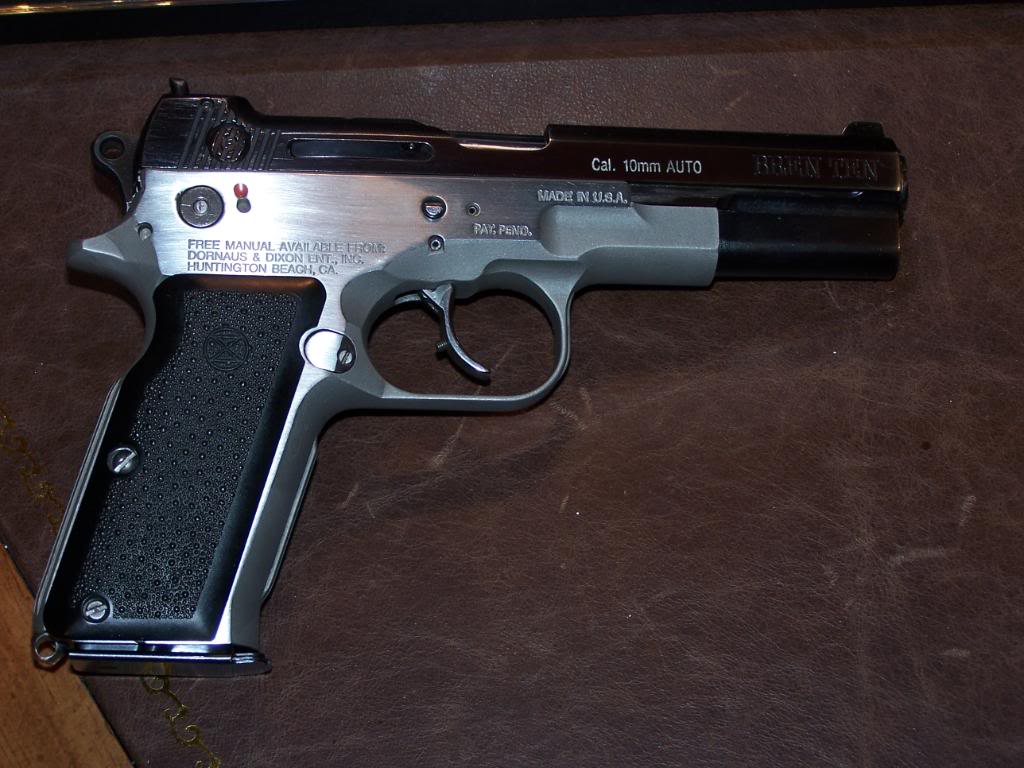
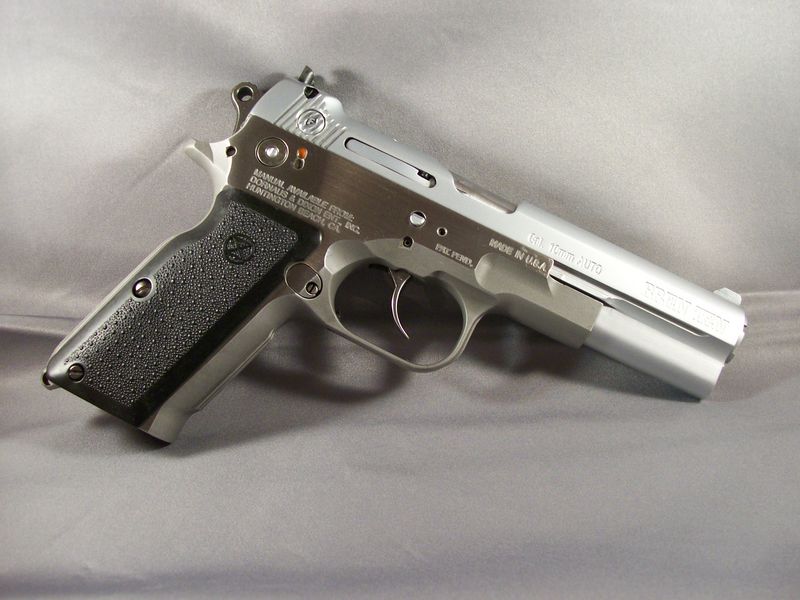
I love the Bren Ten…it’s been one of those guns I’ve wanted to buy for years, but could never get a good deal on.  I fired one way back in the ’90s and loved it — super accurate, powerful, and incredibly comfortable ergonomics.  I have settled for the nearest thing I could get, the Tanfoglio Witness in .45 or 10mm (although these are damned good values!)  VLtor, however, has remade the Bren 10mm handgun and they should be on the market in a matter of months (I’ve already got my local dealer hooking me up with one…)

In it’s day, the Bren was a fairly advanced piece of hardware.  Based on the CZ-75 and beefed up for a new combat round envisioned by Col. Jeff Cooper — famed gunhand — for combat and police work, the 10mm cartridge was an attempt to mate .357 magnum firepower with a semi-automatic pistol.  The Bren died a quick death due to financial woes of the manufacturer, but the 10mm round was — for a time — FBI standard and a popular hunting and self-defense cartridge.  However, the recoil was too stout for the poor Feeb agents and a whimped out version, .40 S&W, became the more popular round in the 1990s for police.  In the age of polymer-frame handguns, it’s a bit dated, but the accuracy and firepower are hard to beat.

VLtor’s version includes dedicated 15 round magazines, and it can use Tanfoglio magazines interchangeably.

PM: +1   S/R: 2   AMMO: 15   DC: H   CLOS: 0-4   LONG: 12-19   CON: +1   JAM: 98+   DR: 0   RL: 1   COST: $1300

GM Information:  The DC is for the original 200 gr, 1250 fps 10mm round (only really available from specialty manufacturers.)  Most 10mm ammo would provide a DC: G.

The gun was featured, most notably, on Miami Vice in the first two seasons.  VLtor is doing a “Vice Model” wth a hard chomed slide.  (The slide was chromed so that it was more visible in night shoots.)

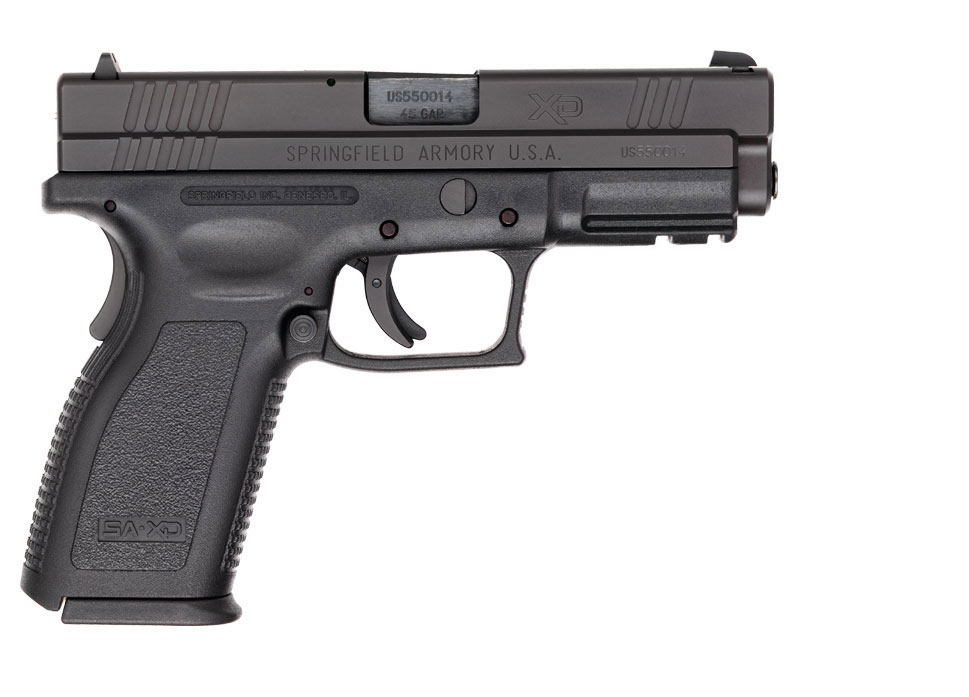
Next up for James Bond: 007 RPG, the Springfield XD series of handguns.

Like the Glocks, Springfield Armory utilizes a polymer frame with lightweight alloy parts for the mechanics for the X-Treme Duty (XD.)  The XD also uses striker fire, like the Glocks, but the grip angle is more ergonomically correct for the shooter, allowing better accuracy.  Take down is also easy, accomplished with a rotating switch near the front of the receiver (similar to the SIG Sauer.)

Early versions, like the Glock, require the trigger to be pulled to allow the slide and barrel assembly to be slid free of the lower; newer versions do not, increasing safety.  Also, the XD used a similar trigger safety feature as the Glock, but improves on this with a grip safety similar to the 1911A1 series handgun.  As a result, the XD is as reliable, often better made, more accurate and safe, and easier to maintain.

The XD can be had in 3″, 4″, and 5″ barrels, and in calibers from 9mm and .40 S&W, to .45ACP and .45 GAP, as well as .357 SIG.  All versions include a Piccitinny-style equipment rail on the weapon for light or laser.  Additionally, SAs always ship with a right-handed holster and dual mag holder.

There is also the XDM — a larger framed version of the service pistol with interchangeable backstraps on the grip to different sized hands, a match grade barrel, and larger capacity.  While very accurate and reliable, the XDM is more difficult to conceal than most service pistols.  The XDM is available only in 9mm and .40S&W

Springfield Armory XD 9mm & .40S&W

PM: +1   S/R: 3   AMMO: 16   DC: F   CLOS: 0-3   LONG: 10-18   CON: +1   JAM: 99   DR: 0   RL: 1   COST: $550

GM Information:  This is for the 5″ XD in 9mm, the .40 version has a S/R: 2, AMMO: 12, and CLOS: 0-4.  For the 4″ version, LONG is reduced to 9-17, 8-16 for the 3″ barrel.  The 3″ Subcompact XD can have a CON: -1, but AMMO is 10 for 9mm, 9 for .40.

Springfield Armory XD .45ACP

PM:  +1   S/R: 2   AMMO: 13   DC: F   CLOS: 0-3   LONG: 10-17   CON: +1  JAM: 99   DR: 0   RL: 1   COST: $600

GM Information:  The .45 caliber gives a -2EF penalty for victims testing against stun.  The compact .45 has a PM: 0, AMMO: 9, and LONG: 8-16, CON: -1.

Springfield Armory XD .357SIG

This version uses the new police-oriented .357SIG round — essentially a necked-down .40S&W case firing a .357 bullet at magnum speeds.  The .357 SIG XD only comes in the full service pistol.

PM: +1   S/R: 2   AMMO: 12   DC: H   CLOS: 0-4   LONG 10-19   CON: +1   JAM: 99   DR: 0   RL: 1   COST: $700

GM Information:  The .357 SIG round is very hard to come by outside of the US, and is mostly seen in the hands of police departments.

Springfield Armory XDM

PM: +2   S/R: 3   AMMO: 19 (16 .40)   DC: G   CLOS: 0-4   LONG: 12-20   CON: +2   JAM: 99   DR: 0   RL: 1   COST: $700

Fields of Experience in the James Bond: 007 RPG were pretty much useless, mechanically.  Here’s some house rules to make them otherwise.  Feel free to use or change as you like…

FIELDS OF EXPERIENCE

American Football:  Gives knowledge of the rules, players, teams, etc.  If played in the past, may add +1EF to evasion and HTH Combat (when charging or tackling.)

Astronomy/Astrophysics:  Gives basic knowledge of the subject as a given, +1EF to INT or SCIENCE tests for more advanced research questions.  Give a +1EF to PER tests regarding navigation when stars are seen.

Biology/Biochemistry:  As with astronomy on basic and advanced knowledge.  Can use SCIENCE +1EF to analyze compounds, mix the same.

Board Games:  Gives knowledge of game rules, also give a +1EF to use of maps.

Chemistry:  As with the other sciences on basic and advanced knowledge.  Gains a +1EF for improvising explosives.

Computers:  Gives a +1EF to CRYPTOGRAPHY or ELECTRONICS tests.

Cricket:  As with American Football for rules, etc.  +1EF for HTH Cmobat involving bludgeons.

Economics/Business:  Understands the intricacies of business and gains a +1EF to INT or PER tests involving examination of financial records for clues.

Fine Arts:  Give a +1EF to FORGERY or PER to identify the same.

Football/Soccer:  As with Football and Cricket regarding rules, etc. Gives a +1EF to Evasion tests.

Forensics:  +1EF to PER tests for forensic examination or searching an area for clues.

Golf:  Knows the rules, etc.  Gains a +1EF to Fire Combat tests to hit a golf ball when playing.

Ice Hockey:  +1EF to ice skating tests…and smacking people with big sticks.

International Law/ Law:  Just damned useful in the field.  Could aid a CHARISMA test when trying to con their way past bureaucrats or police.

Jewelry:  As with Fine Arts.

Mechanical Engineering:  Gives  a +1EF to INT tests to repair machines.

Medicine/Physiology:  Gives a +1EF to FIRST AID tests.

Microphotography:  Stupid — I don’t use it.

Military Science:  Not only do you know military weapons, vehicles, etc. but tactics.  Gain a+1EF PER or STEALTH tests to utilize terrain.  Hero Points to get hints from the GM how to use the surroundings to gain bonuses in combat.

Political Science:  Knowing the players is important, and this allows the character to have basic knowledge of political situations, +1EF to INT or LOCAL CUSTOMS to know more intricate details.

Rare Collectables:  See Fine art.

Skydiving/Fastroping:  Gain +1EF to EVASION tests using parachute or MOUNTAINEERING for fastroping.

Snow Skiing:  +1EF to EVASION using skiing.  I also snowboarding with this, but a

Snowboarding/Skateboarding FOE might be better…

Surfing:  Why this wasn’t in the original, I’ll never know…  +1EF EVASION when surfing.

Squash/Tennis:  As with the other hit it with a hard object skills.

Space Sciences:  As with astronomy.  +1EF INT to know safety procedures for space travel.

Toxicology:  Knowing poisons and how to counteract them.  +1EF to create, use, ID, or treat poison.

Wargaming:  As with board gaming.

Water Skiing:  as with skiing.

…with a side of Angelina Jolie…

…and for the role playing gamers out there, the James Bond: 007 RPG stats (for the bike, not Jolie.)

Triumph’s Street Triple R

A smaller version of the famed and powerful Speed Triple, the Street Triple R has a 675cc triple engine producing 107hp and 51ft-lbs of torque; about 20hp / 20 lbs less than the 1050cc triple of the Speed Triple.  The weight, however, drops by 100 lbs…giving it a better torque and power/weight ratio than its larger brother.  It also makes the handling of the Street Triple sublime.

PM: +2   RED: 3   CRUS:  75   MAX: 150   RNG: 200   FORCE: 0   STRUC: 1   COST: $9400

GM Information:  The Street Triple R gains a +2 quick turn and double back maneuvers.

UPDATE:  I just bought the non-R version of this bike, but kitted out with carbon fibre exhaust that gives it a bit more kick, power-wise.  The standard Street Triple has a softer ride, but about the same stats.

I hate the new advancement system they unveiled in Battlestar Galactica and in the core Cortex book.  I much prefer the Serenity RPG way of advancement — for skills, you need the number of advancement points for the die you are going up to, and I don’t allow the players to horde points to jump levels (say they horde 10APs in the hopes to buy a d6 in something straight to a d10.)  For attributes, it’s the die you’re going to x4.

However, I also like using die ratings for the traits and complications, as was introduced in BSG.  So the conundrum, how to buy traits and complications up or down respectively?  In the Serenity RPG, it’s 20AP to buy down from a major to a minor; 10AP to clear a minor.  Assuming that a minor is equal to a complication of d4, that means 2AP per die step to buy up a trait or buy down a complication.  (ex.  You want to take Friends in Low Places from d4 to d6…12AP; if you want to take some angermanagement courses for that Chip on Your Shoulder of d4, 8AP gets you to d2.)

Recap:  Skills: AP=dice shifted to, 2APxtrait die going to/ 2APxcomplication level you are at to die shift down, 4APxdie going to for attributes.

I’ve been kicking around a few ideas for a sci-fi campaign for our Saturday group, and started working on a Star Trek campaign.  Trek represents a particular problem for the GM that wants to fiddle with Roddenberry’s universe due to the canon-thumpers in its fandom, but fortunately, I don’t have those in this group.  We’re going back to the original show period, and keeping elements from both the Original Series and the new Abrams movie, but this will be its own universe.

One thing that has to be fleshed out:  the United Federation of Planets… How does it work?  What are the politics?  Is it federal, confederacy, or a unified government?  Working from the Abrams movie and the first six or seven episodes of the show, I’ve chosen a very loose federal system:  most of the worlds and their colonies are ruled from their respective planetary governments, but overall security is handled by the UFP and Starfleet.  Poverty, hunger, energy allocation — that’s all been handled in a post-scarcity economy…on the home worlds.  The colonies are another story.

Most of the colonies are either outposts struggling to get the ecologies of their respective worlds wrestled into shape, or are refusniks — worlds where the settlers are moving to escape the new government, or to preserve their particular culture.  (Remember how often people weren’t happy to see Starfleet in TOS?) One of the players is particularly interested in exploring the identity issue of colonial worlds.

To make things worse, there’s a shortage of usable real estate out there in space; plenty of rocky, desolate worlds to land on, but not too many “Class M” planets.  This gives more reason for the respective great powers of the ST universe to need to squabble over those places that can support humanoid life.

Gone are the “head of the week” aliens.  Our imaginations have a bigger budget than Abrams had, so less head prosthetic and more weirdness.  Most of the TNG and later alien races are aced  — I’m keeping the big boys from the show and a few from the movie — but the gangster and Nazi planets..?  Gone.  So Klingons (with ridges), Romluans (without; they’re a nation of Vulcans that refused the precepts of Sarek), Andorians (Enterprise-style), Tellarites (same), Deltans (not Betazoids — which I might have as human/Deltan hybrids), and possibly Ferengi.  A central theme will be why there are so many humanoid races in this particular area of space, and why some are genetically compatible.

On the trappings side:  the new movie uniforms.  Keeping them.  The gear didn’t go far enough.  Our communicators will be, in essence, smartphones capable of most of the features (with access to a network) of TOS tricorders.  Tricorders will be full-blown sensor platforms and computers.  Phasers have two settings: stun and kill…and no you can’t dodge light.

For the ships — keeping the look of the show, but using some of the fantastic reimaginings that artists on scifi-meshs.com have been turning out.  The Constitution-class is the laters bad boy for the fleet, is roughly the size of the original ship, and the interiors will be closer to the original movies, but with some of the trappings of the new movie.

Right now, the characters’ vessel with be a slightly older frigate, USS Shenandoah.  The player character ideas are coming together:

A super-smart scientist type that comes from a human colony.  His only way off the rock was Starfleet, but his family and community see him as a sell-out (What?  This dirt farmer’s life isn’t good enough for you?)  He is top in his class, but surprised to find he actually has competition here at the academy.  He was raised with the idea that aliens weren’t any smarter/stronger/better than humans, and is finding that to be the case.

An Orion communications/cultural specialist who came to the Federation because she wasn’t quite sexy/dangerous enough to be enslaved (see Enterprise season 4.)

An Andorian security/tactical chief who has been posted on Andorian-only ships to date.  This is his first tour on a primarily human ship.

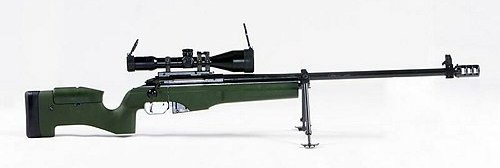
Used by several military forces around the world, the Sako TRG-42 is one of the most accurate sniper rifles on the market.  Designed specifically for that application, the rifle features a synthetic stock that comes in various colors — black, forest green, and desert tan, and can be had with a folding stock.  The standard stock has an adjustable cheek piece.  The weapons weighs between 5.5 and 6.5 pounds fully loaded.

The TRG-42 is a long action bolt (the TRG-22 is a short action), with the receive stabilized with three restraining screws.  The action is fed by a box magazine of five, seven, or ten rounds.  The two stage trigger is adjustable from two to five pounds, as well as adjusting the angle of the trigger itself; the safety is a silent-operation affair inside the trigger guard.  The barrel is 20″ and can be had with a muzzle brake to hide the muzzle flash, and is free-floating, with moly-chrome lining.  Rifling is 1/12, or 1/10 to stabilize longer, heavier bullets.

It has open sights, but is usually paired with a high-powered scope (range stats are for a scoped version.)  All together, the package offers less than a half-minute of angle out to 500 yards, and the effective range is closer to 1200 yards.

PM: +2   S/R: 1/2   AMMO: 5/7/10   DC: L   CLOS: 0-50   LONG: 300-600  CON: n/a   JAM: 99   DR: -3   RL: 2   COST: $7,000

Going to have some tie-ins to Greek mythology in my Hollow Earth Expedition campaign coming up.  To that end, I decided to write up centaurs as a creature/player race option…

CENTAUR (Follower 2)

Primary Attributes: Body 3, Dexterity 3, Strength 3, Charisma 2, Intelligence 2, Willpower 2

Secondary Attributes: Size 1, Move 6 (Run 12), Perception 6, Initiative 5, Defense 5, Stun 3, Health 6

Skills: Archery 5 (7), Athletics 5 (8), Brawl 5 (8), Stealth 3 (6), Survival 4 (6)

Talents: Alertness (+2 Perception)

Flaws: Addiction, alcohol; Herd Mentality; Lustful

Natural Weapon: Kick 8N

Once thought to be creatures of myth or allegory, Centaurs (and the female, Centaurides), roam the plains of the Hollow Earth near Atlantis and Shangri-La.  Usually, they are to be found in herds or in small hunting groups, but the occasional lone adventurer can be encountered almost anywhere in the interior world.

The centaur are a peculiar people — prone to great emotion and little self-control (as a rule.)  They are often drunkards, and when drunk, unpredictable.  When befriended, they are incredibly loyal and caring; when made an enemy, they are implacable and deadly, combining the best and worst traits of man and horse — they are fast, strong, smart, and vicious.

Character Template:

Attribute Adjustments: Size +1, Body +1, Intelligence -1, Willpower -1

Natural Advantages:  Quadruped (doubles speed)

Inherent Flaw:  Herd Mentality, Lustful

« Previous PageNext Page »