Roleplaying Games


White Apes of the Congo is out for Fate and Ubiquity — if you haven’t had a look, they’re available for $2.50.

Our next release, The Zugspitze Maneuver, is done with writing, art, and layout, and is just waiting on the cover art. ETA December 1.

The Death Jade, a get to the McGuffin first adventure set in Shanghai, is done with writing and layout, and is only waiting on the cover and some character profiles to be added. ETA December 23rd.

Murder on the Hindenburg — just that, a murder mystery set on the airship Hindenburg, may jump the queue if editing and character profiles get done before The Death Jade. ETA is December some time.

Two more adventures — The Treasure of the Illuminati, and The Mellified Man — are in the writing phase and should drop early next year, if we can afford the art.

I think I’m gonna need a Patreon page.


The characters found themselves starting the night with members of the science teams from Los Angeles and LZ-128 Deutschland led by RADM Byrd and Werner, attending a dinner in their honor in the Great Hall of Valhalla. Their hosts were naturally curious, asking about their world, countries, customs, weapons. This led to a demonstration of the utility of Hunter’s marine saber vs. the heavy broadsword of one of the warrior vril (with Hunter dressed in woman’s armor — the only stuff small enough for him.) Hunter did the Corps proud and beat the bigger, stronger opponent, gaining the nickname “martin” (as in the small, but vicious tree weasel) from the vril.

They spent the next week exploring the place — the massive halls and streets of Valhalla, seeing the communal dining, the workers — mostly humans from the surrounding villages that come here for service (“It’s considered an honor,” one tells Hunter.) — and eventually the Mountain Hall, the depths of the place where the strange dwarves like those they encountered with Ivora the Magnificent toil building weapons, armor, and making the place run. They have technology, but the denizens of Valhalla eschew it for a simpler lifestyle.

Gus got to go on a hunt with them, impressing the Valhallans with his shooting prowess thanks to the scoped Griffin & Howe .375 magnum he uses, taking shots at a quarter mile! Gould and his brother researched the history of the Inner World (or Asgard to these people) and the Germans and Gus both copied maps of the place.

After a week, they realize the Valhallans have been pumping them for intelligence, as much as the teams have been the people that live here. Byrd an Werner have been opening dialogue and relations with the leaders, and have secured enough blau gas to fuel the airships, as well as wrangling a representative of Valhalla to join them on their mission to make contact with other people. They re also in search of irrefutable proof of their trip to the Hollow Earth. Pictures won’t be enough — they need live specimens to bring back. The team convince Byrd that a trip to Sanctuary is a good idea. They can hunt small dinosaurs, maybe convince one of the half-man racs to join them on the trip back to the surface world.

The representative chosen is Lady Sigrun, one of the Valkyrie, who joins them on Los Angeles, to the chagrin of Werner and the Germans. She is disappointed to find out the ships are essentially big balloons…these are not real warships!

Their course will take them 2500 miles, over dangerous mountains and around treacherous weather, but they finally reached the Aerie — home of the hawkmen — near the Sanctuary. They were met with formations of the hawkmen, closing in on their ships. Byrd and the party climbed to the top of the hull, where the marines were preparing the .50 machineguns. Using the white flag and attempting to contact the swarms of hawkmen warriors, Amon called out to them, identifying themselves.

Without warning, a small group broke away and looked like they were going to land. Instead, they grabbed Amon and Gould and flew over the side of Los Angeles. Gus Hassenfeldt attempted to grab one of the warriors, hampering his one wing, and sending Gus and the warrior tumbling in a deathly embrace over the side of the airship toward the ocean below! Hunter and Byrd had the marines fire warning bursts to try and clear the hawkpeople off, but Deutschland — seeing the attack and hearing the machineguns — opened up with their strange “gauss guns”, hosing the area with magnetically-accelerated ball bearings.

Their peaceful first contact a shambles, Gould and Amon captives of the hawks, and Gus on his way to a crushing impact on the surface of the ocean below, we broke for the evening…

We had a break to test play The Zugspitze Maneuver while one of the regulars was out on work travel, and took up our Hollow Earth Expedition campaign against tonight. We had ended on a cliffhanger — the party’s airship, USS Los Angeles having followed the massive German LZ-128 into the lensing effect of the Northern Polar Entrance, only to be tossed and twisted as they made the transition into the Inner World…could the decade-old airship — not the most robust of vehicles — survive the forces?

In short: yes. After a tumultuous passage, the crew of Los Angeles set about finding their position, gaining altitude from the snow-capped mountains below, and looking for their opposition. They quickly find the German ship three miles off their starboard bow, similarly drifting on the winds and conducting repairs. The Soviet semi-rigid had followed them through the entrance, but looked to have crashed five miles away in the mountains. After radioing to Deutschland, LZ-128, the learned that the ship was captained by Earnst Lehman — the most famed airship captain in DELAG (the Zeppelin cruise line) and that the mission commander is an Oberststurmbannfuhrer named George Werner — the same Werner that had led the Gestapo expedition to Tibet, and whom was assumed dead in a plane crash with the other Nazi survivors after they left India. Himler himself had promoted and tapped Werner to lead the new expedition, which had opened the entrance thanks to a civilian guest…Aaron Gould, David’s brother!

The two airships formed an alliance and after speaking with Amon about the possibilities of finding fuel — the Germans use blau gas, a form of propane and hydrogen that is similar enough to coal gas to easily distill; and Los Angeles gasoline, but her engines can easily be converted back to blau gas — they decide to risk going to Hyperborea, home of the “white vril” — the albino-like vril from the north — who live in Walhalla. After a day’s travel at half speed to conserve fuel, the airships find the massive, city carved out of a mountain.

walhalla_1896_by_max_bruckner-610x454

Walhalla (1896) by Max Brüchner

They are immediately intercepted by a dozen of what appear to be hawkpeople…but they are women in armor, their wings part of some kind of rocket or jet pack they use to fly: the Valkyrie! Led by Mist, they demand to know what the ships are, and their intentions. (The size of the vessels, and their lack of knowing they are lighter-than-air craft, make the twin dirigibles highly intimidating…) Admiral Byrd and Dr. Gould manage to convince them of their non-beligerancy, and to be allowed to seek harbor at the mountain hall.

After some complex maneuvering to use a huge lightning rod as a mooring mast, they put Byrd and the party over the side, and from Deutschland, Werner and two of his archeologists, Herman Wirth and Wolram Sievers — both “experts” in Thule mythology. These men are fervent anti-Semites, who are desperate to find a way to access the Hollow Earth without the Gould brothers, and who cannot bear the thought that these targets of Nazi racial hatred are closer to the Aryan perfection than they are!

Led through giant mythic halls of the city that are like something straight out of Thor, and surrounded by hugely tall, beautifully Nordic looking, armored and armed warriors (men and women) who are part Marvel extra/part SCA, they are brought before King Woden and his queen, and questioned. Along the way, they reveal that they were the rebels that were killed by Emperor Mot’s people; lost to the ocean! He is wondering why they shouldn’t just turn them over to the Emperor to curry some favor.

The party convinces the king to listen to their petition to open relations between Hyperborea and both Germany and the United States. They could work together against Atlantis, but Woden is cautious there — while he and his warriors would welcome a fight with Mot, and believe they would win…the time is not yet right. However, if they could forge an alliance with the mermen and hawkmen once more, he would consider it. Along the way, they find out that the dwarves that live deep in the mountain can make the blau gas for the airships. they are dangerous, treacherous creatures, but they know their place.

After, an offer of dinner and debauchery has the combined landing party back on Deutchland to carefully pick people to represent the mission. They decide on the scientific contingent (including the party), the admiral and Werner. They also meet David’s brother, safe and sound, and under the protection of Captain Lehmann. Gus manages to convince Werner to release the brother Gould under a promise from the admiral that he will be returned when they attempt to transit out of the Inner World. Werner, meanwhile, starts to cultivate Gus with his personal, signed copy of Mein Kampf and a Nazi party lapel pin. Gus, ever the optimist about his nation, takes the gifts…where might this lead?

We ended there for the night, with a new faction introduced, new technology, and hopefully some interesting character development. They have yet to figure out how long they have been gone, but it’s been a while.

The second release for Black Campbell Entertainment is nearing completion — this will be an adventure scenario for Fate and Ubiquity, as with The White Ape of the Congo. Currently, it’s looking like it’s going to come in around 20 pages, with art and maps and will most likely sell for $4.99.

The Zugspitze Maneuver is a spy thriller that takes place during the 1936 Winter Olympics in Germany. The characters have to make contact with a operative who has Gestapo list of suspected private and government agents working against the Nazis that needs to get to your employer so they can protect them.

Writing, interior art, and editing is complete, and layouts have begun. The cover art will be by Matt Bohnhoff. We’re shooting for release in the first week of December, if all goes well.

Following that will by The Death Jade (working title) — set during in China on the eve of the Second Sino-Japanese War.

Our game picked up last night with our heroes in Philadelphia. It was, at the time, one of the most important naval bases in America. It was also one of the hottest cities for the T-Men’s fight against bootlegging. It’s also the home of one of the character’s family.

For the last few sessions, we’ve focused on not just the characters’ attempts to put together a new expedition to return to the Hollow Earth and rescue their companions, but on family and loyalty. Doing this allows the players and their characters to connect to the game world in a way that simply being a wandering adventurer does not. Having a past, and having that past come back to slap you in the face is pretty common for most folks, and in a game setting it is a well of adventure — or at least dramatic — possibilities.

For our characters this has manifested in several ways:

Gus Hassenfeldt is increasingly isolated from his traveling companion, Dr. Gould, over the evils (perceived or real, at this point) in Germany. They haven’t been to the Reich, yet, so all their encounters have been with over-zealous German agents of the Thule Society. The creation of the Gestapo (and for our game, an earlier creation of the Ahnenerbe) and their fixation on Gould as the key to finding clues to support their volkisch ideology just feeds Gould’s distrust of the Nazis, while Gus — honest fellow that he is — wants to believe that it’s all some misunderstanding…that his countrymen can’t be spiraling into a sea of hate and violence.

David Gould has had direct dealings with his family in Spain. We got to call-back some of his history in the shape of his former lover, whose family chased Gould out of Spain a decade ago. She is now a powerful mature woman, not the idealistic girl she once was, and is now firmly in the Nationalist camp…just in case the Spanish Civil War comes into play. Gould’s family are PRR, Republicans, and his youngest brother flirts with the PSOE (socialists) but not seriously. His visit to that brother involved him trying to explain the Atlantean blood and the existence of the Hollow Earth, but his brother blew it off as an elaborate joke. Later, when Gould discovered the GPU’s “Special Department” of psychics was looking at his family, if they can’t get to him, and wrote to warn them of the dangers.

This led to a letter this session from the middle brother, a wealthy banker in Barcelona, who took his warning as evidence that his dishonored and possibly mad brother was causing problems for the family again, and warned him to not contact them again. His younger brother also seems to be blasé about the dangers the communist represent. They are well-off and not in Russia…what are the communists going to do, really?

John Hunter, or Giovanni Cacciatore as his Italian friends and family know him, has a reunion with his family to find out his father is a union president on the docks in South Philly (and tied tightly to crime there.) His eldest brother is in jail for bootlegging, his sisters married to an Italian restauranteur and an Irish Democrat poll boss in Fishtown. The family is keeping their heads down and out of the fight between the two contenders to replace “Sicilian Sal” as the Philly crime boss after the old man decamped for retirement in Florida. He also met up with a few of his friends from his time in “the Paperboys” — an Italian youth gang he ran in before the Great War.

After all this character building, they traveled to New York city with Admiral Byrd to meet a technical advisor to the Terra Arcanum, who had been studying their ray guns brought back from Atlantis. This turns out to be none other than Nikola Tesla, who has figured out how the crystal power sources work, related the Atlantean weapons to his own “electroforce” ray gun idea, and has come up with some theories on what exactly the Inner World is.

Tesla hypothesizes that the Earth is not hollow, but that some kind of “bubble” or pocket world has been superimposed inside the Earth — anchored there by our gravitational and electromagnetic field, perhaps even sustained by the same. The periodic appearances of islands, and other “openings” is this bubble bobbling around inside the Earth. He also had reverse engineered the heat rays, and after a few days, follows them down to their next destination — Lakehurst, New Jersey — there to create his own “cyclotronic electroforce” cannon for their ship.

At Lakehurst, they get a crash course in their expedition’s vessel, the decommissioned USS Los Angeles, sister to Graf Zeppelin. ZR-3, as she is also known, is berthed in the massive airship hanger with the damaged Akron, which is undergoing repairs after her close call off he coast. (In real life, the ZR-4 was destroyed in this accident.) Akron‘s XO and old airship hand, LCDR Herbert Wiley, is given command of the “LA” and is making ready for their trip to the pole.

Finally, they take the four day trip to the pole, stopping off the coast of Greenland to refuel off of a naval tanker that has an airship mast. On arrival at the pole, nearly blinded by the never-setting sun on the ice, they see a strange lensing effect and the Inner World! They also see the LZ-128 — the airship Zeppelin supposedly never built! — and a company of Nazi troops preparing to enter the effect. How did they get here first? How did they open the path to the Inner World (or did they…? Did they just wait for Gould to show up?)

LZ-128 or Deutschland and the troops forge into the polar opening even as they spot another airship approaching, the SSSR-V6. The Soviets have arrived, as well. After convincing Byrd to override Wiley’s safety concerns, Los Angeles pursues Deutschland into the effect, only to have the ship buffeted, spun, bent, and fall through the lensing effect to an uncertain fate..!

This campaign has been an exercise in ignoring my desire to present a more historical game. i trained as a historian in this era of European and American history, and I naturally want to show off the knowledge. At every turn, however, the push to ignore the realism and go for broke on the pulp flavor has worked. I like airships and nothing quite pushed the tropes of the pulp ’30s like these huge, graceful machines — so not only did I keep Akron alive for later, I introduced Hindenburg‘s never-built sister as a surprise opponent for the much smaller Lo Angeles. Hell, the LA is armed with a friggin’ ray gun while trying to travel to the Hollow Earth where the characters ran into flying saucers, merpeople and hawkpeople, and dinosaurs…nothing is offside anymore.

It also provides a strong bit of evidence that if you are going to run a pulp game, throw the history out when it gets in the way; keep it when it either helps with verisimilitude (like the descriptions i gave of the harshness of airship life) or gives you a strong adventure hook (the Spanish Civil War, maybe…)


This week’s play saw our heroes finally arrive in London to inform Zara’s uncle, Lord Trevor Ansom, of his niece and only surviving relative’s probable demise in the Interior World. They passed through France by train, arrived in Dover only to be held up for almost a day due to the weapons they had brought with them. Without permits for the equipment, they had to wait for bureaucracy to be served.

Once the paperwork was settled, they got to the capital and were met by a Geoffrey Reece, a local private investigator and operative for the Terra Arcanum, who was there to drive them in his Morris Cowley around and generally keep them out of trouble.

Their meeting with Lord Trevor and the revelation of their discovery “beyond the Eye of Shambala” staggered the old academic, who had already surmised his niece was dead or as good as. On hearing of their plans to return, the old school professor demanded to be included in their next expedition — as a renowned philologist and archeologist, he would be indispensable. Also having encountered the weirdness of the disappearing city in Africa that started the campaign (a modified version of our White Ape of the Congo module), they figured he would be an excellent addition.

The next day they did some shopping at Abercrombie & Fitch — back when it was an outfitter and not some fashion shop for skinny-jeaned millennials — which allowed Gus to finally replace his gun bag and his hunting rifles. But on exiting the shop, Dr. Gould was contacted by the Russian psychic, Galina Obreva: they know about him, about his two brothers and other family…maybe they have the same abilities he does. The GPU won’t be waiting long to take action against them, and can the Gestapo be far behind? But if he willing joins the Soviets, helps them get into the Hollow Earth, they will be safe.

Gould refuses. At that moment, Gus and Hunter swear they see their missing companion Olga going into Regent’s Park. Dashing into traffic to catch her, Gould realizes they’ve fallen into a Soviet trap! That’s when “the Ghost”, Arkady Lenshev, knocks Gould, Amon, and their minder Reece cold and they never saw him through his ability to cloud their perception of him. Before Lenshev could instruct the burly dockworkers he’s got with him to bundle Amon and Gould into the delivery van, Hunter realizes it’s a trick and circles back for a one-on-one punch up with the man.

Gus is befuddled to have lost Olga, but instead sees Galina and knows they’ve been had. He tries to get at her, but she takes over his mind, causing him to freeze in the middle of Oxford Street traffic. He barely escapes being hit by a horse-drawn truck filled with German beer and a motorcyclist. He loses Galina, but sees Hunter and Lenshev going at it, while the dockworkers drive off with Gould and Amon in the back. He grabs the downed motorcyclist’s Scott Flying Squirrel and races off after them.

In the van, Gould wakes to find himself being trussed up. With a great effort, he rolls over, knocking one of the bad guys over, who in turn knocks the other baddie and Amon out into the street. For his efforts, he gets kicked in the face and knocked out.

With a last moment aid by Lord Trevor, armed with a blackthorn cane from A&F, Hunter is able to knock Lenshev down and run to aid Amon, while Lord Trevor checks on Reece. Lenshev quickly hoofs it and with Galina escapes.

Meanwhile, Gus chases the Morris van with his Scott motorbike, nearly gets pasted by oncoming traffic, but eventually gets behind the van. The last mook throws a length of chain at him, and missed, and Gus decides to board the van by ramming the rear bumper, launching himself into the back and onto the bad guy. (It is a pulp game, after all…) He and the mook wrestle, and in the mist of it, Gus kicked Gould out of the van when it’s taking a turn and has slowed down. For his attention, he gets choked nearly unconscious by the bad guy, but is able to find worm his way loose and shoots the guy at point blank range.

Not wanting to spend time in a British jail, Gus bails out of the van and quickly loses himself on the Underground. The rest of the group has crowded into Reece’s Morris and meets him there. They are visited by the police shortly afterward, who are following up on Gould’s claim of being attacked by communists — most likely a response to their having thwarted an attack on the Marquesa de Montealegre (utter crap, but it sounds good and is verifiable to a point) in Spain. The others corroborate the lie for the most part and the police set them free on their own recognizance while looking for the Russians and their allies.

The group holes up in Zara’s old country home outside of London for a few days while Gould telegraphs a warning to his faily in Spain and Hunter tries to get them Terra Arcanum protection from the GPU and Nazis. Gould is worried that the longer they stay on the surface world, the more danger he puts his family in…

They finally take a liner to the United States, and from there a train to the newly-opened (and beautiful, even today) 30th Street Station in Philadelphia — Hunter’s home town. They are put up by the navy in the Benjamin Franklin Hotel and dine with Admiral Byrd that evening at the Rittenhouse Club. There they learn the main issue with their transport has been Byrd’s support of the heavier-than-air end of the Division of Aeronautics, and he is having to eat crow and aid Admiral Moffett in defending the program from Congress and the budget cutters, especially after the near disaster Akron had offshore. (In our campaign, I had Akron survive her final voyage through a massive storm. Why? I like airships.)

That accident does mean the navy needs a big win with an airship, and a polar expedition — which is what Byrd is selling their mission as — sounds like the ticket. It also means they can’t take Akron and her five scout airplanes…instead, they are pulling the recently decommissioned Los Angeles — sister to Graf Zeppelin — out of mothballs. This takes time as they get her back into flying shape, load her with helium and fuel, and get the victual and crew together.

In the meantime, Hunter is planning to see his family and delinquent friends, and then they are accompanying Byrd up to New York City to meet with a scientific advisor who has been studying the ray guns they brought back from the Interior World.

That was where we left off for the night, with the Soviets and Nazis giving chase, an airship flight in the offing, and a visit with the Terra Arcanum’s mysterious scientist.

The last two sessions with our heroes traveling steerage on the Surface World. After having been sucked through the “Hole in the World” in the Hollow Earth, they had been deposited in the Arabian Sea, where for four days they were adrift — kept afloat only by the high salinity and some scraps of canvas they were using as flotation devices. Hallucinating, half-dead, they were finally rescued by the RMS Majolo, out of Calcutta and bound for Tilbury in England.

They were nursed back to health over the next three days, and deposited in Aden with only a few pounds from the good graces of the ship’s doctor. Fortunately, Gus had operated out of the port before, and had a few contacts, as well as a small bank account here. With enough money to get some clothing and a cheap used Enfield rifle and Webley pistol, they set up in the Mariners’ Hotel. They were able to make inquires to the local consulates — a German, US and UK one were present — to get some kind of passport. Gus was in luck, the others not so much.

This lead to Hunter’s using his larcenous skills to pickpocket a few documents, a Greek passport for Amon, and a Spanish one for  Gould. Gus and Hunter, however, were able to get temporary documents.

That evening, a German official arrived to present Gus with his new passport (complete with swastika) and make an offer directly from Reichfuhrer-SS Himmler himself! He offered to meet them in Trieste, to discuss their recent adventure and offered to provide them with the passage to Italy. After some argument between Gould and Gus, they agreed to head for Britain and try to gain some kind of support from the Royal Geographic Society or British government, and barring that, try the United States.

They were able to buy steerage passage to London. Two days later, they stopped in Alexandria, where the Terra Arcanum has a “library” — a safehouse cum storehouse for artifacts. Hunter had worked out of the place and knows the librarian, a Sam Gilroy — a dissipate former academic from England. They’d already gotten word from the consulate about their having been discovered in the sea, and their original report in India had reached the masters of the organization! After quizzing them on events, Gilroy put them in touch with a VIP from the Terra Arcnum — Admiral Richard E Byrd!

The admiral had claimed to have seen the Northern Polar Entrance to the Hollow Earth in 1926, but it was never seen again. He posits that his co-pilot might have had Atlantean blood, like Gould, and that was why they found it, but never again. He is in the process of putting together funding for another Antarctic Expedition, but is willing to change their focus to the north pole, once more. He already has subscriptions from the American and National Geographical Societies, as well as the Navy. He was already putting together a large mission with scientists and sailors…just what they need for their return to the Inner World.

They jump at the chance.

Their next stop in Gibraltar hooks them up with American passports, to throw off any German pursuers, and they take a train north to England. Part of the deal was they would inform Lord Trevor, Zara’s uncle, of her disappearance, and attempt to get the philologist and archeologist on their team.

This led to a stop in Madrid, where Gould made an attempt to warn his brother about their heritage and the dangers, but realized how insane it sounded…then they ran into his former lover, the now-Marquesa Inez de Montealegre. After some character development, talk about our feelings stuff for Gould and Inez, they boarded their train north to San Sebastian.

The train was stopped by bandits, leading to a gunfight between the characters and the bandits, before they drove them off. With the marquesa’s support, the Civil Guard in Vallavolid hailed the characters as heroes of the day and released them to continue their trip the next day.

We left it there last week, as they were entering France and heading for Paris, then London…

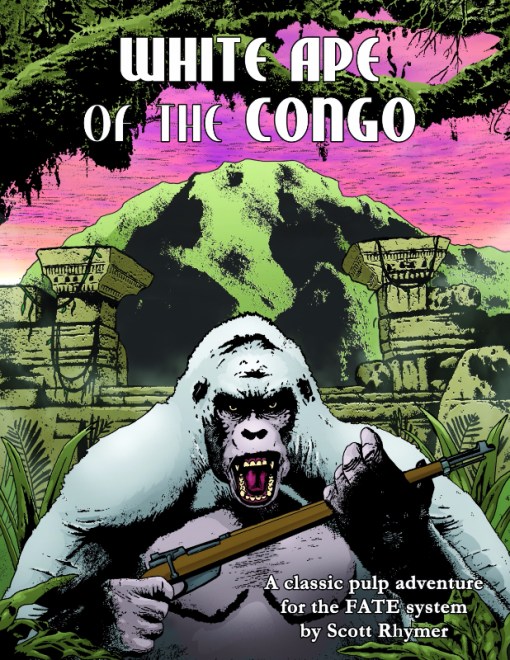
Black Campbell’s first adventure/module/booklet/whateverthe kids are calling them these days is live at DriveThru RPG and RPGNow.com. Set in 1936, it follows a band of explorers into the heart of darkness, looking for a lost biologist and his mythic White Ape of the Congo. It’s designed for two to six players, should take about four hours, and has a lot of tips for using the adventure in an existing campaign.

There is a Ubiquity version for you fans of Hollow Earth Expedition, as well as a Fate version.

The cover was done by comic book artist Bill Forster:

cover-white-ape-of-the-congo

Interior art was by yours truly, with Jim Sorenson of Transformers fame doing layouts, and a last minute save on file size by my wife Susan! It’s 18 pages for Fate, 20 for Ubiquity of pulpy goodness and priced comparably with adventures of the same size at $2.50.

Have a look!

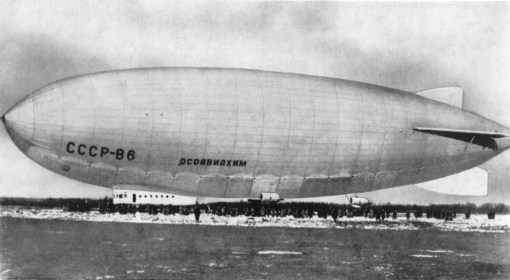
Technically, it’s SSSR-v6 OSOAVIAKhIM, a Soviet-built seni-rigid airship designed by Umberto Nobile, an Italian aviator and inventor who was, after 1928, on the outs with Mussolini and was in exile in Russia. The name is from the acronym for the Volunteer Society for Cooperation with the Army, Aviation, and Fleet…original, as only bureaucrats can be.

w-6_ossoaviachim_wiki

The ship is centered on a keel from stem to stern, and an envelope that has smaller gas cells inside — it’s part blimp, part dirigible. SSSR-V6 is based heavily on Nobile’s previous airships, Norge and Italia, which he used for polar exploration in the mid to late 1920s. It is, through the 1930s, the Soviet Union’s largest airship and most successful, until her loss in 1938.

At 344′ long, she has a total displacement of 685,000 sq.ft. — about a quarter the size of USS Los Angeles or Graf Zeppelin. It is, however, quite light, and only loses 3 tons of her total 13 ton lifting capacity, and is powered by three 190hp gasoline engines that can reach a face-peeling 58mph.

SSSR-V6: Size: 16   Def: 10   Strc: 10   Spd: 60   Ceil: 8,000′   Han: -2   Crew: 15


They’re almost essential to setting the mood in a ’30s pulp game…airships. Zeppelins. Dirigibles. From a boy, I’ve loved these damned things, from the first time I saw the Goodyear blimp. So I thought it might be time to write a few of the old girls up for Hollow Earth Expedition.

The first conceit I changed — the idea that these vessels were lightweights against attack. Outside of a hit by another vehicle, the sheer size of the airship means they can take a lot of bullets before they start to have an issue. This was why the incendiary bullet was developed, to set off the “dirty” hydrogen (hydrogen that had been adulterated with air.)

We’re just going to do the rigid airships that were active in the 1930s:

U.S.S. LOS ANGELES (ZR-3)

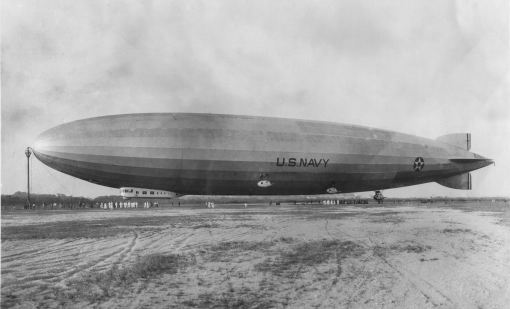
Launched in 1924 from Freidrichshaven, Germany as LZ-126, Los Angeles was part of the war reparations plan. The airship is the sister ship to Graf Zeppelin, and has a flawless service record with the navy. Built as a passenger vessel, Los Angeles has been used for scouting, zeppelin construction studies, and for scientific missions. She ended her active service life in 1932, but remained commissioned and maintained at Lakehurst, New Jersey until 1938, when she was broken up for scrap.

Displacing 2.7 million cu.ft., ZR-3 is 658’ in length, with a bean of 90’ and draught of 104’. She is propelled by five 400hp Maybach V-12 engines and is capable of 75mph for 6,640 miles. She has a pressure height (ceiling) of about 8,000’.

losangeles_panama_1929_1

USS Los Angeles: Size: 16   Def: 12   Str: 18   Spd: 75   Ceil: 8,000′   Rng: 6000 mi   Han: -2   Crew: 36   Pass: up to 20

U.S.S. AKRON (ZR-4) & U.S.S. MACON (ZR-5)

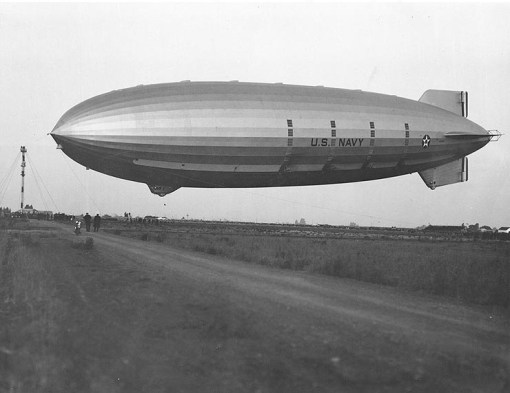
Commissioned in 1931, Akron is the first rigid airship designed and constructed by the Goodyear Company of Akron, Ohio. Currently, the largest flying object ever constructed, the airship is 785’ long, with a beam of 133; and draught of 145’. She is propelled by eight 560hp Maybach V-12 engines that are connected to specialized condensers that use the exhaust to create water ballast to replace the fuel used in operation. She is capable of 80mph and a range of 6000-6500 miles, carries 8 M2A1 .30 machineguns and up to 5 Curtis F9C Sparrowhawk fighter planes in her launch bay.

From the get-go, Akron was something of an unlucky ship, experiencing several incidents where she was suffered minor damage due to mishandling. In 1933, she was on a patrol off the New Jersey coast when she ran into a storm. Unlike German airship handlers, who scrupulously avoided bad weather, naval airshipmen had a habit of running their craft through dangerous weather systems. In this case, the sudden drop in barometric pressure the altimeter in the control gondola left the crew to think Akron was higher than she actually was. Worse, with a high degree of up-angle, the tail of the craft was dangerously low (she was almost 800′ long and typical cruising altitude was between 1500-2000′.) The tail hit waves, and the sudden increase in weight from flooding dragged the ship down.

zrs-4_landing_h42156

Her sister, Macon, had launched about the same period of time. The ship operated for two years without issue until her flight to California in 1934, when she was required to fly over her pressure height to clear the mountains of New Mexico. This did damage to her gas bags and engines, as she was running “heavy” and had to use her speed to aid in lift. Before the craft was finished repairs, she was used in a naval operation off the Pacific coast and was caught in a storm that tore a tail fin loose, causing her to rupture a few gas cells and crashing her into the ocean.

Akron-class airship: Size: 16   Def: 12   Strc: 12   Spd: 80   Ceil: 6,000′   Rng: 6500 mi   Han: -2   Crew: 60

CURTISS F9C SPARROWHAWK

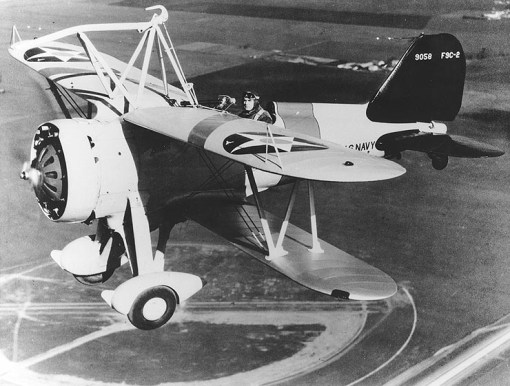
f9c_sparrowhawk

Both Akron and Macon were designed to carry up to five Curtis F9C Sparrowhawk “parasite fighters” — the naval designation for the lightweight, finicky biplanes that the vessels used to increase their scouting range. The F9C could launch and return by connecting to a trapeze system that they lock onto with their top hook. Only seven or eight of these were built.

F9C Sparrowhawk:   Size: 2   Def: 6   Strc: 6   Spd: 175   Ceil: 19,800   Rng: 290 mi   Han: +2   Crew: 1   Armaments: 2 linked Browning .30 machine guns — Dam: 4L (6L linked)   Rng: 250′   Cap: 250 (b)   Spd: A

« Previous PageNext Page »