Roleplaying Games


John Fredericks was making some interesting comments on game continuity over at Gnome Stew, and it spurred a few responses from me, including on one the efficacy and issues of “troupe-style play” As to continuity, however, I have to say: I’m for it.

There are several levels of continuity he addresses, but I think we can ignore a few of the bullet points he uses, and frame this in terms of televisions or novel series. Additionally, however, I want to add the notion of “canon” — that the continuity is also tied to the internal logic and rules of the genre or setting.

Strong Continuity

The game university has an internal logic and history that affects, and is affected by, the actions of the characters. Things that happen are important and can/will be used against you in a future game.

Modern television series tend to follow this model these days, sometimes to abstraction. The characters’ action don’t just impact the universe around them, but drive the personal relationships between the characters. Friendships can be broken, alliances shift, goals change. There is usually some kind of central goal, villain, or motif to be served. There’s a “story arc” that can be a season long (Dr. Who, for instance), or series long (Battlestar Galactica.)

This requires a lot of mental lifting by the GM and the players. Note-taking and record keeping can be a full-time job. In this sort of continuity, I think it’s important to have NPCs changing along with the PCs. Their stats should evolve, if it’s a system with aspects or traits or weaknesses, these should change over time, just as with the players’ characters.

This has been the sort of game I’ve run for quite some time, and I agree with Fredericks that this is the sort of universe most players are interested in — something long-term than allows them to explore a character and feel that they have achieved something.

Ret-continuity

You see this in a lot of modern TV, as well, in shows that were meant to have some kind of central theme or mystery that the writers and executive producers — well — didn’t really have a clue what it was going to be. Shows like X-Files, or Lost are prime examples of this: there’s a conspiracy or mystery, and the characters are working toward figuring it out, but since the writers don’t really know what the hell they’re doing from one season to the net, they have to scramble to put a coherent arc together through seemingly (or obviously) contradictory elements.

I had to do  bit of this with my Battlestar Galactica campaign, which had a few points where I veered in different directions. I had a fairly solid idea of the campaign endpoint, so I was able to tap some of the elements into place, and fortunately (unlike TV) you can go back and rewatch a session to see if all the “facts” are the same as they were three years earlier. You can often get around this bad hand-waving, counting on the players’ faulty memories, or creating some kind of “your perception of the incident was not completely accurate” type out (see Rashamon…different people see an event differently.)

Honestly — this is probably the closest you’ll get to the “strong continuity”.

Loose Continuity

Like ’70s and ’80s TV, the characters tend to be static, or change in personality as the story suits. It’s episodic and each episode is unlikely to be linked; it’s almost like each episode is a reboot of the last episode. Set The A Team, or Starsky & Hutch, or TJ Hooker. Hell, see the original Star Trek…there’s no “canon”, no real continuity beyond the characters and the general flavor of the show. Maybe a character was too good to die in your pilot session, and like Hill Street Blues (which was an early “strong continuity” show) you bring those guys back and just ignore they were shot to death in a stairwell. Certain things that happen might matter — that love interest might be lost to the character, then show up conveniently to cause trouble; the big bad guy might return, or one of his kids; something that happened in “season 1” might suddenly become important for a storyline in “season 4″…but doesn’t really change anything outside of that episode or two.

Yeah, character C disappeared for two sessions of our dungeon crawl (including a bit fight), but he was just off having a pee. Or was there but for some reason never did anything. Doesn’t matter, he didn’t get XPs.

NPCs don’t change. They are there for comedic or supportive effect, or local color. Hell, they might not even have a name. Taking notes on what happened is optional (but the loot is not!) You might be able to ret-con a story arc into the game near the end for a satisfying denouement — all these things were actually under the control of the nameless bartender you guys all liked!

No Continuity

This might be the schtick of the game itself. No matter what you do, you reset to the state of the universe prior to the adventure. Your dungeon crawl? No effect on anything but your character level and stuff. That crime you solved? Hell, maybe the same bad guy is still around; he has a great lawyer. You died? When did that happen?

A campaign like this could be played for laughs, like Paranoia, or it could be — cunningly — the actual metaplot of your campaign. Maybe, all your disconnected adventures were happening while you were in suspended animation on a long space voyage, or holodeck adventures, or some kind of prison you are trapped in.

Canon — or “That Wasn’t in the Show!”

As to “canon” — that word every GM should fear when you are running a licensed universe like Star Trek or Dr. Who — setting ground rules is essential the higher up this scale of continuity you go. When I ran Star Trek, I had a trekkie in the group (it was why I wound up running it.) I was not. So to cover my ass on continuity, we agreed that game continuity trumped the show. Certain things weren’t going to happen. Voyager, for one..

When I ran The Babylon Project in the late ’90s, however, I parked the campaign on the edge of the show’s events so that we could play our own game, but dip our toe into the Babylon 5 continuity as we needed. It worked very well. We ignored certain things from Stargate SG-1 when I ran a short game and kept the good stuff.

Ignore it when it suits the game, don’t when it enhances the game. Your game is a reboot. Go easy on the lens flare.

I was reading an article on another site that was talking about continuity (more on that in another post) and how tight continuity campaigns could be derailed by scheduling issues. As readers of the blog have seen, my group has been beset by scheduling issues this year, and I’ve been something of a whiny bitch about it.

It got me thinking suddenly — we had similar issues with the long-running Battlestar Galactica campaign, lost players and gained them…why wasn’t this as much of a perceived issue before? Then it hit me: for the Hollow Earth Expedition game, the players only have one character.

To be able to explore other areas of the Galactica universe, all the players had two to three characters, each in their own circle of the rag-tag fleet. (In the abortive campaign prior to that, each had a fleet and a survivor on Caprica character…for the same reason.) One of the benefits of this “troupe-style play”, is that if a character isn’t present, they could easily be handwaved away as “on administrative duties”, or “somewhere on leave in the  fleet”, or I could concentrate on characters and situations that didn’t require all of the players to be present. I had an out.

File under “Duh!”

So how do you use this style of play, and what are the up and downsides? Let’s start with the downsides:

First, it shifts the focus away from one single character the player has. In the Battlestar Galactica campaign, for instance, one of the players was playing the Vice President of the Colonies. While this allowed the player to have high-level influence in the policies of the fleet his other characters did not, he wasn’t a combat guy. He didn’t investigate crimes or fly vipers. That mean he got a lot less time and focus as the other characters — a cop and a viper pilot — and wasn’t of as much interest to the player or the GM. But he was a great trapdoor to play when the other players weren’t present.

A codicil to that — the players may also take an interest in a different character than you anticipated, and push the plot or focus of the campaign in a different direction than the GM expected. This can be frustrating for the GM. If he ignores the B-string character, this can be frustrating for the player.

Secondly, if the various characters eventually have to interact, it can be problematic (or funny) to watch a player trying to effectively roleplay a scene between two of his personas. It can work, trust me, if you have a good player, and it can be a blast, even for the players on the sidelines for the scene; it can also be awkward as hell. We even had one player’s characters have to fight each other.

Third, you still have to explain away why the B characters aren’t wandering the dungeon with you. This is probably not as much an issue in a game that doesn’t have the players in a fixed location or vocation with each other, but if you’re on a dungeon crawl, or traveling as a tight group, B might suddenly be of use.

So now the upsides:

The GM and players can branch out and explore the world around them. An example: if the group were playing the Avengers in a superhero game and someone was Spiderman, you could focus on his crime-fighting in NYC, if there were key players missing that week. Or instead of world-shaking efforts, a few of the team might decide to aid another player in a side quest — finding a friend’s murderer, or looking for a shawarma restaurant.

Secondly, the players can switch it up from time to time and play something different to bust the group out of a rut. Maybe you’ve gotten a bit tired with your 12th level paladin, and playing that 4th level rogue sounds like fun that week… Maybe you can switch up genres a bit: maybe instead of playing a cargo ship crew running around the ‘Verse avoiding the Alliance, you are focused on helping a B-story character clear a neighborhood of a gang that has moved in on a neighborhood by the docks. It lets you get the characters out of their comfort zones — crap, my bad-ass fighter needs to schmooze with the upper crust as a date or escort for the team’s wizard at a Magician’s Guild meeting. Maybe the paladin suddenly has to engage in protecting a thief, engaged in a questionable side heist for a good cause (he hopes!)

Third, you can manage no shows much easier by swapping the stories you pursue with side quests.

But, as always, I could be full of crap…

So, I settled on a flag or standard for Atlantis for our Hollow Earth Expedition campaign. I wanted something that would “speak to the Nazis” when they eventually show up, but blended well with the Vedic beats we’ve been using for the “gods” — the devi and asura — that once ruled the Inner World (and may have created it as some kind of prison…)

atlantean-swastika

The city will have a similar radial canals to curving ones, with four great towers in the center.

The emperor’s standard, of course, is the same thing, but in gold.

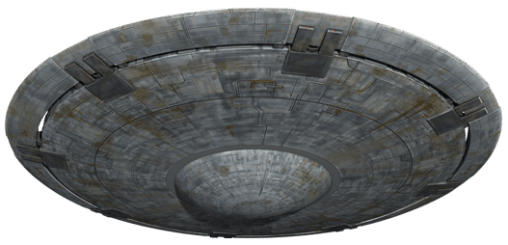
One of the big bads, Captain Thoth, has been chasing the characters around with a fleet of flying saucers. Most of them are smaller vessels, like Aruna or Agni , but the head of Atlantis’ secret police is toddling around in a super-szied version, Durga.

War Saucer Durga

At 60 feet in diameter and with eight dual heat ray batteries at the rim (above and below!) of the machine, Durga is an imposing craft. (The landing gear of the vessel retract into spaces proximate of the cannons.) As with most of the Atlantean craft, she bear the swastika of life and change, but the upper dome is also painted in the eight-pointed starburst of General Inanna’s flag.

pirate_saucer_mothership

The outer third of the saucer is primarily drive and weapons spaces, and the internal layout has a central command desk with four radial crew spaces that then curve to the right, mirroring their flag.

atlantean-swastika

The flag of Atlantis

The vessel can carry approximately two platoons of troops and their gear in tight quarters. In local memory, no one has heard of one of these machines being destroyed.

SIZE: 8   DEF: 4   STRC: 24   SPD: 350   HAN: +2   CREW: 10   PASS: 24; 16 Dual Heat Ray Batteries —   Damage: 10L   Rng: 500’   Cap: n/a   Rate: Beam**   Spd: A

**Beam weapons fire like autofire weapons. Use the same rules.

147bb81e5b980bd7063ae05bf8516b8a

Command flag of Gen. Inanna

Battle Flyer Shiva

shiva

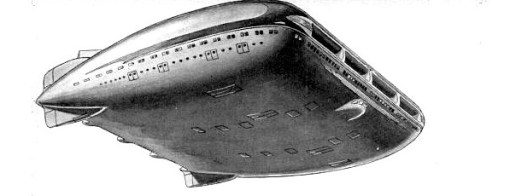
But it is the aerial warship Shiva that is most terrifying in the Atlantean arsenal. At a wondrous 900′ from stem to stern, almost 600 across the beam, and with seven decks — including a launch and recover deck amidships for light saucers — Shiva is the only one of her kind left flying. A dozen repulsion units keep her in the air, and she carries a massive broadside of heat ray batteries. She can — if she sacrifices some of her lift — pack up to 500 troops into the vessel or a dozen smaller saucers. It is rumored the Emperor has a stateroom aboard her from which he can look down on his domains.

Shiva usually patrols the skies above Atlantis, and is commanded by General Inanna, if the emperor does not take personal control.

SIZE: 16   DEF: 2   STRC: 36   SPD: 200   HAN: 0   CREW: 50   PASS: up to 500; 20 Dual Heat Ray Batteries (2 fore and aft, 16/broadside) —   Damage: 10L   Rng: 500’   Cap: n/a   Rate: Beam**   Spd: A; Bomb bays — Damage: 12L (area), Cap: 24 Rate: A   Spd: S

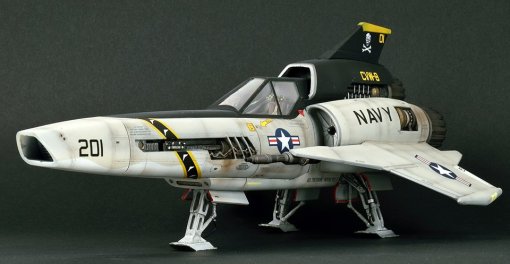
One of the nice things about the reimagined Battlestar Galactica is the idea of the Cycle of Time — that these events recur in variations of a theme throughout time. With that in mind, here’s a little something from the “Starships of the Universe” page from Facebook:

14364747_10210489519498722_3650295513681714909_n

What if, instead of the Twelve Colonies, you start your campaign on Earth? Maybe see the settlement of the 12 Colonies or Kobol as the outcome of your crew fleeing the creation of vicious AI here on Earth (something alluded to at the end of the show?)

Maybe your “Battlestar” class space aircraft carrier Enterprise can lead a rag-tag fleet of cobbled together spacecraft looking for a new home..?

[This is a repost of an oooold one from 2010. Artwork by “Partisan” and is used without permission. No infringement intended; let me know if you want it removed. You can see more of his work here. SCR]

Since we got into the Inner World in our campaign, one of the motifs has been the mythological connections to the beastmen. The various chimeras were created by the devi or the asuras, depending on who you ask, but many have mythological analogues. (The merfolk are the most obvious.)

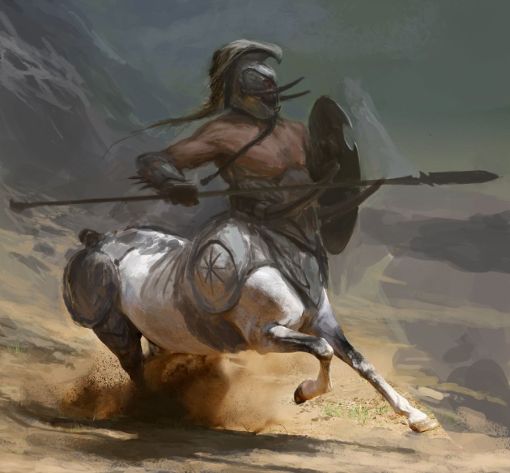
Another chimera race that springs to mind is the centaur, and an excellent one for player characters, so without further ado…

CENTAUR (Follower 2)

20f2040fa9fd6c03ff595b96fb4f85f6

Primary Attributes: Body 3, Dexterity 3, Strength 3, Charisma 2, Intelligence 2, Willpower 2

Secondary Attributes: Size 1, Move 6 (Run 12), Perception 6, Initiative 5, Defense 5, Stun 3, Health 6

Skills: Archery 5 (7), Athletics 5 (8), Brawl 5 (8), Stealth 3 (6), Survival 4 (6)

Talents: Alertness (+2 Perception)

Flaws: Addiction, alcohol; Herd Mentality; Lustful

Natural Weapon: Kick 8N

Once thought to be creatures of myth or allegory, Centaurs (and the female, Centaurides), roam the plains of the Hollow Earth near Atlantis and Shangri-La.  Usually, they are to be found in herds or in small hunting groups, but the occasional lone adventurer can be encountered almost anywhere in the interior world.

The centaur are a peculiar people — prone to great emotion and little self-control (as a rule.)  They are often drunkards, and when drunk, unpredictable.  When befriended, they are incredibly loyal and caring; when made an enemy, they are implacable and deadly, combining the best and worst traits of man and horse — they are fast, strong, smart, and vicious.

Character Template:

Attribute Adjustments: Size +1, Body +1, Intelligence -1, Willpower -1

Natural Advantages:  Quadruped (doubles speed)

Inherent Flaw:  Herd Mentality, Lustful

I’ve been banging together NPCs like crazy for the Hollow Earth Expedition campaign we’ve got going on. One of those described was Captain Thoth, the head of the Atlantean emperor’s secret police. I wanted something with that same vibe Klytus had in Flash Gordon, but not too close…

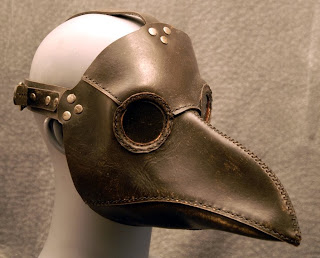
His look was described as an all black outfit with the red swastika (Hindu style) on the chest, a cape and cowl, and a strange near featureless bird mask…something along these lines:

mask4

He has a calm, superior demeanor, couches his interrogations in friendly inquisitiveness, until it’s time to get rough. He is a master torturer and enjoys his work. His face is covered due to his horrifying face, the result of a near-fatal attack. He lacks a lot tactile feeling, and is near impervious to pain.

CAPTAIN THOTH

Archetype: Vril-ya Spy     Motivation: Power     Health: 6

Body: 2, Dexterity: 2, Strength: 2, Charisma: 3, Intelligence: 3, Will: 4; Size: 0, Initiative: 5, Defense: 4 (6*), Stun: 6, Move: 4, Perception: 9

SKILLS: Athletics: 4, Brawl 5, Bureaucracy 7, Con 6, Diplomacy 6, Firearms 4, Intimidation 5, Investigation 6 (Torture 7), Linguistics 6, Melee 4, Pilot, Air 3, Ride 3, Stealth:4, Streetwise 6, Survival 4

RESOURCES: Artifact 2: war saucer; Status 2: Chief, Atlantean Secret Police

TALENTS: Alertness, Atlantean Language,  Danger Sense, Focus Attack/Defense (melee), High Pain Tolerance

LANGUAGES: Atlantean (native), Ancient Greek, Hyperborean, Trade

FLAWS: Albino, Condescending, Low Tactile Sense, Repulsive, Sadistic

WEAPON: Energy Pistol   Dam: 3L   Attack Rating: 9L   Cap: 20   Rng: 100’   Rate: b, Spd: A

Armor: * Adds +2 Defense

Thoth Mask: Ignore night perception mods, +2 vs. airborne toxins, etc.

Due to a fortnight’s absence, I needed to be rid of a character for what was supposed to be a week. Ordinarily, i just have people roll for the missing character and I run them as an NPC for the time the player is away, but for some reason I (foolishly) decided to just have him chucked from the scene by a bad guy with the intention of getting everyone straight back together after the fight.

It didn’t work that way. The other players assumed he was dead and wound up traveling off to Ultima Thule, where they met the new big bad, escaped, and were hiding on the private island paradise of their Vril pilot Shria, who they now know to be the youngest daughter of Emperor Mot, the ruler of Atlantis (and absolutely not the Max von Sydow Ming…no matter how much he looks and acts like him. Really.)

So come this week’s play, I have to either 1) give the player a new character until we can get back to him at some point…, or 2) find a way to get him to the island, 400 miles away. One thing is moving in favor of option 2 — this is a pulp game. Deus ex machina and outrageous coincidence are part and parcel of the genre.

So after establishing that the characters are taking a risk in staying on the island for a few days to rest, heal up, fix their aircraft, and plan their next move, we moved the scene to three days previously, and the Sanctuary, the cargo cultist home in the hulk of the SS Grand Pacific, missing since 1893, and the fight scene between them and the pirates who would later take the Sanctuary.

Gus Hassenfeldt is in the process of reloading his scattergun when Tongo, the gigantic henchman of the pirate king, Captain Trihn, throws him over the side of the ship. Gus doesn’t go quite as far over as they originally thought, crashing through the scaffolding and half-assed housing that buttresses the old ship. He passes out, only to be revived by a young woman as cannon shots tear through the place. Before he can escape, the ‘building”, module, whatever he’s in suddenly heals over and topples into the waves and rocks below! He is stuck with the young girl in a heap of wreckage, and he manages to free her, only to be trapped under water…drowning…

…then an alien face, beautiful and terrible at the same time comes out of the dark waters, and breaths life-giving into his mouth. He loses consciousness at some point, while experiencing the pressures of deeper water, strange music in his ears…then wakes in a dark cave that is lit by bioluminescent critters, with food and water waiting, and a strange figure in the darkness guarding him. After a while, he is visited by a group of creatures — merfolk! nereids! led by a crowned, powerful merman who identifies himself as Triton. He was rescued from Sanctuary because he was recognized. One of the mermaids emembered him as one of the people whose escape from the pirate haven at San Antonio allowed her to escape captivity of Captain Trihn, Triton’s daughter, Osha.

Triton’s people have been pursuing Trihn and his people since they were expelled from San Antonio, and that wretched place destroyed by the Vril (their companions Amon and Shria.) They cannot attack the Sanctuary effectively, but there are some of their kind that can — “walkers”, he calls them — but it will take time. Gus immediately leaps on the idea of trying to forge a coalition of people to put an end to the scourge of piracy, and address the issue of the Vril and the emperor there. He finds out that the merfolk can communicate over vast distances, and that they have heard there are a group of fugitives from Atlantis on an island a “few beats of the world” from here.

Gus manages with some judicious style point usage, to get the mermen provisionally on board an alliance, then Osha and one of her friends agree to take him to his friends on Avanda. He spends the next two or three “beats of the world” — the merfolk can sense the spin of the place and are one of the few creatures that can accurately tell the passage of time — on a kit-bashed catamaran, alternately under sail or drawn by the mermaids, to his destination. During the short voyage, he is entranced by their strange, alien singing, and by the time he arrives at Avanda, he and Osha are an item. After a reunion on the black volcanic sands of Avanda, and a “what the hell happened to you?” dinner, the group is interrupted by the arrival of an imperial sky fleet, led by the large war saucer Durga. 

The group scrambles to their new flying saucer, Agni, and their flying wing, and take to the skies under a fusillade of heat rays, and lead the bad guys on a fast nap-of-earth chase over the jungles and volcanic mountain of the island. They manage to evade capture and wind up hiding the saucer under the waves offshore of the island. After waiting some “turns of the glass”, they race away to find their friends in the flying wing, then travel to where the merfolk are based.

Floating on the surface of the ocean, they negotiate with Triton and his people, and plan a stealthy incursion into Sanctuary to remove Trihn and (hopefully) take the place back. With a few of the “walkers” — merfolk with legs (think Abe Sapien from Hellboy) — one of which is Triton’s son, Glaucus, they slip ashore and enter the hulk through a hole in the hull that leads through the old coal bunkers into the engine room.

In the dark of the old ship, the small group makes their way up toward the pirates and their confrontation with the pirate king, Trihn…

By pulling the last minute deus ex machina of having Gus rescued by the merfolk, it allowed me to introduce one of the beastmen of the Hollow Earth, and pick up one of the threads I’d dangled earlier but went nowhere. If also allowed them to finally forge some friendships, and let me address one of their recurring villains, the “chua te”, Captain Trihn. It also gives them the possibility of finally having some kind of base of operations that is near a possible entrance/exit to the Hollow Earth, the “Hole in the Ocean”; some kind of whirlpool that seems to be created by whatever keeps the Aerie of the hawkmen in the the sky.

The characters have already set on the idea of capturing the Sanctuary, then forging an alliance between themselves and the hawkmen (giving me another thread that has been dangling), and from there, looking to start opposing the emperor.

It’s Flash Gordon meets the Hollow Earth, but with mythological trappings. We’ve mentioned “sky riders”, pterosaur-riding Vril that are outcasts from Atlantis; there’s the barbarians and Amazons of Hyperborea, and the strange asura or demons of Asura ke Shahar — the city that the odious Ivora the Magnificent once ruled and wished to return to.

With these last two sessions, the campaign suddenly has an overarching goal and storyline, mostly thanks to the actions of the players, which will help direct how they explore the game world.

A nice big room with paneled, radiant heated floors, a fireplace, loads of windows, a long wall of bookshelves, and a a videoconferencing rig to play with people around the world. The table could either be a billiards table with a cover to allow tabletop play, or a big Surface screen that people could have their characters, notes, and dice apps running on. Nice comfy chairs.

If you’re gonna dream, dream big.

The Italian Alps or the Amalfi Coast. Preferably on a nice balcony, with a good view, good weather, and a nice couple of bottles of wine.

“How ’bout the South Seas Club, while you’re dreaming..?” — Cliff Secord, The Rocketeer

« Previous PageNext Page »