Roleplaying Games


Admittedly, this is the “partially redacted” e-book version for the Kickstart backers, so some of this may change with the final version. With that out of the way — the boys at Evil Hat and Atomic Robo writer Brian Clevinger bring us the first sourcebook for the game: Majestic 12. The book revolves around the eponymous bad guy organization from the comic (and in particular their latest volume The Ring of Fire.

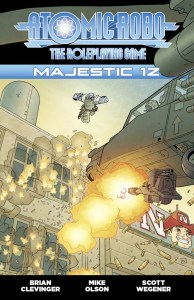
M12-Front-Cover-Mock-662x1024It’s a short splatboot, only 82 pages in .pdf. It begins with “The Secret History of Secret History” and outlines the creation and developmetn of Majestic 12. The second chapter briefly outlines the other secret organizations of the Roboverse — including Project Daedalus (which specializes in Helsingard tech), the Soviet’s Department Zero, China’s Most Perfect Science Division, and Big Science, Inc. This was a section I think could have been built out a bit, but more on that later.

Chapter 3 and 4 are the meat of the book. Three deals with new Weird Modes for characters, each for the six sections of the organization, and includes new skills like Teslology — the study of Tesla science and gear. Four focuses on some new rules — creating mission briefs, and requisitioning gear — which works like Inventions, except here you are getting gear not by building it, but by navigating bureaucracies. It’s a cool conceit and works well with the Atomic Robo rules.

There’s write ups of the various Majestic characters we’ve seen in the comic, as well as a few new ones. The final chapter is a series of adventure hooks.

It looks great, using mostly Scott Wegener’s art from the comics, but includes a comic vignette of the creation of Majestic with art by David Flora. some of the art, the indexing, and other things were incomplete (hence the funny redaction, which works very well with the flavor of the organization. I can’t wait to get the physical copy in a few months.

That said…I was very disappointed that they didn’t expand rules on Factions. In the core book, there’s very basic rules for Factions to cover Tesladyne, and how you can use the company to achieve your goals. In the core book, Factions only have a singular mode: Resources. Resources then have skills: Armory, Intel, R&D, and Transport. There is no write-up for Majestic. It would have been a simple text box to include it, so I’m hoping it’s in the offing, (and this may be the case, as Majestic’s Intel skill is mentioned in a few places) but I think adding similar stat blocks for the other organizations would be a good idea for those players and GMs that don’t want to write the stuff up themselves. With the new rules for Requisitioning, it might be an excellent chance to build out faction rules. (If you want some rules regarding organizations, you could also crib from Mindjammer by Sarah Newton…)

Style: writing and artwork (minus the Flora stuff) is solidly in the mode of the comics. I’d give it a 4 out of 5, for capturing the comic well. Substance: here’s where I have to ding them a bit. The lack of faction stat blocs is a big omission, but they might be part of the unfinished artwork. If so, I would expect to rate it higher than the 3 out of 5 I’m giving it, right now. Call it a solid 3.5/5.

So is it worth it? At $20 in physical form and you’re playing the game, yes. If you’re not a fan of the comics and game, then you probably weren’t looking to buy anyway.

Next up, the ubiquitous steam-powered aerial flyer, and the Aphid-class aerial gunboat of the Royal Navy on Mars:

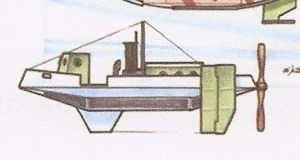
Aerial Steam Launch

SteamLaunchRightThese little craft are made by a few different purveyors in the colonized cities of Mars, and there are a few making these liftwood craft for Earth, as well. They are typically about the size of a water-bound steam launch.

SIZE: 4   DEF: 6   STR: 12   SPD: 20   HAN: 0   CREW: 2   PASS: 4   PRICE: £4,000

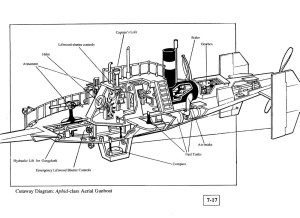
Aphid-class Aerial Gunboat

space-1889-lThe first of its kind, the Aphid class is the workhorse for the British Empire’s holdings in the Syrtis Major region. 65 feet in length, well armed for her size, and caable of speed up to 30mph, these small craft conduct aerial treasury activities throughout the colony.

SIZE: 8   DEF: 4   STR: 14   SPD: 30   HAN: -2   CREW: 15   PASS: n/a   PRICE: £23,000; WEAPONRY: 4′ short cannon (fore) — Dmg: 10L   Rng: 500′   Rate: 1/2   Spd: S   Size: 2; 2 1 lb. Hotchkiss Rotary Cannons (side mount) — Dmg: 8L   Rng: 500′   Rate: 1/2   Spd: S Size: 2; 2 Nordenfeldt machineguns (broadside) — Dmg: 5L   Rng: 250′   Cap: 40 (m) Tate: A   Spd: S

German Passenger Zeppelin

These lighter-than-aircraft are held aloft by hydrogen cells inside a rigid framework. The passengers reside in a car that is attached at the bottom of the hull.

SIZE: 16   DEF: 2   STR: 18   SPD: 50   HAN: -2   CREW: 15   PASS: 10   PRICE: £20,000

One thing Space:1889 fans might be interested in is actually using your aerial flyers and cloudships for the game. The basic rulebook covers just that — basics — but does not give the full statistics for even basic types of ships. So let’s rectify that, shall we?

1889_06Most of the stats for Ubiquity are based on size, and you can find similar vessels to model the other stats on, save speed — the old Space:1889 or Cloudships rules use a speed rating that is roughy 2 cables for a turn, but I didn’t want to bother with a ton of math and findingout what a round was in the board game aspects of theold rules. I used the travel times in the core book where a steam flyer could go 300 miles in a day. Assuming they don’t stop, that gives us roughly a speed of 12-15mph. Most of the ships have a speed rating of 4-6. Assuming that estimate of 300 miles is at a leisurely pace I’m giving the ships a speed in Ubiquity of 5mph/speed point in the old game mechanics.

Martian Screw Galley, Small

The typical example of this type of ship is the Small Bird or Fleetfoot-class galley. Manned by up to a crew of 20, these small vessels are driven by a man-powered crank in the lower deck and are slow and not especially maneuverable.

Small Bird Screw Galley —  SIZE: 8   DEF: 4   STR: 14   SPD: 10   HAN: -2   CREW: ~20 PASS: n/a   PRICE: £13,000

Fleetfoot Screw Galley — SIZE: 8   DEF: 4   STR: 12   SPD: 10   HAN: -2   CREW: ~10

Typically, these ships have little or no armaments, save for sweeper guns (essentially big blunderbusses: DMG: 6L   RNG: 250′ RATE: 1/2   SPD: S   SIZE: 0

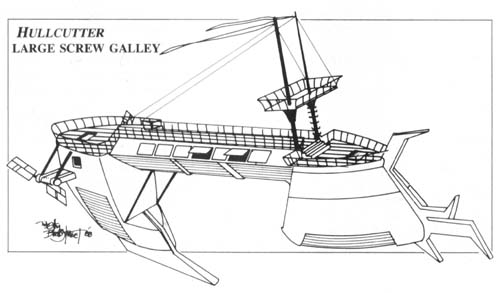
Martian Screw Galley, Large

These mammoth screw vessels are typically between 90 and 130 feet in length, and have a draught of up to 50′, with crews of 60-100 personnel (about half of those yoked to the crankshaft.) Here we present a Hullcutter-class as the typical example:

Hullcutter

SIZE: 8   DEF: 4   STR: 20   SPD: 15   HAN: -2   CREW: ~60   PASS: n/a   PRICE: £50,000 WEAPONS: Rouge Gun (foreward) — Dmg: 8L   Rng: 250′ Rate: 1/2   Spd: S   Size: 1; Lob Gun (amidships) — Dmg: 10L   Rng: 250′   Rate: 1/2   Spd: S   Size: 2; 2 heavy guns (wing mounted) — Dmg: 8L   Rng: 250′   Rate: 1/2   Spd: S   Size: 2; Rod Gun (aft) — Dmg: 8L   Rng: 500′   Rate: 1/2   Spd: S   Size: 2

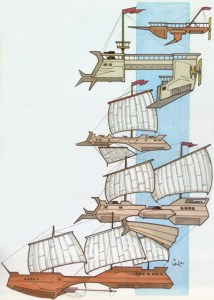
Martian War Kite, Small

The Bloodrunner is the smallest class of warkite likely to be encountered on Mars. At only 50′ in length, with a single deck, these are fragile, but agile, things.

SIZE: 4   DEF: 6   STR: 10   SPD: up to 25   HAN: 0   CREW: ~10   PASS: n/a   PRICE: £7000; WEAPONS: sometimes they will carry a pair of heavy guns fore and aft: Dmg: 8   Rng: 250′   Rate: 1/2   Spd: S   Size: 2

Larger and more typical is the Swiftwood-class light warkite:

SIZE: 8   DEF: 4   STR: 16   SPD: up to 25   HAN: -2   CREW: ~40   PASS: n/a   PRICE: £20,000; WEAPONRY: Rouge gun (fore) — Dmg: 8L   Rng: 250′ Rate: 1/2   Spd: S   Size: 1; 2 light guns (wing mounted) — Dmg: 6L   Rng: 250′   Rate: 1/2   Spd: S   Size: 1; 2 sweepers — DMG: 6L   RNG: 250′ RATE: 1/2   SPD: S   SIZE: 0; Grapnel gun — Dmg: 4L   Rng: 250′   Rate: 1/4   Spd: S   Size: 2

Martian War Kite, Large

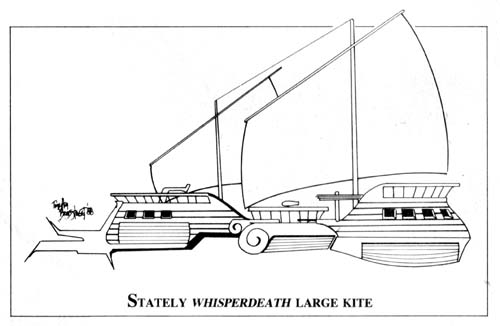
Here is the Whisperdeath-class warkite as an example. These ships are roughly the size of a 18th/19th century sailing frigate:

Whisperdeath

SIZE: 8   DEF: 2   STR: 26   SPD: up to 25   HAN: -2   CREW: ~40   PASS: n/a   PRICE: £60,000; WEAPONRY: Rod gun (fore) — Dmg: 8L   Rng: 500′   Rate: 1/2   Spd: S   Size: 2; 4 heavy guns (2 aft, 2 wing-mounted) — Dmg: 8L   Rng: 250′   Rate: 1/2   Spd: S   Size: 2; 1 Drogue Torpedo — Dam: 12L   Rng: up to 500′   Rate: 1/2   Spd: S   Size: 1; 2 Fire Racks — Dam: 6L*   Rng: 20’**   Rate: 1/2   Spd: S   Size: 2

* Drogue torpedoes are dropped on a line from the underside of a ship, and must be maneuvered into the path of another vessel. ** Fire racks drop incendiary liquid onto the deck of a ship below. Wind and other effects can carry this up to 100′ out from the rack. If hit, the fire will continue to do damgage at a die less/turn vs. the STR of the ship.

Martian Merchant Kite

These massive merchantmen are represented here by the Warm Winds class of kite.

SIZE: 16   DEF: 4   STR: 30   SPD: up to 30   HAN: -2   CREW: ~50   PASS: ~10   PRICE: £113,000

Typically, these ships are not armed, but very well could be, if one were to sacrifice the extensive cargo capabilities.

One of the few things that disappointed me about the Space: 1889 rules that came out recently was the lack of addressing Martian physiology in the rulebook. So here’s something more in line with what I expected for the new Ubiquity-powered game:

MARTIANS

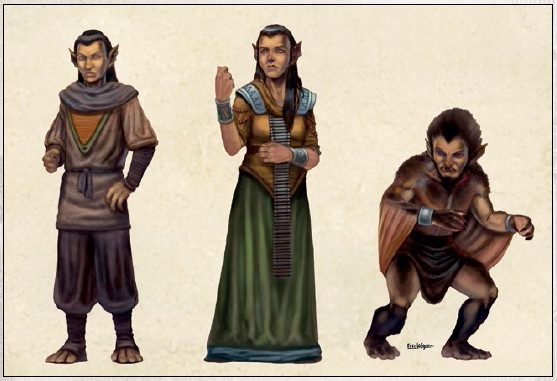
Hill, Canal, and High Martians -- as portrayed in Chronicle City's version

Hill, Canal, and High Martians — as portrayed in Chronicle City’s version

The denizens of Mars have three major racial types — the Hill Marian, found in the desolate wastes of the Red Planet; the Canal Martians, found almost exclusively in the urban and canal-fed areas of the world; and the High Martians — thought to either be the “Ur” Martian, or possibly a Hill Martians evolved to the particular environment of mountainous Mars.

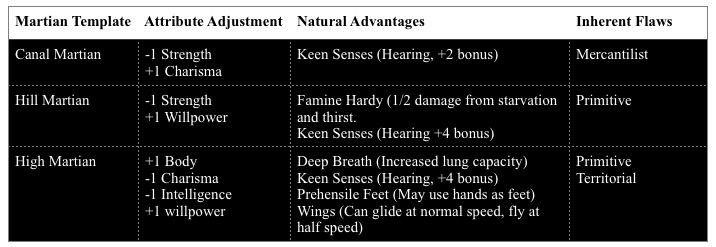
Using some of the Beastmen advantages from Mysteries of the Hollow Earth (pg. 14-25), I slapped together Martian character templates that were more in keeping with the original flavor of the game:

template

Venusians

Venusians aren’t set up as a player character in either any of the editions of Space: 1889, but I’m sure there are folks out there that might want to give them more to do in their campaign than be a poor man’s Sleestak. So here is a Template, vikked from Hollow Earth Expedition‘s Mysteries of the Hollow Earth to use to create a player character Venusian:

venusian

[This is a repost of an older one, but since I’m planning on statting out a bunch of the ships from Space: 1889, I thought it would be a nice kick-off. SCR]

Last week, we got all the players together for our next Hollow Earth Expedition adventure. We picked up with the group having arrived in London after their Africa adventure (see The White Apes of the Congo) — set up for a few days at the Ritz in Piccadilly, the characters set about trying to find out anything they could about the strange artifact from the city of the white apes, Mangala, at the British Library. Gustav Hassenfeldt, their big game hunter/guide, worked with Uncle Trevor doing research on others that encountered strange creatures like his “giant bat” at the Royal Geographical Society. His connections to the hunting world served him well and he is waiting for a vote to see him inducted as a friend of the RGS.

Lady “Zara” and Dr. Gould found a few references to the “Eye of Shambala” in the works of Sir Francis Younghusband during his expedition to Lhasa in 1904, as well as the memoirs of a German climber in 1920, the latter mentioned in the ramblings of Thule Society founder Rudolph von Sebbotendorf. This last claimed the Eye had been moved to protect it from the British in 1904; it was hidden in a cave under the northernmost chapel of the Potala Palace, and this was confirmed by the climber’s tale. Sebbotendorf has recenty escaped the Nazis, after having been jailed for claiming his Thule Society was the real power behind Hitler’s rise to power. The fuhrer, it seems, has not sense of humor…

Gus heard about a mountain climber and hunter named Munro Kinnie who claimed to have shot a “flying dinosaur” in Venezuela. He is currently in Montreux, Switzerland skiing and planning a run on the Eiger in spring. Sebbotendorf in also, supposedly, in the Lausanne area. They start working on trying to get funding for an expedition, andare contacted by Younghusand, who has invited them to dinner.

They learn from the old spy that he is the chair for the Himalaya Exploration Committee of the RGS, and after a long dinner, he offers to support their mission with a grant from the RGS of £100, matched by his own funds. With a loan of £200 from her ex-husband, they have enough to outfit and fly to Tibet, with a stop in Switzerland to talk to Kinnie. He has also arranged for Uncle Trevor’s grant to return to the Congo and find his apes, once more.

In Switzerland, the team is staying at the Beau-Rivage Palace in Lausanne. They go to Montreux and quickly find Kinnie at one of the ski lodges, getting drunk and taking a break from the slopes. Gus and Gould are able to convince him of their sincerity in asking about the dinosaur — he had found it on a tepui in Venezuela, and lost the catch due to the weak limbs of his bearers, who dropped the damned thing while they were scaling down the side of the mountain. The natives claim strange beasts have been sighted on the “Devil’s Mountain” — a tepui perpetually shrouded in mist. No pilot in the area is stupid enough to take on the mission to the top.

The party split, with Zara and Gould heading into town to drink and relax; Gus tries his hand at skiing, but not before being approached by a Dr. Albert Heiser — an archeologist and historian working at the University of Berlin, and a member of the Thule Society; and a George Werner, who if pressed, works for the Office of the Deputy Reichfuhrer. (Himmler, himself!?!) They offer to fund Gustav to find the Eye first for the Germans. They learned of their mission through some friends in the British Union of Fascists, and they also mention Sebottendorf (who they have learned escaped to Turkey), at one point. They believe the Eye is the product of the ancient Aryans — the Thule — and may hold the clue to the location of Ultima Thule, their ancient city (and Nordic knockoff of Atlantis.)

He politely refuses and Heiser is very understanding — he respects a man of integrity and loyalty. Werner, however, may not, as on his way down the slopes, Gus is attacked by a pair of thugs on skis, leading to a chase and fight with ski poles, and a jump off the side of a high cliff onto a sharp bank of snow. After returning to their chalet and informing them of what happened, the group rushes back to Lausanne to find their hotel suite ransacked and their Sikorsky S-36 sabotaged! They desperately get the plane fixed as the sun is going down and race off to Istanbul, to find Sebottendorf.

The chase for the Eye of Shambala is on!

2017 Jaguar F-Type

Jaguar_F-Type_V8_S_Cabriolet_–_Frontansicht,_12._Juli_2014,_Düsseldorf

Jaguar returns to the two-seater sports arena with the F-Type. The car is riding on a shortened XJ chassis, and can be had as a convertible or coupe, and uses an all-aluminum body and chassis. There are multiple engine configurations from the 3 liter supercharged V6 to the 5 liter supercharged V8, with the low end motor producing 340hp and a 0-60 of 5.1 second, and the biggest engine giving 567hp and a 0-60 of 4.7 second. Top speed is about 150 for the smaller V6, and 170 for the V8s. The vehicle features such amenities as 25 different driving profiles for the suspension, a low center of gravity, an automatically deploying spoiler wing, and gives the F-Type fantastic handling. The convertible top will open/close in 12 seconds, there are bi-xenon headlights, an active exhaust to beef up the engine note, and an interior of leather and brushed aluminum.

PM: +2   RED: 3   CRUS: 70   MAX: 150   FCE: 2   STR: 7   COST; $60,000-100,000

GM INFORMATION: The differences between the various models is small enough a single set of stats is applicable, save MAX: the V8 versions have 170.

[I can’t believ i didn’t get around to this one sooner… SCR]

The excellent folks at Mödiphius have gotten the license for the Conan roleplaying game. Now I’m not much on the sword-and-sorcery genre since I left my high school days behind, but for those of you that want some gritty fantasy goodness, jump on this bad boy! They’ve already blown past their $65k goal and at last look were at about $360k…enough they funded 11 other products off this.

I’ve had a look at the quickstart rules, and was impressed with how gorgeous even that 50 page taste of the game was. They’ve pulled top-notch artists for the project — Brom, Jusko, Tim Truman, Syrigos, among others. The system is 2d20 — a rules set that borrows a lot of good concepts, looks to play pretty simply. (Some of the writing makes it seem a bit more complex than I suspect it is.) An looks to capture the vicious, gritty side of fantasy, instead of the more friendly Dungeons & Dragons 5th edition. (Which I, surprisingly, liked!)

Speaking of — the 5th edition D&D is gorgeous. Truly a spectacular job from the production side of things, and Conan looks to be matching or surpassing that.

It’s not my cup of tea — I’m a bit more interested in the John Carter line —  but check it out, by Crom!


So, in addition to trying to boot up the new Hollow Earth Expedition game for the group, another genre I’m thinking of hitting is the cyberpunk, or at least near future sci-fi. Originally, I was thinking something along the lines of Greg Rucka’s excellent Lazarus comic — post collapse of the world economies and polities, and the rise of several large industrial fiefdoms around the world. The other influence vying for my attention is the police procedural cyberpunk of Ghost in the Shell (and specifically Stand Alone Complex animated series.)

After talking with the players, I’m slowly solidifying the game world around another project I’m working on. The police procedural angle has morphed into a news production team working for an internet news channel. Because I want that rainy noir quality to the setting, we were looking at Seattle, Denver, or Philadelphia as the city we’d use. I know the last the best, so right now, that’s the angle. Approximate time out, maybe 20 years in the future.

So how much cyber to put in this punk? The merging of man and machine is a lot less surgical than the works of Gibson and Sterling first posited. Instead of ubiquitous prosthetics, I’m thinking a lot of wearables, perhaps ones that can be worn to use of thought to access the internet, and which would act like the “cyberbrain” of GITS — by manipulating portions of the brain the “link” might allow you to see footage superimposed, or could record from your optic or audio nerve, etc. It gets you the same results, but with the added ability to have the damage the equipment, lose it, whatever… Prosthetics and prosthetic bodies would belong to the long line of military casualties from a never-ending War on Terror that has bled the developed world dry.

With many of the countries of the world “hollowed out”, there’s a lot of corporate sponsorship of government functions, a lot of graft and open corruption by government officials who still cling to the notion they are the only “legitimate” legal actors. Government types are constantly trying to wring cash from the people, and the divide between the rich and the rest has grown dramatically, mostly due to the government selling the legal system to the megacorps. There’s no true “poverty” like you see in Africa in the US, but there’s a lot of underemployment, lack of opportunity to create businesses and innovate because the big boys want no competition. The middle class has essentially been squeezed to the point they are no longer a factor. Without that steady stream of tax dollars, and with far too strong a technocratic oligarchy to steal from, the governments simply stopped being relevant, except for their ability to generate debt and use force. There’s a constant, uneasy tension between surveillance by the government and corporations, and souveillance by the people on these organizations. I’m picturing something between the kleptocracy of Russia, the bakshish culture of the Middle East, balanced by periodic Occupy/Tea Party/BlackLives political unrest and violence.

The goal was not to do the tired “evil corporations vs. the poor masses” schtick of cyberpunk. That was tired even in 1984. I didn’t want to do the Orwellian uber-powerful government, as well for the same reasons. What I wanted was something that looks like today, but twisted and turned up to 11.

I’m still trying to dial in on whether this is the way to go, but I think it could be off to an interesting start.

I discussed this particular game in another post, but that was aimed more at the idea of reusing old game ideas. Still, for those readers who frequent the site, there will be a lot of reused verbiage.

We had brought on a new player, one of the core group was away on vacation, so I thought I’d try them out on Hollow Earth Expedition. It had been four years since the death of the marvelously over-the-top Shanghai Campaign. We’d made a few abortive attempts to get a new campaign going, but the characters and the players just weren’t connecting. So, using the bones of a one-shot I ran for a Meetup RPG group, I put together a “backdoor pilot” using the same basic plot — the characters were looking for an academic that was lost in Equatorial Guinea, and claims to have found the mythic white apes of the Congo. Evil corporate interests with the backing of the local peninsulares are looking to stop word of the apes from getting out because…what does it really matter? They’re the bad guys. Little hints, in this case in the form of one character’s fascination with American pulp novels, allowed me to do a bit of foreshadowing. The lost city and white apes sounded a lot like Opar of the Tarzan books (which the character is reading during the downtimes — Tarzan and the Ant-Men — according to the player) and the Lovecraft short story Facts Concerning the Late Arthur Jermyn and His Family.

Here the missing fellow is Lord Trevor Ansom — Oxford Classics lecturer who runs about the world looking for mythic stuff. He’s a WWI vet, a bit addled thanks to serious PTSD, but just because he’s a bit weird doesn’t mean he’s not often right… The plot hinged on someone that would have the emotional connection to want to rescue him, and I wanted the new player to be the “lead” for the game. Her character: Margaret Ansom-Bose, recent divorcee and one-time companion of her uncle, who took her in after the death of her father in the War, and her mother from Spanish Influenza. She’s a “modern woman” who came of age as a flapper and an aviatrix in the ’20s, but after the Crash got married to an American oil tycoon to keep the family afloat. She’s a Beryl Markham sort of “damn it all, let’s have some fun!” sort.

The player leapt on this, but due to a series of crappy rolls over the course of two nights, this super competent woman kept coming up the damsel in distress for the other character to aid. Instead of decrying the situation, she’s added it to the flavor of Bose — she’s hyper-capable and useful until she needs to be a plot device. (I would point out, this makes her exactly the sort of heroine that was standard for 1930s/40s pulp.)

The next character was the problem one. The player in question just didn’t quite seem to jive with the pulp setting the two times we tried it. He had a big game hunter from Texas the first time around that just didn’t drop in well and the player didn’t connect with him. The second time he played a British occultist aristocrat…he liked the character but the notion didn’t sit well with me. I’ve found that unless magic or mind powers are common or ubiquitous, having a player with them sharply removes the feeling of danger and mystery from having powers loose in the game…it’s something bad guys have. The heroes have to overcome that. Look at almost every good horror/suspense piece — the good guys are usually outmatched and have to find some weakness that allows success. They don’t just hire a bigger sorcerer to take out the baddie.

The piece I was stealing from is set in Africa — big game territory. I took his original character of Gustav Hassenfeldt, and went to work with the editor’s scalpel. Background shifted from Texan of German descent to German who grew up in German East Africa until the British authorities tossed the family out in 1922. Didn’t connect with his dysfunctional homeland (and their actual family home is now in France and confiscated.) His parents moved to Texas to give me American adventure hooks, but he returned to hunting and being an  adventure guide for hire. There was my in to get the characters together. But the big reworking was to make him less arrogant and superb at his job (which he undeniably is — we’re talking Quigley Down Under levels of long shot goodness), less brash and impulsive, and made him a meticulous planner. Sensible and honest; a good man. This culminated nicely in a scene where he had the chance to take out a bunch of Spaniards at range and protect folks toward the end of night two, but quipped “This feels like murder…” This led to a non-violent solution to the scene — set up by the team’s combat bad-ass. It’s a great overturning of tropes. (He was also the guy referencing Tarzan.)

The first night started with getting the characters together through a mutual friend in Tangier. The necessary action scene to establish villains, get the characters to show their expertise and develop a connection, and set the stakes followed: goons hired by the Equatorial Lumber Company to get back the letter from Ansom, the map to his find, and (exposed) film wound up with a punch up and shootout on the harbor wall. Hassenfeldt character established himself as a guy that tried to talk his way out of big troubles, but is willing to throw a punch to be a gentleman and protect his employer (Bose.)

They travel by Bose’s old Sikorsky S-36 (stats are about the same as the S-38, here) over various points to Fernando Po, where they link up with the crew of Sylvia — the boat from the one shot, but now relegated to NPC status — who had been hired by the aforementioned contact in Tangier to get them upriver. The location they are going to will be inaccessible by airplane.

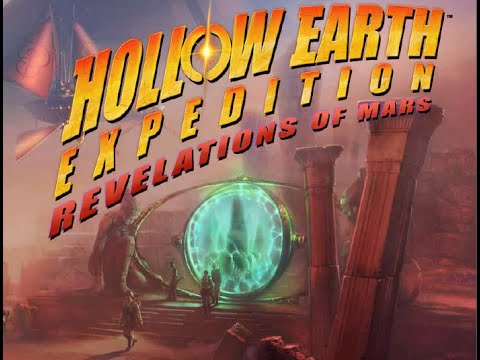
Here I was now back in the framework of the original one shot: a nighttime run past Spanish patrol boats, upriver until they are trapped by the Spanish in a tight section of the Benito River, rescue from the Spanish by the “lost” Professor Ansom and a platoon of gorillas led by a few white apes — gigantic, intelligent creatures that Ansom has befriended. They return to the city of the apes, called Mangani by the locals, and it is a place of strangeness: the color is all wrong, everything ooks like it is viewed through a funhouse mirror — geometry is peculiar, and the architecture looks almost Minoan. Ansom thinks it is an Atlantean outpost…and the piece de resistance is the temple, complete with a strange metal eye altar or icon (with the iris being an open space big enough for a few people to go through) — see the cover of Revelations of Mars for what I’m talking about.
hqdefault

They try to figure out some of the mysteries of the place, but the cameras don’t work — everything must be drawn and annotated. The apes can communicate, and Hassenfeldt helps Ansom train the apes to use the rifles they’ve taken from the Spanish. When Spaniards from the company show up, including a highly educated Jewish doctor named David Gould, they manage to defuse the situation. While showing the Spaniards the importance of the place and why they should cease their attempts to destroy the apes, they discover the doctor — when in proximity to the Eye — causes it to light up with a strange blue energy field. (Yeah — it’s a Stargate. Steal, people, steal!) The Eye firing up spooks the apes, who run away. While investigating, Hassenfeldt trips through the gate, and knocks Bose with him.

On the other side, it almost looks like they are in the Yucatan. The ground curves away for some distance…a massive valley? and they spot some kind of huge creature circling them in the air. A single shot from Hassenfeldt’s .375 magnum brings the creature down: it’s a pterodactyl! Realizing how alone and possibly endangered they are, Bose convinces him to go back through to the ape city and the gate shuts down.

That was where we left, with two possible PCs for the vacationing player — Ansom or the Jewish doctor with Atlantean blood that allows the gate to work. The player in question preferred the Gould character when asked. So this week, when that player away again, I had us return to Equatorial Guinea and Mangani, right at the point we’d left off: they’d come back through the Eye to find the apes had decamped, fleeing the city…but that was not all: landscape around the city seemed discolored and twisty, and the buildings of the city itself seemed to be moving. Whenever they looked away, things had changed.

Lord Trevor went to scout and see if other apes were around. Bose looked at the inscriptions on the walls for more information. But quickly it was obvious that something dangerous was occurring — the very geometry of the buildings was wrong! They looked for an found Lord Trevor in another of the larger buildings, a minaret-like spire. Inside, a red glowing, crystal (never good) was in his hand and when he addressed them, he told them they hadn’t much time.

“I’ve been sleeping a long time… I never expected one of my own to find me. (This to Gould.) It is time I return, before those that cast me out realize I have awaken.” When they try to find out what is possessing Trevor, he remarks “I can only wear this face for a short time. I’ve had so many, over the years, but this karn is old and will not handle the strain for long.” When asked what his real face was, he doesn’t even remember. Those that once worshipped him called him the Faceless One. “The city is returning home. We must not wait.” He took them to the temple and the Eye, where he casts the crystal through to some place of red sands and pink sky. “You must go. The city will disappear soon…” and with that he releases Trevor. The heroes hot foot it out of the city just as it folds and twists and pops out of existence.

The few Spaniards who had escaped when the apes ran, having seen the whole thing, take the characters into custody and question them at the local logging compound. In the end, no one really knows what to make of the situation — the Spanish saw the city disappear, the apes flee into the jungle. While they have issue with Trevor’s actions, and they suspect that the character may or may not have been involved in violence against their people, how the hell are they going to spin any of this? And the characters can’t really make too much of the Spanish actions, white apes, or a missing city. No one will believe it!

Released, the characters flee back down the river and eventually get to Fernando Po, where Bose’s S-36 is moored and fly home to England. On the way, the group decides they aren’t letting this go — they hit the British Library to quietly start looking for references to the Eye in literature and history; Trevor and Gustav talk to the Royal Geographical Society about the apes and to try and find anyone who claims to have encountered a creature like the one Gus shot.

In the end, they had a few leads — an eccentric mountain climber and hunter named Kinnie, preparing for his attempt of the Eiger in Switzerland had claimed to have shot a “dinosaur” in Venezuela; the others found references to the Eye in the Potala Palace of the Dalai Lama in the autobiography of Francis Younghusband (now the chairman for the Himalaya Exploration Committee of the RGS), and another reference in the crazy works of Thule Society founder Rudolf von Sebottendorf (recently arrested in Germany, but escaped, and allegedly in Switzerland, as well…)

So with one quick toss off adventure, I now have two lines of attack for a campaign — the Tibetan mystical one, or the Venezuelan jungles.

It’s a sharp break from the long running space opera of the last half decade, but I’m hoping this time it’ll catch fire with the players.
25 years later…

We open on Argos, the marginally inhabitable world (our New Caprica, if you will) which has become a thriving colony, thanks to the Kobolians and their technology. While the humans and Seraph have their own planetary government, everyone knows it’s the Olympian Council,  led by Zeus, who is in charge.

Visiting the Forge of Hephaestus, we reintroduce Nike, now the Goddess of War after Athena’s disappearance. She is inspecting the massive galleons — half warship, half ark — being constructed to protect the world by the Smith God’s multitude of mechanical assistants. Among his other toys, is a strange craft that she was not able to get a read on, but was a ship designed to reintroduce plant and animal material on Kobol — a world that had apparently been reconstructed by one of the TITAN’s leftover  hekatonchires — the great utility fogs that can repurpose entire worlds.

This led to a diplomatic party scene, where Argos was culminating its 25th anniversary since settlement. Among the guests were diplomats from the Cyrannus Colonies (the 12 Colonies of Man), Earth, and the Pleiades Colonies. Hermes was introduced, just back from his mission to the latter, where he found a culture older than Kobol, the source of the “Aurelian Heresies” — thousands of years ld prophesies that pre-dated Kobol and were frequently referenced throughout the game — and currently more advanced than the Kobolians. Other guests included the twin children of Athena and Admiral Pindarus — Athena and Alexander III, young, handsome, and smart half-Kobolians on a mission to the various worlds of Man.

We got a taste of the politics of Argos — the in-roads the monotheism of the Seraph was making, the shaky “alliance” between Argos and Earth, and the internal beefs of the “gods.” Zeus asks Nike and Hermes to represent them at Earth’s 25th anniversary of the founding of the Earth Alliance.

Six months later, we picked up on a rescue mission in the California Republic, one of the four great polities of Earth, where an earthquake has destroyed much of the City of Angels. Alala — the Seraph pilot introduced a few months back with the addition of a new player is now commander of the new basestar, Galactica, and is commanding the efforts. She is warned by one of the pilots on CAP, the daughter of Hermes and one of the major NPCs that had been a bit player throughout the game, of a tsunami coming, and is rescued by said pilot in a daring move.

When they return to Galactica, a more modern, welcoming basestar, with a much more advanced look, we reintroduce Admiral Armenta — a character that started as a pilot in old Galactica, just before the Fall, and who had wored her way up through the campaign to wing commander. She is 50, now, and older, more tired, and a bit less idealistic. After some character bits with her old friend Alala, and her operations officer, the daughter of Pindarus and Tana, his Seraph wife, she makes ready for the 25th anniversary celebrations of the Alliance. The ship bearing Hermes and Nike arrives from Argos about this time.

After some politicking in the Temple of Athena, in which we meet the older version of Pindarus, now 68 and the Princep (first citizen) of the Alliance, and his wife Tana — now ruler of the Athenian Republic (the city-state where most of the people who survived the Exodus live). There were a few bits of diplomacy, but in the end, the second night of the finale saw a day where the old characters getting together for an old fashioned picnic.

We learned about the fates of these long-running characters. Pindarus’ time as defense secretary putting together the Earth Defense Force, his marriage to Tana and its near collapse after an infidelity five years ago. His widespread cancers from a decade ago, cured by a bone marrow transfusion from Tana. He is now the first prince elected by planetary vote, he wrote a massive history of the Cycle of Time, and now potters about cooking and painting.

Zoe Armenta (formerly Arden, call sign Billboard, then Boss) became a lifer — commanding the fighter wings of Earth, then a basestar, before getting knocked up by her yeoman and taking command of the Sparta Military Reservation, training the EDF soldiers. She has recently taken over the new Galactica. She is married, mostly a settling for the most stable choice sort of match after two decades of short flings and throwing herself into building the EDF.

Hermes has been the chief diplomat for the Kobolians on Argos, but is more interested in furthering Athena’s dream of the worlds of Man (in all its iterations) united. Various NPCs that had been in the game for years were referenced or seen, and in the end, the last night had that same bittersweet quality that the Babylon 5 finale had. These are our heroes — old, tired, at the end of their working lives…but still standing. Still family.

Cut to 500 yeas later, Capricorn Colony in the Pleiades Colonies of Man. Starbuck (a Dirk Benedict-esque one) and Apollo are gambling at “Casino Planet” (this was some fan service for Jim, one of the gamers, who has been lobbying for a casino planet visit since he joined the group) on the Elysium Station over the colony. They are suddenly recalled to their battlestar, Galactica, when a massive fleet, led by the ousted Leader Baltar, strikes without warning. The vessels attacking are “Olympian”, and their mechanical Myrmidon troopers invade the station. After fighting them off in the hangar bay, they take their very futuristic vipers and race back to Galactica, where the ship is preparing for battle.

Apollo meets his father, Commander Adama, who informs him that Fleet Admiral Pindarus is reporting half the fleet has already been destroyed, their worlds nuked. There are refugee ships everywhere, and Galactica has been ordered not to join the main battle, but instead take the civilians out of the combat zone to the only safe harbor they know, the only world that could stand up to the Olympians…Earth.

Thus ended 4 years, 10 months  of one of the best and longest games I’ve ever run. The pay-off — seeing ones characters having come through their epic journey, succeed at rebuilding their lives — seemed to resonate well with the players. The coda 500 years later lend more power to the Cycle of Time, and suggested that the story wasn’t truly over.

Was this episode really needed? After all, they’d gotten to Earth and found a new home. End of story…but after investing so much in their characters, letting them see them aged, well-lived, and a new generation of heroes coming into their own (the children of the characters), gave a sense of continuity and closure. As finishing a campaign — especially one of this length — is relatively rare for a gaming group post high school or college, having that glimpse of what became of your characters is important for the players.

One way to go about this is for the GM to have a plan of what the world looks like five, ten, or a quarter century out. Another is to let the players each have a moment where they tell you what happened to their characters. Either works well. In this case, I asked what the characters wanted to do, long term. I had them roll their attempts at diplomacy or whatever, then I grafted on elements of the overall story arc to show how sometimes this or that didn’t quite work out.


« Previous PageNext Page »