Roleplaying Games


Tonight was a bit more difficult than usual — i was trying to get a pair of new characters linked up with a pair of old characters, but one of the players didn’t show (old character) and one is no longer a part of the group, as he got a job in another town and had to move (new character.)

The new characters were Trevor FitzHugh, a talkative, hard-living pilot and his daredevil sidekick and Hollywood stuntman by day/cat burglar by night “Daredevil” Dan McCoy. We opened with them running guns and ammo to the Nationalists for a group out of Portugal. They get, apparently, set up and the drop is raided by an platoon of Irish volunteers fighting with the Republicans. They have to shoot their way out, and Dan (the player that was here), got to shoot his way out, drawing off the bad guys long enough for “Fitzy” to get the plane moving. Daring leap from horse to plane and boarding the craft? Check!

Unfortunately, in the fighting, Fitzy had taken a bullet, but plays it off until the land in Lisbon a few hours later. Once tied up at the dock in Lisbon, Dan finds Fitzy dead. Dan is now determined to find out who double-crossed them (if so…) He makes contact with a local British reporter and friend of Fitzy’s (and, I imply, a British agent) and finds out his employer has been selling to both sides, despite being in bed with local fascist businessmen. He’s also running the guns of a New York family — old character who’s player didn’t turn up, Jack McMahon.

Jack and Dr. Hannibal Drake, meanwhile, have turned up looking for Ariel Smythe, the femme fatale from the last “volume” which involved the search for Illuminati Treasure. She was responsible for the dead of Uncle Mike. They link up with the family’s broker here in Lisbon, Tom Cullen — a school mate of Jack’s — and are interrupted in their sussing out the situation in Lisbon and whether Ariel has turned up here by a drunk Dan McCoy. The characters’ stories are intriguing to each other and while they’re not working together at the end of the night’s session, they’re at least on friendly terms.

Tom takes Jack and Drake to meet his partner, Spanish businessman-in-exile Roberto Vega, who turns out to be a collector of Columbian and pre-Columbian artwork, conquistador armor, etc. Olmec/early Mayan is his preferred period and one of the pieces is a notebook from about the 1500s from an ancestor of his that catches Drake’s eye. There are drawings of a ziggurat, but the proportions are more in keeping with European architecture than Mayan. A sketch of a brick shows markings, mostly in Mayan, but a six “digit” signature using Roman masonic symbols catches his eye…could this be indications of Roman-period habitation in Mexico?

The night ended with Drake determined to get a better look at the book, Jack determined to find Ariel, and Dan determined to get to the bottom of the gun deal gone bad.

Overall, the pace was solid, if a bit slow for my pulp stuff. the players had a good time despite a series of interruptions, and I think it set the tone for the next “volume” that will lead them to southern Mexico and a run-in with a few old enemies, Jaguar worshipping natives, and possibly the first hints of a hollow Earth.

I’ve seen the idea of a “gamer’s charter” or a “social contract” addressed on a couple of blogs and gaming sites, and have found the subject curious. Perhaps I’ve been lucky and most of the gamers I’ve played with, with a number I could count on a single hand being the exception, have been adult, conscientious, and drama-free. Perhaps it’s that early on, I started being careful with the people that I’ve played with. After an encounter with one especially tragic example of the socially inept that — in this case, a 300 pound “ninja” who could do all manner of extraordinary things with his ninja perception and dexterity (yet couldn’t discern two of us slipping past him one day in our apartment annex, locked doors and all) who was creepily attached to us and was bereft of all manner of social skills — I started screening folks before inviting them to the games. I like to meet them in a neutral setting so that we can get an idea if the personalities will mesh, and that our view of the hobby is similar enough that there should be a minimum of friction.

We’ve never laid down rules. I let folks know I have a pet peeve when I’m running or hosting — give me as much notice as you can if you won’t be there, and that I dislike tardiness. It’s just an artifact of growing up in  another time and on the East Coast, where if you weren’t early, you were late. I don’t berate them if they’re a few minutes late — we just start without them, if we’ve finished eating. If there’s any real “rule” laid down, it’s that I supply dinner and except people to throw in if they eat. A few bucks, a fiver, any more and we count each five as a week paid up front. But it’s never been a contract; it’s just a gentlemen’s agreement that naturally evolved ad hoc.

In play, as GM, I try to make sure people get as equal time as I can. I don’t really stomp on scene chewers and time hogs, but shift the focus as unobtrusively as I can. Telling a gamer that they’re sucking up all the air (and I have one right now that would, if I didn’t keep close watch of the group dynamics) is just as rude as letting them do so. As GM, you can find a way to bring the other players into the mix. (I may do a post on this skill later this week…)

I suppose you could count what we do as a social contract in the Jeffersonian mold — an unspoken, but generally understood set of social norms — but most of these are “rules” of generally good behavior. If you pick adult or polite folks to game with, they should bring these generalized rules of behavior with them.

No contracts needed.

This post was written for the second annual New Year, New Game blog carnival hosted by Gnome Stew as part of the 2013 New Year, New Game challenge.

Think of it as a gamer’s New Year’s resolution — it’s a new year, and in the spirit of renewal, perhaps it’s time to try a new game. This doesn’t necessarily have to mean buying and running a new system; it could also mean trying new characters and a new campaign. Back in October, much of my gaming group had dispersed — one player was finishing their degree and had no time, another got a full-time job with much travel, and another moved to Texas, leaving just two of us.

When you lose the better part of your gaming group, it’s time to find new players, and that usually means a new campaign… So this New Year,New Game challenge isn’t quite so hard for me as it could be: I have new players and we need new games. We were lucky — we were able to resurrect the group with three new players in the space of a few weeks. It’s a good group, and has a sharply different vibe from the last.  Our previous group was more of the get-together and game as a social activity. This group is more seriously interested in roleplaying — with one of the gamers being a serious immersion player.

One of the games has continued with the new players. It was well into the plot, the “lead” was the remaining player, and first of the new players was recruited within a fortnight of the group implosion and was interested in the campaign. So the Battlestar Galactica game that has been getting attention in the blog survived. The Hollow Earth Expedition game did not. Oh, we might bring back Hannibal Drake, but the rest of the cast is changing. As a result, I have started a new campaign for the new group.

Beyond that, there’s a few games that have been attracting my attention and I would like to run. One is a homebrew sci-fi campaign that might use Cortex, or might use the Diaspora Fate rules — it’s still in the formative stages. I’ve thought about trying to run Jovian Chronicles — one of my gaming white elephants. It’s got a great setting, but in some ways the setting limits the options of the gamemaster, if they stick religiously to the setting and the metastory of the game. I don’t intend to. I also will not use the game mechanics, but instead will probably turn to Cortex.

Another way of breaking out of my comfort zone is to run one-shot games for the local gaming Meetup group. I’m running a Hollow Earth Expedition-fueled pulp adventure called “The White Ape of the Congo” early in February. After I run it, I will post the adventure notes and an after action report. Another I hope to run is a Serenity game that rips off the movie Deep Rising (a stupid but lots of fun flick) but with the monster being replaced by reavers. I may run a James Bond game later in the year…who knows?

It’s a new year, there’s a lot of new product from the indie publishers, so get our and try a new game!

Holidays and illnesses have kept the gaming schedule a bit hit or miss this last month or so, but we’ve completed another adventure in our Battlestar Galactica RPG campaign. This one saw the introduction of a new character — a fresh from training viper pilot who finds herself assigned to Galactica as her first posting, instead of her preferred Pegasus.

The fallout from the campaign thus far is finally starting to hit. Commander Pindarus, the “lead” character, and much of his command staff has been parked on Galactica as a means to cool his career off by jealous officers. (He is also a pawn in a personal tiff between the fleet admiral, Nagala, and his father, now the defense secretary.) Special Agent Chaplain, the Colonial Security Service officer that was investigating Cylon infiltration was exposed as having been an agent himself. The last “episode” had ended with their secret investigation having been outed by a major colonial news service. The assumption in the halls of power is that Pindarus ratted because he didn’t think the brass and politicians were taking the matter seriously. Without proof, however, all they could do was bench him on what is soon to be a spacegoing museum.

Pindarus’ efforts to get the political machine to acknowledge and do something about the toaster threat have, however, paid off. President Aidar is aware of the threat and is quietly shuffling his cabinet to prepare. The most important change for the characters is the return of Pindarus’ father to government. Having been ingloriously binned as presidential security advisor near the beginning of the investigations, the bellicose old man is now in as defense secretary.

This “episode” mostly revolved around the new PC, and her perceptions of what was going on aboard Galactica. To that end, I tried to structure the adventure so that while the other players were doing their own particular things, the new pilot — call sign Billboard — was usually present to witness things. The player of the new character has been documenting her reactions and opinions in a little journal he’s been sending to me. (Got him a few plot points for the effort!) The first thing she noticed was the strong animosity between the former (temporary) XO, now returned to CAG — Dipper (he’s in the miniseries) and the new one, Pindarus’ XO from Aegis, the (too?) young Major Evripidi. She meets the characters from the show that were continued into the campaign — Helo, Boomer, Starbuck. We also see JOlly (mentioned in the miniseries and reutrned in his slightly overweight, gloriously mustachioed glory.) WE’re using the Katee Sackhoff Starbuck, but without the tremendous angsty stuff that made her annoying to me.

The crew is befuddled. The new commander knows the ship is to be decommissioned in a matter of months and they are doing their last CAP of Caprica and Gemenon, before heading to Picon for the refit that would make her a museum and her disarmament at the Zeus Armory. So why is Pindarus running them hard on full-scale combat drills — complete with damage control exercises and boarding repelling operations? Why does he have the chief engineer (a cousin to Billboard) attempting to refit their FTL drive and get the ship rearmored? He says it is to put her back in the condition she was in during the First Cylon War and make her more authentic an experience for the guests.

Also aboard, is the Ministry of Education archivists, designers, and wonks — led by the Deputy Director for Public History, Aron Doral (this time more of a Oded Fehr type.) The man is slick, friendly, and seems genuinely interested in making Galactica a big attraction. They have installed a secondary, civilian network that is unconnected to the ship’s essential functions (save communications…), they’re putting up informative signage and color-coded paths through the ship, here and there, for the tour. I’m trying to give it more of a ship at the end of her life feel than the miniseries had.

Adventure seed here: The new character is put to the test when the ship receives a distress call. They were just entering Gemenese orbit when a Caprica-Gemenon liner was struck by the FTL bubble of another ship jumping in. Disabled and in a rapidly decaying orbit, they are requesting aid. Meanwhile, the vessel that had illegally jumped into orbit outside the prescribed commercial “bullpen” is racing into Gemenese orbit to escape apprehension. Galactica scrambles her alert fighters, including Billboard, to chase and monitor the ship, which is running an IFF transponder that does not register as belonging to any legally registered craft.

The rescue of the liner was done in the background, and directed by one of the characters; Billboard and the alert fighters follow the other freighter to the Gemenese surface — the Gramada Mountains, which another PC tells them is a hotbed of separatists, individualists, and illicit drug manufacturers. (Khammala and canaba are legal and used for “religious purposes” but synthetic opiates, endorphins, and amphetamines are tightly controlled.) The ship is a smuggler, moving synthetic dope from Leonis to Gemenon.

The characters have to capture the smugglers, who are armed with at least one shoulder-fired anti-aircraft missile system. Billboard nearly gets splashed, and they get cleared by Pindarus to take out the trucks. Marines in a raptor arrive and eventually take the ship, discovering weapons, drugs, and other violations of the law.

Overall, the adventure ran well. It was mostly interstitial stuff between push adventures, a chance for more character development over action. It was also a chance to set the mood for Galactica prior to the events of the miniseries.

Next week: 1930s pulp using Hollow Earth Expedition!

I’m about a quarter through writing my next novel, currently with the working title Firestorm (which is a bit pedestrian in my opinion, but will probably work well…) It’s a modern western/murder mystery set in a small new Mexico town being threatened by a massive wildfire.

Also, I’m blocking out the following novel, as well. It is tentatively titled Therapy on Two Wheels and will revolve around a widower who goes on a motorcycle trip around the country to heal himself.

Finished and turned in is a prospectus for a movie script called Only Way to Rich — a heist movie about a bunch of well-educated, but unsuccessful friends. Their hit on a casino and subsequent escape quickly goes sideways due to interpersonal issues. It might get a novel treatment if nothing comes of the film project.

There’s a good chance I may be working for Cubicle 7 again on the Victoriana line later this year. I may be contributing to the America and Africa books.

On the list is a possible Kickstarter for a “new” espionage game system from Black Campbell Publishing sometime later this year.

nij ratingsThe Q Manual gives the James Bond: 007 RPG player armor ratings for vehicles, but did not really address personal body armor. I covered this in my Q2 Manual, but thought it might be worth coming back to for those who want to understand the reason for the game specifications on personal body armor.

Level I armor is lightweight and allows for easy production of body armor that can look like ordinary clothing — a tee-shirt or a vest. They stop most light rounds — .22, .32, .380 — but does not usually take care of all of the kinetic damage. These are usually in the range of DC C to E. The armor reduces the damage class by -2DC.

Level IIA armor can handle mid-weight and speed bullets like 9mm and .40 S&W (DCs in the range from E to G.) Damage class is reduced by -4.

Level I and IIA are usually older vests or special order items, as they are considered by law enforcement to be ill suited to protecting officers from modern ammunition. The older armor also rarely protect against bladed weapons, something that most newer vests do. That doesn’t mean, however, they wouldn’t be perfect for the deep cover officer looking to have some protection, but not advertise this fact. Level I armor has the equivalent of a CON -4, Level II CON -2 to be spotted with a PERCEPTION test.

Level II armor  is is the standard for hot-weather police department and is also available to civilians in the US and a few other nations. Level II is rated to stop fast (“hot”) 9mm, .40S&W/10mm, .357 magnum+P ammunition (DCs in the G-I range.) It lowers DC by -4DC but also provides a -1WL benefit, but also cuts the Run/Swim and Stamina times by a quarter.

Level IIIA is typical of police and military units where concealment of armor is not a high priority. They are rated to handle up to .44 magnum pistol cartridges and can stop most shotgun shot (DCs in the H to J range.) It provides -6DC protection, but halves the Run/Swim and Stamina times of a character using it.

Level III is “tactical” armor, and is normally worn over clothes with MOLLE or velcro-attached pouches to carry ammunition, radios, etc. It also typically adds a “rifle plate” or “trauma plate”, which provides protection for up to .308/7.62mm rifle rounds and 12 gauge slugs (DCs in the I to L range.) It provides -6DC and a -2WL benefit, but it also halves a character’s Run/Swim and Stamina times, and adds a -1EF to Dexterity tests. Often tactical units will include a kevlar helmet that provides protection worth -4DC .

Level IV armor is rated for high-power armor-piercing rounds like the US APM2 .30-06 round. It is hot, heavy, and uses both ceramic, steel, or carbon fiber plates, in addition to kevlar fabric to protect against these high-energy projectiles. Level IV armor also nearly always includes a helmet that gives -4DC protection, but gives the character a -1EF to any Perception-based test. Also the neck roll on Level IV armor gives a -6DC rating.

One issue: these materials are, however, brittle and usually break up on impact, providing single shot protection against high energy bullets. The armor provides a -8DC  for the first impact on the vest (front or back.) However, it loses a -4DC of protection per hit where the original DC was K or higher.

As you can tell, the design intent is to drop the damage to about DC B or C, where the worst the character suffers is a light wound, but usually takes a stun. Gamemasters can add hit locations to the mix, if their players get a bit too cocky, thinking the armor makes them invincible. (See the GM Screen for hit location table.) All of this armor is generally good for the torso area, although Level IV armor is a notable exception.

Here are some examples of modern body armor:

Second Chance makes a concealable armor in Level IIa through IIIa in the Summit line. They also make a “stab-proof” twaron armor vest for correctional officers in their Prism Spike line and gives a Level IIa protection versus both handguns and blades. Their Prism Multi-Threat armor is Level IIIa.

American Body Armor (ABA) makes the Xtreme line of police vests from Level IIa through to Level IIIa.

Savvy is one of the few manufacturers of body armor specifically for females. It also provides improved impact resistance in the breast area. Their vests come in Level II and IIIa.

Point Blank makes armor for both police and military. Their Vision and Hi-Lite series are more focused on deep cover protection, and the C-Series on uniform use. They also make “carriers” — tactical vests that can have armor plates inserted into them and typically provide Level IIIa protection. Police tactical line — Level III and IV are the Dragonfire and Spider lines. Their military offerings are the IOTV (Improved Outer Tactical Vest) in Level III and IV.


Most of these aren’t canon, but were cobbled together for our Battlestar Galactica campaign. Added them to the Twelve Colonies document in the RPG section of the site, as well.

Pancolonial Political Holidays:

Armistice Day Junius 21 — Colonial government holiday

Colonial Day Sextilus 8 — Colonial government holiday

Colonial Fleet Birthday Sextilus 12 — Military “holiday”

Pancolonial Religious Festivals:

Bacchanalia Martius (last weekend) — big drinking holiday, arts, celebrations to Dionysus.

Thesmophoria Aprilius 17 — Mostly a “women’s” holiday in cities. Big in farming communities. Honors Demeter.

Diasia Junius 6 — General Colonial government religious holiday.

Olympic Games Junius, second week every four years. Sporting competitions honor Zeus.

Panathenea Games Julius, first week every four years [midway between Olympic Games. Military-oriented sports competitions; honoring Athena.

Thargella Sextilis 19 — Celebrates Apollo.

Exodus Novilis 1 — Celebrates the tribes’ leaving Kobol. Probably not the real date.

Mars Day Novilis 11 — Celebrates Colonial veterans.

Saturnalia Decilus, last weekend. Festivals, parties, noted for costumes and masks.

Traditionally, the rich and poor, aristocrats and servants traded places for a day.

Posidea Decilus 26 — Honors Poseidon. Horse racing on Leonis, Picon, and Virgon.

Apaturia Febrarius 14 — Known as Eros Day on Caprica, honors Aphrodite.

Colony-Specific Holidays:

Arelon: Thesmophoria, Aprilus 17 — Honors Demeter. Farming fesitvals, known for drinking.

Independence Day, Septimus 12 — Celebrates the independence from Virgon.


Aquaria: Hermaia, Decilus 11 — Honors Hermes. Practical jokes, hospitality to travelers. People put out herme, small phallic stones, to bless those traveling.


Canceron: Eleusina, Sextilus 15-18 — Celebrates the mysteries of death and rebirth.

Democratia, Septimus 21 — Celebrates the creation of the Canceron global government.

Independence Day, Septimus 12 — Celebrates independence from Virgon.


Caprica: Hyacinthia, Ianarius 17-19 — Three day holiday celebrating aspects of Apollo.

Eros Day, Februarius 14 — Apaturia on most other Colonies.


Gemenon: Heraea, Martius 10 — Honors Hera.

Diasia, Junius 6 — General thanksgiving day to the gods.


Leonis: Daphnephoria or “The Hunt”, Aprilus 22-24 — Hunter’s weekend.


Libran: Athenaia, Julius 28 — Known for sporting and craft competitions.


Picon: Pohoidaia, Decilus 28-30 — Horse and boat races dedicated to Poseidon. Picon’s version of the Posidea.


Sagittaron: Lycaea , Novilis 12-14 — Honors Zeus.

Freedom Day, Octilus 29 — Celebrates independence from Leonis.


Scorpia: Dionysia, Maius 3 — Celebrates Dionysus. Best known for wishes hung on trees.

Saturnalia, last weekend of Decilus. — People change roles, wear costumes, etc. Popular vacation draw to Scorpia.


Tauron: Enyalia, Junius 14 — Celebrates Ares. Known for impromptu bouts of fisticuffs.

Our Day, Martius 2 —  Celebrates the independence from Virgon.


Virgon: Hestaia, Octilus 10 — Worship of Hestia, involves parties at home.

These holidays use our campaign specific date system:

The months of the year are as follows (assuming Sextilis is the sixth month, the year starts with March): Martius/01, Aprilus/02, Maius/03, Junius/04, Julius/05, Sextilis/06, Septimus/07, Octilis/08, Novilis/09, Decilus/10, Ianuarius/11, Februarius/12.

There’s a new Google+ gaming question running about concerning the seven games you play the most. Considering I haven’t gotten to play in a game until a few one-shots at the local game store recently (the zombies on a cruise ship was such a good set-up I even ignored my zombie fatigue to play in it…), I figured I’d go with the seven game I’ve run most often (starting with the most recent.)

1. Battlestar Galactica (Margaret Weis Productions) — 2007 to present
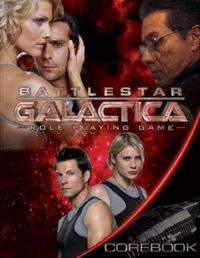
200px-BSG_RPG_CoverI first started running this about halfway through the series. Anyone familiar with this blog has an idea of the things I’ve done with the setting and plotlines to make it work for the groups, but here’s a quick recap:

The first campaign was a “second fleet” style game, with the characters having two characters each — a set of ground survivors, and members of a battlestar, Pleiades, which had been doing some deep space exploration and returned to find everything gone to hell. Galactica and Pegasus were out there, but they never were able to link up. I ran it close to the new series, canon-wise. It rand for about two or so years, then imploded with my marriage and loss of half the game group.

It was one of the games that the new group was interested in, so it came back, but adapted to fit some of the game style preferences of the players — more Cold War intrigue and paranoia prior to the Fall (coming soon!) More chances to try and stop the attacks, or possibly win them.

The game runs on the MWP Cortex rules — not the “Cortex Plus” they foisted on us with Leverage and Smallville (gag!) Character creation is fast and easy, play is not hampered, but enhanced by the rules, and it the first rules sets to come along since James Bond that I would gladly use for just about anything.

2. Hollow Earth Expedition (Exile Games) — 2007- Present

Hollow_Earth_Expedition

Ubiquity is one of those rules systems that hovers on the edge between rules lite, with fantastic mechanics like “take the average”, but bogs down a bit in too many modifiers and special rules in combat (most of which I now just ignore.) For pulp action, it’s almost perfect, and one of the licensed products using the system, League of Adventure, looks to have adapted it well to the Victorian speculative fiction subgenre.

We’ve had several campaigns using HEX. There was a game that was based in South America oin which they found an entrance to the Hollow Earth. That campaign fizzled a bit toward the end, then died for the same reasons as the BSG game. I’ve used it for the Gorilla Ace campaign, as well as an early ’40s Cold War game (Artemis Campbell — our take on Modesty Blaise.) The most recent game was set in China and has suffered the loss of most of the players, but the new group iteration looks to be interested in playing more of this.

The weak part for me is character creation, with is a bit math heavy and overly complicated (in my opinion, but at least you don’t need a Cray supercomputer like you did for early GURPS or Champions.)

Now if they’d only get the Revelations of Mars sourcebook out!

3. James Bond: 007 (Victory Games) — 1984 to present
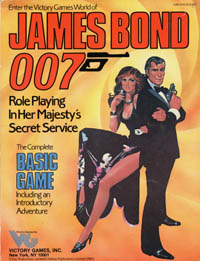
James_Bond_007_role-playing_coverThis was my go-to rules set for anything modern. I tweaked it, back in the ’90s to run Cyberpunk effectively. It was used to run a Stargate campaign. There’s been numerous iterations of the campaign — MI6 agents, CIA, private investigations/espionage (before this became cool with the Terror War), Miami Vice style cops…

The system is a percentile dice roll under your attribute or skill x the difficulty rating. Guns and cars all have different modifiers and are much more diverse mechanically than in many game systems. This can be a hassle unless you are looking for the brand-name cache that Bond (or Miami Vice, for that matter) bring to the screen — can your Aston-Martin DB5 outmaneuver and outrun a Ferrari F355 like in Goldeneye? (Hell to the no!) But the game did do a good job of making some vehicles and weaponry more attractive than others.

Character creation is a bit more involved, and if you aren’t using the tables on the excellent GM screen (eBay!), you can occasionally find it math heavy.

It’s still my favorite system, more from nostalgia than anything else.

4. Castle Falkenstein (R Talsorian) — 1995 to 2008
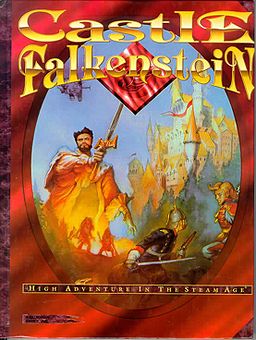
256px-Castle_Falkenstein_CoverI had already been running Victorian sci-fi since Space: 1889 came out but found the GDW rules problematic, to be kind. Falkenstein‘s card-based system (“Gentlemen don’t play dice…”) was novel, the character creation was very easy and quick — and since this game, I’ll admit that any character creation that takes more than an hour for the first go-’round annoys the pants off of me.

The weak part — the background. This was the first attempt to “Shadowrun” a Victorian game. Elves and other mythic beasts are there to get the D&D crowd to buy in; I ditch the fantasy aspects and stick to the more 19th Century speculative fiction side of things. The other was combat. The design was an attempt to emulate fencing, but not the cinematic fencing a game liek this should be putting forth. It was awful and overly complex. One of the players and I kit-bashed a combat rules set using the standard card deck of CF with the combat design of Lace & Steel to create a fast combat system that made it fun to forget guns and go with fisticuffs and swords.

The first campaign was simply Space: 1889 with CF rules to play by. It worked beautifully. The other campaigns, over time, lost the Space: 1889 elements and became more Earth-bound historical with science fictiony bits games…what can I say? I’m a historian!


5. Star Trek (Decipher) — 2000-2006
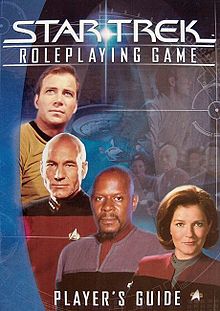
220px-ST_RPG_PlG_cov

I bought the Last Unicorm Games Star Trek sets because they were beautiful and had elegant rules systems, if they did have the dreaded race/class elements of D&D. I never got to run LUGTrek before it folded, was bought up by Wizards (IIRC), then was spun out to Decipher, which treated the franchise like a hated wife with herpes that you just can’t seem to give up.

The mechanics were solid, character creation wasn’t too much of a chore (still — races and “classes”) and for a while there it looked like this might be the one to carry the Star Trek role playing experience for a while. And like every other line, it died.

Star Trek was always the white elephant of gaming to me. Seemed like a great idea — a setting everyone is at least slightly familiar with, rich universe to plump…but it never quite worked. It felt, much like most of the series since “the Old Show”, soulless.

I originally planned it as a minicampaign for a Trekker in the group. It would up running six years. One of the things I did was throw canon right out the window. Whole movies and series were ditched. Technology was not easily and quickly convertible. No more turning the deflector dish into a can opener. The Federation was a wondrous place where everyone did adult education and bad art; the only place for the motivated and talented was politics and Starlfeet. By the end we had androids and sentient ships – it was an attempt to fuse “Singularity” style sci-fi (before it was cool) with Trek. It worked beautifully. Sadly, I think it’s one of those lightning in a bottle scenarios — I don’t expect to pull it off again.

Sticking with the idea of the stuff I ran the most successfully rather than most recently, I’m going to not put some of the games that got run for a short time. There was a decent Serenity game that I wrote myself into a corner and couldn’t plot my way out. It was also my first attempt to sandbox a game, and got to watch the characters/players wander where most people have gone before…boredom; it’s why I disagree with a lot of GM advice out there. Try not to railroad the players, but construct the adventures in a way where encounters will happen and seem natural, even though they were pre-ordained. Another would be Marvel Heroic Role Playing — which uses “Cortex Plus” and is the first of the post-Jamie Chambers stuff to really do a great job.

6. The Babylon Project (Chameleon Eclectic) — 1997-2000

show-water

This one is a bit of an odd-man out. The character creation is a bit clunky, the base mechanics easy (two dice — one a plus, one a minus, add/subtract to your skill vs. a target number), but the combat was clunky. For some reason, however, I “got it” — the damage allowed for the kind of stuff that I heard/saw in the military: serious injuries that didn’t phase a person, minor injuries that dropped a body from shock, and everything in between. Ship combat was cribbed from Full Thrust and was great.

It didn’t hurt that this was the big show for us, at the time. I’d gotten into it with the G’Kar and Londo in the elevator episode and we stuck with it through the crappy movies of the 2000s. I ran a rogue colony of “Amazons” — humans that had been protected by one of the lesser Old Ones which had pretended to be Olympians in the classical period. They were another front of the Shadow War and were allowed to do their thing without bumping up against canon too badly, until the end fight at Coriana 6.

Great characters and adventures kept it moving despite a clunky system and I’ve given thought to buying the old books online after a glancing blow with the disastrous Mongoose Babylon 5 d20 stuff. (To be fair, they too 3ed as far as they could to make it work.) It was, like the Star Trek game that followed it, a bit of lightning in a bottle. When I attempted to run a d20 version, it just sort of fizzled out.

7. Space: 1889 (GDW) — 1989-1995

300px-Space1889rpg

As with The Babylon Project, this game is a testament to how a great setting can overcome shitty mechanics. Character creation is plenty fast, the die mechanics are easy but mathematically unsound, but who cared! I was a redcoat on Mars flying a cloudship!

I bought it right off from The Complete Strategist there in downtown Philadelphia, worked through an early campaign with almost no knowledge of the period, and within two years was a bachelor degree holder in history , specializing in the Victorian period. (It’s a common thread that my professional and gaming life mirror each other…)

Even when we found better mechanics, we clung to 1889 setting queues long into the 1990s. I keep thinking of bringing it back, but the Victorian “pulp” and ’30s “pulp” have a lot of the same tropes and the guns and cars and planes of the 1930s seem to be more accessible for players. (It’s a similar problem between Space: 1889 and Serenity — both are Old West/Victorian period pieces, just one has Verne-style spaceships, the other more realistic looking ones.)

Prior to Space: 1889 most of the GMing or playing I did was either in James Bond: 007 or DC Heroes games during the Philadelphia years, so I could have made a good case for the latter as my number 7.

(Turns out Martin Ralya did something similar over on Gnome Stew…)

One of the readers is looking to maybe play in a Skype-based James Bond:007 game, if there’s anyone out there GMing one. Jonathan’s in the eastern time zone, and if you hit the comments on the JB:007 page of the site, you should be able to get his contact info. Or just sing out in comments on this post.

Passin’ it forward!

I posted the production notes for Blood & Chrome that were up on Facebook a few days ago, and have finally had time to compare them to notes on how a battlestar group might look I drew up a few years ago. So here’s my take on a miniseries-period battlestar group (BSG.)

Going with the idea that there are 12 “main battlestars” or “heavy battlestars” (I’m using the former term), one to do CAP on each colony and the surrounding shipping space, this would be the usual wartime battlestar group. Figure they’re rarely more than half strength, with half their number on temporary or detached duty.

COMPOSITION, BATTLESTAR GROUP

A combat-ready battlestar group consists of a main battlestar (Mercury, Minerva, or Columbia-class) and its attendant air group, 2 light battlestars (Erynis [Valkyrie] or Berzerk-class) and their air groups, 2 support escorts of Vanguard-class — one hospital, one an aerospatial assault unit, 4 assaultstars (Cygnus or the older Orion-class), 2 replenishment tyliers (pronounced til-i-ers; replenshiment oilers in the wet navy carry fuel, but also other supplies. They would be the refinery ships from the series), a combat support vessel (a repair ship like the Flatop from the series), and two victualing ships (basing on Blood & Chrome, these are the Celestra-style freighters.)

Assuming the support vessels are mostly civilian/merchant marine, that’s roughly 10 ships a BSG or 120 capital ships…which seems about right with Starbuck’s comment about the initial losses in the miniseries.

Considering how expensive and time-consuming peace time construction of these ships would be, I think 120-150 ships is about right.

Next off — nomenclature. I figure a battlestar is always a “group” (BSG), as per the patches in that they have an air group aboard. Any ships attached to, say, Galactica might have their own ship patch — say an escort named Diomedes is attached for longer than temporary duty to Galactica — the patch would read “Battlestar Diomedes” (or whatever you want to call your escorts; I call ’em gunstars if they’re cannon heavy, assaultstars if they’re missile heavy) and the bottom of the patch would be BSG-75, even if Diomedes herself was BSG-12, say. On her own, she’s BSG-12. (Hey, you have to keep the guys that make uniform patches in business…)

Any “battlestar” with an air group of any size is a BSG, otherwise, it’s just BS (that would be the assaultstars and gunstars.) Support ships would have registrations like DD (for the escorts like Vanguard [I’m going off of the numbering on the model for that particular ship; do whatever you feel like), RT for the tyliers, CSV for the combat support ships, and SV for the victualers.

Figure the battlestar groups during peacetime are broken up and doing missions throughout colonial space — light battlestars doing interdiction work, hospital ships aiding in disaster and humanitarian support. Escorts would also be doing policing, but would also cover the hospital ships and civilian contractor vessels doing deep space exploration, etc.

« Previous PageNext Page »