Roleplaying Games


Here’s a few of the house rules traits from our BSG campaign:

Chronic Injury (Complication d2-d10): The character has a chronic injury that effects their performance. A d2-d4 might be a bad knee or shoulder — an injury that effects the character’s physical tests involving that particular area that suffers from the injury. A d6 or higher could be a serious injury or injuries that haven’t healed properly and effect the physical characteristics on tests.

Done It 100 Times… (d2/d4): The character has been through particular types of training, intensively. This might be a constant round of combat flight exercises or heavy practice doing atmospheric reentry and fast landings with marine combat shuttles (applies to Pilot tests), damage control (applies to Mech or Tech Engineering.)

Intelligence Officer (d2/d4): The character is trained in intelligence analysis. They can use the trait on Perception/Investigation and Interrogation tests.

Soft Touch (Complication d2/d4): The character might play tough, but is actually sympathetic to their shipmates or companions. The complication adds to any social tests to convince the character to see things their way.


I’ve been playing with the Marvel Heroic Roleplaying game for the past few days, cobbling together characters to see how I can stretch the system. It does very, very well on higher powered supers, not so well on the street-level types (but they’re still doable.)

Here’s an ooooold character from my first supers game I played in (before I was into comics.) It’s the Beauty & the Beast sort of brooding outsider trying to do good. Lion-like in appearance: big, scary, but very smart. Think the Beast from X-Men.

ASLAN (aka Henri LeCeour)

Solo d10, Buddy d6, Team d8

Distinctions: Beast Behind the Man, Rugged Individualist, Smartest Man in the Room

Power Sets: Beast in the Dark — Superhuman Reflexes d10, Superhuman Durability d10, Enhanced Strength d8, Enhanced Stamina d8; SFX – Claws & Fangs: +d6 to attack pool, -1 step on high die, but +1 step for effect die; SFX – Spiteful: Like Second Wind, physical stress swapped to doom pool for a +1 step on an action; SFX – Berserk: Borrow doom pool die for a +1 step on action, and return the doom pool die next round; Limit – Porphyry: Shut down Stamina for 1PP. Must recover in transition; Limit – Fearsome Appearance: No PP used in social tests. 1PP when he operates through his front man.

Specialties: Acrobatic Expert, Combat Expert, Covert Master, Medical Master, Menace Expert, Science Expert

Milestones: For Science!, Modern Day Cyrano (1XP When he allows someone to take responsibility for an action, 3XP to place himself in a situation where he must work openly with others; 10XP anytime he is openly exposed for his works.

I took a few minutes last night to try and bang out a characters using the new Marvel Heroic Roleplaying game from Margaret Weis Productions. (Review here.) Normally, the weakest portion of a supers game, I find, is character creation — to keep game balance players usually have a certain number of points based off of the grandness of the campaign envisioned to work with. You never have quite enough points, or you have to sacrifice concept for more weaknesses or limitations than you might like, and this is understandable in the traditional campaign context where you start out as new heroes…but superheroes tend to pop into existence ready made and ready to hammer bad guys. they’re not on some Campbellian path of the hero.

Now MHR is a bit free form on character creation. There’s plenty of powers, special effects for the same, and a few limitations (that are, of course, marvel-centric like “mutant”), and you have several dozen templates to work from if you want to craft your hero. So I decided to go for a character that was one of an old gaming buddies who was so well liked he’s made an appearance in some variant or other as an NPC in nearly every super or modern game I’ve run. This is as close to the original character (once he had matured to his concept) as I’ve ever gotten.

Jedediah Callahan

Affiliations: Solo d6, Buddy d8, Team d10

Distinctions: Mysterious Origin, Gonzo Inventor, Wealthy Arms Dealer

Power Sets: Unified Organism (Godlike Stamina d12 SFX, Healing: 1PP to clear physical stress, reduce physical trauma -1; SFX, Regeneration: 1PP to regenerate destroyed limbs.) Experimental Weapons (Weapon d8 SFX: Area Attack, SFX: Ricochet, Limitation: Gear, Limitation: May use 1PP to trade in an SFX for another more appropriate one to the weapon. Must roll vs. doom pool as if recovering Gear.)

Specialities: Business Expert, Combat Expert, Science Expert, Tech Master

Milestones: Callahan Industries, Bleeding Edge Tech

History: Jed Callahan hails from Houston Texas. He’s a shortish, scruffy, and colorful fellow with a love of tings that go bang. His father was an aerospace engineer who made a small fortune off of patents and worked at NASA. All his life, Jed has been a tough bugger — he bounces back from injuries incredibly quickly, but with his first major injury — from a car accident that left his 1980 Camaro a twisty, almost unrecognizable ump of metal, his ability to heal has gone into high gear. (He told the police he had been lucky and gotten away with a scratch…he didn’t mention the severed limb that has sintered itself back on.)

He left college early and founded Callahan Firearms, quickly building the company into a respectable arms company, before expanding into military hardware. He earned his BS in his spare time, but has been considered an amateur by the rest of the arms engineering establishment.

He quietly sought out medical specialists that could figure out why he heal so quickly and learned that he is a “unified organism” — all the cells in his body act in concert with each other, reconfiguring themselves as needed. His DNA is definitely not human…but what is he? His father held the key to this knowledge, but has gone missing.

Personality: Jed is a free-wheeling, happy fellow who drinks and smokes far too much…or would if his body couldn’t handle the toxins. He likes fast vehicles, things that go bang (the bigger the better), and other than an unreasonable fear of heights, loves to push the boundaries of what he can do. At heart, however, he’s a south Texas boy, no matter what his DNA might say.

Resources: Jed is the CEO and majority holder in Callahan Industries, which makes all manner of dangerous small arms for militaries around he world. His company also does modifications for vehicles, uparmoring and arming and the like. He has access to a fair fortune (low millions) and anything that CI has in the works. He’s got friends all over, and loads of government and military connections.

So in essence — Jed is a combo of Wolverine and Tony Stark, with a bit of John Caprenter’s The Thing thrown in. His original concept was that, no matter what was done to him, he always survived. He’s not super-strong or even super-smart — his strength is that he keeps plugging away, even when badly outclassed, and

Blasting up bad guys is fun, and for espionage or military-based games, it’s bound to turn up, but here’s a good way to really challenge the players: make them avoid conflict.

The latest espionage campaign I’m running has the team as part of an experimental team that is shared by DHS and CIA — the goal being to allow them to operate anywhere in the world, including CONUS. (This was prior to the disastrous NDAA this year that allows military to operate in law enforcement actions on US soil — I’m going to make it a part of the campaign that their success helped “excuse” the NDAA.) Most of the team are an Army spec ops team, but they’re operating with Secret Service in a joint counterterrorism task force; while in the US, they’re on loan to the DHS to get around the legal blocks.

The down side: they have to act like cops in the US. The USSS characters have to run the ops domestically and have had to push the other characters to obey the laws governing evidence, searches, violent encounters (one character is in trouble because while searching a suspect’s trailer, he was aggressed and used the bad guy’s .44 magnum…then didn’t check it into evidence.)

Most of the time, their goal is not to waste the bad guys, but to capture and interrogate (and not in the “enhanced” way.) That means a lot less gunplay, a lot more planning, a lot more thinking things through, and more use of charisma and intimidation skills. They have to be carful in car chases not to get too crazy in urban settings (although we had a Bentley on Ferrari chase in South Beach that was pretty damned cool.)

The most recent involved stealing information from a mark’s laptop without him knowing. They couldn’t hurt the target, they were protected by diplomatic immunity. They didn’t want the information they were out to get be compromised, so they had to get to the machine while the man was away, either subvert the password, or find a way to image the drive without getting through the password. (There’s a couple of good exploits for the latter for the MacBook the bad guy was using that one of the players found online.)

Most of the characters were busy playing distraction for the French DCRI, which was providing security for the target and his cohort that were in Paris for a “cultural conference.” The goal was to keep the security types following them by being suspicious enough to warrant surveillance, while doing nothing illegal or detention-worthy, while a two man team slipped into the target’s hotel room while the bad guy was out partying.

The natural inclination from years of fantasy hack & slash, and other violence-tending adventures in RPGS, is to bust heads or open up with high order violence where possible. Pushing them to be subtle usually runs against the grain. It can be more challenging to do things quietly, and more fulfilling when they get away with a mission without the opposition even knowing they were there.

I wasn’t going to buy the new Marvel RPG — I’ve made no secret I’m not a fan of the FATE-ification of Cortex, although I think Leverage does a good job of emulating the series’ “best at what they do” characters and is pretty sleek as a set of mechanics. Not a bad system, but it’s not Cortex. Smallville was a hot fucking mess from the crappy character creation/group dynamics matrix stuff through to the point seeming to be playing people in the writers’ room for a soap opera based on a superhero character. Some like it, and more power to you — I consider it the best example of a totally-unplayable RPG since Space Opera.

So I was understandably a bit trepidatious about buying the new game. But since we’re looking for a system to do a supers campaign, and all of them have some serious issues — the latest Mutants & Masterminds is pretty decent, but like most supers games (looking at you Champions,) you need a week and a Cray supercomputer to calculate up a character. The old DC Heroes was my initial choice, but their gadgeting rules were a nightmare. The old, old Mavel game from the ’80s was disastrous all around; far too abstract for my taste. Icons is a nice lightweight system but not really good for anything other than street-level supers…and I can run that sort of game in the old James Bond system pretty easily.

Enter Marvel Heroic Roleplaying. First off, presentation: I bought the pdf version, so I can’t speak to the quality of the book, but based off of the electronic copy, it’s damned pretty — a full color, high quality version of the game book, along with a player and GM (called the Watcher for MHR)…and you’ll need it the first few times. And a character sheet. The file for Marvel is far superior to the other Cortex PLus stuff — there’s not a lot of lag time on page turns on the iPad 2, unlike the previous Cortex Plus core books.

Onto the substance. First the bad — the base mechanic is nightmarish to describe; it’s, at base, pretty simple, but describing it is a pain in the ass. I’ll try (again, this is my third pass) to distill it: you have a dice pool based on whether you work Solo, witha Buddy, or in a Team. Add your die in a power set and/or a Distinction (a description of your character’s motivations, etc.) Take the two highest dice as your result to hit a target number based on the opposing dice pool of the bad guy (or the “doom pool” for non-character incidents.) Except it’s more complex — there’s all sorts of dice you can get from special effects on your powers, or borrowing from the doom pool with plot points, or or or… Out of the dice left over you have an effects dice — how much damage you do. Damage here is like the Fate stress — physical, mental, or emotional and rated from d4 to d12. More than that and you take Trauma — longer-term injuries that stick with you between action scenes. It’s easier to track than it sounds.

The complexity of the dice mechanic not withstanding, the game is not as unplayable as it will first read. If you cut out a lot of these options, and for the beginner I think you should ignore some of this, the system gets very manageable. The authors should have included some kind of stripped rules set for people just coming into the role playing game, or even people who don’t have a lot of time to reread the rules the half dozen times it took to get it down. Once played a few times, I think it would be easier, it just has too high a learning curve right off the bat.

The good: character creation is superb. No points. No balancing. What do you want to play? Give them the right skills, power sets (with a limitation or two to make it interesting), and go. It will require a bit of restraint from the munchkins in the party, but I think it’s pretty much the only way to do superheroes. One of the benefits here is that there are only four real levels of “strength” for a power: normals have a d6 (or lower…you’re not playing these guys), there’s the enhanced folks with d8 — the street level heroes; superhuman at d10, godlike at d12. You can reskin powers listed with new names, distinctions add characterization (as do Milestones — goals that earn you experience points), and there’s a couple dozen Marvel Universe characters to get a good idea of how to build that character you want. Gadgets are handled like powers, except you can take ’em away.

Simple, straightforward…only the extensive list of plot pont fired options causes it to be overly complex for the beginner.

So with that in mind, I think I can recommend it. I wanted to hate it when I bought it; I wanted to like it after a read through, but am still on the fence over the base mechanic…and after Smallville, that’s a move in the positive direction.

Style: 5 out of 5 — it’s beautiful, and the method of producing examples of how to play interspersed in the text (including dice graphic examples) really helps. Substance 4 out of 5: it’s a well thought out game system, it just needs a “simple” version for those just getting into the hobby or who have little experience with RPGs. For the $12.99 on Drive Thru RPG, it’s definitely worth it.

Quick note for the GMs out there: this is a toy you might not want your players to get their hands on unless absolutely necessary. They’re new, rare, still in testing, and expensive.

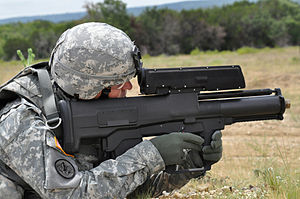
XM-25 25mm Defilade Target Engagement System (“Punisher”)

The XM-25 is a airburst grenade launcher that uses various targeting methods, including a thermal sight, and a laser aiming designator to program the internal ballistic computer onboard the round, allowing the user to program the range at which the grenade should detonate. This allows the round to be fired over an obstruction and explode above the target. They can also breach a thin barrier (like a window or door) and explode on the other side.

The 25mm × 40 low velocity grenades called high-explosive airbursting (HEAB) rounds, armour piercing explosive rounds, flechettes or canisters of lethal tiny darts for close-quarters combat, door breaching loads, anti-personnel rounds, and probably the weapon’s most lethal type of ammo: thermobaric (or fuel-air bombs [FAE]) grenades.

Here’s the US DoD description of the FAE effects: The [blast] kill mechanism against living targets is unique–and unpleasant…. What kills is the pressure wave, and more importantly, the subsequent rarefaction [vacuum], which ruptures the lungs…. If the fuel deflagrates but does not detonate, victims will be severely burned and will probably also inhale the burning fuel. Since the most common FAE fuels, ethylene oxide and propylene oxide, are highly toxic, undetonated FAE should prove as lethal to personnel caught within the cloud as most chemical agents.

A GM can probably understand why you don’t want characters wandering about with the latter. Considering the cost of the FAE round is about $1000/shell, you have a good reason for why they wouldn’t be issued one under anything but the most extreme conditions.

PM: 0   S/R: 1   AMMO: 4   DC: see below   CLOS: 0-30   LONG: 100-210   CON: n/a   JAM: 95+   RL: 2   COST: $30,000

GM Information: The XM-25 must be aimed to use the programmable function of the grenades. The user gets the usual +3 EF modifier, but can ignore cover modifiers against them. The damage of the grenades is DC: J for the HEAB and HEAP rounds (the armor piercing rounds half the armor of a vehicle and ignore personal armor benefits.) The canister rounds do DC: I and ignore half the personal armor benefits. Door breaching rounds are area effect, but the damage if DC: H and the barrier provides double the usual damage protection, but is itself destroyed.

The FAE grenade does DC: L with a blast radius of 25′ for damage falloff. Fire damage at DC: F follows for 6 rounds, unless the fire can be extinguished. The damage is applied to any structure that the person might be in — like a small house, say. They’re incredibly destructive.

There’s been some talk about one or more of the other players taking over GM duties from me from time to time (if only it works this time!), as I’m inundated with a 10-month old, dissertation work, new part time work at a local university, and projects that I hope will come to fruition this summer. (Can you say Kickstarter? And spies..?)

One of the players was thinking of running a fantasy campaign, but we’re all pretty united in not liking d20 — either Dungeons & Dragons or Pathfinder. We also are serious anti-GURPers. I figured I’d have a look at The One Ring by Cubicle 7 for system ideas. And hence, this review…

First off, I can only speak to the pdf version, but judging from the production values of the files, the books are probably nicely done. I understand it’s two hardcovers in a slipcase, plus two maps. The books and maps are done from the proofs for the pdf version of the game, not some lame scan, so the quality of the maps is tremendous — you can zoom in tight and have good quality  graphics. The books are nicely done, full-color pages with decent artwork. The files are also well optimized, so there’s not a lot of the lag time in getting legible views when turning pages on the iPad, unlike Margaret Weis’ Leverage or Smallville files, which are disastrously slow in loading.

The game mechanics are delightfully easy. Roll a d12 plus a number of d6 equal to your skill. You can use “hope points” to add attribute dice. Get a 6 and you succeed on the skill dice. Get a 12 on the d12 and good things happen to you, 11 and something untoward happens, whether you succeed or not. (On the game box set, the dice are modified — the d12 as an Eye of Sauron for the 11, a Rune of Gandalf on the 12; the d6 as another rune to indicate success.) You try to beat a target number between 10 and 20 (for the most part.) Combat works not with the traditional initiative, but rather how you position yourself on the battlefield — more on that in a moment.

The Adventurer’s Book is the character creation/player handbook. It has most of the rules in it. Your characters are chosen less by the class/race of traditional fantasy games, that by a culture — the Beorning, Dwarves of Lonely Mountain, Elves of Mirkwood, Woodmen of the Wilderland or Bardings for humans. Your culture gives you “blessings” and your skill packages are driven by the same, although you can tailor the character for their own background, etc. There are only three attributes: Body, Heart, Wits. Hope points work like the tradional hero/plot/fate points in most games, but as they drop you can start to pick up “corruption”…if you do bad things, or questionable things from a cultural standpont, you can start to feel the draw of the Evil One. Characters can be Weary, Miserable, or Wounded and this effects how well they can function.

The Loremaster’s Book is the GM book and much of it is given up to the how and whys of running a game — how to set up encounters, the differences between combat and other elements of play. It deals with the mechanics of the corruption mechanic, gives examples of the adversaries you could run into, and a lot of material on the world of Middle Earth post-The Hobbit, but pre-Lord of the Rings.

It’s an interesting period to set the game — it’s a point in the Tolkien settling that is hazily defined and leaves a lot of room for adventuring and heroics without interrupting the upcoming action of LOTR. In general, games set in Middle Earth are either bogged down by the pedantic, heavy detail of the books. It’s great for setting depth, but it can overwhelm play. The One Ring gives you enough to know what is going on, what the area focused on is like, but leaves the heavy history to Tolkien’s works. If you need more detail, crack open the applicable novel.

Tolkien’s universe is less about killing the monster and stealing the treasure than the usual fantasy game. The McGuffin of Smaug aside, much of The Hobbit is about getting there, meeting other people and dangers on the road, and how these encounters change you for better or worse. TOR does a good job of emulating this feel, much more so than any iteration prior to it. Allegedly, C7 will be putting out another three “core” sets that cover The Lord of the Rings, expanding the setting to cover other races, events, locations.

The books and maps are gorgeous and style is definitely a 5 out of 5. The mechanics are light, but not too much so, and are designed to drive role playing, and to emulate the flavor of Middle Earth — I think successfully. Substance is 4 out of 5, more because they had to skimp on a lot of the background material to keep the game focused and playable. It’s worth a buy — especially for the under $30 price for the pdf. (The box set is $60.)

Sooner or later, you will most likely have a time when a new player is coming to join your group for the first time. When this player is an “experienced” player — someone who has played at least a few times — this is not as big a jolt as getting a new player — someone who has never played before. You would think that most groups would love new blood in their company, but this is not always the case…

Some groups play together for years. They’re comfortable with each other, with how they play, their GM’s style of storytelling, their characters, the worlds and systems they run. Change can be uncomfortable, but if the new player has been vetted a bit, the entry of a new player can really charge up a gaming group.

One of the best ways I’ve found to vet a new player is simple: meet them in a non-game environment, like a coffeeshop or wherever to chat about games, what they’ve played, what you play, the personalities of the group. Like a first date, you want to get the broad strokes of who this person is and what interests them in gaming. If they get along with a few members of the group, they’ll usually get along with the group in toto. (Usually, it’s just me doing the vetting in my group, but bringing along another player isn’t a bad idea.) This allows you to weed out the stereotypical crazies of the hobby (like the 300 pound “ninja” whose highly honed senses couldn’t pick up on me and my roommate of the time slipping past him and into our apartment building during the “stalking” phase of dealing with him), those who are sharply different (and not in a good way) from the rest of your group (usually this manifests in game preference and personal politics…putting a screaming socialist in a group of conservative/libertarian gamers? Not good.), or who simply don’t get on well with the group.

Once you’ve established there is a good fit, the first night’s going to be where the rubber meets the road. Do you let them create their own character without really knowing what the rest of the group is playing, what the feel of the game is? Or do you drop a pre-generated character on them and toss them in the deep end? If you are deep in a campaign, it might not be the best to do either, but rather get together for a character creation jam. I prefer to do a pre-gen character if your group is only playing one game, and do a side mission — a flashback or a side quest. Optionally, a good idea, if you’re playing different games from time to time is do a one-shot in another system and setting — something that puts all the players on the same starting line and knocks everyone out of their comfortable, established relationships and expectations.

Don’t focus too much on the new person in this latter option, but make them an important, if not the most important character in the piece. Even if they’re not the lead, they should be above the line, as they say in the movie biz. If it goes well, integrate them into the existing campaign. Often, I like to fire up a new game and campaign to include the new person. For existing games, I try to bring them in at a decent break point, but that’s not always doable. For the traditional dungeon crawl, it’s kind of hard to have them “just appear…” find a good way to bring them in: were they a prisoner of the bad guys? Are they part of a failed expedition that preceded the group?

Introducing a new player/character to an existing game, I feel needs a “teaser”, to use TV/movie lingo — a set-up sequence at the beginning of the night that is short enough to be interesting to the other players (who should not be involved) to give the character a chance to get the flavor of the game, campaign, and their own character. This is similar to the action movie set-up where the character is introduced on another quest/mission in media res — Indiana Jones in South America 1936 in Raiders of the Lost Ark, for an example…once we see them in action, bring in the scene where they meet the others. Never kill off a character in the teaser!

For those new to gaming in general, introducing the new player is a bit more tricky because you’re not just selling you game and group, but the hobby in general. There are a few good ways to do this: run a solo game for them — something simple and straightforward, there’s no pressure to “be good at this” (as my wife would say.) Pick a simple system that is easy to learn on the fly. For introducing my wife to gaming, I chose a quick spy mission set during the 1936 Winter Olympics. Her character is a rich socialite with an adrenaline junkie personality who gets enlisted in finding and recovering secret papers a former mentor has stolen from the Nazis. There was a teaser set in the part to give her a feel for her background, then there was the opening scene setting in Germany and meeting her former mentor. Social tests and roleplaying were the focus. He gets killed and she chases the bad guys down the Zugspitze: chase and action tests and how they work. It flows quick and gets them into the fun. There was an investigation/problem solving sequence to search the mentor’s room and find clues to where the papers are. Another social sequence to get invited to a big Olympics party with the fuhrer himself. A scene where she has to stealth around the ski chalet and find the material, then a escape without detection. There was to be a big fight sequence, but she played it smart, outfoxed the bad guy, then escape to Austria in a stolen staff car.

A leads to B leads to C. Simple. Fun. I chose Hollow Earth Expedition because i know it well and it plays fast. She had fun. She now games. Had her first experience been the next game run by a former friend, she would have given it a pass. He wasn’t really into it, the characters didn’t quite jive, the adventure sort of meandered with little direction from the GM on where we needed to be going. It was boring. So to recap: simple, fast, no chaff.

Bringing them into the existing group, it’s pretty much the same advice as above. Make sure the new guy/girl gets enough to do (as withe all of the players), try and keep that first night or two simple and fast-paced. First and foremost, I think it’s important that the people get on well — gaming groups that meet just to game can last a long time, but I prefer to game with friends — people I want to see outside of the gaming group. It makes the play that much more entertaining.

This is loosely based on the mission the group played last week. It’s for a team of four to six spy/military type characters.

Moving on intelligence gathered at Camp Delta from a Russian arms dealer, the team is being put in play to stop the sale of weapons from the bratva (Russian mob) and al-Shahab in Somalia. the method of delivery is keen: the freighter Kapitan Kurila has been “hijacked” by Somali pirates and brought into port in Mogadishu. Their mission is two fold: 1) destroy the shipping container (standard 20x8x8′) with serial number BF20389 and the armaments (including explosives, ammunition, etc.), and 2) capture/kill the arms dealer’s number two guy who is moving into the lead position, Igor Borodin. Borodin is with the deal to do a face-to-face with the al-Shahab #2 Sheik abu Yassou Rouma. Abu Yassou, if discovered, is eminently expendable.

Satellite imagery puts the freighter at the wharf inbound of the southern waterbreak. There’s easy ingress from the sea, but a 50 yard area to cross that will most likely have Somali terrorists hanging around waiting to offload and take possession of the weapons. They can come in from the sea, as well and board on the starboard side, away from the wharf. (Use Google maps — they have a good shot of the area I’m talking about.)

The ship itself is a 300′ Feeder-style freighter with the cargo holds modified to take standard containers, two arranged side to side, with up to four or five stacked on top of each other. There will be a small area to maneuver around the containers to check numbers, gain entrance, etc. The gunwhales of the ship are lower than the main deck, allowing for relatively easy access (EF5 Mountaineering.) There are three holds, searching each will take about 3 minutes, during which time they should have to be careful of the crew of 14 and about 4 of Somalis. An EF6 Demolitions is needed to destroy the container, delivering a DC L to the container, and a DC H to the boat.

The team members looking for Borodin will find him on the second deck of the superstructure in the officer’s wardroom with Abu Yassou, two former-Spetnaz-types, and there is a Somali lookout in the corridor. Six of the crew are in the first level wardroom watching Russian porn and with a good Charisma EF4 can be subdued. There is a man working the ship’s crane, there are three men aiding in moving the containers, and two guards roving. The Somali guards are on the cargo deck with the loading crew. There’s about a dozen ashore waiting for delivery with a couple of pickups they are going to offload into. The sheiks old Mercedes-Benz C class is there, as well.

Any alert and they’ll have the place swarming with the Somalis from the wharf. Ten minutes after a firefight starts, they’ll have more bad guys than they can handle.

They will extract by boat to a waiting submarine.

Have fun…

I was watching the last few episodes of Chuck and there’s a great moment where Sarah says, “So, it’s one last mission.” All the male characters at this point groan and shake their heads. “You never say that!” is the response. Because anyone who’s ever watched a heist-gone-wrong flick, or a spy film, or pretty much any movie or TV show know that when the phrase “one last job” comes up, you’re going to get butt-raped by a mastodon without the benefit of lube.

So to adequately reflect that, I suggest anytime the phrase “one last job…” or some variant such as “Just this last mission and we’re gone…” the GM automatically has, at some key moment, the player reroll a task and take the lesser test. Either that or give them a plot/style/whatever point in advance and them just simply screw them over as part of the narrative.

A variation on this is the “Goodbye, Mr. Bond” house rule I have. If the henchman or villain at some point uses that famed [phrase, you get an automatic style/plot/hero point to use for your cunning escape. The players will often try to get me to say it in a sticky situation, and from time to time I have. The point usually save their lives. You could also do this by GM fiat.

« Previous PageNext Page »