Here’s a two-hour fanfilm that uses about 5-10 minutes from each film, in order, from Dr. No to Quantum of Solace.
13 November, 2012
12 November, 2012
d20 From Ancient Egypt
Posted by blackcampbell under Roleplaying Games | Tags: d20 |Leave a Comment
The Metropolitan Museum of Art has the oldest known d20 in their collection, from some time in the Ptolemaic era (older than 300BC.) It was found by Reverend Chauncey Murch between 1883 and 1906, while Murch was a missionary in Egypt.
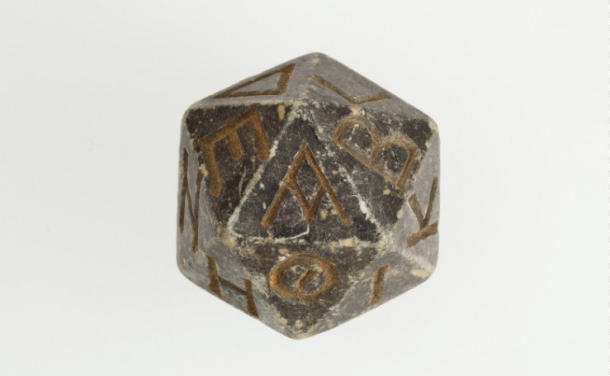
I wonder what edition they were playing..? More at C/Net.
11 November, 2012
I’ve been a Bond movie fan since I first saw The Spy Who Loved Me when I was a kid. I’ve stuck with the franchise, even when it was long in the tooth and stinking (Octopussy and A View to a Kill) and when it was excelling (For Your Eyes Only, Casino Royale). I’m glad to say that Skyfall drops itself comfortably into the latter. While I’m not as aggressively hateful toward muddled, frenetic Quantum of Solace as many folks — I had no trouble following the plot, but spent most of the movie thinking about how I could have fixed it — I think that the filmmakers knew they had a lot to make up for.
Sam Mendes directs the movie and brings a slick, stylish flavor to the movie. The action sequences don’t get stuck in the Bourne-esque flashy edits that make it seem like there’s more going on than there is; the initial chase sequence through Istanbul is fast, furious, and for a motorcyclist very exciting. The technical proficiency to pull off the stunts is mind-boggling to me. The fight scenes are not overly complicated and flashy, but they use their surroundings to create atmosphere and advance the plot. In particular, there is a fantastic sequence in Shanghai that could have been ripped out of a science fiction movie – all shadows and neon. The character reveals are superb, from Bond walking out of shadows to have only his eyes highlighted, to the villain Silva’s monologuing while walking toward the viewer from a distance, the character slowly resolving in speech and focus. Brilliant.
The music is not by Bond alumni David Arnold, (and it shows) but Thomas Newman, who scored The Shawshank Redemption and Wall-E, just for example pulls off a sleek, modern sound while keeping many of the classic queues. Adele’s title theme is fantastic and she Basseys the hell out of it.
The cast is solid: Craig owns the role now, and manages to make a broken, violent killer sympathetic. Javier Bardem is by turns creepy scary, creepy funny, and just plain old creepy…but there is a scene between he and Judy Dench’s M that also makes him sympathetic. Like Bond, he was a fragile creature emotionally and M used the weaknesses to craft a model agent. The scene is, for my money, that best in the entire film. Naomie Harris is probably the weak link, here; she’s adequate in the role, but there’s a forced quality to her flirting with Bond, and a restraint that characterizes a lot of her work I’ve seen. Ralph Fiennes is..well, Ralph Fiennes. Even if he were phoning it in, you’d get a good performance.
Did I mention the old Aston-Martin DB5 tuns up? We’re talking the Goldfinger DB5 — fully loaded. Well, it does. Speaking of — there’s a lot of complaints about product placement in the new movies, to which my response is there always was. Bond movies are expensive and you need the financial support to make ’em. Also Bond is — much like Miami Vice was in the ’80s — about the lifestyle, as much as the character and plot: the Walther PPK (gag!), the Aston Martins or Lotuses or BMWs, the Brioni suits, British Airways, the places he goes (a travel agent’s dream ad), etc. etc. Just enjoy it and lust after the stuff you can’t have.
Had this not been a Bond movie, it would still have been a great thriller, and that makes it a top-notch Bond flick.
Style: 5 out of 5, Substance: 5 out of 5. Go see it. Now.
9 November, 2012
New Gun for JB:007 — Walther PPS 9mm
Posted by blackcampbell under Roleplaying Games | Tags: james bond role playing game |Leave a Comment
In honor of Skyfall, and the idiotic biometrically tagged PPK/S (great idea…when it works…), here’s the weapon Bond should be using when undercover (if we’re sticking with Walther.) I’ve shot one of these and was shocked by how accurate it was out to about 15 yards and how controllable, despite the low weight.
WALTHER PPS 9mm

Introduced in 2007, the PPS (Police Pistol, Slim) is one of the smallest 9mm self-defense guns available. Weighing in at 19.4 ounces unloaded, having an overall length of 6.3 inches and 5.9 inches from bottom of the large magazine to top of slide, it is easily concealable, powerful, and very accurate. Unlike the PPK, the PPS is highly reliable. The magazines come in 6, 7, or 8-rounds — the six round lies flush with the grip and is best for concealment, the eight best for grip and control.
PM: +1 S/R: 2 AMMO: 6 DC: F CLOS: 0-3 LONG: 8-14 CON: -3 JAM: 99 DRAW: +1 RL: 1 COST: $600 GM Information: The stats are for the 6 round magazine, the 7 and 8 round raise the AMMO appropriately and lowers the CON to -2. There is a .40 S&W with the same stats, but has a 5, 6, and 7 round magazine.
9 November, 2012
New Car for JB:007 — Aston Martin DBS
Posted by blackcampbell under Roleplaying Games | Tags: james bond role playing game |Leave a Comment
Just in time for Skyfall, here’s the Aston Martin DBS…
ASTON-MARTIN DBS

Introduced in 2007 to replace the Vanquish, the DBS is a 5.9 litre 12-cylinder luxury GT automobile that brings an even more aggressive look, power, and handling to the line. The motor generates 510 horsepower and 420 ft-lbs of torque that takes the car from 0-60mph in 4.3 seconds and up to 191 mph (183 mph if through the Touchtronic2 transmission.) 85% of the car’s weight rests between the wheels and the hull of the vehicle is carbon fiber to reduce weight and aid in acceleration and fuel savings. The Adaptive Damping System, or ADS, tweaks the suspension for road/weather conditions.
The interior of a DBS is a blend of carbon fibre, alcantara leather, wood, stainless steel and aluminium surfaces. The seats both bear the DBS signature with an optional 2+2 seating configuration. The key is made from stainless steel and glass and is inserted into a special hole in the dashboard. It also has a 1000-watt Bang & Olufsen sound system with 13 speakers in 10 different locations throughout the cabin, as well as an integrated Apple iPod connector.
PM: +2 RED: 2 CRUS: 110 MAX: 191 RNG: 260 FCE: 2 STR: 6 COST: $290,000
GM Information: The DBS receives a -1EF to Force maneuvers and safety rolls associated with the same, however, otherwise it receives a +1EF to safety tests.
Q Department: The 00 section DBS vehicles are equipped with the latest in vehicular armor (-4DC to attacks), and a shielded, biometric secret compartment in the glove box that can hold a sidearm and extra magazine. There is also a vital signs monitor/ emergency defibrillator (in the glove box) and combat medic kit (in a compartment under the passenger seat.) GPS, wifi hotspot for the agent’s cell phone are also standard.
8 November, 2012
Fact or Fiction: SHIELD Helicarrier
Posted by blackcampbell under Comic Books, Science Fiction, Technology | Tags: helicarrier |Leave a Comment
Possible? Not possible? Who cares? It’s awesome! Unless something breaks down…then it’s a dramatically awful idea…
5 November, 2012
Blood and Chrome Finally Dropping
Posted by blackcampbell under Science Fiction, Television | Tags: battlestar galactica |Leave a Comment
Apparently, Universal finally got off their butts and are releasing Battlestar Galactica: Blood & Chrome first online this Friday in installments, then on SciFi (I refuse to call it SyFy) and then on DVD.
29 October, 2012
The Offense Lies With The Offended
Posted by blackcampbell under Comic Books | Tags: atomic robo, scott wegener, the offense lies with the offended |[2] Comments
I’m amused. The artist for one of my favorite comic books has no sense of humor. I am, apparently, an “ignorant over-privileged right-wing fuck” responding to a retweet saying “[Mitt Romney]’s not afraid to face a ravening, grasping horde of subhumans, because that’s how he sees poor people already.” My response, “They’re not?” A quick review of my tweets would show I’m a sarcastic bastard. I’m also a writer and college prof and a full-time dad…so I’m not exactly rolling in dough, myself. I suppose my response should have been “We’re not?” to maximize the effect, but hey — shoulda woulda coulda.
Of course, he gets butthurt and flies into a multi-tweet response (that’s when you know someone’s really mad at you!)
As a poor person (and most comic creators are extremely poor) I would say no. Y’see, we dangle at the end of a very-
long and predatory business model where @bclevinger and I do 90% of the work and reap 10% of the reward. Many poor —
poor people also exist in similarly unfair and unbalanced work situations. We work long hours for little reward. So–
on behalf of my fellow poor grasping subhumans let me answer with a NO. You ignorant over-privileged right-wing fuck
So, because he’s a poor person he’s outrageously outraged! My response to Scott Wegener is pretty simple: 1) You aren’t poor due to the predatory business model…you’re poor because you chose a poor career path. So did I (several times, actually.)
2) You went into comics despite the fact that there is a long, well-published set of data on exactly how truly awful the publishers of comics are to the talent. I can only assume you value your creative work and lifestyle more than money…so what’s the beef? If you want to eat and be happy in your work, get yourself a well-paid spouse or lover; or a day job you despise. Hell, I soldiered just to make ends meet.
3) There’s a remarkably wide swathe for people out there who don’t fit into the “left wing/right wing” pigeon holes. I know that requires a ore nuanced view of politics than the traditional and simplistic, Manichean, us/them political spectrum, but it will make your insult sting if you actual have an idea of who your are attempting ad hominen attacks on.
Lastly, this is a prime example of my axiom, “The offense lies with the Offended.” If you want to get butthurt over something somebody said, if you want to give them power over your emotional state — that wasn’t their doing. That was yours. If you had the power of your convictions, you’d have shrugged me off as a troll and gotten on with the next issue of the excellent Atomic Robo (Yes — I’m even plugging his material!)
He might need one of these…

I’m going to go lord it over my serfs now. Everyone have a great day!

