The return of our Hollow Earth Expedition campaign included one of the players wanting to trade out his character, the French cat-burglar/actor for something new. He was leaning toward a character in the classy gentleman spy, John Steed vein but left it to me to build it.
Our adventure coming up was how there was a lost island, possibly a bit of the Hollow Earth that got “stuck” to the Surface World in the South China Sea. I figured we needed someone who was familiar with the lifeforms and might have a direct connection to the mission. Hence this character was born:
Aristotle Strange
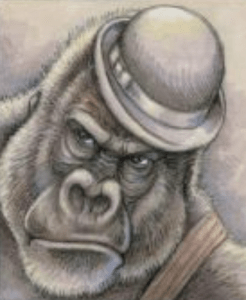 Ari Strange started his life as a philosopher and thinker in the ancient city of Molad, one of the apeman cities arrayed against the Emperor Mot. When the Interior World emerged in 1933, he was deposited in Hong Kong, where his ability to speak and reason earned him study by MI-13, the United Kingdom’s secret science intelligence agency. He was eventually recruited to aid the British with the leftover problems from the emergence of the “ghost world” and has become one of their most skilled, if least secret, agents in the East.
He is incredibly dapper, always well dressed in town, and he prefers a safari suit in the field. He rarely uses guns, preferring one of his custom-made gadget-laden umbrellas. His bowler hat is steel-lined so it can be used as a bludgeoning weapon or shield. He is frequently assigned to missions with two Special Branch officers who have been seconded to MI-13 — Sergeants Thicket and Tweed. Tweed acts as driver for the Bentley 6.5 litre “Green Train” car that MI-13 has issued to the large not-so-secret agent.
Archetype: Spy Motivation: Knowledge Nationality: British Age: 40-45?
Place of Birth: Molad, the Interior World Date of Birth: June or July, 1889
Ht: 5’11” Wt: 370 lbs Hair: Black Eyes: Brown
ATTRIBUTES: Body: 3 Dexterity: 2 Strength: 4 Charisma: 2 Intelligence: 3 Willpower: 2
Secondary Attributes: Size: 0 Move: 6 Perception: 5 Initiative: 5 Defense: 5 Stun: 3 Health: 5 Style 5
Resources & Talents: Animal Presence: Use Body for intimidation base, Natural Advantage: Climb (x2 move when climbing), Prehensile Feet, Rank 2: Special Officer, MI-13 (equiv. Lieutenant); Skill Mastery, Academics; Strong: +1 strength at creation
Flaws: Code of Honor: 1 style pt. when he does the right thing; Curiosity: 1 style pt when it gets him into trouble, Obligation: MI-13, Weird Appearance: -2 social tests with new people.
Languages: Ophiri (native); Ancient Greek, Cantonese, English, Spanish
Skills: Academics 3/6, Athletics 2/ 6, Brawl 2/6, Bureaucracy 2/5, Firearms 1/3, Intimidation 2/5, Investigation 2/5, Larceny 1/3, Linguistics 3/6, Melee 1/5, Science (Biology) 1/4, Stealth 2/4, Survival 3/6
Weaponry: Sword Umbrella DAM: 2L, Attack Rating: 7L (Has a small whiskey flask in handle); Shotgun Umbrella (12 gauge): DAM: 4L, Attack Rating: 5L, Rng: 25’, Cap: 1, Rate: 1, Spd: S; Steel-Lined Bowler DAM: 1N, Attack Rating: 6N Range (thrown): 20’ (Can be used as a shield for Armor 1)
Gadgets: Umbrella with gas spray: Range 10 (Test BODY 3 or fall unconscious for successes x minutes), Umbrella with camera (Can take up to 20 pictures (35mm cartridges), Smith Brothers wristwatch with compass, Belt with secret money pouch (5 gold sovereigns)
Note: I pulled the image off the interwebz at Traditional Games, but there was no citation for the artist who created it. No infringement is intended and as soon as I find a citation I’ll post it.



 The Black Campbell