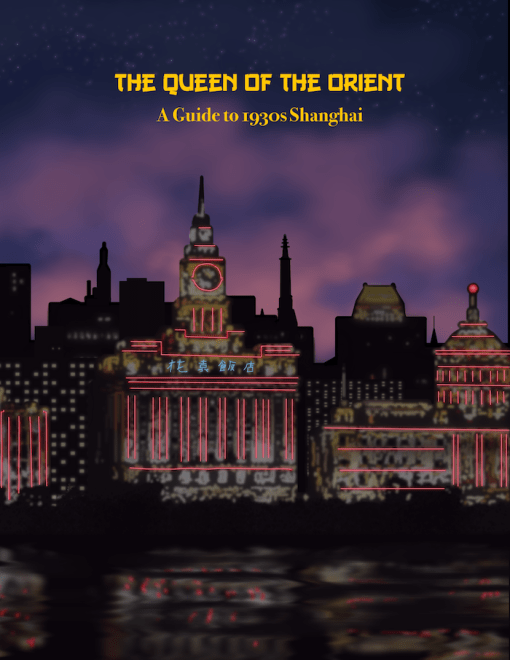
Our latest release, The Queen of the Orient, is now available for the Ubiquity and Fate role playing systems as an ebook on DriveThruRPG and RPGNow! It comes with a period-accurate map of Shanghai (in PDF).

cover small.png

The Queen of the Orient features information on the history of the city and the three municipal entities — the International Settlement, the French Concession, and the native City Government of Greater Shanghai. There is information on the infamous Green Gang (Qing Bang) that ran much of the crime in “the most dangerous city in the world”, as well as their opponents: the yakuza, the Triads, and  the Shanghai Municipal Police.

Crime is a close cousin of espionage, and Shanghai was a hot-bd of that. Chinese communists and Soviet allies, the Nationalist government of the Republic of China, British intelligence, the Japanese kempaitai were all active in the city. Everything you need to create a living, breathing Shanghai for your 1903 pulp game is here.

The ebook/map is $9.99, the print version (which will include the ebook and map) should drop next week at $19.99.

Here are the links for the Fate version and the Ubiquity version.

A note on the map — there’s no print version right now because the size of the thing is not supported by DriveThruRPG’s POD service — it’s a whopping 86×55″! You could possibly find a local shop that could print the thing as a poster.

Another question that has a couple of ways to address it. Do you mean personally — what we want to play, what i hope happens in a game? From the industry — what I want to purchase, or trends in the RPG scene?

In the personal realm, I am looking forward to seeing how the D&D game plays out. This is my first shot at doing fantasy in decades, and I’ve been trying to amp up the horror and existential dread end of things. I never liked how finding monsters and stealing their treasure was just a sort of work-a-day thing for adventurers in games; this should be stuff that is frightening and awe-inspiring.

I’m hoping to convince the new players to branch out from 5th ed. and try some other stuff. We’ll see how it goes.

From the industry? I’d like to see a move toward smaller, more tightly written books, with better (not flashier) layout and design. I’d like to see a bit less politicking and more keeping things fun. I want to see the Fate version of the Greek myth game that Evil Hat’s got on the back burner, and I want the d6 Star Wars republish (Thank you, Fantasy Flight!)

I hate to say it, but I think most of them have been done. Greek myth meets sci-fi? Hellas. Cyberpunk and fantasy? Shadowrun. Mythos meets pulp meets sci-fi? Atomic Robo.

It’s a tie. The folks at Evil Hat did a multi-book Kickstarter that included the Atomic Robo RPG. It was well-run, successful, got the books out on time, and kept the backers informed every step of the way. Similarly, the Transhuman Kickstarter by Posthuman Studios for the Eclipse Phase game was excellent on communication, delivered slightly ahead of time, and had been continuing to pump out their stretch goals on time.

I would also throw in a big shout out for Dr. Dante Lauretta and the people at Xtronaut Games for their superb Kickstarters for Xtronaut and the soon-to-ship Constellations board games. Lauretta is a project manager, I believe with the OSIRIS-Rex mission, and both campaigns were absolute exemplars of how to do Kickstarter. The games are also superb and I highly recommend them.

Specifically, they asked which films/series were the biggest source, but I think that’s a bit limiting. This is a curious question more for what it says about geek culture, rather than gaming itself…every game, I’m sure, has had it’s “Game Over, man! Game Over!” or “Let’s nuke it from orbit…” moment.

I’d bet good money it’s the most used quote regardless of group.

Outside of Aliens, which has an excellent selection, there’s the ever-ready “Get to the choppah!” or any other Arnold-ism. I rather like quips from South Park or Archer. More interesting, I think, is that there is a quote”shorthand” or “macro” to explain a situation or character’s reaction to the same for many gamers and geek in general. Even in real life, I address the nostalgia that people spout off about the “good ol’ days” with the Winter Soldier quote, “The food’s better; we used to boiil everything. No polio is nice.” when people idealize the past.

Gamers, if anything, are so immersed in popular culture, whether its movies, music, TV, or books, because we use games to mix and match ideas and characters, and try to find a version that is ours. We like seeing permutations on our favorite entertainment (with the possible exception of Star Trek fans — who always want something different, until they get it…then they bitch about velour shirts and bad sets from the 1960s like it was real.) For all the complaining about cultural appropriation, it is the heart of gaming and geek culture at large, whether it’s a black Batman, a young white girl doing Japanese anime cosplay, a Korean Wonder Woman, Japanese comic book writers stealing from Greek  mythology, or copyright-infringing, fan-made Star Trek films — this is a subculture that borrow, bends, reworks, repurposes to make something unique and cool. Just like cultures have done since time immemorial.
 

If you’d asked this 20 years ago, it would have been a library and a notebook. Today? A good laptop or tablet. You can store the rule books, have a dice program, notes, maps, pictures, mood music — whatever you need. Need to access information on the fly? If you’ve got wifi, there you go.

When I was running Battlestar Galactica, I used my MacBook Air because I would have so many windows open to access character writeups, ships, etc… Running Hollow Earth Expedition, I often just use my iPad or laptop. For the current D&D game, there’s such good support apps — I highly recommend Game Master 5 and Fight Club 5 — that I use the iPad exclusively.

Define resources…

There are a few games that do a plethora of splatbooks to give you new mechanics or setting material, or reference material. If we’re using that as a metric, there’s no competition: GURPS.

What do you want to play? GURPS has a book on it. I wouldn’t be surprised if there’s a sourcebook on being an accountant in the 17th Century. It will be almost scholarly in quality (well, for today, it’ll be better than scholarly), it will plug and play. You can use the material for other games and never play GURPS. (That would be my recommendation.)

If you are talking a game with online support, apps for character building, GMing, and plenty of books with rules and creatures you’ll never use. Dungeons & Dragons, 3rd or 5th edition (I’m including Pathfinder in this, so Paizo fans settle down.)

I can’t speak for others but for me? A good Islay scotch (Lagavulin, please!) or gin (The Botanist.) Good food comes in second.

No. The very idea is flawed.

“Pay what you want” publishing proceeds from the idea that demand drives pricing. This is inherently a correct approach if the publisher is unsure of the worth of their product, or values short-term market share more than near-term profit. In the latter instance, they’re looking to expand their brand and catch eyeballs, and will most likely charge more traditional rates once they’ve achieved this. The former instance is one where you have the hobbyist who wants to monetize their hobby and aren’t interested in making money, so much as getting their stuff out there. There’s nothing wrong with either of these reasons for doing PWYW. There is no “should.”

When I started Black Campbell Entertainment, I was leaning toward the idea of PWYW, but I also wanted to make sure that if we were selling, everyone who was involved would see some kind of profit, however small. That meant paying the artists up front, cutting my editors in on the royalties. That meant these products weren’t valueless beyond what the customers wanted to pay. There were real hours, real effort put in (and I think it shows.) I set prices commensurate with similar products. If they weren’t moving, I lowered the prices to something people were willing to pay. But PWYW often means $0.00…the work put into these means they have a value we expect to at least recoup.

By not being greedy — most of our adventures are $2 — we have steady sales. Artists are paid, editors are paid, and we’ve recouped about 2/3rd the payout on the first wave of adventures, thanks to a bundle that is seeing real sales. (And thank you!!!) We put a value on our stuff. You agree and buy it, or you don’t…and don’t. That’s commerce. That’s fair.

The PWYW publishers, for whatever reason they have chosen this pricing structure, are signaling that they understand the inherent value of their product is low (because with POD and e-books, games are glutting the market) or they value dispersion over profit. I wish them well.

Second guessing their intent is fruitless.

I think this question is interesting because it calls out a problem I think the industry as a whole has — the need to make game books look like art books. (Tales From the Loop is essentially a game built around an art book, for @#$% sake!) By focusing on slick art and fancy designs, newer games often fall into the same trap as the CGI-heavy Hollywood blockbuster. The game looks great…but is a bitch and a half to find the rules you want, and sometimes those rules are badly explained. Sometimes the great complementary colors between text and page color mean you can’t bloody read the text. And like the latest iteration of a superhero movie, it’s too long. Page counts regularly top 350 now. There’s a lot of chaff, as well — fancy verbiage and tone-setting interstitial material (to be fair, that’s how I got my start in RPGs, writing exactly that stuff…) — that blows the book up to these page counts. Fancy full-color pages, and lots of them, also makes the product expensive to produce, and hence buy.

Jaw-dropping layouts, to be blunt, are a waste of your money.

Two of the nicest looking games out right now fall prey to all these issues — Mödiphiüs’ Star Trek Adventures and Conan. They’re gorgeous books, but they are expensive! (To be fair, their PDF prices are reasonable.) Reading them if you have tired, old eyes is hard — especially the Conan book. The explanations of momentum and threat are disastrous. They’re long and packed with loads of stuff — which makes it feel like you’re really getting you money’s worth. (It’s the same reason that movies are getting longer. Chinese audiences want most run time for their renminbi and this is pushing the run times up.) But just like Avengers didn’t need a 48 minute final fight sequence, most of these books would be better with a 200 page count on the corebook. Save the other crap for a splatbook book you can charge too much for. (Exhibit A: Do you really need a splatbook for every Doctor in Doctor Who. No, you do not…but they sell.)

I would like to see a lot less “jaw-dropping” and a lot more effective use of layouts and word count, not to impress the buyer, but to make the product more readable and useable.