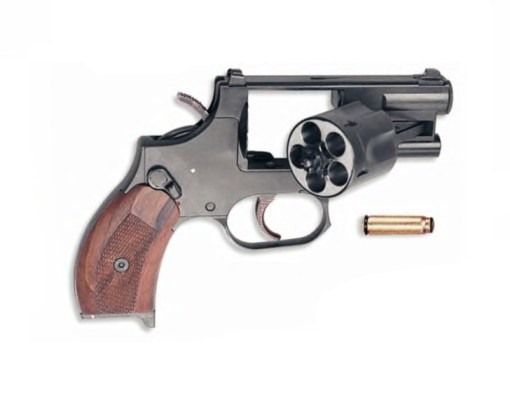
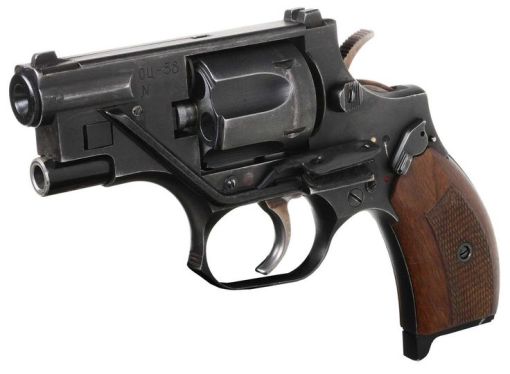
OTs-28 Stetchkin “Silent” Revolver

tumblr_o0a6kyrPkc1uryk28o1_1280A 5-shot 7.62x43mm pistol in service with the Russian Internal Service (I guess KGB is out of style…) since 2002, the OTs-38 uses a specialized cartridge first developed in the 1970s that is it’s own sound suppressor. A special necked cartridge captures much of the gasses from firing and makes the revolver not much louder when fired than simple dry firing. Due to the lower impulse, the 7.62mm, 143 grain round is moving at only 660 feet per second and quickly loses velocity, making this a very close proximity weapon.

The revolver features several strange elements: the barrel is actually below the pivot point for a swing out cylinder, which opens to the right, and this reduces recoil to almost nothing. The rounds are rimless and held in place my “moon clips” similar to older .45ACP caliber revolvers. It features a safety catch — unusual in revolvers — allowing to be safely carried with the hammer cocked.

tumblr_o0a6kyrPkc1uryk28o4_1280

PM: +1   S/R: 2   DC: D   CLOS: 0-3   LONG: 8-15   CON: -2   JAM: 99+   DR: 0   RL: 2   COST: ~$800

GM Information: The Stetchkin makes almost no noise when fired and give a -2EF to Perception tests to locate (or even identify there is) a shooter. Armor or cover value doubles, and there is a -1 WL penalty toward vehicles or other inanimate objects.

My daughter got a little diecast of one of these, and I’d never seen one. After a bit of research, I decided we needed something from the “ordinary” end of Euro sports cars:

OPEL SPEEDSTER

This mid-engine two-seater was built from 2001-2005 by Lotus for Opel of Germany, but there is also a Vauxhall-badged VX220 in Britain. Built on the Lotus Elise platform, the Opel uses a General Motors Ecotec Z22SE 2.2 litre engine (making it more powerful, at the time, than the Lotus Elise, itself),  and later a turbocharged 2L Ecotec punching out 200hp for a 2050 pound car (the chassis is glass-reinforced plastic.) It hits 60mph from a dead stop in 4.5 seconds with a top speed of 150mph.

Speedster_Turbo_1

PM: +1   RED: 4   CRUS: 75   MAX: 150   RNG: 200   FCE: 2   STR: 4   COST: $40,000

GM Information: The Speedster gains a +1EF to Pursue/Flee tests.

Here’s a video of Operation Black Swan which effected the capture of “El Chapo” Guzman. It’s helmet cam footage and should give you a good idea of how to describe combat sequences in your game.

It’s chaotic even if you had a good plan. It’s loud and disorienting, even when you know what to expect. (It would be no different with swords and magic — fighting is loud and confusing.) If you want to get the feel of the thing, concentrate less on the number of 10′ squares in the room; no one is pausing to say “gee, this looks to be a 50×20′ room, I now know my fireball will do…”

You might even misdraw the map for the initial portion of the fight, then reapportion the dimensions as people move through and realize it’s bigger/small than they thought; drop things on them that “should have been visible” (really, what could you see in portions of that video that were well lit?) They blow a perception (or whatever you’re calling it) test and that guy/goblin/alien/whatever that was hiding pretty much in plain sight gets the better of you. Damn that wizard for flashing his damn light spell right in your eyes! Or crap, my large friend with the two handed-sword didn’t realize I was inside the arc of his swing when he cut that monster in half; or Johnny over on Team C was a bit out of position and you thought he was the bad guy…good thing he had kevlar on.

Make it murky, stressful, and confusing.

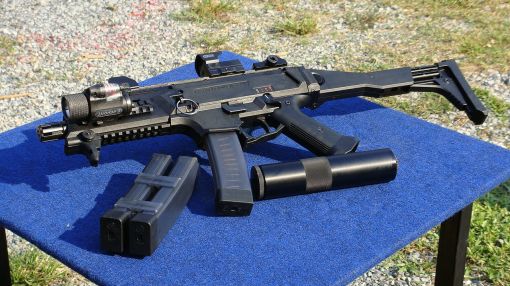
CZ SCORPION EVO 3 A1

Česká Zbrojovka Uherský Brod has been around since 1936, making excellent weaponry. Their biggest claims to fame are the superlative CZ-75 pistol and the CZ vz.61 Skorpion machinepistol. Today’s CZ is quickly expanding it’s reach into police and military armories around the world with the new Scorpion.

CZ_Scorpion_EVO_III

The Evo 3 A1 is a short-barreled “personal defense weapon” or submachinegun in the mold of the MP-5. With a barrel length of 11″ and a folding stock, it is easy to store and carry for soldiers or police that are vehicle-mounted. (Without the stock, it is a “pistol” — the Evo 3 S1.) They come with a 20-round translucent magazine allowing the operator to see the amount of ammo left. Light due to the polymer-frame, very portable, and using a 3 round burst or full-auto select fire, it is an excellent choice for urban engagements.

PM: 0   S/R: 2/6   AMMO: 20   DC: G/I   CLOS: 0-9   LONG: 25-50   CON: +4   JAM: 99   DR: -2   RL: 2   COST: $4000

GM Information: The Evo 3 S1 pistol — or the Evo 3 A1 with the stock collapsed — has the following specs:

PM: 0   S/R: 2/6   AMMO: G/I   CLOS: 0-7   LONG: 20-40   CON: +4   JAM: 99   DR: -2   RL: 2   COST: $900 ( for a semi-auto S1, which has a S/R: 2 and DC: G.)

[I think I’m going to have to look into a Class 3 Evo 3 A1…very, very nice… SCR]

While working on the other post Blood on the Deck: Combat in RPGs, I had a paragraph I later pulled to tighten the focus of the article, but something about it stuck with me. Blood on the Deck talks about the centrality of combat in many RPGs and their adventures. That leads to the paragraph in question:

…[M]ost RPGs are analogous to action movies. There can be philosophy, and deep character growth, and political or social commentary, but in the end the monster is going to kill folks/the protagonist is going to throw down with the bad guy/the heroes are going to have to overcome the [pick your disaster]/or the crew is going to pull of that “one last job…” Depending on what the denouement is, that should be the focus of the rolling and the description in the game.

Action movies are about action. You dogfight the evil galactic empire. You find and kill the monster (and steal its treasure.) You find the big bad and throw down, preferably in a secret volcano base. But they’re not always about fighting, and neither do your games need to be.

If you are exploring, the big denouement can be climbing a mountain or escaping the avalanche. You could be navigating your ship through a particularly nasty maneuver near Jupiter. It could be the heist (with or without fighting) requiring climbing and sneaking and safecracking. It could be a car/horse/airplane/boat chase. This is the focus of the adventure

The focus is where the game should move in, get close to the characters emotionally, but also this should be where the most time is spent. The buildup to the focus can be interesting, but these are the things that — unless tied to the finale — can be glossed over with a “did you succeed or no” sort of roll. An excellent example of this in a movie is the recent The Man from UNCLE, which made some really intriguing choices in the action sequences. Most of the focus is on the character interaction, the action is mostly handled quickly unless it ties to the characters’ motivations. There is a sneak and peak scene at the Vinciguerra Yards. They need to find evidence of a nuclear bomb. Most of the action is to show the strengths and weaknesses of the skills and character of the two leads — Solo and Kuryakin. Once they find the bit of evidence, it’s a quick escape, followed by a boat chase/fight that we see mostly in reflections on the window of a truck after Solo has fallen off the boat and swam to shore. It’s funny and shows Solo moving from casual indifference to the people he’s working with to a grudging respect and desire to do the right thing. The fight is just there to help him get from Point A to B.

This might have been well emulated with a few tests to show the two PC’s skills: a stealth roll, a roll to defeat the fence, the door; a test to knock out the guard; a test to overcome the safe. A few tests to run away and exchange some shots with guards, then a some kind of discipline or willpower test for Solo while watching Kuryakin’s boat getting sunk.

By comparison, the raid on the bad guy castle is handled in quick, ’60s split screen that could have been handled with a single test to overcome the guards defenses. It’s not about the characters; they are part of a bigger action piece. It’s over very quickly, and the action slows and focuses of the two once they find evidence of the bomb and have to rescue Gabrielle, their MI6 partner. It’s about the people. In a game, you might run the basic raid as a contest of Tactics or a combat skill to lead the commandos, then slow down to do a few investigation-style tests, before launching on the bike/ATV vs. Jeep scene, where you would want multiple rolls to emulate the need to use the terrain to try and close on the escaping bad guy.

What’s the focus in your game or adventure? That’s where the players should be rolling to heighten suspense and give them chances to shine by doing things their characters would do. Is it a heist? A quick sneak test to climb the wall, get through the window, and past the guards unseen might do…but if the point is to rob the place, you should have tests that show that: a climbing test — oh, crap! the rain gutter is corroded!, another to open the window three stories up without falling, another to incapacitate or slip past the guard, another to crack the safe…

Is the character a “driver” — the final “fight” should be a car chase, using the environment to battle each other until the good guy escapes or best the other driver. Is the final objective for the character’s socialite to best her rival in verbal combat at a dinner and win the affection of Lord Stuffinpants? You get the picture — focus on the point of the story, and let the other stuff take a back seat.

Since the early days of role playing games, fighting has been a central theme or the specific purpose of play. This is no surprise for a hobby that grew out of wargaming — the simulation of warfare through the use of maps, dice, and complicated rules regarding the various elements of combat. Look at any game book pre-1990 (and even a few today), and you will often see combat takes up more pages in the rules than the basic mechanics of play: modifiers for range, for being prone, for fatigue or injury, for ammo or blade types, explosives and other area weapons, environmental condition, and on and on… Even in games that are oriented more toward social activities, you eventually get into verbal jousting. Some games go so far as to have mental “damage” you can take from a harsh word or brilliant insult.

In a game, in the end, it’s usually easier to search a room, drive a car, negotiate a price, or hack a computer system, than it is to pull a knife on a guy. Complexity ramps up the instant the fight starts, from the use of initiative (you don’t tend to have to throw dice to decide if you got the last box of Klondike Bars in the supermarket…but that kinda sounds fun, now that I think about it.) Some games look to limit this disparity in complexity. In Fate, you can have a simple challenge between players or players and GM — one roll to beat the two mooks guarding the door. You win the roll, they’re down and you’re in; you lose, take a complication or get “taken out” in some way. some are even more abstract.

The keys to a successful fight scene can be summed up by looking at the difference between two (recent) movies — Quantum of Solace and John Wick. Both have great action sequences…or should. QoS follows the Greengrass “Jason Bourne” style of close shots, quick cuts, and shaky camera action to heighten the sense of danger and confusion of a fight. It is a great way for a guy who doesn’t know how to shoot fight scenes to get a fast-paced, seemingly vicious scene on the screen. The choreography could be excellent, but you wouldn’t know it; your experience of the fight is truncated to claustrophobic space and frenetic movement — not unlike a real fight, where you are tripping over things, missing when you throw punches, bouncing off of people and things.

This method of description in an RPG is best handled by not using more than the most basic of maps, if that Descriptions of the space the fight occurs in should be short, pointed, and designed to either increase peril (that floor-to-ceiling window with the ten story drop outside, for instance), or for use by the character (“you land on the coffee table next to the heavy-looking brass lamp…”) The environment and the actions come into the character/player’s perception as needed to keep the action flowing. It is particularly good for certain kinds of large-scale combat, as well, where the character doesn’t have a complete view of the field, lacks a complete understanding of the objectives, and is being pummeled with the sensory input of war — explosions, smoke, dirt, blood, screams, panic — to the point where they focus too tightly on certain things. (The excellent initial scene of Saving Private Ryan does this very well.)

A game system that does this well is Fate: where fights happen in “zones.” Zones aren’t necessarily consistent in their scale, but are instead defined by a few bits of scenery (aspects) to give the environment character. Here, the players can use the aspect in ways that give the fight the quality we discussed above. Say your intrepid police are staging a raid. Two PCs are involved, and enter a large warehouse from different directions with their teams. Player A goes through a side door into Zone 1: “Cavernous warehouse” while Player B goes through the front door into Zone 2: “Small, cramped reception area”. While A might engage in a firefight with badguys on the ubiquitous “second story catwalks” and “sparsely located crates”, B must get past the tight doors and furnishings of the reception room to Zone 3: “tight corridor with small offices on either side” in which bad guys lie in wait. the ranges are tight and personal, and the details might be lost in the action.

The other end of the spectrum is the surprisingly good John Wick, which was made by stuntmen and film makers tired of the Greengrassian shaky camera fight scenes. All the fight scenes are beautifully choreographed, but still look fairly realistic. They are shot medium frame, so you can see what the hell is going on, and only dive to close shots to show injury or characters grappling. The environments are there to be used for the fight: the rack of something you can knock over to stall your opponent getting to you, or to distract/injure; the pool that you can fall into for the grappling underwater schtick; the stairs — so nice to toss (or get tossed) down your enemy; columns or crates to hide behind. The fights show the character thinking his way through the fight — prioritizing the closer or faster moving enemies for a quick, non-fatal gunshot, to slow them while he takes out the guy at the end of the hall, then returns to the closer baddie. Similarly, the famed hallway fight in Daredevil (the Netflix one, not the…shudder…) does something similar.

In doing combat this way, you’ll want to either give an excellent description of the fight space, or have a solid map for the characters to use, so that they can strategize their actions. This is the traditional Dungeons & Dragons approach: battlemap, minis, well-estabilshed scale. This would work particularly well for the above example of “Zone 1” — the massive interior of the two-story warehouse lets the character find a place to pause and assess before they leap in. A better map, showing the I-beam supports, the locations of crates or vehicles parked inside, the catwalks overhead, the stairs up, the location of the  tilting windows on the upper floor, etc. could be filled in to allow this player to have a more clear picture of what is going on than Player B in the dark, tight corridor with people spilling out of the offices on either side.

The key to describing combat in your game is to decide what the emotional and stylistic beats you want or need.

Need something from the ’60s with some style for a character that’s not the DB-5? We’ve got you covered with one of the more popular cars with the film and political stars of the period (Steve McQueen and Eric Clapton owned them) — the Ferrari GT250 Lusso.

1964_Ferrari_250_GT_Lusso

The Ferrari 250 GT California was already a huge success and the Lusso was the last of the 250 models, produced only for 18 months. It is a two-seater GT car with a 3 litre “Colombo” V12 making 250 horsepower and 266 ft-lbs. of torque run through a four-seed manual transmission. Under heavy acceleration, the motor tends to smoke impressively. Steering and suspension were good, but the brakes were…adequate at best.

The engine on the Lusso was positioned a bit further forward than in previous 250s and made for a very spacious cabin, and boot (complete with quilted leather luggage shelf.)

PM: +2   RED: 3   CRUS: 75   MAX: 150   RNG: 220   FCE: 2   STR: 6   COST: £3000 (in 1964), $2 mil (2015)

GM Information: The Lusso suffers a -1EF to Double Back maneuvers and Safety rolls from that maneuver due to shoddy brakes.

The latest “episode” of our Battlestar Galactica campaign was a response to how the game had been progressing with our last big action piece on New Ophiuchi. The characters had a bunch of stuff they wanted to do with their characters that probably could have been glossed over, but we 1) have a new player and I want to give her time to develop her characters, 2) there’s opportunities for good character development around the horn, and 3) it gave me the opportunity to do some development of NPCs.

Following their confirmation that the Cylons hadn’t done anything nefarious with the TITAN shard on the planet, and their recovery of a few of the Seraph from the Seeker ship that they had found in the middle of the dead from a huge battle between Cylons and Seraph.

In the end, they discover that the Seeker ship was the last of her kind, a museum of sorts to the early attempts to force conversion of the scattered human populations to worship of the Blaze. When the centurions revolted, a massive civil war rocked Kobol (prior to Galactica‘s arrival and the destruction of the planet by Athena) and a few thousand Seraph rescued their Kobol-human charges and fled to the stars.

The original intent of the episode (named “Eros and Angst”) was to give some small character vignettes and look for the Seeker ship. What we wound up with was a “talking abut our feelings” episode, where we had veered sharply away from the plot to focus on the characters. For some GMs and players, this can be frustrating. You set up a mission/adventure and suddenly the characters are…talking. This, however, is a good thing. The players are getting comfortable with their characters and the setting, and are interacting with both. This — to my mind — is the entire purpose of role playing games; this is an activity not just for killing monster and taking their stuff (although there is certainly a play for that), but for escaping your life to be someone else…even if it’s just in your head.

The evening started with the characters visiting those NPCs that had been gored pretty badly in the last two evenings. One was a young viper pilot who lost his hand in the fight with the Cylons, another was a Three from the Seeker fleet they had rescued after she had interposed herself between Hermes and a horde of rampaging Cylons.

I’m very pleased I got to use the phrase “horde of rampaging…”

This gave us a chance to see the new PC, Alala — a Seraph that had been involved in the scene where the pilot, “Spaz”, lost his hand to a centurion — start to really form a connection with her human counterparts. The CAG, “Boss”, showed a snese of responsibility and guilt for Spaz’s injuries, but also extended her kindness to the Three she hadn’t even met. She’s the face of this “alliance” between the humans and Seraph, and how the walls are breaking down between them. We got to see Hermes, the Kobolian, have a moment with the Three he’s dubbed “Soteria” (savior)…it’s rare that they’ve had people throw themselves in front of bullets, much less a creature that sees them as false gods and frightening. It’s had a real impact on the “god’s” psyche.

The admiral, Pindarus, had his time in the spotlight. He’s attempting to maintain a relationship with Athena, who is ever less human and more herself. She has been thrust into a role as leader, but is trying to keep the pretense she is here to advise…while dispensing justice to the miscreants in the fleet.

There was a meeting after a few days time between all the ship captains to cover the raft of stuff the characters thought they should do. They wanted to salvage what they could from the battlefield over New Ophiuchi, so the captains talked about the swag they found, the repairs, the dead recovered, but also talked about the search for the Seeker (not yet successful.) Nike (now a PC) sat in to represent Athena, and made her suggestions plain to the folks there. It was a nice “champing at the bit” moment where this superior being was becoming annoyed at an (unnecessarily?) subordinate position.

During the meeting, it became obvious to Nike that there was something wrong with the basestar commander, Tana, another Three. We’d established that the Kobolians are, essentially, as good a biological “human” as can be engineered, and one of their traits is a sort of ability to just know the probabilities of genetics with a look at, or a whiff of scent from, people. She knows immediately the Seraph is pregnant. Pindarus, who she’s been sleeping with, is the obvious father. This is a great set up for drama between Pindarus and Athena, as well as between Tana and Pindarus, and their respective people — there are still plenty that are not happy with the alliance on both sides and they might view this union as problematic. Pindarus, however, sees opportunity in this to create a strong symbol of unity. I suspect the seeds of a dynasty are in the offing…

Where the evening when “off track” was when Nike took a trip through the Hall of Remembrance with Boss. The sight of the thousands upon thousands of pictures of loved ones and places, the votives, the little notes, hits her very hard. The player did a great job here as the “goddess” realizes that these people have lost everything, and that their wee ships and few tens of thousands of people are it; all the eggs are in one basket. (It also is a good moment for her to realize that her own people are similarly placed — a few dozen on a lonely, cold outpost world from thousands of years ago [Argos], and the Seraph, too, are in the same boat…all these versions of humanity scrambling to find safe harbor somewhere…)

Nike drags Boss to the” off-the-books, but everyone knows where it is” speakeasy on Galactica to get roaring drunk — difficult with her physiology — and it wound up with a very drunk Nike decrying their situation and grousing about Athena in a lovely moment of “resentment for the smarter/better sister” that twined with her frustration at the Cycle of Time and her not knowing all the ins and outs that Athena might know. It was good roleplaying and made Nike seem a real creature.

This is all the more admirable when you research Nike and realize that in the old myths she had the depth of a greeting card. She is obviously an older iteration of Athena, not fleshed out. The player took this shadow of the Goddess of War and made her real in a half hour of drunken tirade that took the game off the main course, but into a thicket of great character development.

This is when “talking about our feelings” sessions get good. I would suggest when they happen, don’t fight it, don’t try to pull them back on track, but let the players explore their characters for a while, instead of the world.

[Ed. I know the player in question reads the blog, so if you want to comment on what processes you were using to develop Nike, please do. SCR]
After a two week break to play some Hollow Earth Expedition, we jumped back into the action with our Battlestar Galalctica campaign. The rag-tag fleet had send a recon mission to New Ophiuchi to confirm that the Blaze was absolutely, completely, posilutely, irrefutably dead…and ran smack into the middle of a fight between a Seraph “Seeker” ship and a small fleet, and Cylons in basestar. The characters were captured, tortured, and escaped, and the fleet jumped to preserve their location security.

However, they had not confirmed that things were still copacetic on the ground, in the nuked, long dead city of Hecatopolis, where a shard of the TITAN — the ancient machine intelligences that had destroyed Mankind, recreated Man after a fit of guilt and created the Lords of Kobol to rule over them — was being “jumpstarted” by the Blaze months ago. This led to the final battle between the fleet and the Cylon/Seraph god.

Concerned about the Cylon activities on the ground, Athena leads a mission composed of herself, Nike, and Hermes (see early AARs for more on this) and a group of Seraph to check out Hecatopolis in a couple of raptors. They find a massive field of carnage, thousands of Seraph and centurions strewn for a quarter mile around the shard. They find a few Seraph survivors, and Cavil — the Nine who was resurrected despite resurrection being defunct (and an agent of God?) has a vision: He finds out the Blaze has “returned to that which made us all” and gets his instructions for leaving some f his brethren to spread the Word to the humans, members of the 13th Tribe that either never made it to Earth or left that world for here, that still remain on the planet.

At this point, they are aggressed by a company of centurions, backed by a stories-tall decurion “tank” and we get to really see the Kobolians in action for the first time. Two fo the players have characters — Hermes and Nike — that they are playing, and Athena is an NPC, more because she is so fleshed out I didn’t want to hand her off to one of the players. Athena leads a 10-man fire team against the toasters and cleans house over the space of 20 minutes or so, Hermes (leading another fire team of ten) and Cavil try to get the Seraph survivors to the raptors, and Nike uses her flight suit/armor (wings!) to provide aerial support. We got to see how the character design I put together for the Kobolians — specifically an Asset called PHYSICAL EXEMPLAR came into play.

To try and model these paragons of bioengineering, this asset apply to all physical tests, giving them a third die. In play, this means they are usually first to act, hard to hit, and deliver a hell of a wallop. For mental assets, they have a few that are tailored to show their particular specialities: Hermes is the MESSENGER GOD which gives a die to any influence or social type test; Athena’s GODDESS OF WISDOM adds to any Perception tests (where deduction and intuition, etc. are parked.) The result was their support got chewed up — 6 dead, about the same injured, of 18; the Kobolians blew threw the bad guys exuberantly, but could still screw up. Hermes stumbles at one point. He has a pair of jams on his gun back to back. Nike misses a perception queue. Athena flubs an athletics roll and cannot get to the people she wants to aid, but overall, these “super-assets” gave them a super-human, but not divine, quality.

In the end, they discover that the Seeker ship was the last of her kind, a museum of sorts to the early attempts to force conversion of the scattered human populations to worship of the Blaze. When the centurions revolted, a massive civil war rocked Kobol (prior to Galactica‘s arrival and the destruction of the planet by Athena) and a few thousand Seraph rescued their Kobol-human charges and fled to the stars. Now, Galactica is looking to find the other fleet and attempt to extend their alliance with the basestar, Unity, to this new group.

We also had some nice character vignettes — the new PC, Alala (a Seraph) and Boss, the CAG, showing concern over the very young pilot that was brutally maimed in their escape from the Cylon basestar, and Alala’s sudden realization that the humans had some worth. Boss handles her PTSD through work, and playing busybody in people’s love lifes, etc. She’s — we realized — the “Leslie Knope” of the BSG universe. The admiral (a PC) has an increasingly complex and frustrating love life, stuck between Athena and the Seraph commander, Tana.

Overall, the campaign has continued to be a solid, rich game that we’ve all enjoyed tremendously.