7 December, 2014
Wanderers Brings Back the Why of Space Travel
Posted by blackcampbell under Movies, Science, Science Fiction, Space | Tags: erik wernquist, space travel, wanderers |1 Comment
4 December, 2014
Quick Review: Rock Island 1911A2 .22TCM/9mm
Posted by blackcampbell under Firearms | Tags: .22 tcm, rock island .22 tcm, rock island 1911a2 |[6] Comments
So I got a hold of a Rock Island 1911A2 .22TCM today and had a chance to take it straight to the range for a break in. I only got 100 rounds of .22TCM and a box of 50 9mm through the gun, but it was enough to get some initial impressions on the weapon.
First, the look of the pistol is very nice. Unlike the usual natty RIA finish (very practical for a workaday gun), the TCM is beautiful with a nice black to the receiver, the underside and the flat top of the slide. The sides are polished and look a lot like the Kimber Eclipse, giving it a nice black on silvery gray two-tone. The fit and finish are premium quality — easily on par with much more expensive guns. It is a wide-frame, double-stack 1911. More on that in a moment. There are adjustable sights that work well, but a white or red dot on the front sight would have been a plus.


The grips. I know a lot of people like the wrap-around finger groove thing — I think it sucks. And blows. At the same time. Some complain about the look, but the fit was fine — they just make the gun a bit too wide for me, and the finger groove crap always messes with my natural hold on a 1911. There are almost no options for the pistol because the grip screws are just a smidge different from the Para-Ordinance A2. You can use the P-14 grips, but you have to dremel a bit on the screw holes, apparently. There are VZ Grips for the pistol, but they are available only in black through Armscor. I consider this a bit of a “lose” for the gun, but not enough to naysay buying one.
The upside to the double stack 1911: 17 rounds of 9mm or 18 rounds of .22TCM. The pistol is heavy — it’s not a great choice for concealed carry, but it isn’t a bad choice for backpacking, open carry, or the like. The magazines fit well, and mine functioned flawlessly. Another downside — it doesn’t seem to fit in a standard 1911 holster, or at least not the SERPA I have. Weight is about 41 oz., so about a quarter again heavier than, say, the Kimber Pro Carry II’s 35ish oz.
Function: Oh, but this is a great gun. For the $600 or so you’ll shell out for the TCM, you get one of the single best triggers I’ve used on a 1911, which means better than just about anything not costing you $2000+ (and even on par with some of those.) It broke at 3.5 lbs. nice a crisply with no creep at all. Reset is quick and loud enough that if you watch some video, you will hear it. The trigger and hammer are skeletonized, and there is a nice beavertall grip safety. The weapon ran all of the 150 through it with no malfunctions, save for me accidentally putting the safety on while shooting. (Lefty…)
Accuracy: 2 inches at 15 yards, free hand, taking my time in 9mm and .22. Better at 10 yards. The groups were amazing, but I consistently shot a bit low due to the finger groove grips. (Seriously…hate these things.) I suspect I can do better in another trip or two.
Ammunition: Armscor’s the only people doing .22TCM, just like FN was humping their customers on 5.7x28mm for the longest time. Seriously, Armscor, here’s your winning friggin’ proposition — do an AR in .22TCM. Yesterday. Why, you ask? Because you get the same performance as the 5.7mm out of a standard-size grip handgun. The rounds I shot were chronographed at 2000-2060fps by one of the other shooters who frequents the range. With a 40 gr. bullet, that’s about 350 ft lbs of energy, or the low end of 9mm. With almost zero recoil — the 1911A2 weighs enough you get less recoil than the FiveSeven, and more accuracy because the weight actually make your hand move less and the trigger is lightyears better than the FN’s. (And I love the FiveSeven — carried one for a decade.)
Even better, if you can’t find .22TCM (as low as $17/box online, usually $22-25 in town), you can swap the barrel and recoil spring with ease in about a minute, and shoot 9mm. I did not try hollowpoints this time out, just crappy Federal 115 gr. white box stuff. No issues. It shot well with little recoil. Armscor — make some kind of AR or carbine that uses the pistol mags and a swappable barrel and you have a winner. Just do it. Yesterday!
The two big complaints I have are the obvious grip screw, hard to find alternate grips thing, and the lack of an indicator dot on the front sight. Otherwise, this is a better functioning 1911 than the two Rock Island .45s my ex-wife had, better than the CDP 9mm and the Stainless Pro Carry II from Kimber, better than the Springfield Armory 1911s I’ve shot (with the exception of a friend’s Yost-Bnitz modified Springfield.) It’s got a superb stock trigger, good sights that a bit of paint on the front post would make great, CZ levels of ammunition in the magazine, and comparable accuracy to my CZ-85 (which is excellent.) Fit, finish, and frills are all high quality for budget 1911 prices. And you can shoot two different calibers.
So is it worth it? Not just yes, but hell yes.
2 December, 2014
New Gun for JB:007 — Rock Island 1911 .22TCM/9mm (Revised)
Posted by blackcampbell under Roleplaying Games | Tags: james bond role playing game |Leave a Comment
I’m supposed to be trading my .45 1911 for one of these this weekend, so the specs might change once I’ve had a chance to shoot it.
ROCK ISLAND .22TCM 1911 Fullsize
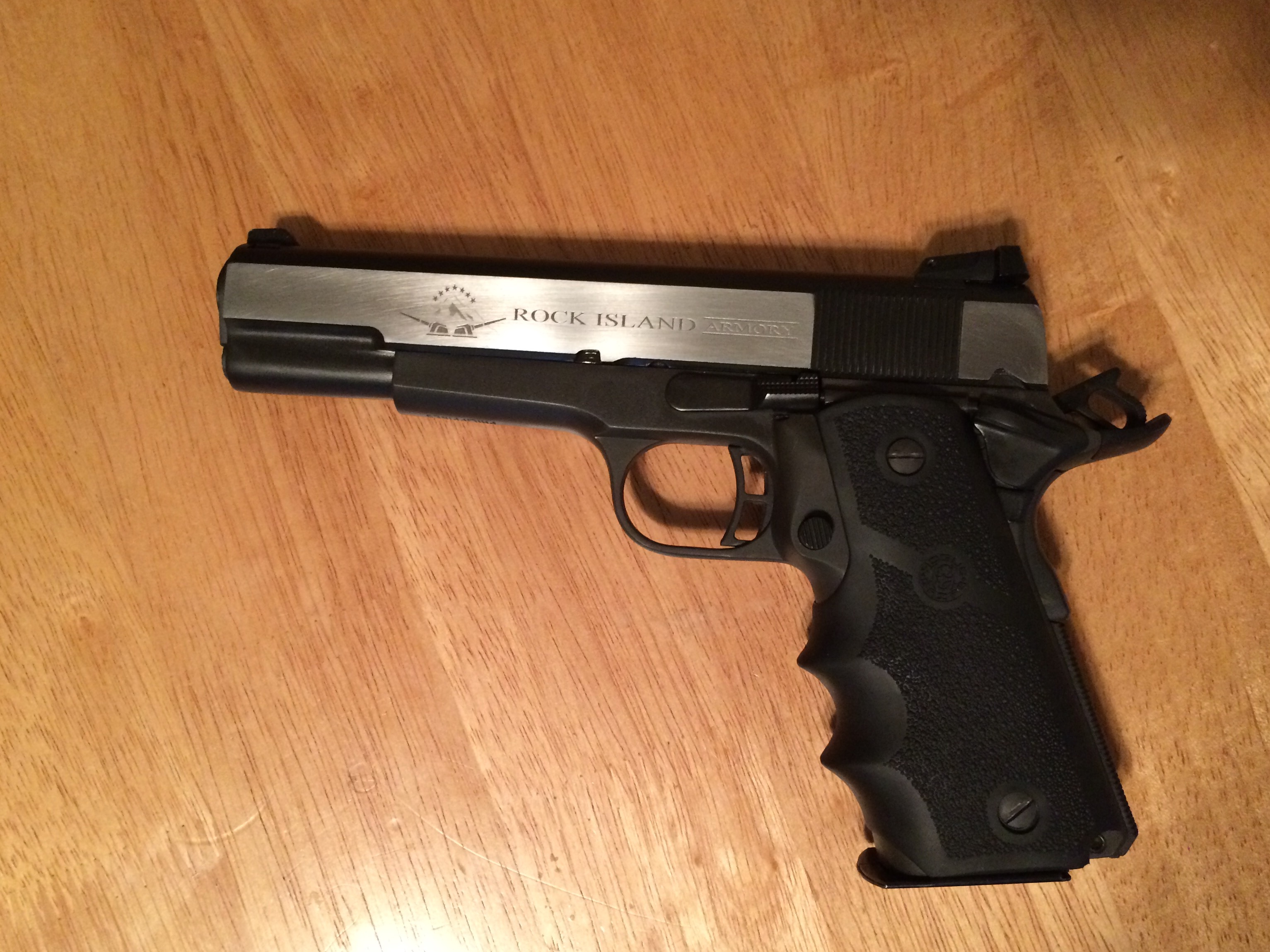
There are currently a few versions of the 1911 Fullsize for .22TCM, and a commander-sized “Midsize”, but they are exclusively manufactured by Armscor (as is the ammunition.) The idea is similar to that of the 5.7x28mm cartridge — a light, fast bullet that minimizes recoil, increases accuracy and armor penetration, and give a large magazine capacity. The .22TCM uses a 40 grain bullet moving at between 1900-2100fps with a muzzle energy between 312-375 ft lbs. (I chrono’ed the stuff I shot at 2050 average.)
The platform is a double stack (although there is a single stack available) 1911-style pistol. The quality of manufacture is very high, although the standard grips are awful (at least the ones with the finger groove, but some folks like those), and has an excellent trigger, which aids in the accuracy of the gun. The .22TCM and 9mm barrels can be swapped quickly, and gives the shooter the ability to use different ammo; the magazine used is the same 18-round double stack. There are reported issues with the last round of the magazine “jamming” because the slide stop engages early, but I had none of that in my original magazine. The new one I bought, however, did, and the culprit is the follower is not shaved appropriately. Ammunition availability for .22TCM can be problematic, but it’s plentiful online.
The handgun does not fit standard fitted 1911 holsters like the SERPA, etc.
PM: +1 S/R: 3 AMMO: 18 (17 in 9mm) DC: F (G in 9mm) CLOS: 0-7 LONG: 12-20 CON: +1 JAM: 99 DRAW: 0 RL: 1 COST: $700
GM Information: The .22TCM ammunition will reduce personal armor ratings by a DC step, but the DC against inanimate objects (cars, etc.) is reduced one. The barrels can be swapped in about a minute. The 9mm barrel does not give the armor bonus, nor does it lose DC against inanimate objects.
25 November, 2014
Character Idea: Hawkgirl
Posted by blackcampbell under Roleplaying Games | Tags: atomic robo rpg, hawkgirl, hollow earth expedition |Leave a Comment
 I was just spitballing a version of the Hawkgirl character that DC has been floating around in their Bombshell series. We have the classic redheaded tomboy in a flight suit, lace-up boots, and a winged rocketpack, with a hawkman helmet. It’s a great 30s/40s image and I thought I’d do a basic write up of a pulp-period aerobat.
First, in Atomic Robo‘s Fate-powered system:
HAWKGIRL
Concept Aspect: Rocket-Powered Aerobat; Omega Concept: Yearning for Adventure!
Stress: Mental – 3, Physical – 4
Pilot Mode +3: Contacts +4, Notice, +4, Vehicles +4; Aspect: Fly It Like I Stole It
Action Mode +2: Provoke +3; Aspect: Wingwalker
Banter Mode +1: Rapport +2, Will +2; Aspect: Sugar & Spice
Stunts: Barnstormer, Breakneck Ace, 2 more to be decided in play
…and then in Hollow Earth Expedition …
HAWKGIRL
Archetype: Adventuress Motivation: Escape
ATTRIBUTES: Body: 2, Dexterity: 3, Strength: 2, Charisma: 4, Intelligence: 2, Willpower: 3
SECONDARY ATTRIBUTES: Size: 0, Move: 5, Perception: 5, Initiative: 5, Defense: 5, Stun: 2, Health: 5, Style: 3
RESOURCES & TALENTS: Artifact 2 — Jetpack, Attractive, Evasive Action, Lucky, Mobile Attack
FLAWS: Impulsive, Overconfident
SKILLS: Acrobatics 4/7, Athletics 3/5, Brawl 2/4, Con 2/6, Diplomacy 1/5, Drive 2/5, Pilot, Air 3/6 (Jetpack 7), Ride 1/4, Stealth 2/5, Streetwise 1/5
Jetpack — Size: -1, Def: 4, Str: 5, Spd: 100, Han: -2, Crew: 1
24 November, 2014
Space: 1889 — An Alternate Take on Martians in Ubiquity System; Update!
Posted by blackcampbell under Roleplaying Games | Tags: chronicle city, exile games, space: 1889, ubiquity system |[5] Comments
One of the few things that disappointed me about the Space: 1889 rules that came out recently was the lack of addressing Martian physiology in the rulebook. So here’s something more in line with what I expected for the new Ubiquity-powered game:
MARTIANS
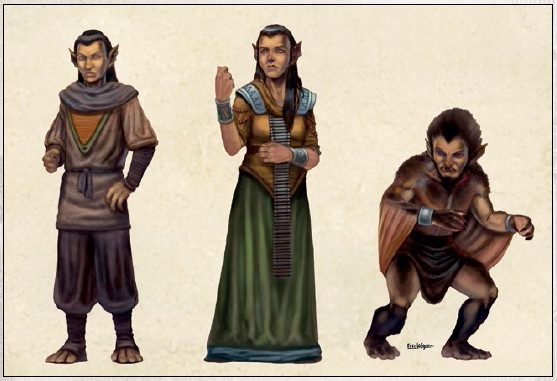
Hill, Canal, and High Martians — as portrayed in Chronicle City’s version
The denizens of Mars have three major racial types — the Hill Marian, found in the desolate wastes of the Red Planet; the Canal Martians, found almost exclusively in the urban and canal-fed areas of the world; and the High Martians — thought to either be the “Ur” Martian, or possibly a Hill Martians evolved to the particular environment of mountainous Mars.
Using some of the Beastmen advantages from Mysteries of the Hollow Earth (pg. 14-25), I slapped together Martian character templates that were more in keeping with the original flavor of the game:
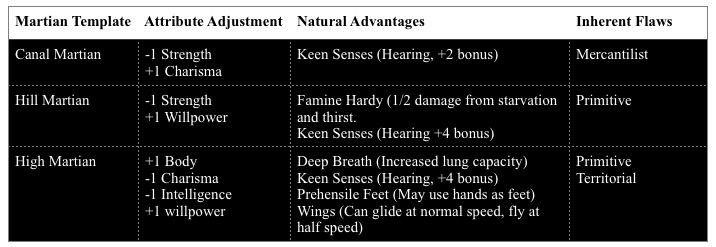
Venusians
Venusians aren’t set up as a player character in either any of the editions of Space: 1889, but I’m sure there are folks out there that might want to give them more to do in their campaign than be a poor man’s Sleestak. So here is a Template, vikked from Hollow Earth Expedition‘s Mysteries of the Hollow Earth to use to create a player character Venusian:

Update: Looks like the boys at Clockwork, over in Germany — the originators of the Ubiquity Space: 1889 noted this piece and are interested in incorporating it into future productions. Might lead to some more work, which would be nice.
22 November, 2014
RPG Blog Carnival, November 2014: On Races and Race in RPGs
Posted by blackcampbell under Roleplaying Games | Tags: race in rpgs, rpg blog carnival |Leave a Comment
 RACES is the subject for the RPG Blog Carnival this year — hosted by Roleplaying Tips — and having perused a few of the entries, all of the entrants seem to have kept to the the safe zone of “species”, really — how to treat having dwarves, and elves, etc. in you game, along with a few excellent posts on building culture of these other races/species. But no one really has touched on race…because it’s like to cause a shitstorm if you stray outside the comfortably politically correct lines set up by critical race theory halfwits of the endless [your group here] Studies in academia.
I’ve already covered this in another post, and I’m going to borrow from it for this one. Please forgive my self-plagiarism. How do you approach different species or races in a game can be varied — from the “we don’t see color” notions of Star Trek to more accurate portrayals of race in historical RPGs. The key here is simple — if the players want to play color-blind, 21st century-style characters in medieval Europe, they can. If they want to embrace a period-specific game, that is appropriate as long as the table agrees to keep any racism and sexism in game.
But Scott! Racism and sexism are never appropriate! I agree. Neither is slaughtering people with swords, halberds, guns, and lasers. Queue the Schwarzenegger line from True Lies, “But they were all bad!” So is killing everyone in your way in a game an indication of psychopathy in your players? The first rule of thumb, when dealing with touchy issue in a game is to realize everyone has different comfort levels. Establish the ground rules before you start the game, and adjust if someone can’t cope with how things are going around the table. The first rule of gaming applies here: Don’t be a jerk.
For future-based games, most “racism” will fall under the category of allegory for modern issues. The players are likely to be the Star Trek-like heroes that find the notion distasteful and will gladly treat every new species, no matter how awful or culturally bereft as something to be taught how to love their neighbor in 48 minutes plus commercials. Hell, Peter Quill slept with an Oscararian (But it was just that one time…) Species and race, here, are conflated and makes it easier to approach the idea of hating someone or thing because they are different. There’s socially-acceptable padding to addressing the issue, and this second-hand racism helps to create verisimilitude — a feeling of reality.
Let’s look at a popular game setting for this blog: Battlestar Galactica, where the Cylons are “toasters” and “skin jobs”, and are viewed as a hated and feared “other”, despite their very obvious human characteristics and desires. Equally, the Cylons view man as obsolete — or “backwards” in racial or Social Darwinist terms — but we overlook the blatant racism as just part and parcel of the “fun.” Even when the show got heavy handed with the moral equivalence, you could fall back on “these guys killed 30 billion people…we have a few zeros to go before the score is evened up.” Can you address this aspect of the setting without being racism yourself? Yes.
What about modern games, however? Is there still racism rampant in the world today? Um…yeah, and addressing it from time to time can create a sense of realism, but don’t beat your players over the head with it (or let them do the same to the others.) It should be appropriate to the genre and flavor of the game. Are you playing a Tarantino-esque crime gang? Then the constant flood of racial, gender, and sexual preference epithets might help to create a faux 1970s flavor that particular director goes for. No my thing, but to each his own.
What about spy-fi or some other modernish setting? Is it always the imperialistic, peckish white male seeking to subjugate and ritual rape their lesser man? (I’m not kidding…I listened to this shit for six years.) No. Having traveled pretty extensively and having a fair bit of understand of several non-western cultures — racism is pretty rampant around the world. Trying being anything other than a pure Japanese male in Japan. That white privilege doesn’t even enter into the equation. How about being black or Muslim in China? Oh, you like to pick the “difficult” setting in the game of life! You can use this particular element of the setting’s culture to create a sense of reality. But here’s the thing: We play role playing games because we want to be something, if only for a few hours in the safety of fantasy, extraordinary. The brave fighters, the canny wizard or hacker, the fighter pilot, the plucky thief, the social diva — whatever…we want something larger than life. If addressing race or sex, or gender is uncomfortable, leave it out. Outside of your group, no one is going to know your incredibly artful approach to the issue of [insert pet issue here.]
Keep that in mind for games set in periods before modern day. Maybe your fantasy setting is the usual milquetoast Tolkein retread with the numbers filed off — you can ignore race/color, or gender issues, if you like. You can add a female lesbian elf warrior (and many a teenage boy does…) and no one looks askance. However, if the need for verisimilitude in a setting is important for the audience (your players) buy-in, you might want to approach the issue of race or sex more directly.
Race relations were not exactly stellar prior to …well, ever. And being a woman before the first sexual revolution of the 1920s was not conducive to a life of high adventure or being treated as an equal. And what if you were poor? Not a lot of crofters had the option to race off and explore the world unless they were wearing army red. The societies of pre-industrial nations aren’t known for their open-minded stance on gender, race, or sexuality. Combine that with class issues and the thought of living pre-1920 should put most people off. So how do you handle this? Set the reality dial too high and you will exclude certain character types, and by extension, certain demographics of players.
First off, no matter how real it is for the NPCs, the players are special. There are always exceptions to the rule in history. Boudica was a warrior woman who wasn’t about to take crap from anyone, but lived in a world where women were second-class citizens in the Britain of the Roman Empire. Joan d’Arc was a peasant girl and maybe a lunatic, but she was an excellent general. Mary Read was a successful pirate you didn’t mess with. Jane Digby and Lola Montez were different stripes of female adventurer when is was not acceptable, they knew it, and played to their eccentricities — to the delight of those that knew them (and the hatred of those who did not.) Tom Molineaux was a successful boxer, despite being black, in the 1830s and was the toast of town, getting away with things that no other black man could. The Lafayette Escadrille had a black pilot who was treated the equal of the others he flew with. (Plenty of women and minorities found escape in early aviation and motorsports. they might be on the harder setting of the game of life, as John Scalzi would put it, but they still got away with things most colored folks and women couldn’t because cars, and motorcycles, and planes, and jazz music, and movies were new — and this novelty insulated them to some extent from traditional values.)
The players’ characters are the exceptions, the special ones…and you can use this to also address racism or sexism because their vaunted position in the game allows them more latitude. Giving your players realistic impediments can (and should) be frustrating, but they should be able to outsmart, outfight, or out-politic their foes. They should have detractors who decry their stepping out of place or take steps to ruin the character socially, but there should always be those folks that back them. It’s actually pretty realistic, historically.
When dealing with different cultures and races (or species) it’s important remember this one uncomfortable fact — stereotypes exist for a reason. They are society’s “macro” for dealing with the other, but they are not always accurate, and there are plenty to folks who break the type. You should build up the expectations the characters might have for a foreign culture — be it the wogs in Sardinia, or those penny-pinching dwarves under Frosty Mountain, or the sneaky Romulans…then smash the prejudice with examples that defy the stereotype, or portray it in a different light. Those Sardinians have a very similar outlook and culture to your Scottish highlanders, just with a prettier language and better looking women; those penny-pinching dwarves actually believe that your have an obligation not to impose on other people — the cheapness is fiscal frugality designed to make you less a burden on your family in your dotage; Romulans aren’t “sneaky”, but adapted to life in a police state — they’re home life is loving, tight-knit, and suspicious of outsiders for good reason. Kind of like those thieving pikies. By using the racial stereotypes, you can break them by diving into why those traits exist, and why they were viewed incorrectly.
Here are a few examples of how race or sex was using in some of my campaigns, over the years:
Example 1: I often ran Victorian sci-fi games until my recent spate of ’30s pulp and space opera games. One of the players chose to play aristocrats almost exclusively. Why? Because of the freedom that money and connection gave her characters to flaunt convention and get away with it. She played almost exclusively characters that were socially adept and attractive — the sort that thrived in the nooks and crannies of the Victorian period.
Example 2: A young Chinese street urchin, female, who was able — because she was young, a girl, and Chinese — hence invisible, right or wrong — was the perfect spy and go-between for the Western male characters in 1936 Shanghai. She was always in danger of physical or official abuse, was often hungry and dirty…but her utility allowed her to tag along on adventures and gained her respect by from the characters. But that didn’t stop one from calling her “My little monkey” — racist and awful? Yes. Fully appropriate for the period? Yes…and that was all it was, part of the character, not the player (who was in a biracial marriage at the time.)
Example 3: A black woman who had gone into prostitution in our Victorian game, but who managed to seduce the right men, gain some level of financial stability and notoriety, then launched on a series of adventures with the other characters who — being the exceptions to the rule — were at least tolerant of the character.
Example 4: A female Martian in a Space:1889 game got involved with an American cowboy wandering the Red Planet. Despite their string of high-profile adventures and relative acceptance by Martians, human religious types viewed their union as “bestiality.” This caused them troubles, and was very realistic for the period, but these issues were not insurmountable ones because they are the heroes.
18 November, 2014
Four Years On, a Review of the MacBook Air 13″ (Late 2010)
Posted by blackcampbell under Computers | Tags: macbook air 13", macbook air battery life |Leave a Comment
I don’t see a lot of these around the internet, but like cars and appliances, it’s nice to know what the longevity, etc. of an expensive piece of equipment is likely to be.
My then-girlfriend bought me my first MacBook Air in October 2010, four years ago, mostly because I had so loved my first iPad she thought I might appreciate the aesthetics of the device and the small size and weight — important at the time, as I pretty much went everywhere by motorcycle, and it would fit in my tank bag. Here’s the initial impressions of the computer.
So, four years on, how is it? The body is still solid, doesn’t creak, and still looks great — no scratches or blemishes to speak of. The display is still clear and bright, with no pixels burned out. I don’t have quite as much need for the size, as I either work at home, or when the kid’s in daycare, which means I’m in the “cage” (car), but it’s still the most comfortable computer to use that I’ve owned.
Once I got used to the Mac interface, I found it worked quite well, although they really need to work on their help references; when you run into issues, you often have to go online and hit the Apple support boards to find answers. The Air has had four or five friggin’ OS changes since I bought her, and I suspect Yosemite — the latest — is going to see the end of support for the pre-2012 machines. That’s perhaps the one issue with Apple — they don’t do backward compatibility for more than a five or six years, then you are on obsolete OS and tech (the original iPad that found it’s way to my little girl is now in that limbo — none of the app she has are upgradable, and it can handle the new iOS8.) However, I’ve met plenty of folks still pounding along on decade old MacBooks and happy to not have the latest and greatest.
To that end — with Mountain Lion, the Air started having issues with video and running up the fans on the computer. For the first few months I didn’t even know it had them; I never heard them. The video card just can’t handle the new Flash and H.265 streams without get seriously hot. Even web sites with Flash would also run the machine hot and drain the battery. Up until recently, I used Chrome for most of my web work, but recently found the newer version of Safari was faster and did a better job of keeping the various ads from killing battery life.
As they’ve moved out the various OS, I saw negligible improvement or reduction in performance, battery life, etc. I was lucky and had none of the bugs that hit some of the machines for wifi and other problems, so I can’t comment to those that did. Yosemite was a sharp improvement in the user experience: you can make and receive phone call without getting your lazy ass up to find your phone (if you have a newer iPhone on iOS8), do text messaging the same, and their productivity suite has mostly recovered from the gutting it got to make it talk to the iOS version better. All the iCloud stuff is nice, but I don’t use it because I’m too cheap to pay for space, and too security conscious to throw all my data out where people can get at it easily. (I still pull the SD card with my personal stuff when traveling. Screw you, TSA.)
The older CPU is more than ample to handle most of my daily chores — i can have as many as six docs open, a few tabs on Safari, iTunes playing something that is stored on the external drive and have nary a skip in performance, although when it comes, it’s inevitably iTunes that’s the culprit. Battery life at 300 cycles, four years in, is about 6-7 hours doing some writing, some web surfing, and the like. If I turn off the wifi, it jumps about 2 hours. The original 6700 mAh is now 6067mAh (90%)…that’s pretty friggin’ good for a four year old machine. None of my old laptops had a battery survive more than two years before they had to be replaced. With the curve these batteries have, I can anticipate another year to two before battery failure.
So if you are in the market for a MacBook Air and don’t want to pay premium prices for a new one, a used laptop looks to be a good buy; if you want a new one, you can expect to keep it for four to five years before it slides out of the support stream…and even them should be usable. That’s only rivaled by my original Compaq from the late ’90s, and the 10″ Dell Inspiron I knew was still running like a top at six years old when I saw it last. (Sold it.)
 The Black Campbell