So, I got an opportunity at the local Meetup group in Albuquerque to play Firefly with one of the system leads, Mark Truman. I was interested to see if someone with familiarity in the game would run it dramatically differently than I had, and whether my opinions regarding the game would change. We ran through one of the canned adventures from MWP, and he had obviously run the game a few times. It was well tailored to the selection of characters we had. The experience as a player was much easier than that of GM for the game. I found I was having a good time (as I did running the game), but was able to focus on the mechanics and how they played because I only had to focus on one character. (I played Zoe.)

So how did it play? I thought the players dove in well and utilized the rules much more enthusiastically than my group had. This is a typical experience for one-shots and convention games, I’ve found. The simplified character attributes and skills (as compared to Serenity) worked well for the pacing, and the distinctions allowed for some good mechanical advantages for the dice pools. As the night went on, especially in the main action piece, the dice pools ballooned and were hard to keep track of as assets and complications were created. At one point we had over a dozen stickies with notes on the table to keep track of the action. In the hands of a gamemaster with experience in running the game, it seemed to flow no better or worse than it had for me.

So in the end, what is the verdict as a player, rather than a GM? One — it’s still a good game, and I think the rules could be adapted very very well to other settings (Star Trek or Star Wars particularly!) Two — the assets and complications quickly get out of hand, even if players are spending plot point to step them back. Three — the asset/complication mechanic seems is supposed to enhance player contribution to the narrative, but I found it hampered the gamemaster while only allowing a little extra power to the players. How? I noticed that the asset or complications on the table felt, often, like they had to be taken into a account…whether that was the case or not, the sticky was there, crying to be used. Four — the assets and complications, and the plot points, are much, much more manageable than they were in Marvel Heroic Roleplaying.

The final verdict: Firefly is a good game that is potentially a great one for new players. There are still a lot of moving parts to the game at times, and I think that could swamp a new gamemaster. It’s a buy.

[p.s. A lot of people are getting frustrated (myself included) by the constant delays in the release. This seems to be tied to coordinating all the publishing nonsense that goes with a simultaneous international release — copyrights, shipping, yadda yadda…]

This post is going to have double purpose: To address the issues of player agency and narrative control, and to tie into a short review (as a player) of the new Firefly system.

This weekend, I got a chance to play in a game of Firefly by Margaret Weis Productions run by one of the systems leads, Mark Truman, for the game. I figured it might be interesting to see if the experience of the game would be different, and if my opinions of the game would be changed by it. Along the way, there were some interesting chances to speak with the others at the table.

Mr. Truman had had a chance to peruse the previous review, and we talked about the experience of the game as I (and others) saw it. One of my comments was that the assets and complications mechanic, as in Fate, was overly complex and could lead to some confusion for the players and the GM. The assumption seemed to that I didn’t understand the mechanic, which was incorrect — I did, and even saw use in it — or that my lack of skill with the system was coloring my perception of the game. This response, I thought, harkened back to some of the issues of the Is there a right way to Game? post from a few weeks ago, and brought up some interesting questions for me:

1) Is the skill or familiarity with a system intrinsically linked to perceiving a game as good or bad? Is it a case of “It’s not the game that sucks; you’re playing it wrong”? That was certainly the implication I inferred. (Which means I could have completely misread the statement — so consider that my “I could be full of shit” caveat.) 

2) By this metric, if you are very skilled with a set of rules does that make a game “good?”

 3) Is your skill at pretending to be a character tied to an understanding of the rules? Are are skill, familiarity, and preference linked, or is this a case of correlation not being causation?

4) Is your prefreence for one system over another based on a lack of proficiency with the system?

I’m going to start with the last point first: absolutely. I’ve known plenty of gamers for whom if the rules are not GURPS, OGL d20, or Fate, they’re not playin’. (Says the guy bitterly clinging to a half dozen defunct games…) Most of these guys have also been playing the same games for years. For these people, it is familiarity that produces preference, but what about people who do venture forth and try new games? — which I have advocated in the past.

I would suggest that for these intrepid gamers, preference comes from two factors: ease of play or learning curve, and from how well a game models the genre or the setting. Ease of play usually ties to the simplicity of the core mechanic. The traditional attribute+skill (+asset or other factor) beating a target number has been pretty standard for at least 20 years. Before that, in early D&D, it was as simple as roll a d20 and get under the number for your trait (strength, etc…) The learning curve was relatively slight, with a bit of a rise when you hit combat or magic. Add a ton of math into character creation or into managing modifiers to a roll was a good way to lose a player’s interest — although GURPS and early Champions still had plenty of adherents.

More importantly, especially with the wave of newer system designs in the 1990s, were games tailored more toward role playing rather than tactical gaming with role playing rules tacked onto them (have a look at your favorite game — if the chapter on combat is twice the size as the core mechanics, we’re talking about you…) White Wolf, Call of Chthulu, Castle Falkenstein, Fudge (later Fate) were relatively simple to learn, gave the players more say in character design than race, class, etc; and oriented toward pushing story, rather than wargames with characters. This required the games to also adhere to genre convention well.

What does this have to do with preference? There are games that have lived a long and healthy life after they went out of print. Some of those were settings that would be recreated in newer games. Case in point: Why play Last Unicorm or Decipher Star Trek when FASA already did it in the 1980s. (And there are die-hard FASA fans that will not consider doing that…) LUG Trek managed to do a good job of modeling the universe of the various Star Trek television shows, and was a lot easier to learn than FASA’s version. Decipher took a lot of the LUG ideas, thought about cramming it into OGL d20, then relented and gave a bastardized version of LUG Trek that did a good job of handling all of the series (LUG had series specific core books!), but lost some of the ease of the prior set of rules. Still I jumped to Decipher…why? The core rules were easy and the game captured the feel of Trek pretty well.

Why use Spycraft when there’s Top Secret or James Bond: 007? Why buy Victoriana when there’s Castle Falkenstein? Why buy anything else when there’s GURPS? Because the new game captures the flavor of the genre you are playing in. 

If familiarity or skill with a system were so intrinsic to preference, why would people branch out? Can you look at your favorite game for a certain genre and say “this would be better, but I like this better”? I’ll start it off — Classic Cortex would probably work just as well, if not better, for espionage games such as James Bond. But JB:007 helps emulate the world of the movies better than Cortex’s mechanics would, despite being more complex. Preference here is due to familiarity, but it does not create in me the impression that other systems are not good…for this, JB:007 just does it better. Firefly does a decent job of capturing the show, but would be better at modeling Star Trek. Take that FASA guys!

Which starts to deal with point the third: Is your skill at pretending to be a character tied to an understanding of the rules? Can a player role play well enough that the rules are incidental. After 30+ year of doing this, that’s an unequivocal YES. In other words — there’s no way to play wrong. Your “skill” as a player, nor your enjoyment of a game, is necessarily hinged on the mechanics. However, there is a way to design a game that will not play well for certain expectations. Those expectations are not wrong, nor is a preference for, say, how mechanics divvy up narrative responsibility (for instance, strong v weak GM.) Those expectations can help someone understand if running a certain system or playing with those rules is more preferable than another set of rules. (Again, see A/B test of the Firefly/Serenity rules and the “Is There a Right Way to Game?” posts.)

My response to this is — familiarity or proficiency with a system for a GM or players can make the game easier or more fun — but ultimately, the mechanics rarely make a game more fun…but they can dash it very quickly. A couple of case studies that will also play to point 2: 

Call of Chthulu is a fairly easy set of mechanics to learn, and I understood how they drove the game perfectly well. The guy running the game blew goats, so my opinion of the game has been badly tainted. I understand this preference was based on a single outlier and I have been open to trying it again…but there’s usually something I’d much rather play than a game where the point (seems to be) to see how you go mad and die. That’s not the game’s fault and Truman’s statement about GM skill is spot on here, but it also wasn’t aided by the fact I find Lovecraft-style horror unengaging — that that more taints the perception of the game and has nothing to do with familiarity of the system or the universe; a good GM could make me invest in the universe…but horror is hard to do.

Example 2: I ran Chameleon Eclectic’s version of the Babylon 5 universe for years. It has an easy base mechanic — a minus die and a plus die with the result (anywhere from a -5 to a +5) added to the skill. The combat system was a hot mess, except! I understood what it was modeling, so it made sense to me. It captured how a small injury could be instantly debilitating or not, and how a vicious injury could be leading to your very imminent demise, but not slow you down. Because I got it, I ran it well and the players quickly got a hold of the base mechanic and left the combat stuff to me to adjudicate. The rules set sucked, but because the “skill” of the GM was high, the game ran well and was, in Truman’s terms, a good game. That is wrong, however — the players and GM were good enough to rise above the limitations of a bad rules set.

Likewise, I ran Space: 1889 for years and was very familiar with it, but the limitations of the mechanics from a probability standpoint were glaringly, painfully obvious. We swapped to the Castle Falkenstein rules despite terrible combat rules (which we figured out were bad even before trying them out, but try we did.several times…) Was this due to a lack of expertise in running it? Perhaps, but they also did not model swashbuckling adventure well. We kit-bashed a version of the Lace & Steel combat rules (also a card-based game) that captured the fun of sword and fisticuffs play so well that, in one of those rare instances, they made play more fun. Players sometimes eschewed the ease gunplay for the fun of clashing blades. The new rules were not “familiar”, either, and evolved a bit over the course of play…but they accelerated the pace of fights and made it more competitive. So yes, the mechanics can aid play…but after 30 years of doing this, I can safely say it’s a rarity. Space: 1889 has a phenomenal setting that is so good game designers have started pasting it into other rules — Savage Worlds and Ubiquity. Castle Falkenstein’s steampunk meets fantasy was equally engaging but the core mechanics could not survive quirky side rules mechanics for sorcery and fighting. Again…great setting, crappy GAME.

At heart, I think the argument is between whether you think rules should help engage the players, or you players should engage with the rules. Newer indie games seem to be trying to find new ways to do the first — having the mechanics engage the players in some way by having them take part in the storytelling process. This, coupled with a recent trend of game designers wanting to view RPGs as “art” (James Franco agrees!) or “socially relevant”, leads to games more interested in the mechanics as art. They absolutely want the people playing the game to have fun, but their perception of what the fun part is, and how it is achieved might not quite jive with what their audience wants.

I would describe it this way: If you know how to tell a story, and the players are invested in theur characters and the setting, the mechanics can only hinder you. Rules light systems can capture that quite well, but in the end, good role playing and understanding the mechanics are mutually exclusive to having fun or good game rules. Familiarity can cause a better perception of the rules, but not all new games we play “suck” until we get better at them. Sometimes the mechanics enhance play, sometimes they simply disappear, and sometimes they curtail play. 

Sometimes, the game does just suck.

Am I so in.

While this is not as much an issue with a lot of fantasy games, where the players are off exploring or doing whatever in a wilderness setting, modern and science fiction games — particularly where the players’ characters are part of a larger organization — can have an issue where players are quick to either slough off the danger or responsibility on NPCs.

Having characters tap their contacts, allies, or superiors for help occasionally is a good thing — it gives them a chance to interact with their organization, which makes it more real, but also more comforting; it also gives the GM the opportunity to use a deus ex machina at the behest of the players without it seeming too pat. But once a team starts calling on aid too often, it’s likely to bring their competency into question by the powers that be. Here are a few instances of how calling the office for help can be used, and a few ideas for controlling over-dependence on the NPCs for help:

They’re Turning My Car Into Swiss Cheese! I Need Backup Now! Now, goddammit!

There are times the players are going to be in too deep. That’s part of the challenge. And sometimes, they’re going to need help. If that help is “cinematically appropriate” or something likely to happen, go for it.

David One-Four, officer needs assistance! In a game where the players are a police officer, a federal agent, a soldier on the battlefield, calling for help is sometimes just a radio call away. Say your team walks into the largest drug deal in history (’til the next one), and you are out-gunned and pinned down. Calling for assistance is certainly reasonable, and hopefully will even get there in time.

In a system with rules for contacts, or getting favors, etc. this might help manage response time to a call for help. Otherwise, it’s always good to keep the players right on the edge of their seat, then bail them out at the last minute. This doesn’t mean they don’t have to chase the big bad guy through [appropriate action set piece] to catch him, it just means the mooks that have been making life a bit too hard are distracted or dispatched by the backup.

Longhorn, Devil Niner — I need a fire order at the following grid… In a military-themed game, this might scale to something like calling in a fire order from artillery or an air strike. (Come on…you know you want to…) It’s a way to make things hard enough on the players to be very challenging, yet give them a pathway to success if they can’t handle it on their own.

In a spy game, calling for help is the last thing you want to do unless you have to…

But say they call for help a bit too often, or turn to the NPCs the moment there’s any opposition. How do you handle that?

David One-Four, backup dispatched. Estimate 15 minutes… A good one is time constraints. Backup is too far away, or your division is too jammed up, or maybe that self-righteous spat in the locker room with another detective got you the Serpico treatment. Either way, no one’s showing until the music is long over…

Say again, Devil Niner? Another is comms trouble. How many times has your cell phone dropped a call for no reason at all? Radio frequencies get stepped on by other transmissions, or buildings mask the signal. Maybe that new guy didn’t programs the PLGR for the radio before you left the FOB. Or that planet you landed on plays havoc with your communicator. For whatever reason, you can’t get a call through. You can leave them hanging for longer than they’d like, or leave them to twist. Another good variant is the message is garbled enough that you get a worse result…like when your artillery starts raining fire on you.

For an espionage game, any communication with the home office is a chance for either interception of your calls, the bad guys locating you or sending someone as “help”, but actually to stop you. Worse, your organization could get nervous about the outcome of your little op that wasn’t quite sanctioned in that particular country and your are suddenly deniable. No help. Find your own extraction. Hope to see you again. If they don’t just burn you, or send someone to clean up your mess…including you.

Reduction in rank or responsibility is a very real penalty in all of these situations, especially if it’s obvious that the players were shirking their duties.

…Requesting Further Instruction!

In most game scenarios, we can assume that — unless being in the dark was part of the challenge — the players got some kind of mission briefing, or have some kind of rules of engagement. There’ a goal and parameters to work inside. But sometimes, you get overtaken by events and need some clarification:

Yamato, We’ve encountered a possible new lifeform… Sometimes, you were just to darned clever  for the players (or were unprepared and haven’t explained things particularly well) and they need help. Letting them tap that expert in exobiology, or criminal law, or calling a language expert back in Ft. Meade, or some other subject matter expert can help get a story back on the rails.

Big Bear, Duchess: Flash mission update! Another scenario where calling for further instruction from the hierarchy might be when the players discover some element of the plot that the bosses might need to know, or something has happened that would cause you to exceed your orders. Say that convoy of weapons you were supposed to stop managed to get past you with some super weapon or crossed a border into a country denied to you. Do you go in? Do you call for permission?

Superintendent, you won’t believe where the money trail leads to… Maybe that criminal investigation got a lot more interesting than you expected. Following the money, you’ve started turning up people of power — the sort that can shut your op down if they get word, or which you simply won’t be allowed to go after unless you can get cover from the higher-ups. This is an appropriate time to check in with the powers-that-be. Remember that golden rule of politics…don’t surprise your bosses.

Sometimes, however, the players are looking for a gimme…at times like that, it’s time to use the magical power of bureaucratic sloth or expectation against the players:

If you can’t handle it, Lieutenant, I’ll find someone who can! Say your mission was to beam down to a planet and observe a lesser advanced species of aliens without revealing yourself. Calling the ship to ask the science officer or captain for instructions every time you get stumped might see you recalled in favor of a “more competent officer.”

You’re on the ground, Devil Niner, not me! You’ve stumbled onto the enemy in a place they’re not supposed to be and the rest of the force is otherwise engaged…it’s you, or it’s nobody. What’re you going to do, sergeant? Let your force get flanked?

I’m not putting myself on the chopping block… Never underestimate the power of covering your own ass. Maybe your investigation is likely to embarrass someone to powerful to get to. The heat hasn’t even started to come down, but your boss isn’t going to stick his neck out for the chop this close to his pension. All that work — great stuff and you’ll get a commendation, but now it’s over…just let me know where you don’t want to go in the department so I can get you where you (don’t) want to go.

Do you know how expensive it is to retask a satellite!?!  Another given, bureaucracies don’t like to commit resources they don’t have to. Maybe you need a satellite retasked — nope! Maybe you want a mini-sub to infiltrate an area, but the navy isn’t playing along. Oh, you want an Aston Martin, Mr. Bond — you know how many £150,000 automobiles you’ve destroyed this quarter? Here’s a Vauxhall.

This is one of those things where the GM has to be aware of how often and how quickly the players resort to calling for aid or instruction when they are stumped.


One of the things that nearly all role playing games have in common is some form of “advancement” — experience points, advancement points, milestones; a point where the characters’ journeys and experiences lead to them getting better at certain things.

The oldest form of this was “leveling up” in Dungeons & Dragons — you would hit a certain number of experience points and would suddenly be better at fighing, have more spells to cast, gain hit points (get tougher), etc. It happens boop! just like that. You would gain XP for the events of a session based on the monsters opposed and other story aspects. Realistic? No — but it set the stage for RPGs, both tabletop and electronic, to come.

Other games came along that broke the experience/session pattern — James Bond: 007, for instance, gave you experience at the end of a mission, rather than per session. Marvel Heroic Roleplaying has a very nice system based on playing to the milestones you set for your character. As you address them, you gain points, rather than for the villain of the week you beat up. (I have a real soft spot for this mechanic!)

What is the best way to handle experience? This is usually where I should get wishy-washy and say “what works best for your campaign”, but after a few decades of doing this, i feel confident about this one: experience points (or whatever you call them), should be given at the end of a specific adventure or chapter in the same, unless there was some specific thing in the session that would have led to gaining or improving a skill. (Montage!)

Characters shouldn’t just jump in abilities after the equivalent of a day or two wandering in a dungeon, or fighting for a few days on the beach at Normandy. It takes time to process mental skills, it takes longer to hone physical prowess in something, and the better you are, the harder it is to improve that little bit more. (Just ask an Olympian…) I wouldn’t suggest just rolling this out on your game group without talking the reasoning through with them. you might get lynched. But here’s my reasoning:

1) Over the course of a session representing a day or more, a player should be able to learn one new skill at a very basic level. (If you want to give them advancement/session.) Didn’t you just say the very opposite thing a second ago? Not quite…okay, I did,

It’s really easy to learn a new skill at a truly basic level. One trip out to a firing range, and most people can get from not knowing how to work a firearm to being able to hit center mass(ish) most of the time. You can learn to ride a motorcycle or drive stick with a few hours practice. You’re not good at it, but you can do it. You can learn a couple of phrases of a new language, or start to parse bits of a language similar to one you are good with. You might have picked up just enough information to actually be dangerous to yourself, in that you might not be up to the difficulty of an ordinary task with the skill.

2) Most real development for the characters takes place in the spaces between the big moments. Sure, you kicked the snot out of those Imperial TIE fighters…but what did you learn? Most fighter pilots learn from their mistakes and successes during after action reports where they study gunsite footage and analyse what worked and why. This is why I say most points should be given at the end of a major chapter or adventure of a campaign.

3) One way to handle learning basic skills when you don’t have points is to go into “point debt.” I will allow characters who use a new skill well enough to learn the basics to take the skill on loan. s soon as they have the experience to cover it, they pay.

For more advanced skills, suggesting to your world-trotting archeologist could learn the various languages at his Linguistics skill (or whatever) if he has a certain length of time, then give him a discount on the cost of improving the language skill if he waits that length of time to buy it.

But what about…?

The improvement of skills, hit points, and the like is not the only sort of advancement players see. As they move through the game’s campaign, they might see themselves amass power or wealth. These benefits often come with responsibilities or other consequences. If your 20th level fighter has not carved his own petty kingdom, Conan-like, from the power structure of your fantasy world, how much of his time is now taken up with satisfying the needs of his people? What about that aqueduct they need? How about filling that granary for the winter? Whaddya mean my treasurer absconded with the kingdom’s cash? How does he account for justice? If he is a hard tyrant, how long before there is an usurper? Might that be his own friends?

This is a type of advancement that comes from role playing, and which could be tied to “leveling up” (“Hey, you’re a 13th level science officer now — you get your promotion to lieutenant commander!”) or through role playing. Recently, a player character that started as a raw lieutenant junior in our Galactica campaign got a surprise promotion to captain and squadron leader. (Ah…attrition!) We’re only just starting to touch on how this new responsibility is alienating from her old friends…she’s the boss now. She hasn’t found out, yet, that just doing things your own way when you are responsible for 8-10 vipers and pilots isn’t an option. She’s also under more scrutiny from the command, and who wants to lose a promotion? Pressure!

In a police game, maybe you finally get to run an op yourself. All eyes on you, tiger; don’t screw it up, or we’ll ask you where you don’t want to get assigned next. A private eye might have a few high-profile cases, and now has too much work. You hire a few more dicks, but are you pounding the streets or are you supervising Manny, Moe, and Jack half the time..?

By dropping responsibility on top of the characters, as well as position, you can help create challenges they can’t just swing their +5 Vorpal sword through to solve.

Then there’s the ultimate advancement…retirement (or death.) What is the consequence of a hero, king, whatever stepping away from his position? Do they just fade into obscurity, as General MacArthur said? Would it have been more appropriate for James T Kirk to have died ignominiously slipping in the shower? (Bones: “He was right…he did die alone.”) Or is it better to get dragged back into one last mission/case/fight? (“You did not just say that!”)

Advancement can be so much more than just handing out experience points.

So I’m over on one of the Facebook RPG groups and read an intro to a post that made me eye roll:

All the other stuff aside, Wizards of the Coast get a lot of extra credit from me for including the following text from the Basic Rules set:
_________________

“You don’t need to be confined to binary notions of sex and gender. The elf god Corellon Larethian is often seen as androgynous or hermaphroditic, for example, and some elves in the multiverse are made in Corellon’s image. You could also play a female character who presents herself as a man, a man who feels trapped in a female body, or a bearded female dwarf who hates being mistaken for a male. Likewise, your character’s sexual orientation is yours to decide.”
_________________

Brilliant.

Now, don’t get me wrong — I don’t particularly care about people sexuality unless we’re having an intimate moment together; outside of that, it’s none of my business. We’ve had bisexuals, homosexuals, and one transvestite that was a bit of an odd character (and not because he dressed as a woman), as well as a stripper who wanted to play in the nude…much odder — doesn’t bother me. In game, there’s been plenty of sexual issues and non-standard characters.

But especially after the “Don’t let you parent enforce gender binaries” bullshit on the slide at my kids park — a park for 3-5 year olds — I’ve had my fill of Progressive reformist nonsense.

My response was my usual snarky, sarcastic self. “Can’t we just play without somebody bringing gender politics into everything?”

At this point, I apparently did the internet version of shit on their dinner table.

The immediate response is the classic example of reformist twats at their worst:

No we can’t.
Not when oppression and objectification still exists within the greater community of roleplaying.

And if you can’t understand that you’re part of the problem.

Oooo…sick burn, man. I hope you can fit all that self-importance through your bedroom door, or you’ll be in real danger of disappointing that lesbian transexual woman with a taste for making her male subs watch.

Now for the less asshole-ish response: 1) Oppression? If you feel you are being oppressed by your gaming group — you’re in the wrong fuckin’ game group. 2) Objectification? Listen, ladies, if the men are treating you like a sexual object, or just the “girl at the game”…you’re in the wrong fuckin’ game group.

I had a related issue with group way back in the ’90s where all the players were treating the female at the table like their “kid sister” (their view point), when they were actually treating her like some doll to be joked over and ignored (my POV.) I made a point of teaming up with her character and forcing the guys to take her seriously. It worked.

No whining about gender norms. No filing lawsuits. No puffing out my chest in righteous indignation about how much of a feminist I was. Just play and treat everyone the same. (“Just like shit…” LCDR Richard Marcinko.)

And if I can understand that, if makes you a bit of a pretentious prat, Mr. Angry About the Latest Trendy to be Angry About.

But wait! There’s more from the guy that started the thread:

Because sex and gender is pivotal to the human condition. We play ROLE playing games, and those include many different lifestyles and cultures. That’s why.

Wow — I got told, huh? Back to Mr. Angry About the Latest Trendy Thing to be Angry About:

Go play with your game group if you want to escape reality, or a singleplayer videogame.

The internet (and this community) is made up of people from reality, so that whole argument is moot.
And as a society/community we wish to include/cater to people of all genders/sexualities. Just because you don’t want to acknowledge their presence whilst you play your game doesn’t mean we shouldn’t see it as an issue that should be tackled (and is starting to be by WotC).

As Spock so aptly put it “the needs of the many outweigh the needs of the few”, and we all NEED to accept/acknowledge our NB compatriots.

Did you just, in the space of saying you’re “from reality” quote Spock at me? Better yet, you use a quote that actually runs contrary to the very thing you are bitching about: a small subculture — the few — wants to be treated normally by the main culture, or the many (or peckish white patriarchy, if it’ll make you feel more accepted), then make a point of being as contentious as they can on the issue…only to be shocked when the many don’t rally to the cause of the few.

But that’s “gender binaries” for you. Darned breeders.

Here’s a notion you might not have considered, Mr. AATLTTBAA. I don’t have to accept or acknowledge your lifestyle, because I’m not affected by it. Because I am a decent fellow, I do feel I have to tolerate you and treat you like i do most people. To a point. That point is when you make an ass out of yourself. (Which I was declared to be doing for not reflexively applauding WOTC for their “inclusiveness.”) Accept you? Nope, I don’t have to do that. And I’m less like to do so when you are a posturing tit.

Now considering Dungeons & Dragons is marketed to teens, I can see where WOTC wants to be warm and cuddly, but there is a question of appropriateness. There are kids that are not yet sexualized reading the book. There are kids who are in the early stages of puberty and most don’t need confusing concepts tossed at them.

Mr. AATLTTTBAA again:

I don’t see how teaching children about the spectrum and lifestyle choices could be inappropriate.

I’m guessing because you don’t have kids. Granted, Progressives slinging gender around as a political mace don’t see problems with sex education for kindergarteners, either…but then, the reformist impulse Progressivism inherited from the new religiosity of the Second Great Awakening is only concerned with being right. Whether an argument over slavery, gender, or forcing people to stop drinking or doing narcotics, or disarming the public — they just want to win the argument.

A perfect case to illustrate this is a close relative of mine who has had trouble with every PTA, library board, Democrat Party committee, local government board they’ve been on. Recently, this person was staggered that the library board could not move on an obvious issue — that front desk the library has had since I can remember. This person decides a new one is needed, but the board takes no action. “My son-in-law can build it for cheap!” They still are not convinced. My wife asks the relative after hearing this, “Did you ask them if they needed a new desk?”

“Well, no…but they need a new desk.”

The desires (not needs) of the few probably have no impact on the “going about my life” of the many.

WOTC took the opposite approach to a vocal portion of the gaming community who apparently define themselves primarily by their sexuality or gender, and who demand that we acknowledge them. The paragraph isn’t particularly offensive, so much as it is tiresome after 10 years of listening to half-witted academics talk about “gender binaries” like the universe (or most folks just trying to feed their families) gives a shit we don’t like our sexual choices. But like my relative, squeezing your opinion on the latest trendy “issue” into every place you can, regardless of whether it is wanted or appropriate, is unlikely to win you traction from anyone but your own subculture. (As if gaming weren’t a small enough one…)

SIG-Sauer MPX

SIG-Sauer enters the submachinegun field with the new MPX. The weapon comes in several configurations, from a Kurz (or short) personal defense weapon, to a full size carbine. There is a suppressed version, the MPX-S, as well. It is typically chambered for 9mm, but can be had in .40S&W and .357 SIG. The stats below are for the MPX-K, MPX-S, and carbine versions:
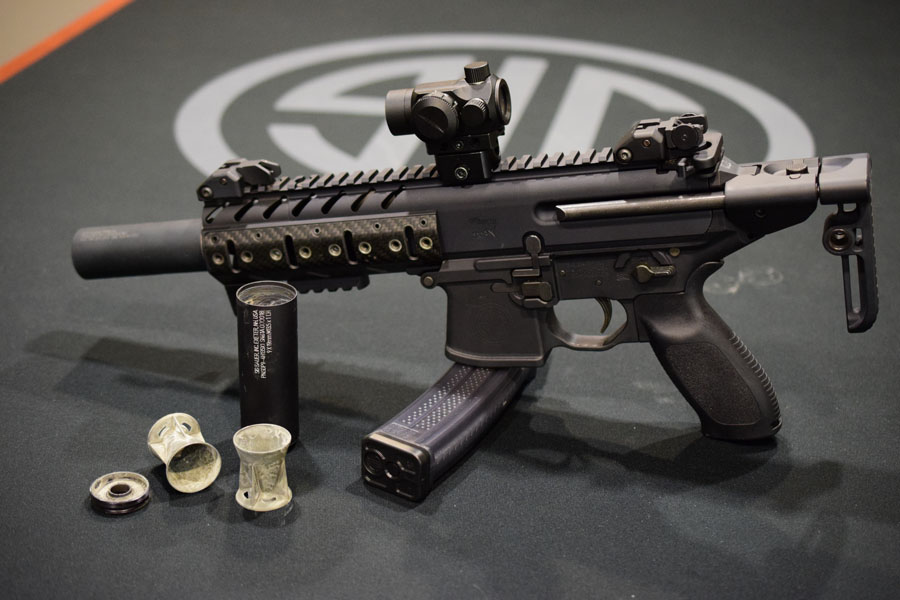
MPX_NEED

PM: 0   S/R: 2/6   AMMO: 30   DC: F/H   LONG: 0-10   CLOS: 30-50   CON: +4   JAM: 98+   DR: -2   RL: 2   COST: $3000

IMG_3771

PM: +1   S/R: 2/6   AMMO: 30   DC: F/H   LONG: 0-10   CLOS: 40-60   CON: n/a   JAM: 98+   DR: -2   RL: 2   COST: $2500

1368429409

PM: +1   S/R: 2/6   AMMO: 30   DC: G/I   LONG: 0-15   CLOS: 45-80   CON: n/a   JAM: 98+   DR: -3   RL: 2   COST: $3000

This post came about from my thoughts on the graph in Runeslinger’s Spectrum of Play  article, as well as his Right Way to Game posts. The first has been reblogged here on The Black Campbell, but you can pop over to his Casting Shadows page to read more. His YouTube channel is probably even more useful.

There’s a lot of thought and opinion spilled into the series of tubes on how to play role playing games. The main point of contention is between those who like a game with a defined plot versus the “sandbox”, or a style of play in which the environment and the players’ actions (hopefully) give rise to some kind of adventure.

…we each will have our favorite ways to go about [gaming], and among the voices talking about them there may be some strident calls for one way over an other…The next step was to address the nature of the play environment itself with a look at the concepts of the sandbox and the defined narrative

The quote is from Anthony Boyd (or Runeslinger), over at Casting Shadows. He has cobbled together a rather elegant continuum of play styles that address this argument. He separates the issue into matters of player agency — how much effect the player has on the narrative and outcome of a game; and defined story spectrum. I found the chart instructive in that if well describes how the the power  relationships of a role playing game between players and a game master/storyteller/etc.. or between players, is dependent on how well defined the story is. 
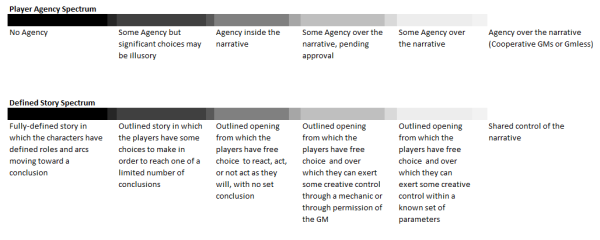
Spectrum1

I found this chart particularly pertinent after my recent post on a comparison test of the Firefly (Cortex) and Serenity (Cortex Plus) rules from Margaret Weis Production. In that test, we found that aspects of the system designed to spread narrative control, while fun, seemed to hamper the coherency of the story. 

He points out that …we like what we like, and given choice, we tend to pick our favorite options over the rest… Some new game may draw us in with its setting, but push us in a new or formerly avoided direction with its mechanics…” This was certainly part of the issue the gaming group had with Firefly — we’ve run Cortex for quite some time and have found it (mostly) to be an excellent set of rules for creating nuanced characters and handling most scenarios for an adventure. When it falls down, though, it tends to do it hard. One of those genres it did not handle well was superheroes. Marvel Heroic Roleplaying may have been a busy system with a lot of moving parts, but it emulated the flavor of comic books near perfectly. Firefly we all wanted to like…but we like what we like, and in this case, for not over the top science fiction, we like Cortex (the Battlestar Galactica or Cortex 1.1 version.)

But why was that the case? Partly it was a preference in most of the group for stories that have some kind of defined plotline to an episode and the campaign overall, while still allowing for character action to sharply change the outcome of the same. Firefly — like Fate and many of the new wannabe-artsy “indie” games — does that, but the ability of the players to set complications and assets added new visions of the plot that aren’t necessarily well-meshed with what has been ongoing.

To use a cinema or television analogy, you have too many writers in the writers’ room and not a strong enough head writer or executive producer to contain their disparate visions of the story or universe. All those shows that “jumped the shark” by wandering off course badly; nearly ever movie you’ve seen where you leave saying “it was so close to good!” is the result of multiple writing teams working to please a different audience in the production or direction staff of the show or movie. (Case in point: Spaight’s excellent draft for what would be Prometheus versus the disaster of Lindelof’s final script, coupled with Scott’s last minute changes.) Too many cooks, as the expression goes, spoils the soup.

In the chart above are two bands of specific points along a spectrum of implementation options ranging from ‘none’ to ‘total.’ I believe if you let your eyes roam across these bands, it should be pretty easy to spot roughly where your basic preferences lie. With a little effort, it should also be possible to spot where specific games require you to be to run them as intended. This might be useful in assessing if a game will be suitable for your group, or if an idea you have for a game will flow like you want within its confines, but I feel it has better uses yet. From my  perspective, it might offer a hint as to why a given campaign or group is or isn’t working for you, but will really shine when used to help add a new kind of scene, scenario, or mood to your toolbox of techniques.

This point is particularly well thought out. A quick look at the chart puts my gaming style at 3-4 on the player agency and the narrative of the chart. This suggests that the indie, GM-less systems aren’t going to be my cup of tea. The main reason: I really cut my teeth as a GM on espionage games where the villains had a specific plan, the players would investigate to uncover and stop it, and to emulate the spy movies we were aping, I had to design (and still do from time to time) my adventure around specific action set pieces, exposition scenes, and a denouement that was usually quasi-planned out. Player actions might cut some of these scenes, force me to add others, or change the ending, but there was an outline of “things that should happen…”

Think of it as similar to building rooms in a dungeon. The players can choose where to go, in what order and manner, but the very definition of the space and the hazards is essentially a plot based on action set pieces. So despite the appearance of a sandbox-like environment, dungeon crawling is in many ways the most restrctive – story-wise — an RPG can get. Players can have almost total agency in what they do, but ultimately the act of wandering the space of the adventure constructs action.

The sandbox gaming style is much more collaborative and reduces the role of the gamemaster or storyteller to an equal, or “but is more equal than others” position wherein they act as referee at most. This certainly has its place, but I have yet to see this style of play hold together a long-term campaign outside of LARP circles, where the gaming environment and the larger number of people require a more cooperative approach to character interaction.

The idea that your play style might dictate the sort of game you will like should seem self-evident, but is it when you are looking over the games in your LGS (or more likely perusing DriveThru these days…)? Firefly is a setting all of our gaming group enjoy, but the mechanics forced us further right on the player agency spectrum that most of us were comfortable with. I found it didn’t so much effect my style of gamemastering, but the complications mechanic forced me into narrative corners I had to duck and weave to get out of.

I’ve played in campaigns — a Shadowrun game leaps to mind from the ‘90s — where it was mostly sandbox. We were nearly all the way right on the narrative — there was a proposal put before the group we could take or leave (but wanting to do more than hang out at the bar and trade quips, we took the job) and we had to plan and execute the job with no GM input. The GM style was so hands off that the guy disappeared for about an hour and we found him working under his old project Porsche 911… Not the sort of engagement that brings folks together. The players were fully in control of the narrative for the session, and what happened is one or two of the people at the table naturally took on the “leader” role from the GM so that when he came back to the table and tried to referee the big action scene, he discovered we had managed to plan it out well enough to overcome the opposition with ease, and he obviously started moving the goal posts. It was frustrating for everyone — too many cooks in the kitchen. A modern GM might have allowed the success to happen and tried to set something up to go wrong later, or with a system like Fate tossed a complication in that would bite the players later.

In the end, is there a right way to game? No…but there is a right way for you and/or your group to game. It’s worth venturing out of your confort zone from time to time to see if you like something that isn’t quite what you are used to. I’ve been on a mission to try and like Fate, of late — both Atomic Robo and Mindjammer use it, and I like the settings…but the mechanics just don’t jive with how I or my group tend to play.

And that’s alright.

Here is an excellent piece on the various styles of play — both for players and gamemasters — ranging from the freeform “sandbox” to the rigid “sit and listen to the GM tell you a story all night” style.

There will be a follow up post from myself to this presently…

Runeslinger's avatarCasting Shadows

As has been mentioned on this blog in a few places, such as posts and videos on developing a language for describing play, there are times when speaking about the hobby of roleplay with other roleplayers of different experience can end up in an utter failure to communicate. People enjoy the conversation, but can sometimes not even realize that they were misunderstanding each other all along.

Player: What’s the next story going to be about?

GM: I don’t have a story.

Player: We are still playing, right?

GM: Of course…

Player: Oh good!  So, you are just going to wing something, then?

GM: No… I am prepared for the session…

Player: I thought you said you didn’t have a story!

GM: I don’t

Player: Why do I feel like Abbott and Costello are about to yell, “Third Base!”?

In an effort to establish a collection of concepts, terms, and points of…

View original post 1,370 more words

I’ve done a few of the Kickstarters, a d pre-ordered a couple of RPG books over the last year or so, hoping to help companies and lines I like stay alive. I’ve noted, however, a truly annoying tendency lately for gaming companies to keep bumping their ship dates.

Catalyst did a great job with their Transhuman kickstarter — the book was on time and quite nice. One got the impression that the piece was in the final stages when they went to the public for cash.

Others have been an exercise in frustration. One of the other ended well funded close to a year ago. Still no product and every update — though they have been good about keeping the supporters in the loop — pushes the product back further.

Another was a preorder that was due in May…I mean June…I mean sometimes if the moon is opposition with the house of whatever. PDF: out. Book: not so much. Same with another game book I was part of testing

These examples show a few issues with game companies. They are perpetually underfunded, so the people have real jobs. That means they aren’t too focused on their product. They make promises they don’t keep because their time management sucks, or they spent the funding on that new deck instead of art, or because they have a licensed property and should know what pain i the ass it is to deal with entertainment companies. It’s not all their fault…but it is also not not their fault.

I finally cancelled my pre-orders of the physical books for several of these games. I’ll see if they actually get to market, and I’ve got the PDFs. This is an object lesson that could have been learned by studying the history of the innovative Bren Ten pistol by Dornhaus & Dixon. They promised a fantastic new product and couldn’t get the gun to market fast enough, or with enough magazines for the weapons. People pulled their orders after a long wait. D&D died, and the Bren with it.

Don’t make promises you can keep. Don’t keep the people with the money waiting. There’s always another game to fund or buy.