This week’s Battlestar Galactica game brought us up to the events in the miniseries and might help for those looking to run a campaign in a licensed or established setting where you want to use elements from the original work, but cut out on your own.

One of the nice things about Galactica‘s universe is the idea of a cyclical history — a Wheel of Time — in which different people across time act out roles in a story that is told over and over again with variations on the main theme. In this case, the player characters have replaces those main characters from the Moore version, and many of the trappings of the same setting are in place, but tweaked for this retelling of the story. Instead of Adama, we have Commander Pindarus — a younger man, but with many of the same traits. Apollo is replaced by “Lucky”, the commander’s brother in law. Roslin is still around, but she is replaced by Pindarus’ father, the acting defense minister as president after the Fall of the Colonies. Starbuck is still present, but many of the traits that would go to her in later seasons have been moved onto Lucky — he has prophetic visions and may or may not be an oracle. The XO is Athena — a tip of the hat to the old series — and she is a young, hyper-intelligent, tactical genius, but not a people person. Tyrol and other background characters are around as NPCs, but all have been tweaked for this iteration of the story.

We still have Galactica being decommissioned and retired. This is on Armistice Day — a major holiday during an election season. Half the fleet is on leave. The politicians are scattered around the Colonies politicking. Old man Pindarus and several minor government officials are on the ship for the decommissioning ceremony and opening of the museum. The ship is undermanned, many of the officers in non-essential positions having been transferred (like their gunnery officers…after all, she’s offloaded all but her point defense munitions, and only the PDS and a squadron of fighters are still with the ship to prevent piracy of the craft.) Dipper, the CAG, is taking the last of their fighter squadrons to Caprica, escorting the MinDef and other officials after they leave Galactica.

We did the reveal of the attacks differently. One of the PCs is watching the Armistice Day parade from Picon (17 minute delay) when the newscasters start talking about the fireworks display the fleet is putting on. Minutes later, they get the first reports of a fight between the Colonials and unidentified forces they think might be the Cylons. For the rest of the session, they keep getting dribs and drabs of information — all more catastrophic than the last. They did not abuse their out-of-game knowledge about the Command Navigation Program, figuring out the fleet was being hacked, but not knowing how. Pindarus (the CO) pulls the network that the museum set up on the ship, just to be safe, and orders his father’s ship back to Galactica.

About that time, Adar’s surrender comes through, but the Cylons ignore it. More reports of ships lost and nuclear attacks on the various worlds. The PC that had seen the initial attacks on the news, and who has all their family on Picon near the major military base, hears of the nuking of the city. Lots of characters angst.

Then the Cylons find them and Dipper takes the squadron to meet them, only to be shut down and destroy as in the miniseries. The PCs Lucky (in the MinDef’s old MK II from the war) and Billboard (whose MK VII had computer issues earlier and had to be restored to factory settings…no CNP) rush to meet the four Cylons. A good dogifght ensued and the Cylons were splashed. Shortly after the Case Orange reponse making Pindarus senior the president comes in.

They’ve queried a few of the military repositories and found them all under attack but one — Ragnar. They jump to the planet to rearm, then get into the fight or aid in rescue operations. Their first priority is also t get raptors out and gain intelligence they don’t have from the various colonies — at this point, they know they are losing, but the fight is not lost…

The night ended there. The main elements of the miniseries are present, but twisted here and there to provide better chances for the characters to have an impact. Overall the night’s pacing was good, and we wound up running much later than expected. Can’t wait to see what they do next…
This week’s BSG game was the beginning of the “season finale”. The game has been building up to what will be, essentially, our version of the miniseries. there are two groups of characters that we’ve been focusing on, so two “finales” that we’re playing back to back.

In this past week, the paths of the two main characters, Thaddeus Chaplain — a disgraced Colonial Security Service agent that had been a pawn of the Cylons before the Fleet Intelligence enlisted Dr. Richard Amarak to do some tricky experimental surgery to remove Cylon implants; and Dar Arris — a computer programmer and troubleshooter for Home Robotics, a subsidiary of the Vergis Corporation — had intersected a few episodes back. Chaplain was continuing to obsessively track down the networks of Cylon infiltrators (both humanoid Cylon and humans that had been modified to be intelligence gathers and puppets under remote control), while Arris was attending a big futurist symposium where Home Robotics was going to roll out their new VOS9, which is used in all manner of HR and other branded devices from smartphones to computers to automobile autodrive systems to other home electronics (including “dumb” robot servants.

VOS9 or “Nike” becomes the focus of their collective efforts when Arris finds strange code scattered through the program that he suspects is malicious and baked right into the operating system. The bits of code appear interconnected, but cannot be compiled without a code. They enlist the aid of hackers and conspiracy nuts on BBS around the Colonies, and are almost certain that the code is designed to allow someone with the key to take control of any Nike powered device. Worse, there appears to be a parallel development fork Nike b3.2.1 that they cannot gain a copy of. this led them to break into HR and face down the head of the Nike Development Group (essentially a #6 from the series) and a vicious killer (think the Rock, who we now know is another humanoid Cylon.) They were able to stop the dissemination of Nike, but were unable to get the other fork.

This week picked up with the characters being picked up by Colonial Fleet Intelligence, who were letting Chaplain run off the leash to let him scare up evidence and leads they could not legally. His notes and evidence have finally convinced the Colonial government they need to move on the threat and his suspects (including Gaius Baltar) are due to be picked up under a general presidential warrant of questionable legal standing.) However, their progress is being slowed, as it is Armistice Day weekend and 1/3 to 1/2 the Colonial government and fleet are on leave. that leads this small team to turn their attention tothe center of the web of conspiracy — a recluse billionaire philanthropist that lives on his own private island on Virgon –a former spa and hotel. CFI is planning an operation to arrest the man (Lord Azarius Lucan) and raid the computers of his island to try and find the key and the other version of Nike.

They get lucky, find another “update server” for Nike on Virgon in “the Great City” of Lydisius — an architectural wonderland — and they get a hold of the fork. They also find that it is more polished, and that the back doors of the “real” Nike OS are simply backdoor and control interfaces for a small, but highly smart artificial intelligence that can run on most devices. The Cylons are going to bootstrap intelligence into every networked device that can and turn them against the Colonials — phone that won’t work, cars that kill pedestrians or their occupants, cleaning robots run amok…the sort of distraction and psy-ops that would render the civilian population vulnerable in an attack.

The mission ended with the characters going into Dalvera Island, Lucan’s home, with a marine spec-ops team, only to find themselves up against heavy opposition — not just humanoid Cylons, but centurions of the older stripe (but a bit modified [think the Blood & Chrome look]) and they were quickly paired down to the PCs and a few NPCs trying to beat a retreat from the island. They call in an airstrike — an orbital bombardment from Atlantia group — and have minutes to evacuate. In the midst of this, the Cylon attack begins. They are able to get to a local spaceport, commandeer a pilot for their marine raptor, and try to jump to safety…

The adventure worked well — over the past few weeks, the pace of the adventures and the level of violent opposition has been ramping up. Our Cylons are tough — like they were portrayed in the miniseries and first two seasons — and the centurions were very tough nuts to crack. Since the players knew we were coming up on the season end (the episode was called Endgame), they were anticipating a similar thing to last time I ran a Battlestar Galactica campaign, when I dropped the attacks right in the middle of an adventure that was completely unconnected to the attacks to give a sense of surprise. Throughout the night, there were fireworks displays and others things going on for the holiday, news reports on Galactica‘s decommissioning (which the players, but not the characters, know is a trigger point), and other red herrings to make them thing the end was nigh. Overall, I thought the atmosphere of imminent danger and war, and the intense personal danger, but with the idea that there efforts had at least shut down one line of the Cylon attack, kept the players really engaged.

The night also showed a few of the tricks mentioned in my posts on pacing. The scenes were only as long as they needed to be this past night. The story and the pacing was paramount to keep the pressure on the players and characters. The clock’s ticking. The mission is running now, and the indications of an imminent attack gave them no time for lots of planning and chit-chat. The action sequences were kept short until the denouement on Dalvera, and even that was cut short as we were running late. I had an entire “get captured, learn the big bad guys’ plans from a monolouging villain”, but time was getting short. So it hit the cutting room floor, as it were, and they were hammered by bad guys and quickly left without their NPC support, forcing a retreat. I figured popping the attack, which they could see above them in the night sky — oblong blobs they know are battlestar exploding, flashes of weaponry, the first meteoric streaks of debris coming into the atmosphere, and finally the first flashbulb pops of nukes going off over Lydisius.

Narratively, I thought it a bit unsatisfying, but the players were excited and engaged and had a ball…and ultimately, that’s why movies with plot holes you could drift a big-ass spaceship through (*cough” Star Trek *cough*) still are fun enough we ignore the story issues. You’re having fun.

Next week — our version of the miniseries, as the other set of characters will be on the decommissioned, recently defanged Galactica when all hell breaks loose…

One of the conceits in our Battlestar Galactica game is that the Colonial Fleet steadily moved away from a fixation on preparing for war with the Cylons, to a more ‘Coast Guard” sort of footing — reduced special operations ability, more drug/gun interdiction, counterterrorist, and search and rescue-oriented missions where the main threat were humans. Instead of heavy battle rifles, they moved to pistol cartridge carbines like the Storm and P90 — guns that were well-suited for shipboard combat against soft targets (people) and were easier to teach Colonial Fleet personnel to use comfortably.

In the event of the return of the Cylons, however, I submit that the small arms lockers of repositories like Ragnar would be loaded with older weaponry that was oriented toward Cylon-killin’. To that end, here’s one of the weapons systems I would think we’d see in the Colonial Fleet inventory, but which doesn’t see widespread use:

Armor-piercing ammunition — I would assume that most of the rounds fleet personnel scrambling to mean the Cylon threat would grab would be AP rounds. These would be steel core or nosed rounds like the SS190 for the 5.7x28mm and 5.56mm.  These ignore 3W of armor according to the rulebook. I would assume they also had some kind of depleted uranium or similar AP round for heavier weapons like anti-materiel rifles and heavy machineguns. These should gain the benefit for small arms but for use against vehicles. (Example: a .50 M2 would have a d4W against vehicles, but with the DPU rounds would gain the “ignore 3W armor” benefit.

Another thing you would most likely see would be battle rifles in the .30/7mm to 8mm range. An example might be the FAL .7.62mm with a d8W damage, a range of 300 yards, and 20 rounds in the magazine. But the weapon I think you would have seen for boarding/counterboarding actions and urban settings would be the venerable shotgun…but with an improved payload.

For our game, I’m introducing the equivalent of the real-world FRAG-12 round. This is a 3″ 12 gauge shell that has a fin-stabilized 19mm round that increases the range of the shotgun dramatically. These rounds could be armor piercing slugs that fragment on hard targets, showering metal fragments throughout the Cylons that should damage electronic components and tear the “musculature” of the machines. Like the FRAG-12, there could also be HEAP (high explosive, armor piercing) rounds to add insult to injury. The FRAG-12 rounds would give a d10W damage and ignore 3W of armor for the AP version, and would increase the range of a shotgun the usual 8 yards to 30 yards; the explosive “grenade” rounds would do the usual d10W+2d6W explosive round damage.

Because of the utility for engaging Cylons, you could make a good bet that your marines would not waste AP rounds on humans when doing counterterror or law enforcement operations, and would be armed with the standard rounds for their weapon. But feel free to disagree.

One of the platforms that is pretty bloody deadly on its own, before you include the FRAG-12 rounds is the AA-12 automatic shotgun. Here’s a look at this beast in action:

Here’s the AA12 stats for BSG — AA12 shotgun   Damage: d10W (+2d6W)   Range: 30 yards   Cost: 3500   Availability: Military, rare   Ammo: 8 (stick mag), 20 (drum)

And for James Bond: 007 — 

AUTO-ASSAULT 12 SHOTGUN

PM: +1   S/R: 2/5   AMMO: 8/20   DC: I/K   CLOS: 0-10   LONG: 20-50   CON: n/a   JAM: 95+   DRAW: -2   RL: 2   COST: $3,500

FRAG-12 Ammunition

The FRAG-12 ammunition in JB:007 doubles the long range of the shotgun using it. The explosive version does DC: J and has half the blast radius of a standard grenade. In the AA-12 the explosive FRAG-12 does DC: J/L

(Or “the John Maclane” rule…)

I’ve been a shooter for a long time, in civilian, military, and other capacities. One thing that most RPGs don’t model well, more for game balance than anything else, is multiple shots from a handgun. This rule is presented for those GMs that want their Cortex-based game to have a more modern, gun-fu sort of flavor to it.

Much like burst fire, rapid fire lets the character blast off multiple rounds with a single die test. But whereas a burst fire/automatic weapon doesn’t require the character to pull the trigger multiple times, a semi-automatic or revolver does. When using RAPID FIRE, the character trades a skill step for a damage step — this represents multiple rounds fired at a single target. Additionally, any other actions taken that round — like, say, during rapid fire on a second target, suffer from the usual multiple actions step down from whatever number of steps were used on the initial attack.

Example: SGT Snuffy of the Metro Dade County Police is up against a pair of baddies who are heavily armed. He’s gotten initiative and doesn’t want to get stredded with their MP5 sub-guns. He pops off three rounds from his Bren Ten in rapid succession against the first target. The 10mm has a d6W damage (he’s using substandard ammo), so he wants to crank his damage +2 steps. He has a d10 Agility, so he rolls his agility as a d6 plus his excellent pistol skill of d8. He gets lucky and maxes the roll for 16. He now rolls a d10W for damage on the guy. Still worried about the next bad guy, he turns his attention to him and rapid fires again — he can only do a single step, since his second action starts with a d4 — so he rolls a d2+d8 on the next guy and gets lucky, just hitting, and rolls a d8W damage.

Had he chosen to roll for cover after the first rapid fire, he would have rolled a d4 agility plus his athletics

This should give you the appropriate magazine-draining action that has been the norm in action movies since the ’80s.


Our Battlestar Galactica campaign returned this week from the cliffhanger two weeks ago. We opened with Chaplain the former Colonial Security Service agent, locked in a fight with a man mountain in body armor. The man is bakced by a trio of shooters, all in combat gear — two inside the hotel suite where the boss of the other character, Dar Arris — a computer programmer for Home Robotics, a Vergis Corp. subsidiary — is tied to a chair and has obviously been roughed up a bit. Chaplain had been punched across the room after missing Gigantor at point blank range. He manages to snap off a trio of shots — all excellent hits and the man is staggered, stunned but does not drop. Chaplain clears the room in an intense firefight I wasn’t certain he would survive. Meanwhile, Arris, who was outside the suite when the attack was launched runs away from the last of the shooters yelling “Fire!” and was a good deal of hilarity.

Chaplain has injured all of the men enough to escape, as his pistol has run dry. He catches the man chasing Arris by surprise, puts him down with a whack to hte head with his pistol and the two board the elevator for the lobby. Total fight time, 30 seconds. they get maybe two stories when the man-monster comes crashing through the elevator hatch, his impact blowing out the glass windows on the elevator and stunning Chaplain. A close hand to hand engagement and their opponent suddenly seems to shut down. His last words, “No matter where you go, I’ll be there…” Then he drops through the elevator window and splats on the lobby floor.

They manage to get away, with Chaplain calling his CSS contacts. They hide out overnight in a hacker internet cafe and do research on the software that HR is releasing, putting the strange bits of code on the web. The white hats help them figure out it’s some kind of back door with a key to activate it, and would give access to all things running the software — 32% of the home electronics, many car autodrive systems…it would be a disaster. They also find out the CSS is looking for Chaplain and they think he has kidnapped Arris. The boss is alive and well. They decide to get offworld and track down the software in question on the HR servers on Tauron.

They manage to wrangle passage in a smuggler’s compartment packed with fumarella and canaba that is bound for Tauron, slipping past the taxation people. We ended there. There was a lot of character interaction that was funny enough my wife in the kitchen was chuckling over it.

The goal was to switch up the flavor from the police procedural/spy novel flavor toward something a bit more Bond-like, with exotic locale changes, worlds-shaking import, and fast action. The intention is for the speed and pressure to increase over the next two “episodes” leading to the season finale (for these characters.)

Last week saw a shift in our Battlestar Galactica game from the going on aboard the battlestar to civilian characters on Canceron. The former CSS agent, Chaplain, has been cleared of Cylon influence, but he is unlikely to ever hold a clearance or a government position. It’s been a month of recovering from the brain surgery that took out the Cylon CPU and transceiver in his head, but Chaplain is damned if he’s going to sit on the sidelines. We got a nice scene of his with a mind map he’d made from what he remembered from the cases he was working against the Cylons — printouts, 3×5 cards, pictures, etc. joined with colored twine to mark relationships.

He hits the Technology Futures Conference in an attempt to make contact with Gaius Baltar, one of the subjects of interest in his research. He links up with another character, Dar Arris — troubleshooter for Vergis Corp looking into their latest operating system roll out guaranteed to make people’s lives better by networking your smartphone, computer, home electronics, Home Robotics robots, etc. He’s discovered there are strange bits of code that won’t compile, the updater points to unusual addresses. He brings it up with his boss, who kicks it up the local HQ. The VP in charge of developing the new OS is another of Chaplain’s suspects.

Eventually, they go over the code, the subject of hacking, what the Cylons could be up to, and the implications of the Vergis executive being connected to them. The two decide to team up and investigate the situation. The night ended with them walking in to find Arris’ boss tied up and three armed men in the room waiting to kill Arris. Chaplain takes a shot at a giant “the Rock”-like man who dodges the headshot at point blank range and proceeds to punch him in the chest and across the room.

Cliffhanger!

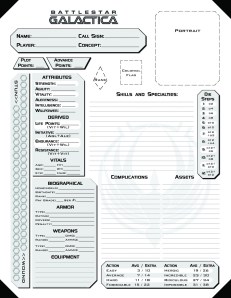
Courtesy of Jim Sorenson, here’s a few things for your BSG game. First, a one sheet character record. He normally pastes a rank pin pic and colonial flag for the character on his…

BSG Char Sheet - Jim version - Blank

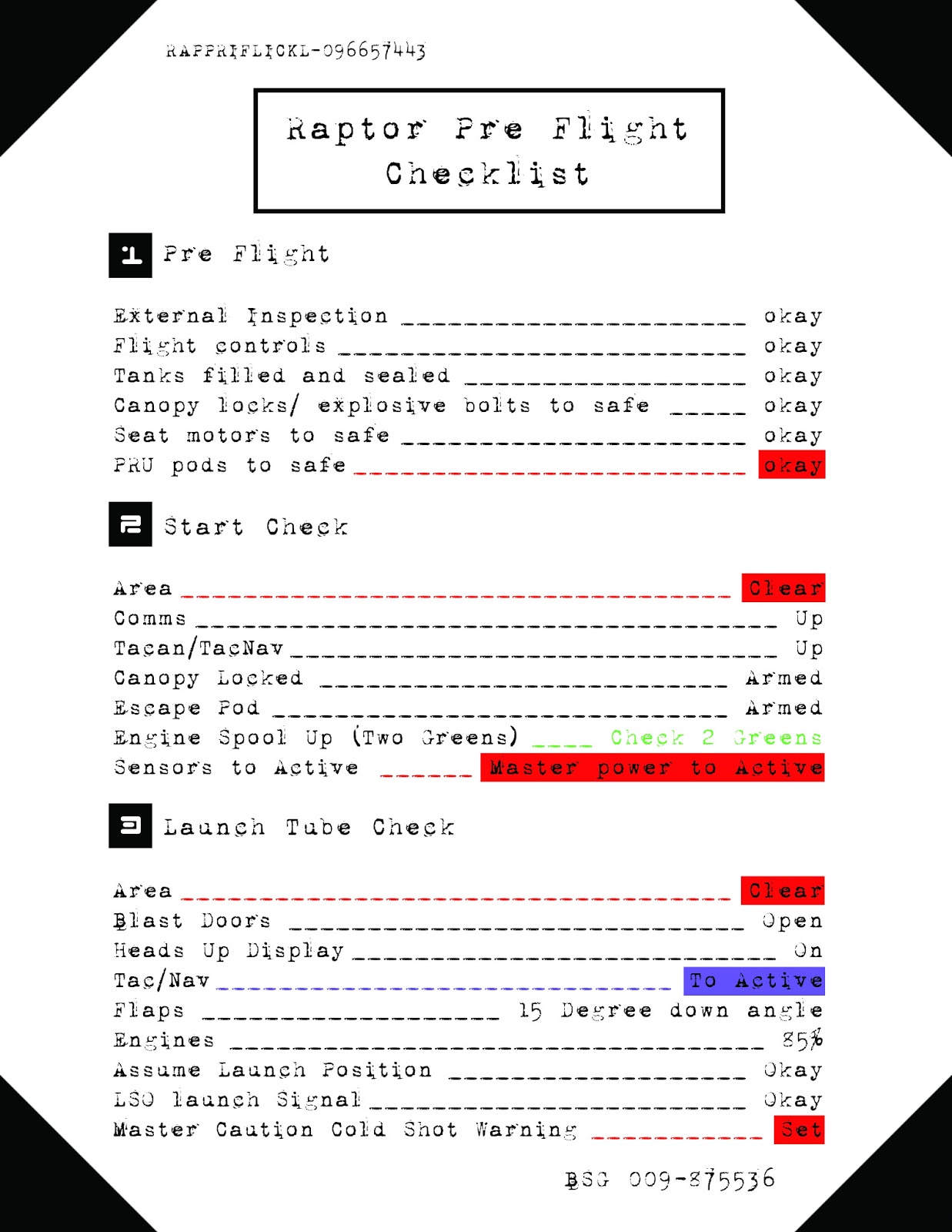
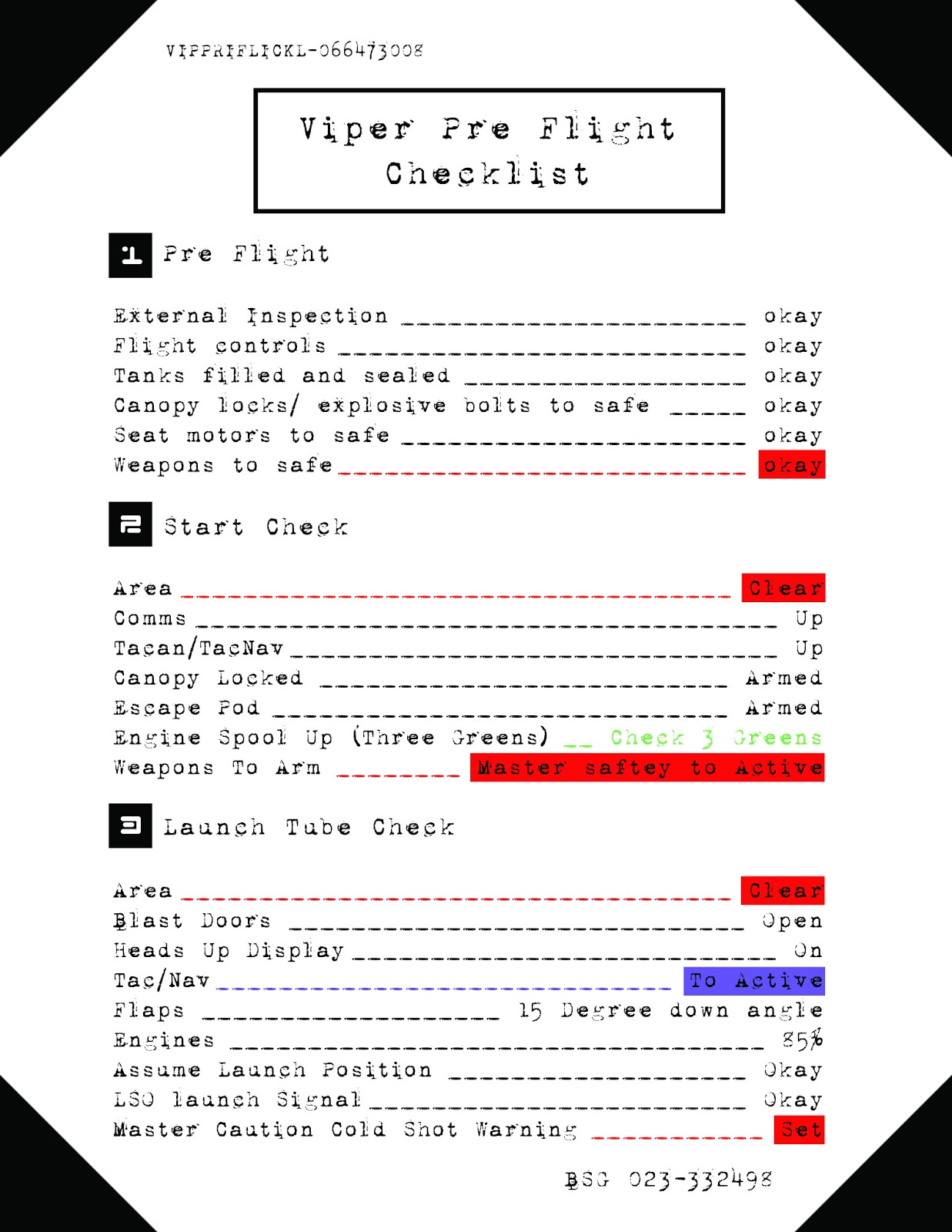
Here’s your viper and raptor launch checklists:

Viper Pre-Flight Checklist

Raptor Pre-Flight Checklist

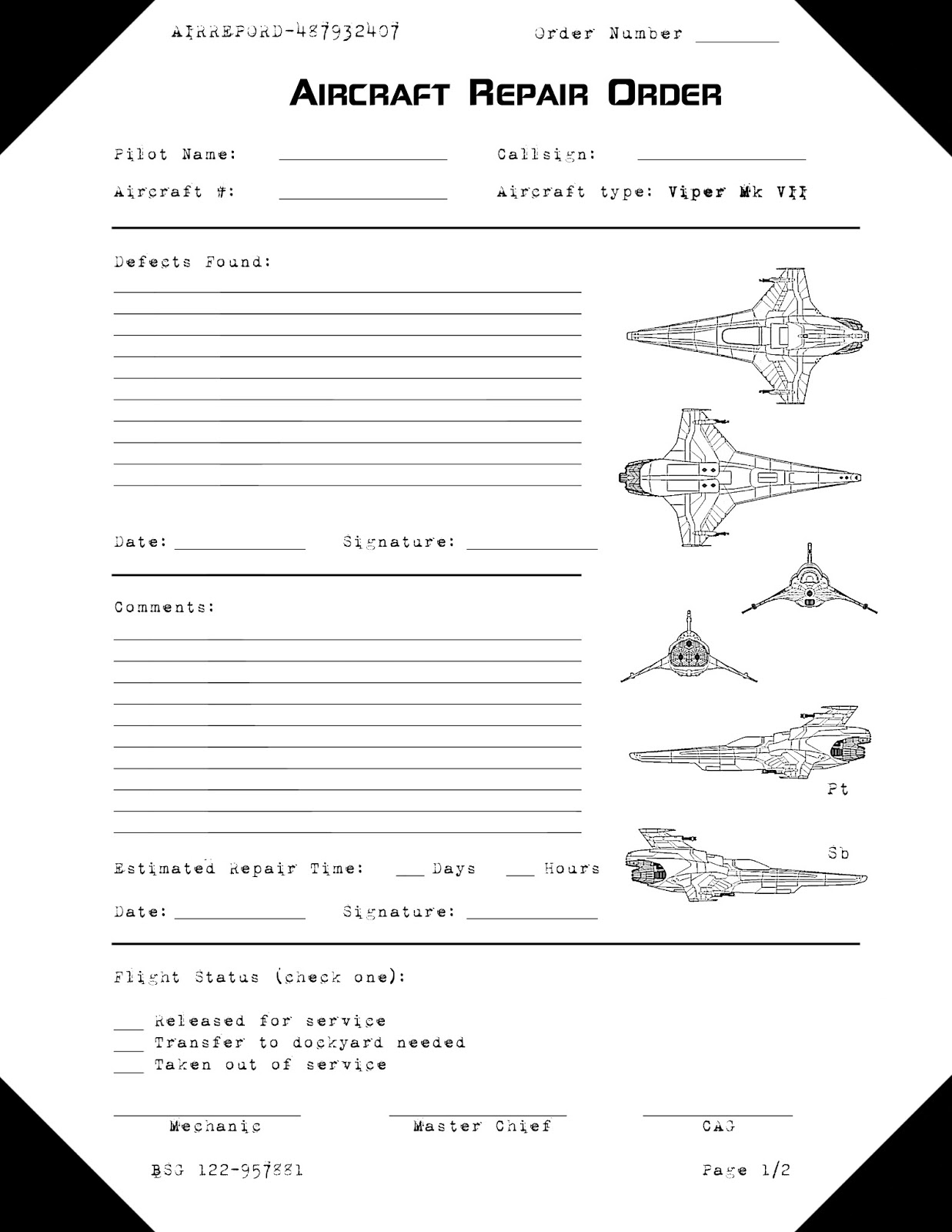
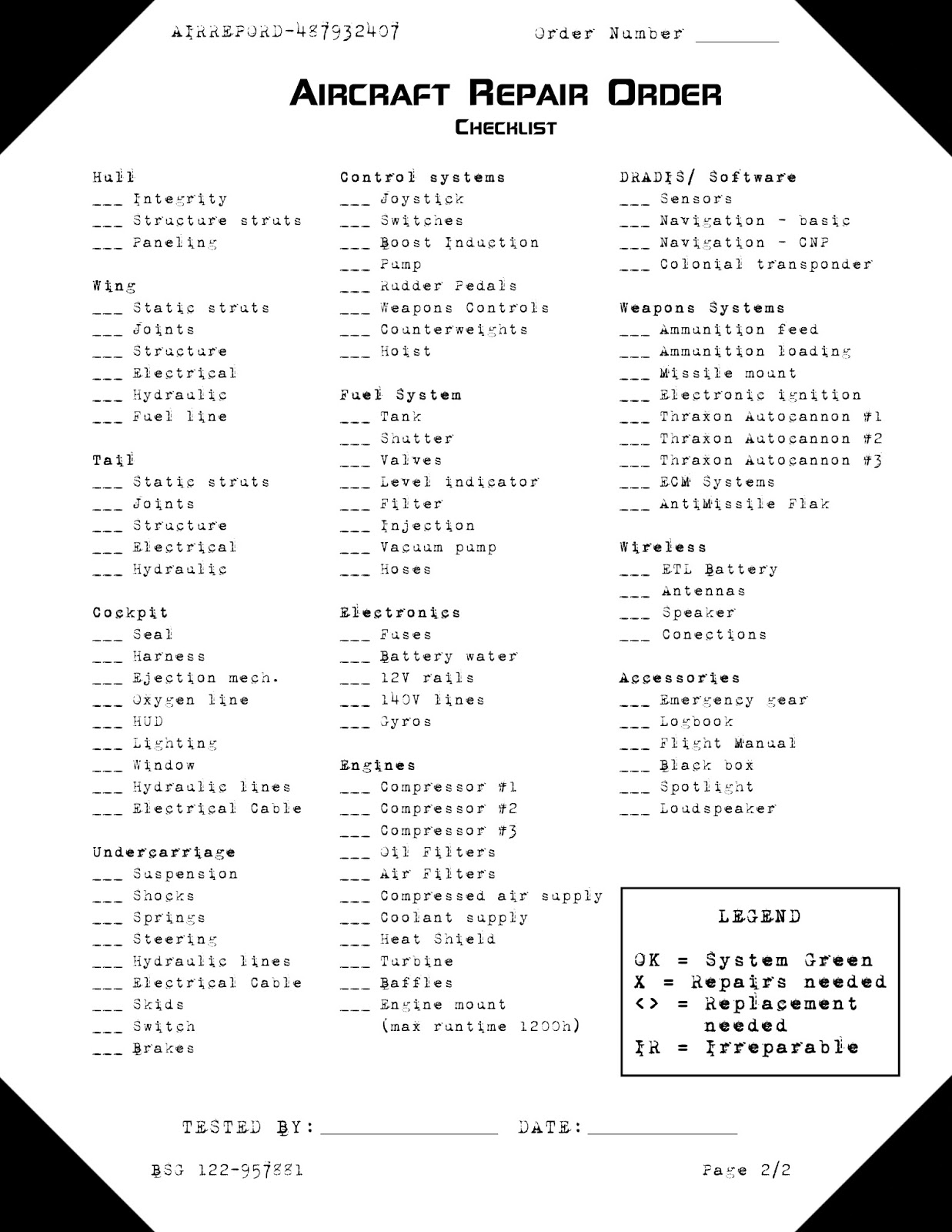
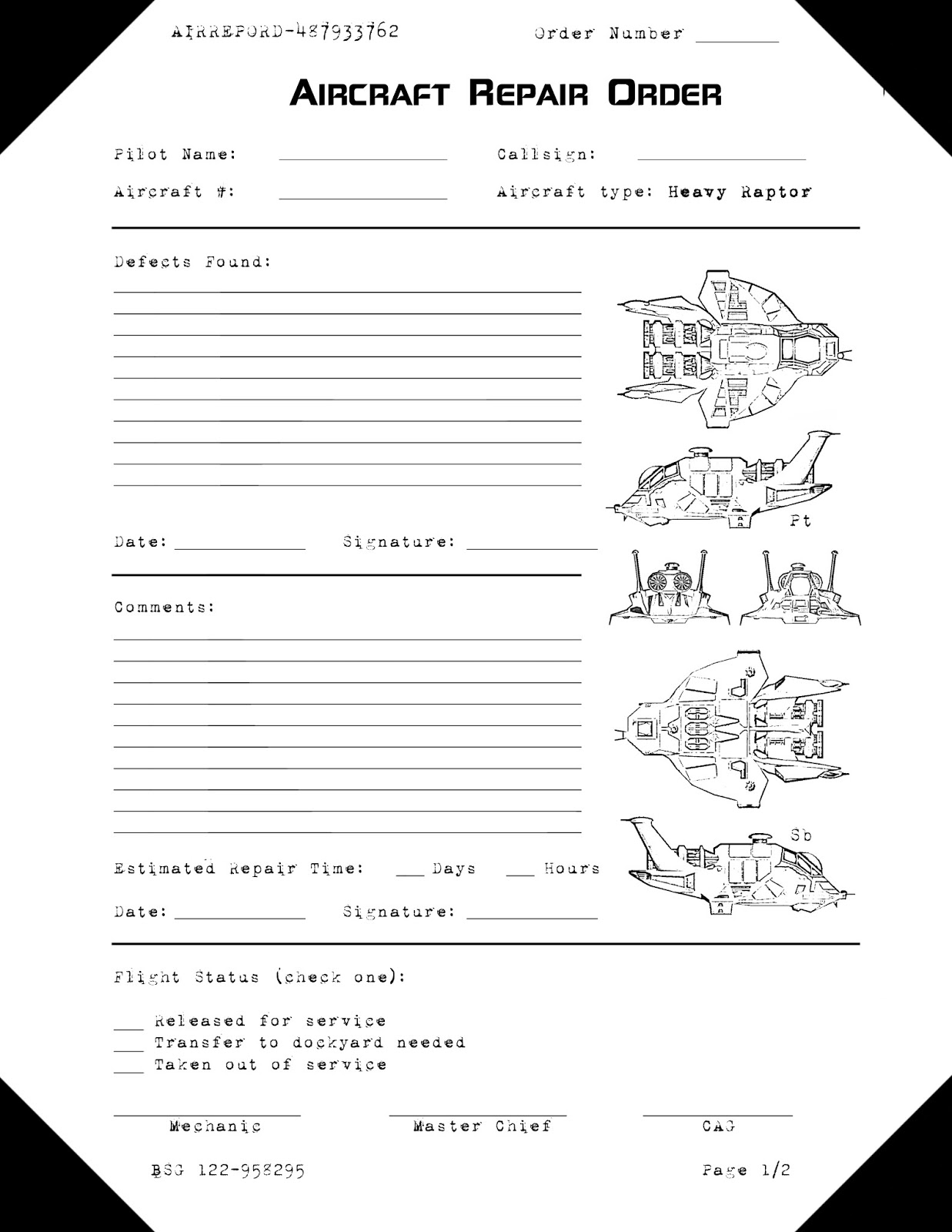
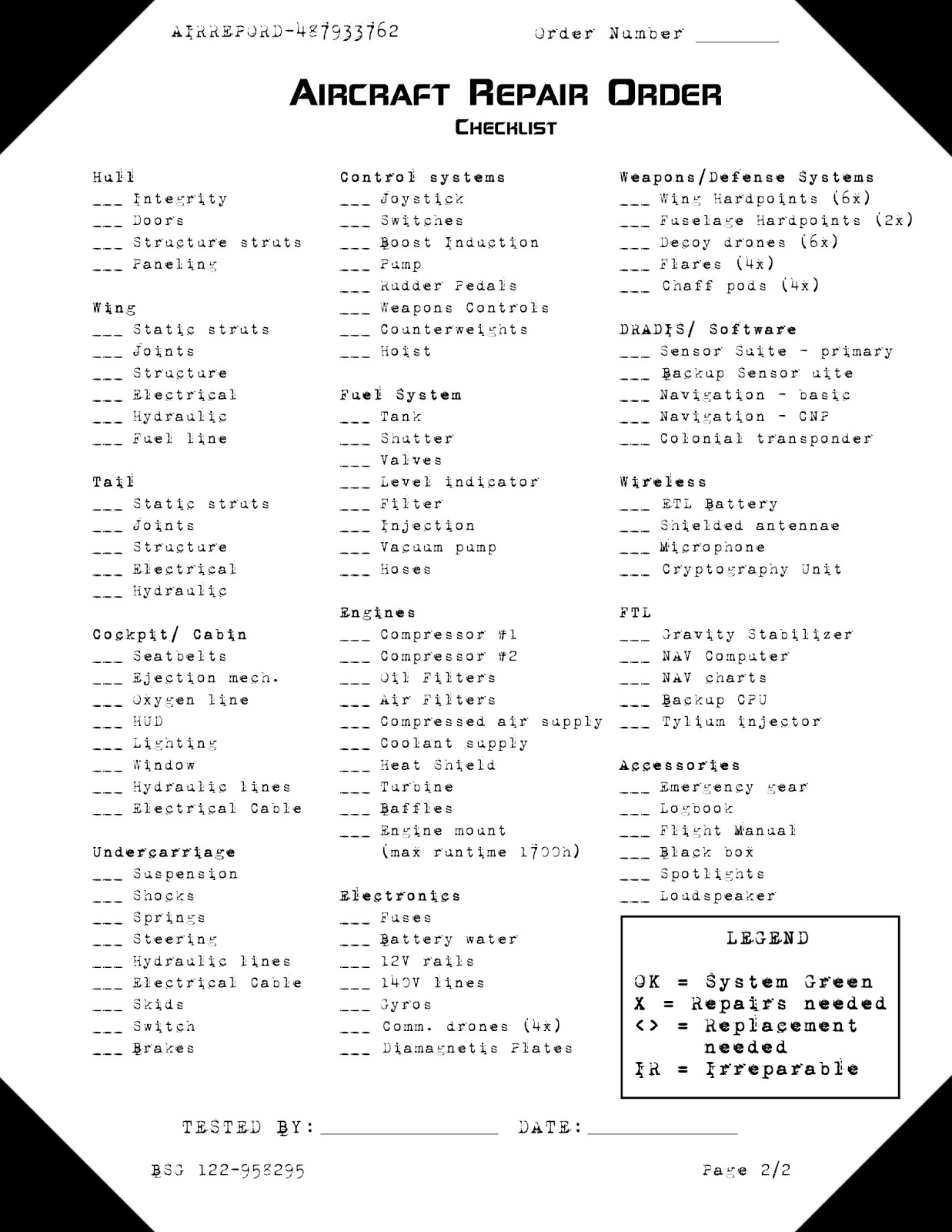
And how about a work order sheet for your rides?

Viper_MKVII Repair - 1

Viper_MKVII Repair - 2


Raptor Repair - 1


Raptor Repair - 2


Holidays and illnesses have kept the gaming schedule a bit hit or miss this last month or so, but we’ve completed another adventure in our Battlestar Galactica RPG campaign. This one saw the introduction of a new character — a fresh from training viper pilot who finds herself assigned to Galactica as her first posting, instead of her preferred Pegasus.

The fallout from the campaign thus far is finally starting to hit. Commander Pindarus, the “lead” character, and much of his command staff has been parked on Galactica as a means to cool his career off by jealous officers. (He is also a pawn in a personal tiff between the fleet admiral, Nagala, and his father, now the defense secretary.) Special Agent Chaplain, the Colonial Security Service officer that was investigating Cylon infiltration was exposed as having been an agent himself. The last “episode” had ended with their secret investigation having been outed by a major colonial news service. The assumption in the halls of power is that Pindarus ratted because he didn’t think the brass and politicians were taking the matter seriously. Without proof, however, all they could do was bench him on what is soon to be a spacegoing museum.

Pindarus’ efforts to get the political machine to acknowledge and do something about the toaster threat have, however, paid off. President Aidar is aware of the threat and is quietly shuffling his cabinet to prepare. The most important change for the characters is the return of Pindarus’ father to government. Having been ingloriously binned as presidential security advisor near the beginning of the investigations, the bellicose old man is now in as defense secretary.

This “episode” mostly revolved around the new PC, and her perceptions of what was going on aboard Galactica. To that end, I tried to structure the adventure so that while the other players were doing their own particular things, the new pilot — call sign Billboard — was usually present to witness things. The player of the new character has been documenting her reactions and opinions in a little journal he’s been sending to me. (Got him a few plot points for the effort!) The first thing she noticed was the strong animosity between the former (temporary) XO, now returned to CAG — Dipper (he’s in the miniseries) and the new one, Pindarus’ XO from Aegis, the (too?) young Major Evripidi. She meets the characters from the show that were continued into the campaign — Helo, Boomer, Starbuck. We also see JOlly (mentioned in the miniseries and reutrned in his slightly overweight, gloriously mustachioed glory.) WE’re using the Katee Sackhoff Starbuck, but without the tremendous angsty stuff that made her annoying to me.

The crew is befuddled. The new commander knows the ship is to be decommissioned in a matter of months and they are doing their last CAP of Caprica and Gemenon, before heading to Picon for the refit that would make her a museum and her disarmament at the Zeus Armory. So why is Pindarus running them hard on full-scale combat drills — complete with damage control exercises and boarding repelling operations? Why does he have the chief engineer (a cousin to Billboard) attempting to refit their FTL drive and get the ship rearmored? He says it is to put her back in the condition she was in during the First Cylon War and make her more authentic an experience for the guests.

Also aboard, is the Ministry of Education archivists, designers, and wonks — led by the Deputy Director for Public History, Aron Doral (this time more of a Oded Fehr type.) The man is slick, friendly, and seems genuinely interested in making Galactica a big attraction. They have installed a secondary, civilian network that is unconnected to the ship’s essential functions (save communications…), they’re putting up informative signage and color-coded paths through the ship, here and there, for the tour. I’m trying to give it more of a ship at the end of her life feel than the miniseries had.

Adventure seed here: The new character is put to the test when the ship receives a distress call. They were just entering Gemenese orbit when a Caprica-Gemenon liner was struck by the FTL bubble of another ship jumping in. Disabled and in a rapidly decaying orbit, they are requesting aid. Meanwhile, the vessel that had illegally jumped into orbit outside the prescribed commercial “bullpen” is racing into Gemenese orbit to escape apprehension. Galactica scrambles her alert fighters, including Billboard, to chase and monitor the ship, which is running an IFF transponder that does not register as belonging to any legally registered craft.

The rescue of the liner was done in the background, and directed by one of the characters; Billboard and the alert fighters follow the other freighter to the Gemenese surface — the Gramada Mountains, which another PC tells them is a hotbed of separatists, individualists, and illicit drug manufacturers. (Khammala and canaba are legal and used for “religious purposes” but synthetic opiates, endorphins, and amphetamines are tightly controlled.) The ship is a smuggler, moving synthetic dope from Leonis to Gemenon.

The characters have to capture the smugglers, who are armed with at least one shoulder-fired anti-aircraft missile system. Billboard nearly gets splashed, and they get cleared by Pindarus to take out the trucks. Marines in a raptor arrive and eventually take the ship, discovering weapons, drugs, and other violations of the law.

Overall, the adventure ran well. It was mostly interstitial stuff between push adventures, a chance for more character development over action. It was also a chance to set the mood for Galactica prior to the events of the miniseries.

Next week: 1930s pulp using Hollow Earth Expedition!

Most of these aren’t canon, but were cobbled together for our Battlestar Galactica campaign. Added them to the Twelve Colonies document in the RPG section of the site, as well.

Pancolonial Political Holidays:

Armistice Day Junius 21 — Colonial government holiday

Colonial Day Sextilus 8 — Colonial government holiday

Colonial Fleet Birthday Sextilus 12 — Military “holiday”

Pancolonial Religious Festivals:

Bacchanalia Martius (last weekend) — big drinking holiday, arts, celebrations to Dionysus.

Thesmophoria Aprilius 17 — Mostly a “women’s” holiday in cities. Big in farming communities. Honors Demeter.

Diasia Junius 6 — General Colonial government religious holiday.

Olympic Games Junius, second week every four years. Sporting competitions honor Zeus.

Panathenea Games Julius, first week every four years [midway between Olympic Games. Military-oriented sports competitions; honoring Athena.

Thargella Sextilis 19 — Celebrates Apollo.

Exodus Novilis 1 — Celebrates the tribes’ leaving Kobol. Probably not the real date.

Mars Day Novilis 11 — Celebrates Colonial veterans.

Saturnalia Decilus, last weekend. Festivals, parties, noted for costumes and masks.

Traditionally, the rich and poor, aristocrats and servants traded places for a day.

Posidea Decilus 26 — Honors Poseidon. Horse racing on Leonis, Picon, and Virgon.

Apaturia Febrarius 14 — Known as Eros Day on Caprica, honors Aphrodite.

Colony-Specific Holidays:

Arelon: Thesmophoria, Aprilus 17 — Honors Demeter. Farming fesitvals, known for drinking.

Independence Day, Septimus 12 — Celebrates the independence from Virgon.


Aquaria: Hermaia, Decilus 11 — Honors Hermes. Practical jokes, hospitality to travelers. People put out herme, small phallic stones, to bless those traveling.


Canceron: Eleusina, Sextilus 15-18 — Celebrates the mysteries of death and rebirth.

Democratia, Septimus 21 — Celebrates the creation of the Canceron global government.

Independence Day, Septimus 12 — Celebrates independence from Virgon.


Caprica: Hyacinthia, Ianarius 17-19 — Three day holiday celebrating aspects of Apollo.

Eros Day, Februarius 14 — Apaturia on most other Colonies.


Gemenon: Heraea, Martius 10 — Honors Hera.

Diasia, Junius 6 — General thanksgiving day to the gods.


Leonis: Daphnephoria or “The Hunt”, Aprilus 22-24 — Hunter’s weekend.


Libran: Athenaia, Julius 28 — Known for sporting and craft competitions.


Picon: Pohoidaia, Decilus 28-30 — Horse and boat races dedicated to Poseidon. Picon’s version of the Posidea.


Sagittaron: Lycaea , Novilis 12-14 — Honors Zeus.

Freedom Day, Octilus 29 — Celebrates independence from Leonis.


Scorpia: Dionysia, Maius 3 — Celebrates Dionysus. Best known for wishes hung on trees.

Saturnalia, last weekend of Decilus. — People change roles, wear costumes, etc. Popular vacation draw to Scorpia.


Tauron: Enyalia, Junius 14 — Celebrates Ares. Known for impromptu bouts of fisticuffs.

Our Day, Martius 2 —  Celebrates the independence from Virgon.


Virgon: Hestaia, Octilus 10 — Worship of Hestia, involves parties at home.

These holidays use our campaign specific date system:

The months of the year are as follows (assuming Sextilis is the sixth month, the year starts with March): Martius/01, Aprilus/02, Maius/03, Junius/04, Julius/05, Sextilis/06, Septimus/07, Octilis/08, Novilis/09, Decilus/10, Ianuarius/11, Februarius/12.

I posted the production notes for Blood & Chrome that were up on Facebook a few days ago, and have finally had time to compare them to notes on how a battlestar group might look I drew up a few years ago. So here’s my take on a miniseries-period battlestar group (BSG.)

Going with the idea that there are 12 “main battlestars” or “heavy battlestars” (I’m using the former term), one to do CAP on each colony and the surrounding shipping space, this would be the usual wartime battlestar group. Figure they’re rarely more than half strength, with half their number on temporary or detached duty.

COMPOSITION, BATTLESTAR GROUP

A combat-ready battlestar group consists of a main battlestar (Mercury, Minerva, or Columbia-class) and its attendant air group, 2 light battlestars (Erynis [Valkyrie] or Berzerk-class) and their air groups, 2 support escorts of Vanguard-class — one hospital, one an aerospatial assault unit, 4 assaultstars (Cygnus or the older Orion-class), 2 replenishment tyliers (pronounced til-i-ers; replenshiment oilers in the wet navy carry fuel, but also other supplies. They would be the refinery ships from the series), a combat support vessel (a repair ship like the Flatop from the series), and two victualing ships (basing on Blood & Chrome, these are the Celestra-style freighters.)

Assuming the support vessels are mostly civilian/merchant marine, that’s roughly 10 ships a BSG or 120 capital ships…which seems about right with Starbuck’s comment about the initial losses in the miniseries.

Considering how expensive and time-consuming peace time construction of these ships would be, I think 120-150 ships is about right.

Next off — nomenclature. I figure a battlestar is always a “group” (BSG), as per the patches in that they have an air group aboard. Any ships attached to, say, Galactica might have their own ship patch — say an escort named Diomedes is attached for longer than temporary duty to Galactica — the patch would read “Battlestar Diomedes” (or whatever you want to call your escorts; I call ’em gunstars if they’re cannon heavy, assaultstars if they’re missile heavy) and the bottom of the patch would be BSG-75, even if Diomedes herself was BSG-12, say. On her own, she’s BSG-12. (Hey, you have to keep the guys that make uniform patches in business…)

Any “battlestar” with an air group of any size is a BSG, otherwise, it’s just BS (that would be the assaultstars and gunstars.) Support ships would have registrations like DD (for the escorts like Vanguard [I’m going off of the numbering on the model for that particular ship; do whatever you feel like), RT for the tyliers, CSV for the combat support ships, and SV for the victualers.

Figure the battlestar groups during peacetime are broken up and doing missions throughout colonial space — light battlestars doing interdiction work, hospital ships aiding in disaster and humanitarian support. Escorts would also be doing policing, but would also cover the hospital ships and civilian contractor vessels doing deep space exploration, etc.