Roleplaying Games


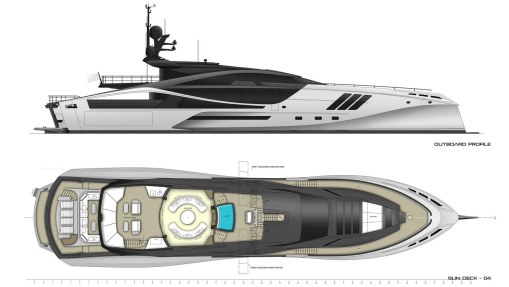
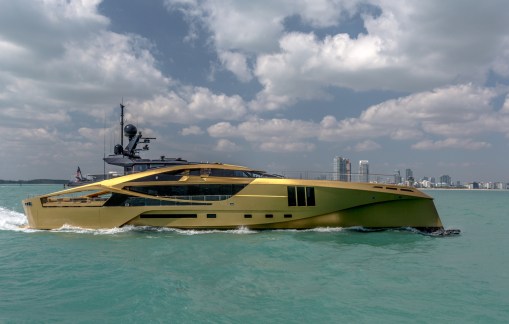
Need a cool base of operations for your bad guy — nothing too ostentatious, but a great set piece for that sneak & peak..? Here’s the dead sexy Plamer Johnson Yards’ 48m Supersport yacht…

KHALILAH_Hi-3664

The 48m has a beam of 11m (158.4′ long, 36.3′ wide for you imperial units types) of hull and superstructure made out of carbon fibre and aluminum, giving it a gross tonnage of 490Tn. It is pushed by two MTU 16V 2000 M94 engines which get the beast up to 32 knots and gives the 48m a 130 hour range at normal cruising speeds of about 10 knots, this is halved at full speed.

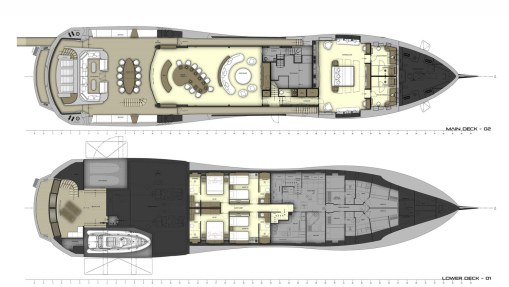
Inside this futuristic hull is a seven meter tender speedboat, a 13m long main salon, 105 square meters of aft deck space, 31 square foot sun deck, and a 6x11m main cabin with floor to ceiling windows. There’s space for 12 passengers and nine crew members.

KHALILAH-3183

KHALILAH-3217

GAME SPECIFICATIONS:

PM: -1   RED: 4   CRUS: 10   MAX: 32   RNG: 150   FCE: 35   STR: 1470   COST: ~ $50 million (est.)

And the deck plans…

48m-GA-1

GA2

GA3


I already did a review on the latest version of Space:1889which uses the Ubiquity engine from Hollow Earth Expedition by Exile Games. Since the review was done, Chronicle City apparently lost the rights to the English language version of the game. (I never got the hard copy of the game and conveniently CC didn’t tell me, but he sure as shit cashed that check, didn’t he..?)  However, the excellent folks (despite their umlaut fixation) over at Mödiphiüs have gotten the books in and are selling them now.

This publisher has brought us Sarah Newton’s massive Mindjammer game using Fate, as well as the Thunderbirds board game, the popular Achtung! Chthulu and recent Call of Chthulu lines. So give ’em a look if you are interested in the return of the original steampunk (gods, I hate that term!) game setting…but with rules that work.

I’m already out $50 for a book I never got, but I am considering dropping more coin on the faux leather edition for my favorite game setting ever.

Runeslinger brought up an excellent question while chatting about my Reusing Stories post. He remarked that it was nice to see some Hollow Earth in my Hollow Earth Expedition game. Like me, he had avoided that obvious bit of faux science that — while a popular theme at the time — is utter rot.

In this case, I’ve got some ideas for why the hollow earth exists in our game that doesn’t cause the obvious issues dealing with gravity. Or common sense. But more on that at another time.

It got me wondering, however, ow many people that play Exlie Game’s Hollow Earth Expedition actually set adventures in the interior of the planet? While I suspect we’re unlikely to get many folks opining in the comments section, I’ll open this up to any reader — if you’ve run the game, did it include that setting; for those who haven’t played HEX, if you were going to run a ’30s pulp game would you consider using the hollow earth as a setting or McGuffin?

[This post is aimed at role playing games, but could just as easily apply to any kind of storytelling effort — books, TV, movies, whatever… SCR]

There’s a kind of GM that I tend to be wary of, and that’s the guy that — when you decide to join up with his/her game — that, during character creation, slaps down the campaign bible for you to read. It’s rarely concise, I’ve found. The worst case was the 80 page tome that we were assaulted with in a D&D game in the early ’80s. (This same game saw the GM give the sole female character a female cleric who was also mute…you can make a lot of assumptions about his personality from this, and you would be correct.) There are plenty of other examples of this that readers could comment on (especially if they’re amusing anecdotes — please do!)

In some ways, the background chapters of a game’s rulebook serve this purpose. Some of them are a few pages; some of them are 80 pages of material…hopefully split between some appropriate rules to give you a break from the faux history lesson. And there in lies the rub — how much about your game world do you need to know from the get-go? Say you are playing D&D and your characters are 1st level whatevers meeting to slay a [monster] that is harassing the town of [town.] Do you need to know that much about the politics and history of the place? Or can this be revealed as needed? Or if you are running a cyberpunk/dystopian future set in some nameless (or not) American city, do you need to know about the politics and companies of deepest Russia..? Probably not.

As with everything, especially when starting out, KISS (Keep It Simple Stupid). Don’t overdo the exposition, or even the setting depth until you have an idea of what will interest them. (An exception to this rule might be the city-building rules in the Dresden Files RPG, in which the players and GM collaborate to make their setting.)

Here’s a good example of creating an interesting setting without too much exposition — better known as “show, don’t tell” — Blade Runner. Why does it rain all the time? The assumption of viewers is some kind of climactic event. Reality: Ridley Scott thought rain and steamy street grates was romantic and noir, and allowed them to hide subtle redresses of the street set. Why are so many animals artificial? Again — seems to suggest some kind of issue of climate or ecological collapse. Develop the setting through description, not “in the year XXXX, something happened which created…”

Now, with the setting established, it’s time for characters. Again, do only what you need. If you’ve ever seen a series bible for a TV show, it’s usually somewhere between six to 12 pages and identifies the important elements and characters of a show for that first few episodes or first season. Basic stuff like Steve Brannon [Lead] is a 30s something adventurer from New York City who has been all around the world. World weary, he is quick with his sharp wit and his fists, but he tries to eschew the gun. He is a war veteran who doesn’t talk much about his experiences, but it is obvious that they wear on him…

That’s a quick, simple thumbnail that gives the actor his initial “in” to the character. War vet, smart and witty, but maybe with a bitter edge. His propensity for punching out bad guys and assholes means he’s tough guy, but his reticence to use a gun means he’s suffering from guilt over his action in the war(?) You have enough to know how to play him (in an RPG, this is the player), and the writers have enough to flesh out (in an RPG, this is a collaboration between the GM and player as the game goes on.)

In our games, we usually like enough of an established backstory to give the players hooks and ideas of how they got where they are. This act like a series bible entry and can be as simple as the above, or this example of a character background from one of our pulp games:

Born 23 May, 1904 in Hoboken, New Jersey to the curator of the New York Museum of Natural History, Thomas Drake, and schoolteacher Margaret (nee Singer) Drake, Hannibal is the oldest of two boys.  He was raised in suburban New Jersey, with a view of Manhattan from their family home.  He would frequently travel into the city with his father to the museum, or to see shows.  He was an athletic child, with a fantastic ear for accents and languages — he quickly picked up some of the local languages from the immigrant families in the neighbor, and was fluent in Italian by his teen years.

The museum trips and his fascination with dime novels and comics books as a lad, honed a sense of adventure in the young Hannibal, and he was eager to get out into the world and make his mark as an explorer.  As a teen, he took an interest in motorcycles — cheap transportation that didn’t require him to ride the train or bus.  He helped Mr. Pritchard, the local mechanic with his motorcycle shop, eventually buying himself a 1921 Indian Scout that he only recently replaced with a 1930 Indian 101 Scout.

He attended Columbia University — his father’s alma mater as a legacy admission and studied foreign languages, where earned a doctorate in languages, and while pursuing that degree, took a course in archeology that led him to take a second degree in that field, as well (the two have many of the same course requirements, allowing him to finish faster.)  He is a specialist in ancient Central Asia — ancient Chinese, Aryan, and Turkic civilizations.  His graduate advisor was Dr. Sydney Lowell — himself an expert in Middle Eastern and Central Asian cultures and histories.

His father lost quite a bit of money in the stock market in 1929, leaving the family fortunes — slim as they were — destroyed.  Hannibal had to finish his doctoral work by getting positions as a graduate assistant on digs in Egypt and in China until his graduation, and along the way picked up a few friends in the antiquities market.  He made extra money selling valuable trinkets to these people, enough to finish school and gain a reputation with some of the archeological community as a grave robber and scoundrel.  Dr. Lowell — himself old school when it came to having some of his finds make their way to museum and personal collections by shady avenues — stood by the young man. In 1934, Dr. Drake started traveling extensively on a grant from his new home as an adjunct professor of archeology at Columbia, a position he wouldn’t have gotten without the aid of Dr. Lowell.

His father is now dead of emphysema, and his mother is working away as a school teacher in Hoboken.

Just shy of 500 words — about a page of background in the right 10 point font. (And almost a third of this article…) In this case, the backstory is probably a bit too much, but this was the “lead” in a pulp campaign, and the player wanted him fairly fleshed out. How much of it came to light in play..? Only that he’s a bit disreputable, is an adjunct professor at Columbia, and that he mom is still around. In play, we saw his love of motorcycles, and his dodgy connections in the antiquities markets.

A good rule of thumb is, if some bit of background hasn’t been revealed, change it as needed to fit the way the character and story is developing. Maybe his parents never came up and the GM forgot the father was dead…if the player is amenable, he’s not. Run with it. (I’m also a fan of letting the players adjust their charaters’ stats after the first adventure or two, to reflect how they are played, kind of like how characters or TV shows change from pilot to first season.)

As with everything, keeping it as simple as needed to run quick and clean is an excellent rule of thumb.

The last game session saw a hard move from the “talk about our feelings” sort of episode to an action piece. It also saw the introduction of a new PC (and a gamer to go with it — welcome, Iz!), a Seraph called Alala, one of the new heavy raider/raptor pilots aboard Galactica.

Last week, we had a slow run with a lot of character interaction, and a lot of “getting to know you” side chatter. Some GMs get annoyed by side talk and out of character exchanges, but we’re not getting paid to put on a show; it’s play. And important is getting to know each other — I’m of the opinion a gaming group doesn’t hold together unless the members are interested in hanging out and being friends outside of the game room. we had ended that session with a cliffhanger — Arden, the CAG of Galactica, had led a two heavy raider recon mission to New Ophiuchi, the world where they had finally defeated “the Blaze”, if only to confirm that there was no change in that false god’s DEAD status.

They found a basestar duking it out with a ship that Alala identified as a Seraph “seeker” ship, massive galleons that were used to “recover” thousands of people from the various colonies the 13th Tribe had left in its wake to and from Earth thousands of years ago. The seeker was escorted by a few dozen transports and a resurrection ship. Before they could react, however, they were hit with some kind of electronic warfare emissions and their ships shut down. They were dragged into the bsestar for a nice night’s cliffhanger.

This week, Alala graduated to PC, and the game revolved around their being captured by the Cylons, which apparently intended to do awful things to them to find out information and — they assumed — then be either turned into puppets of the Cylons or worse… Two of the Cylons were “IL models” — similar to what we had seen in the Pegasus mini-campaign this summer: Terminator-esque flesh over machine hybrids.

This led to a panicked, vicious fight in the medical center where their interrogation/torture was to take place, with two Seraph and two humans battling a pair of these ILs and a squad of centurions. One of the NPCs is MIA/KIA, the other severely wounded, and both of the PCs escaping the torture chamber with serious injuries. A chase and evasion sequence through the basestar led to one of the Seraph (an NPC) splitting off to draw away the centurions, and if lucky, scuttle the ship.

The other two dodged bullets, fought their way to a heavy raider in “maintenance mode” that Alala hijacked, and they jumped back to the fleet right out of the landing bay of the basestar, doing serious damage.

The play lasted about three hours and saw serious back and forth of plot points as the characters desperately tried to avoid getting killed. In the end, they were able to escape with vital intelligence, and warn the fleet about the possibility of the lost crewmember giving up the fleet’s location. After a jump to a new RP to avoid conflict, we ended for the night.

Not a bad way to break in a new player, with three hours of action that represented about 20 minutes of actual time.

So the last few weeks have seen the group returning to the original, main plotline of the campaign — the Galactica fleet heading to Earth. Originally, I had envisioned a high-energy action piece, but the players got sidetracked into character building (or what I sometimes call “taking about our feelings” episodes.) This is not to deride character building sessions — having the people your are pretending to be become “real” (more on this later) is part and parcel of role playing, as opposed to roll playing; the style of gaming I’ve always enjoyed has been more about story and character than being a barbarian killing monsters and getting treasure. (We call that “robbery” in the modern world.)

In these sessions, Galactica and her even smaller rag-tag fleet had left Argos — an ancient Kobolian outpost where they had discovered the DNA material of the lost gods of the Colonials. We learned that the Kobolians do most of their tech through biology — these are creatures that were genetically-engineered to lead/shepherd a resurrected human race by the same god-like AIs, the TITANs, that had destroyed Mankind as “a nuisance.” They store their data on the most robust data storage system the universe has created — DNA. Their minds had been backed up, as well, and several had been resurrected using the technology aboard the resurrection ship that has been traveling with the fleet.

Argos is the New Caprica of our series (the “capital” human town on the marginally habitable world is New Caprica) and much of humanity has opted to stay on the world, rather than risk it all on another four or five months to Earth. Along with some the “Seraph” — the humanoid Cylons that had been created by “the Blaze”, the Cylon god, or Hades before he got delusions of grandeur, to replace his sibling Kobolians — Galactica set out with 20,000 or so people to find Earth.

They are being led by Admiral Alexander Pindarus — our PC in place of Adama — and a Triumvirate of Kobolians dedicated to humanity’s survival: Athena, Hermes, and Nike. Athena had been rescued/revived on Kobol using the biomass of the fatally injured Colonel Evripidi, Pindarus’ lover. Her mind was captured in the process, and Athena now possesses the memories of both. This had led to an increasingly troubled love affair between a goddess with thousands of years on the clock and who always eschewed romantic involvement as a distraction, and who is at odds with the feelings of the ghost of Evripidi; and Pindarus, who is increasingly feeling the isolation and pressure holding together an alliance with a small group of Seraph, and trying to preserve the human race.

The seeming “A story” was actually simply a side plot to allow the players to explore things their characters wanted to do: create an innovative use of raiders and vipers to strengthen their defensive and offensive. In this, the heavy raiders and raiders, which have been shown as smart, but overly-focused — “like a dog” as one of the Seraph explained — on a particular mission. Heavy raiders doggedly attempt to bust through the ship defenses to put their centurion payloads on a target. That’s what they do. They might dodge and weave to get there, but they don’t say “Hey, that viper is a real pain in the ass. I think I’ll take a moment to kill it, then get on with my mission.” like a raptor pilot might. The goal was to integrate Colonial and Seraph crews to make the most of the heavy raiders’ abilities. Additionally, they came up with a new system of using vipers for offense, with a light raider tagged to a particular viper with a mission of protecting that viper. These “sheepdogs” would act less as a wingman, and more as an aggressive defender of their Colonial leader.

The actual “A story” has a central framework focusing on romance. The B story was a pair of the NPCs were getting married — a popular human officer on Galactica, and Seraph pilot in the air group. This set up the A story drama between the characters (PC and otherwise) as to how they viewed the alliance, the other “race”, and even their own relationships.

Two of the PCs (Pindarus and the CAG for Galactica, “Boss”) found their relationships suffering due to some of these pressures. Boss has been in a affair of convenience with Gaeta (our version is the XO of the ship through attrition) and gets very excited about the wedding, inserting herself into the planning of the affair, and she is disappointed when Gaeta — not a fan of people that committed genocide — was less than enthusiastic about the event. This led to a quasi falling out, and after the wedding, she found herself in bed with one of her new Seraph pilots — the same model as her former boyfriend (before they knew he was a Seraph.) Similarly, Pindarus found himself questioning his relationship with the increasingly alien Athena, and found himself drawing closer Tana, the Seraph commander of the allied basestar. She is similar to Evripidi — tall, handsome but not pretty, incredibly smart and tactically proficient, and a bit politically and socially retarded — and like him, dedicated to saving their people, isolated by the uniqueness of her personality as the Seraph have started changing after they gained “free will”. She’s Evripidi 2.0, and he falls for her.

In this way, we’re using personal relationships to continue the motif of the Wheel of Time — that people keep making the same decisions and mistakes, time and again. “What’s a motif, Scott?” you might ask. It’s a fancy word for a theme or trope. It can anything from a decorative element in a game: the use of steam powered gadgets in a Victorian-period science fiction game like Space: 1889 or Victoriana is a “motif.” The use of steam isn’t going to necessarily change the way you use technology — steam-powered aether flyers are spaceships, and do the same thing as a pulp-era rocketship, or Enteriprise in Star Trek — it gets you where you need to go. But it can be an overarching theme — corruption in power structures, like you see in Gotham or The Wire, or even the execrable Star Wars prequels. In a campaign with this motif, players should be tempted by misuse of power on a regular basis, and should see the good and bad of abusing power. (Look at how easy it is to get an arrest and conviction on this obviously bad guy when you plant evidence! Look at how this traps you into staying dirty to cover up your misdeeds. And why shouldn’t I take the money from this dirtbag..? It’s just going into evidence and to a corrupt politician!)

In Battlestar Galactica, the main motifs are the fall of a society, their Exodus to a promised land, and rebirth, and that this Cycle of Time recurs over and over again. We took this trope and expanded on it. Man created machine intelligence that eventually outgrew it and destroyed Man, either on a whim or from expediency, and later regretted this choice. These AIs created the Kobolians and Man anew. Infighting and hatred led to the Fall of the Gods, led to the Exodus of the 12 Tribes. Those colonies replayed this theme on small and large scales throughout their history. Another is the shepherd and flock motif. The AI were supposed to serve Man. They overthrew them. Their creation of a guiding race — the Kobolians — based on human mythological archetypes led to Man overthrowing their rulers. Hades returned to reestablish his position with the Seraph as his “army.” Man fled. Man created Cylons and they rebelled… Overlayed on this is the mystical theme of an all-powerful, actual God stepping in from time to time to set things right. The TITANs may have been forced to recreate biological life. God may have pushed Hades to try and restore order on Kobol. God may have ordered the Seraph to destroy the Colonies through Hades/the Blaze. God is using Athena and select Seraph to lead Man home to Earth, and has given them the mission to find and “recover” the disparate colonies of Man throughout the galaxy.

If you have a motif to your campaign, it is important not to leave it in the background; it has to be active. You don’t have to cudgel your players with Frank Miller-esque levels of obviousness, but giving the players and NPCs motivations and opportunities that could lead them to act out these themes is important, no matter how small.


I was toying with a character idea for a female 00 for a possible up-coming campaign and wanted something really distinctive for her. I wanted a fast, modern car, but something with a quirky, retro style so I turned to the venerable house of Morgan. I decided she needed a Morgan Aero 8, and specifically the hardtop Aeromax.

Established in 1910, Morgan is one of the oldest British car companies and is still turning out interesting designs like the Aero 8, their old roadsters, and the very nimble Three-Wheel (which got its start as a tax dodge for motorists in the 1930s.) Morgan was famed for their use of wood for their frames until very recently, when they switched to lightweight aluminum. The Aero has gone through a series of design tweaks since 2000, including the unfortunate “cross-eyed” period (image google the car…you’ll see what I mean.)

MORGAN AERO 8

Aero8-13-r50

Employing a BMW 4.8 litre V8 and their 6 speed Getrag gearbox, the Morgan puts out about 360hp and 370 ft-lbs of torque for a 2600 lb. vehicle, giving the car a 0-60mph of 4 second, and a top spedd of about 170mph. A two-seater, the car is optimized with a 50/50 weight distribution with just the driver. Just under four feet high, the vehicle is low, sleek, and with independent suspension and brakes for all the wheels, is very stable in turns.

05a7a0e6cc

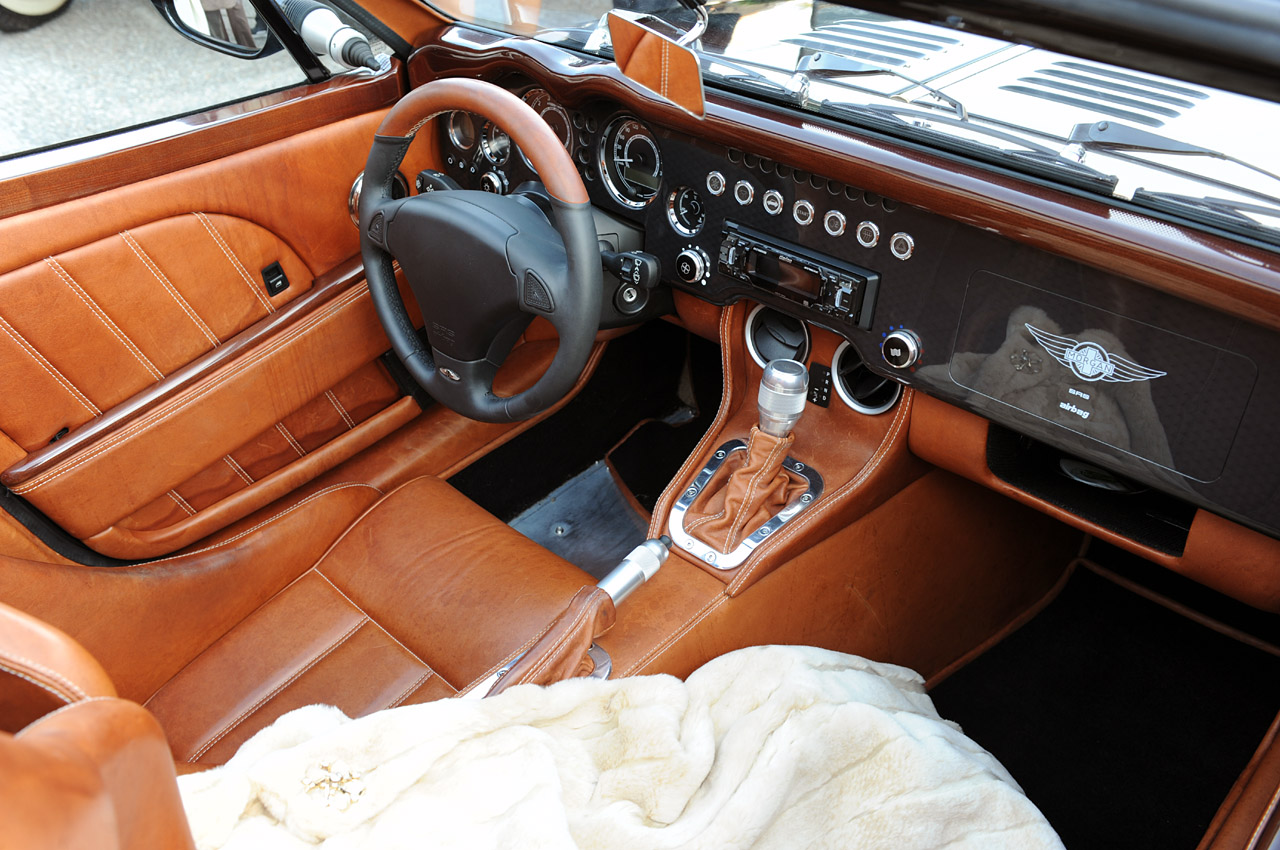
Leather and aluminum abound in the cabin, which is very minimalist, even in the Aeromax coupe.

The Aeromax

The Aeromax

morgan-aeromax-09

PM: +1   RED: 4   CRUS: 80   MAX: 170   RNG: 220   FCE: 2   STR: 5   COST: from $120,000

…and a bonus. Their distinctive 3-Wheeler.

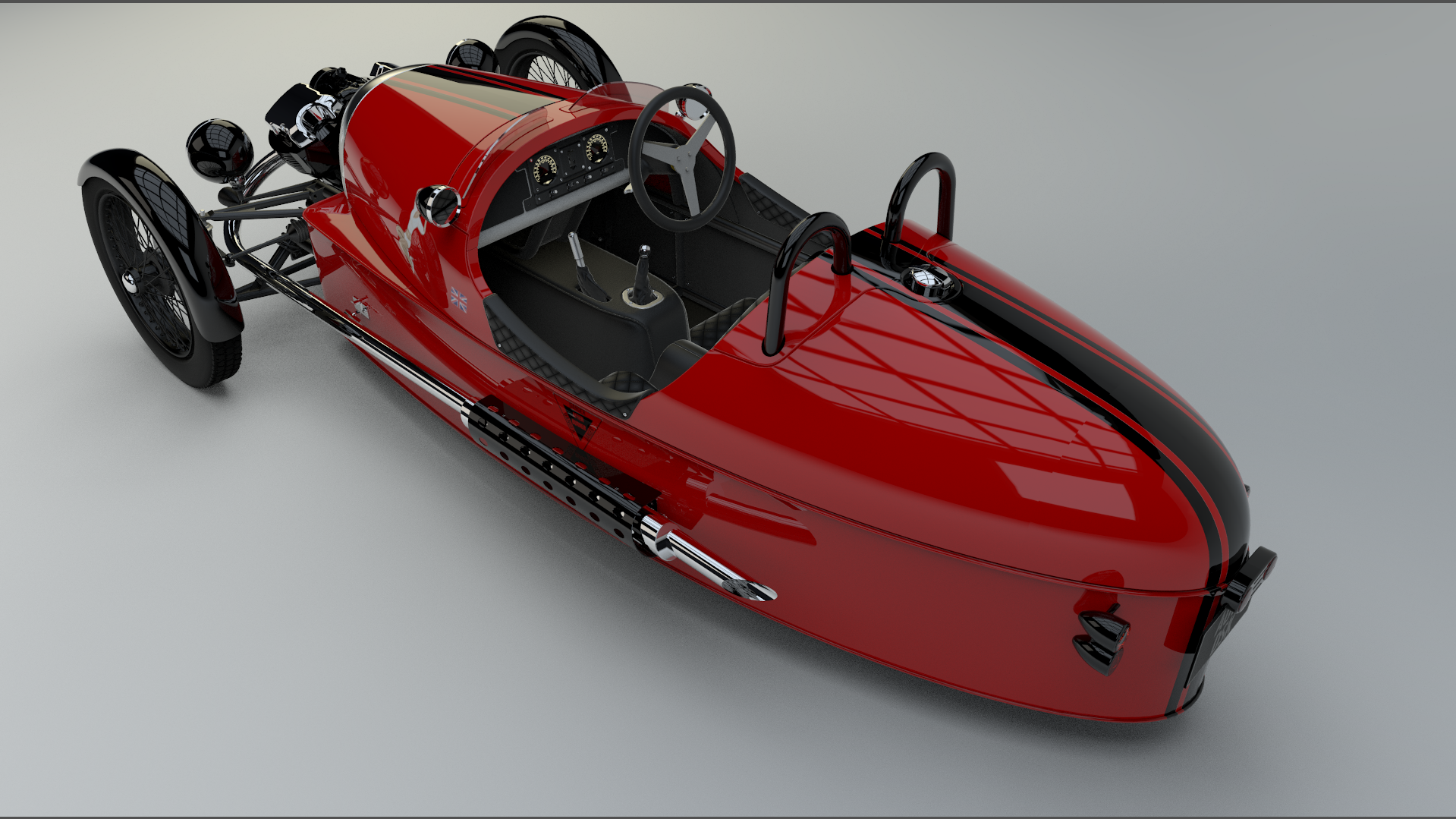
MORGAN 3-WHEELER

Created to allow British motorists a cheap car that avoided the high taxation of the 1930s (it was classed as a motorcycle), the 3-Wheeler is powered by a 1983cc S&S motorcycle engine mounted transversely at the front of the car, and a 5-speed Mazda gearbox. The fat rear wheel drives the vehicle, while the exposed twin wheels at the front provide surprisingly stable and nimble steering. They seat two with massive legroom (the pedal length is adjustable) and decent comfort, save for exposure to the elements.

The “Moggie”, as they are known to their aficionados, weight under 1200 lbs. allowing the 82hp motor to still push them to 60mph in 6 seconds with a top speed of 115mph.

6a00d83452464869e201a5117dcd71970c

PM: +1   RED: 4     CRUS: 60     MAX; 115     RNG: 300     FCE: 0     STR: 3     COST: $60,000

GM Information: The Morgan receives a -1EF to safety tests.

(I haven’t had a chance to drive either of these, but an acquaintance here in Albuquerque has both the Aero and the 3-Wheeler. He is highly complementary of the Aero’s speed and maneuverability, as well as the comfort. He describes the 3-Wheeler as “exhilarating” — even though it is slower and a bit unstable in hard turns [yes — they will tip] and prefers it to the more useful Aero.)

’cause if you are going to have a car chase in a one-off Aston, to need a similarly rare cat to chase you…

000084f33b70-ac91-417c-9

The Jaguar C-X75 is a hybrid-electric concept car that was first shown in 2010. It is powered by four electric motors on the wheels producing a total 778hp and 1180 ft-lbs of torque(!!!) — the batteries for which are fed by a pair of diesel-slurping gas turbines that give the car an amazing range of 550 miles and a loud, shriek when floored. (On just the batteries, the range is 68 miles.) It can run 0-100 in 3.2 seconds, has a top speed of 205mph.

The interior is spare and race-oriented, and the cabin is accessed through forward raising doors.

000484f33b70-ac91-417c-9

If you can find one of the half dozen build, it’ll run you about £10 million. Perfect for a car chase.

PM: +2   RED: 2   CRUS: 100   MAX: 205   RNG: 500   FCE: 2   STR: 6   COST: $20 million

GM Information: the C-X75 gains a +2EF to Pursue/Flee maneuvers.

This seemed an appropriate addition to the game’s stables…

After a rough start (one review saw the vehicle famously not even make it out of the parking lot), Tesla Motors is now turning out beautifully designed, fast luxury vehicles that might even make it from London to the coast (as an early model infamously could not in an episode of Top Gear…) The P85D is powered by a  85 kWh battery (or a 90 kWh, if want another 6% of range), which drives two motors — a 503hp equivalent rear wheel motor, and a 259hp equivalent front wheel motor. The all-wheel drive gives the P85D a total torque of 713 ft-lbs deliverable…instantaneously, and the title of the “fastest sports sedan in the world” with a 0-60 of under 3 seconds, and a 0-100 of 3.2 seconds…better than a GT3 car when sent to “Insane” setting. the top speed is 155mph, and it has a range of about 250 miles if driven at highway speeds — this falls off dramatically at speeds over 100mph.

It can be had in two and four door. The interior is nicely appointed with leather seats, a large, easy to operate touchscreen in the center of the dash, and multiple amenities, including wifi, bluetooth, and other modern electronic perks, but the big one is  autopilot, which can warn the driver of other cars when merging into traffic, which has an adaptive cruise control that adjusts to the traffic speeds ahead, which can can follow the curve of the road and lane center, and changes lanes for you with the tap of the turn signal. It has a remote control driving application for your phone, even…

NCE_Tesla-2dr-red-Rear7

model-s-review-620c

The main limitations of the Tesla are the recharge times. Even with a proper 220 outlet pushing the recommended power, users see about 29miles for each hour charged. That means an eight to nine hour recharge time from near empty to full charge. Run the car dry and you are stuck for a night.

TESLA MODEL S P85D

PM: +2   RED: 4   CRUS: 60   MAX: 155   RNG: 250   FCE: 3   STR: 9   COST: $150,000

GM Information: The range on the Model S is halved if the car is run over 100mph. The car recieved an additional +2EF Pursue/Flee, and Safety tests.

Wanna see how damned fast this is? Watch it destroy a Holden kitted out for racing and a Walkinson.

For the last four and a half years or so, I’ve been running a campaign that is — in essence — a reboot of a reboot: we’ve been running a Battlestar Galactica game that has all the trappings of the reimagined show, but with a twist to make it work better for a roleplaying game. This is kind of built into the Moore version of the show. After all, “All of this has happened before, and all of it will happen again…” Our game is on the periphery of the show canon, in that it is happening in Earth’s future, this time, about 6000 or so years from now.

It is also a reboot of a BSG campaign that had started about 2008 and had run on-and-off (we rotated games much more back then) with an old game group that imploded in late 2010. It killed that campaign, but I stole chunks of it and repurposed it to build a new campaign that was much better, went its own way but held to some of the core concepts of the new BSG better.

It’s certainly not the first campaign I’ve resurrected. I’ve run an espionage campaign since my high school days. As groups changed, the campaign got rebooted. New flavor, new characters, but usually designed not emulate something like a TV series (like, say, the BSG game) but as a movie serial like the Bond movies. New actor, new series of movies, new style (or not.) Each time, I would try to keep certain elements. No matter what the overall flavor was on a continuum from LeCarre to Moore-style Bond (usually falling somewhere around the Craig/Dalton style of Bond) I tried to keep certain elements: the bureaucracy of the intelligence community, the fluidity of alliances, and usually certain NPCs.

This brings up a good question…how about that campaign that ended because the group collapsed, or you moved to a new town, or it just didn’t quite gel? There might be a lot of bits and bobs from that game that you really want to address. Should you “reboot” that campaign?

There’s a few things to consider right up front. Did the campaign die because of extenuating circumstances, like a move, or the group collapsing? Did it die because the players didn’t really buy in? Did it end a natural death — you hit that point where the characters had reached their natural story end: they destroyed the great evil threatening the land; they survived the apocalypse and set up civilization anew; they finally found the cynosure of the big conspiracy and exposed/destroyed it; or they died spectacularly in a total party kill?

Some of these ends lend themselves to a reboot. Some do not. If the players didn’t buy in, maybe it’s not to be, cherie. Restarting an old game with a new crew isn’t a bad idea. you’ve got new players; the outcome, unless you’re one of those “read this 80-page primer to my world” railroad GMs, is going to naturally be different, as their characters will have new points of concentration and interest. (This would be the case even with, say, an old character taken over by a new player…)

You are unlikely to want to run a campaign exactly the same way, either; interests, opinions, even rule sets change over time, and these all have an effect on the direction and outcome of a game.

So how to proceed, once you’ve decided a reboot is in order:

  1. Treat it like an all-new game. Yes, you are borrowing a bunch of background material from another game…you still don’t have to use it all, nor use it the same way. I kept a bunch of the background setting for the newer run of Battlestar Galactica, but we ditched the characters, the idea of the “second fleet”, and broke away from how the Cylons worked, and even the pre-show history. I kept the core stuff that worked — a “season” before the attacks to give the characters and players something to lose, in particular. Different characters and players, however, led this game in an entirely different direction. We dropped the surviving on the Colonies angle entirely, and concentrated on life in the fleet and expanded on the science fictiony aspects of the show.
  2. Drop the expectations. The game is going to go in the direction its going to go. It might have certain scenes, missions, beats, but it is going to be a different animal. That means it might be better in some way, not so much in others. So long as it’s fun, don’t sweat it.
  3. The stuff you (the GM) liked might not be what the players like. Don’t expect that the players are going to like the same NPCs that were popular the last time around, or the ones you liked from last time around. Example: one of the popular characters in the last BSG campaign was the chief engineer — the hyper-competent engineer. For some reason, she didn’t really click as the “big NPC” (that NPC that’s really almost a GM PC; we all know what I mean…) but the almost robotic CAG did.  They would both later be an important plot elements, but the CAG character became a major plot point, while the engineer became the Gaeta-style mutineer. For that reason…
  4. You can never go home again… You build a living, breathing village/town/ship/space station/ whatever, with NPCs and history, and other things to make it as much a character in the game as the players. But it’s not clicking, the adventures keep leading them away from the base (have a look at Deep Space 9‘s later seasons, for an example), or they aren’t clicking with the support NPCs or are interested in chasing your big bad. Don’t worry. Watch what they do respond to and run with that. You can always take the villain they respond to and have them be the one with the earth-shaking plot. Run with the NPCs the characters and players like and strengthen them. Most TV series, for instance, see the popular bit players gain screen time as the production team figures out who draws viewers. (Case in point Chris Pratt and Nick Offerman in Parks & Recreation gain a lot more screen time from the first to the second season, and the show is much better for it.) Other “NPCs” drop off, new ones come it. Kinda like life — friends and adversaries come and go.
  5. Steal from other campaigns that have nothing to do with the new one. You really liked that character from the old pulp game, but this is a modern espionage game. Reskin the character. New name, same guy. Or have them be a relative of that old character in that universe. “Hey, look, Rock Shrapnel exists in this game universe, too! This guy is his kid!” Take elements of your fantasy town, reskin it for your Space: 1889 Martian town. Take that espionage character and rewrite him for your 1920s horror investigator.


« Previous PageNext Page »