Roleplaying Games


After a week off for the holidays, a couple of simmering plot thread finally came together tonight. Between the president having been sick and uninvolved, the interfleet gang war that left the Salamir Cartel in charge of the black market, the loss of important characters on Kobol (and the finding of Lord of Kobol — Athena — inhabiting the daughter of the heretofore unknown head of the cartel), the putting Boomer and another turncoat Cylon back in uniform, and the discovery that the fleet has been working with a faction of the humanoid Cylons running from the centurions…one of the player’s black marketeers staged a violent coup d’etat, while a simultaneous mutiny is going on aboard Galactica.

The set up involved the shooting of a well-liked madam and matchmaker on Cloud 9 (where our government resided…seriously, politicians wouldn’t live on the nicest ship in the fleet?) The investigation starts chasing the murder suspect, who is the main fixer for the Salamir, and was eliminating a person that knew their plans. The cops are sidetracked by a corrupt officer and are not there when the action goes down in the quorum chambers.

Meanwhile, Galactica‘s mutineers — led by the popular, hyper-competent, and thoroughly destroyed by the apocalypse chief engineer — get most of the pilots off the ship in a big combat exercise, sequester the ones they are unsure of, and stage a big fire by the main antenna that requires, in the engineer’s plans, the shutting down of the main power trunks to the antenna. Galactica is suddenly deaf and dumb, and the internal comms go down, as well. The warning about losing comms caused the president to call the quorum — three of whom are coup leaders — together.

While the cops are chasing down the bad guy, he is leading thugs against the quorum security, and the gangster PC, and the two other NPCs, gun down the quorum, but not before there was some serious action hero moments by the 76 year old president, who managed to stab one of the gunmen in the eye and turn his weapon of several of the others. In the end, one coup leader was dead, several of their mooks, and another leader injured, but the other nine quorum delegates were killed.

Next week, we resolve the situation on Galactica


Here’s a website with a nice set of utilities for the Firefly RPG. There’s a probability generator for the dice pools, starship complications charts, travel time calculator, an interactive map that’s a bit twitchy, and a name generator.

Have at!

I’ve been toying with an idea for a late ’40s/early ’50s spy game of late, and have been trying to decide if i want to do the heavy lifting to write up cars, etc. for the James Bond: 007 RPG, or try something with a different flavor, like Ubiquity (Hollow Earth Expedition). I opened up the Leverage RPG — Cortex Plus — and had a shufty around the rules.

At their heart, con/thief settings are very comparable to the espionage genre. There are certain archetypes that are used that cross the two genres — the thief, the “face” or grifter, the assassin or thug. The hacker is present in the new spy-fi, but prior to the 1980s, it’s more likely they would be some sort of tech.

The main thing to do to turn Leverage into a spy-fi game is sort the “roles.” In the game, these are Grifter, Hacker, Hitter, Mastermind, and Thief. But these don’t quite match a classical espionage setting, so here are the ones I propose:

ANALYST: This is sort of the hacker of the pre-computer age. They know how to look up and find information, analyze it, and aid the team with the information.

HITTER: Pretty much the same as Leverage, this is the two-fisted man of action or the cold shooter.

RECRUITER: This is the “face” — part grifter, part diplomat, part “mastermind” from the game. They known how to manage assets, bureaucracies, and how to get people to do what they want.

TECH: This is the gadgeteer or the “McGuiver” trope — the guy that knows how to build/destroy things with Science!

THIEF: the classic second-story man (or woman).

WHEELMAN: This is another classic trope from spy-fi — the guy that can drive like the devil (The Transporter), the race car driver turned operative, the “guy who can drive/fly anything.”

To reflect the wider skill set usually given superspies in this genre, you might want to account for the extra role by having characters take the usual primary role at a d10, secondary at d8, but increase the tertiary from one to two d6s, with the rest being d4. A more realistic campaign might stick to the d10/d8/d6’everything else d4 of Leverage. 

One of the reasons I’ve been considering Leverage is to increase the speed of play — combat is resolved like any other action, instead of a series of action rounds. The other is laziness — I can run a game in the system without having to stat out the Ferarri barchetta the character happens across, or figure out the specs on a particular airplane. The issue I could see is you lose that “brand name” quality that the Bond movies brought with them and James Bond: 007 captured so well — the specific gin, the Aston Martin, the Walther, the Beechcraft airplane, the Brioni suits and Omega watches, etc.

I’m supposed to be trading my .45 1911 for one of these this weekend, so the specs might change once I’ve had a chance to shoot it.

ROCK ISLAND .22TCM 1911 Fullsize

left

There are currently a few versions of the 1911 Fullsize for .22TCM, and a commander-sized “Midsize”, but they are exclusively manufactured by Armscor (as is the ammunition.) The idea is similar to that of the 5.7x28mm cartridge — a light, fast bullet that minimizes recoil, increases accuracy and armor penetration, and give a large magazine capacity. The .22TCM uses a 40 grain bullet moving at between 1900-2100fps with a muzzle energy between 312-375 ft lbs. (I chrono’ed the stuff I shot at 2050 average.)

The platform is a double stack (although there is a single stack available) 1911-style pistol. The quality of manufacture is very high, although the standard grips are awful (at least the ones with the finger groove, but some folks like those), and has an excellent trigger, which aids in the accuracy of the gun. The .22TCM and 9mm barrels can be swapped quickly, and gives the shooter the ability to use different ammo; the magazine used is the same 18-round double stack. There are reported issues with the last round of the magazine “jamming” because the slide stop engages early, but I had none of that in my original magazine. The new one I bought, however, did, and the culprit is the follower is not shaved appropriately. Ammunition availability for .22TCM can be problematic, but it’s plentiful online.

The handgun does not fit standard fitted 1911 holsters like the SERPA, etc.

PM: +1   S/R: 3   AMMO: 18 (17 in 9mm)   DC: F (G in 9mm)   CLOS: 0-7   LONG: 12-20   CON: +1   JAM: 99   DRAW: 0   RL: 1   COST: $700

GM Information: The .22TCM ammunition will reduce personal armor ratings by a DC step, but the DC against inanimate objects (cars, etc.) is reduced one. The barrels can be swapped in about a minute. The 9mm barrel does not give the armor bonus, nor does it lose DC against inanimate objects.

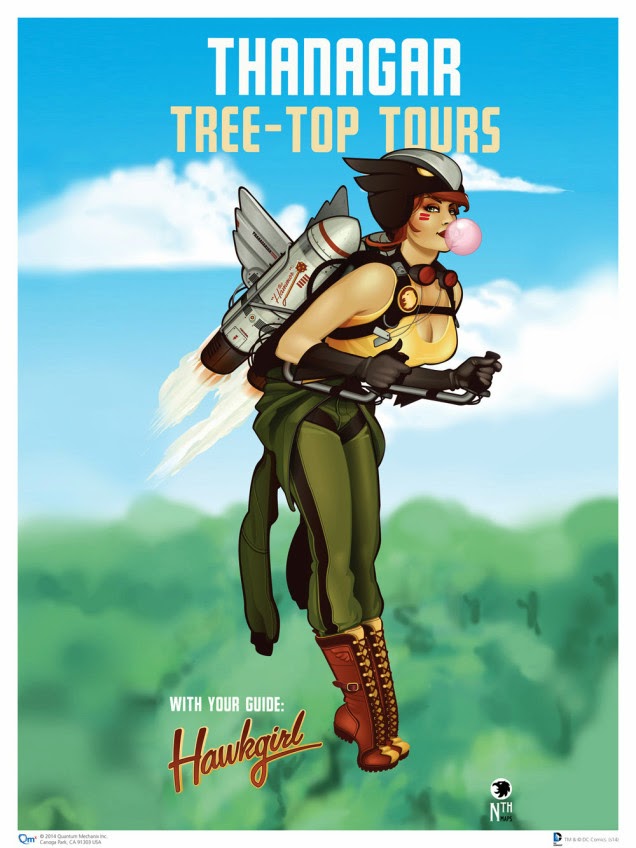
amyfrpppyhs56kirr6tw-734364I was just spitballing a version of the Hawkgirl character that DC has been floating around in their Bombshell series. We have the classic redheaded tomboy in a flight suit, lace-up boots, and a winged rocketpack, with a hawkman helmet. It’s a great 30s/40s image and I thought I’d do a basic write up of a pulp-period aerobat.

First, in Atomic Robo‘s Fate-powered system:

HAWKGIRL

Concept Aspect: Rocket-Powered Aerobat; Omega Concept: Yearning for Adventure!

Stress:  Mental – 3, Physical – 4

Pilot Mode +3: Contacts +4, Notice, +4, Vehicles +4; Aspect: Fly It Like I Stole It

Action Mode +2: Provoke +3; Aspect: Wingwalker

Banter Mode +1: Rapport +2, Will +2; Aspect: Sugar & Spice

Stunts: Barnstormer, Breakneck Ace, 2 more to be decided in play

…and then in Hollow Earth Expedition

HAWKGIRL

Archetype: Adventuress     Motivation: Escape

ATTRIBUTES:   Body: 2, Dexterity: 3, Strength: 2, Charisma: 4, Intelligence: 2, Willpower: 3

SECONDARY ATTRIBUTES:   Size: 0, Move: 5, Perception: 5, Initiative: 5, Defense: 5, Stun: 2, Health: 5, Style: 3

RESOURCES & TALENTS:   Artifact 2 — Jetpack, Attractive, Evasive Action, Lucky, Mobile Attack

FLAWS:   Impulsive, Overconfident

SKILLS:   Acrobatics 4/7, Athletics 3/5, Brawl 2/4, Con 2/6, Diplomacy 1/5, Drive 2/5, Pilot, Air 3/6 (Jetpack 7), Ride 1/4, Stealth 2/5, Streetwise 1/5

Jetpack — Size: -1, Def: 4, Str: 5, Spd: 100, Han: -2, Crew: 1


One of the few things that disappointed me about the Space: 1889 rules that came out recently was the lack of addressing Martian physiology in the rulebook. So here’s something more in line with what I expected for the new Ubiquity-powered game:

MARTIANS

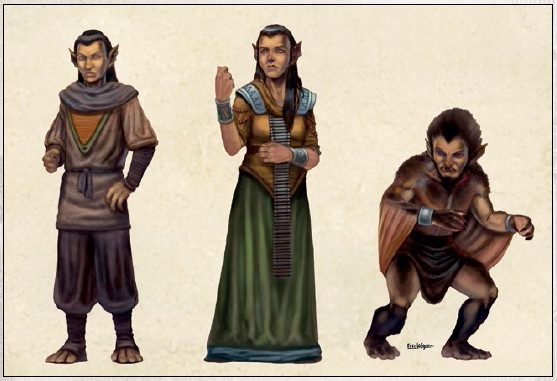
Hill, Canal, and High Martians -- as portrayed in Chronicle City's version

Hill, Canal, and High Martians — as portrayed in Chronicle City’s version

The denizens of Mars have three major racial types — the Hill Marian, found in the desolate wastes of the Red Planet; the Canal Martians, found almost exclusively in the urban and canal-fed areas of the world; and the High Martians — thought to either be the “Ur” Martian, or possibly a Hill Martians evolved to the particular environment of mountainous Mars.

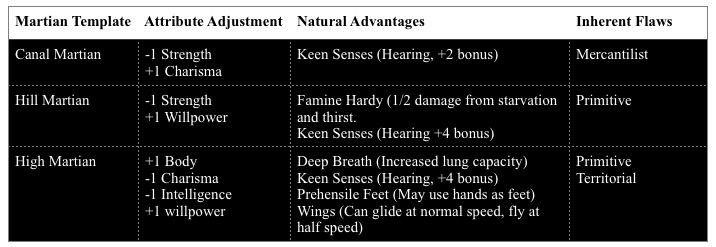
Using some of the Beastmen advantages from Mysteries of the Hollow Earth (pg. 14-25), I slapped together Martian character templates that were more in keeping with the original flavor of the game:

template

Venusians

Venusians aren’t set up as a player character in either any of the editions of Space: 1889, but I’m sure there are folks out there that might want to give them more to do in their campaign than be a poor man’s Sleestak. So here is a Template, vikked from Hollow Earth Expedition‘s Mysteries of the Hollow Earth to use to create a player character Venusian:

venusian

Update: Looks like the boys at Clockwork, over in Germany — the originators of the Ubiquity Space: 1889 noted this piece and are interested in incorporating it into future productions. Might lead to some more work, which would be nice.

RPGBlogCarnivalLogocopyRACES is the subject for the RPG Blog Carnival this year — hosted by Roleplaying Tips — and having perused a few of the entries, all of the entrants seem to have kept to the the safe zone of “species”, really — how to treat having dwarves, and elves, etc. in you game, along with a few excellent posts on building culture of these other races/species. But no one really has touched on race…because it’s like to cause a shitstorm if you stray outside the comfortably politically correct lines set up by critical race theory halfwits of the endless [your group here] Studies in academia.

I’ve already covered this in another post, and I’m going to borrow from it for this one. Please forgive my self-plagiarism. How do you approach different species or races in a game can be varied — from the “we don’t see color” notions of Star Trek to more accurate portrayals of race in historical RPGs. The key here is simple — if the players want to play color-blind, 21st century-style characters in medieval Europe, they can. If they want to embrace a period-specific game, that is appropriate as long as the table agrees to keep any racism and sexism in game.

But Scott! Racism and sexism are never appropriate! I agree. Neither is slaughtering people with swords, halberds, guns, and lasers. Queue the Schwarzenegger line from True Lies, “But they were all bad!” So is killing everyone in your way in a game an indication of psychopathy in your players? The first rule of thumb, when dealing with touchy issue in a game is to realize everyone has different comfort levels. Establish the ground rules before you start the game, and adjust if someone can’t cope with how things are going around the table. The first rule of gaming applies here: Don’t be a jerk.

For future-based games, most “racism” will fall under the category of allegory for modern issues. The players are likely to be the Star Trek-like heroes that find the notion distasteful and will gladly treat every new species, no matter how awful or culturally bereft as something to be taught how to love their neighbor in 48 minutes plus commercials. Hell, Peter Quill slept with an Oscararian (But it was just that one time…) Species and race, here, are conflated and makes it easier to approach the idea of hating someone or thing because they are different. There’s socially-acceptable padding to addressing the issue, and this second-hand racism helps to create verisimilitude — a feeling of reality.

Let’s look at a popular game setting for this blog: Battlestar Galactica, where the Cylons are “toasters” and “skin jobs”, and are viewed as a hated and feared “other”, despite their very obvious human characteristics and desires. Equally, the Cylons view man as obsolete — or “backwards” in racial or Social Darwinist terms — but we overlook the blatant racism as just part and parcel of the “fun.” Even when the show got heavy handed with the moral equivalence, you could fall back on “these guys killed 30 billion people…we have a few zeros to go before the score is evened up.” Can you address this aspect of the setting without being racism yourself? Yes.

What about modern games, however? Is there still racism rampant in the world today? Um…yeah, and addressing it from time to time can create a sense of realism, but don’t beat your players over the head with it (or let them do the same to the others.) It should be appropriate to the genre and flavor of the game. Are you playing a Tarantino-esque crime gang? Then the constant flood of racial, gender, and sexual preference epithets might help to create a faux 1970s flavor that particular director goes for. No my thing, but to each his own.

What about spy-fi or some other modernish setting? Is it always the imperialistic, peckish white male seeking to subjugate and ritual rape their lesser man? (I’m not kidding…I listened to this shit for six years.) No. Having traveled pretty extensively and having a fair bit of understand of several non-western cultures — racism is pretty rampant around the world. Trying being anything other than a pure Japanese male in Japan. That white privilege doesn’t even enter into the equation. How about being black or Muslim in China? Oh, you like to pick the “difficult” setting in the game of life! You can use this particular element of the setting’s culture to create a sense of reality. But here’s the thing: We play role playing games because we want to be something, if only for a few hours in the safety of fantasy, extraordinary. The brave fighters, the canny wizard or hacker, the fighter pilot, the plucky thief, the social diva — whatever…we want something larger than life. If addressing race or sex, or gender is uncomfortable, leave it out. Outside of your group, no one is going to know your incredibly artful approach to the issue of [insert pet issue here.]

Keep that in mind for games set in periods before modern day. Maybe your fantasy setting is the usual milquetoast Tolkein retread with the numbers filed off — you can ignore race/color, or gender issues, if you like. You can add a female lesbian elf warrior (and many a teenage boy does…) and no one looks askance. However, if the need for verisimilitude in a setting is important for the audience (your players) buy-in, you might want to approach the issue of race or sex more directly.

Race relations were not exactly stellar prior to …well, ever. And being a woman before the first sexual revolution of the 1920s was not conducive to a life of high adventure or being treated as an equal. And what if you were poor? Not a lot of crofters had the option to race off and explore the world unless they were wearing army red. The societies of pre-industrial nations aren’t known for their open-minded stance on gender, race, or sexuality. Combine that with class issues and the thought of living pre-1920 should put most people off. So how do you handle this? Set the reality dial too high and you will exclude certain character types, and by extension, certain demographics of players.

First off, no matter how real it is for the NPCs, the players are special. There are always exceptions to the rule in history. Boudica was a warrior woman who wasn’t about to take crap from anyone, but lived in a world where women were second-class citizens in the Britain of the Roman Empire. Joan d’Arc was a peasant girl and maybe a lunatic, but she was an excellent general. Mary Read was a successful pirate you didn’t mess with. Jane Digby and Lola Montez were different stripes of female adventurer when is was not acceptable, they knew it, and played to their eccentricities — to the delight of those that knew them (and the hatred of those who did not.) Tom Molineaux was a successful boxer, despite being black, in the 1830s and was the toast of town, getting away with things that no other black man could. The Lafayette Escadrille had a black pilot who was treated the equal of the others he flew with. (Plenty of women and minorities found escape in early aviation and motorsports. they might be on the harder setting of the game of life, as John Scalzi would put it, but they still got away with things most colored folks and women couldn’t because cars, and motorcycles, and planes, and jazz music, and movies were new — and this novelty insulated them to some extent from traditional values.)

The players’ characters are the exceptions, the special ones…and you can use this to also address racism or sexism because their vaunted position in the game allows them more latitude. Giving your players realistic impediments can (and should) be frustrating, but they should be able to outsmart, outfight, or out-politic their foes. They should have detractors who decry their stepping out of place or take steps to ruin the character socially, but there should always be those folks that back them. It’s actually pretty realistic, historically.

When dealing with different cultures and races (or species) it’s important remember this one uncomfortable fact — stereotypes exist for a reason. They are society’s “macro” for dealing with the other, but they are not always accurate, and there are plenty to folks who break the type. You should build up the expectations the characters might have for a foreign culture — be it the wogs in Sardinia, or those penny-pinching dwarves under Frosty Mountain, or the sneaky Romulans…then smash the prejudice with examples that defy the stereotype, or portray it in a different light. Those Sardinians have a very similar outlook and culture to your Scottish highlanders, just with a prettier language and better looking women; those penny-pinching dwarves actually believe that your have an obligation not to impose on other people — the cheapness is fiscal frugality designed to make you less a burden on your family in your dotage; Romulans aren’t “sneaky”, but adapted to life in a police state — they’re home life is loving, tight-knit, and suspicious of outsiders for good reason. Kind of like those thieving pikies. By using the racial stereotypes, you can break them by diving into why those traits exist, and why they were viewed incorrectly.

Here are a few examples of how race or sex was using in some of my campaigns, over the years:

Example 1: I often ran Victorian sci-fi games until my recent spate of ’30s pulp and space opera games. One of the players chose to play aristocrats almost exclusively. Why? Because of the freedom that money and connection gave her characters to flaunt convention and get away with it. She played almost exclusively characters that were socially adept and attractive — the sort that thrived in the nooks and crannies of the Victorian period.

Example 2: A young Chinese street urchin, female, who was able — because she was young, a girl, and Chinese — hence invisible, right or wrong — was the perfect spy and go-between for the Western male characters in 1936 Shanghai. She was always in danger of physical or official abuse, was often hungry and dirty…but her utility allowed her to tag along on adventures and gained her respect by from the characters. But that didn’t stop one from calling her “My little monkey” — racist and awful? Yes. Fully appropriate for the period? Yes…and that was all it was, part of the character, not the player (who was in a biracial marriage at the time.)

Example 3: A black woman who had gone into prostitution in our Victorian game, but who managed to seduce the right men, gain some level of financial stability and notoriety, then launched on a series of adventures with the other characters who — being the exceptions to the rule — were at least tolerant of the character.

Example 4: A female Martian in a Space:1889 game got involved with an American cowboy wandering the Red Planet. Despite their string of high-profile adventures and relative acceptance by Martians, human religious types viewed their union as “bestiality.” This caused them troubles, and was very realistic for the period, but these issues were not insurmountable ones because they are the heroes.

After about a month, I’m finally getting around to doing a new AAR for our Battlestar Galactica game. Originally, that’s because we had a couple of “let’s talk about our feelings” episodes that are great for the players, but don’t really work well for these posts (or a season of The Walking Dead, either…) But tucked in all that character development, there have been big doings that are driving the plot in a direction that both mirrors the show (RDM, not TOS) and breaks away from it.

When last we checked in, the Kobol mission had succeeded, the roadmap to Earth was recovered, and the team had brought back the Lord of Kobol, ATHENA, inhabiting the body of their CAG. The government and military are skeptical about revealing this to the fleet, but the word gets out and soon the priests are clamoring to have access to her. The crew is split between those who really need her to be their Goddess of War and Wisdom, right now, and those who either view her with suspicion — some kind of Cylon, maybe? — or view her as some kind of advanced being, maybe not a “god”, but certainly something greater than humans. Some of her acquaintances are trying to reach out, see if there’s any of their old comrade, others reject her outright. They don’t know how she fits — she’s not in the chain of command and is being careful not to interfere with the operation of the ship or the government; she’s not an officer (they declared her KIA), but has offered to fly with the air group, and they don’t know how to even refer to her — is “sir” really acceptable for this creature? The commander pushes this option, but quickly is dismayed that the crew are referring to Athena as “your holiness”, or “your divinity”, or “your grace.” They’re leaving offerings at her door. It’s annoying the shit out of her.

They discover that much of Evripidi (the character that was possessed by Athena) is still there, and the memories and personalities and memories of the two are often in conflict. Evripidi has made Athena understand humans like she never bothered to — she was always a creature of reason and kept herself apart from romantic interludes and real connections; now she has the memories of love, lust, sex to contend with. Evripidi sees a fellow spirit who has lost her whole race, and is now on a divine mission to aid not just humans, but “life.” In one cryptic conversation, she tells Pindarus, the commander, that she still instinctively is an atheist, but knows how terribly wrong she is.

The government is trying to use her to bolster the spirits of a people who lost everything, then were crammed into metal cans in space, with limited food, space, and no way to blow off steam or escape their reality. There’s elections coming up and the president was not running again. He was quickly succumbing to his cancer, but an experimental treatment using Cylon blood has put him into remission in a matter of a week. The doctor and veterinarian that came up with the idea are still claiming it was Colonial science, and not Cylon blood, that did the trick. They are trying to find ways to artificially create the “leukobots” in Cylon blood to start treating those they know will eventually be stricken with cancer after a protracted interstellar flight in ships designed for short-term radiation exposure. (We’ve already established that most Fleet servicepeople get cancer later in life; it’s part of “the life.”)

With the Cylons locked into a civil war between the centurions and other machines vs. the biologial or biomimetic Cylons, the fleet splits to try and increase their chances of success. Kobol is destroyed, and with it most of the Cylon industrial base. There know where the other Cylon outposts are, and have a good number on the remaining basestar groups. With hit and run attacks, Admiral Cain thinks it is possible to break the Cylon supply lines, confounded them, and distract them while the fleet slips away to Earth. In a best case scenario, Pegasus could carry the flight back to the Colonies, then follow the fleet with survivors they found.

There were some gang machinations that toppled one of the PCs from running the black market, and cost him his position as security minister after it was discovered his aide was a Cylon. This group — the Salamir Cartel — is one of the oldest, savviest criminal enterprises, and they are getting involved in politics, looking to set up an alternative party to the Pindarus “regime.” They get some traction when the fleet stumbles across a Cylon battle group running from the centurions. After some tough moments, they finally manage to cut a deal for prisoner exchanges, and a truce — at least with this group. The president manages to catch enough support in the fleet (it was a HEROIC leadership test) that it’s mostly stable. But the Cartel is working to undermine him, already, and they are getting traction when in a show of trust after her near death defending the Kobol mission, Boomer is put back in uniform.

The crew is, again, split. Most are distrustful and furious, they think the commander is losing it. Others, including ATHENA think this is a necessary step. The cycle of hatred that has played out across time hasn’t worked, maybe it’s time to try the hard road of redemption and forgiveness. Pindarus risks his credibility by putting the one other Cylon that chose not to be exchanged — a Three that had been a sleeper in the Colonies, and still has trouble separating her “human” cover identity of LT Ishtar Biroi from her Cylon side. The commander is gaining insight into this sort of struggle from Athena, and decides to give her a chance. But the sides are hardening toward a possible mutiny, and it’s even splitting families in the fleet.

This is a subject that comes up frequently in RPG circles: Realism — how “real” should your games be? Ultimately, the issue is that you are not modeling reality, but are engaged in some form of storytelling. Dependent on the demands of genre, or the style of story told, your “reality” is likely to be different. Realism, however is the wrong word. A more appropriate one would be verisimilitude:

ver·i·si·mil·i·tude ˌverəsəˈmiliˌt(y)o͞od noun: the appearance of being true or real. “the detail gives the novel some verisimilitude.” Synonyms: realism, believability, plausibility, authenticity, credibility, lifelikeness “the verisimilitude of her performance is gripping”

Not only is it more accurate a description of what you are trying to explain, but it’s a damned cool-smart word.

Almost no movie, book, or game is going to be based in “reality.” There is some aspect of the fantastical — either you are in a world with elves, dwarves, and the like; or you are in a spy-fi world where you go out and hunt down bad guys (or are bad guys engaged in amazing acts of cool criminality) instead of sitting at a desk reading and translating a five foot high pile of SIGINT captures and hoping the TS-cleared coffee guys at the Starbucks in the lobby showed up today, while negotiating the hazards of the CIA Style Guide; or you are fighting killer robots in space, in airplane like fighters that have no business being plane-like in space; or you are fighting zombies/robots/ancient horrors….

See my point? Not reality. But you can use elements of reality to make it feel real. Steven King, for all his faults, is a great horror writer because most of his books start out normal. They really dig into the mundanity of every day life so that when things tip into the supernatural, or simply the dangerous (like getting stuck in a car with a rabid dog outside), the stakes feel heightened.

Why did the reimagined Battlestar Galactica work so well? Because it felt real. Clunky intercom phones, realistic military jargon, battered metal ships that broke down, guns not lasers. In the end, even the ability to do FTL jumps could be waved away, as there were issues with the time to “spin up” or distance limitations. The outlandish technology felt real because it seemed to have limits and they were consistent.

In multiple action movies, guys can shoot a propane tank –which, by the way, is probably built tougher than an actual battle “tank” — with a 9mm and BOOM! We don’t question it. You can shoot a car gas tank (again, kinda engineered to resist punctures) and BOOM! Pistols are magic. The heroes can fall ridiculous distances and with a pained grunt, limp away. We buy it. Grenades apparently explode in a neighborhood-sized ball of fire (they don’t; I know) and that fireball will travel linearly (just turn the corner!) and only as fast as you run/drive/fly. Is that real? Or even remotely realistic? No — but it is part of the tropes of that genre. It is the reality of that universe.

Is Tolkein “realistic”? Hell, no; but between the rich history, the different languages, the maps, the great characters, the feeling of real injury and danger, and the general consistency of how magic works, it feels real.

The key to verisimilitude is to, from the start, have a set of rules for the universe, or at the very least, an understanding of how it works. If technology works a certain way, don’t rewire the spiraling quantum whatsinator in your deflector dish this week to solve and issue, then forget all about it the next. If time travel requires living material, then your morphing death machine should still have to be inside a living creature to travel (and then it can be much more frighteningly revealed…) If your Cylons can’t breed, why? Is it “God” stopping them, or something to do with their bio-tech hybrid nature?

Example: Often when I run “spy-fi”, the game universe is based pretty tightly on how the nations, agencies, groups operate in reality. There’s politics to take into account, there’s technological limits to satellite imagery, cell phone captures, etc. You can’t get from Washington to Dubai in less than a day (but it’s still a nice smash cut for the sake of getting on with it.) You spend time doing some investigations, but often the analyst team has done the heavy lifting for you…otherwise, you are gaming sitting in an office going over reports and transcripts of phone calls. Guns aren’t magic, nor are explosives; you can only pack some many gadgets in a high-end car and if you keep breaking them, eventually they’re going to give you the Nissan subcompact rental with you have to pay for the insurance. This helps it feel real.

But you can still do things that are outside the norm of human ability — after all, you’re the heroes. And the villains are sometimes going to be larger than life — because that’s spy-fi. you can’t be hunting the same group of Islamic terrorists week to week; sometime you have to go for that evil environmental philanthropist looking to collapse the world economy to make another tens of billions on shorting currencies. (Not that governments would send you after these guys…they’re the politicians’ bread and butter.) This is what keeps it fun.

Depending on the genre and tone of the game, there will be a natural balance between the fantastic and verisimilitude. A ’30s pulp game could run the gambit from a Raiders of the Lost Ark setting where high action, very tough characters, and really high stakes (and the occasional supernatural) are going on but few generally know, to something a bit more outlandish like the plethora of masked crime-fighters from The Phantom and The Shadow to their more successful derivative, Batman. Pirates are loose in the world doing evil things, villains dress up like clowns, or guys have the power to “cloud men’s minds.” There is a natural step away from realism in these settings. You can embrace it, or you can try to amp up the “realism” but that only works if you show how unusual the hero and villain really are. (The Dark Knight does this to good effect in the first 2/3rds of the movie — Batman is established, but still odd, still an outsider; and the Joker…?)

Another great example of how verisimilitude can work is The Incredibles, a movie I borrowed a lot from for my short-lived Marvel Heroic RPG campaign. The heroes are pushed out of adventuring and crimefighting under the weight of a litigious society and ordinary folks’ envy and fear of them. I combined this with the desire of the state to box, catalogue, and control pretty much anything they can (read Seeing Like a State by James Scott) to make a game setting where heroes and villains exist, super-powered creatures have been around since the beginning of time, but with the population boom of the 20th Century, what was once a rare thing is still statistically rare, but common enough to be an ever-present threat. To use your powers, you needed licenses and insurance against damages. Many of our villains were folks that couldn’t get these permits and started operating outside the confines of the law. There was “the Crane” – a super-strong guy that worked construction illegally, but because it’s a federal crime, it’s a felony; there was the Hollywood heartthrob hero who liked little girls and lost it all. There were special teams of supers and well-trained normals with incredible gear to stop the bad guys. But it had certain rules to ground it in a reality where the normals were desperately trying to control creatures that were beyond that.

So how “real” do your game settings have to be? The answer is “it depends” — look at the conventions of the setting you are working with through the lens of the tone you want. There should be a natural balance that you will arrive at. Then be consistent with your rules.

Glen A Larson died at UCLA Medical Center of esophageal cancer this weekend. Without this producer, we wouldn’t have had the Star Wars knockoff that would be the inspiration for one of the best science fiction shows in TV history.

Since that reimagined show, and the RPG tied to it, is a (if not, the) major draw of visitors to this site, I thought it would be appropriate to mention him.

« Previous PageNext Page »