There’s a new Google+ gaming question running about concerning the seven games you play the most. Considering I haven’t gotten to play in a game until a few one-shots at the local game store recently (the zombies on a cruise ship was such a good set-up I even ignored my zombie fatigue to play in it…), I figured I’d go with the seven game I’ve run most often (starting with the most recent.)
1. Battlestar Galactica (Margaret Weis Productions) — 2007 to present
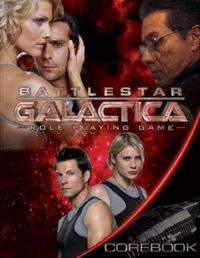 I first started running this about halfway through the series. Anyone familiar with this blog has an idea of the things I’ve done with the setting and plotlines to make it work for the groups, but here’s a quick recap:
The first campaign was a “second fleet” style game, with the characters having two characters each — a set of ground survivors, and members of a battlestar, Pleiades, which had been doing some deep space exploration and returned to find everything gone to hell. Galactica and Pegasus were out there, but they never were able to link up. I ran it close to the new series, canon-wise. It rand for about two or so years, then imploded with my marriage and loss of half the game group.
It was one of the games that the new group was interested in, so it came back, but adapted to fit some of the game style preferences of the players — more Cold War intrigue and paranoia prior to the Fall (coming soon!) More chances to try and stop the attacks, or possibly win them.
The game runs on the MWP Cortex rules — not the “Cortex Plus” they foisted on us with Leverage and Smallville (gag!) Character creation is fast and easy, play is not hampered, but enhanced by the rules, and it the first rules sets to come along since James Bond that I would gladly use for just about anything.
2. Hollow Earth Expedition (Exile Games) — 2007- Present
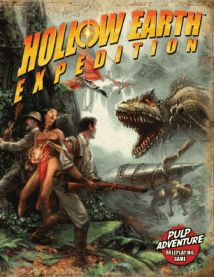
Ubiquity is one of those rules systems that hovers on the edge between rules lite, with fantastic mechanics like “take the average”, but bogs down a bit in too many modifiers and special rules in combat (most of which I now just ignore.) For pulp action, it’s almost perfect, and one of the licensed products using the system, League of Adventure, looks to have adapted it well to the Victorian speculative fiction subgenre.
We’ve had several campaigns using HEX. There was a game that was based in South America oin which they found an entrance to the Hollow Earth. That campaign fizzled a bit toward the end, then died for the same reasons as the BSG game. I’ve used it for the Gorilla Ace campaign, as well as an early ’40s Cold War game (Artemis Campbell — our take on Modesty Blaise.) The most recent game was set in China and has suffered the loss of most of the players, but the new group iteration looks to be interested in playing more of this.
The weak part for me is character creation, with is a bit math heavy and overly complicated (in my opinion, but at least you don’t need a Cray supercomputer like you did for early GURPS or Champions.)
Now if they’d only get the Revelations of Mars sourcebook out!
3. James Bond: 007 (Victory Games) — 1984 to present
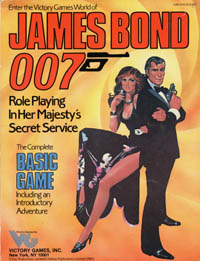 This was my go-to rules set for anything modern. I tweaked it, back in the ’90s to run Cyberpunk effectively. It was used to run a Stargate campaign. There’s been numerous iterations of the campaign — MI6 agents, CIA, private investigations/espionage (before this became cool with the Terror War), Miami Vice style cops…
The system is a percentile dice roll under your attribute or skill x the difficulty rating. Guns and cars all have different modifiers and are much more diverse mechanically than in many game systems. This can be a hassle unless you are looking for the brand-name cache that Bond (or Miami Vice, for that matter) bring to the screen — can your Aston-Martin DB5 outmaneuver and outrun a Ferrari F355 like in Goldeneye? (Hell to the no!) But the game did do a good job of making some vehicles and weaponry more attractive than others.
Character creation is a bit more involved, and if you aren’t using the tables on the excellent GM screen (eBay!), you can occasionally find it math heavy.
It’s still my favorite system, more from nostalgia than anything else.
4. Castle Falkenstein (R Talsorian) — 1995 to 2008
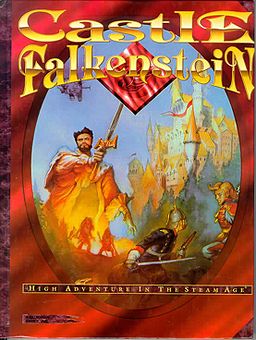 I had already been running Victorian sci-fi since Space: 1889 came out but found the GDW rules problematic, to be kind. Falkenstein‘s card-based system (“Gentlemen don’t play dice…”) was novel, the character creation was very easy and quick — and since this game, I’ll admit that any character creation that takes more than an hour for the first go-’round annoys the pants off of me.
The weak part — the background. This was the first attempt to “Shadowrun” a Victorian game. Elves and other mythic beasts are there to get the D&D crowd to buy in; I ditch the fantasy aspects and stick to the more 19th Century speculative fiction side of things. The other was combat. The design was an attempt to emulate fencing, but not the cinematic fencing a game liek this should be putting forth. It was awful and overly complex. One of the players and I kit-bashed a combat rules set using the standard card deck of CF with the combat design of Lace & Steel to create a fast combat system that made it fun to forget guns and go with fisticuffs and swords.
The first campaign was simply Space: 1889 with CF rules to play by. It worked beautifully. The other campaigns, over time, lost the Space: 1889 elements and became more Earth-bound historical with science fictiony bits games…what can I say? I’m a historian!
5. Star Trek (Decipher) — 2000-2006
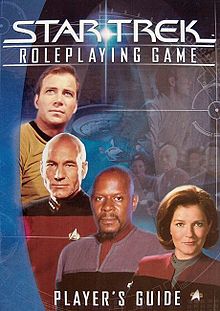
I bought the Last Unicorm Games Star Trek sets because they were beautiful and had elegant rules systems, if they did have the dreaded race/class elements of D&D. I never got to run LUGTrek before it folded, was bought up by Wizards (IIRC), then was spun out to Decipher, which treated the franchise like a hated wife with herpes that you just can’t seem to give up.
The mechanics were solid, character creation wasn’t too much of a chore (still — races and “classes”) and for a while there it looked like this might be the one to carry the Star Trek role playing experience for a while. And like every other line, it died.
Star Trek was always the white elephant of gaming to me. Seemed like a great idea — a setting everyone is at least slightly familiar with, rich universe to plump…but it never quite worked. It felt, much like most of the series since “the Old Show”, soulless.
I originally planned it as a minicampaign for a Trekker in the group. It would up running six years. One of the things I did was throw canon right out the window. Whole movies and series were ditched. Technology was not easily and quickly convertible. No more turning the deflector dish into a can opener. The Federation was a wondrous place where everyone did adult education and bad art; the only place for the motivated and talented was politics and Starlfeet. By the end we had androids and sentient ships – it was an attempt to fuse “Singularity” style sci-fi (before it was cool) with Trek. It worked beautifully. Sadly, I think it’s one of those lightning in a bottle scenarios — I don’t expect to pull it off again.
Sticking with the idea of the stuff I ran the most successfully rather than most recently, I’m going to not put some of the games that got run for a short time. There was a decent Serenity game that I wrote myself into a corner and couldn’t plot my way out. It was also my first attempt to sandbox a game, and got to watch the characters/players wander where most people have gone before…boredom; it’s why I disagree with a lot of GM advice out there. Try not to railroad the players, but construct the adventures in a way where encounters will happen and seem natural, even though they were pre-ordained. Another would be Marvel Heroic Role Playing — which uses “Cortex Plus” and is the first of the post-Jamie Chambers stuff to really do a great job.
6. The Babylon Project (Chameleon Eclectic) — 1997-2000

This one is a bit of an odd-man out. The character creation is a bit clunky, the base mechanics easy (two dice — one a plus, one a minus, add/subtract to your skill vs. a target number), but the combat was clunky. For some reason, however, I “got it” — the damage allowed for the kind of stuff that I heard/saw in the military: serious injuries that didn’t phase a person, minor injuries that dropped a body from shock, and everything in between. Ship combat was cribbed from Full Thrust and was great.
It didn’t hurt that this was the big show for us, at the time. I’d gotten into it with the G’Kar and Londo in the elevator episode and we stuck with it through the crappy movies of the 2000s. I ran a rogue colony of “Amazons” — humans that had been protected by one of the lesser Old Ones which had pretended to be Olympians in the classical period. They were another front of the Shadow War and were allowed to do their thing without bumping up against canon too badly, until the end fight at Coriana 6.
Great characters and adventures kept it moving despite a clunky system and I’ve given thought to buying the old books online after a glancing blow with the disastrous Mongoose Babylon 5 d20 stuff. (To be fair, they too 3ed as far as they could to make it work.) It was, like the Star Trek game that followed it, a bit of lightning in a bottle. When I attempted to run a d20 version, it just sort of fizzled out.
7. Space: 1889 (GDW) — 1989-1995

As with The Babylon Project, this game is a testament to how a great setting can overcome shitty mechanics. Character creation is plenty fast, the die mechanics are easy but mathematically unsound, but who cared! I was a redcoat on Mars flying a cloudship!
I bought it right off from The Complete Strategist there in downtown Philadelphia, worked through an early campaign with almost no knowledge of the period, and within two years was a bachelor degree holder in history , specializing in the Victorian period. (It’s a common thread that my professional and gaming life mirror each other…)
Even when we found better mechanics, we clung to 1889 setting queues long into the 1990s. I keep thinking of bringing it back, but the Victorian “pulp” and ’30s “pulp” have a lot of the same tropes and the guns and cars and planes of the 1930s seem to be more accessible for players. (It’s a similar problem between Space: 1889 and Serenity — both are Old West/Victorian period pieces, just one has Verne-style spaceships, the other more realistic looking ones.)
Prior to Space: 1889 most of the GMing or playing I did was either in James Bond: 007 or DC Heroes games during the Philadelphia years, so I could have made a good case for the latter as my number 7.
(Turns out Martin Ralya did something similar over on Gnome Stew…)



 The Black Campbell