My novel Perseus is now live over on iBooks, Nook, and Kindle, and is headed to Kobo and Sony readers in a few days. Only $1.99!

Here’s a preview.

I’d appreciate if you left a review or rated it the book, should you buy it; thanks!

There’s been some talk about one or more of the other players taking over GM duties from me from time to time (if only it works this time!), as I’m inundated with a 10-month old, dissertation work, new part time work at a local university, and projects that I hope will come to fruition this summer. (Can you say Kickstarter? And spies..?)

One of the players was thinking of running a fantasy campaign, but we’re all pretty united in not liking d20 — either Dungeons & Dragons or Pathfinder. We also are serious anti-GURPers. I figured I’d have a look at The One Ring by Cubicle 7 for system ideas. And hence, this review…

First off, I can only speak to the pdf version, but judging from the production values of the files, the books are probably nicely done. I understand it’s two hardcovers in a slipcase, plus two maps. The books and maps are done from the proofs for the pdf version of the game, not some lame scan, so the quality of the maps is tremendous — you can zoom in tight and have good quality  graphics. The books are nicely done, full-color pages with decent artwork. The files are also well optimized, so there’s not a lot of the lag time in getting legible views when turning pages on the iPad, unlike Margaret Weis’ Leverage or Smallville files, which are disastrously slow in loading.

The game mechanics are delightfully easy. Roll a d12 plus a number of d6 equal to your skill. You can use “hope points” to add attribute dice. Get a 6 and you succeed on the skill dice. Get a 12 on the d12 and good things happen to you, 11 and something untoward happens, whether you succeed or not. (On the game box set, the dice are modified — the d12 as an Eye of Sauron for the 11, a Rune of Gandalf on the 12; the d6 as another rune to indicate success.) You try to beat a target number between 10 and 20 (for the most part.) Combat works not with the traditional initiative, but rather how you position yourself on the battlefield — more on that in a moment.

The Adventurer’s Book is the character creation/player handbook. It has most of the rules in it. Your characters are chosen less by the class/race of traditional fantasy games, that by a culture — the Beorning, Dwarves of Lonely Mountain, Elves of Mirkwood, Woodmen of the Wilderland or Bardings for humans. Your culture gives you “blessings” and your skill packages are driven by the same, although you can tailor the character for their own background, etc. There are only three attributes: Body, Heart, Wits. Hope points work like the tradional hero/plot/fate points in most games, but as they drop you can start to pick up “corruption”…if you do bad things, or questionable things from a cultural standpont, you can start to feel the draw of the Evil One. Characters can be Weary, Miserable, or Wounded and this effects how well they can function.

The Loremaster’s Book is the GM book and much of it is given up to the how and whys of running a game — how to set up encounters, the differences between combat and other elements of play. It deals with the mechanics of the corruption mechanic, gives examples of the adversaries you could run into, and a lot of material on the world of Middle Earth post-The Hobbit, but pre-Lord of the Rings.

It’s an interesting period to set the game — it’s a point in the Tolkien settling that is hazily defined and leaves a lot of room for adventuring and heroics without interrupting the upcoming action of LOTR. In general, games set in Middle Earth are either bogged down by the pedantic, heavy detail of the books. It’s great for setting depth, but it can overwhelm play. The One Ring gives you enough to know what is going on, what the area focused on is like, but leaves the heavy history to Tolkien’s works. If you need more detail, crack open the applicable novel.

Tolkien’s universe is less about killing the monster and stealing the treasure than the usual fantasy game. The McGuffin of Smaug aside, much of The Hobbit is about getting there, meeting other people and dangers on the road, and how these encounters change you for better or worse. TOR does a good job of emulating this feel, much more so than any iteration prior to it. Allegedly, C7 will be putting out another three “core” sets that cover The Lord of the Rings, expanding the setting to cover other races, events, locations.

The books and maps are gorgeous and style is definitely a 5 out of 5. The mechanics are light, but not too much so, and are designed to drive role playing, and to emulate the flavor of Middle Earth — I think successfully. Substance is 4 out of 5, more because they had to skimp on a lot of the background material to keep the game focused and playable. It’s worth a buy — especially for the under $30 price for the pdf. (The box set is $60.)

Sooner or later, you will most likely have a time when a new player is coming to join your group for the first time. When this player is an “experienced” player — someone who has played at least a few times — this is not as big a jolt as getting a new player — someone who has never played before. You would think that most groups would love new blood in their company, but this is not always the case…

Some groups play together for years. They’re comfortable with each other, with how they play, their GM’s style of storytelling, their characters, the worlds and systems they run. Change can be uncomfortable, but if the new player has been vetted a bit, the entry of a new player can really charge up a gaming group.

One of the best ways I’ve found to vet a new player is simple: meet them in a non-game environment, like a coffeeshop or wherever to chat about games, what they’ve played, what you play, the personalities of the group. Like a first date, you want to get the broad strokes of who this person is and what interests them in gaming. If they get along with a few members of the group, they’ll usually get along with the group in toto. (Usually, it’s just me doing the vetting in my group, but bringing along another player isn’t a bad idea.) This allows you to weed out the stereotypical crazies of the hobby (like the 300 pound “ninja” whose highly honed senses couldn’t pick up on me and my roommate of the time slipping past him and into our apartment building during the “stalking” phase of dealing with him), those who are sharply different (and not in a good way) from the rest of your group (usually this manifests in game preference and personal politics…putting a screaming socialist in a group of conservative/libertarian gamers? Not good.), or who simply don’t get on well with the group.

Once you’ve established there is a good fit, the first night’s going to be where the rubber meets the road. Do you let them create their own character without really knowing what the rest of the group is playing, what the feel of the game is? Or do you drop a pre-generated character on them and toss them in the deep end? If you are deep in a campaign, it might not be the best to do either, but rather get together for a character creation jam. I prefer to do a pre-gen character if your group is only playing one game, and do a side mission — a flashback or a side quest. Optionally, a good idea, if you’re playing different games from time to time is do a one-shot in another system and setting — something that puts all the players on the same starting line and knocks everyone out of their comfortable, established relationships and expectations.

Don’t focus too much on the new person in this latter option, but make them an important, if not the most important character in the piece. Even if they’re not the lead, they should be above the line, as they say in the movie biz. If it goes well, integrate them into the existing campaign. Often, I like to fire up a new game and campaign to include the new person. For existing games, I try to bring them in at a decent break point, but that’s not always doable. For the traditional dungeon crawl, it’s kind of hard to have them “just appear…” find a good way to bring them in: were they a prisoner of the bad guys? Are they part of a failed expedition that preceded the group?

Introducing a new player/character to an existing game, I feel needs a “teaser”, to use TV/movie lingo — a set-up sequence at the beginning of the night that is short enough to be interesting to the other players (who should not be involved) to give the character a chance to get the flavor of the game, campaign, and their own character. This is similar to the action movie set-up where the character is introduced on another quest/mission in media res — Indiana Jones in South America 1936 in Raiders of the Lost Ark, for an example…once we see them in action, bring in the scene where they meet the others. Never kill off a character in the teaser!

For those new to gaming in general, introducing the new player is a bit more tricky because you’re not just selling you game and group, but the hobby in general. There are a few good ways to do this: run a solo game for them — something simple and straightforward, there’s no pressure to “be good at this” (as my wife would say.) Pick a simple system that is easy to learn on the fly. For introducing my wife to gaming, I chose a quick spy mission set during the 1936 Winter Olympics. Her character is a rich socialite with an adrenaline junkie personality who gets enlisted in finding and recovering secret papers a former mentor has stolen from the Nazis. There was a teaser set in the part to give her a feel for her background, then there was the opening scene setting in Germany and meeting her former mentor. Social tests and roleplaying were the focus. He gets killed and she chases the bad guys down the Zugspitze: chase and action tests and how they work. It flows quick and gets them into the fun. There was an investigation/problem solving sequence to search the mentor’s room and find clues to where the papers are. Another social sequence to get invited to a big Olympics party with the fuhrer himself. A scene where she has to stealth around the ski chalet and find the material, then a escape without detection. There was to be a big fight sequence, but she played it smart, outfoxed the bad guy, then escape to Austria in a stolen staff car.

A leads to B leads to C. Simple. Fun. I chose Hollow Earth Expedition because i know it well and it plays fast. She had fun. She now games. Had her first experience been the next game run by a former friend, she would have given it a pass. He wasn’t really into it, the characters didn’t quite jive, the adventure sort of meandered with little direction from the GM on where we needed to be going. It was boring. So to recap: simple, fast, no chaff.

Bringing them into the existing group, it’s pretty much the same advice as above. Make sure the new guy/girl gets enough to do (as withe all of the players), try and keep that first night or two simple and fast-paced. First and foremost, I think it’s important that the people get on well — gaming groups that meet just to game can last a long time, but I prefer to game with friends — people I want to see outside of the gaming group. It makes the play that much more entertaining.

This is loosely based on the mission the group played last week. It’s for a team of four to six spy/military type characters.

Moving on intelligence gathered at Camp Delta from a Russian arms dealer, the team is being put in play to stop the sale of weapons from the bratva (Russian mob) and al-Shahab in Somalia. the method of delivery is keen: the freighter Kapitan Kurila has been “hijacked” by Somali pirates and brought into port in Mogadishu. Their mission is two fold: 1) destroy the shipping container (standard 20x8x8′) with serial number BF20389 and the armaments (including explosives, ammunition, etc.), and 2) capture/kill the arms dealer’s number two guy who is moving into the lead position, Igor Borodin. Borodin is with the deal to do a face-to-face with the al-Shahab #2 Sheik abu Yassou Rouma. Abu Yassou, if discovered, is eminently expendable.

Satellite imagery puts the freighter at the wharf inbound of the southern waterbreak. There’s easy ingress from the sea, but a 50 yard area to cross that will most likely have Somali terrorists hanging around waiting to offload and take possession of the weapons. They can come in from the sea, as well and board on the starboard side, away from the wharf. (Use Google maps — they have a good shot of the area I’m talking about.)

The ship itself is a 300′ Feeder-style freighter with the cargo holds modified to take standard containers, two arranged side to side, with up to four or five stacked on top of each other. There will be a small area to maneuver around the containers to check numbers, gain entrance, etc. The gunwhales of the ship are lower than the main deck, allowing for relatively easy access (EF5 Mountaineering.) There are three holds, searching each will take about 3 minutes, during which time they should have to be careful of the crew of 14 and about 4 of Somalis. An EF6 Demolitions is needed to destroy the container, delivering a DC L to the container, and a DC H to the boat.

The team members looking for Borodin will find him on the second deck of the superstructure in the officer’s wardroom with Abu Yassou, two former-Spetnaz-types, and there is a Somali lookout in the corridor. Six of the crew are in the first level wardroom watching Russian porn and with a good Charisma EF4 can be subdued. There is a man working the ship’s crane, there are three men aiding in moving the containers, and two guards roving. The Somali guards are on the cargo deck with the loading crew. There’s about a dozen ashore waiting for delivery with a couple of pickups they are going to offload into. The sheiks old Mercedes-Benz C class is there, as well.

Any alert and they’ll have the place swarming with the Somalis from the wharf. Ten minutes after a firefight starts, they’ll have more bad guys than they can handle.

They will extract by boat to a waiting submarine.

Have fun…

I was watching the last few episodes of Chuck and there’s a great moment where Sarah says, “So, it’s one last mission.” All the male characters at this point groan and shake their heads. “You never say that!” is the response. Because anyone who’s ever watched a heist-gone-wrong flick, or a spy film, or pretty much any movie or TV show know that when the phrase “one last job” comes up, you’re going to get butt-raped by a mastodon without the benefit of lube.

So to adequately reflect that, I suggest anytime the phrase “one last job…” or some variant such as “Just this last mission and we’re gone…” the GM automatically has, at some key moment, the player reroll a task and take the lesser test. Either that or give them a plot/style/whatever point in advance and them just simply screw them over as part of the narrative.

A variation on this is the “Goodbye, Mr. Bond” house rule I have. If the henchman or villain at some point uses that famed [phrase, you get an automatic style/plot/hero point to use for your cunning escape. The players will often try to get me to say it in a sticky situation, and from time to time I have. The point usually save their lives. You could also do this by GM fiat.

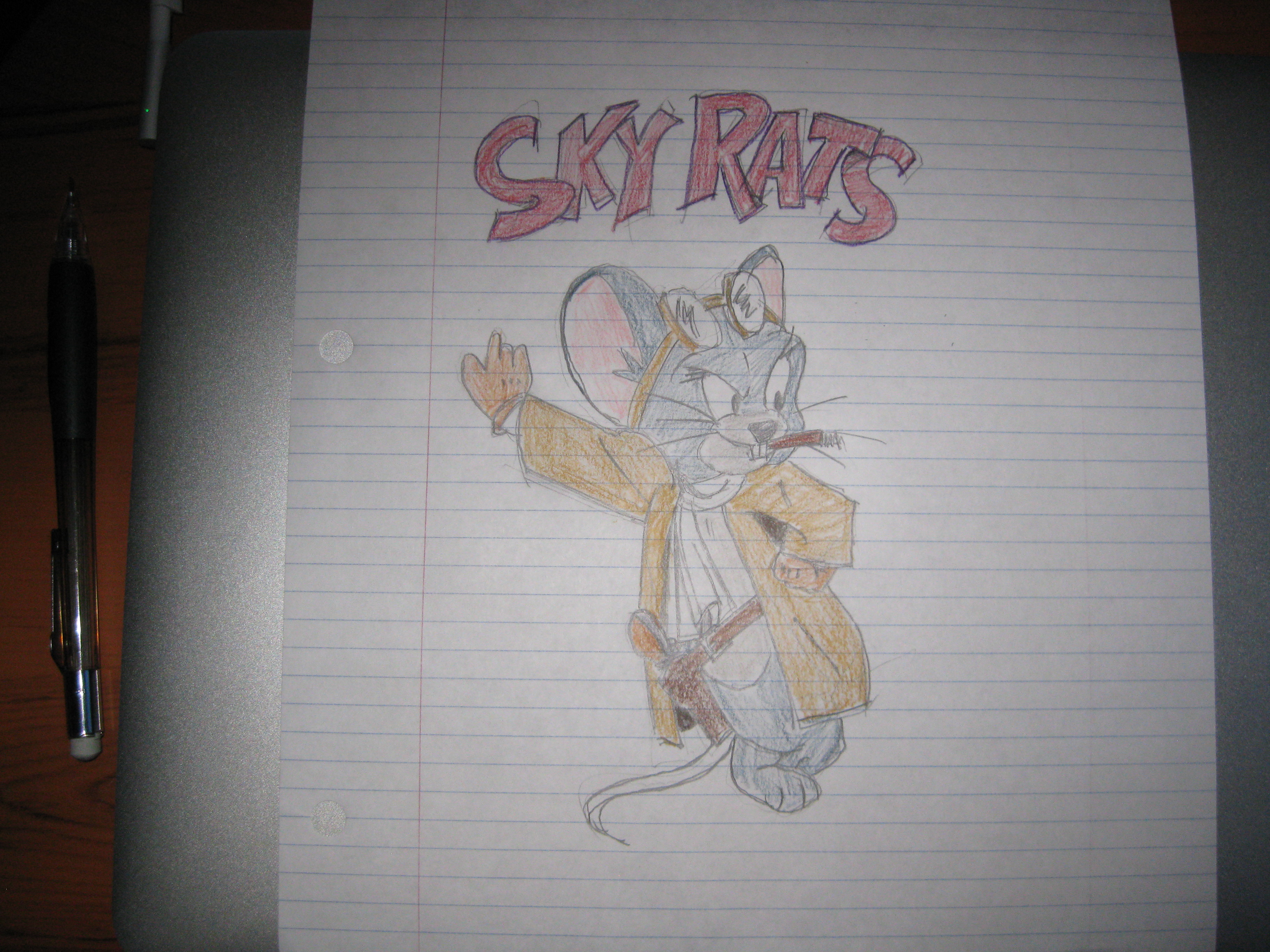
I spent the morning, on and off, drawing a flash for the Sky Rats. The initial passes had it as a crusty, nasty looking thing, but I realized that in the back of my head i was seeing something more Hanna-Barbera (yes, they were primarily the ’40s, but that’s the look that came to mind.)

So after 6-7 passes, I was able to finally get the look right, so here it is — the Sky Rats squadron flash & nose art:

My novel Perseus is now available on Smashwords, as well as Amazon and Nook, and should be going hot on iBooks, Kobo, and other readers in the next fortnight or so. Click on the pic to get to the Smashwords site, which has all the formats your wee heart could desire! Only $1.99!

Thanks in advance!

The final bit of our Sagittaron interlude sees the ship come under attack by Sagittaron terrorists, who use a resupply freighter of a defense contractor to get inside the flight pod of the vessel, then jump out while inside the pod, doing a ton of damage to the craft. There was a bunch of important scenes: the CAG, who had been running a PT test in the companionway near the entrance to the flight pod has to get his people out safely and seal the section. They lose three pilots and about a half dozen enlisted. The command master chief has to run the damage control board and to keep the fires that are sl]pinning out of control in check, he vents the compartments effected — fast! — and then does an excellent job managing the damage containment from the CIC. The commander has to coordinate getting the ship under control: it’s been knocked into a flat spin and lost enough energy it’s slipping into a lower orbit.

While all this is happening, another (they assume connected) attack on the Sagittaron archeological dig they’ve been defending is aggressed. The MARDET commander has to secure the location and send out skirmishers (led by her gunnery sergeant PC) to gain intelligence and knock ’em down. They finally get support from the local base and air support from Aegis once the characters have everything under control. In the end, they manage to keep the dig site safe.

The ship is headed for Scorpia Yards for repair, so they are pulled off the mission on Sagittaron, which is passed onto the Night Flight battlestar group. But there’s questions unanswered: Where did the ship jump away to and can they find it? Were the dig attack and the attack on the ship coordinated and connected…? It seems unlikely they weren’t. Who stood to benefit from stirring up trouble between the Sagittaron separatists and the Colonial military? It was almsot assured this would go badly for the Sagittarons, and would spur military action…was it a false flag mission?

…and here I thought i was done with the BSG-related posts for a couple of weeks.

While looking around for a nifty internal cutaway the inestimable Ice Dragon did (at least I think it was him) on the battlestar Valkyrie (and did not find, by the way), I was looking at his excellent fleet size graphic, comparing the various canon and otherwise vessels and found that my estimate of this class of vessel was smaller than I had originally written up.

So here’s an adjusted version of what I call the Erynis-class (there’s no official class name.)

Erynis-class Light Battlestar

DIMENSIONS: Scale: Spacecraft, Length: 2680’, Beam: 1019’, Draught: 426’, Decks: 17, Crew: 919, Passengers: up to 1000

ATTRIBUTES: Agility d6, Strength d12, Vitality d6, Alertness: d8 **, Intelligence d8, Willpower d10

Initiative: d6+d8, Speed: 5 [SL/JC], Life Points: 18,  Armor: 4W, 4S

SKILLS: Heavy Weaponry d6, Mechanical Engineering d4, Perception d6, Pilot d4

TRAITS: **Early Warning Variant [Has the roll bars seen in Razor] Features a large interferometer wing that gives an Alertness of d10; New Ship Smell d4, Slow to Launch [Complication] d4***

ARMAMENT: Heavy Skirmish-Range Point Defense System [d12W Vehicle-scale], 14 Capital Range Heavy Railgun Batteries [d12W Spacecraft-scale] which can also fire Short-DRADIS Heavy Railgun-Fired Missiles [d12W Spacecraft-scale], 6 Short-DRADIS Nuclear Missile Systems [d12+d4W Spacecraft-scale]

AUXILIARY CRAFT: 18 Vipers, 10 Raptors, 5 Shuttles

*** The Erynis was designed for the primarily modern mission of the Colonial Fleet — piracy and criminal interdiction, and deep-space early warning missions…not Cylon fighting. She only has six launch tubes under her landing bays and either must launch a flight at a time, or launch her other fighters from the launch bays, which takes an extra action to get her fighters into the fray.

Looks like I’ll be teaching a college-level class or two in history starting sometime around April. Evening classes, enough time to watch the wee one. Very Pleased.