Continuing to post Star Trek: Discovery period ships for those CODA fans out there.

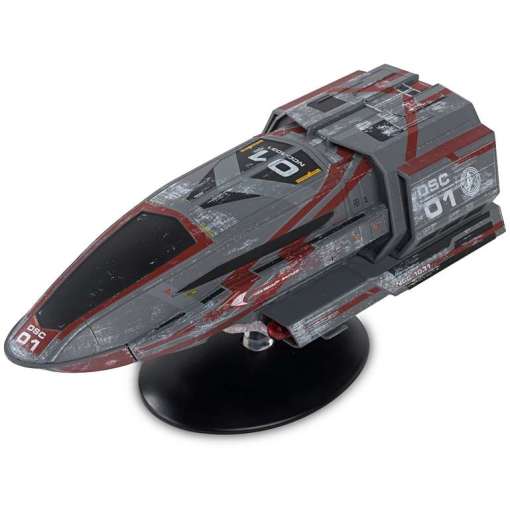
CLASS C SHUTTLECRAFT

Here’s one of the ships I’ve really liked in the new series…the shuttlecraft! The weird red striping is cool. Here’s a pic of the Eaglemoss model (which is quite nice — heavy, well-built, but a bit nose heavy for the positioning of the landing gear.)

ssduk019_1

SIZE: 2     STRUCTURE: 10     CREW: 2+10 passengers     CARGO: 20     TRANSPORTERS: 1 cargo     LIFE SUPPORT: Class 1R (BB)      OPERATIONS: Class 1R (BB)     SENSORS: Class 2 (+2/+1/+1/0/0  D)     IMPULSE DRIVE: SBB (.5c/A)     WARP DRIVE: WE-5 (3/4/5  C)     ARMAMENT:  1 Type II Phaser arrays (2/2/1/0/0/ A)     DEFENSE SYSTEMS: PFF-2a  (Protection/Threshold: 12/2  Reliability: B)     MANEUVERS: CMD -1   HELM +2   TAC: -1

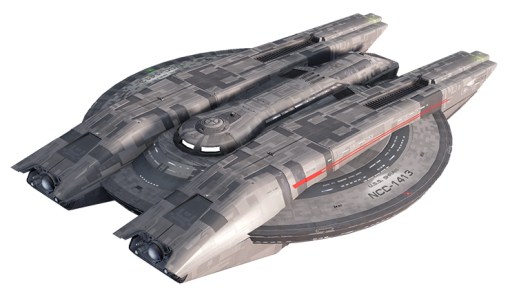
MAGEE CLASS FAST SCOUT

We saw this little ship at the Battle of Two Suns and in the amusing Short Trek involving tribbles. The idea is that these were used as a testbed for new warp designs, as well as small escorts.

Star_Trek_Shran_1413_740

SIZE: 4     STRUCTURE: 25     CREW: 80     CARGO: 40     TRANSPORTERS: 2 personnel, cargo     SHUTTLEBAY: 1 (2 shuttlecraft)     LIFE SUPPORT: Class 3 (D)     OPERATIONS: Class 3 (D)     TRACTOR BEAM: 1 dorsal/aft    SENSORS: Class 2R (+2/+1/+1/0/0  C)     IMPULSE DRIVE: SBE (.5c/D)     WARP DRIVE: PB-32 Mod 3 (6/7/8  C)     ARMAMENT:  4 Type II Phaser arrays (3/3/2/0/0/ A),  2 Mk12 IF Photon Torpedo Launchers (3/3/3/3/3 A);    DEFENSE SYSTEMS: PFF-2a  (Protection/Threshold: 12/2  Reliability: B)     MANEUVERS: CMD +0   HELM +4   TAC: +0     TRAITS: Small Warp Signature — +5TN to Sensor rolls to discover/locate ship, Vulnerable System, Throughdeck Warp Nacelles: When 1 block of propulsion damaged, also check a box of life support.

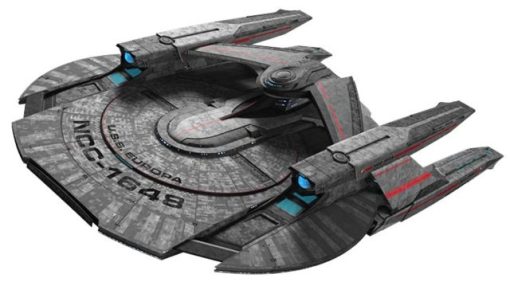
NIMITZ CLASS COMMAND CRUISER

Here’s the “admiral ship” they created for the series. Of the Eaglemoss stuff, this is the most disappointing of the ships for detail, but I suspect the CGI models were pretty thin, as this was banged out for a quick set of shots during the Battle of Two Suns and is quickly destroyed; it most likely didn’t need to be terribly detailed. The bridge was originally supposed to be under the roll bar, but later was added. I prefer to think of that as some kind of observation/science area with the bridge still in the dish.

fed_europa-640x354

SIZE: 6     STRUCTURE: 40     CREW: 300     CARGO: 60     TRANSPORTERS: 3 personnel, cargo     SHUTTLEBAY: 1 Aft  (7 shuttlecraft, 3 workbees)     LIFE SUPPORT: Class 3 (D)     OPERATIONS: Class 3 (D)     TRACTOR BEAM: 2 dorsal/aft     SENSORS: Class 3 (+3/+2/+1/0/0  D)     IMPULSE DRIVE: SBD (.6c/C)     WARP DRIVE: PB-32 Mod 3 (6/7/8  C)     ARMAMENT:  8 Type II Phaser arrays (4/4/4/4/4/ B), 12 Mk12 IF Photon Torpedo Launchers (7/7/7/7/7 C) DEFENSE SYSTEMS: PFF-2a  Protection/Threshold: 12/3  Reliability: B     MANEUVERS: CMD +3   HELM +0   TAC: +3


Sorry for the quiet these last few months. I started working at a local high school that services about 45% native, and 45% Hispanic populations. It’s a poor district with lots of the usual administrative fuckitude, and even more idiocy coming from the new government up in Santa Fe. In addition to a full time gig, i was also working a quarter-time load at the local community college teaching US history. Toward the end of the semester, I volunteered to cover for a teacher that had quit, giving me an extra section of Government (civics, to the rest of the world).

I worked myself waaaaay to hard, and that slowed the release of The Sublime Porte, our new city sourcebook for Fate and Ubiquity. (The art’s also far behind schedule; the maps are proving to be a bitch to do), and cut into my blog time.

Next semester, I’m forgoing a gig at the college, and focusing on the high school since they’re buying out my prep time to keep me on the extra section, but I’m hoping this will translate into more time to write and get things done.

Next up: a playtest review of Alien. Discovery series ships for the CODA Star Trek. A reiew of Arcadia and Odyssey of the Dragonlords, both Greek-inspired setting for D&D. Reviews of the Eaglemoss Battlestar Galactia and Discovery models. (The gist: they’re great!) Probably some new weapons for the old James Bond RPG combined with reviews of some of the new weapons I’ve tested and/or bought.

Way back in 2002, I had picked up the new Decipher Star Trek RPG. I had liked the Last Unicorn Games version, but we hadn’t played it. The same team had moved on to Decipher, which had made their name in card games in the 1990s. I had a couple of friends at the time that were die-hard Trekkies, and I decided to run a post-Dominion War campaign for them. I had anticipated a short mini-campaign; nothing extended or extravagant. It wound up being a game that ran for almost four years in different “series” that built one on the other.

The company had issues and eventually the RPG folded around 2006. (As usual, it seems every Star Trek RPG collapses as soon as they do a Klingon sourcebook.) It was a quick collapse, leaving fans of their CODA system wonder WTF? If you look around the site, you’ll find a lot of the fan-made stuff, including a lot of my earlier work on Artilects and other aliens not included in their Species book.

About six months ago, I wanted to take a break from the 1930s game we’ve been playing for about a year. I really wanted to get back to some space opera and it was down to Battlestar Galactica or Star Trek. I had already run an epic (in the classic sense of the word) BSG game that last five years and was one of the better bits of GMing I’ve done in about 40 years of gaming. About the same time, one of the players got me access to Star Trek: Discovery — which I was unenthused about, but liking the idea of a series not based on the captain, I figured I’d give it a try.

I loved the aesthetic of the show (which I see as a reboot and not a prequel, no matter what the producers say), and saw some potential in a modernized Trek universe. When season two rolled around with the fantastic portrayal of Captain Pike by Anson Mount (and tip of the hat to the writers for getting the character right), I was in. I picked up a few of the Eaglemoss models for the series’ ships. I was originally doing the old-time fanboy thing and rejecting the Klingon aestethic, but my young daughter’s excellent critique of the look of the vessels, and the desire to break away from the Japanese samurai in head makeup, led me to go all in on the look and new style of the Klingons. I did, however, keep the Andorians with the moveable antennae from Enterprise.

With that lengthy intro, what’s Decipher’s CODA like and is it a better option than the 2d20 system that Modiphius has been using for the setting? Right off the bat, I’ll start with this: I despise the 2d20 system. We were on the playtesting for John Carter and found the rules badly written to the point of the game being unplayable. There were simply too many moving parts for the players. CODA ain’t perfect by any stretch, but it’s much easier to play.

The basic mechanic is simple: roll 2d6 plus a character’s attribute modifier (like D&D, the actual attribute rating is meaningless) and the skill level added together and try to beat either a similar roll if opposed by another character or NPC, or a target number. This basic mechanic holds true throughout the game, including the ship combat. There are also class and race traits, features, etc. to modify your rolls. I’m not a fan of the race/class thing, but Decipher was under the thumb of the mighty Wizards of the Coast from the start, and at least they didn’t force them to go d20 — which I understand, at the time, was what WotC wanted. There’s an option for randomly creating attributes or picking them; skills and other character elements are chosen during a short background and career package build. You can build beyond the basic starting character with advancements. I’ve found for basic department head level characters, you want to give the players about 5-6 advancements to get started.

Combat is fast and can be pretty deadly. The weapons of Star Trek are pretty damned deadly. Firefights are over and there’s not a lot of leeward for characters. The old Star Trek game we had saw most of the players lose a character or two over the course of play. Hand-to-hand and melee combat, on the other hand, takes a while — especially if you have a tank of a character. First aid and medical attention is pretty good in the future, and if you survive, they can usually fix you up. (With the Discovery aesthetic, a lot of this is cybernetics. I went with the idea that if it was something they could organic 3D print, you would get a skin graft or organ replacement using your own DNA, but for major limbs or other complicated structures, it’s easier to just have engineering whip up a robotic part in the manufacture lab.)

Starship combat was pretty good in this game. It was designed to give everyone on the bridge something to do. Certain maneuvers required the helm, tactical, and operations guys to hit targets, and the commander to do the same to pull something off. Engineers were busily jury rigging repairs, medical teams were aiding injured. the ships were fairly evenly matched — which is something we see even between largely mismatched sizes and capabilities in vehicles in Star Trek — hell, a Bird of Prey killed Enterprise D. It’s how good the characters are that matters. The basics of Trek are there, as well. So long as the shields hold, you’re golden. You still take damage; the shield absorb some, but not always all of the damage; if you lose shields, you’re dead and pretty quickly.

By today’s standards, save for D&D, there’s a lot of fidlly bits — off-hand modifiers that are a bit ridiculous, heavy mods against you for extra actions, in the name of game balance, but overall, it’s a serviceable and clean system. You can find the PDFs around the web with ease, and the books turn up from time to time.

Is it worth it? Yes, if you want to play Trek and don’t want to pay the premium prices that Modiphius is charging for the 2d20 system. (Don’t get me started on their sourcebooks — just hit up the Memory Alpha site online. That’s where most of it came from.)

On another note, I’ll have up more CODA versions of Discovery ships in the next few days, I hope.

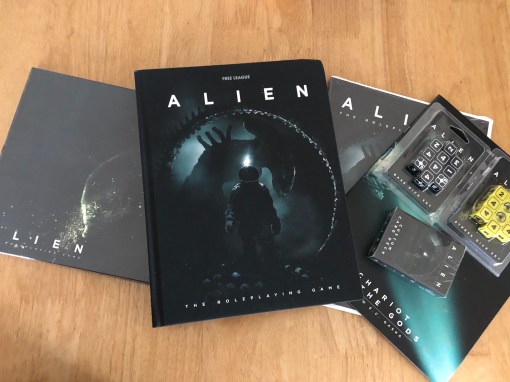
When I saw the pre-order call for Free League’s Alien Role Playing Game back in August I jumped on it. The wife encouraged me to go for broke and get the full set of stuff for the game, and after a long way (but really, not that long for most RPG publishers…) the game came in last week. The order came with a PDF of their “cinematic” adventure Chariot of the Gods plus a stripped down version of the rules, minus character creation and other parts of the rulebook, but after receiving the set, the PDF held about 2/3rds of the core rules.

IMG_0901.jpg

So here it is: For the bundle I got the rulebook (without the fancy cover option), the adventure booklet, a GM screen (with most of the needed charts in it), a set of specialty Alien dice and a set of yellow “stress” dice, as well as a deck of cards that for initiative, gear, and pre-gen characters for the Chariots adventure. Lastly, there’s a map of local space with the settled worlds, and a set of carboard counters for handling more tactical movement/fighting.

Production quality is high, as it was with their Tales from the Loop, and Things from the Flood games. The hardcover is well constructed, the binding superb, and the interior is well laid-out for ease of reading and finding rules. The print density on this thing is high with lots of black. A lot of the pre-order folks were complaining of intense chemical smells from the book and when I got mine in, you could smell the ink — this is due, most likely, to wanting to punch the product out before Christmas. The artwork, as with the other books I mentioned, is gorgeous and highly-atmospheric. The dice are well-done and seem to be rolling pretty randomly. I’m not one of those gamers that has to test the balance of my dice, nor do I obsess on their randomness, but after a few throws, they seemed to be pitching without any tendency to a particular number. The cards are pretty and used for drawing initiative, but otherwise they are pretty useless. The map is gorgeous; the counters are so-so.

The rules are a variation of Free League’s d6 dice pool where you need a 6 to succeed on a test (and sometimes more 6s to succeed at harder tasks, gain more damage in a fight, or get some kind of benefit from the extra successes.) If you’ve played Tales from the Loop or Forbidden Lands, the core mechanic will be familiar. Character creation is simple and quick, as with those other products — you have four stats: Strength, Agility, Wits, and Empathy, and each has three skills tied to them. You get to split 14 points between the attributes, and ten for skills. Your health is tied to strength. There’s a career specific trait you can take from some choices (or make your own up) to aid the character in a certain way, and there is the signature item — a thing that the character can use to relieve stress, as well as relationships — a buddy and an adversary — between the character and the other PCs/NPCs. There are also rules for playing a synthetic — whether a sleeper like Ash, or a more robotic version like Bishop. Synthetics have higher stats and don’t take stress, but they cannot push rolls, do not have signature items to assist them, and damage can affect them more more harshly.

Stress is the big mechanic for the game. When a character “pushes” a roll on a skill test, rerolling for a better result, they gain a stress die that is applied to the roll. On a 6, they’ve got a success; on a 1, they panic. When panicked, they have certain actions imposed on them. Some gamers might not like the mechanic forcing their characters to act in a certain way for a few turns, but getting players to respond realistically to fear is difficult, I find, and this is a way for the game to address that. This also means that a little stress actually is beneficial and can help the character, but too much and you might lose control of yourself. It emulates the reactions of horror movies pretty well.

There’s a lot of material on the world of Alien — some of the corporations, the politics, the governments are covered extensively and provide a lot of options for adventuring without even encountering the eponymous monster. There is a lot of data on the alien, but not so much on the Engineers. The other aliens that were thrown in are a bit bland, but there’s plenty of room to throw in your own stuff, and there’s a lot of folks already hacking the game for use with other horror franchises. Surprisingly, there are rules for space combat — something we haven’t seen in the Alien movies, but its a nice touch.

So is it worth it? The set cost me $100 (the core book was about $50 when last I checked) and yes it is. The production values are top-notch, the game system is light and ease to use and modify, and the background material is dense enough to allow even the most casual fan to jump right in. The pre-orders have been filled and they game should start turning up on store shelves by December 10.

After four months of working full-time at a local high school and teaching a half-time load at the local community college, I finally got a week off. Most of that has been spent getting all the stuff that went over the side with the workload, including the editing on the upcoming The Sublime Porte — a sourcebook to 1930s Istanbul for Ubiquity (and specifically Hollow Earth Expedition) and Fate. We’re still waiting on the artwork, but as soon as that is in, the final prep on the book will get underway. I had been hoping for an October release, but January now seems the most likely timeframe.

That said, I’ve also got about 40 pages of notes for a Rio de Janeiro book, so that will probably be the new project for Black Campbell.

I’ve got about three weeks left, then the college gig is over until Fall of next year (earliest), and I should be able to start punching out material again.

Strangely, I started this post right after the Day 18 prompt for Plenty. The thoughts I had toward the end naturally dovetailed into this prompt so here we go:

“I tend to run the games we play, simply because I have plenty of stories running about my head at any one time. When we finish a session, my brain is already leaping ahead to what I can do with the consequences and outcomes of the players’ actions. I love having to invent characters on the fly, and while my games usually involve some level of research and planning — I’m not the total sandbox sort of GM — there is a joy n having the decision trees the players create sprout in my imagination.” — Me.

For every player action, good die roll, bad die roll, there’s more choices, more directions to go. It’s a recursive exchange, as well: the players have decision trees sprout up in front of them from these as well. Every for every hint or clue, every mission briefing or scene set-up, every combat thrown at them, there’s also the input of the players — quippy exchange, every botched roll, every success or failure, injury, NPC met, other player character interacted with. The more people at the table, the bigger the number of decisions and events that can be birthed, the more vast the field of possibilities. There simple aren’t that many hobbies where the interaction of players, their characters, random chance, and differing frameworks of rules, settings, and the like come together.

One of the genres I don’t tend to run is horror. I have nothing against it. I love a good scary pic — The Thing (Carpenter! dammit!) scared the hell out of me and remains one of the best examples of how to do it. Alien — come on. Trust me on this one: The Autopsy of Jane Doe. Spare, superbly acted, tense, and short enough to not drag and still get the job done.

But it’s really hard to create that atmosphere at the gaming table for me. We’ve had a session here and there that’s been creepy, or discomfiting, but really scary? Nope. To try and keep that tension across a whole campaign? I’ve never seen it done, but I’m sure there are those that could pull it off. At best, we’d get a sort of Ghostbusters kind of vibe. It’s just not the players’ nature to play dark.

About the best I’ve managed is for my Dungeons & Dragons campaign. One of the things I noted when prepping for it…you’re dealing with monsters! This isn’t some heist film in armor with swords, you’re going into caves or what have you to take on some f***ing creature of the night to save a village if you’re noble, or nick its stuff if you’re not. It should be scary. Taking that angle and running with it, I ran that angle. The players were expecting light high fantasy. they got gore and misty forests with creatures that were trying to kill them. It was about the closest I managed to get, so far. (That my daughter started playing in a side game after this meant she got a taste of this. It works a lot better on kids. The psychiatry bills will be enormous.)


Plenty: an abundance especially of material things that permit a satisfactory life : a condition or time of abundance — Webster’s Dictionary

Role playing games present the players with an infinite number of stories to tell, an infinite number of universes to inhabit, an infinite number of characters to play. Want to be a space fighter pilot? There’s a game for that. A cybernetic cop working the streets of Ridleyville, where the streets are always wet and neon lights the night? Can do. A classy super spy fighting a cryptic organization dedicated to chaos, or communism, or terorism, or what have you? There’s a game to accommodate you. A heroic dwarf bent on avenging some ancient wrong done to your people? There’s an app for that. (No, seriously — the Fight Club 5 character creation app for D&D5 is excellent. )

There’s always a new bad guy, or maybe — like a comic book — your villains are never really dead. A village to rescue from banditos; better get together some of those gunslingers you know. Treasures to find, dragons or Borg or dinosaurs or corporations to fight.

The world can be your own — sprung like Athena from your head. It can be a licensed property you’ve always loved — just about every sci-fi TV show or movie series has or has had an RPG done for it. The rules aren’t always stellar, but the game’s out there. And the rules systems! There’s plenty. Fate can be tweaked easily and often on the fly to fit any universe you have in mind. It was designed as a pick up game system back when it was FUDGE, and that quick and dirty quality remains even in Evil Hat’s most polished work. There’s d20 in its myriad of forms, but usually it’s some form of 3.5 or 5th edition. It’s powered almost every genre you can think of. Want simple sci-fi rules? Get the old “black book” Traveler (and for whatever deities you hold dear, steer clear of the execrable new version.) You only want to roll 6 siders? There’s a system. Only percentile? Gotcha covered. Dice pool games where you roll a number of whatever die you prefer? They’re out there. I can recommend the old Star Wars game by West End…but if a Stardestroyer is involved in your fight, you might need plenty of dice (like a dump truck of ’em.) There’s at least four official Star Trek games out there. And the number of “indie” games…like grains of sand on a beach these days.

There’s so much to play!

I tend to run the games we play, simply because I have plenty of stories running about my head at any one time. When we finish a session, my brain is already leaping ahead to what I can do with the consequences and outcomes of the players’ actions. I love having to invent characters on the fly, and while my games usually involve some level of research and planning — I’m not the total sandbox sort of GM — there is a joy n having the decision trees the players create sprout in my imagination.

Sometimes there’s a new game out and we want to swap and play different games from time to time. It’s nice to have choice, isn’t it?

“If you could only play one role playing game, what would it be?”

I’ve had this conversation, and I’m sure the answer has changed over time. There’s also an obvious follow up question: Do you mean one RPG system or rules set, or one setting? With a little work, most RPG mechanics can be house ruled to the point they can adequately model any setting and scenario you want. If you mean that, then my answer would probably be the original Cortex system that powered Battlestar GalacticaSerenitySupernatural, etc…

If you mean one setting? I think I’d probably choose Space:1889. It incorporates elements from just about every genre: there’s action and intrigue of the Victorian period, there’s aliens and space travel, and it’s a historical period where swordplay, gunslingers, and ridiculous superscience can easily coexist.

How ’bout you — what’s your “one” game?

“She never felt like she belonged anywhere, except for when she was lying on her bed, pretending to be somewhere else.” ― Rainbow Rowell, Eleanor and Park.

I stumbled upon this quote while looking for something frightfully literate to start off this post. Something that would make me look smart and erudite. This quote, however, struck to the heart of why role playing games have been the center of my creative and social life, and why I had such a love of movies — and by that I mean bicycling to the theater and seeing a film on the big screen — as a kid: I never really felt like me, never felt like I belonged anywhere, in real life.

When I was in my friends’ basements sharing a communal daydream of being spies, or superheroes, or heroes on an epic quest to kill monsters and nick their stuff, or roaming the galaxy I was me. But me was never really me. Working, going to school, serving in the military, all that stuff — I was an imposter. The real me was waiting to explore and survive dangers in a host of settings. I could let out my inner Walter Mitty, my Baron Munchausen, between the time the game session started and ended.

Even today, much older, well traveled, and remarkably — still alive and mostly sane — I sometimes feel like a fraud because the real me is waiting for Nerd Night…when I get to be all the real mes hidden inside.

“A great book is an hallucinated IMAX film for one.” — Derek Thompson, Hit Makers: The Science of Popularity in an Age of Distraction. And a good roleplaying session is the same thing. It’s a communal daydream. You all dream the same story, you all get to see the same movie, but it’s made by different directors, and while the basics of the play are the same for all, the minutiae, the special effects, the details — these are all personal.

“There is such a place as fairyland—but only children can find the way to it. And they do not know that it is fairyland until they have grown so old that they forget the way. One bitter day, when they seek it and cannot find it, they realize what they have lost; and that is the tragedy of life. On that day the gates of Eden are shut behind them and the age of gold is over. Henceforth they must dwell in the common light of common day. Only a few, who remain children at heart, can ever find that fair, lost path again; and blessed are they above mortals. They, and only they, can bring us tidings from that dear country where we once sojourned and from which we must evermore be exiles. The world calls them its singers and poets and artists and story-tellers; but they are just people who have never forgotten the way to fairyland.”  ― Lucy Maud Montgomery

That’s gaming.