So, there’s the chance of a second game group and a day of play in the offing for me. After some Wild_Talents-232x300blathering at each other, we’ve seem to come to the conclusion a superhero campaign might be the best received. The GM is looking to do a gritty superhero game. The idea seems to be to shoot for a The Dark Knight Returns sort of flavor.
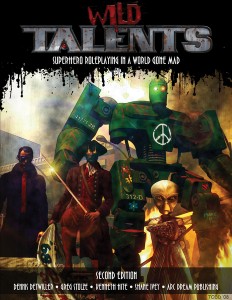
The system he’s suggesting for the action is Wild Talents — a superhero game by Arc Dream Publishing from back around 2006. It was a follow-on game/setting to Godlike, a “gritty superhero game set in WWII” that prided itself on losing the spandex. Wild Talents had some good talent on it. Wild Talents is being pitched on Arc Dream’s page as leaving the characters more vulnerable physically and motivationally. “All too superhuman” is the catch phrase, which implies a game where the character’s are “appropriately” angsty and “realistic.”

I’m reviewing the ebook, as I don’t have a physical copy. The layout and look is good, but the writing is a bit dry. As to the system, it uses the “One Roll Engine” which is, I suspect, an attempt to speed play and make it easier. It might play that way (haven’t actually played yet…), but it reads as paradoxically complex for a single roll mechanic.

It’s a dice pool game. Collect d10s according a skill or power rating. You look for matches. The highest matched dice is the “height” — how well you succeeded, the number of matches is the “width” or how fast you succeeded (or did damage in combat.) There’s a difficulty scale from 0-10, and the situational modifiers pull or give dice. for simplicity sake, you are limited to rolling no more than 10 dice. Sounds easy…;til you get to dice “types”; there’s a litany of them — regular, hard, and wiggle, penalty and gobble, and you can add expert or fixed or squishy dice… Hard dice do a fixed result, wiggle can be modulated in their effect by the player; penalty and gobble dice are tied to difficulty — losing dice due to a situation, or losing their number of matches if they are beaten in a contest.

It could be an easy set of rules to play, but reading the book, it doesn’t come off that way.

Characters have six stats that can have regular, hard, or wiggle dice. There’s skills. The powers are hyperstats (superhuman stats), hyperskills, or “miracles” (powers.) The dice ratings are linked to examples of how much you could lift, how smart or persuasive you are, etc. Powers have flaws, pretty standard for supers games.

Combat is pretty straightforward, if you find the basic mechanic straightforward. There’s also a ‘damage silhouette’ with a certain amount of boxes of shock or lethal damage you can take.

There’s an alternate history for the campaign at the end that isn’t bad, and allows for a universe in which supers haven’t just shown up.

Overall, the basic idea of the “realistic” superhero game is pretty hard to pull off. If you’re going to add in actual powers, instead of just playing Batman, these assumptions won’t play very well with creatures like Superman or Wolverine. Verisimilitude is going to come more from the universe, than how “messed up” the characters are going to get. The One Roll Engine reads as terribly clunky, but I suspect this could be an artifact of the description of the mechanic in the book — I’ll hold judgment until it’s played.

Substance: The setting is well fleshed out without being too restrictive, and the rules cover the necessaries for playing a superhero game: 4 of 5. Style: the layout is good, the art is darkly atmospheric, in keeping with the style of the setting, but is average “game art” quality. The writing is surprisingly stilted and occasionally confusing for the people they had on the book: 3 out of 5.

Is it worth it? I honestly don’t know yet, but based off reading the game, if you want a “realistic” superhero game where the characters will get mashed up instead of riding through a lot of fighting — almost the antithesis of a supers setting — you could find a system for modern settings that accounted for, or could be adapted for, lower level powers. If you’re looking to do four color or even The Avengers cinematic-style supering, I’d suggest looking elsewhere.

Postscript: When I decided to take a crack at a “realistic” superheroes game, one of the things I also did was to make supers a historical artifact — we bent history to include alternate events with supers involved. Instead of going for the “look how real this is; the characters really get hurt!” angle, I went for more social restrictions. Sure you can knock down a building with your bare hands, but can you afford the lawsuit? Do you have a license to use your heat powers as a welder? does you wife know you were out all night fighting the sexy supervillainess? Shame you didn’t bring allies to back you up that nothing happened! This universe assumed the supers were willing to most act inside the law, but there were hints that most the governments of the world were just blustering and hoping these new gods wouldn’t just run roughshod over everything.

Should be interesting to see someone else’s take on supers.

Something I’m cooking up for the 1950 and 1970s period of our Atomic Robo game:

WHEELMAN

The wheelman is an expert with a vehicle (usually car, truck, boat…) and is often hired to get people in and out of a mission safely. The thought here is to emulate the bootlegger turned racer or getaway driver.

Skills: Contacts, Mechanic, Notice, Vehicles

Improvements: Specialize two trained skills.

Sample Stunts:

Duck in That Alley!: For a Fate Point, use Vehicle instead of Stealth to hide from a pursuer.

Just a Good Ol’ Boy: +2 with Vehicle skill to create an advantage when attempting a fancy stunt.

Peddle to the Metal: +1 to vehicle test when overcoming in a chase.

Rev’ It: Use Vehicle instead of Provoke when in a vehicle.

She’ll Hold Together: The vehicle driven has an Armor: 2.

Snagged from wishforagiraffe on Reddit.

guardfox

With the new year now kicked off and our Battlestar Galactica  game in the final stretch, I’ve been hardening my choices for running a game after the end of Galactica and the main contenders are:

Atomic Robo — It’s Fate, but I like the ability to do a variety of genres under the banner of pulp adventure. The idea is to have a modern team whose adventures spur a flashback period adventure that will ultimately affect what the modern team is doing. I can do ’30s pulp, WWII action in the Captain America vein, 1950s-80s Cold War spy-fi, with some ’70s blacksploitation and ’80s Miami Vice vibe, 1990s computers and rogue states spy-fi, and 2000s terrorism stuff with a science backdrop.

Space: 1889 — Having pretty much given up on seeing the Revelations of Mars book for Hollow Earth Expedition anytime in the near future, I’m looking at this old classic. I haven’t run this setting in over a decade and I kinda miss it. Now the question is if I use the Ubiquity rules from Chronicle City, or Cortex, which the group likes and is used to from Battlestar Galactica.

Playtesting of a certain new version of a certain spy game named for a certain British superspy — I’m looking at getting to playtesting of Double Aught this year. The campaign might revolve around a private intelligence and security agency that gets hired by governments to do the stuff they can afford to get caught doing.

On top of these choice, one of our number is supposed to be running a supernatural horror game.

On to the next adventure!

Tonight was one of those nights where it seems nothing and way too much happened in the game. We continued on from the last session where the fleet had found an old colony world of the Kobolians, Argos. They investigated, retrieved some DNA-based data storage, including the DNA and mind-states of six Lords of Kobol. Their resident lord, Athena, is unsure they should reconstitute them. She doesn’t think that waking thousands of years later to their culture destroyed will make these “gods” each to manage.

But they also have two other big problems: Argos is a habitable world for a tired fleet. The civilians are ready to give it a go on this uninhabited, but habitable world. The civilians want to stop. The second: they have found out the Blaze — Hades — escaped the destruction of Kobol and is regrouping with the remnants of his Cylon followers at a nearby world the humanoid Cylons (Seraph, as they are now known) “recovered” 200 years ago by force. A recon mission shows four basestars, and on the surface, Hades’ commandstar (a super-basestar, if you will.) He is conducting some kind of operation at the ruins of a large city centered on a huge skyscraper. Athena thinks he might have a shard of a Titan (a Ship of Lights) hidden there.

There was a lot of character interaction, including a dream sequence for the Leoben-ish character, who dreams of a great battle under the three faces of Hecate between centurions and Seraph on both sides, and Athena and Hades. In the end, Athena reveals herself to be an angelic creature — wings and all — who burns away Hades (and everyone else.)

A plan of attack is formed. They had established that the Cylons can imprint new memories and consciousness on those Seraph bodies still in storage on the resurrection ship. Also, their recon vessels are not being identified by the Cylons at the Blaze’s rally point; the centurions cannot tell the humanoids apart. Athena is going to implant new Seraph with the memories of her fellow lords, slip into Hades area of operations on the ground, and stop him before he can recover the shard and either become a real threat again, or worse…if it’s from Hecate’s body, possibly attempt to break causality (the only real immutable law of existence) which could go so far as to unmake everything.

Meanwhile, the fleet — Galactica leading Cygnus, their pocket escort, and Basestar 19 — will hit the Cylons in orbit and when the time is right, nuke the grounded commandstar. If they pull this off, they destroy the Blaze forever, and end the Sacred Cycle once and for all.

To do this, they are taking the massive risk of leaving the civilians at Argos, with only a few squadrons of rebel raiders and heavy raiders for protection.

Monday: the denouement of a four year long campaign.

Here’s a site with a nice random name generator for RPGs. Pick the gender and the general nationality and hit generate.

This week’s game session saw our fleet discover the remains of a Kobolian outpost from millenia before the 13th Tribe decamped. The place is identifed by ATHENA as Argos, one of the colony worlds set up in the Olympians’ attempts to find the Titans that made them. The place is abandoned — cities standing empty and in collapse. There are plants and animals on the planet, however, and the idea of setting down and letting the grieving Colonials get some respite is quickly gaining popularity. The characters had been thinking of leaving the civilian fleet here with some protection so that they could race ahead to Earth to scout that world.

They do reconnaissance of the world and find the place deserted…except for the massive complex in a mountain range up against a glacier. Scouting the location, which they haven’t been able to get good data on due to a weather event, the scout raptor is shot down, and it’s viper escort nearly dropped, as well. They spot a SAM site with centurions operating it, and a heavy raider launched to escape. One of the characters does a strafing run that takes out the SAM site, and eventually drops the heavy raider before it can jump.

The SAR mission includes some of the humanoid Cyln (Seraph) who access the mind of one of the dead centurions and find out they’ve been assigned to 1) find any recoverable data — the Kobolians (Olympians, whatever…) store their data in DNA because it is more robust than optical or magnetic storage; millennia is easily possible. 2) There are other missions like this to other Kobolian outposts, and they were 3) given the mission by a massive, darkly-handsome man Athena identifies as Hades. Their nemesis is still alive.

Worse, he’s looking for a Titan body — a “ship of lights” — to inhabit. They now know the Blaze is alive, apparently in physical form, and is waiting at a world, New Ophiuchi (the Ophiucans were the 13th Tribe, in our game) for the scouts.

There were several action sequences as they explored the Olympian citadel — a massive, 50-story arcology — and in the end they discovered not just data storage, but DNA samples of some of the Olympians that had remained behind after whatever happened…happened.

They’ve figured that the Cylons that were here were on an indefinite assignment, and are thinking of having the civilian fleet remain and do harvesting on the world, while they race to New Ophiuchi and deal with Hades.

This is leading toward the denouement of the campaign much quicker than I had anticipated.

The last post brought up an issue I don’t think I’ve addressed before…what do you do when a campaign is over? I don’t mean that game you’ve played a few times and are done with, or even that longer one that’s gone a year or so…I mean the epic game campaigns. The ones where you’ve lived with the characters and the universe for four or five or more years until its as real as the time you spend at work or school or home. You know the characters, the NPC, the setting locations and you love them; you have adventures and moments that are as sharp and impactful as your last vacation. Maybe you’ve all made the journey, maybe you’ve lost and gained folks along the way, but in the end, like a good TV show, the final credits are rolling. The story is told.

Now what?

For groups that trade off GM responsibilities and/or games, this might not be as big a deal as those groups playing that one game for years on end. At the start of my Battlestar Galactica campaign, I had been running an earlier iteration on and off with other games for a few years. The current game started after my game group blew apart along with my first marriage, and for the first year or two, there was trading off of different games, but eventually this was the one folks wanted to play. For at least two years, this has been close to the only game on the table. Now the end is in sight…

A lot of groups I’ve seen have one GM. He’s the guy with the time, or the inventiveness, to crank out stuff week after week (or whatever your schedule is.) For these groups, it’s his/her world you are playing in. You might make the stories, but it this person’s sandbox; you’re putting on your play of the mind in his theater. For long campaigns, there’s as much investment for the GM as a producer of a television show or movie, or an author writing novels. When you’re done, there’s a sense of accomplishment, but there’s also a sense of loss. This thing you’ve lived with for years is gone now, and hopefully it hasn’t just petered out, as so many campaigns — that’s actually, I think easier to accept; no, this baby has grown up and moved off to college.

I’m in that place now. While the players have been surprising me for the last few sessions with some of their decisions, they are taking me — more rapidly than anticipated — toward the denouement of the game. It’s the summer before my baby leaves home.

Now what?

The best option is take a break. If you have someone else to run, have them do so, even if it’s just a few pick up games. Maybe there’s that rules set you’ve wanted to try, like Mouse Guard or a setting like Warhammer‘s RPG — have someone else take a crack at the GM seat. I have a player returning after more than a year’s absence who is hoping to run a Supernatural-ish campaign. Not normally my cuppa, but he’s good and familiar with horror, and it sounds like it could be fun.

But, if you’re the person that does the GM duties — and I’m sure I’m not the only one that hands the reigns off, only to wind up running the games when someone’s much less hectic than your own schedule is “overwhelmed” — here’s the two big ones:

Do something similar. You might find the idea of the sequel campaign appeals. (Here’s a post on sequel campaigns.) Do something new in the same universe — like Crusade to Babylon 5, or Deep Space Nine to The Next Generation… This is especially interesting, I think, if you also swap GM along with the tone. You can step away from the campaign slower. Maybe it fizzles out like Crusade, or maybe you turn a children’s novel into three 4 hour special effects extravaganzas. (Fuck you, Mr. Jackson.)

Do something different. I’ve been running space opera with heavily realistic politics, increasingly transhuman science fiction, loads of Greek myth mixed with Mormon cosmology (just to stick with the vision of Moore’s version.) The temptation was to run into Mindjammer, and do a full-blown transhuman space opera. Now I find myself being seduced toward something with a completely different tone.

An obvious choice would be a fantasy game. Go back to basics. But for me I’m finding an Agents of SHIELD-flavored Atomic Robo campaign that has a modern main story, and ties to a WWII/Cold War secondary story is calling. The version of FATE Evil Hat is using is pretty nicely done, I love the comic and the idea of having rules for brainstorming science in the middle of fight sequences, and since Fate’s worked its way into every other game, what the hell…

It’s not the only thing, either: I’m developing a real desire to do a campy, full-color DeLaurentis-style Flash Gordon pulp campaign. I was waiting on Revelations of Mars to hit from Exile Games and use Hollow Earth Expedition, but I’m thinking it’ll be at least another six months before that’s done. So now I’m thinking of combining this with my love of the Space: 1889 setting and tweaking them to do a  classic rocketship pulp game, but with the Martians and Venusians of the Space: 1889 setting — Nazies and Commies on Mars! but losing liftwood in favor of the John Carter Barsoomian ancient technology for skyships. It’ll be my own beast, but with a lot of borrowed crap from pulp through the ages. Kinda like Dungeons & Dragons files the numbers off the great fantasy epics and smashes them together. it also isn’t too like the very successful, but short lived Chinese-based Hollow Earth Expedition campaign that I ran in ’11, or the shorter but no less fun Gorilla Ace! game a few months before that. (GA may make a comeback in Atomic Robo…it seems apropos.)

The other thing likely to get to the table is playtesting of the retroclone of a certain spy game from teh 1980s I’ve been working on. It’s less and less a retroclone as a reimagining. The rules are getting some streamlining, character design is getting some polishing, and the general look of the product is starting to come together in my head. I’m glad my daughter put the project on hold, I have a much more matured view of it now. So modern espionage, or a series of short campaigns set in various eras from the early Cold War to today are likely to be happening soon.

I would love to go back to doing a superheroes campaign. It’s been 25 years since I’ve had more than a few connected adventures to do. I like the Marvel cinematic universe; it could be fun to play in. I know my daughter loves the DC cartoon universe…so maybe when she gets older.

All of these have a sharply different tone and flavor. All will require a shift in mindset, a bunch of work to bring to life — but it also allows you to look ahead, and not behind. After all, you still have the memories…

New Year’s Day saw everyone able to get together for an extended gaming session over jambalaya and beer. We picked up after a few rough starts because I had forgotten a few of the going-on last session, but finally we hit the ground running and the adventure I thought would be done by third hour ran five, almost until we knocked off for the night.

The Cylon player character (a Leoben type) and “Tana” — meaning “commander” in Kobolian — a Three than the Colonials had as a POW in earlier episodes figure out that someone has been tweaking the programming of the “humanoid Cylons” or Seraph when they have been going to the resurection ship to have their experiences downloaded directly. (They can’t simply upload wirelessly as they once had.)

The commander of the ship, a player character, was promoted to admiral, and after some politicking the Seraph leadership accepted him as the commander of the military assets. There was a moment of tension when ATHENA recommended not the One model to command the Cylon basestar, but Tana Three. After some consultation between the models that had come for the alliance confab, this was made the case. She was made a “commander” and the second highest ranking officer in the military, over the objections of the Colonial colonel commanding the light escort they have in tow.

Tana askes for Colonial help in sussing out what is going on, and during a state visit to the basestar, the admiral brought along two of the characters working on Cylon reproductive issues. They went with the PC Cylon to the resurrection ship and in a great display of mad scientist moments, they were able to distract the Caretaker of the ship and got a look at Cylon/Seraph coding. They discovered with a spectacular roll by one of their programmers that the Ones were trying to program in fealty to the models. He also found all the deep psychological blocks that the Blaze — their once God — had programmed into their machine part of their brains, preventing them from all manner of behavior. Essentially, they were slaves to this Blaze, fugueing out whenever they tried to address their infertility issues, or discuss certain things tied to the Blaze, or other important issues.

Despite the dangers, the programmer character wrote a virus that stripped all these inhibitors out of the Seraph and set it loose in the Cylon fleet. This not only freed them from the inhibitors their God put in place, but allowed them to know about the manipulation of the Ones. A full-scale uprising and overthrow of the Ones occurred in about a minute and a half as the models conferred and voted to keep most decisions a democratic quorum of the models, but they placed Tana 3 in command of the fleet’s military decisions. They also view the programmer as something of a hero of the Seraph, now.

The alliance looks solid, they are on their way to Earth, and the episode ended with the trial of the various ringleaders of the mutiny — which included the cousin and last remaining family of one of the PCs, the new CAG. She was able to make herself vote for death. Lots of role playing pathos ensued.

We started the next episode before closing out the night. One of the recon missions, following leads that the ATHENA had generated for possible Kobolian outposts, finds Argos — a colony of the Lords of Kobol that predates the 13th Tribe’s exodus by almost 1000 years. The place is barely habitable in a New Caprica sort of way, but there is the added possibility of ancient tech to be plundered. Athena seems intent on doing so. Might she have ulterior motives?

One of the things the players started tossing about was the idea of settling the civilian fleet, which has been slowing their travel as older vessel, and those not really designed for extended space and FTL travel are increasingly experiencing malfunctions. Additionally, the fresh food is about to end, and they’ll be on stabilized and canned stuff for the next six months or so it will take to get to Earth. But Argos has indications of familiar crops and animal life. After five months stuck in tight quarters, grieving over the loss of…everything, the players are starting to think it might be necessary to drop the civilian fleet someplace relatively safe, and press on at best speed to Earth.

That was where we ended the night with some big decisions that could decide how much longer the campaign goes on. The end, I think, is in sight after four years.

(This isn’t the longest continuous campaign I’ve run, but it’s damned close. IT has been, by far, the most rewarding from a storytelling and fun standpoint of any game in the last fifteen years.)

Here is an excellent companion piece to “Agency, Fiat, and Randomness” describing one of the central issues I have with the new hotness of sharing out narrative control in games.

Eero Tuovinen's avatarGame Design is about Structure

This is going to rpg be theory stuff, just so you know.

A thing I’ve noticed lately specifically at Story Games, but also on other gaming fora, is the increased acceptance and advocation of narration authority sharing between players in a roleplaying game. It’s a nice technique, but I also find that it is being recommended and utilized in ways that might have unexpected consequences that need to be considered in depth. I’ll write a short treatise about the topic here – I don’t particularly want to piss in anybody’s cereals if they find that unrestrained sharing of narrative authority brings them happiness, but it’s not correct to call it the universal panacea of roleplaying, either – there are solid reasons for refusing to introduce this technique into every single game you might ever wish to play.

View original post 4,581 more words