After a session or two of buildup and planning, the characters finally popped the trigger on the mission to find the Tomb of Athena on Kobol they called Operation PARTHENON. They had the benefit of a ton of intelligence from the damaged basestar they had found a few sessions ago — PHOTINT of the area, some idea of disposition of forces, and they know that with the skin jobs and centurions fighting each other, the attention will be off of a possible Colonial incursion. That said, they knew the mission was going to be extremely dangerous. They have a secondary mission after recovery of the “roadmap to Earth” of destroying the Tower with a nuke delivered from Galactica.

The mission entailed four raptors doing a LAAI [Low Altitude Atmospheric Insertion] jump. Parthenon 1 & 2 were carrying the ground mission, Parthenon 3 & 4 were ECM raptorsthat immediately took off through the mountain passes, hoping to draw any Cylon attention away from the ground mission. I put together a series of PHOTINT pieces for the players to work with on my iPad. Example: here’s the basic layout of what’s left of Olympus, overlooing the “City of the Gods” in the valley below, which is dominated by the massive Tower of Dis — the “home” or headquarters of the Blaze on Kobol, and now either the HQ for the centurions or the skin jobs (they don’t know which…)

olympus

And the insertion…

insertion plan

In this case, the Deiopolis (City of the Gods) is in the valley in the upper left. There is another inhabited (or not due to the civil war) city to the north (off the pic to the right.) For these aids, I pulled up Maps on the computer, killed all the notations (set to satellite view), and then captured the window and added the rest with Seahorse. (I’m on a Mac.) I threw together a Keynote/Powerpoint presentation for the mission…because Powerpoint, once invented, is like the herpes of an organization; you can’t get rid of it. Standing in for Olympus/the City of the Gods is Telluride, Colorado. It was the closest I could get to my verbal description of the area.

The insertion is a close thing — they get the coordinates right, so no one winds up in a mountain, but going off of what was on screen and what we’ve established in the game, the jump effect creates a split second of vacuum around the raptors, which are moving at supersonic speeds, but that bubble collapses immediately. I rated the effect as a FORMIDABLE for the pilots. Parthenon 1 and 4 biff their rolls, lose control, but managed to make their recovery rolls at HARD. Had they missed, the raptors would have crashed.

The ground assault cuts through tight canyons and put down out of sight of the Tower of Dis, which can see much of the ridge that Oympus is on. One of the player’s characters did an excellent job with his ECM rolls and they go unobserved for almost 20 minutes while the ground team moves to Olympus and climbs a small rock face. Once in Olympus, however, they get spotted by strange boa snake meets lamprey meets robot sentries and the fight is on!

About this time, Parthenon 4 gets shot down, Parthenon 3 runs out of its decoys and other EW gear and jumps back to Galactica, which is waiting at about 30SU from Kobol (about the orbit of Neptune, if this were our solar system. They are 4 hours from knowing what is going on….

Except. The ground team gets aggressed by not just raiders, but directed energy weapons from the Tower that are destroying the ancient ruins around them. Heavy raiders bring in centurions and in a heavy exchange of fire, a few of the raiders and heavy raiders are destroyed. Unfortunately, Parthenon 2 is disabled and the crew injured; it is unable to make space. Parthenon 1 is damaged, but still in the game, but it is only a matter of minutes before the unarmed craft will be overrun.

In Olympus, the ground team loses four of their eleven members, and they finally move to rappel down to the Tomb of Athena. We cliffhangered (literally), with the group descending just as the Tower obliterates the buildings near them, possibly endangering the team. The raptor crews are either injured and about to be hit by a 12 man squad of centurions, and Parthenon 1 can’t stay on site much longer…

The session ran long — almost until 11pm, instead of the usual 930-1000 time. Only one of the (former) PCs had been killed, a few minor NPCs, and there was the chance of two major NPCs from the show (Starbuck and Helo) buying it.

Cut out the dreamy crap about spirals and life at the end and you have a pretty cool video of how the planets actually move around the sun. Now the “old model” they’re describing works just fine when you are looking at just the solar system, but the addition of the movement of the sun does give am interesting perspective…

Between rewatching Role Models and reading up on the Jedburgh Ba’ tradition, I realized something that can improve on the verisimilitude (a word I use because i love the sound of it, and it makes me sound smarter than I am) of your RPG setting. People play games, watch games, beat each other up over games…always have, always will.

Here’s some basic ideas for games your players’ characters might play:

There medieval football, the closest to which today would by the Jedburgh or Kirkwall game of ba’ (ball…with a Scottish accent.) You choose two destinations — one for the Uppies, one for the doonies (downies) from either end of town. There’ a designated person to “throw up” the ball, usually a leather hand-stitched thing about 4″ in diameter, sometimes adorned with ribbons, etc. The goal is to get the ball over the destination point up the town or down. You play in a mob — none of this small numbers crap — and it can take all day. The big honor of keeping the ball goes to someone on the winning side.

Rugby/football/soccer — There are other obvious variants of football. Some even use your foot, NFL fans. Rugby is a nice one — it’s like American football, but without all the padding and helmets. Score points by getting the ball into the goal, and have fun pummeling other people into the grass. Soccer is a bit more civilized, with mostly kicking, rather than throwing and carrying the ball, as in football and rugby.

Keep It Up — Volleyball, beach ball, tennis, badminton even jai alia are keep it up games. Drop the ball, the other side gets a point. There might be other rules, etc., but this is the basic game. Jai alia just adds the extra fun of a hard ball moving at high speeds for greater injury potential!

Get It In — Basketball, Battlestar Galactica‘s pyramid, Rollerball — all are versions of this: Get the ball, throw it in the basket/hole/whatever for points.

Ball games typically are team sports, with teams as small as doubles up to the mob scrums of handball. Team sports, like their older brother political parties, inspire intense — often idiotic — loyalty and pride. They can have a lot more subtext than just colored jerseys — they imply where you are from, your religion, your politics. Get asked in Glasgow is you are Rangers or Celtics, and they’re not just asking if you like blue or green; are you Catholic or Protestant. On a Friday night after a few pints, this could lead to a beat down in the wrong neighborhoods.

Speaking of beat downs: Contests of skill, strength, etc. are fun. Arm wrestling over a few pints? Always good. Archery or shooting contest? Obstacle courses? Boxing/karate/cage fighting matches — these are ways to have the characters earn some dosh or respect without having to run a mission of some kind.

The other major gaming you see is racing. People will race anything. If slugs were big enough to ride, we’d race ’em. Dog racing, Pinewood derbies, horse racing, bicycles, trains (yes, there have been train races),motorcycles, cars, boats, planes, spaceships — we either ride ’em or watch ’em. For powersports, half the fun is when the person biffs it. Everything from regulated tracks with warning flags, and rules for not trying to wreck other racers, road rallies where you go from point A to B, timed events (to prevent crashes), demolition derbies — add some nasty terrain and speed and it gets fun.

Games of chance: People love the easy money, and the thrill of maybe winning is enough to have people playing the Redneck Retirement Fund weekly across the United States (the lottery, for those trying to figure out the putdown…) Dice. Cards. Roulette (with or without the gun), pachinko, dominoes….the quick way to handle this in game is to have the players roll some kind of gambling skill or attributes appropriate to the matter. But if the game is the point of the adventure — say, you’re running Casino Royale as a scenario in a espionage game — why not bust out the cards for some high stakes action? Even if it’s just a few hands, it will change the flavor of the session. (I bought triad cards for Battlestar Galactica for just this thing, but the characters have been a bit to busy for games, lately…) Now add gambling to any of the situations above and you can add drama to the events.

Can you make a simple game played in a session as intense and “important” as fighting the bad guys? Have a look at Role Models — a lightweight comedy that is actually much more respectful and understanding of geek culture than something like Zero Charisma. The climactic SCA/LARP battle is not life threatening, but for one of the characters, it is central to who he is — losing the scrum to the “bad guy” really is that important, and despite the characters using boffer swords and dressed like members of KISS (seriously, see this movie!), the audience does feel that this is high stakes, even if it is stupid to some of the characters.

We play role playing games because we want to be something, if only for a few hours in the safety of fantasy, extraordinary. The brave fighters, the canny wizard or hacker, the fighter pilot, the plucky thief, the social diva — whatever…we want something larger than life.

Most games are set in different periods from ours. Maybe it’s the faux medieval fantasy world, Renaissance or Enlightenment pirate settings, Victorian science fiction,  interwar pulp action, or futuristic settings. the draw is the difference from your modern day life. Even espionage games typically do the spy-fi settings where you drive expensive cars, sleep with comely enemy agents, shoot things indiscriminately, and maybe — if you’re lucky — you get to blow up a volcano secret base. The point being: it’s not reality.

However, the need for verisimilitude in a setting is important for audience (your players) buy-in. So how real should you go? The societies of pre-industrial nations aren’t known for their open-minded stance on gender, race, or sexuality. Combine that with class issues and the thought of living pre-1920 should put most people off. Set that reality dial too high and you will exclude certain character types, and by extension, certain demographics of players.

Race relations were not exactly stellar prior to …well, ever. And being a woman before the first sexual revolution of the 1920s was not conducive to a life of high adventure and being treated as an equal. And what if you were poor? Not a lot of crofters had the option to race off and explore the world unless they were wearing army red. How do you handle this?

First off, no matter how real it is for the NPCs, the players are special. There are always exceptions to the rule in history. Boudica was a warrior woman who wasn’t about to take crap from anyone, but lived in a world where women were second-class citizens of the Roman Empire. We’ll get back to her in a moment. Joan d’Arc was a peasant girl and maybe a lunatic, but she was an excellent general. Mary Read was a successful pirate. Jane Digby and Lola Montez were different stripes of female adventurer when is was not acceptable. Tom Molineaux was a successful boxer, despite being black, in the 1830s. The Lafayette Escadrille had a black pilot, and plenty of women and minorities found escape in early aviation.

They are the exceptions, the special ones…the ones the players are playing.

Gender and class come together here very well — the women mentioned are not middle-class. The typical view of the domestic goddess raising kids and doing what her husband told her, while quaint, was typically a middle class thing. Aristocrats like Boudica (a Welsh queen), or Jane Digby (the former Lady Ellenborough), or the spy Lady Hamilton had the freedom to buck convention because they were wealthy or well-connected, and their eccentricities — while decried — often made them popular figures. Conversely, the poor woman could find herself with more options than the middle class woman by sheer virtue of having nothing to lose, and that they were “invisible” to proper society. By the time you get noticed, like Lola Montezz, you’ve used you talent or sexuality to become the lover of the King of Bavaria. Lower-class women pretty made the West — that madam, that landowner whose husband died…they were the ones that made Western society, not the cowboys and prospectors.

Similarly, even during the height of the slavery issue, freed or scaped blacks like Frederick Douglass traveled freely and openly spoke their mind. Jews might find themselves in a sticky situation in Nazi Germany — unless the were much-needed scientists — but with money and connections, you might still slip by. The exceptions should be the exceptions.

That doesn’t mean you should shy away from race or gender or class issues. Giving your players realistic impediments can (and should) be frustrating, but they should be able to outsmart, outfight, or out-politic their foes. They should have detractors who decry their stepping out of place or take steps to ruin the character socially, but there should always be those folks that back them. It’s actually pretty realistic, historically.

Example 1: I often ran Victorian sci-fi games. One of the players chose to play aristocrats almost exclusively. Why? Because of the freedom than money and connection gave her characters to flaunt convention and get away with it. She played almost exclusively characters that were socially adept and attractive — the sort that thrived in the nooks and crannies of the Victorian period.

Example 2: A young Chinese street urchin, female, who was able — because she was young, a girl, and Chinese was the perfect spy and go-between for the Western male characters in 1936 Shanghai. She was always in danger of physical or official abuse, was often hungry and dirty…but her utility allowed her to tag along on adventures.

Example 3: A black woman who had gone into prostitution in our Victorian game, but who managed to seduce the right men, gain some level of financial stability and notoriety, then launched on a series of adventures with the other characters who — being the exceptions to the rule — were at least tolerant of the character.

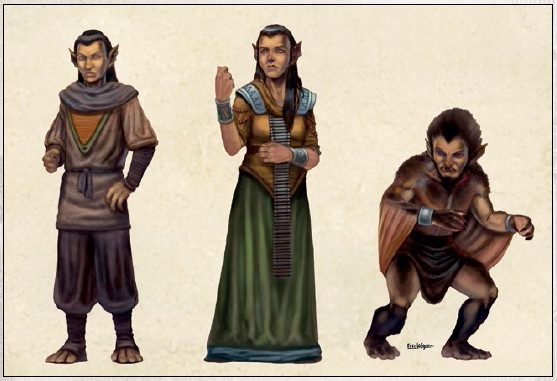
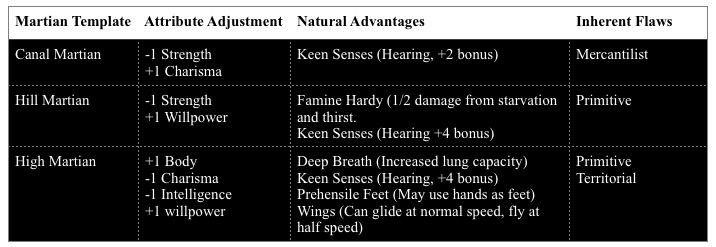
Example 4: A female Martian in a Space:1889 game got involved with an American cowboy wandering the Red Planet. Despite their string of high-profile adventures and relative acceptance by Martians, human religious types viewed their union as “bestiality.” this caused them troubles, but not insurmountable ones because they are the heroes.

Here’s a briefing sheet that went along with a briefing to the characters regarding the history of Kobol. This is, of course, specific to our campaign, so feel free to ignore it — but it also shows what can happen when youtake the bit and run in a different direction than “canon.”

History of Post-Exodus Kobol

Analysts: Gaius Baltar, PhD — Colonial Science Minister; Ambra Gallardo, PhD — Chief Astronomer, Galactica

Based on ELINT and SIGINT collected by the ships of the fleet, and the data recovered from Basestar 32, the intelligence compartment of Gaactica, in conjunction with the science ministry, has gleaned certain facts about the history of Kobol from the time of the Exodus of the 12 Colonies to current day.

BF is Before Fall, or the year of C Day.

~2200BF: The Thirteenth Tribe flees Kobol ahead of the War between Man and Gods. They settle on a place called Earth.

~2200-2100BF: War between Man (those rejecting the leadership of the Lords of Kobol) and the Gods. The population of Kobol is seriously reduced.

~2000BF: Arrival of “the Blaze” — an “angry, jealous god” — who we now believe to be the Lord of Kobol, Hades, returned from his efforts to find the Titans to aid in the war.

The Twelve Tribes of Man flee to the Colonies. The trip takes almost six months.

~2000-1500BF: Collapse of Kobol civilization and rise of the Blaze. Rules from the Tower of Dis.

Population of Kobol about 6 million — about 0.01% of pre-war levels. Pogroms of polytheists reduces this to a million or so. Tech level collapses to about TL2-3 (Iron Age.)

The Blaze was apparently not “present” through most of this period.

~1500-1000BF: Slow development of Kobol civilization to TL5 (industrial revolution). Humanism and religious schisms.

991BF: Creation of the Holy Kobolian Empire.

978-765BF: Religious wars between monotheists, polytheists, atheists, etc. Rise to TL6 (Advanced industrial revolution.)

789BF: Creation of the Republic of Cumae.

764-760BF: First World War. Destruction of HKE .

760BF: Establishment of multiple new countries in HKE territory.

760-700: Rise to TL8 (Information Age.) First spacecraft launched. Population rises to ~2 billion.

697BF: Small scale nuclear war between Soldiers of the One and Cumae. Destruction of most large political entities. Collapse of population to 500 million. Drop to TL5-6

509BF: Return of the Blaze and the Gift of “the Twelve”, also known as “Seraphs.”

508-500BF: Resistance to the Twelve. Population drops to 160 million. Establishment of the Rule of the Seraph (the Twelve.)

509-450: Rise to TL9 (Microscale engineering and early space travel.) Discovery of signals from The Twelve Colonies.

440BF: Development of the jump drive: TL10.

430-400BF: First of the Seeks — looking for other human settlements.

425BF: Discovery of the Twelve Colonies. The political situation is deemed too volatile to intervene.

401BF: Discovery of the remains of the Pleiades Colonies of Man. Recovery of the Aurelian Prophesies.

375BF: Rise to TL11. Development of the Cylons — cybernetic servants for the Seraph.

350-300BF: The Second Seek (for Earth.) Unsuccessful. All vessels lost.

299-200BF: The Third Seek.

299-250BF: First introduction of monotheism into the Colonies by Kobolian agents.

276BF: Discovery of New Ophiuchi — a small colony of the 13th Tribe.

275-200BF: “Recovery” of the Ophiuchi settlers.

250BF: Loss of Seekers to possible location of Earth.

120-55BF: Involvement in the establihsment of Soldiers of the One and other monotheist groups, including the Eleusinians, in the Twelve Colonies.

Seraph involvement in the development of the Cylon.

52-40BF: YR1947-59 — The First Cylon War.

40BF: Seraphs stop the First Cylon War to save Mankind.

39-30BF: Incorporation of the remaining Colonial Cylons into Kobolian society.

18-1BF: Third Recovery of the Twelve Tribes — influencing Colonial society and preparation for possible war.

17BF: Assassination of President Guderian before Cylon infiltration can be revealed.

5BF: Replacement of Lord Lucan and insertion of Seraphs into Colonial society in an attempt to prevent war.

1BF: Operation UNDERTOW and discovery of Cylon infiltration. Seraph realize war in imminent and decide to move early on “recovering” the Twelve Tribes, hoping to force them to Kobol and submission to the Blaze.

THE FALL OF MAN: Cylon attacks on the Twelve Colonies. Galactica leads a rag tag fleet to safety.

C+64: Battle of the Blaze. Major Crius Muir, an oracle and CAG of Galactica, leads two and ten vipers to strike at the Enemy through the fire. The Blaze disappears without warning after Muir rams the “Ship of Light” with his fighter. The Cylons flee the field and no contact is made until C+77.

C+66: Caprica 6 releases the centurions from behavioral control. 60-70% of the centurions revolt against the Seraph.

C+67-70: Spread of the Cylon Revolt in the fleet.

C+70…: Cylon Civil War (Second Resistance to the Seraph.)

C+77: Discovery of Basestar 32. Intelligence on Cylon strengths, location of the Tomb of Athena, and other important strategic finds in Colonial hands.

Battle of Kobol between Cylon fleets. At least 14 basestars engaged in combat with each other.

C+105: Operation PARTHENON — Colonial mission to find the “map to Earth” from the Tomb of Athena.

Apparently, the role playing community has a problem with women and minorities — at least that what a bunch of the designers have been squawking about recently. “We have to get more [insert token] into gaming!” Here’s my response:

NO WE DON’T.

We don’t need to categorize our players into sex, race, or wrestling weight class. If they aren’t jerks, you just have to treat them decently and let them play. “What if they’re gay?” So what? Unless they’re hitting on me, I don’t care. “Or transexuals?” Had one (Phrasing!) in a game back in 1990. He/she was a bit odd, but was a good player. Hell, I’ve had a stripper show up in BDSM garb. I don’t care. It did tweak one of the players, which is why I asked her not to do it again…but the rest of us were cool with it. One of the women held her leash for her.

We still got through the session without too much distraction, the player got the attention she was seeking, some of us enjoyed the show. But we didn’t say anything. ’cause we weren’t jerks. Conversely, you could make a good case the said stripper was, because she was looking for a rise (PHRASING!) out of us. (And most likely got it.)

Inclusion is trendy, right now. Wizards of the Coast has a few paragraphs extolling how gamers should let people explore different sexuality in their game. Sounds good…if you don’t have kids at the table. I didn’t think this much vaunted bit of verbiage was necessary (or appropriate) for a book that was going to be read by young kids and early teens. A few people lost their minds on a Facebook thread when I said this. the sorts of self-important turds that feel the need to show you how much more cultured, understanding, and tolerant they are — but really, they just love to be offended, and they love the attention their offense brings them.

I’ll admit it — I’ve never understood the side of gaming culture where a bunch of supposedly geeky man-boys think sexually harassing female players is acceptable. I’ve rarely seen it, and can only think of one instance since about 2000, and that was a few years ago when my ex-wife shut down a player who was making some pretty off-color remarks about a female character (but not the player…) But it still happens, which isn’t a character of the role playing community, as it is a confirmation that some sexist dicks like to play RPGs. Supposedly, it’s worse online — which I can believe; anonymity breeds obnoxiousness.

Outside of that aforementioned moment, I remember two instances that really stuck out — one was a Dungeons & Dragons game with a GM that was either Aspergers or Asshole…not sure which, but I suspect the latter. He handed out characters after reading from his 80 page historical treatise on his world (new GMs…don’t do this), and my ex-wife was given the cleric. Who was mute. Because women are best seen, not heard, is my guess; it seemed to match the way he treated his own wife. We didn’t go back. The other was a Shadowrun campaign where the players spent much of their time treating the female player’s character as a pet, really — they would “protect” her, harass her, talk over her, ignore her input while they caroused at a bar. Part of the problem was the GM, who was hands off to the point he disappear to go work on his garage queen Porsche 911, and the male players — all SCA types that croak about chivalry and protecting women, but really see them more as possessions (much like the knights of old) to be petted when convenient. One of these jerks would eventually drive his wife absolutely bughouse crazy. His brother was a long time friend (and the guy from the first anecdote) who, as he got older, the misogynistic side of his “chivalrous” personality crept out. Needless to say, we’re not friends anymore. Unlike many friends that have passed out of my life, I don’t miss him.

As for race — plenty of folks have sat at the same game table as me. Some dark skinned, some so white the reflection of sunlight caused retinal damage, giant tall to dwarf-like short, many fat (some dangerous to my furniture so0 and others not, glasses or no, handsome/pretty and…not so much. Social awkward. Some glib. Male and female, homosexual, bi, and heterosexual. Guys who couldn’t eat around other people due to anxiety, the wannabe actors and actresses (the worst!), the introvert that wouldn’t stop knitting while playing and the extroverts that wake my kid up with their brash pronunciations (I leave those ones to the wife to discipline…again, phrasing!)

It shouldn’t matter. If it does, that a reflection on you, not the hobby.

Angela Murray had a neat little piece on Gnome Stew that I thought was a good starting point for an examination of death in an RPG, and how appropriate it might be due to expectations of conventions of genre. She only dips her toe into the matter, but I it raised some interest questions for me.

Character death is always a bit of a hot topic among gamers. While it’s not quite as common today as it was back in the days of yore, the issue can still bring out vehement opinions on both sides of the argument. One school of thought pushes for ‘realistic’ outcomes to dangerous choices and doesn’t flinch at the idea of a dead character when the roll of the dice turns against the player. Conversely, many modern games emphasize the idea that character death is a rare thing and should never be taken lightly.

Thinking on it, as a game master I like to avoid killing off characters when it isn’t cinematically or plot appropriate. (A point she brings up regarding Boromir’s death in The Fellowship of the Ring.) As a player, I’ve strangely been less worried about that — maybe because having been stuck with the GMing role for most of my 30 years playing, I’m used to having to off favorite NPCs when needed.

One of the mechanical points I dislike about FATE, for instance, is the use of stress over an “injury” rating for combat. I think stress could be wholly appropriate in, say, a superhero game like Marvel Heroic, where the players can take mental or social or spiritual injury that is not immediately life threatening. Even stress for minor injury seems a nice mechanic…but it just didn’t tend to have that level of finality that combat — to me — should have.

On the flip side, Dungeons & Dragons, with the armor class and hit point system that allows a guy to get hit with swords for half the afternoon also didn’t work for me. While there’s a nice quantitative method of measuring damage, the realism is so obviously non-existent as to pull me out of the experience.

I always rather liked James Bond: 007‘s approach, with light, medium, heavy damage, followed by incapacitation and killed. You could use hero points to “get out of death”, holding the reaper off until it was cinematically appropriate, or succeeding where a bad die roll might scotch a great plotline.

There’s where I think I break with the modern idea that death should be rare — your characters are typically involved in hazardous adventuring. Death should be a real, present danger, but unless you are a favorite second-string character in a Joss Wheedon story, death shouldn’t just pop up and punch a big wooden spike through your chest. Or as Murray explained,

…in recent years I have had characters die in games where I didn’t have a problem with it… I never had an issue with losing a character in a horror game like Dread, or even a full-bore military-esque Shadowrun game. Eventually it struck me that my problem with character death has more to do with the genre of the game than it has to do with actually losing the character. Nobody likes losing a character, but when it fit with the story, I was okay with it.

It’s the conventions of story-telling or genre vs. the simulation/wargaming approach of gaming. Her mention of horror games is very apropos here: the horror genre has certain conventions. You’re going to lose folks, and probably messily — even if you don’t split up to cover more ground, walk backward into the monster a dark room, decide to take a shower or strip down to your underwear in the middle of events, or have a high melanin count in your skin that requires the others to elect you to go out “and see what that was.” Horror=death, or in Lovecraftian games, insanity at the very least.

For those who don’t like our characters drawing on rubber walls with out feces, or having our head ripped off after we go nuts and lose our crap…well, maybe horror is a genre to steer clear of. (Also doing horror well at the gaming table is hard I find…)

What about a military game (which Shadowrun is not…)? Say Twilight:2000 or Battlestar Galactica — life should be cheap unless you are in a story with an overarching metaplot like BSG and are playing a main character important to the plot. The post-apocalyptic genre where “life is cheap” (more the Twilight:2000 end of things) however, might be good to play troupe style, with multiple characters per player. (This is how I run Battlestar Galactica due to high attrition. Marine or Viper pilot..? Unless you are an angel or have a destiny or something…you might want to have another character in the offing.) A Western is another good example. Everyone but the lead is pretty much open season, if we’re running a spaghetti Western, and even the lead in a modern deconstructionist piece like Unforgiven.

Spy games tend to have a lone or small group of folks fighting the bad guys. It’s spy-fi like 24, or James Bond or MI5, not espionage fiction like LeCarre (which would make for a dreadful full game) or The Sandbaggers. The characters are supposed to get tashed up, hurt, have setbacks, but ultimately you stop the master plot, get the bad guy in a big raid of their volcano base, or (unless it is that unfortunate string of ’90s movies) you stop the bomb. Maybe you get killed, but it’s at an appropriate time. “Aren’t you dead yet?” “Almost, Starchild…”

In a sci-fi universe like Star Wars, however, heroes should do very well. Fate, for instance, is an excellent system for Star Trek or Star Wars precisely because the convention of that setting is heroes don’t die…they get beat up, the might lose a hand, they might have cheated or tricked their way out of death, but unless the actor thinks they’ve got a shot at a movie career, they’ll be there next week. Random character death here is not appropriate to the genre. That’s why you knew Groot was going to be okay. It’s why Lando was going to get Millennium Falcon out of the exploding Death Star, and why fire and explosions only travel linearly and as fast as the hero can run/drive/fly. It’s the in joke that must be told, even though we all know it’s crap.

It was interesting she brought up Doctor Who — the main companions always do alright. They don’t die. They might get abandoned here or there, left in an alternate reality, retire to Sussex; they don’t die. The Doctor dies(ish.) And everybody else around them — especially since the Eccleston run — have a good chance of corking it…but the companion? Nope. Their challenge is coping with all the horrible stuff that happens around them.

So how does this all fit into your game campaign? Hopefully, the players have talked about what they expect from the new campaign, and everyone has bought it on the conventions — is it grand space opera? We know what we should be getting? Is it a post-apocalyptic cars-and-deserts game? We know we might bite it. Horror — have a backup character?

Knowing the conventions of the setting you chose is important not just to setting expectations, but will help with the mechanics you use. (No, GURPS is not the only game you’ll ever need…) Fate is great for those settings where the challenge is overcoming rarely-fatal obstacles (superheroes, Star Trek/Wars, . Cortex and Ubiquity are a nice middle ground systems that have death built in, but also mechanics for avoiding death (until appropriate.) Dungeons & Dragons or d20 — at least at lower levels, is a great game for “oops! You died” games.

Match the system to the setting, and the play style to the expectations, and you’re halfway to an enjoyable game or campaign.

Wired has a nice article of the High Energy Laser Mobile Demonstrator (HEL MD) by Boeing being developed for the Army. The system will eventually run a 50-60kW energy weapon, rather than the 10kW here. And controlled with an XBox controller…soon your fat game kid might be able to join the military and shoot stuff from your basement.

Click for video.


I’ll be participating in the Distinguished Gentleman’s Ride in Albuquerque on September 28th. The proceeds are going to prostate research. Photo to follow.

If I get up to $250, I’m riding the event in my kilt. That’s right, I’m risking burning my knees on the heads of my Triumph for your entertainment and SCIENCE!

IMG_1079.JPG

There will be photographic evidence posted, so pop over to my DGR HOME PAGE or cut and paste this into your googlamatic whatsinator — http://www.gentlemansride.com/rider/BlackCampbell — and give generously. Or stingy-like!

These are characters that are either tweaked from the reimagined show, or are specific to this campaign. The first thing I did was work from the hints of the first season and a half of the show, ditched the ancient Earth stuff, and concentrated on their link to the Blaze — the “angry god” from the cut scenes in Kobol’s Last Gleaming. This allowed me to create a Twelve that was allegory for the Lords of Kobol, a lesser version of them, just as the Lords were supposedly a lesser version of the Titans. I kept some of the actors for the characters, changed others, just to keep the players from thinking they knew what was what.

Some things you will see are ideas I had that didn’t particularly pan out, but might be useful for a GM looking to set up their own campaign. Additionally, I slapped together some rules on sleeper agents, etc. Hit the header below for a pdf.

Alternate Humanoid Cylons

Near the end of the First Cylon War, the machines decided to up the ante by creating androids that were hard to detect for infiltration and sabotage missions. The previous androids were close to lifelike, but could be identified by their silicon skin and slightly uncanny movement and responses. Rumors of Cylon POWs being used for experiments to create a hybrid Cylon model were squashed by the Colonial government as heresay and PTSD-induced hysteria.

[The italicized bits following here were originally part of my plan to mess with the players by having human Cylons agents that were completely indistinguishable, but I dropped it because I thought it would move the game too far away from the vision of the show.]

During the forty year, however, since the War, the Cylons were successful in creating biomechanical hybrids. Cylons can build an android “clone” of a person using 3D flesh printing and programming of the doppleganger’s cybernetic brain implants. They cannot scan the human brain yet, so they use publicly available information to create as deeply accurate a copy as they can. These can be tripped up by the gaps in their knowledge and mistakes in emulating behavior, but it’s subtle enough people might mistake it for the person “having an off day” or some such. Only with capture and heavy interrogation can the Cylons get a better picture of the person, and create a more lifelike copy. They are on the verge of being able to use destructive brain scanning to create a near perfect copy.

The one-offs and copies are not biomechanical, other than the cybernetics in the brain, so a DNA or blood test won’t reveal their nature; only a detailed scan or biopsy of the brain would do that. As they are essentially a clone assembled kit-like, they are not super strong or fast, but they have the following traits in common:

The first copy of the agent will still have the assets and complications, as well as the same attributes as the original, but their skill set will reduced to 40 skill points at creation to represent the gaps in their memories. However, any resurrected agent will be exactly the same as the deceased agent at the time of death.

CLONED CYLON OPERATIVE ASSET & COMPLICATION: COST d8

ELECTRONIC INTERFACE d6: This is an unconscious uplink to the Cylon handlers of the unit which allows the Cylons to access their senses, memories, thoughts, etc. without their knowledge.

BACK DOOR d10 complication: The mind of the agent can be hijacked by their handlers, forcing them to do as the Cylons wish. This is an imperfect control, however, and the agent can fight the commands with a successful WILLPOWER+DISCIPLINE/RESISTANCE test versus the WILLPOWER+DISCIPLINE of the Cylon.

VIRTUAL IMMORTALITY d12: The agent’s mind-state can be saved and reloaded into a clone at any time.

Instead of using these “cloned” agents, I wound up going with the ides of the “puppet” — people who had been caught or somehow disabled long enough for a short low-invasive process that injected a short-lived self-replicating group of molecular machines that build a cybernetic brain that runs parallel to the human brain, recording information and periodically transmitting it to their handler. The same operative package can be used, but the computer can be found with a CAT or MRI scan. I added a fail safe device on early ones where a small explosive charge would pop the brainstem and kill the puppet if discovered.

Much more dangerous are “the Twelve”…the command and control humanoid Cylons. How these creatures came to rule the Cylons when they were originally just another tool for the centurions to fight Mankind is unknown. They are biomechanical androids and gynoids who are good enough copies of humans that they cannot be detected save through a specific test for synthetic material through a biopsy or blood test. They share their memories through staggered data dumps to a resurrection ship or facility (they can do this willingly or schedule times to not distract [usually while they are asleep]) and can communicate wirelessly up to a half mile in urban environments, twice that in open areas. Their muscle fabric is dense and powerful, and run through with synthetic nerve tissue allowing for very fast perception and reaction. Their brains are augmented with biomechanical molecular computers that allow them to store vast amounts of data, recover information faster and with little loss, but their perceptive abilities are hardly better than a human — they see, hear, taste, feel along the same parameters as a person, with only slight improvement to their acuity.

The 12 all have the following assets and complications package:

HUMANOID CYLON PACKAGE: Total Cost d32

ELECTRONIC INTERFACE d8: Cylons can communicate wirelessly for up to half a mile in urban environments, a mile in open areas, or line of sight in space. They can also hardwire into a system through fiber optic interfaces.

IMMUNITY d12: Cylons are immune to most modern diseases, as well as most radiation signatures (although some can jam the communications of their Electronic Interface asset.)

PHYSICAL PUSH d8: Cylons can split d8 any way they want between their physical attributes for a minute’s duration. They need five minutes between each push, with an extra test requiring an EASY VITALITY+WILLPOWER test to gain the benefit, with each new test increasing the difficulty +3. Failure gives no push and gives a -1 shift to their attributes until they can rest for four hours.

VITUAL IMMORTALITY d12: If Cylons can upload a backup, they can be downloaded into a new copy. The range of these downloads is astronomical and might be some form of quantum entanglement. (This might explain why they don’t spawn their memories outside of their particular model.)

VULNERABILITY d8 complication: Cylons can be harmed by certain radiation signatures which cause degradation of their cybernetics. They must make an EASY WILLPOWER+VITALITY test after four hours, with the difficulty increasing each hour by +3. On a fail, they suffer d8W each hour afterwards.

Those of the Twelve that were programmed as sleeper agents have different skill sets and asset/complication combinations that match their cover legend. What follows are the typical statistics of the individual Twelve models:

Number 1

This model was rarely fielded in the Colonial infiltration operations of the Cylons. They are usually found aboard basestars, where they typically are the senior-most of the Cylon commanders. While all of the models participate in decision-making quorums, the Ones are considered to be a sort of “most equal among equals.”

This model is crafted to appear as a middle-aged man — tall, powerful, and intimidating in stature. They are charismatic and intelligent, but also overconfident, callous, and hedonistic. (We use an old Liam Neeson for the face.)

ATTRIBUTES: Agility d6, Strength d10, Vitality d10, Alertness d8, Intelligence d8, Willpower d8

SECONDARY ATTRIBUTES: Initiative d6+d8, Life Points 18

ASSETS: In addition to the Cylon package –Formidable Presence d4 is typical

COMPLICATIONS: Duty, Cylons d10; Lustful d4, Overconfident d4, Sadistic d4

SKILLS: Athletics d6, Covert d4, Discipline d6 (Intimidation d8, Leadership d10), Guns d2,  Influence d6, Knowledge d6, Perception d6, Pilot d6, Planetary Vehicles d4, Technical Engineering d4, Unarmed Combat d6

Number 2

Twos are used as command elements, but they also do well as infiltration units. As a middle-aged, pretty but matronly woman, they tend to blend well in large populations. They are cunning and petty, vain and self-conscious, and vindictive. They do not work and play well with the other female models. (We use a late 40s Rene Russo for the face.)

ATTRIBUTES: Agility d6, Strength d6, Vitality d8, Alertness d10, Intelligence d8, Willpower d10

SECONDARY ATTRIBUTES: Initiative d6+d10, Life Points 18

ASSETS: In addition to the Cylon package — Sly d4 (adds to Influence/Persuasion and Covert/Streetwise)

COMPLICATIONS: Duty, Cylons d6; Prejudice, Humans d4; Rivals d4

SKILLS: Covert d4, Discipline d4, Guns d2,  Influence d6 (Leadership d8, Politics d8), Perception d6 (Empathy d8), Performance d6, Pilot d4, Technical Engineering d6, Unarmed Combat d4

Number 3

These female Cylons are dangerous in the extreme. They look to be young, athletic women, and are highly intelligent, analytical, vicious, and combat capable. They have a rebellious streak and tend to buck the wishes of other Cylon models. Typically they command ground forces or are used as intelligence assets.

Nearly all of the sleeper agents functioned perfectly when “awakened” during the War. (We use a 30-ish Gabrielle Reece for the face/build.)

ATTRIBUTES: Agility d6, Strength d6, Vitality d6, Alertness d10, Intelligence d10, Willpower d10

SECONDARY ATTRIBUTES: Initiative d6+d10, Life Points 16

ASSETS: In addition to the Cylon package — Talented Fighter d4 (adds to unarmed and melee combat) or Talented Tactician d4 (adds to Perception/Tactics)

COMPLICATIONS: Duty, Cylons d10; Rebellious d4, Rivals d4, Sadistic d4

SKILLS: Athletics d6, Covert d6, Discipline d6, Guns d6,  Influence d2, Knowledge d6, Perception d6, Pilot d6, Planetary Vehicles d4, Survival d4, Technical Engineering d6, Unarmed Combat d6

Number 4

This Cylon model looks like a middle-aged dark-skinned man. They are smart, perceptive, and are typically used as doctors and scientists. Most are cold and professional, with little empathy or compassion, but they are highly curious. Those that were programmed with artificial memories and backgrounds tend to the exact opposite and about a quarter of them malfunctioned and could not resolve their differing personalities. They are usually found co-located with Farms and other humanoid Cylon populations. (Same guy — Rick Worthy.)

ATTRIBUTES: Agility d6, Strength d6, Vitality d8, Alertness d10, Intelligence d10, Willpower d6

SECONDARY ATTRIBUTES: Initiative d6+d10, Life Points 14

ASSETS: Cylon package

COMPLICATIONS: Curiosity d4

SKILLS: Discipline d6, Influence d6, Knowledge d4, Medical Expertise d6 (Surgery d8), Perception d4, Scientific Expertise d6 (Life Sciences d10)

Number 5

This model is a dark-skinned woman with a thin, athletic build and an indeterminate age. They are a combat model, excellent trackers and hunters with a bloodthirsty personality. They often act as scouts and command smaller units of centurions.

Many of these were undercover sleeper agents, programmed with alternate personalities. About a quarter of these models “malfunctioned” (were unable to resolve the difference between their programming and their actual nature.) We’re using gina Torres for the character.

ATTRIBUTES: Agility d10, Strength d6, Vitality d6, Alertness d10, Intelligence d6, Willpower d8

SECONDARY ATTRIBUTES: Initiative 2d10, Life Points 14

ASSETS: In addition to the Cylon package — Talented Hunter d4 (add to Perception/Tracking and Guns/Rifle)

COMPLICATIONS: Overconfident d4, Out for Blood d8, Prejudice, Humans d4; Sadistic d4

SKILLS: Athletics d6, Covert d6 (Camouflage d8, Stealth d8), Discipline d4, Guns d6 (Rifle d8), Influence d2, Knowledge d2, Perception d6 (Sight d8, Search d8), Pilot d4, Planetary Vehicles d4, Survival d6, Technical Engineering d4, Unarmed Combat d4

Number 6

This model is designed to be a shapely, attractive blonde of indeterminate age. She is an infiltration, sabotage, and assassination specialist. Many of these were seeded through the Colonies in the run up to the war. They have the most variable of personalities of any of the models, but all are vain, lovelorn or at the very least lusty, and self-involved to the point of narcissism. They can be vengeful, and sadistic.

Many of these were planted as sleeper agents and some had trouble breaking their programming when they are wakened for the War. (Same — Tricia Helfer.)

ATTRIBUTES: Agility d6, Strength d6, Vitality d6, Alertness d8, Intelligence d0, Willpower d10

SECONDARY ATTRIBUTES: Initiative d6+d8, Life Points 16

ASSETS: In addition to the Cylon package — Allure d4

COMPLICATIONS: Lustful d4, Memorable d4, Narcissist d4, Sadistic d4

SKILLS: Athletics d4, Covert d6 (Sabotage d8, Stealth d8), Discipline d6, Guns d2, Influence d6 (Persuasion d8, Seduction d8), Perception d6, Pilot d4, Performance d6, Technical Engineering d6 (Hacking d10, Programming d10), Unarmed Combat d6

Number 7

This Cylon is dangerous in the extreme, and so unstable that sleeper programming would not work. They are unrepentantly violent, vainglorious, overconfident. Their personality is so incendiary that many of the other models have considered boxing the entire line.

These monsters are tall, powerfully-built, and lead ground units with mindless fury. They frequently clash with the Threes over tactics (which the Sevens find pedantic.) We went with the Rock, but Vin Diesel would be a good choice, as well.

ATTRIBUTES: Agility d8, Strength d10, Vitality d12, Alertness d6, Intelligence d6, Willpower d6

SECONDARY ATTRIBUTES: Initiative d6+d8, Life Points 20

ASSETS: In addition to the Cylon package — Formidable Presence d4, Tough d4

COMPLICATIONS: Gloryhound d4, out for Blood d8, Rivals d4, Sadistic d4

SKILLS: Athletics d6, Covert d2, Discipline d4, Guns d6, Heavy Weaponry d6, Influence d4,Melee Combat d6, Perception d6, Pilot d6, Planetary Vehicles d4, Unarmed Combat d6 (Brawling d10)

Number 8

Dour, ambitious, and chafing at it’s middle management status, the Eights have shown themselves to have an abnormally high incident of “malfunction” when programmed with alternate personalities for sleeper missions — over half of them either committed suicide or went rogue. They are frequently commanding ground units and often squabble with the Threes and Sevens over hierarchy and tactics.

Eights are strong, swarthy, and usually bearded. They are handsome and charismatic, can be kind and compassionate, but also violent and impulsive. (This was our “Doral.”  We were using Oded Fehr)

ATTRIBUTES: Agility d6, Strength d10, Vitality d8, alertness d8, Intelligence d6, Willpower d10

SECONDARY ATTRIBUTES: Initiative d6+d8, Life Points 18

ASSETS: In addition to the Cylon package — Allure d4

COMPLICATIONS: Duty, Cylons d6; Gloryhound d4, Lustful d4, Rivals d4

SKILLS: Athletics d6, Covert d4, Discipline d6 (Intimidation d8, Leadership d8), Guns d4, Influence d6 (Seduction d8), Knowledge d4, Perception d6, Pilot d4, Planetary Vehicles d4, Survival d2, Technical Engineering d4, Unarmed Combat d6

Number 9

The Nines are a strange lot. They claim to have visions, to be able to “see the streams” of history and fate. They are highly religious (monotheists), clever tricksters who are used for psychological operations and intelligence gathering. These were one of the most active units before the War and were usually not programmed with sleeper identities; they lie so well they did not need to “believe” their legends…

They are blond, average-looking males with a tendency to dress slovenly. they have an intense quality to them and have been known to periodically work with the humans, if only to sow dissension in their ranks. (This is our “Leoben” — same guy, Callum Keith Rennie)

ATTRIBUTES: Agility d6, Strength d6, Vitality d6, alertness d10, Intelligence d10, Willpower d10

SECONDARY ATTRIBUTES: Initiative d6+d10, Life Points 16

ASSETS: In addition to the Cylon package — Faith d6, Intuition d8

COMPLICATIONS: Delusions of Grandeur d2, Duty, Cylon d6, Liar d4, Superstitious d4

SKILLS: Athletics d6, Covert d6 (Sabotage d10), Discipline d6, Guns d4, Influence d6 (Persuasion d10), Knowledge d6, Perception d6 (Intuition d10), Pilot d4, Planetary Vehicles d2, Technical Engineering d6, Unarmed Combat d4

Number 10

The Tens are rarely seen outside of the Cylon baseships or main bases of operations ashore. They are dark-skinned, taciturn, massively strong, and very intelligent. They are technicians and engineers who tend to fall in line with the other models in decision making, waiting for a trend to show in the voting, then siding with the majority. They stay out of the personal politics of the other Cylons, although they seem to have an affinity to the Threes. Few of these volunteered for sleeper agent duty and an alarmingly high number of them were turned by their programming — nearly half. (We went with Idris Elba on this one.)

ATTRIBUTES: Agility d6, Strength d10, vitality d8, Alertness d6, Intelligence d12, Willpower d6

SECONDARY ATTRIBUTES: Initiative 2d6, Life Points 14

ASSETS: Cylon package — Mechanically Inclined d6

COMPLICATIONS: Fixated d4 (They tend to tunnel vision on their projects.), Toes the Line d4

SKILLS: Athletics d6, Craft d6, Discipline d4, Guns d2, Mechanical Engineering d6 (Create d8, Repair d8), Technical Engineering d6 (Programming d8, Repair d8), Unarmed Combat d2

Number 11

This female model is also a scientist/technician type — mostly involved in the life sciences. they frequently work with the Fours. They are lovely, young women — their hair color varies more than any model — and are surprisingly non-violent for Cylons.  They were used extensively as sleeper agents with a high level of “malfunction” due to the memory overlays; they are, however, highly intelligence and take well to the alternate skill sets they are programmed with. (This is our Boomer — same actress, Grace Park.)

ATTRIBUTES: Agility d8, Strength d8, Vitality d10, Alertness d8, Intelligence d8, Willpower d8

SECONDARY ATTRIBUTES: Initiative d8+d8, Life Points 18

ASSETS: Cylon package

COMPLICATIONS: Combat Paralysis d2, Curiosity d4, Idealist d4

SKILLS: Craft d6, Influence d6, Knowledge d6, Mechanical Engineering d6 (Cybernetics d8), Scientific Expertise d6 (One specialty d8), Technical Engineering d6 (Programming d8)

Number 12

Twelves are infiltration and psychological operations units, much like the Nines. They are tall, often slightly overweight, but always charismatic and extroverted. Like the Nines, they are very good at weaving a yarn. Their sleeper programming made many of them bughouse crazy, alcoholic hedonists, but only a few malfunctioned. (We never got around to using these — Oliver Pratt.)

ATTRIBUTES: Agility d6, Strength d6, Vitality d10, Alertness d8, Intelligence d8, Willpower d8

SECONDARY ATTRIBUTES: Initiative d6+d8, Life Points 18

ASSETS: In addition to the Cylon package — Good Natured d4

COMPLICATIONS: Addiction d4 (Alcohol, drugs, whatever), Hedonist d4, Unstable d4

SKILLS: Artistry d6, Athletics d4, Covert d6 (Sabotage d8, Streetwise d8), Discipline d2, Guns d2,  Influence d6 (Persuasion d8, Seduction d8), Knowledge d6, Perception d6, Technical Engineering d4, Unarmed Combat d6

Waking Sleeper Agents

Cylon agents that have been programmed for sleeper operations with alternate personalities can be activated a number of ways — through a phone call or a direct communication to their cyberbrain using the Electronic Interface. Normally, however, it is face-to-face with another Cylon who will wake them with a code phrase. This is done to ease the sleeper out of their false personality and avoid malfunction.

The alternate personalities don’t always give up their “lives” without a fight — much like a schizophrenic or a multiple personality disorder, there can be conflict between the program and the Cylon identity, causing them to deny their real self, or to have the personalities collapse into each other. The Cylon, if a player character, can attempt to fight the takeover of their mind by the Cylon identity: they must make a FORMIDABLE WILLPOWER+DISCIPLINE test. Success means they might realize what they are and fight the urges of their real self; an extraordinary success and they can completely deny the Cylon personality to manifest…at least consciously.

Other members of their model can pick out a malfunctioning unit with a successful opposed ALERTNESS+PERCEPTION test versus the malfunctioning sleeper’s WILLPOWER+DISCIPLINE test. If they upload after dying, their nature cannot be hidden.